Extracting Parallel Fragments from Comparable Corpora for
Data-to-text Generation
Anja Belz Eric Kow
Natural Language Technology Group
School of Computing, Mathematical and Information Sciences University of Brighton
Brighton BN2 4GJ, UK
{asb,eykk10}@bton.ac.uk
Abstract
Building NLG systems, in particular sta-tistical ones, requires parallel data (paired inputs and outputs) which do not gener-ally occur naturgener-ally. In this paper, we in-vestigate the idea of automatically extract-ing parallel resources for data-to-text gen-eration from comparable corpora obtained from the Web. We describe our compa-rable corpus of data and texts relating to British hills and the techniques for extract-ing paired input/output fragments we have developed so far.
1 Introduction
Starting with Knight, Langkilde and Hatzivas-siloglou’s work on Nitrogen and its successor Halogen (Knight and Hatzivassiloglou, 1995; Knight and Langkilde, 2000), NLG has over the past 15 years moved towards using statistical tech-niques, in particular in surface realisation (Langk-ilde, 2002; White, 2004), referring expression generation (most of the sytems submitted to the TUNAandGRECshared task evaluation challenges are statistical, see Gatt et al. (2008), for example), and data-to-text generation (Belz, 2008).
The impetus for introducing statistical tech-niques inNLGcan be said to have originally come from machine translation (MT),1 but unlike MT, where parallel corpora of inputs (source language texts) and outputs (translated texts) occur naturally at least in some domains,2 NLGon the whole has to use manually created input/output pairs.
Data-to-text generation (D2T) is the type ofNLG that perhaps comes closest to having naturally oc-curing inputs and outputs at its disposal. Work in D2T has involved different domains including generating weather forecasts from meteorological
1Nitrogen was conceived as an
MTsystem component.
2Canadian and European parliamentary proceedings, etc.
data (Sripada et al., 2003), nursing reports from in-tensive care data (Portet et al., 2009), and museum exhibit descriptions from database records (Isard et al., 2003; Stock et al., 2007); types of data in-clude dynamic time-series data (e.g. medical data) and static database entries (museum exhibits).
While data and texts in the three example do-mains cited above do occur naturally, two factors mean they cannot be used directly as example cor-pora or training data for building D2T systems: one, most are not freely available to researchers (e.g. by simply being available on the Web), and two, more problematically, for the most part, there is no direct correspondence between inputs and outputs as there is, say, between a source language text and its translation. On the whole, naturally occurring resources of data and related texts are not strictly parallel, but are merely what has be-come known as comparable in the MT literature, with only a subset of data having corresponding text fragments, and other text fragments having no obvious corresponding data items. Moreover, data transformations may be necessary before cor-responding text fragments can be identified.
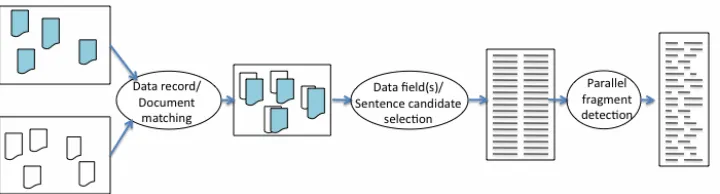
Figure 1: Overview of processing steps.
generates new texts describing them. Figure 1 il-lustrates steps 1–3 which this paper focuses on. In Section 3 we look at steps 1 and 2; in Section 4 at step 3. First we briefly survey related work inMT.
2 Related work in MT
In statistical MT, the expense of manually creat-ing new parallelMTcorpora, and the need for very large amounts of parallel training data, has led to a sizeable research effort to develop methods for automatically constructing parallel resources. This work typically starts by identifying compara-ble corpora. Much of it has focused on identify-ing word translations in comparable corpora, e.g. Rapp’s approach was based on the simple and el-egant assumption that if words Af and Bf have
a higher than chance co-occurrence frequency in one language, then two appropriate translations
Ae and Be in another language will also have
a higher than chance co-occurrence frequency (Rapp, 1995; Rapp, 1999). At the other end of the spectrum, Resnik & Smith (2003) search the Web to detect web pages that are translations of each other. Other approaches aim to identify pairs of sentences (Munteanu and Marcu, 2005) or sub-sentential fragments (Munteanu and Marcu, 2006) that are parallel within comparable corpora.
The latter approach is particularly relevant to our work. They start by translating each docu-ment in the source language (SL) word for word into the target language (TL). The result is given to an information retrieval (IR) system as a query, and the top 20 results are retained and paired with the given SLdocument. They then obtain all sen-tence pairs from each pair of SL and TL docu-ments, and discard those sentence pairs with few words that are translations of each other. To the re-maining sentences they then apply a fragment de-tection method which tries to distinguish between source fragments that have a translation on the tar-get side, and fragments that do not.
The biggest difference between theMTsituation and theD2Tsituation is that in the latter sentence-aligned parallel resources exist and can be used as a starting point. E.g. Munteanu & Marcu use an existing parallel Romanian-English corpus to (au-tomatically) create a lexicon from which is then used in various ways in their method.
InD2Twe have no analogous resources to help us get started, and the methods described in this paper use no such prior knowledge.
3 A Comparable Corpus of British Hills As a source of data, we use the Database of British Hills (BHDB) created by Chris Crocker,3 version 11.3, which currently contains measurements and other information about 5,614 British hills. Ad-ditionally, we perform reverse geocoding via the Google Map API4 which allows us to convert latitude and longitude information from the hills database into country and region names. We add the latter to each database entry.
On the text side, we use Wikipedia texts in the WikiProject British and Irish Hills (retrieved on 2009-11-09). There are currently 899 pages cov-ered by this WikiProject, 242 of which are of qual-ity category B or above.5
Matching up data records and documents: Matching up the data records in the BHDB with articles in Wikipedia is not trivial: not all BHDB entries have corresponding Wikipedia articles, dif-ferent hills often share the same name, and the same hill can have different names and spellings.
We perform a search of Wikipedia with the hill’s name as the search term, using the Mediawiki API, and then retain the top n search results returned (currently n = 1). The top search result is not always a correct match for the database record. We
3
http://www.biber.fsnet.co.uk
4http://code.google.com/apis/maps/ 5B = The article is mostly complete and without major
{ "id": 1679, "main-name-info": {"name": "Hill of Stake", "notes": "", "parent": "", "parent-notes": ""},
"alt-name-info": [], "raw-name": "Hill of Stake", "rhb-section": "27A", "area": "Ayr to River Clyde", "height-metres": 522, "height-feet": 1713, "map-1to50k": "63", "map-1to25k": "341N", "gridref": "NS273630", "col-gridref": "NS320527", "col-height": 33, "drop": 489, "gridref10": "NS 27360 62998", "feature": "trig point", "observations": "", "survey": "", "date-climbed": "", "classification": "Ma,CoH,CoU",
"county-name": "Renfrewshire(CoH); Renfrewshire(CoU)", "revision": "28-Oct-2001", "comments": "",
"streetmap": "http://www.streetmap.co.uk/newmap.srf?x=227356&y=663005&z=3&sv=227356,663005&st=4&tl=˜&bi=˜&lu=N&ar=n", "ordanancesurvey-map": "http://getamap.ordnancesurvey.co.uk/getamap/frames.htm?mapAction=gaz&gazName=g&gazString=NS273630", "x-coord": 227356, "y-coord": 663005, "latitude": 55.82931,
"longitude": -4.75789, "country": "Scotland", "region": "Renfrewshire" }
Hill of Stake is a hill on the boundary between North Ayrshire and Renfrewshire , Scotland . It is 522 metres ( 1712 feet ) high . It is one of the Marilyns of Lowland Scotland . It is the highest point of the relatively low-lying county of Renfrewshire and indeed the entire Clyde Muirshiel Regional Park of which it is a part .
Table 1: Output of step 1: data record from British HillsDBand matched Wikipedia text (Hill of Stake).
manually selected the pairs we are confident are a correct match. This left us with 759 matched pairs out of a possible 899.
Table 1 shows an example of an automatically matched database entry and Wikipedia article. It illustrates the non-parallelism discussed in the pre-ceding section; e.g. there is no information in the database corresponding to the last sentence.
4 Towards a Parallelised Corpus 4.1 Aligning data fields and sentences
In the second processing step, we pair up data fields and sentences. Related methods inMThave translation lexicons and thesauri that can be used as bridges between SL and TL texts, but there is no equivalents inNLG. Our current method asso-ciates each data field with a hand-written ‘match predicate’. For example, the match predicate for
height-metresreturns True if the sentence con-tains the words ‘X metres’ (among other patterns), where X is some number within 5% of the height of the hill in the database. We retain only the sen-tences that match at least one data field. Table 2 shows what the data field/sentence alignment pro-cedure outputs for the Hill of Stake.
4.2 Identifying Parallel Fragments
While it was fine for step 2 to produce some rough matches, in step 3, parallel fragment detection, the aim is to retain only those parts of a sentence that can be said to realise some data field(s) in the set of data fields with which it has been matched.
Computing data-text associations: Following some preprocessing of sentences where each oc-currence of a hill’s name and height is replaced by lexical class tokens NAME, HEIGHT METRES or HEIGHT FEET, the first step is to construct a
kind of lexicon of pairs(d, w)of data fieldsdand wordsw, such thatwis often seen in the realisa-tion of d. For this purpose we adapt Munteanu & Marcu’s (2006) method for (language to lan-guage) lexicon construction. For this purpose we compute a measure of the strength of association between data fields and words; we use theG2
log-likelihood ratio which has been widely used for this sort of purpose (especially lexical association) since it was introduced to NLP (Dunning, 1993). Following Moore (2004a) rather than Munteanu & Marcu, our current notion of cooccurrence is that a data field and word cooccur if they are present in the same pair of data fields and sentence (as identified by the method described in Section 4.1 above). We then obtain counts for the number of times each word cooccurs with each data field, and the number of times it occurs without the data field being present (and conversely). This allows us to compute the G2 score, for which we use the for-mulation from Moore (2004b) shown in Figure 2.
If theG2 score for a given(d, w)pair is greater
thanp(d)p(w), then the association is taken to be positive, i.e. w is likely to be a realisation of d, otherwise the association is taken to be negative, i.e.wis likely not to be part of a realisation ofd.
For eachdwe then convertG2scores to
proba-bilities by dividingG2by the appropriate normal-ising factor (the sum over all negative G2 scores
"main-name-only": "Hill of Stake", NAME is a hill on the boundary between North Ayrshire and Renfrewshire, "country": "Scotland" Scotland.
"height-metres": 522, It is HEIGHT METERS metres (HEIGHT FEET feet) high. "height-feet": 1713
"country": "Scotland", It is one of the Marilyns of Lowland Scotland. "classification": ["Ma", "CoH", "CoU"]
[image:4.595.69.530.61.147.2]"main-name-only": "Hill of Stake" It is the highest point of the relatively low-lying county of Renfrewshire and indeed the entire Clyde Muirshiel Regional Park of which it is a part.
Table 2: Output of step 2: aligned data fields and sentences, for Hill of Stake.
2N
p(d, w)log p(d, w)
p(d)p(w)+p(d,¬w)log
p(d,¬w)
p(d)p(¬w)+p(¬d, w)log
p(¬d, w)
p(¬d)p(w)+p(¬d,¬w)log
p(¬d,¬w)
p(¬d)p(¬w)
[image:4.595.88.278.272.466.2]
Figure 2: Formula for computingG2 from Moore (2004b) (N is the sample size).
Data keyd Wordw P+(
w|d)
main-name-only NAME 0.1355
a 0.0742
in 0.0660
classification as 0.0412 adjoining 0.0193 qualifies 0.0177
region District 0.1855
Lake 0.1661
area 0.1095
country in 0.1640
NAME 0.1122
Scotland 0.0732 height-metres metres 0.1255
m 0.0791
height 0.0679 height-feet feet 0.1511
HEIGHT METERS 0.0974
( 0.0900
Table 3: Data keys with 3 most likely words.
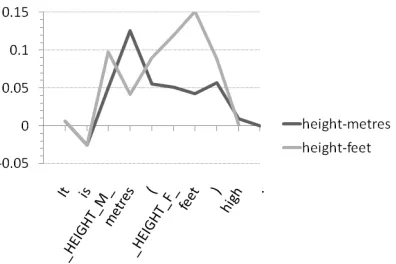
Identifying realisations: The next step is to ap-ply these probabilities to identify those parts of a sentence that are likely to be a valid realisation of the data fields in the input. In Figure 3 we plot the positive and negative association probabilities for one of the sentences from our running exam-ple, Hill of Stake. The light grey graph represents the association probabilities between each word in the sentence and height-feet, the dark grey
line those between the words in the sentence and
height-metres. We plot the negative association
probabilities simply by multiplying each by−1. The part of the sentence that one would want to extract as a possible realisation of { height-metres, height-feet }, namely “HEIGHT METRES metres ( HEIGHT FEET feet ) high”, shows up clearly as a sequence of relatively strong positive association values. Our current approach identifies such contiguous positive
Figure 3: Positive and negative association prob-abilities plotted against the words they were com-puted for.
association scores and extracts the corresponding sentence fragments. This works well in many cases, but is too simple as a general approach; we are currently developing this method further.
5 Concluding Remarks
[image:4.595.320.518.276.408.2]References
Anja Belz and Eric Kow. 2009. System building cost vs. output quality in data-to-text generation. In Pro-ceedings of the 12th European Workshop on Natural Language Generation, pages 16–24.
A. Belz. 2008. Automatic generation of weather forecast texts using comprehensive probabilistic generation-space models. Natural Language Engi-neering, 14(4):431–455.
Ted Dunning. 1993. Accurate methods for the statis-tics of surprise and coincidence. Computational Linguistics, 1:61–74.
A. Gatt, A. Belz, and E. Kow. 2008. The TUNA Challenge 2008: Overview and evaluation results. In Proceedings of the 5th International Natural Language Generation Conference (INLG’08), pages 198–206.
A. Isard, J. Oberlander, I. Androutsopoulos, and C. Matheson. 2003. Speaking the users’ languages. 18(1):40–45.
K. Knight and V. Hatzivassiloglou. 1995. Two-level, many-paths generation. In Proceedings of the 33rd Annual Meeting of the Association for Computa-tional Linguistics (ACL ’95).
Kevin Knight and Irene Langkilde. 2000. Preserving ambiguity in generation via automata intersection. In Proceedings of AAAI/IAAI, pages 697–702.
I. Langkilde. 2002. An empirical verification of cover-age and correctness for a general-purpose sentence generator. In Proc. 2nd International Natural Lan-guage Generation Conference (INLG ’02).
Robert C. Moore. 2004a. Improving ibm word-alignment model 1. In Proceedings of the 42nd An-nual Meeting of the Association for Computational Linguistics, pages 519–526.
Robert C. Moore. 2004b. On log-likelihood-ratios and the significance of rare events. In Proceedings of the 9th Converence on Empirical Methods in Natu-ral Language Processing (EMNLP’04), pages 333– 340.
Dragos Munteanu and Daniel Marcu. 2005. Improv-ing machine translation performance by exploitImprov-ing non-parallel corpora. Computational Linguistics, 31:477–504.
Dragos Stefan Munteanu and Daniel Marcu. 2006. Ex-tracting parallel sub-sentential fragments from non-parallel corpora. In Proceedings of the 21st In-ternational Conference on Computational Linguis-tics and the 44th annual meeting of the Association for Computational Linguistics (COLING-ACL’06), pages 81–88, Morristown, NJ, USA. Association for Computational Linguistics.
F. Portet, E. Reiter, A. Gatt, J. Hunter, S. Sripada, Y. Freer, and C. Sykes. 2009. Automatic gener-ation of textual summaries from neonatal intensive care data. Artificial Intelligence, 173:789–816.
Reinhard Rapp. 1995. Identifying word translations in non-parallel texts. In Proceedings of the 33rd an-nual meeting on Association for Computational Lin-guistics, pages 320–322, Morristown, NJ, USA. As-sociation for Computational Linguistics.
Reinhard Rapp. 1999. Automatic identification of word translations from unrelated english and german corpora. In Proceedings of the 37th annual meeting of the Association for Computational Linguistics on Computational Linguistics, pages 519–526, Morris-town, NJ, USA. Association for Computational Lin-guistics.
Philip Resnik and Noah Smith. 2003. The web as a parallel corpus. Computational Linguistics, 29:349– 380.
S. Sripada, E. Reiter, J. Hunter, and J. Yu. 2003. Ex-ploiting a parallel text-data corpus. In Proceedings of Corpus Linguistics 2003, pages 734–743.
Oliviero Stock, Massimo Zancanaro, Paolo Busetta adn Charles Callaway, Anbtonio Kr¨uger, Michael Kruppa, Tsvi Kuflik, Elena Not, and Cesare Rocchi. 2007. Adaptive, intelligent presentation of informa-tion for the museum visitor in PEACH. User Mod-eling and User-Adapted Interaction, 17(3):257–304.