The Method of Improving the Specific Language Focused
Crawler
Shan-Bin Chan
Graduate School of Fundamental Science and Engineering Waseda University
Hayato Yamana
Graduate School of Fundamental Science and Engineering Waseda University
Abstract
In recent years, more and more CJK (Chinese, Japanese, and Korean) web pages appear in the Internet. The infor-mation in the CJK web page also be-comes more and more important. Web crawler is a kind of tool to retrieve web pages. Previous researches focused on English web crawlers and the web crawler is always optimized for English web pages. We found that the perform-ance of the web crawler is worse in re-trieving CJK web pages. We tried to en-hance the performance of the CJK crawler by analyzing the web link struc-ture, anchor text, and host name on the hyperlink and changing the crawling al-gorithm. We distinguish the top-level domain name and the language of the anchor text on hyperlinks. The method that distinguishes the language of the an-chor text on hyperlinks is not used on CJK language specific crawler by other researches. Control experiment is used in this research. According to the experi-mental results, when the target crawling language is Japanese, the 87% of the crawled web pages are Japanese web pages and improves the efficiency about 0.24% compares to the baseline results. When the target crawling language is Chinese, the 88% of the crawled web pages are Chinese web pages and im-proves the efficiency about 0.07% com-pares to the baseline results. When the target crawling language is Korean, the 71% of the crawled web pages are Ko-rean web pages and improves the
effi-ciency about 10% compares to the baseline results.
1
Introduction
The growth of web pages in the internet becomes rapidly in recent years. How to efficiently collect web pages and how to gather more language or topic relative web pages become important. Focused crawling is a kind of method that collects topic specific web pages. (Chakrabarti et al., 1999) Intelligent crawling that can self-learning and predicating makes the focus crawling more efficient. (Chara et al., 2001) Mining for patterns and relations over text, structures, and links is an interesting research. (Neel et al., 2001) In the past few years, the researches are focused on the topic specific focused crawling and optimized the performance of focus crawler for crawling English web pages. Web pages are not only described in English but also in other languages. Our research will be emphasized on the study of language specific focused crawler and how to optimize the crawler for specific language (For example: Chinese, Japanese, and Korean).
Huge amounts of hyperlinks on the CJK web pages link to English web pages. But the hyper-links on the English web pages almost don’t link to the CJK web pages. If we deeply crawl the web pages from CJK seed sets, finally we will gather many English web pages. In this kind of situation, the efficiency of the CJK focus crawler is very worse.
queue these URLs for the next crawling. If the top-level domain in the hyperlink URLs is not .jp, we will distinguish the language of the an-chor text of the hyperlink. If the language of the anchor text is Japanese, we also queue these URLs for the next crawling. Otherwise, we drop the URLs.
This research uses the Nutch as the crawler and uses the Hadoop as the storage. Because of the web pages is enormous, Hadoop is a very efficient tool that can store and process vast amounts of data. We choose the URLs on the DMOZ as the seeds set and extract the URLs by the top-level domain name .cn, .tw, .jp, .kr, .com, .net. After extracting the URLs, we sort these URLs by language (Chinese, Japanese, and Korean). We use these sorted URLs as the seeds set for crawling by Nutch.
The experiment method in our research is control experiment. We divided our experiment to two groups. One is control group and the other one is experimental group. The crawling methods of the control group use the default crawling algorithm in Nutch. The crawling methods of the experimental group use the modi-fied crawling rules provided by us. After crawl-ing by both control group and experimental group, we compare the crawled web pages be-tween baseline results and experimental results. Finally, the results show that we can improve the crawling efficiency by using our modified method.
2
Related Researches
2.1 Web data collection of specific topic
The research of focus crawler is applied in the medical information science. (Thanh et al., 2005) Their research mentions that there are relationships between the hyperlink URLs and the 50 words before and after hyperlinks with the contents in the crawling target pages. And they also mention that if the URL filters are applied in the breadth-first crawling, The crawled results will be better then without URL filters.
2.2 Collection methods of specific language web pages
Tamura (2006) introduces the research of spe-cific language web pages focus crawler. Their
research is focused on the collection of Thai lan-guage web pages. When crawling, the link selec-tion methods of their research are descript as below:
1. When the authors collect web page j on web server i, they distinguish the lan-guage of web page j.
2. If the language of the web page j is Thai, Nr(i) increases 1. (Nr(i) is Thai language web page counts of web server i)
3. Na(i) increases 1. (Na(i) is collected page counts of web server i)
4. Extract the hyperlinks in the web page j. 5. Drop the hyperlink that top-level domain
is not Thai.
6. Drop the hyperlink that has been crawled.
7. If the language of web page j is Thai, queue the remained hyperlinks to high priority.
8. If the language of web page j is not Thai, queue the remained hyperlinks to low priority.
The research data set is collected from famous portal web pages in Thailand from July to Au-gust in 2004. They download 18,344,217 HTML pages from 574,111 servers, and use this data set for simulating their selective collection method. The estimation methods are as below:
• Server-based filtering, aggressive: No limits when the crawler chooses the new web server.
• Server-based filtering, conservative:
On-ly Thai servers when the crawler chooses the new web server.
• Directory-based filtering, conservative:
Only Thai directory when the crawler chooses the directory on the server.
• Hard focused: Drop all the hyperlinks
when the web page is not Thai language.
• Soft focused: If the web page is Thai language, queue the hyperlinks with high priority. If the web page is no Thai lan-guage, queue the hyperlinks with low priority.
• BFS: Breath-first search.
found a hyperlink, which is Thai, web page, the crawler start to follow this Thai hyperlink and crawl the web pages from this URL.
The result of the estimation method “Perfect” is obvious. While crawling, when the total amount of crawled web pages increase, the cu-mulative Thai web page ratio increase smoothly from 92% to 99%.
2.3 Seeds set generation method for web crawler
HITS algorithm is used to generate crawler seeds set. (Shervin et al., 2003) Their research consid-ered that it’s better to crawl the most important web pages on the resource limited internet. They use the collected web pages to draw a web graph and perform the HITS algorithm to generate seeds set for crawler.
2.4 Focus crawling for dark web forums
Dark web forum is a kind of forum that the con-tents are associated with cybercrime, hate, and extremism. Fu (2010) developed a focus crawler for crawling dark web forums by using lan-guage-independent features, including URL to-kens, anchor text, and level features. They also use forum software-specific traversal strategies and wrappers to support incremental crawling. Their system maintains up-to-date collections of 109 forums in multiple languages. Their focus crawler gathers contents from three regions, which are U.S. domestic supremacist, Middle Eastern extremist, and Latin groups. Their hu-man-assisted accessibility mechanism can access identified forums with a success rate of over 90%.
2.5 The differences between previous stud-ies
The previous researches almost focus on the English web page crawlers or the topic specific crawlers. There are few researches about the CJK language specific focus crawlers. The method that judges the top-level domain name of the URLs on hyperlinks has been studied on crawling Thai web pages. And the crawling method of judgment the language of an anchor text on the hyperlink has not studied by other researchers. We consider that if we combine the
top-level domain name judgment method and anchor text language distinguish method, we will enhance the efficiency more on crawling CJK web pages. So, we use this combined method to enhance the performance of CJK language spe-cific focus crawler.
3
Methods
The probability is very high that hyperlinks on the CJK web pages link to English web pages. And the probability is very low that hyperlinks on the English web pages link to CJK web pages. If we crawl the web pages deeply from CJK seed sets, finally we will gather huge amounts of Eng-lish web pages.
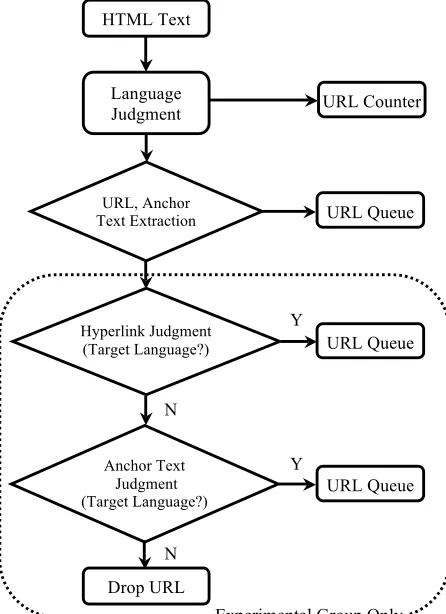
We implement the control experiment to re-solve the problems that mentioned above. We split our research to 5 steps and show the process in the Figure 1.
[image:3.595.321.525.403.599.2]Before crawling, a seeds set is very important for the crawler. DMOZ (http://www.dmoz.org) is the biggest web directory service in the world. We use the URLs in the DMOZ as the seeds set. Our URLs extraction method shows as follow.
Figure 1. Research Process
• Download the XML formatted web di-rectory data from DMOZ homepage on October 26th 2009.
• Extract URLs form XML formatted web directory data.
• Sort the URLs by top-level domain. (.cn, .tw, .jp, .kr, .com, .net, etc…) Control Group Experimental Group
Compare the Results Seeds Set Collection
URLs Extraction
• Choose the .cn, .tw, .jp, .kr, .com, .net
top-level domains for language distin-guish.
• Use the Perl Lingua::LanguageGuesser which produced by Nakagawa Labora-tory of Tokyo University to distinguish the language (Chinese, Japanese, and Korean) of each web pages in the sorted URLs. Perl Lingua::LanguageGuesser is a language distinguisher that is based on N-Gram text categorization. (William et al., 1994)
• Use these sorted seeds sets and perform crawling by using Nutch.
We implement our research by separating into two groups, control group and experimental group. The control group follows the default crawling rules supported by Nutch. And we change the crawling rules in experimental group by importing a URLs queuing replacement plug-in plug-into Nutch. We will explaplug-in the modified URLs queuing rules by using the Chinese web pages collection procedures.
• If the top-level domain in the URL is .cn, store this URL to the queue. The reason is that it is high probability that the web page with .cn domain name is a Chinese web page.
• If the top-level domain in the URL is
not .cn, distinguish the language of the anchor text on the hyperlink. Then, if the anchor text is Chinese, store the URL to the queue. The reason is that it is high probability that the web page which hy-perlink with Chinese anchor text links to is a Chinese a web page.
• Drop the URLs from queue when other
situations.
At the final stage, calculates the percentage of each language and compares the results between baseline results and experimental results.
4
Results
[image:4.595.363.501.78.211.2]URLs extracted from DMOZ that with .com domain is 1,964,053, .net domain is 182,595, .jp domain is 130,125, .cn domain is 14,769, .tw domain is 10,259, .kr domain is 4,910. Figure 2 shows the percentage of each domain.
Figure 2. Distribution of DMOZ top-level do-mains
CJK web page counts in each top-level do-main (.com and .net, .cn, .tw, .jp, .kr) are shown in Table 1. We extract 43,216 Chinese URLs, 175,666 Japanese URLs, and 5,252 Korean URLs. We randomly pick 1,000 URLs for each language from these CJK URLs and start to crawl by using these URLs as seeds sets.
We write two functions into URLs queuing replacement plug-in on Nutch. One is html text language distinguisher, and the other one is web page counter. We use the same language distin-guisher that supported by Nakagawa Laboratory of Tokyo University with seeds set extraction stage.
Domain CN JP KR
com&net 24,851 56,256 1,975
cn 11,937 40 1
tw 6,220 573 16
jp 147 118,729 14
kr 61 68 3,246
[image:4.595.307.524.443.546.2]Total 43,216 175,666 5,252 Table 1. CJK web page counts from each
top-level domain
queue. Control group implements the process described above.
Figure 3. Crawling process
Experimental group also implements the process of control group. After the control group process, we add top-level domain judgment on hyperlinks. When we are focusing on crawling Chinese web pages, and if the top-level domain on hyperlinks is .cn, we store the URL of this hyperlink to the queue. If the top-level domain on hyperlinks is not .cn, we check the anchor text of the hyperlink. If the language of the an-chor is Chinese, we also store the URL of this hyperlink to the queue. Otherwise, drop the URLs from queue. We don’t prioritize the URLs in queue in this research. In order to not crawl-ing the web pages that are not Chinese, we de-cide to drop these URLs that may not be Chinese web pages.
We pick a Chinese web page as the crawling example for experimental group. The crawler chooses a URL “http://www.bsc.org.cn/” in the sorted DOMZ seed sets. First, we parse the
HTML text of this URL and extract the hyperlinks and anchor text from HTML text. We get a part of the hyperlink and anchor text shown in Table 2.
Anchor text Hyperlinks
中国科学技术协会 http://www.cast.org.cn
中国科学院生物物 理研究所
http://www.ibp.ac.cn
IUPAB http://www.iupab.org
Asian Biophysics Association
http://www.aba-bp.com
美国生物物理学会 http://www.biophysics.org
Protein and Cell http://www.protein-cell.org
[image:5.595.302.527.136.301.2]… …
Table 2. A part of anchor text and hyperlinks extracted from “http://www.bsc.org.cn/”
Second, according to the URL queuing rules mentioned above, we show a part of matched hyperlinks and anchor text shown in Table 3.
Anchor
text Hyperlinks Matched
Page lang
中国科学 技术协会
http://www.ca st.org.cn
Yes CHS
中国科学 院生物物 理研究所
http://www.ib p.ac.cn
Yes CHS
IUPAB http://www.iu pab.org
No ENG
Asian Biophys-ics Asso-ciation
http://www.ab
a-bp.com No ENG
美国生物 物理学会
http://www.bi
ophysics.org No ENG
Protein
and Cell http://www.protein-cell.org No ENG Table 3. A part of matched hyperlinks by using
experimental group queuing rules from “http://www.bsc.org.cn/”
Finally, we use these matched hyperlinks as the URLs for next crawling loop.
The web page crawled results of control group and experimental group from Feb. 5th to Feb.
12th 2010 show in Table 4. Because of the longer
HTML Text
Language Judgment
URL, Anchor Text Extraction
Hyperlink Judgment (Target Language?)
Anchor Text Judgment (Target Language?)
Drop URL
URL Counter
URL Queue
URL Queue
URL Queue Y
Y N
N
[image:5.595.303.526.377.618.2]processing time of language distinguish in perimental group, the total crawl results of ex-perimental results are fewer then baseline results.
Chinese Japanese Korean Other Total KR-C∗ 12,523 1,926 80,049 36,273 130,771
KR-E 1,757 380 11,328 2,386 15,851 JP-C 6,555 66,235 108 2,838 75,736
JP-E 1,179 11,890 24 465 13,558
CN-C 112,924 2,468 1.052 11,321 127,765
[image:6.595.75.291.122.218.2]CN-E 10,078 202 99 1,015 11,394
Table 4. The crawled web pages for each lan-guage
When the crawling target language is Korean, the language percentage of gathered web pages in baseline results shows as Figure 4. Total 130,771 web pages are crawled and 61.21% are Korean web pages.
Figure 4. Language distribution of Korean baseline results
[image:6.595.333.469.216.334.2]
Figure 5. Language distribution of Korean ex-perimental results
When the crawling target language is Korean, the language percentage of gathered web pages in experimental results shows as Figure 5. Total
∗KR(Korean)、JP(Japanese)、CN(Chinese)、 C(Baseline
Re-sults)、E(Experimental Results)
15,851 web pages are crawled and 71.47% are Korean web pages.
According to the crawled results in Figure 4 and Figure 5, our methods can improve about 10% efficiency in crawling Korean web pages.
When the crawling target language is Japa-nese, the language percentage of gathered web pages in baseline results shows as Figure 6. To-tal 75,736 web pages are crawled and 87.46% are Japanese web pages.
Figure 6. Language distribution of Japanese baseline results
When the crawling target language is Japa-nese, the language percentage of gathered web pages in experimental results shows as Figure 7. Total 13,558 web pages are crawled and 87.70% are Japanese web pages.
Figure 7. Language distribution of Japanese ex-perimental results
[image:6.595.340.469.468.589.2]When the crawling target language is Chinese, the language percentage of gathered web pages in baseline results shows as Figure 8. Total 127,765 web pages are crawled and 88.38% are Japanese web pages.
Figure 8. Language distribution of Chinese baseline results
When the crawling target language is Chinese, the language percentage of gathered web pages in experimental results shows as Figure 9. Total 11,394 web pages are crawled and 88.45% are Japanese web pages.
Figure 9. Language distribution of Chinese ex-perimental results
According to the crawled results in Figure 8 and Figure 9, our methods can improve about 0.07% efficiency in crawling Chinese web pages.
The experimental results show that the effi-ciency improvement of Korean crawling is very obvious. The efficiency improvement of Chinese and Japanese are lower then 1%, actually the improvement is unobvious. We picked some URLs from crawling log to analyze why the im-provement of Korean language specific crawler is obvious. We found that many Korean web
pages content multi-language links on the main page, such as English, Chinese, Japanese, etc…. It is high probability that the hyperlinks on the Korean web pages link to web pages which are other languages. The languages of anchor text on Chinese or Japanese web pages are always Chi-nese or JapaChi-nese. So following our modified crawling rules, the crawled Korean web pages increase conspicuously and the crawled Chinese or Japanese web pages increase unobvious.
5
Conclusions
The purpose of this research is to enlarge the crawling amounts of language specific crawler. We propose language judgment on anchor text method to enhance the efficiency of the focus crawler. And combine the method which is dis-tinguish the top-level domain name of URLs on hyperlinks to implement a control experiment in this research.
This research also proposes language specific focus crawler by importing a plug-in into Nutch and crawling the web pages with a modified al-gorithm. This method can easily program, install, and implement modified crawling rules by using plug-in on Nutch.
According to the comparison of control group and experimental group, the efficiency im-provement is obvious on Korean focus crawler. And the efficiency improvement is unobvious on Chinese and Japanese focus crawler. It is be-cause many hyperlinks on the Korean web pages link to web pages that are other languages. So that the improvement of Korean web pages crawling is obvious.
Perl language guesser is implemented by us-ing JAVA external call. If we can use the JAVA language guesser, the crawling speed will be improved.
[image:7.595.100.238.405.523.2]is flawless, the collection speed of web pages will be boosted.
According to the crawled results in experi-mental group, the percentage of crawled Chinese web pages by Chinese focus crawler is 88%. The percentage of crawled Japanese web pages by Japanese focus crawler is 87%. The percentage of crawled Korean web pages by Korean focus crawler is 71%. We will increase the efficiency of language specific crawler more in the future work.
This research uses DMOZ as the seed sets. We extract CJK URLs from DMOZ data. Actu-ally, the percentage of CJK URLs in DMOZ data is very low. We will try to use the famous CJK portal web sites as the seed sets in the future work.
Acknowledgements
This research is supported by Waseda University Global COE Program “International Research and Education Center for Ambient SoC” and JST Program “Multimedia Web Analysis Framework towards Development of Social Analysis Software."
References
Charu C. Aggarwal, Fatima Al-Garawi, and Philip S.
Yu. 2001. Intelligent Crawling on the World Wide
Web with Arbitrary Predicates, WWW conference. DMOZ: The Open Directory Project is the largest, most comprehensive human-edited directory of the Web. http://www.dmoz.org
Hadoop: A reliable, scalable, and distributed comput-ing system. http://hadoop.apache.org
HITS: Hyperlink-Induced Topic Search.
http://en.wikipedia.org/wiki/HITS_algorithm
Lingua::LanguageGuesser.
http://gensen.dl.itc.u-tokyo.ac.jp/LanguageGuesser/LanguageGuesser_j a.html
Neel Sundaresan, and Jeonghee Yi. 2001. Mining the
Web for Relations, Computer Networks, Volume 33, Issue 1-6: 699-711.
Nutch: A JAVA based open source web crawler de-veloped by Apache Software Foundation. http://nutch.apache.org
Shervin Daneshpajouh, Mojtaba Mohammadi Nasiri,
and Mohammad Ghodsi. 2003. A Fast Community
Based Algorithm For Generating Web Crawler
Seeds Set.
Soumen Chakrabarti, Martin van den Berg, and
Byron Dom. 1999. Focused Crawling: A New
Ap-proach to Topic Specific Resource Discovery, WWW Conference.
Tamura Takayuki, Somboonviwat Kulwadee, and
Kitsuregawa Masaru. 2006. A Method for
Lan-guage Specific Web Crawling and Its Evaluation, The IEICE transactions on information and sys-tems, J89-D(2):199-209.
Thanh Tin Tang, David Hawking, Nick Craswell, and
Kathy Griffiths. 2005. Focused Crawling for both
Topical Relevance and Quality of Medical Infor-mation, CIKM.
Tianjun Fu, Ahmed Abbasi, and Hsinchun Chen.
2010. A Focused Crawler for Dark Web Forums,
Journal of The American Society for Information Science and Technology, 61(6):1213-1231
William B. Cavnar and John M. Trenkle. 1994.