Extending NegEx with Kernel Methods for
Negation Detection in Clinical Text
Chaitanya Shivade†, Marie-Catherine de Marneffe§, Eric Fosler-Lussier†, Albert M. Lai∗ †Department of Computer Science and Engineering,
§Department of Linguistics, ∗Department of Biomedical Informatics,
The Ohio State University, Columbus OH 43210, USA.
[email protected], [email protected] [email protected], [email protected]
Abstract
NegEx is a popular rule-based system used to identify negated concepts in clinical notes. This system has been reported to perform very well by numerous studies in the past. In this paper, we demonstrate the use of kernel meth-ods to extend the performance of NegEx. A kernel leveraging the rules of NegEx and its output as features, performs as well as the rule-based system. An improvement in per-formance is achieved if this kernel is cou-pled with a bag of words kernel. Our exper-iments show that kernel methods outperform the rule-based system, when evaluated within and across two different open datasets. We also present the results of a semi-supervised approach to the problem, which improves per-formance on the data.
1 Introduction
Clinical narratives consisting of free-text documents are an important part of the electronic medical record (EMR). Medical professionals often need to search the EMR for notes corresponding to specific medical events for a particular patient. Recruitment of subjects in research studies such as clinical tri-als involves searching through the EMR of multi-ple patients to find a cohort of relevant candidates. Most information retrieval approaches determine a document to be relevant to a concept based on the presence of that concept in the document. How-ever, these approaches fall short if these concepts are negated, leading to a number of false positives. This is an important problem especially in the clini-cal domain. For example, the sentence: “The scan
showed no signs of malignancy” has the concept ‘malignancy’ which was looked for in the patient, but was not observed to be present. The task of nega-tion detecnega-tion is to identify whether a given concept is negated or affirmed in a sentence. NegEx (Chap-man et al., 2001) is a rule-based system developed to detect negated concepts in the clinical domain and has been extensively used in the literature.
In this paper, we show that a kernel-based ap-proach can map this rule-based system into a ma-chine learning system and extends its performance. We validate the generalization capabilities of our approach by evaluating it across datasets. Finally, we demonstrate that a semi-supervised approach can also achieve an improvement over the baseline rule-based system, a valuable finding in the clinical do-main where annotated data is expensive to generate.
2 Related Work
Negation has been a popular research topic in the medical domain in recent years. NegEx (Chapman et al., 2001) along with its extensions (South et al., 2006; Chapman et al., 2013) is one of the oldest and most widely used negation detection system because of its simplicity and speed. An updated version -ConText (Harkema et al., 2009) was also released to incorporate features such as temporality and experi-encer identification, in addition to negation. These algorithms are designed using simple rules that fire based on the presence of particular cues, before and after the concept. However, as with all rule-based systems, they lack generalization. Shortage of train-ing data discouraged the use of machine learntrain-ing techniques in clinical natural language processing
(NLP) in the past. However, shared tasks (Uzuner et al., 2011) and other recent initiatives (Albright et al., 2013) are making more clinical data available. This should be leveraged to harness the benefits offered by machine learning solutions. Recently, Wu et al. (2014) argued that negation detection is not of prac-tical value without in-domain training and/or devel-opment, and described an SVM-based approach us-ing hand-crafted features.
3 Kernel Methods
Our approach uses kernel methods to extend the abilities of the NegEx system. A kernel is a sim-ilarity function K, that maps two inputs x and y
from a given domain into a similarity score that is a real number (Hofmann et al., 2008). Formally, it is a functionK(x, y) = hφ(x), φ(y)i → R, where
φ(x) is some feature function over instancex. For a functionKto be a valid kernel, it should be sym-metric and positive-semidefinite. In this section, we describe the different kernels we implemented for the task of negation detection.
3.1 NegEx Features Kernel
The source code of NegEx1reveals rules using three
sets of negation cues. These are termed as pseudo negation phrases, negation phrases and post nega-tion phrases. Apart from these cues, the system also looks for a set of conjunctions in a sentence. We used the source code of the rule-based system and constructed a binary feature corresponding to each cue and conjunction, and thus generated a feature vector for every sentence in the dataset. Using the LibSVM (Chang and Lin, 2011) implementation, we constructed a linear kernel which we refer to as the NegEx Features Kernel (NF).
3.2 Augmented Bag of Words Kernel
We also designed a kernel that augmented with bag of words the decision by NegEx. For each dataset, we constructed a binary feature vector for every sen-tence. This vector is comprised of two parts, a vec-tor indicating presence or absence of every word in that dataset and augment it with a single feature in-dicating the output of the NegEx rule-based system. We did not filter stop-words since many stop-words
1From https://code.google.com/p/NegEx/
serve as cues for negated assertions. The idea behind constructing such a kernel was to allow the model to learn relative weighting of the NegEx output and the bag of words in the dataset. Again, a linear ker-nel using LibSVM was constructed: the Augmented Bag of Words Kernel (ABoW).
4 Datasets
A test set of de-identified sentences, extracted from clinical notes at the University of Pittsburgh Medi-cal Center, is also available with the NegEx source code. In each sentence, a concept of interest has been annotated by physicians with respect to being negated or affirmed in the sentence. The concepts are non numeric clinical conditions (such as symp-toms, findings and diseases) extracted from six types of clinical notes (e.g., discharge summaries, opera-tive notes, echo-cardiograms).
The 2010 i2b2 challenge (Uzuner et al., 2011) on relation extraction had assertion classification as a subtask. The corpus for this task along with the an-notations is freely available for download.2 Based
on a given target concept, participants had to clas-sify assertions as either present, absent, or possible in the patient, conditionally present in the patient un-der certain circumstances, hypothetically present in the patient at some future point, and mentioned in the patient report but associated with someone other than the patient. Since we focus on negation detec-tion, we selected only assertions corresponding to the positive and negative classes from the five as-sertion classes in the corpus, which simulates the type of data found in the NegEx Corpus. The i2b2 corpus has training data, partitioned into discharge summaries from Partners Healthcare (PH) and the Beth Israel Deaconess (BID) Medical Center. This gave us datasets from two more medical institutions. The corpus also has a test set, but does not have a split corresponding to these institutions.
Using the above corpora we constructed five datasets: 1) The dataset available with the NegEx rule-based system, henceforth referred to as the NegCorp dataset; 2) We adapted the training set of the i2b2 assertion classification task for negation detection, the i2b2Trainmod dataset; 3) The
Dataset Affirmed Negated Total
NegCorp 1885 491 2376 i2b2Trainmod 4476 1533 6009
[image:3.612.317.536.59.156.2]PH subset (1862) (635) (2497) BID subset (2614) (898) (3512) i2b2Testmod 8618 2594 11212
Table 1: Number of affirmed and negated concepts in each dataset.
care, henceforth referred to as the PH dataset; 4) The training subset of i2b2Trainmodfrom the Beth Israel
Deaconess Medical Center, henceforth referred to as the BID dataset; and 5) The adapted test set of the 2010 i2b2 challenge, henceforth referred to as the i2b2Testmoddataset. Table 1 summarizes the
distri-bution for number of affirmed and negated assertions in each dataset.
5 Experiments
We implemented the kernels outlined in Section 3 and evaluated them within different datasets using precision, recall and F1 on ten-fold cross valida-tion. We compared the performance of each model against the NegEx rule-based system as baseline.
5.1 Within dataset evaluation
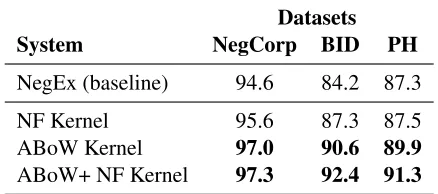
As can be seen in Table 2, the NegEx Features Ker-nel performed similarly to the baseline (the improve-ment is not significant). However, the ABoW ker-nel significantly outperformed the baseline (p<0.05, McNemar’s test). Joachims et al. (2001) showed that given two kernels K1 and K2, the composite kernel
K(x, y) = K1(x, y) +K2(x, y) is also a kernel. We constructed a composite kernel adding the ker-nel matrices for the ABoW and NF kerker-nels, which resulted in a further (but not significant) improve-ment.
5.2 Cross dataset evaluation
In order to test the generalizability of our approach, we evaluated the performance of the ABoW ker-nel against the baseline. We trained the ABoW kernel on different datasets and tested them on the i2b2Testmoddataset. Table 3 summarizes the results
of these experiments.
Datasets
System NegCorp BID PH
NegEx (baseline) 94.6 84.2 87.3 NF Kernel 95.6 87.3 87.5 ABoW Kernel 97.0 90.6 89.9
ABoW+ NF Kernel 97.3 92.4 91.3
Table 2: Within dataset performance of kernels based on F1-score using 10-fold cross validation. Bold results indi-cate significant improvements over the baseline (p<0.05, McNemar’s test).
System Precision Recall F1
NegEx (baseline) 89.6 79.9 84.5 ABoW trained on
NegCorp 89.9 79.3 84.2 PH 89.4 88.1 88.7
BID 89.2 89.9 89.7
i2b2Trainmod 89.9 90.0 90.0
Table 3: Cross dataset performance on the i2b2Testmod
dataset given different training datasets.
We found that the ABoW kernel significantly out-performed the baseline when trained on datasets that were generated from the same corpus, namely PH and BID. A kernel trained on i2b2Trainmod, i.e.,
combining the PH and BID datasets performs bet-ter than the individually trained datasets. These ex-periments also tested the effect of training data size (PH <BID <i2b2Trainmod) on the kernel
perfor-mance. We observed that the performance of the kernel increases as the size of the training data in-creases, though not significantly. The kernel trained on a dataset from a different corpus (NegCorp) per-forms as well as the baseline.
5.3 Semi-supervised approach
We tried a semi-supervised approach to train the ABoW kernel, which we tested on the i2b2Testmod
dataset. We trained a kernel on the NegCorp dataset and recorded the predictions. We refer to these bels as “pseudo labels” in contrast to the gold la-bels of the i2b2Trainmod dataset. We then trained
a semi-supervised ABoW kernel, ABoWss on the
this predicted dataset. Finally, we tested ABoWss
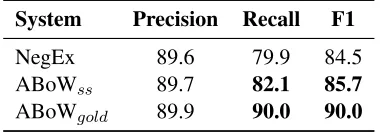
on the i2b2Testmod dataset. Table 4 summarizes
the results of these experiments. For ease of com-parison, we restate the results of the ABoW ker-nel, ABoWgold trained on the gold labels of the
i2b2Trainmoddataset.
System Precision Recall F1
NegEx 89.6 79.9 84.5 ABoWss 89.7 82.1 85.7
[image:4.612.91.281.152.218.2]ABoWgold 89.9 90.0 90.0
Table 4: Semi-supervised models on the i2b2Testmod
dataset.
These results demonstrate that the kernel trained using a semi-supervised approach performs better than the baseline (p<0.05, McNemar’s test), but per-forms worse than a kernel trained using supervised training. However, supervised training is dependent on gold annotations. Thus, the semi-supervised ap-proach achieves good results without the need for annotated data. This is an important result espe-cially in the clinical domain where available anno-tated data is sparse and extremely costly to generate.
6 Dependency Tree Kernels
Dependency tree kernels have been showed to be effective for NLP tasks in the past. Culotta et al. (2004) showed that although tree kernels by them-selves may not be effective for relation extraction, combining a tree kernel with a bag of words nel showed promising results. Dependency tree ker-nels have also been explored in the context of nega-tion extracnega-tion in the medical domain. Recently, Bowei et al. (2013) demonstrated the use of tree kernel based approaches in detecting the scope of negations and speculative sentences using the Bio-Scope corpus (Szarvas et al., 2008). However, the task of negation scope detection task is different than that of negation detection. Among other differences, an important one being the presence of annotations for negation cues in the Bioscope corpus. Sohn et al. (2012) developed hand crafted rules representing subtrees of dependency parses of negated sentences and showed that they were effective on a dataset from their institution.
Therefore, we implemented a dependency tree kernel similar to the approach described in Culotta and Sorensen (2004) to automatically capture the structural patterns in negated assertions. We used the Stanford dependencies parser (version 2.0.4) (de Marneffe et al., 2006) to get the dependency parse for every assertion. As per their representation (de Marneffe and Manning, 2008) every dependency is a triple, consisting of a governor, a dependent and a dependency relation. In this triple, the gover-nor and dependent are words from the input sen-tence. Thus, the tree kernel comprised of nodes corresponding to every word and every dependency relation in the parse. Node similarity was com-puted based on features such as lemma, general-ized part-of-speech, WordNet (Fellbaum, 1998) syn-onymy and the UMLS (Bodenreider, 2004) semantic type obtained using MetaMap (Aronson, 2001) for word nodes.
Node similarity for dependency relation nodes was computed based on name of the dependency relation. A tree kernel then computed the simi-larity between two trees by recursively computing node similarity between two nodes as described in (Culotta and Sorensen, 2004). The only difference being, unlike our approach they have only word nodes in the tree. The kernel is hence a function
K(T1, T2)which computes similarity between two dependency trees T1 and T2. See (Culotta and Sorensen, 2004) for why K is a valid kernel func-tion. However, we got poor results. In experiments involving within dataset evaluation, the tree kernel gave F1 scores of 77.0, 76.2 and 74.5 on NegCorp, BID and PH datasets respectively. We also tried con-structing composite kernels, by adding kernel ma-trices of the tree kernel and the ABoW kernel or NF kernel, hoping that they captured complimen-tary similarities between assertions. Although per-formance of the composite kernel was better than the tree kernel itself, there was no significant gain in the performance as compared to those of the reported kernels.
7 Discussion
implies that the kernel fetches more cases than the baseline. The bag of words contributes towards the increase in recall and thus raises performance.
It is instructive to look at sentences that were mis-classified by NegEx but correctly mis-classified by the ABoWgold system. The NegEx rule-based system
looks for specific phrases, before or after the target concept, as negation cues. The scope of the nega-tion is determined using these cues and the presence of conjunctions. False positives stem from instances where the scope is incorrectly calculated. For exam-ple, in “No masses, neck revealed lymphadenopa-thy”, the concept ‘lymphadenopathy’ is taken to be negated. The issue of negation scope being a short-coming of NegEx has been acknowledged by its au-thors in Chapman et al. (2001). There were cer-tain instances where the NegEx negation cues and the target concept overlapped. For example, in “A CT revealed a large amount of free air”, the target concept ‘free air’ was wrongly identified by NegEx as negated. This is because ‘free’ is a post nega-tion cue, to cover cases such as “The patient is now symptom free”. Similarly, with ‘significant increase in tumor burden’ as the target concept, the sentence “A staging CT scan suggested no significant increase in tumor burden” was wrongly identified as an affir-mation. Since the closest negation cue was ‘no sig-nificant,’ NegEx would identify only concepts after the phrase ‘no significant’ as negated. We also found interesting cases such as, the “Ext: cool, 1 + predal pulses, - varicosities, - edema.” where the concept ‘varicosities’ is negated using the minus sign.
We studied cases where NegEx made the right de-cision but which were incorrectly classified by our system. For example, in the assertion “extrm - trace edema at ankles, no cyanosis, warm/dry”, the ker-nel incorrectly classified “trace edema” as negated. In “a bone scan was also obtained to rule out an oc-cult hip fracture which was negative”, the concept “occult hip fracture” was incorrectly classified as af-firmed. We found no evident pattern in these exam-ples.
The tree kernel was constructed to automati-cally capture subtree patterns similar to those hand-crafted by Sohn et al. (2012). Although, it resulted in a poor performance, there are a number of possi-bilities to improve the current model of the kernel. Clinical data often consists of multi-word
expres-sions (e.g., “congestive heart failure”). However, the word nodes in our dependency tree kernel are uni-grams. Aggregating these unigrams (e.g., identifica-tion using MetaMap, followed by use of underscores to replace whitespaces) to ensure they appear as a single node in the tree could give dependency parses that are more accurate. Similarity for nodes involv-ing dependency tree relations; similarity in our ker-nel is a binary function examining identical names for dependency relations. This could be relaxed by clustering of dependency relations and computing similarity based on these clusters. We followed Cu-lotta and Sorensen (2004) and used WordNet syn-onymy for similarity of word nodes. However, open-domain terminologies such as WordNet are known to be insufficient for tasks specific to the biomedical domain (Bodenreider and Burgun, 2001). This could be coupled with domain specific resources such as UMLS::Similarity (McInnes et al., 2009) for a better estimate of similarity. Finally, since learning struc-tural patterns is a complex task achieved by the tree kernel; training with a larger amount of data could result in improvements.
8 Conclusion
We demonstrate the use of kernel methods for the task of negation detection in clinical text. Using a simple bag of words kernel with the NegEx out-put as an additional feature yields significantly im-proved results as compared to the NegEx rule-based system. This kernel generalizes well and shows promising results when trained and tested on differ-ent datasets. The kernel outperforms the rule-based system primarily due to an increase in recall. We also find that for instances where we do not have ad-ditional labeled training data, we are able to leverage the NegEx Corpus as a bootstrap to perform semi-supervised learning using kernel methods.
Acknowledgments
References
Daniel Albright, Arrick Lanfranchi, Anwen Fredrik-sen, William F Styler, Colin Warner, Jena D Hwang, Jinho D Choi, Dmitriy Dligach, Rodney D Nielsen, James Martin, et al. 2013. Towards comprehensive syntactic and semantic annotations of the clinical nar-rative. Journal of the American Medical Informatics Association, 20(5):922–930.
Alan R Aronson. 2001. Effective mapping of biomedical text to the UMLS Metathesaurus: the MetaMap pro-gram. In Proceedings of AMIA Annual Symposium., pages 17–21.
Olivier Bodenreider and Anita Burgun. 2001. Compar-ing terms, concepts and semantic classes in WordNet and the Unified Medical Language System. In Pro-ceedings of the NAACL 2001 Workshop: WordNet and other lexical resources: Applications, extensions and customizations., pages 77–82.
Olivier Bodenreider. 2004. The Unified Medical Lan-guage System (UMLS): integrating biomedical ter-minology. Nucleic Acids Research, 32(Database issue):D267–70.
Zou Bowei, Zhou Guodong, and Zhu Qiaoming. 2013. Tree Kernel-based Negation and Speculation Scope Detection with Structured Syntactic Parse Features. In Proceedings of the 2013 Conference on Empirical Methods in Natural Language Processing, pages 968– 976.
Chih-Chung Chang and Chih-Jen Lin. 2011. LIBSVM: A library for support vector machines. ACM Transac-tions on Intelligent Systems and Technology, 2:27:1– 27:27.
Wendy W Chapman, Will Bridewell, Paul Hanbury, Gre-gory F Cooper, and Bruce G Buchanan. 2001. A sim-ple algorithm for identifying negated findings and dis-eases in discharge summaries. Journal of Biomedical Informatics, 34(5):301–10, October.
Wendy W Chapman, Dieter Hilert, Sumithra Velupillai, Maria Kvist, Maria Skeppstedt, Brian E Chapman, Michael Conway, Melissa Tharp, Danielle L Mowery, and Louise Deleger. 2013. Extending the NegEx lexi-con for multiple languages. Studies in health technol-ogy and informatics, 192:677.
Aron Culotta and Jeffrey Sorensen. 2004. Dependency Tree Kernels for Relation Extraction. InProceedings of the 42Nd Annual Meeting on Association for Com-putational Linguistics, ACL ’04.
Marie-Catherine de Marneffe and Christopher D. Man-ning. 2008. The Stanford typed dependencies repre-sentation. InColing 2008: Proceedings of the work-shop on Cross-Framework and Cross-Domain Parser Evaluation, pages 1–8.
Marie-Catherine de Marneffe, Bill MacCartney, and Christopher D Manning. 2006. Generating Typed De-pendency Parses from Phrase Structure Parses. In Pro-ceedings of LREC, pages 449–454.
Christiane Fellbaum. 1998. WordNet: An Electronic Lexical Database. Bradford Books.
Henk Harkema, John N Dowling, Tyler Thornblade, and Wendy W Chapman. 2009. ConText: An algorithm for determining negation, experiencer, and temporal status from clinical reports.Journal of Biomedical In-formatics, 42(5):839–851.
Thomas Hofmann, Bernhard Sch¨olkopf, and Alexander J. Smola. 2008. Kernel methods in machine learning.
The Annals of Statistics, 36(3):1171–1220, June. Thorsten Joachims, Nello Cristianini, and John
Shawe-Taylor. 2001. Composite Kernels for Hypertext Cate-gorisation. InProceedings of the Eighteenth Interna-tional Conference on Machine Learning, pages 250– 257. Morgan Kaufmann Publishers Inc.
Bridget T McInnes, Ted Pedersen, and Serguei V S Pakhomov. 2009. Interface and UMLS-Similarity : Open Source Software for Measuring Paths and Semantic Similarity. InProceedings of the Annual AMIA Symposium., volume 2009, pages 431– 5.
Sunghwan Sohn, Stephen Wu, and Christopher G Chute. 2012. Dependency Parser-based Negation Detection in Clinical Narratives. InProceedings of AMIA Sum-mits on Translational Science.
Brett R South, Shobha Phansalkar, Ashwin D Swami-nathan, Sylvain Delisle, Trish Perl, and Matthew H Samore. 2006. Adaptation of the NegEx algorithm to Veterans Affairs electronic text notes for detection of influenza-like illness (ILI). In Proceedings of the AMIA Annual Symposium, pages 1118–1118.
Gy¨orgy Szarvas, Veronika Vincze, Rich´ard Farkas, and J´anos Csirik. 2008. The BioScope Corpus: Anno-tation for Negation, Uncertainty and Their Scope in Biomedical Texts. InProceedings of the Workshop on Current Trends in Biomedical Natural Language Pro-cessing, BioNLP ’08, pages 38–45.
¨Ozlem Uzuner, Brett R South, Shuying Shen, and Scott L DuVall. 2011. 2010 i2b2/VA challenge on concepts, assertions, and relations in clinical text. Journal of the American Medical Informatics Association : JAMIA, 18(5):552–6.
Stephen Wu, Timothy Miller, James Masanz, Matt Coarr, Scott Halgrim, David Carrell, and Cheryl Clark. 2014. Negations Not Solved: Generalizability Versus Opti-mizability in Clinical Natural Language Processing.