Extracting Information for Generating A Diabetes Report Card from
Free Text in Physicians Notes
Ramanjot S Bhatia
University of Ottawa Heart Institute
Ottawa, Ontario. Rbhatia
@ottawaheart.ca
Amber Graystone
McMaster University Hamilton, Ontario. amber.graystone
@medportal.ca
Ross A Davies
University of Ottawa Heart Institute
Ottawa, Ontario. RADavies
@ottawaheart.ca
Susan McClinton
University of Ottawa Heart Institute
Ottawa, Ontario. SMcClinton @ottawaheart.ca
Jason Morin
National Research Council Canada
Ottawa, Ontario. jason.morin @nrc-cnrc.gc.ca
Richard F Davies
University of Ottawa Heart Institute
Ottawa, Ontario. RFDavies @ottawaheart.ca
Abstract
Achieving guideline-based targets in patients with diabetes is crucial for improving clinical outcomes and preventing long-term complica-tions. Using electronic heath records (EHRs) to identify high-risk patients for further interven-tion by screening large populainterven-tions is limited be-cause many EHRs store clinical information as dictated and transcribed free text notes that are not amenable to statistical analysis. This paper presents the process of extracting elements needed for generating a diabetes report card from free text notes written in English. Numerical measurements, representing lab values and phys-ical examinations results are extracted from free text documents and then stored in a structured database. Extracting diagnosis information and medication lists are work in progress. The com-plete dataset for this project is comprised of 81,932 documents from 30,459 patients collected over a period of 5 years. The patient population is considered high risk for diabetes as they have existing cardiovascular complications. Experi-mental results validate our method, demonstrat-ing high precision (88.8-100%).
1 Introduction
medical domain for decision support (Chapman et al. 2005), classifying medical problem lists (Meystre and Haug 2005), extracting disease re-lated information (Xu et al. 2004), building dy-namic medications lists (Pakhomov et al. 2002), building applications for better data management, and for diagnosis detection. (Friedman et al. 2004, Roberts et al. 2008, Liu and Friedman 2004).
Our goal is to automatically generate diabetes report cards from the free text in physicians' letters. The report card can be used to detect populations at risk for diabetes mellitus and track their vital information over a period of time. Previous work in similar area has seen Turchin et al. (2005) iden-tify patients with diabetes from the text of physi-cian notes by looking for mention of diabetes and predefined list of medication names. They use a manually created list of negation tokens to detect false examples. They compare the process to ma-nual chart review and billing notes and show the automatic system performs at par with manual re-view with the advantage of it being highly effi-cient.
In Turchin et al. (2006) the authors use regular expressions to extract blood pressure values and change of treatment for hypertension. They use a set of regular expressions to detect the presence of a blood pressure related tag, which predicts that the sentence is likely to contain a blood pressure value. The value itself is then extracted using regular ex-pressions. They identify the strength of the process in it being relatively simple, efficient and quick to setup, while its weakness is its lack of generaliza-tion. Voorham and Denig (2007) solve a similar problem as in here and extract information regard-ing diabetes from free text notes usregard-ing a number centric approach. They identify all positive numer-ical values and then attach respective labels to the values. They use a keyword based approach with a four word token window and apply a character se-quence algorithm to check for spelling errors.
Extracting relevant information from free text represents a challenging problem since the task can be considered to be a form of reverse engineering and is above the mere presence of keywords or patterns. It is necessary to generate semantic repre-sentations to understand the text. The free text document may contain multiple values for the same label, and it's important to be able to distin-guish and choose the correct value. These values could be:
multiple readings (in which case a prede-fined rule may be enough, e.g. choosing the smallest mean arterial blood pressure value)
potential target values (which may or may not be important)
values taken over a period of time
values taken at different locations
values reflecting family history
change in a value and not the actual value
values influenced by some external reasons (e.g. take medication if the weight is above a certain value).
Friedman and Hripcsak (1999) discuss some of the many problems of dealing with free text in medical domain. One method to resolve these problems is to build a full grammar tree and assign semantic roles to accurately interpret the text. However, generating full parse trees for medical text requires specialized parsers developed for the clinical domain (Freidman, 2005). It has been shown that shallow syntactic approaches can yield similar results to the ones using full syntactic de-tails (Gildea & Palmer, 2002).
In this work we use shallow syntactic and se-mantic features (manually created concept list and WordNet, Miller 1995) to tag information relating to the numerical values extracted from the text. We use machine learning tool WEKA (Hall et al. 2009) to build binary classifiers that pick positive values from the list of values extracted from the document. Our method allows us to build a robust and extendible system which should be easily port-able to texts from different institutions and other medical domains.
2 Method
reg-ular expressions/pattern matching based tech-niques. The demographic information extracted is year of birth, date of encounter and gender. The gender information is determined using a heuristic, which counts the number of third person masculine and feminine pronouns present in the text. Numeri-cal measurement values extracted include blood pressure (systolic and diastolic), LDL, HDL, HbA1C, weight, total cholesterol, fasting glucose, glucose (unspecified) and creatinine. The medica-tion list extracmedica-tion process uses a manually created database of applicable medications. The diagnosis detection involves negation detection in the sen-tences that mention diabetes using the NegEx algo-rithm (Chapman et al. 2001).
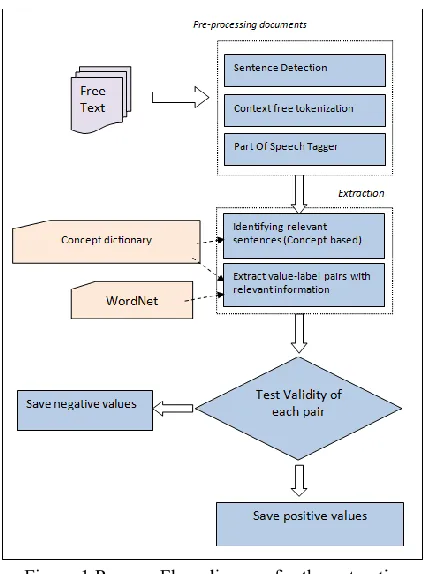
In this study we use shallow syntactic and se-mantic attributes to build a system that extracts the physical examination and laboratory results data. The values are extracted as numeric value-label pairs. The system is divided into three main parts (Figure 1): preprocessing stage, extraction of the numeric value-label pairs, and testing the validity of the extracted pairs.
Preprocessing: The documents were originally stored in Microsoft Word format (WordML). They are converted to XML using XSLT transformation. All formatting information is stripped except for bold and italic font information and paragraph boundaries
The paragraphs in the document are further broken down into sentences and tokens. We use OPENNLP Maxent1 library to do sentence
boun-dary detection and tokenization. OPENNLP Max-ent is based on maximum Max-entropy algorithms described in Ratnaparkhi (1998) and Berger et al. (1996). The OPENNLP statistical tagger is used to assign syntactic tags to the tokens.
Data Extraction: In this phase the system extracts all potential numerical values and assigns them labels. The system loops through all of the tokens in the document, testing for numerical values. It tests each numerical token against a set of regular expressions and assigns them a list of potential labels based on the regular expression it matches. The system takes into account the presence of a measurement unit and revises the potential list of labels based on the unit. For each potential label, using a knowledge base, the system looks for con-cepts that validate the labels. The closest possible
1 http://opennlp.sourceforge.net/
[image:3.612.316.528.142.429.2]validation is accepted as pairing. The Edit distance algorithm is used to test for matching concepts in order to account for any spelling errors. The con-cepts are searched within the constraints of the sen-tence.
Figure 1 Process Flow diagram for the extraction process
In case multiple labels are validated because of the presence of multiple concepts in the same sen-tence, the label indicated by the closest concept is selected. For each pair, the system extracts a list of features which help to resolve for positive values. One exception to the sentence level boundary rule is: if no concepts are found in the sentence, and the sentence contains a third person singular inanimate pronoun, the search is extended to the previous sentence.
Features: The following is the list of features ex-tracted for each pair.
a) Absolute distance between the label and the numerical value.
b) Label shared (Yes/No): Yes, if the same con-cept label is attached to another numerical val-ue in the same document.
c) Closest verb token appearing left of the numer-ical value.
d) Presence of a modal verb (Yes/No)
e) Distance of numerical value from the modal verb (a positive value is assigned for the modal verb if it occurs before the numeric token, and a negative value when it appears after). f) Conjunction present (Yes/No): If there is
con-junction present between the label and numeri-cal value or not.
g) Coreference present (Yes/No): If third person singular inanimate pronoun is present or not. h) Negation concept present (Yes/No): True if
there is any negation concept present in the vi-cinity of the numerical value/label. The nega-tion concepts include not just negative statement markers, but also false cognates and other concepts collected by the domain ex-perts. (e.g. systolic murmur or systolic volume do not indicate systolic pressure).
i) Locational Information token: The stemmed token is stored if it is recognized as a location-al information token. The location information is deduced by generalizing each token and checking to see whether it resolves to one of many Locational cues in WordNet. The list of location indicators is presented in Figure 2. The cues are resolved against the WordNet hypernym definitions for that token.
j) Distance of numerical value from Locational token.
k) Temporal information token: Similar to (i), the stemmed token indicating temporal informa-tion. The temporal information token includes any tokens that indicate date or time. The list of temporal indicator cues in WordNet is shown in Figure 2.
l) Distance of the numerical value from the tem-poral token.
For features (c), (i) and (k) the tokens are stored in their uninflected form, achieved using Porter Stemmer. For the report card, in case of multiple positive values for the same label, the smallest
[image:4.612.313.534.106.270.2]val-ue is selected. In the case of blood pressure, the smallest mean arterial pressure is selected.
Figure 2 WordNet hypernym based generalization cues for location and time indicators
3 Evaluation
Evaluation was done using a test set consisting of 804 documents from 260 patients (50 percent had positive diagnosis for diabetes). The test set was created by a first year student at Michael G De-groote School of Medicine at McMaster Universi-ty. The reviewer manually analyzed the notes and extracted final values that would appear on the re-port card along with a time stamp for each value to indicate the source document. The human reviewer took approximately 10 minutes per patient; in comparison the computer analyzed the data at 6.43 patients per minute.
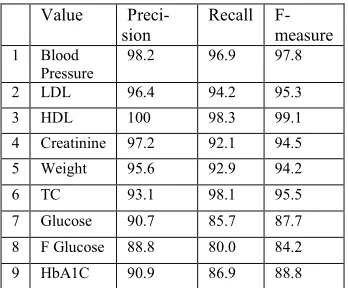
Evaluation results testing the performance of the system using the manually coded test set are shown in Table 1 below.
Value
Preci-sion Recall F-measure 1 Blood
Pressure 98.2 96.9 97.8
2 LDL 96.4 94.2 95.3
3 HDL 100 98.3 99.1
4 Creatinine 97.2 92.1 94.5
5 Weight 95.6 92.9 94.2
6 TC 93.1 98.1 95.5
7 Glucose 90.7 85.7 87.7
8 F Glucose 88.8 80.0 84.2
9 HbA1C 90.9 86.9 88.8
[image:4.612.338.512.530.674.2]4 Results and Discussion
The precision, recall and f-measure for all nine label values extracted for the system along with the recall values for the human reviewer are listed in Table 1. The system demonstrates high precision in extracting and selecting positive numeric value-label pairs. Blood pressure is extracted with a pre-cision of 98.2% and recall 96.9%. HDL and LDL values are easy to spot and extract as they usually occur without description. At the lower end of pre-cision are fasting glucose, glucose and HbA1C where precision results are in the range of 88-90%. The majority of errors for all categories occurred due to problems in identifying numeric values be-cause of typing errors.
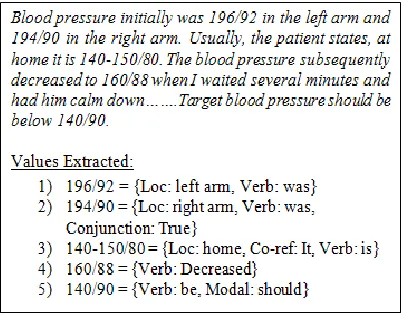
Figure 3 shows an example of the level of com-plexity resolved using the algorithm developed here. The clinical documents frequently have mul-tiple values for weight and blood pressure in a sin-gle document. The lab values do not have the same level of multiplicity but it can occur. In this exam-ple, the extraction step extracts all five values, and the classifier successfully rejects values #3 and #5. To comply with the report card’s output requiments the lowest mean arterial pressure of the re-maining three values is adopted, which is the correct response. This approach is extendible to build a slot-filler system for the values, which would allow the system to reason on its choice.
In previous work, the disambiguation of the values is only based on the presence of negation concepts within a pre-specified boundary. We ex-tend this to include a simple need based co-reference, location and temporal information, and a heuristic approach to include the head verb (it only takes into account the closest verb, which may or may not be the governing verb). The system can successfully detect negative values such as target values, previous values, change in value or values measured elsewhere.
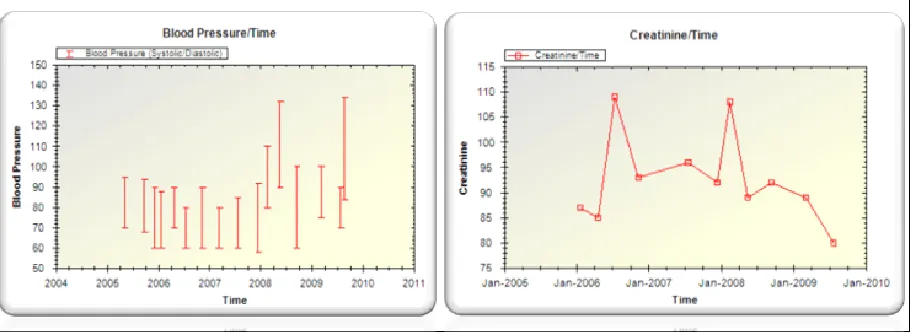
[image:5.612.332.534.84.246.2]The information extracted is stored in a struc-tured MySQL database. The system allows mul-tiple views on this information. Figure 4 shows the output for blood pressure and creatinine for a pa-tient that was created from the information ex-tracted from the free text.
Figure 3 Example 1
At this time we have not evaluated the contribu-tion of each feature individually, as this requires building a comprehensive test set; it remains as future work.
5 Conclusion
Our preliminary results demonstrate that the sys-tem performs with high precision and recall at the task of extracting numerical values. It also shows the ability to build a patient-chart abstractor within the restricted domain. The use of semantic and syntactic features enables the system to tag the values which permit the overall extraction process to generate more informative numeric value-label pairs. The use of machine learning algorithms coupled with a large enough learning dataset pro-duces a robust system that should work reliably on similar data from any source. We plan to test the system on a dataset obtained from the free text notes of endocrinologists at a different health insti-tution to validate the generalization of the algo-rithm. The next step for the Diabetes Report Card is to extract the list of medications and track any changes in medication, dosage and frequency.
Acknowledgments
6 References
Berger, A. L., Pietra, V. J., & Pietra, S. A. (1996). A maximum entropy approach to natural language processing. Computational Linguistics , 39-71. Chapman, W. W., Christensenb, L. M., Wagnera, M. M., Haugb, P. J., Ivanova, O., Dowlinga, J. N., et al. (2005). Classifying free-text triage chief complaints into syndromic categories with natural languages processing.
Artificial Intelligence in Medicine , 31-40.
Chapman, W., Bridewell, W., Hanbury, P., Cooper, G., & Buchanan, B. (2001). Evaluation of negation phrases in narrative clinical reports. Proc AMIA Symp , 105-114. Freidman, C. (2005). Semantic Text Parsing for Patient Records. In Medical Informatics (pp. 423-448). Springer US.
Friedman, C., & Hripcsak, G. (1999). Natural Language Processing and Its Future in Medicine. Acad Med , 890-895.
Friedman, C., Shagina, L., Lussier, Y., & Hripcsak, G. (2004). Automated Encoding of Clinical Documents based on Natural Language Processing. Journal of
American Medical Informatics Association .
Gildea, D., & Palmer, M. (2002). The Necessity of Syntactic Parsing for Predicate Argument Recognition.
Association for Computational Linguistics, (pp.
239-246).
Hall, M., Frank, E., Holmes, G., Pfahringer, B., Reutemann, P., & Witten, I. H. (2009). The WEKA Data Mining Software: An Update. SIGKDD
Explorations .
Heinze, D. T., Morsch, M. L., & Holbrook, J. (2001). Mining free-text medical records. AMIA, (pp. 254-258). Hripcsak, G., Friedman, C., Alderson, P., DuMouchel, W., Johnson, S., & Clayton, P. (1995). Unlocking
clinical data from narrative reports: a study of natural language processing. Ann Intern Med , 681-689. Liu, H., & Friedman, C. (2004). CliniViewer: a tool for viewing electronic medical records based on natural language processing and XML. MedInfo , 639-643. Lovis, C., Baud, R. H., & Plancheb, P. (2000). Power of expression in the electronic patient record: structured data or narrative text? International Journal of Medical
Informatics , 101-110.
Mcdonald, C. J. (1997). The Barriers to Electronic Medical Record Systems and How to Overcome Them.
Journal of the American Medical Informatics
Association , 213-221.
Meystre, S., & Haug, P. J. (2005). Automation of a problem list using natural language processing. BMC
Medical Informatics and Decision Making , 5-30.
Miller, G. A. (1995). WordNet: A Lexical Database for English. Communications of the ACM, 38, 39-41. Pakhomov, S. V., Ruggieri, A., & Chute, C. G. (2002). Maximum entropy modeling for mining patient medication status from free text. Proceedings of the
American Medical Informatics, (pp. 587–591).
Ratnaparkhi, A. (1998). Maximum Entropy Models for
Natural Language Ambiguity Resolution. Phd Thesis.
Roberts, A., Gaizauskas, R., Hepple, M., & Guo, Y. (2008). Mining clinical relationships from patient narratives. Natural Language Processing in
Biomedicine (BioNLP) ACL Workshop.
Ruch, P., Baud, R., Geissbuhler, A., & Rassinoux, A.-M. (2001). Comparing general and medical texts for information retreival based on natural language
processing: An inquiry into lexical disambiguation., (pp. 261-266).
Turchin, A., Kohane, I., & Pendergrass, M. (2005). Identification of patients with diabetes from the text of physician notes in the electronic medical record.
[image:6.612.67.524.44.210.2]Diabetes Care , 1794-1795.
Turchin, A., Kolatkar, N., Grant, R. W., Makhni, E. C., Pendergrass, M. L., & Einbinder, J. S. (2006). Using regular expressions to abstract blood pressure and treatment intensification information from the text of physician notes. Journal of the American Medical
Informatics Association , 691-696.
Voorham, J., & Denig, P. (2007). Computerized Extraction of Information on the Quality of Diabetes Care from Free Text in Electronic Patient Records of General Practitioners. The Journal of the American
Medical Informatics Association , 349-354.