Integrating Models Derived from non-Parametric Bayesian
Co-segmentation into a Statistical Machine Transliteration System
Andrew Finch NICT 3-5 Hikaridai Keihanna Science City
619-0289 JAPAN [email protected]
Paul Dixon NICT 3-5 Hikaridai Keihanna Science City
619-0289 JAPAN [email protected]
Eiichiro Sumita NICT 3-5 Hikaridai Keihanna Science City
619-0289 JAPAN [email protected]
Abstract
The system presented in this paper is based upon a phrase-based statistical machine transliteration (SMT) framework. The SMT system’s log-linear model is aug-mented with a set of features specifically suited to the task of transliteration. In par-ticular our model utilizes a feature based on a joint source-channel model, and a fea-ture based on a maximum entropy model that predicts target grapheme sequences using the local context of graphemes and grapheme sequences in both source and target languages. The segmentation for our approach was performed using a non-parametric Bayesian co-segmentation model, and in this paper we present ex-periments comparing the effectiveness of this segmentation relative to the publicly available state-of-the-art m2m alignment tool. In all our experiments we have taken a strictly language independent approach. Each of the language pairs were processed automatically with no special treatment.
1 Introduction
In the NEWS2010 workshop, (Finch and Sumita, 2010b) reported that the performance of a phrase-based statistical machine transliteration system (Finch and Sumita, 2008; Rama and Gali, 2009) could be improved significantly by combining it with a model based on the n-gram context of source-target grapheme sequence pairs: a joint source-channel model similar to that of (Li et al., 2004). Their system integrated the two approaches by using a re-scoring step at the end of the de-coding process. Our system goes one step fur-ther and integrates a joint source-channel model di-rectly into the SMT decoder to allow the probabili-ties from it to be taken into account within a single search process in the similar manner to (Banchs et al., 2005).
2 System Description
2.1 Bayesian Co-segmentation
The typical method of deriving a translation-model for a machine translation is to use GIZA++ (Och and Ney, 2003) to perform word alignment and a set of heuristics for phrase-pair extraction. A com-monly used set of heuristics is known as grow-diag-final-and. This type of approach was taken by (Finch and Sumita, 2010b; Rama and Gali, 2009) to train their models.
An alternative approach is to use a non-parametric Bayesian technique to co-segment both source and target in a single step (Finch and Sumita, 2010a; Huang et al., 2011). This ap-proach has the advantage of being symmetric with respect to source and target languages, and fur-thermore Bayesian techniques tend to give rise to models with few parameters that do not overfit the data in the same way as traditional maximum likelihood training. In experiments on an English-Japanese transliteration task, (Finch and Sumita, 2010a) showed that that a Bayesian approach of-fered higher performance than using GIZA++ to-gether with heuristic phrase-pair extraction. Their approach unfortunately required a simple set of ag-glomeration heuristics in order get good perfor-mance from the system. Similarly, (Huang et al., 2011) show that their Bayesian system is able to outperform a baseline based on EM alignment, by removing the need to align to a single grapheme in one language to avoid over-fitting.
In our approach, we adopt the same Bayesian co-segmentation (bilingual alignment) framework as (Finch and Sumita, 2010a), and replace the agglomeration heuristics by incorporating a joint source-channel model directly into the decoder as an additional feature. Our motivation for this was simply that the phrase-based translation model lacks contextual information, and in the experi-ments of (Finch and Sumita, 2010a), the model gained this contextual information implicitly by the use of agglomerated phrases. In other words,
the longer phrases carried with them their own built-in context. In our model these contextual de-pendencies are made explicit and modeled directly by the joint source-channel model.
The termination condition for our Bayesian co-segmentation algorithm was set based on pilot ex-periments that showed very little gain in system performance after iteration 10, and no loss in per-formance by continuing the training. We arbitrar-ily chose iteration 30 in all our experiments as the final iteration.
2.2 Phrase-based SMT Models
The decoding was performed using a specially modified version of the CLEOPATRA de-coder (Finch et al., 2007), an in-house multi-stack phrase-based decoder that operates on the same principles as the MOSES decoder (Koehn et al., 2007). The system we used in this shared task is a log-linear combination of 5 different models, the following sections describe each of these models in detail. Due to the small size of many of the data sets in the shared tasks, we used all of the data to build models for the final systems.
2.2.1 Joint source-channel model
The joint source-channel model was trained from the Viterbi co-segmentation arising from the final iteration of the Bayesian segmentation process on the training data (for model used in parameter tun-ing), and the training data added to the develop-ment data (for the model used to decode the test data). We used the MIT language modeling toolkit (Bo-june et al., 2008) with modified Knesser-Ney smoothing to build this model. In all experiments we used a language model of order 5.
2.2.2 Target Language model
The target model was trained from target side of the training data (for model used in parameter tun-ing), and the training data added to the develop-ment data (for the model used to decode the test data). We used the MIT language modeling toolkit with Knesser-Ney smoothing to build this model. In all experiments we used a language model of order 5.
2.2.3 Insertion penalty models
Both grapheme based and grapheme-sequence-based insertion penalty models are simple models that add a constant value to their score each time a grapheme (or grapheme sequence) is added to the target hypotheses. These models control the ten-dency both of the joint source-channel model and
the target language model to generate derivations that are too short.
2.2.4 Maximum-entropy model
In a typical phrase-based SMT system, the trans-lation model contains a context-independent prob-ability of the target grapheme sequence (phrase) given the source. Our system replaces this with a more sophisticated maximum entropy model that takes the local context of source and target graphemes and grapheme sequences into account. The features can be partitioned into two classes: grapheme-based features and grapheme sequence-based features. In both cases we use a context of 2 to the left and right for the source, and 2 to the left for the target. Sequence begin and end mark-ers are added to both source and target and are used in the context. The features used in the ME model consist of all possible bigrams of contiguous ele-ments in the context. We do not mix features at the grapheme level and grapheme sequence level, so for example, a grapheme sequence bigram can only consist of grapheme sequences (including se-quences of length 1).
2.3 Parameter Tuning
The exponential log-linear model weights of our system are set by tuning the system on develop-ment data using the MERT procedure (Och, 2003) by means of the publicly available ZMERT toolkit
1(Zaidan, 2009). The systems reported in this
pa-per used a metric based on the word-level F-score, an official evaluation metric for the shared tasks, which measures the relationship of the longest common subsequence of the transliteration pair to the lengths of both source and target sequences.
2.4 Official Results
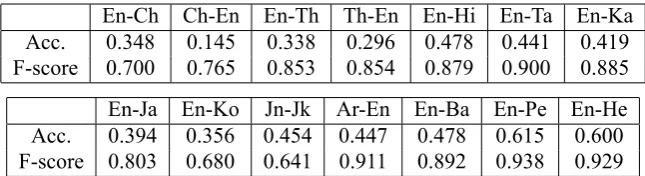
The official scores for our system are given in Ta-ble 1. Some of the data tracks will benefit from a language-dependent treatment (for example in Ko-rean it is advantageous to decompose the charac-ters), and in these tracks our language-independent approach was not competitive. Our system typi-cally gave a strong relative performance on those tracks with larger amounts of training data.
3 Segmentation Experiments
A novel feature of our system is the Bayesian co-segmentation approach used to bilingually seg-ment the data in order to yield training data from which to train the models in our system. It has been
1http://www.cs.jhu.edu/
En-Ch Ch-En En-Th Th-En En-Hi En-Ta En-Ka Acc. 0.348 0.145 0.338 0.296 0.478 0.441 0.419 F-score 0.700 0.765 0.853 0.854 0.879 0.900 0.885
[image:3.595.137.460.61.149.2]En-Ja En-Ko Jn-Jk Ar-En En-Ba En-Pe En-He Acc. 0.394 0.356 0.454 0.447 0.478 0.615 0.600 F-score 0.803 0.680 0.641 0.911 0.892 0.938 0.929
Table 1: The Evaluation Results on the 2011 Shared Task for our System in terms of the official F-score and Top-1 accuracy metrics.
shown (Finch and Sumita, 2010a) that in translit-eration, this Bayesian approach can give rise to a smaller and more useful phrase-table than that derived by using GIZA++ for alignment and the grow-diag-final-and heuristics which have been shown to be effective for transliteration (Rama and Gali, 2009). In these experiments we compare the Bayesian segmenter to a similar state-of-the-art segmentation tool that is capable of many-to-many alignments: the publicly available m2m alignment tool 2 (Jiampojamarn et al., 2007) that is trained using the EM algorithm and is based on the prin-ciples set out in (Ristad and Yianilos, 1998).
We used a similar system to that in the shared task, but without the maximum entropy model. The experiments were run in the same way us-ing the same script, the only difference beus-ing the choice of aligner used. We used data from the 2009 NEWS workshop for our experiments, and evalu-ated using the F-score metric used for the shared task evaluation. The aligners were run with their default settings, and with the same limits for source and target segment size. It may have been possible to obtain better performance from the aligners by adjusting specific parameters, but no attempt was made to do this. The results are shown in Table 2. In all experiments, the Bayesian segmenter gave the best performance, and the largest improvement was on language pairs that have large grapheme set sizes on the target side. The grapheme set size is shown in Table 2 in the ‘Target Types’ column. The source grapheme set sizes were very similar and small (around 27) for all experiments, as the source language was either English or in the case of Jn-Jk, a romanized form of Japanese. Looking at then-gram statistics in Table 2, for languages with large grapheme sets the number of unigrams in the Bayesian model is less than half that used by the m2m model. Learning a compact model is one of the signature characteristics of the Bayesian model we use; adding a new parameter to the model is extremely costly, and the algorithm will therefore
2http://code.google.com/p/m2m-aligner/
strongly prefer to learn a model in which the pa-rameters are re-used.
Initially we considered the hypotheses that the difference in performance between these two ap-proaches came from differences in the sparseness of the language models. Surprisingly however, the numbers of bi-grams and tri-grams in the joint lan-guage models are quite similar.
Another explanation is that the smaller num-ber of unigrams indicates that the segmentation is more self-consistent and therefore makes the gen-eration task less ambiguous. This is supported by looking at the development set perplexity. On the Jn-Jk task where the differences between the sys-tems are the largest, we found that a joint language model trained on the Bayesian segmentation had 1-, 2-, and 3-gram perplexities of 218.3, 88.4 and 87.5 respectively, whereas the corresponding m2m model’s perplexities were 321.8, 120.5 and 119.3. The number of segments used to segment the cor-pus was the same for both systems in this experi-ment.
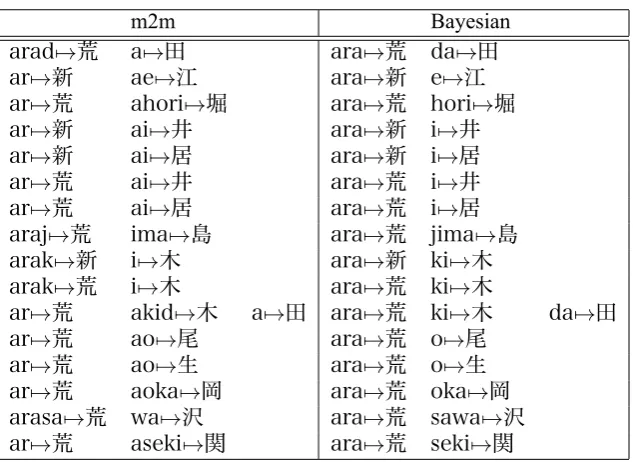
Table 3 gives an example from the data of the differences in segmentation consistency. The Bayesian segmentation is strongly self-consistent. The source sequence ‘ara’ has been segmented identically as a single unit in all cases. The m2m system also shows self-consistency, but uses a few different strategies to segment the start of the se-quence. Interestingly the Bayesian method in this example has segmented according to the correct linguistic readings of the kanji. We investigate this further in the next section.
3.1 Linguistic Agreement
Language Target m2m Bayesian m2m Bayesian
[image:4.595.72.551.62.170.2]Pairs Types F-score F-score 1-grams 2-grams 3-grams 1-grams 2-grams 3-grams En-Ch 372 0.858 0.880 9379 44003 75513 4706 38647 72905 En-Hi 84 0.874 0.884 3114 15209 30195 1867 20218 34657 En-Ko 687 0.623 0.651 4337 11891 14112 2968 11233 14729 En-Ru 66 0.919 0.922 1638 6351 14869 1105 12607 23250 En-Ta 64 0.885 0.892 2852 14696 27869 1561 17195 30244 Jn-Jk 1514 0.669 0.767 7942 27286 38365 3532 22717 37560
Table 2: System performance in terms of F-score, by using alternative segmentation schemes together with statistics relating to be number of parameters in the models derived from the segmentations.
m2m Bayesian
arad7→荒 a7→田 ara7→荒 da7→田
ar7→新 ae7→江 ara7→新 e7→江
ar7→荒 ahori7→堀 ara7→荒 hori7→堀
ar7→新 ai7→井 ara7→新 i7→井
ar7→新 ai7→居 ara7→新 i7→居
ar7→荒 ai7→井 ara7→荒 i7→井
ar7→荒 ai7→居 ara7→荒 i7→居
araj7→荒 ima7→島 ara7→荒 jima7→島
arak7→新 i7→木 ara7→新 ki7→木
arak7→荒 i7→木 ara7→荒 ki7→木
ar7→荒 akid7→木 a7→田 ara7→荒 ki7→木 da7→田
ar7→荒 ao7→尾 ara7→荒 o7→尾
ar7→荒 ao7→生 ara7→荒 o7→生
ar7→荒 aoka7→岡 ara7→荒 oka7→岡
arasa7→荒 wa7→沢 ara7→荒 sawa7→沢
ar7→荒 aseki7→関 ara7→荒 seki7→関
Table 3: Example segmentations from the m2m segmenter and the Bayesian segmenter, taken from a long contiguous section of the training set where both techniques disagree on the segmentation.
name reading dictionary as a reference. We found that Bayesian segmentation agreed with the human segmentation in 96% of the test cases, and whereas the m2m system agreed in 42% of cases.
4 Conclusion
The system entered in the year’s shared task is built within a statistical machine translation framework, but has been augmented by adding features specif-ically suited to transliteration. In particular, a joint source-channel model and a maximum entropy model were integrated into the decoder to enhance the translation model of the SMT system by con-tributing local contextual information. Our sys-tem uses a novel Bayesian co-segmentation tech-nique to perform a many-to-many source-target sequence alignment of the corpus. The models of our system are trained directly from this co-segmentation. We have shown that this tech-nique is very effective for producing training data
for a joint source-channel model, and is able to accurately induce the linguistic segmentation of Japanese names, building a compact model based on a self-consistent segmentation of the data. In the future we would like to develop more sophis-ticated Bayesian models, and investigate methods for identifying and dealing with different source languages. We would also like to measure the utility of training the language model component of our system independently on large amounts of monolingual data, which is often much more read-ily available than aligned bilingual corpora.
Acknowledgements
[image:4.595.142.460.210.441.2]References
Rafael E. Banchs, Josep Maria Crego, Adria Degispert, Patrik Lambert, Marta Ruiz, and Jose A. R. Fonol-losa. 2005. Bilingual n-gram statistical machine translation. InProc. of Machine Translation Sum-mit X, pages 275–282.
Bo-june, Paul Hsu, and James Glass. 2008. Iterative language model estimation: Efficient data structure and algorithms. InProc. Interspeech.
Andrew Finch and Eiichiro Sumita. 2008. Phrase-based machine transliteration. InProc. 3rd Interna-tional Joint Conference on NLP, volume 1, Hyder-abad, India.
Andrew Finch and Eiichiro Sumita. 2010a. A Bayesian Model of Bilingual Segmentation for Transliteration. In Marcello Federico, Ian Lane, Michael Paul, and Franc¸ois Yvon, editors,Proceedings of the seventh International Workshop on Spoken Language Trans-lation (IWSLT), pages 259–266.
Andrew Finch and Eiichiro Sumita. 2010b. Transliter-ation using a phrase-based statistical machine trans-lation system to re-score the output of a joint multi-gram model. InProceedings of the 2010 Named En-tities Workshop, NEWS ’10, pages 48–52, Strouds-burg, PA, USA. Association for Computational Lin-guistics.
Andrew Finch, Etienne Denoual, Hideo Okuma, Michael Paul, Hirofumi Yamamoto, Keiji Yasuda, Ruiqiang Zhang, and Eiichiro Sumita. 2007. The NICT/ATR speech translation system for IWSLT 2007. InProceedings of the IWSLT, Trento, Italy.
Yun Huang, Min Zhang, and Chew Lim Tan. 2011. Nonparametric Bayesian Machine Transliteration with Synchronous Adaptor Grammars. In ACL (Short Papers), pages 534–539.
Sittichai Jiampojamarn, Grzegorz Kondrak, and Tarek Sherif. 2007. Applying many-to-many alignments and hidden markov models to letter-to-phoneme con-version. In Human Language Technologies 2007: The Conference of the North American Chapter of the Association for Computational Linguistics; Pro-ceedings of the Main Conference, pages 372–379, Rochester, New York, April. Association for Com-putational Linguistics.
Philipp Koehn, Hieu Hoang, Alexandra Birch, Chris Callison-Burch, Marcello Federico, Nicola Bertoldi, Brooke Cowa, Wade Shen, Christine Moran, Richard Zens, Chris Dyer, Ondrej Bojar, Alexandra Constantin, and Evan Herbst. 2007. Moses: open source toolkit for statistical machine translation. In
ACL 2007: proceedings of demo and poster sessions, pages 177–180, Prague, Czeck Republic, June.
A. Kumaran and Tobias Kellner. 2007. A generic framework for machine transliteration. InSIGIR’07, pages 721–722.
Haizhou Li, Min Zhang, and Jian Su. 2004. A joint source-channel model for machine transliteration. In
ACL ’04: Proceedings of the 42nd Annual Meeting on Association for Computational Linguistics, page 159, Morristown, NJ, USA. Association for Compu-tational Linguistics.
Franz Josef Och and Hermann Ney. 2003. A systematic comparison of various statistical alignment models.
Computational Linguistics, 29(1):19–51.
Franz J. Och. 2003. Minimum error rate training for statistical machine translation. InProceedings of the ACL.
Taraka Rama and Karthik Gali. 2009. Modeling chine transliteration as a phrase based statistical ma-chine translation problem. InNEWS ’09: Proceed-ings of the 2009 Named Entities Workshop: Shared Task on Transliteration, pages 124–127, Morris-town, NJ, USA. Association for Computational Lin-guistics.
Eric Sven Ristad and Peter N. Yianilos. 1998. Learning string edit distance. IEEE Transactions on Pattern Recognition and Machine Intelligence, 20(5):522–532, May.