Java Libraries for Accessing the Princeton Wordnet:
Comparison and Evaluation
Mark Alan Finlayson
Computer Science and Artificial Intelligence Laboratory Massachusetts Institute of Technology
32 Vassar Street, Room 32-258, Cambridge, Massachusetts, 02139 [email protected]
Abstract
Java is a popular programming language for natural language processing. I compare and evaluate 12 Java libraries designed to ac-cess the information in the original Prince-ton Wordnet databases. From this compari-son emerges a set of decision criteria that will enable a user to pick the library most suited to their purposes. I identify five deciding fea-tures: (1) availability of similarity metrics; (2) support for editing; (3) availability via Maven; (4) compatibility with retired Java versions; and (5) support for Enterprise Java. I also pro-vide a comparison of other features of each li-brary, the information exposed by each API, and the versions of Wordnet each library sup-ports, and I evaluate each library for the speed of various retrieval operations. In the case that the user’s application does not require one of the deciding features, I show that my li-brary, JWI, the MIT Java Wordnet Interface, is the highest-performance, widest-coverage, easiest-to-use library available.
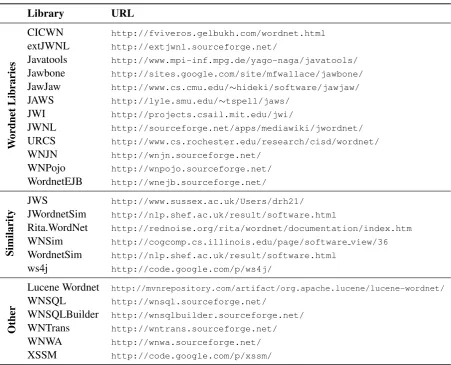
A Java developer seeking to access the Prince-ton Wordnet is faced with a bewildering array of choices: there are no fewer than 12 Java li-braries that provide off-the-shelf access to Word-net data, each with various combinations of fea-tures and performance. In addition to these 12 libraries, there are also at least 12 additional li-braries1that, while not providing direct access to
Wordnet data themselves, provide functions such as similarity metrics and deployment of Wordnet data to database servers. In this paper I compare, contrast, and evaluate each of the 12 libraries2
that provide direct access to the Princeton Wordnet data, so as to help Java developers find the library
1See Table 6 for a list of all libraries and their URLs. 2I have made my best effort to be as complete as possi-ble in identifying libraries that support access to Wordnet. It is possible, however, that I have missed some more obscure libraries, especially libraries whose primary purpose is not Wordnet access but some other function.
that is right for their application. To my knowl-edge this is the first paper to attempt a thorough comparison of any of these libraries.
I proceed as follows. First I present the bottom line, which is a set of five deciding features most commonly encountered when using Wordnet in a Java. I then discuss other features that distinguish some libraries from the others. I present an assess-ment of what Wordnet data is accessible via which library, and which libraries are compatible with which Princeton Wordnet versions. I also evalu-ate the performance of each library on nine dif-ferent retrieval metrics, as well as the time to ini-tialize in-memory Wordnet dictionaries for those libraries that suport that function.
The code for reproducing the evaluation (in-cluding all required source code, copies of all the described libraries, and the various versions of Wordnet) is available online.3
While the software evaluated in this paper is ex-clusively for Java, and is limited to libraries avail-able at the time of writing that are designed for ac-cessing the original Princeton Wordnet, this work should be helpful to those who seek to evaluate other application programming interfaces (APIs) for interacting with Wordnet data. In particular the set of features identified here and the set of retrieval metrics should be of some use.
1 Deciding on a Library
Before discussing the feature and performance evaluation in detail I will lay out the bottom line: which library a developer should choose if your application falls into one of the common situations described below. First, I will outline which library a developer should choose if there are no particu-lar constraints. Next, I list five deciding features that, if an application needs that feature, will
termine which library the developer should choose (or which libraries there are to choose from).
Note that an application may have additional or alternate special requirements that are not ex-plicitely discussed here. If this is the case the developer should examine the tables and figures in this paper, as well as the project websites (Ta-ble 6), to determine what library provides the right combination of features and performance.
1.1 No Special Requirements
If there have no special requirements, then the li-brary a developer should choose is my own: JWI, the MIT Java Wordnet Interface. JWI is a ma-ture library, nearly five years old, and has demon-strated its stability and utility, having been down-loaded over 15,000 times in the past five years. It has the following nine advantages: (1) JWI sup-ports access to the widest array of information in the widest selection of Princeton Wordnet ver-sions (see Tables 2 and 3), plus has been tested on a number of Wordnet variants; (2) JWI uses the Wordnet files as they are distributed with no mod-ifications; (3) JWI provides both file-based and in-memory dictionary implementations, allowing you to trade off speed and memory consumption; (4) JWI sets no limit on the number of dictionaries that may be instantiated in each JVM; (5) JWI is high-performance, with top-ranked speeds on var-ious retrieval metrics and in-memory dictionary load time (see Tables 4 and 5 and Figure 1); (6) JWI has a small on-disk footprint and requires no additional Java libraries, no native dynamically-loaded libraries (dlls), and no configuration files; (7) JWI has extensive documentation, including Javadoc and a User’s guide with code examples; (8) JWI is open-source and distributed under a li-cense which allows it to be used for any purpose; and (9) JWI is being actively supported and devel-oped by myself.
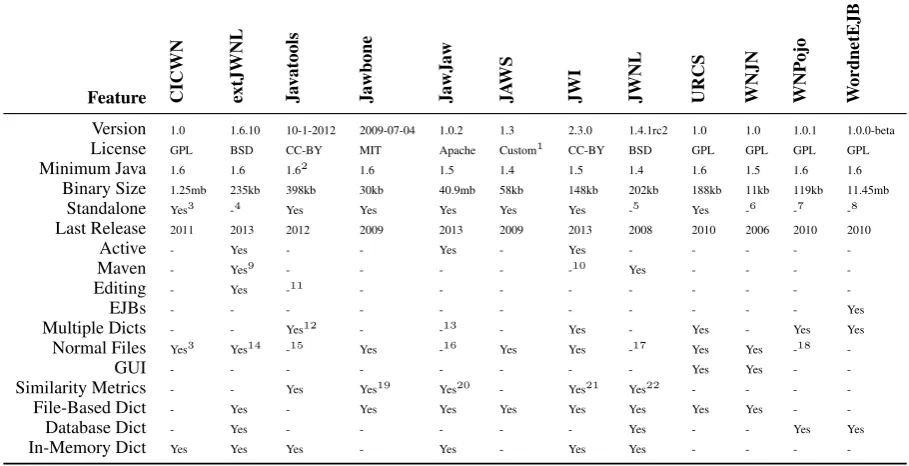
There are, however, at least five deciding fea-tures that, if an application requires them, will po-tentially lead to another library. These features are listed below (and are included in Table 1).
1.2 Similarity Metrics
The availability of similarity metrics is the most common deciding feature, as many developers want to use Wordnet not per se, but so as to
measure the semantic similarity between words. JWNL has the most similarity metrics to choose from, with at least three different compatible
li-braries providing this function: RitaWN, WNSim, and WordnetSim.
Choosing JWNL, however, entails a few penal-ties: First, JWNL requires a notoriously confus-ing and error-prone external configuration file; second, JWNL depends on an external library, Apache Commons Logging; third, JWNL follows the singleton dictionary model, in that it only al-lows one dictionary to be open at a time; finally, JWNL has rather poor performance relative to other libraries. If these factors outweigh the posi-tives of having the widest array of similarity met-rics, then there are four other libraries that have some measure of similarity metric support: Java-tools, Jawbone, JawJaw, and JWI.
1.3 Editing
If your application depends on being able to edit the Wordnet data, there is only option: extJWNL. This library is a re-implementation of JWNL for Java 1.5, copying much of the same source code, and so it suffers from the same problems as JWNL as described above, with the additional caveat that has an additional dependency: a custom Map im-plementation.
1.4 Maven
If an application’s build process uses Maven, and the project absolutely requires that dependent li-braries be available in the Maven repository, then extJWNL is the only choice.4 As noted above,
extJWNL suffers from a number of problems.
1.5 Retired Java Versions
Java is backward-compatible, meaning libraries compiled on older Java versions will still run under newer versions, but it is not forward-compatible: libraries compiled with newer com-pilance levels will not run in older JVMs. If an ap-plication requires libraries that will run under Java 1.4, then the developer should choose JWNL5. If
an application requires Java 1.5, then the devel-oper should choose JWI6.
4Some versions of JWNL and JWI are available in the Maven repository. However, publishing artifacts to the repos-itory is not currently a part of the JWI build process, and therefore there is no guarantee that future versions will be available there.
5JAWS will also run under 1.4, but lacks significantly in features and performance.
Feature CICWN extJWNL Javatools Jawbone JawJ
aw
JA
WS
JWI JWNL URCS WNJN WNP
ojo
W
ordnetEJB
Version 1.0 1.6.10 10-1-2012 2009-07-04 1.0.2 1.3 2.3.0 1.4.1rc2 1.0 1.0 1.0.1 1.0.0-beta License GPL BSD CC-BY MIT Apache Custom1 CC-BY BSD GPL GPL GPL GPL
Minimum Java 1.6 1.6 1.62 1.6 1.5 1.4 1.5 1.4 1.6 1.5 1.6 1.6
Binary Size 1.25mb 235kb 398kb 30kb 40.9mb 58kb 148kb 202kb 188kb 11kb 119kb 11.45mb Standalone Yes3 -4 Yes Yes Yes Yes Yes -5 Yes -6 -7 -8
Last Release 2011 2013 2012 2009 2013 2009 2013 2008 2010 2006 2010 2010
Active - Yes - - Yes - Yes - - - -
-Maven - Yes9 - - - - -10 Yes - - -
-Editing - Yes -11 - - - - - - - -
-EJBs - - - Yes
Multiple Dicts - - Yes12 - -13 - Yes - Yes - Yes Yes
Normal Files Yes3 Yes14 -15 Yes -16 Yes Yes -17 Yes Yes -18
-GUI - - - Yes Yes -
-Similarity Metrics - - Yes Yes19 Yes20 - Yes21 Yes22 - - -
-File-Based Dict - Yes - Yes Yes Yes Yes Yes Yes Yes -
-Database Dict - Yes - - - Yes - - Yes Yes
In-Memory Dict Yes Yes Yes - Yes - Yes Yes - - -
-Table 1: Information on and supported features of each library. License
1JAWS license is similar to the MIT License.
Minimum Java
2Javatools requires a 64-bit JVM to load all supported pointers into memory.
Standalone
3CICWN requires Wordnet files to be placed in a particular sub-directory, plus a file containing a list of prepositions to use the
plain Wordnet functionality; it requires additional libraries and data files to use the full stemming functionality.
4extJWNL requires an external properties file, Apache Commons Logging, and a custom Map implementation. 5JWNL requires Apache Commons Logging.
6WNJN requires a native library that depends on the wordnet version in use. The native library is available in for Windows and
Linux 32-bit, but would have to be re-compiled using C++ for other platforms.
7WNPojo requires approximately 14 supporting libraries.
8WordnetEJB requires a Database server and a Java Application server deployed with the WordnetEJB implementation.
Maven
9extJWNL versions 1.5.0 to 1.5.3 and 1.6.0 to 1.6.10 are available in the Maven repository. 10JWI Versions 2.2.1, 2.2.2, and 2.2.3 are available in the Maven repository.
Editing
11Javatools allows you to remove synsets from the in-memory dictionary only.
Multiple Dictionaries
12Javatools allows multiple dictionaries to be instantiated, but each dictionary only captures one relation. 13JawJaw only allows single dictionary to be opened for the life of each JVM.
Normal Files
14extJWNL in-memory dictionary uses special files that must be compiled from the normal Wordnet files. 15Javatools uses the Prolog-formatted Wordnet files.
16JawJaw uses an sqlite3 file, generated from the Japanese Wordnet files.
17JWNL’s in-memory dictionary implementation requires special files that must be compiled separately from the Wordnet files. 18WNPojo requires the normal Wordnet files to be processed and loaded into a relational database.
Similarity Metrics
19Jawbone has similarity metrics via the RitaWN library. 20JawJaw similarity metrics are provided by the WS4J library.
[image:3.595.71.526.112.345.2]1.6 Enterprise Java
Finally, if an application absolutely requires that Wordnet data be accessible via an Enterprise Java Bean (EJB), the only out-of-the-box choice is WordnetEJB, which provides all the tools to de-ploy an EJB that provides access to Wordnet onto a Java application server. Unfortunately, given WordnetEJB’s dismal performance and difficulty of use, one is probably better off implementing one’s own EJB by wrapping another library.
2 Features and Information
I expand now on other features of the libraries which, while not necessarily decisive, are worthy of consideration when other factors do not compel your choice.
2.1 Features
As noted, Table 1 shows the basic list of features, which was constructed by taking the union of all features7 for all libraries. I describe in this
sec-tion those not yet discussed. A dash in a particu-lar cell means that I determined, either by reading the documentation or the code, that the library did not support that feature. It is important to under-stand that I consider here only out-of-the-box fea-tures and compatibility: because the source code for each library is available, an enterprising devel-oper could certainly modify any of these libraries to provide any of the lacking features. Most devel-opers, however, will not be willing or able to invest the time required for this, and thus are restricted to the features provided.
Binary Size This feature indicates the size of the binary jar file on disk. This number does not in-clude the size of any required dependencies or ex-ternal files, and does not include the size of the Wordnet data files. The size of the libraries ranges dramatically: from a mere 11kb for WNJN to 40.9mb for JawJaw. JWI clocks in at a quite mod-est 202kb, which is approximately the median of the range.
Standalone Whether or not the library requires additional Java libraries or external resources to run (other than the Wordnet files themselves). In certain cases, such as WNPojo, these external li-braries are extensive: at least 14, comprising over 10mb of jar files.
7Note that due to space limitations I do not discuss in de-tail the ease of use of the various APIs.
Perhaps the most pernicious requirements are those for the JWNL/extJWNL pair and WNJN. Both JWNL and extJWNL require an external configuration file (in XML format) that sets vari-ous properites of the singleton dictionary. These parameters cannot be set programmatically, and the file is not well documented, which leads to quite a bit of consternation in the use of these li-braries.
WNJN, on the other hand, is a JNI interface to a native dll. Using WNJN thus means that one looses the platform-independence so prized in Java (unfortunately for not much gain: WNJN is impoverished both in features and performance compared to other libraries).
JWI is especially easy to use: it requires no ex-ternal libraries or files to run (other than the Word-net files themselves), its out-of-the-box defaults are suitable to most applications, and any configu-ration required can be done programmatically. Last Release The year when the most current version was released. JWI is one of only three li-braries that saw an update in 2013, the year this paper was written.
Active Whether or not the project appears to be under active development. The last release year, along with indications of activity on the project’s webpage or correspondence with the developer, were used to determine this feature.
Multiple Dictionaries Heredictionaryrefers to
a Java object which manages access to the Word-net data. This feature indicates whether or not multiple dictionaries can be open at the same time. This, for example, would be useful in a context where you want simultaneous access to different Wordnet versions. Many of the Wordnet libraries have, unfortunately, adopted the singleton design pattern, where only one Wordnet dictionary may be instantiated at a time. Fortunately, most of these libraries do allow the dictionary to be closed and a new dictionary to be opened.8 JWI allows any
number of dictionaries to be open simultaneously. Normal Files Whether or not the library uses the normal Wordnet files as distributed. Some li-braries require an unusual format (e.g., the Prolog versions of the files), or require the files to be pro-cessed in some way before the library can be used to access the data. JWI uses the Wordnet files as provided.
GUI Whether or not the library provides a graph-ical user interface (GUI) to interact with Wordnet data. Only two libraries, URCS and WordnetEJB, provide a GUI.
File-based Dictionary Whether or not the li-brary provides a dictionary implementation that reads Wordnet information directly from the files when requested. Four libraries do not provide such an implementation: CICWN and Javatools, which provide in-memory implementations only; and WNPojo and WordnetEJB, which use a database-backed implementation.
Database-backed Dictionary Whether or not the library provides a dictionary implementation that retrieves Wordnet data from a database server. JWI does not provide database-backed access, but four libraries do: JWNL, extJWNL, WNPojo, and WordnetEJB.
In-Memory Dictionary Whether or not the li-brary provides a dictionary implementation that loads Wordnet information completely into mem-ory. These implementations allow for extremely fast data access speeds, at the price of initialization time (see Figure 1). JWI provides an in-memory dictionary implementation.
2.2 Accessible Data
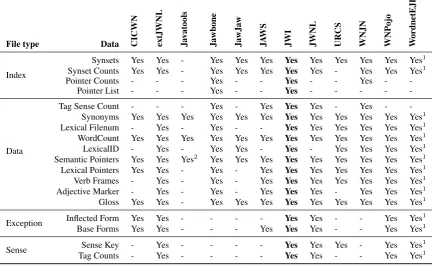
Each library provides access to a different sub-set of the information contained in Wordnet. In-formation in Wordnet is stored across four differ-ent types of files: indexfiles,datafiles,exception
files, and the sense.index file. Each Wordnet
li-brary provides access to various subsets of the in-formation contained in Wordnet, and this is cap-tured in Table 2. The only library that provides complete access to all the Wordnet data is JWI, although JWNL, extJWNL, WNPojo, and Word-netEJB all come close.
2.3 Supported Wordnet Versions
Table 3 shows which libraries are compatible with which Wordnet versions. Most libraries support Princeton Wordnet versions 1.6 and above. No li-brary supports Wordnet 1.5, and no lili-brary sup-ports access to the Wordnet 1.6 cousin files or 3.1 stand-off annotations.
The final row in Table 3 indicates known com-patibility with other Princeton Wordnet variants. JWI is the only library I know for sure that sup-ports Wordnet variants, namely, the Stanford Aug-mented Wordnets (Snow et al. 2006). Other li-braries can probably support Princeton Wordnet
variants that conform to the Wordnet file specifi-cations, and so the question mark only indicates that, to my knowledge, compatibility has not been demonstrated or documented.
3 Performance Evaluation
In addition to the features listed above, I also eval-uated the performance of each library under nine different retrieval metrics (as applicable). I wrote a standard test harness that ran each library through its paces in exactly the same environment.9 For
those libraries that provide an in-memory dictio-nary implementation, I also measured how long it took for that implementation to load Wordnet into memory.
3.1 Retrieval Times
I measured three different types of retrieval met-rics. First, I measured the speed of iteration over the four main object types (corresponding to the four file types). For index files, for example, I measured the average time for the dictionary to it-erate over all index words in Wordnet. Second, I measured the speed of retrieval for individual ob-jects of the four different types, given the mini-mally necessary identifying information. For in-dex files, for example, I measured the average time to retrieve an index word given a lemma and part of speech. Third, I measured the time to iter-ate across all index words and retrieve the synsets listed in those index words.
Not every library supports all nine different types of retrieval: Tables 4 and 5 show which braries support which retrieval type. The only li-braries that support every type of retrieval are JWI and WNPojo. For retrieval of individual objects, JWI outperforms WnPojo by a factor of 10. For iteration over object types, JWI and WNPojo are approximately equivalent, except for iteration over synsets by index words, where JWI outperforms WNPojo by a factor of 25.
A note on CICWN: I include CICWN’s retrieval times even though the library does not provide
File type Data CICWN extJWNL Javatools Jawbone JawJ
aw
JA
WS
JWI JWNL URCS WNJN WNP
ojo
W
ordnetEJB
Index
Synsets Yes Yes - Yes Yes Yes Yes Yes Yes Yes Yes Yes1
Synset Counts Yes Yes - Yes Yes Yes Yes Yes - Yes Yes Yes1
Pointer Counts - - - Yes - - Yes - - Yes - -Pointer List - - - Yes - - Yes - - - -
-Data
Tag Sense Count - - - Yes - Yes Yes Yes - Yes - -Synonyms Yes Yes Yes Yes Yes Yes Yes Yes Yes Yes Yes Yes1
Lexical Filenum - Yes - Yes - - Yes Yes Yes Yes Yes Yes1
WordCount Yes Yes Yes Yes Yes Yes Yes Yes Yes Yes Yes Yes1
LexicalID - Yes - Yes Yes - Yes - Yes Yes Yes Yes1
Semantic Pointers Yes Yes Yes2 Yes Yes Yes Yes Yes Yes Yes Yes Yes1
Lexical Pointers Yes Yes - Yes - Yes Yes Yes Yes Yes Yes Yes1
Verb Frames - Yes - Yes - Yes Yes Yes Yes Yes Yes Yes1
Adjective Marker - Yes - Yes - Yes Yes Yes - Yes Yes Yes1
Gloss Yes Yes - Yes Yes Yes Yes Yes Yes Yes Yes Yes1
Exception Inflected FormBase Forms YesYes YesYes -- -- -- -Yes YesYes YesYes -- -- YesYes YesYes11
[image:6.595.82.515.104.369.2]Sense Tag CountsSense Key -- YesYes -- -- -- -- YesYes YesYes -Yes -- YesYes YesYes11
Table 2: Wordnet data accessible from each library.
1WordnetEJB returns all data as XML documents: it provides no Java API for accessing data within an index word, word,
synset, sense entry, or exception entry record.
2Javatools only supports some semantic pointer types.
Version CICWN extJWNL Javatools Jawbone JawJ
aw
JA
WS
JWI JWNL URCS WNJN WNP
ojo
1
W
ordnetEJB
1
1.6 Yes Yes - Yes - Yes Yes Yes Yes Yes Yes Yes 1.7 Yes Yes - Yes - Yes Yes Yes Yes Yes Yes Yes 1.7.1 Yes Yes Yes Yes - Yes Yes Yes Yes Yes Yes Yes 2.0 Yes Yes Yes Yes - Yes Yes Yes Yes Yes Yes Yes 2.1 Yes Yes Yes Yes - Yes Yes Yes Yes Yes Yes Yes 3.0 Yes Yes -2 Yes Yes Yes Yes Yes Yes Yes Yes Yes
3.1 Yes Yes - Yes - Yes Yes Yes Yes Yes Yes Yes
[image:6.595.126.471.498.650.2]Other ? ? ? ? - ? Yes ? ? ? ? ?
Table 3: Versions of the Princeton Wordnet supported by each library. No library supports version 1.5, version 1.6 cousin files, or the 3.1 stand-off files.
1WNPojo/WordnetEJB do not provide pre-compiled Wordnet database images other than for Wordnet 3.1 for MySQL; other
Wordnet versions require the user to compile the Wordnet files into the database image (and load it into the appropriate database server) using the WNSQLBuilder project.
a file-based dictionary implementation. This is not a completely direct comparison, however, as CICWN requires all of WordNet be loaded into memory (with associated memory footprint and initialization time penalties). It is interesting to note, however, that CICWN’s in-memory mance is comparable to JWI’s file-based perfor-mance, with retrieval times around the neighbor-hood of 10 microseconds. JWI’s in-memory re-trieval significantly outperforms CICWN (I do not show those results here for lack of space).
3.2 In-Memory Dictionaries
Six libraries support in-memory dictionary imple-mentations. Of them, JawJaw supports only Word-net 3.0. JWNL, extJWNL and JawJaw all have av-erage load times (the time to load the Wordnet data fully into memory) in the 15-20 second range. Of the remaining three, Javatools and CICWN do not support access to the full range of Wordnet data. Only JWI has a load time of a few seconds and supplies complete access to all Wordnet data.
Retrieval of. . . (µs) WordnetEJB JAWS URCSW
ordnet
extJWNL JWNL Jawbone WNJN WNP
ojo
JawJ
aw
JWI CICWN
Index Word 506ms 4.1ms 2662.5 1.5ms 1.5ms - 253.3 184.5 67.4 12.3 22.9 Synset - - - 3.3ms 479.6 768 228.6 226.6 61.9 7.1 4.1 Word-by-Sense-Key - - - 11.1ms - - - 176.1 - 17.2
-Exception Entry - 2.1 - 545.3 537.9 - - 138.5 - 16.1 1.7
Table 4: Average time to retrieve an object of the named type (from Wordnet 3.0) using a file-backed dictionary, for libraries that support this functionality. Times are in microseconds (µs), unless otherwise noted (ms = milliseconds).
Iteration Over. . . (ms) extJWNL JWNL Jawbone WNP
ojo
1
JWI CICWN
2
Index Words 16.4s 16.4s 192 393 296 -Synsets 6.4m 56.1s - 273 798 1
Words via Sense Keys - - - 635 141
-Exception Entries 271 274 - 10 4 1
Synsets by Index Words 15.7m 2.1m 5.6m 51.0s 1.8s
-Table 5: Average time to iterate over all objects of the named type (from Wordnet 3.0) using a file-backed dictionary, for libraries that support this functionality. Times are in milliseconds, unless otherwise noted (s = seconds, m = minutes).
1WNPojo uses a database-based dictionary implementation. 2CICWN only provides an in-memory dictionary implementation.
4 Conclusion
For an application without special constraints, most Java developers should use JWI to access Wordnet, for three reasons. First, it is among the easiest to use: it has extensive documention, a small disk footprint, requires no special configura-tion or supporting libraries, and is completely con-figurable programmatically. Second, it supports the most Wordnet versions and variants, and its API exposes all available Wordnet data. Third, it has top-tier performance, often outperforming other Java libraries by factors of 5 to 100.
Acknowledgments
The preparation of this article was supported by DARPA under grant D12AP00210.
References
Rion Snow, Daniel Jurafsky, and Andrew Y. Ng. 2006. Semantic taxonomy induction from heterogenous
evidence. InProceedings of the 44th Annual
17.40
16.70 16.50
6.10
15.70a
8 10 12 14 16 18 20
al
iz
n
Ti
m
e
(s
ec
on
ds
)
3.60
1.30
0.50b
0 2 4 6
JWNL extJWNL JawJaw Javatools JWI CICWN
In
-Me
m
or
y
[image:8.595.84.521.74.271.2]I
Figure 1: Times to load Wordnet into memory for the libraries that support in-memory dictionaries.
aJawJaw has a slightly lower load time when the data file is already present in the temporary directory. bJavatools has a lower load time when loading only synsets, with no pointers.
Library URL
W
ordnet
Libraries
CICWN http://fviveros.gelbukh.com/wordnet.html extJWNL http://extjwnl.sourceforge.net/
Javatools http://www.mpi-inf.mpg.de/yago-naga/javatools/ Jawbone http://sites.google.com/site/mfwallace/jawbone/ JawJaw http://www.cs.cmu.edu/∼hideki/software/jawjaw/ JAWS http://lyle.smu.edu/∼tspell/jaws/
JWI http://projects.csail.mit.edu/jwi/
JWNL http://sourceforge.net/apps/mediawiki/jwordnet/ URCS http://www.cs.rochester.edu/research/cisd/wordnet/
WNJN http://wnjn.sourceforge.net/
WNPojo http://wnpojo.sourceforge.net/ WordnetEJB http://wnejb.sourceforge.net/
Similarity
JWS http://www.sussex.ac.uk/Users/drh21/
JWordnetSim http://nlp.shef.ac.uk/result/software.html
Rita.WordNet http://rednoise.org/rita/wordnet/documentation/index.htm WNSim http://cogcomp.cs.illinois.edu/page/software view/36 WordnetSim http://nlp.shef.ac.uk/result/software.html
ws4j http://code.google.com/p/ws4j/
Other
Lucene Wordnet http://mvnrepository.com/artifact/org.apache.lucene/lucene-wordnet/ WNSQL http://wnsql.sourceforge.net/
WNSQLBuilder http://wnsqlbuilder.sourceforge.net/ WNTrans http://wntrans.sourceforge.net/
WNWA http://wnwa.sourceforge.net/
XSSM http://code.google.com/p/xssm/
[image:8.595.73.525.331.696.2]