http://www.scirp.org/journal/jamp ISSN Online: 2327-4379 ISSN Print: 2327-4352
Phase Space Path Integral Representation for
Wigner Function
A. S. Larkin1,2, V. S. Filinov1
1Joint Institute for High Temperatures, Russian Academy of Sciences, Moscow, Russia 2Moscow Institute for Physics and Technology, Moscow, Russia
Abstract
Quantum interference and exchange statistical effects can affect the momen-tum distribution functions making them non-Maxwellian. Such effects may be important in studies of kinetic properties of matter at low temperatures and under extreme conditions. In this work we have generalized the path integral representation for Wigner function to strongly coupled three-dimensional quantum system of particles with Boltzmann and Fermi statistics. In sug-gested approach the explicit expression for Wigner function was obtained in harmonic approximation and Monte Carlo method allowing numerical calcu-lation of Wigner function, distribution functions and average quantum values has been developed. As alternative more accurate single-momentum approach and related Monte Carlo method have been developed to calculation of the distribution functions of degenerate system of interacting fermions. It allows partially overcoming the well-known sign problem for degenerate Fermi sys-tems.
Keywords
Wigner Function, Path Integral, Quantum Monte Carlo, Momentum Distribution
1. Introduction
Computer simulation is one of the main tools in studies of thermodynamic properties of many-particle strongly coupled systems under extreme conditions. Some of the most powerful numerical methods for simulation of quantum sys-tems are Monte Carlo methods, based on path integral (PIMC) formulation of quantum mechanics [1]. These methods use path integral representation for partition function and thermodynamic values such as average energy, pressure, heat capacity etc. PIMC methods are widely used for studying dense hydrogen plasma [2], electron gas in metal [3] [4][5], electron-hole plasma [6] in semi-How to cite this paper: Larkin, A.S. and
Filinov, V.S. (2017) Phase Space Path Integral Representation for Wigner Func-tion. Journal of Applied Mathematics and Physics, 5, 392-411.
https://doi.org/10.4236/jamp.2017.52035
Received: December 27, 2016 Accepted: February 12, 2017 Published: February 16, 2017
Copyright © 2017 by authors and Scientific Research Publishing Inc. This work is licensed under the Creative Commons Attribution International License (CC BY 4.0).
http://creativecommons.org/licenses/by/4.0/
conductors, superfluidity [7][8][9] and even quark-gluon plasma [10][11][12]. Unfortunately PIMC methods cannot cope with problem of calculation of av-erage values of arbitrary quantum operators in phase space or momentum dis-tribution function, while this problem may be central in studies of kinetic prop-erties of matter. Quantum effects may strongly disturb the momentum Maxwel-lian distribution function [13] and are important in studies of kinetic properties of matter at low temperatures and under extreme conditions, when particles are strongly coupled and perturbative methods cannot be applied. The mentioned before PIMC methods or even recently developed “Configuration Path Integral Monte Carlo” approach [4][5][14] up to now cannot also solve kinetic problem. The Wigner formulation of quantum mechanics in phase space allows more natural considering not only kinetic but also thermodynamic problems. Methods for phase space treatment of single-particle quantum dynamics in Wigner ap-proach in microcanonical ensemble were proposed in [15] [16] [17][18] [19]. Recently a generalization of these one-body Wigner Monte Carlo methods to the many-body distinguishable particles has been done in [20]. Wigner dynamics of relativistic particle was studied in [21]. However for theoretical studies of kinetic properties the ab initio many particle approaches in phase space are required.
In this paper we continue developing the ab initio path integral Monte Carlo approach in phase space by using the basic ideas suggested before in [22]. Here we have generalized the path integral representation for Wigner function to three-dimensional many-particle quantum system with Boltzmann and Fermi statistics. Here we present also alternative single momentum approach for cal-culations of momentum distributions and quantum observables. This approach allows avoiding harmonic approximation at consideration of degenerate systems of interacting fermions and partially overcoming the well-known sign problem for degenerate Fermi systems. These two methods were tested on some simple models like particles in external potential field and ideal Fermi gas.
2. Wigner Function in Canonical Ensemble
Average value of arbitrary quantum operator Aˆ can be written as Weyl’s sym-bol A p q
(
,)
averaged over phase space with Wigner function W p q(
, ; ,β V)
[23]:
(
)
(
) (
)
3 3
3
d d
ˆ , , ; , ,
2π
N N
N
p q
A =
∫
A p q W p q β V (1)
where the Weyl symbol of operator Aˆ is :
(
)
(
)
3
3
d ˆ
, 2 2 .
2π N
isq N s
A p q =
∫
e p+s A p−s (2)
Weyl symbols for common operators like pˆ, qˆ, ˆ2
(
)
(
)
1 3(
)
, ; , , d N i p 2 , 2; ,
W p q β V =Z β V −
∫
ξe ξρ q−ξ q+ξ β (3)where Z
(
β,V)
is partition function of canonical ensemble of N particles, 1kTβ = is inverted temperature, V—volume, p=
(
p p1, 2,,pN)
,(
1, 2, , N)
q= q q q ,
1
N a a a
pq=
∑
=p q etc. Hamiltonian of the system consists of kinetic and potential parts: Hˆ =Kˆ+Uˆ, where 21
ˆ N ˆ 2
a a
K =
∑
= p m ,(
1 2)
ˆ ˆ ˆ, , ,ˆ
N
U =U q q q —potential energy of particles, interacting with each other
and/or external field. For simplicity we will consider system containing identical particles of mass m. Generalization on systems with several kinds of particles is direct. The Wigner function W p q t
(
, ;)
being the analogue of the classicaldis-tribution function in the phase space has a wide range of applications in quan-tum mechanics and statistics.
For spinless bosons or fermions the density matrix in canonical ensemble looks like
(
)
( )
ˆ(
)
2 , 2; 1P 2 H 2 ,
P
q q q e β P q
ρ −ξ +ξ β =
∑
± −ξ − +ξ(4)
where symbol P denotes particle permutations, +1 corresponds to Bose
sta-tistics, −1—to Fermi statistics. Since operators of kinetic and potential energy
in Hamiltonian do not commutate, the exact explicit analytical expression for Wigner function does not exist. To overcome this difficulty let us represent Wigner function similarly to path integral representation of the partition func-tion [1] [24]. So we represent statistical operator Hˆ
e−β as product of large
number
( )
M of operators e−Hˆ formally related to high temperature(
=β M)
and write down Wigner function in form of multiple integral of theproduct of the high temperature density matrices:
(
)
(
)
( )
0
1 3 3 1 3 1
2 1
ˆ 1
0 2
, ; , , d d d
.
M
N i p N N M
q P q M
m H m
m q q
W p q V Z V e q q
q e q
ξ
ξ
ξ
β β − ξ −
= + − − + = = − = ×
∫
∫
∏
(5)
In the limit →0 the high temperature density matrices can be easily
cal-culated with accuracy up to
( )
2O [1]:
(
)
2( )
ˆ 1 1 2 1
exp π ,
m H m m m m
q e− q + ≈λ− − λ− q + −q − U q
(6)
where we use abbreviation
(
1)
2(
1)
2 1N
m m m m
a a
a
q + −q =
∑
= q + −q , and2
2π m
λ = is the thermal wavelength at high temperature M T⋅ . Thus expression for Wigner function takes the form:
(
)
(
)
( )
(
)
( )
( )
( )
0
1 3 3 1 3 1
2 2 1 2 1 2 0 2
, ; , , d 1 d d
1
exp π ,
M P
N ip N N M
P
q P q M
m m m
m
q q
W p q V Z V e q q
M
q q U q
M
ξ
ξ
ξ
β β ξ
β λ − − = + − + = = − = × ± × − − +
∑
∫
∫
∑
(7)where λ= 2π2β m is the thermal wavelength at temperature
T. In
con-tinuous limit M → ∞ this expression turns into path integral over trajectories
( )
di-mensionless parameter, which may be interpreted as “imaginary time” [1]:
(
)
(
)
( )
( ) (( ) ( ))( )
( )
(
( )
)
1 2
1 3 3
0 2
2 1
2 0
, ; , , d 1
exp π d .
π
q P q P
N i p N
P q q
W p q V Z V e D q
q
U q
ξ ξ
ξ
β β ξ τ
τ β τ τ λ = + − = − = ± × − +
∑
∫
∫
∫
(8)
Measure of the path integral depends on Fourier variables ξ and positions
q. To get rid this dependence we change variables from trajectories q
( )
τ toclosed dimensionless trajectories z
( )
τ :( )
( ) (
1)(
2)
(
2 .)
q τ =λ τz + −τ q−ξ +τP q+ξ
(9)
Taking into account new boundary conditions z
( ) ( )
0 =z 1 =0 we obtain thedesired path integral representation of Wigner function:
(
)
(
)
( )
( ) ( ) ( ) ( )( )
( ) ( ( )) 2 2 1 2 0 π 2 2 1 3 π d π 30 1 0
, ; , , d 1
,
P q q
P N i p
P
z U q
N
z z
W p q V Z V e e
D z e
ξ ξ
ξ λ
β
τ τ τ
β β ξ
τ − + − − − − + = = = ± ×
∑
∫
∫
∫
(10)
where q
( )
τ is given by (9), symbol P denotes permutation of identicalpar-ticles and Dz
( )
τ means integration over trajectories. In fact, this expressionmeans that Wigner function is Fourier transform over ξ of symmetrized or antisymmetrized density matrix, which is represented by path integral. Unfor-tunately this Fourier transform cannot be calculated analytically in general case even for non-interacting bosons or fermions.
3. Harmonic Approximation
Momenta p in expression (10) for Wigner function are connected with other
variables through 3N-dimensional Fourier transform, which is not integrable
analytically or numerically in general case. Exclusions are the linear or harmonic potentials, when power of variable ξ is not more than two. So let us take the approximation for potential U q
( )
arising from its expansion into series. Forsimple estimations let us consider only term related to identical permutation de-scribing system with Boltzmann statistics. Thus in harmonic approximation we expand potential energy into Taylor series up to second order in ξ:
( )
(
)
(
)
(
( )
)
(
)
(
( )
)
(
)
(
( )
)
, , 2 2 , , , ,1 2 1 2
1
1 2 ,
2
a i
a i
a i b j
a i b j
U z q
U z q U z q
q
U z q
q q
λ τ λ τ ξ τ λ τ τ ξ
λ τ τ ξ ξ
∂ + + + − ≈ + + − ∂ ∂ + + − ∂ ∂ (11)
where we denote summation over repeated indices a b, from 1 to N and i j,
(
)
(
)
( ) ( )( )
{
( )
( )
}
( )
( )
( )
( )
( )
( )
( )
1 3
0 1 0
2 , , , , , , 2 1 2 , , , , , ; ,
, exp π π ,
exp , π , , ,
4π
det , cos , , .
N z z
a i ai bj b j a i ai bj b j
ai bj a i ai bj b j
W p q V
Z V D z K z P q z
p q z p J q z q z J q z
q z p q z J q z
β
β τ τ τ
λ χ τ τ χ τ τ
λ
χ τ χ τ τ
− = = = − − × − + ×
∫
(12)Here we introduced scalar functionals K and P, as well as functionals Ja i,
and χai bj, of first and second potential derivatives having form of 3N - dimen-sional vector and matrix correspondingly. They depends on trajectories z
( )
τand positions q:
( )
1 2( )
0d ,
K z τ =
∫
τz τ( )
1(
( )
)
0
, d ,
π
P q z τ =β
∫
τU q+λ τz( )
1(
)
(
( )
)
, 0
,
, d 1 2 ,
2π
a i
a i U
J q z q z
q
βλ
τ = τ τ − ∂ +λ τ
∫
∂( )
(
)
1 2 2 2 , 0 , ,, d 1 2 .
2π
ai bj ab ij
a i b j U q z
q q
β βλ
χ τ δ δ τ τ
− ∂ = + − ∂ ∂
∫
Note that the first term in exponent (12) looks similarly to Maxwell distribu-tion in classical statistics. The major difference is in matrix χai bj, q z,
( )
τ andcosine which are equal to identity matrix and unit for non-interacting particles. This matrix and cosine provide correlation of particle momenta with each other and with their positions.
The expression for Wigner function (12) is obtained under assumption that potential energy U is expandable in Taylor series of second order ξ with a
good accuracy. Let us discuss the legality of such assumption in the simplest 1D case. Primarily, note that the exponent (10) contains variable ξ in three posi-tions. The first one is in Fourier term
(
ipξ )
, which makes momentacorre-lated with other dynamical variables. The second one is in gaussian-like term
(
πξ λ2 2)
. The third one is in integral term, where ξ is argument of potential:( ) (
)
(
)
1
0
dτβU q+λ τz +ξ τ−1 2
∫
. Gaussian term provides rapid decaying when ξincreases, so main contribution comes from ξ near π 1 2
0.6
− ≈ . Argument of potential function contains ξ multiplied on τ −1 2, which is modulo less than
0.5. Using mean value theorem, we can roughly get symbolic estimation of these integrals in exponent (10) as
( )
(
( )
)
(
)
( )
1 0 0 1 0 1 11 1 1
d ,
! 2 ! 1 2
n n
n n
n n n
U q U q
n q τ τ n n + q
+ −
∂ ∂
− =
∂
∫
+ ∂ (13)where x0 is certain point of trajectory. Numerical value of this integral rapidly decreases: when n=2, 4, 6 it equals 1 24, 1 1920 and 1 322560. Thus we
Numerical calculations for some potentials, done in this work, confirm this as-sumption.
For calculation of Aˆ we are going to use the harmonic approximation of
the Wigner function in path integral representation (12). For making use of the Monte Carlo method (MC) [3] we have to represent path integrals in discrete form of multiple integral like (7). As a result we obtain expression for MC calcu-lations in the following form:
(
)
(
) (
)
(
) (
)
1 1 1 1
1 1 1 1
, , , , , , , , , ˆ . , , , , , , , , M M w M M w
A p q f p q z z h p q z z
A
f p q z z h p q z z
− − − − ⋅ ⋅ = ⋅
(14)
Here brackets
(
1 1)
, , , , M
w
g p q z z − denote averaging of any function
(
1 1)
, , , , M
g p q z z − with positive weight w p q z
(
, , 1,,zM−1)
:(
)
(
)
(
)
1 1 3 3 1 1 1 1
1 1
, , , , d d d d , , , ,
, , , , ,
M N N M M
w
M
g p q z z p q z z g p q z z
w p q z z
− − − − = ×
∫
∫
(15)
while
(
)
(
)
(
)
2 1 1 , , , , , , 2 1 1 , , , 1 2 1 1 ,, , , , exp π π π ,
4π
, , , , cos ,
, , , , det .
M
a i ai bj b j a i ai bj b j
M
a i ai bj b j
M
ai bj
w p q z z p p J J K P
f p q z z p J
h p q z z
λ χ χ
λ χ χ − − − = − + − − = = (16)
4. Single-Momentum Approach
Now we are going to introduce another approach to calculation of momentum distribution functions and quantum averages. As it was discussed above, precise path integral representation (10) is useless for practice due to 3N-dimensional
Fourier transform, which cannot be calculated even for a few particles. However we can overcome this difficulty in many important cases.
Let us consider some operator A, whose Weyl symbol is a sum of equal
sin-gle-particle symbols:
(
,)
1(
,)
N
a a a
A p q =
∑
=a p q . Due to the fact that all particlesare identical, average values on ensemble of aˆ for arbitrary particles a and b are equal: aˆa = aˆb . Therefore we can use Weyl symbol N a⋅
(
( ) ( )
p1 , q1)
instead of 1
(
,)
N
a a a=a
∑
p q and integrate Wigner function over other momenta. Thus in single-momentum formalism:(
)
( )
(
)
3
3 3
1
1 1 1 1
3
d
ˆ d d , , , ; , .
2π N sm N
p
A =
∫
q q N A⋅ p W p q q β V (17)
Here we introduce single-momentum Wigner function as integral of
(
, ; ,)
W p q β V over all momenta except p1, which we will denote by p
fur-ther:
(
)
3 3(
)
1 2 1 1
, , , ; , d d , , , , , ; , .
sm N N N N
As momenta in definition of Wigner function appear only in Fourier trans-form eipa aξ , integrals on them gives delta functions
( )
a
δ ξ for a=2,,N.
This exterminates all ξa except ξ1, which now is denoted as simple ξ. Thus formula for single-momentum Wigner function is
(
)
3(
)
1 1
, , , ; , d i ; , , ; , ,
sm N N
W p q q β V =
∫
ξepξρ ξ q q β V (19)i.e. it is 3-dimensional Fourier transform of single-momentum density matrix:
(
)
(
)
[ ]
( ) ( )
( )
{
( )
( )
}
1 1
3 0 1 0
; , , ; , , ,
exp π π , , .
N
N
z z
V Z V D q
D z K z P q z
ρ ξ β β ξ
τ τ ξ τ
−
= = =
×
∫
− − q q
(20)
Here K is the same functional on trajectories as in (13), P and D are
poten-tial functional and determinant of permutations:
( )
(
( ) (
)
)
[ ]
(
(
) (
)
)
0
2
2
, , d 1 2 ,
π π
, det 2 2 .
a b
P q z U q z
D q q q
β β
ξ τ τ λ τ ξ τ
ξ ξ ξ
λ = + + − = − + − −
∫
(21)Such reasoning would not change if we calculate average value of operators of
the form 1
(
1)
ˆ N , , ,
a N
a
C=
∑
=c p q q or Bˆ=B(
q1,,qN)
. To summarize, insin-gle-momentum approach we are able to deal with quantum operators of partic-ular form only:
(
1)
(
1)
1
ˆ N ˆ ,ˆ, ,ˆ ˆ, ,ˆ ,
a N N
a
A c B
=
=
∑
p q q + q q (22) so average value of it is:(
)
(
)
(
)
3
3 3
1 1 1 1
3
d
ˆ d d , , , , , , ; , ,
2π N N sm N
p
A =
∫
q q A p q q W p q q β V (23)
with Weyl symbol depending only on first particle’s momentum
(
1)
(
1)
(
1)
:A , , , N = ⋅N c , , , N +B , , N
p p q q p q q q q . In fact many quantum
operators being interesting for statistical physics have such single-momentum form: Hamiltonian, kinetic and potential energy, pair correlations and correla-tions between position and momentum, momentum distribution function etc.
Now let us apply the basic ideas of this approach to the degenerate system of interacting fermions. In degenerate system average distance between fermions is lesser than the thermal wavelength λ and trajectories in path integrals (see (10), (9)) are strongly entangled. This is the reason that permutations can not strongly affect the potential energy βU
(
λ τz( ) (
+ −1 τ)(
q−ξ 2)
+τP q(
+ξ 2)
)
in comparison with the case of identical permutation.
So βU
(
λ τz( ) (
+ −1 τ)(
q−ξ 2)
+τP q(
+ξ 2)
)
can be presented as energyrelated to identical permutation βU
(
λ τz( )
+ +q ξ τ(
−1 2)
)
and smalldiffer-ence βU
(
λ τz( ) (
+ −1 τ)(
q−ξ 2)
+τP q(
+ξ 2)
)
−βU(
λ τz( )
+ +q ξ τ(
−1 2)
)
,which, for example, for 1D Coulomb system is of order
( )
(
)
( )
( )
π
U n Ry
n n
q
β λ λ β
λ λ λ
∂
≈
∂ , where n is 1D density of particles. Then
following simplification:
( ) (
)(
)
(
)
(
1 2 2)
(
( )
(
1 2)
)
U λ τz + −τ q−ξ +τP q+ξ ≈U λ τz + +q ξ τ− .
Now all permutations in (10) are connected with variables q and ξ and
can be beared out of the path integral 3N
( )
D z τ . Moreover, one can gather all
permutations into Slater determinant of N×N matrix:
(
)
(
)
(
(
) (
)
)
( ) ( )( )
( ) ( ( ) ( )) 1 2 0 2 1 3 2π d 1 2
π 3
0 1 0
π
, ; , , d det 2 2
. N i p
a b
z U z q
N z z
W p q V Z V e q q
D z e
ξ
β
τ τ λ τ ξ τ
β β ξ ξ ξ
λ τ − − + + + − = = = − + − − ×
∫
∫
∫
(24)
In conclusion of this section we consider practical application of the ap-proach. Making use of the Monte Carlo again we have to represent path integral for single-momentum density matrix (20) in discrete form, i.e.
(
; ,1 , N; ,V)
ρ ξ q q β in form of multiple integral over “intermediate quantum coordinates” 1 1
, , M
z z − . Firstly, by standard Monte-Carlo procedure we are
able to calculate Fourier preimage of averaged single-momentum operator Aˆ of form (22):
(
)
(
1(
)
(
)
1)
1
, , , , , ,
ˆ , ,
, , ,
sm
sm
N sm N w
sm N w
A f A f ξ ξ ξ ⋅
= p q q q q
p
q q
(25)
which depends on momentum p by Weyl symbol and ξ only. Here brackets
(
1 1)
, , , , ,
sm M
w
g pξ q z z − denote averaging of any function g with positive
weight
(
1 1)
, , , , M sm
w ξ q z z − :
(
)
(
)
(
)
1 1 3 1 1 1 1
1 1
, , , , , d d d , , , , ,
, , , , ,
sm
M N M M
w
M
g q z z q z z g q z z
w q z z
ξ ξ ξ − − − − = ×
∫
∫
p p
(26)
while
(
)
[ ]
( ) ( )( )
{
( )
( )
}
(
)
[ ]
1 1 30 1 0
1
, , , ,
, exp π π , , ,
, , , sign , .
M sm
N z z
sm N
w q z z
D q D z K z P q z
f D q
ξ
ξ τ τ ξ τ
ξ ξ − = = = = − − =
∫
q q (27)So we obtain Aˆ
(
p,ξ)
in form of ξ distribution function. Then we can doFourier transform over variable ξ numerically, using Fast Fourier Transform algorithms. After that it is easy to average expression over momenta to obtain desired average value Aˆ .
To calculate average values of simpler quantum operators like Hamiltonian containing single-momentum operator as separate term we can use easier way. The terms which do not depend on momentum can be calculated by averaging (25) over ξ without Fourier transform. The terms which are functions of p
can be calculated from single-momentum distribution function:
( )
3(
)
1
d N , , , ; , ,
p sm N
W p =
∫
qW p q q β V (28)(
; 1, , N; ,V)
ρ ξ q q β integrated over all positions q.
5. Numerical Results
Let us consider some results obtained by both approaches described above. To test the limits of applicability of harmonic approximation we have carried out calculation of thermodynamic values for single quantum particle in some strongly unharmonic potential fields. We have considered 1D and 3D cases
and applied single momentum approach to calculations of momentum distribu-tions. Finally, we tested single momentum approach on systems of non-inte- racting strongly degenerated fermions.
Single particle in one dimension As the first example we consider one par-ticle in 1D-power potential of the fourth order, i.e. unharmonic oscillator:
( )
2 42 4 ,
V− x =ax +cx (29)
where a and c are adjusted parameters of potential. When c=0 this
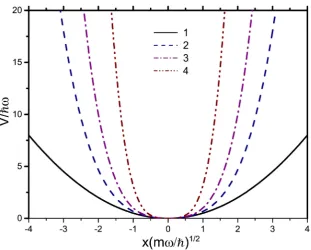
po-tential describes harmonic oscillator and formula (12) is exact. If c does not equal zero, oscillator is unharmonic and can be used for verification of the har-monic approximation. The Figure 1 shows potentials (29) for 2
0.5
a= mω and
different values of parameter c when anharmonicity is significant.
Left plot of Figure 2 shows dependence of full energy on inverted temperature for potential V2 4−
( )
x . Results of harmonic approximation are marked bysym-bols, while results of usual PIMC method are represented by curves. Results of both methods agree well with each other. When temperature is low (from
1.5
β ω = to β ω = 5) the energy tends to constant value, namely to the
[image:9.595.219.531.450.700.2]ground state energy E0.
Figure 1. Potential V2 4−
( )
x for a=mω2 2 and different values of unharmonicpara-meter c c: =0 (1), 2 3 6
c=mω (2), 2 3 2
c=mω (3) and 2 3
8 3
Right plot of Figure 2 shows dependence of squared energy on inverted tem-perature for potential V2 4−
( )
x . From analysis of this figure it follows thathar-monic approximation gives correct enough values of H2 even for the
ground state. Weyl’s symbol of ˆ2
H is polynomial of the 8 order, so the main contribution to H2 comes from “wings” of Wigner function calculated with
larger statistical error. This is the reason of some deviation of obtained results especially at low temperature. However ground state is reached earlier and this deviations are not important.
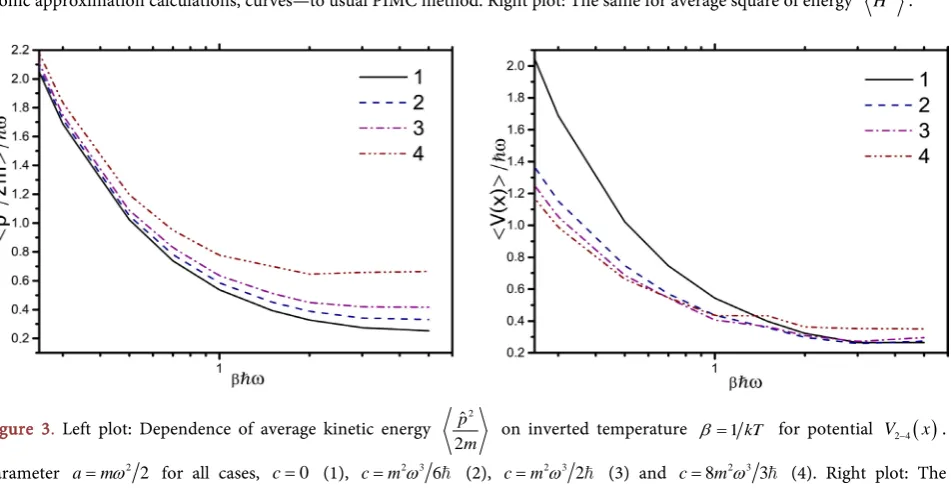
[image:10.595.61.543.209.420.2]Dependencies of average kinetic and potential energies on inverted tempera-ture are represented on the left and right plots of Figure 3. Note that usual PIMC method has encountered difficulties at calculation of these val-
Figure 2. Left plot: Dependence of average energy Hˆ on inverted temperature β=1kT for potential
( )
2 4
V− x . Parameters
2 2
a=mω for all cases, c=0 (1,2), 2 3 6
c=mω (3,4), 2 3 2
c=mω (5,6) and 2 3
8 3
c= mω (7,8). Symbols refer to har-monic approximation calculations, curves—to usual PIMC method. Right plot: The same for average square of energy ˆ2
H .
Figure 3. Left plot: Dependence of average kinetic energy ˆ2
2 p
m on inverted temperature β=1kT for potential V2 4−
( )
x . Parameter 22
a=mω for all cases, c=0 (1), 2 3 6
c=mω (2), 2 3 2
c=mω (3) and 2 3
8 3
c= mω (4). Right plot: The same for average potential energy ˆ2
[image:10.595.65.541.470.715.2]ues as it calculates derivatives of partition function Z
( )
β .As a second example we consider 1D-potential of the fourth order:
( )
(
(
) (
3)
4)
3 4 ,
V− x =E b x σ + xσ (30)
where 2 2
E= mσ is characteristic energy of potential. Dimensionless
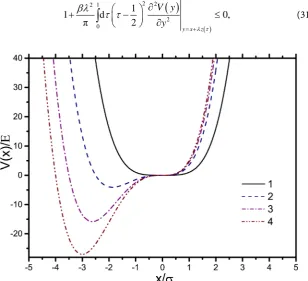
para-meter b specifies contribution of the cubic term. Figure 4 shows potentials
(30) for different values of this parameter. With gain of b the depth of the
po-tential well rapidly increases and the popo-tential well becomes asymmetric. Left plot of Figure 5 shows dependence of average energy on inverted tem-perature. As before symbols relate to harmonic approximation, while curves re-late to usual PIMC method. Good agreement between results of these methods is evident. With increasing parameter b the average energy becomes lower and
[image:11.595.224.533.415.696.2]approaches ground state energy, which is of order of the potential minimum (see
Figure 4).
Right plot of Figure 5 shows dependence of average squared energy Hˆ2
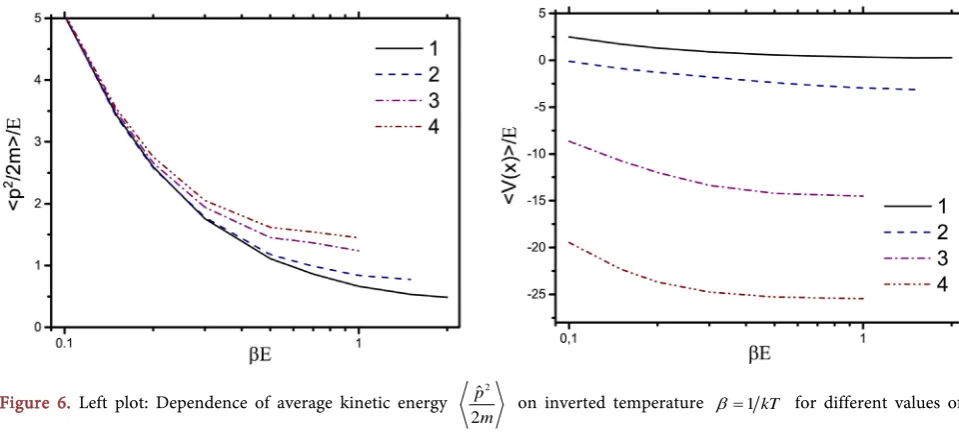
on inverted temperature. Dependencies of average kinetic and potential energies on inverted temperature are represented on left and right plots of Figure 6. One can see weak influence of parameter b on kinetic energy, while the potential
energy rapidly decrease when b gains. Thus contribution of potential energy
into the full energy is dominant at low temperature. At very low temperatures some points on left plot of Figure 5 are missed for large values of parameter b
when expression below for the most trajectories z
( )
τ becomes negative:( )
( ) 2 2
1 2
2 0
1
1 d 0,
π 2
y x z V y
y λ τ
βλ τ τ
= + ∂
+ − ≤
∂
∫
(31)Figure 4. Power potential V3 4−
( )
x for different values of parameter b b: =0 (1),5 3
Figure 5. Left plot: Dependence of average full energy Hˆ on inverted temperature β=1kT for different values of parame-ter b b: =0 (1, 2), b=5 3 (3, 4), b=7 3 (5, 6) and b=6 (7, 8). Right plot: The same for average square of energy ˆ2
H . Results have been obtained by harmonic approximation method and PIMC.
Figure 6. Left plot: Dependence of average kinetic energy ˆ2
2 p
m on inverted temperature β=1kT for different values of parameter b b: =0 (1), b=5 3 (2), b=7 3 (3) and b=6 (4). Right plot: The same for potential energy Uˆ . Results have obtained by harmonic approximation method and PIMC.
and functional χ
[ ]
x z, can be imaginary. This situation occurs at lowtemper-atures for potentials with negative second derivative like in potential (30). How-ever this happens at very low temperature when the system is already in the ground state.
As the third example we consider one-dimensional soft-core Coulomb poten-tial (SCC):
( )
2scc
2 2
0
. e
V x
x x
= −
+ (32) Here e is electrical charge, while parameter x0 is characteristic length of
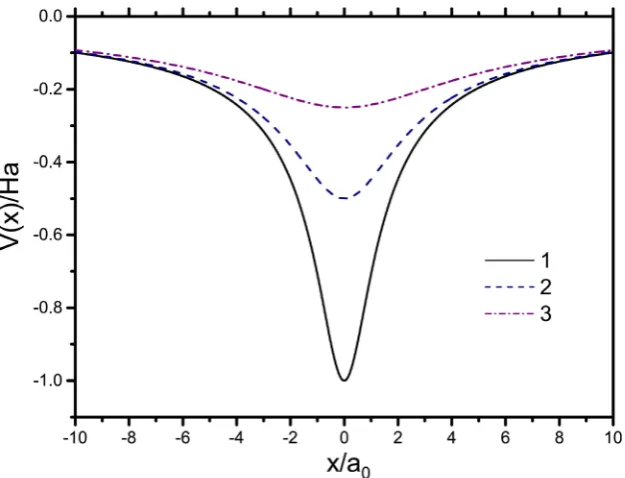
[image:12.595.57.537.295.511.2]SCC potential for different values of x0. Curves refer to x0 =a0, x0 =2a0 and 0 3 0
x = a , where 2
0
a = me is Bohr radius. It coincides with Bohr radius in
three dimension [25]. Left plot of Figure 8 shows dependence of average energy on inverted temperature for SCC potential. Results of both methods are in good agreement with each others. The same agreement takes place for average squared energy H2 represented on right plot of Figure 8. At high-temperatures
functions Hˆ and 2
H are not affected by parameter x0, while at low- temperature the strong dependence on x0 is evident.
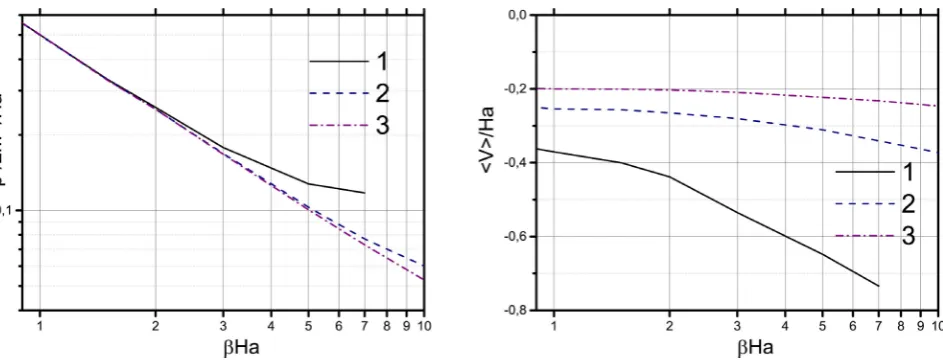
Finally, dependencies of average kinetic and potential energies on inverted temperature are represented on left and right plots of Figure 9. To the contrary of the potential energy the kinetic energy is not significantly affected by parame-ter x0.
It should be noted, that some points are missed when βHa≥7. The reason is the same as for potential V3 4− . This happens at very low temperature, when sys-tem is already in ground state. However when x0≤0.8a0 harmonic approxi-mation fails to calculate ground state, as the second derivative of potential Vscc takes a large value near origin of coordinates.
Single particle in three dimensions Let us consider one particle in spheri-cally symmetrical fourth order potential, i.e. unharmonic oscillator:
( )
2 42 4 ,
V− r =ar +cr (33)
where a and c are adjusted parameters of potential, r is length of
ra-dius-vector
(
x y z, ,)
. When c=0 this potential describes symmetrical 3D- [image:13.595.218.531.450.689.2]harmonic oscillator and harmonic approximation (12) is exact. If c does not equal zero, oscillator is unharmonic and can be used for verification of the devel-
Figure 7. Soft-core Coulomb potential Vscc for different values of x0:x0=a0 (1),
0 2 0
x = a (2), x0=3a0 (3). Here
2 2 0
a = me is Bohr radius, 2 0
Figure 8. Left plot: Dependence of average full energy Hˆ on inverted temperature β=1kT for potential
( )
sccV x when:
0 0
x =a (1, 2), x0=2a0 (3, 4), x0=3a0 (5, 6). Here
2 2 0
a = me is Bohr radius, 2 0
Ha=e a —Hartry energy. Symbols refer to harmonic approximation calculations, curves—to usual PIMC method. Right plot: The same for average square of energy
2 ˆ H .
Figure 9. Left plot: Dependence of average kinetic on inverted temperature β=1kT for potential Vscc
( )
x when x0=a0 (1),0 2 0
x = a (2), x0=3a0 (3). Here
2 2 0
a = me is Bohr radius, 2 0
Ha=e a —Hartry energy. Results were obtained by harmonic approximation method. Right plot: The same for average potential energy.
oped approach. The Figure 10 shows potentials (33) for 2
0.5
a= mω and
dif-ferent values of parameter c. Solid curve corresponds to c=0, i.e. harmonic oscillator. Another curves correspond to values of c equals to 2 3
2 mω and
2 3
2mω respectively. As it follows from analysis of this figure an harmonicity
can be significant.
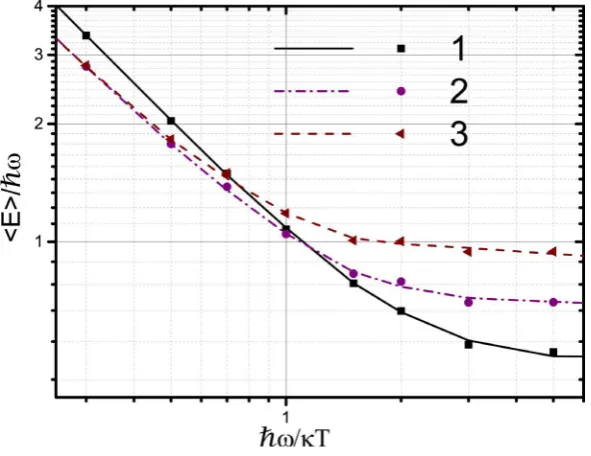
The Figure 11 shows dependence of full energy on inverted temperature. As before reference results of usual PIMC method are represented by curves, while results of harmonic approximation are marked by turned triangles. Let us stress that results of proposed above single-momentum method are marked by straight triangles. Results of all methods agree well with each other.
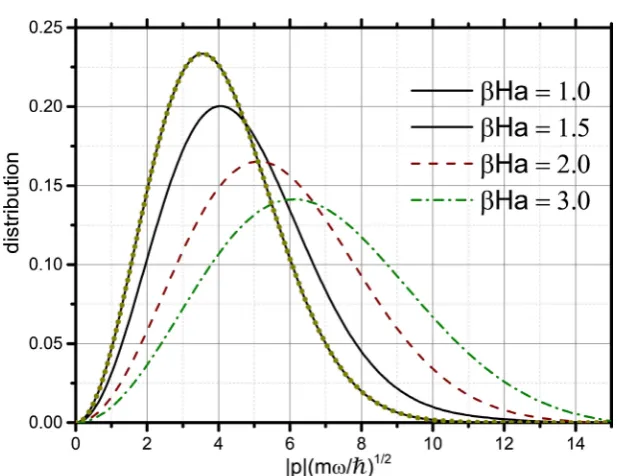
[image:14.595.67.539.326.506.2]discussed above. Momentum distributions for unharmonic oscillator with
2 3
2
c=mω (3) calculated by single-momentum method are shown on Figure
[image:15.595.231.516.168.394.2]12. When βHa≤1, distribution is quite Maxwellian. However when tempera-ture is lower, distribution is much wider than Maxwell one. Results of harmonic approximation for momentum distributions are the same and are not shown here.
Figure 10. Spherically symmetrical potential V2 4−
( )
r for2 2
a=mω and different val-ues of unharmonic parameter: c=0 (1), 2 3
2
c=mω (2), 2 3 2
c= mω (3).
Figure 11. Dependence of average energy Hˆ on inverted temperature β=1kT for
potential
( )
2 4V r =ar +br . Parameter 2 2
a=mω for all cases, c=0 (1), 2 3 2
c=mω (2), c=2m2ω3 (3). Curves refer to usual PIMC method, up-triangles—
[image:15.595.227.523.443.671.2]Figure 12. Momentum distribution for spherically symmetrical potential with
2 3 2
c=mω on different values of temperature. Dotted yellow line corresponds to Maxwell distribution.
Ideal Fermi gas Finally we consider application of single-momentum ap-proach to system of non-interacting degenerated spinless fermions, i.e. ideal Fermi gas with Fermi-Dirac momentum distribution [26]:
( )
2 3 ( )1 ,2π kT 1
g n p
e −µ =
+
(34)
where 2
2
p m
=
is energy, µ is chemical potential, g=2s+1 is statistical weight equal to unity in spinless case. Chemical potential connects implicitly density and temperature by integral equation [27], which can be easily numeri-cally solved:
(
)
3 22 3 0
d . 1
2π z kT
g mkT
N z z
V e µ
∞ − =
+
∫
(35)
Thermodynamical state of ideal Fermi gas is defined by single dimensionless
parameter 3
n
χ= λ , where n is density and λ is the thermal wavelength. Degree of degeneracy is reflected by this parameter called as degeneracy para-meter. When χ1 thermal wavelength is much lesser than average distance between particles, so gas is far from degeneracy. In opposite case degeneracy and exchange effects are significant. We have carried out our calculations for dege-neracy parameter χ from 1 to 7.
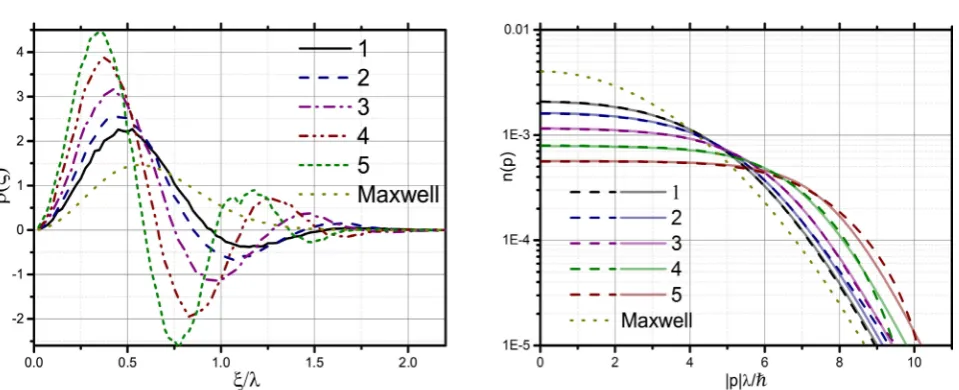
Figure 13. Left plot: Dependence of single-momentum density matrix (20) ρ on ξ for different values of degeneracy: χ=1.3 (1), χ=2 (2), χ=3 (3), χ=5 (4), χ=7 (5). Right plot: Fermi momentum distributions n p
( )
. solid lines—analytics (34), dashed lines—single-momentum numerical method, dotted line—Maxwell density matrix and distribution.obtained through sine Fourier transform of single-momentum density matrix. Solid semi-transparent lines correspond to theoretical Fermi distribution (34). When degeneracy parameter χ is small then distribution is close to Maxwel-lian. However it tends to the “shelf” form in degenerate Fermi gas.
One can note that in cases χ≤5 agreement of single-momentum Monte- Carlo with explicit theoretical result (34) is very good with error about some percents. However it increase significantly for greater values of χ, especially at large momenta. The main source of this discrepancy is finite size of basic Monte Carlo cell. In simulations the thermal wavelength has to be much lesser than size of Monte-Carlo cell as in this case the surface effects are negligible
(
λL)
.For example, when in our simulations number of particles in Monte-Carlo cell is about 100, for χ=1.3 the ration λ L≈0.25 and influence of boundary
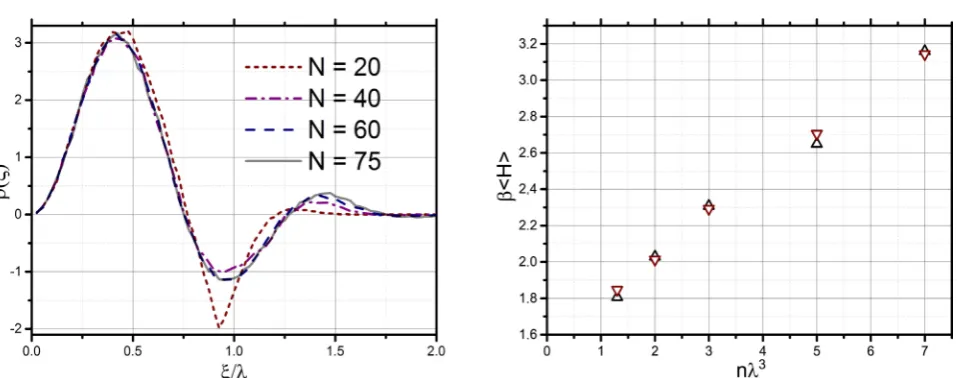
con-ditions is small. However for χ=10 this ratio is more than 0.5, so influence of surface effects becomes significant. One has to increase Monte-Carlo cell and number of particles in it. Left plot of Figure 14 shows influence of boundary conditions on result for Fermi gas at χ=3. We change the number of particles
N in basic Monte-Carlo cell while density was constant. One can see that result
for small numbers N differs significantly from the others. With increasing N
the momentum distributions tend asymptotically to unit not depending on N
more. This behavior is expected as increasing N at constant density leads to
increasing size of Monte-Carlo cell. So to obtain better results we have to in-crease number of particles in Monte Carlo cell and, as a consequence, to inin-crease the available computing power or improve algorithm of calculations. This work is now in progress.
However this limitation affects mainly on momentum distribution at high momentum values, but less essential for calculation of integrals such, for exam-ple, as average full energy Hˆ , which is shown on right plot of Figure 14.
Figure 14. Left plot: Single-momentum density matrix: influence of boundary conditions on result for Fermi gas with χ=3 under constant density. N is number of particle in Monte-Carlo cell. Right plot: Energy of ideal Fermi gas with different values of χ. Up-triangles corresponds to single-momentum calculation, down-triangles —to analytical formula 34.
6. Conclusions
In this paper we have generalized path integral representation of Wigner func-tion for canonical ensemble on many-particle non-relativistic quantum systems. Using this representation we have obtained explicit expression of Wigner func-tion in harmonic approximation resembling the Maxwell distribution on mo-mentum variable but with corrections depending on the second derivatives of potential field. We also propose new single-momentum approach based on Wigner function integrated over momenta of some particles.
We have developed quantum Monte-Carlo method based on harmonic ap-proximation for Wigner function for calculating average values of arbitrary quantum operators and momentum distributions for non-ideal many-particle systems. We have tested this method on some simple systems in potential field. Obtained results have shown very good agreement with results of usual path- integral method Monte-Carlo and proved that harmonic approximation gives practically exact results even for potentials, which have no matter with harmonic potential.
Also we have developed new quantum Monte-Carlo method based on sin-gle-momentum approach. It is able to calculate momentum distributions and average values of single-particle operators without approximation. This method is suitable for non-ideal systems of fermions. We have tested it on degenerate ideal Fermi gas. Results are in good agreement with available analytical and nu-merical data.
Acknowledgements
References
[1] Feynmann, R. and Hibbs, A. (1968) Quantum Mechanics and Path Integrals. Mir, Moscow.
[2] Filinov, V., Fortov, V., Bonitz, M. and Levashov, P.R. (2001) Phase Transition in Strongly Degenerate Hydrogen Plasma. JETP Letters, 74, 384-387.
https://doi.org/10.1134/1.1427127
[3] Brown, E., Clark, B., DuBois, J. and Ceperley, D. (2013) Path-Integral Monte Carlo Simulation of the Warm Dense Homogeneous Electron Gas. Physical Review Let-ters, 110, Article ID: 146405. https://doi.org/10.1103/physrevlett.110.146405
[4] Groth, S., Schoof, T., Dornheim, T. and Bonitz, M. (2016) Ab Initio Quantum Monte Carlo Simulations of the Uniform Electron Gas without Fixed Nodes. Physi-cal Review B, 93, Article ID: 085102. https://doi.org/10.1103/PhysRevB.93.085102
[5] Dornheim, T., Groth, S., Schoof, T., Hann, C. and Bonitz, M. (2016) Ab Initio
Quantum Monte Carlo Simulations of the Uniform Electron Gas without Fixed Nodes II: Unpolarized Case. Physical Review B, 93, Article ID: 205134.
https://doi.org/10.1103/PhysRevB.93.205134
[6] Filinov, V., Fehske, H., Bonitz, M., Fortov, V. and Levashov, P. (2007) Correlation Effects in Partially Ionized Mass Asymmetric Electron-Hole Plasmas. Physical Re-view E, 75, Article ID: 036401. https://doi.org/10.1103/physreve.75.036401
[7] Ceperley, D. (1995) Path Integrals in the Theory of Condensed Helium. Reviews of Modern Physics, 67, 279-355. https://doi.org/10.1103/RevModPhys.67.279
[8] Dornheim, T., Filinov, A. and Bonitz, M. (2015) Superfluidity of Trapped Quantum Systems in Two and Three Dimensions. Physical Review B, 91, Article ID: 054503.
https://doi.org/10.1103/PhysRevB.91.054503
[9] Dornheim, T., Groth, D., Filinov, A. and Bonitz, M. (2015) Permutation Blocking Path Integral Monte Carlo: A Highly Efficient Approach to the Simulation of Strongly Degenerate Non-Ideal Fermions. New Journal of Physics, 17, Article ID: 073017. https://doi.org/10.1088/1367-2630/17/7/073017
[10] Filinov, V., Ivanov, Y.B., Bonitz, M., Fortov, V. and Levashov, P. (2012) Color Path-Integral Monte Carlo Simulations of Quark-Gluon Plasma. Physics Letters A, 376, 1096-1101. https://doi.org/10.1016/j.physleta.2012.02.005
[11] Filinov, V., Ivanov, Y.B., Bonitz, M., Fortov, V. and Levashov, P. (2013) Color Path-Integral Monte-Carlo Simulations of Quark-Gluon Plasma: Thermodynamic and Transport Properties. Physical Review C, 87, Article ID: 035207.
https://doi.org/10.1103/physrevc.87.035207
[12] Filinov, V., Bonitz, M., Ivanov, Y.B., Ilgenfritz, E.-M. and Fortov, V. (2015) Color Path Integral Equation of State of the Quark-Gluon Plasma at Nonzero Chemical Potential. Plasma Physics and Controlled Fusion, 57, Article ID: 0440041.
https://doi.org/10.1088/0741-3335/57/4/044004
[13] Eletskii, A.V., Starostin, A.N. and Taran, M.D. (2005) Quantum Corrections to the Equilibrium Rate Constants of Inelastic Processes. Physics-Uspekhi, 48, 281-294.
https://doi.org/10.1070/PU2005v048n03ABEH002039
[14] Schoof, T., Groth, S. and Bonitz, M. (2014) Introduction to Configuration Path Integral Monte Carlo. In: Michael Bonitz, K., Lopez, B.J. and Thomsen, H., Eds.,
Introduction to Complex Plasmas: Scientific Challenges and Technological Oppor-tunities, Springer Series on Atomic, Optical, and Plasma Physics 82, Springer, Berlin 153-194. https://doi.org/10.1007/978-3-319-05437-7_5
https://doi.org/10.1016/S0375-9601(01)00344-9
[16] Shifren, L. and Ferry, D. (2002) A Wigner Function Based Ensemble Monte Carlo Approach for Accurate Incorporation of Quantum Effects in Device Simulation.
Journal of Computational Electronics, 1, 55-58.
https://doi.org/10.1023/A:1020711726836
[17] Shifren, L. and Ferry, D. (2002) Wigner Function Quantum Monte Carlo. Physica B, 314, 72-75. https://doi.org/10.1016/S0921-4526(01)01392-8
[18] Querlioz, D. and Dollfus, P. (2010) The Wigner Monte Carlo Method for Nanoelec-tronic Devices—A Particle Description of Quantum Transport and Decoherence. ISTE-Wiley, Hoboken.
[19] Sellier, J.M., Nedjalkov, M., Dimov, I. and Selberherr, S. (2014) A Benchmark Study of the Wigner Monte-Carlo Method. Monte Carlo Methods and Applications, 20, 43-51. https://doi.org/10.1515/mcma-2013-0018
[20] Sellier, J.M. and Dimov, I. (2015) On the Simulation of Indistinguishable Fermions in the Many-Body Wigner Formalism. Journal of Computational Physics, 280, 287-294. https://doi.org/10.1016/j.jcp.2014.09.026
[21] Larkin, A. and Filinov, V. (2014) Wigner’s Pseudo-Particle Relativistic Dynamics in External Potential Field. Physics Letters A, 378, 1876-1882.
https://doi.org/10.1016/j.physleta.2014.04.051
[22] Larkin, A., Filinov, V. and Fortov, V. (2016) Path Integral Representation of the Wigner Function in Canonical Ensemble. Contributions to Plasma Physics, 56, 151-360. https://doi.org/10.1002/ctpp.201500078
[23] Tatarskiy, V. (1983) Wigner Representation of Quantum Mechanics. Успехи Физических Наук, 139, 587-619. https://doi.org/10.3367/UFNr.0139.198304b.0587
[24] Zamalin, V. and Norman, G. (1973) The Monte-Carlo Method in Feynman’s For-mulation of Quantum Statistics. USSR Computational Mathematics and Mathe-matical Physics, 13, 408-420. https://doi.org/10.1016/0041-5553(73)90139-0
[25] Palma, G. and Raff, U. (2006) The One-Dimensional Hydrogen Atom Revisited.
Canadian Journal of Physics, 84, 787-800. https://doi.org/10.1139/p06-072
[26] Huang, K. (1966) Statistical Mechanics. Mir, Moscow.
Submit or recommend next manuscript to SCIRP and we will provide best service for you:
Accepting pre-submission inquiries through Email, Facebook, LinkedIn, Twitter, etc. A wide selection of journals (inclusive of 9 subjects, more than 200 journals)
Providing 24-hour high-quality service User-friendly online submission system Fair and swift peer-review system
Efficient typesetting and proofreading procedure
Display of the result of downloads and visits, as well as the number of cited articles Maximum dissemination of your research work
Submit your manuscript at: http://papersubmission.scirp.org/