In vitro embryo production (IVP) technology has been successfully applied in a number of ani-mal species with transferred embryos resulting in live offspring. The application of IVP can be expected to bring about a significant increase in the population of superior genetic merit animals. The production of transgenic goats that produce milk containing proteins of pharmacological value is of special interest. Despite the efforts of several research teams over a number of years, blastocyst development from in vitro matured and fertilized caprine oocytes remains inefficient because less than a third of the embryos resulting from in vitro maturation (IVM) and in vitro fertilization (IVF) will develop to the morula stage (Martino et al., 1995; Rho et al., 2001; Teotia et al., 2001). Furthermore, there have been no reports on the birth of Boer kid by IVP procedure.
The availability of a sufficient number of oocytes is the pre-requisite for IVP procedure. Ovaries from slaughtered animals are the cheapest and the most abundant source of primary oocytes for large-scale production of embryos by IVP procedure (Agrawal et al., 1995). However, the number of slaughtered Boer goats is lower than the number of other ani-mals such as pigs and cattle because of their high price. The development of an efficient technique of oocyte harvesting from finite ovaries is thus very significant for this species.
IVM is also one of the essential steps in the IVP process of Boer goat. Caprine oocytes have also been studied for different aspects of maturation (Mogas et al., 1997). In most studies, the basic me-dium was supplemented with hormones and dif-ferent concentrations of serum. The maturation medium and the selection of protein supplements
Effects of oocyte collection techniques and maturation
media on
in vitro
maturation and subsequent embryo
development in Boer goat
Z.G. Wang, Z.R. Xu, S.D. Yu
College of Animal Science, Key Laboratory for Molecular Animal Nutrition, Zhejiang University, Hang Zhou, China
ABSTRACT: The oocytes (experiment 1) were harvested by one of the four collection techniques (slicing, punc-ture, aspiration I and aspiration II) and the total number and the number of each grade of oocytes were counted, respectively. The good-quality oocytes (good and fair grade) were cultured for maturation. In experiment 2, the oocytes were matured in TCM-199 supplemented with 10 ng/ml of epidermal growth factor (EGF) or 10% FCS, either alone or with 1 IU/ml FSH, or the oocytes were matured in TCM-199 supplemented with 1 IU/ml FSH. After maturation, the oocytes in the two experiments were fertilized, respectively. Slicing (6.3) and puncture (5.8) of the ovaries yielded a higher (P < 0.05) number of oocytes per ovary compared to aspiration I (2.9) and aspiration II (3.1). Oocytes matured in the TCM-199 medium supplemented with EGF or FCS with FSH had a significantly higher proportion of blastocysts than the other treatments (P < 0.05). In conclusion, slicing and puncture are alternative techniques of oocyte recovery in Boer goat. The TCM-199 medium supplemented with EGF or FCS in the presence of FSH is suitable for in vitro maturation of oocytes.
Keywords: Boer goat; collection techniques; oocyte maturation; ovary; medium
and hormones for IVM play an important role in subsequent IVF and in vitro development (Pawshe et al., 1996). The reduced development of in vitro-derived zygotes in goats suggests that the conditions of IVM do not support cytoplasmic maturation. So it is very important that the improvement of the in vitro maturation system for oocytes be aimed at defining in vitro conditions more similar to the in vivo environment.
The objective of this study on Boer goats was: (1) to compare the effects of four oocyte collec-tion techniques on recovery efficiency, maturacollec-tion rate and subsequent embryonic development; (2) to compare the effects of three different matura-tion media on in vitro maturamatura-tion and subsequent embryonic development.
MATERIAL AND METHODS
Reagents
All chemicals and media were purchased from Sigma Chemical Co. (St. Louis, MO, USA) unless otherwise indicated.
Oocyte collection and classification
Goat ovaries were obtained from a slaughterhouse and transported to the laboratory within 2 hours in 0.9% saline solution. Oocytes were harvested by one of the following techniques. (1) Slicing: ovaries were placed in a graded plastic Petri dish containing a saline solution and were chopped into small pieces with a surgical blade. The cumulus-oocyte complex-es (COCs) were selected from the saline solution. (2) Puncture: follicles visible on the surface ranging from 2.0 to 6.0 mm in diameter were punctured with an 18-g needle. The COCs were selected from the follicular fluid. (3) Aspiration I: the follicular fluid from surface follicles (2.0 to 6.0 mm) was aspirated through a sterile 18-g needle attached to a 5 ml sy-ringe containing a sterile saline solution. Aspirated contents were expelled into a fresh Petri dish con-taining the saline solution and COCs were selected from it. (4) Aspiration II: oocytes were aspirated by applying a constant pressure (60 mm Hg) with a vacuum pump (Cook Australia, Brisbane, Australia). The aspiration needle was connected through PVC tubing into a sterile 50 ml plastic tube. The COCs were selected from the aspirated follicular fluid. The
COCs recovered by four techniques were then clas-sified under an inverted microscope. The COCs were graded as good, fair and poor according to the char-acter of cumulus cells (Pawshe et al., 1994); oocytes with many complete layers of cumulus cells and uniform cytoplasm were graded as good, oocytes with thin or incomplete layers of cumulus cells and uniform cytoplasm as fair, and oocytes with few or no cumulus cells as poor. The number of good, fair and poor COCs was recorded for each ovary.
In vitro maturation and evaluation of meiotic maturation
The COCs were washed three times with a matu-ration medium. In experiment 1, the matumatu-ration medium was TCM-199 supplemented with 10% FCS (GIBCO, Grand Island, NY, USA) and 1 IU/ml FSH. In experiment 2, COCs collected through the puncture of follicles with an 18-g needle were ma-tured in TCM-199 supplemented with 10 ng/ml of epidermal growth factor (EGF) or 10% FCS, either alone or with 1 IU/ml FSH, or they were matured in TCM-199 supplemented with 1 IU/ml FSH. The oocytes were cultured for 24 h in 5% CO2 in humid air at 38.5°C.
To evaluate the nuclear stage after maturation, a sample of oocytes after IVM was denuded of cu-mulus cells and fixed on a slide with 3:1 acetic acid: ethanol, stained with 1% lacmoid. Metaphase-II (MII) was regarded as the nuclear maturation of oocyte.
In vitro fertilization and embryo culture
At the end of the fertilization period, zygotes were transferred to B2 medium containing 10% FBS and were cultured under paraffin oil and humidi-fied 5% CO2 in air at 38.5°C and half of the culture volume was replenished with fresh medium every 24 h. Zygotes were assessed for cleavage 48 hours after the beginning of culture and in 192 hours for determination of the number of embryos reaching the blastocyst stage.
Statistical analysis
All experiments were replicated three times. Data were analyzed by analysis of variance (ANOVA) of the SAS software (1989). Comparisons were con-sidered significantly different if P < 0.05.
RESULTS
Experiment 1: effects of collection techniques on oocyte recovery, in vitro
maturation and subsequent embryo development
As shown in Table 1, slicing (6.3) and puncture (5.8) of the ovaries yielded a higher (P < 0.05)
number of oocytes per ovary compared to aspira-tion I (2.9) and aspiraaspira-tion II (3.1). Furthermore, the number of good grade oocytes per ovary collected by the slicing (3.9) and puncture (3.2) method was significantly higher than that collected by aspira-tion I (1.4) and aspiraaspira-tion II (1.8) (P < 0.05).
There was a statistically lower (P < 0.05) propor-tion of M II stage after in vitro maturapropor-tion of the oocytes harvested by slicing methods, compared to the other three collection techniques (Table 2). No significant difference was observed between punc-ture, aspiration I and aspiration II in the percentage of M II oocytes. As shown in Table 2, the cleavage rate and the proportion of blastocysts were not significantly different between the four groups.
Experiment 2: effects of different
maturation media on in vitro maturation of oocytes and early embryo development
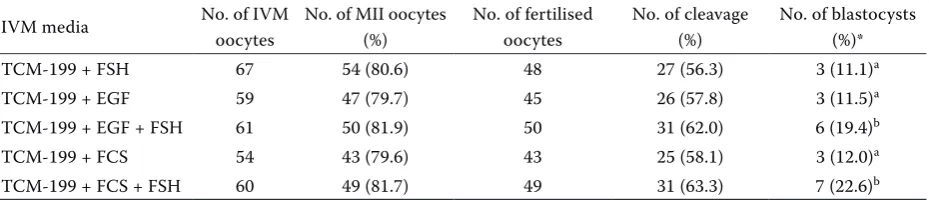
[image:3.595.64.534.483.572.2]As shown in Table 3, no significant differences in the M II rate and cleavage rate were found between the treatments. But oocytes matured in TCM-199 medium supplemented with EGF plus FSH or TCM-199 medium supplemented with FCS plus FSH had a significantly higher proportion of blasto-cysts than the other three treatments (P < 0.05).
Table 1. Effects of collection techniques on the quantity and quality of recovered oocytes per ovary in Boer goats
Methods
of collection No. of ovaries
No. of recovered oocytes per ovary
total good (%) fair (%) poor (%)
Slicing 31 6.3a 3.9a (61.9) 1.3a (20.6) 1.1a (17.5)
Puncture 35 5.8a 3.2a (55.2) 1.5a (25.8) 1.1a (19.0)
Aspiration I 29 2.9b 1.4b (48.3) 0.5b (17.2) 1.0a (34.5)
Aspiration II 32 3.1b 1.8b (58.1) 0.7b (22.6) 0.6b (19.3) a,bNumbers in the same column with different letters (a,b) differ significantly at P < 0.05
Table 2. Effects of collection techniques on in vitro maturation of oocytes and embryonic development in Boer goats
Methods of collection
No. of IVM oo-cytes
No. of MII oocytes (%)
No. of fertilised oocytes
No. of cleavage (%)
No. of blastocysts (%)*
Slicing 79 48 (60.8)a 48 29 (60.4) 4 (13.8)
Puncture 75 63 (84.0)b 63 37 (58.7) 5 (13.5)
Aspiration I 30 24 (80.0)b 24 15 (62.5) 2 (13.3)
Aspiration II 43 34 (79.1)b 34 20 (58.8) 3 (15.0)
*Blastocyst percentage calculated from cleaved embryos
[image:3.595.65.533.637.723.2]DISCUSSION
Several techniques were used for the collec-tion of oocytes from the ovaries in goats (Mogas et al., 1992; Pawshe et al., 1994) and sheep (Wani et al., 1999). Based on the present results the re-covery of oocytes using the slicing and puncture methods yielded more oocytes per ovary and more good-quality oocytes per ovary than the two aspi-ration methods (P < 0.05). In accordance with the results of the present study on Boer goat, Wani et al. (1999) indicated that slicing (9.5 ± 0.4) and puncture (9.5 ± 0.4) yielded significantly (P < 0.05) more oocytes per ovary than follicle aspiration (6.8 ± 0.3) in sheep. The higher number of good qual-ity oocytes which had been recovered per ovary by slicing (5.2 ± 0.2) and puncture (5.2 ± 0.2) compared to aspiration (4.4 ± 0.2) was also in accordance with the results reported here. In contrast to the results of the present study, however, the number of oocytes per ovary for slicing (4.0) and aspiration (3.7) did not differ significantly in ewe lambs (Shirazi et al., 2005). A high number (93) of oocytes per ovary was harvested in sheep (Mogas et al., 1992), using the slicing technique. The lower number of oocytes ob-tained by slicing in this study may be due to different slicing techniques. The slicing technique consist-ing in choppconsist-ing the ovary into small pieces with a surgical blade was used in this study, while other researchers used blades to incise the follicles on the ovarian surface. A number of oocytes was therefore retained in the ovary without recovery or they were disintegrated due to injury during chopping.
After a representative sample of good-quality oocytes (good and fair) recovered by each method was put through the IVM/IVF/IVC procedure, there was a significantly lower (P < 0.05) rate of oocytes reaching the M II stage when using
slic-ing techniques, compared to the other techniques. This lower maturation rate may be due to more preantral oocytes collected by slicing techniques than by other techniques, it is known that preantral oocytes have a low maturation rate compared with antral oocytes (Izquierdo et al., 2002). No study of the effect of oocyte collection methods on the capacity of subsequent embryonic development has been reported. In this study it was observed for the first time that the good-quality oocytes recovered by four different collection methods had the similar cleavage rate and blastocyst yield of the embryos af-ter in vitro fertilization of the M II stage oocytes.
In experiment 2, there was no significant differ-ence in maturation rate between different media, but a significantly higher proportion of blasto-cysts (P < 0.05) was found in oocytes matured in TCM-199 supplemented with EGF in the presence of FSH than in oocytes matured in the absence of FSH. Similarly, oocytes matured in TCM-199 supplemented with FCS in the presence of FSH had a significantly higher proportion of blasto-cysts than oocytes matured in the absence of FSH. Furthermore, the cleavage rate (56.3%) and the pro-portion of blastocysts (11.1%) were not significantly different between oocytes matured with FSH alone and oocytes matured with EGF or FCS alone. These findings proved that FSH with FCS or EGF in matu-ration media had the cooperative effect on early embryonic development of Boer goat.
[image:4.595.68.533.116.216.2]In accordance with the present results of oocytes reaching the blastocysts, Mogas et al. (1997) obtained 8.3% of blastocysts by co-culturing embryos with granulosa cells; and Koeman et al. (2000) obtained 8% of blastocysts by culturing in G1.2 and G2.2 me-dia while Crozet et al. (1995) obtained up to 26% of blastocysts with oocytes from adult goats that in accordance with blastocyst development of oocytes
Table 3. Effects of different maturation media on in vitro maturation of oocytes and embryonic development in Boer goats
IVM media No. of IVM oocytes No. of MII oocytes(%) No. of fertilised oocytes No. of cleavage (%) No. of blastocysts (%)*
TCM-199 + FSH 67 54 (80.6) 48 27 (56.3) 3 (11.1)a
TCM-199 + EGF 59 47 (79.7) 45 26 (57.8) 3 (11.5)a
TCM-199 + EGF + FSH 61 50 (81.9) 50 31 (62.0) 6 (19.4)b
TCM-199 + FCS 54 43 (79.6) 43 25 (58.1) 3 (12.0)a
TCM-199 + FCS + FSH 60 49 (81.7) 49 31 (63.3) 7 (22.6)b
*Blastocyst percentage calculated from cleaved embryos
matured in TCM medium with EGF plus FSH or TCM medium with FCS plus FSH. Oocytes matured in TCM-199 medium supplemented with FCS or EGF in the presence of FSH had a significantly higher number of blastocysts (P < 0.05), which may indicate that oocytes matured in these media had a higher rate of cytoplasmic maturation, a variety of changes in the intracellular organization and physiology of oocytes that allow normal embryo development after fertilization (Eppig. 1996). Normal embryonic devel-opment presumes complete nuclear and cytoplasmic maturation of in vitro matured oocytes. So nuclear maturation of oocytes along with cytoplasmic matu-ration is important for the completion of meiotic division for the success of fertilization.
In conclusion, the present results indicate that in Boer goats: (1) slicing and puncture of the ovaries are alternative techniques for oocyte recovery and (2) TCM-199 media supplemented with EGF or FCS in the presence of FSH are suitable for in vitro maturation and subsequent embryonic development of oocytes.
REFERENCES
Agrawal K.P., Sharma T., Sexana C., Sharma N. (1995): Chronology of first meiotic events of caprine oocytes matured in vitro. Indian. J. Anim. Sci., 65, 285–288. Bavister B.D., Leibfried M.L., Lieberman G. (1983):
De-velopment of pre-implantation embryos of the golden hamster in a defined culture medium. Biol. Reprod., 28, 235–247.
Crozet N., Ahmed-Ali M., Dubos M.P. (1995): Develop-mental competence of goat oocytes from follicles of dif-ferent size categories following maturation, fertilization and culture in vitro. J. Reprod. Fertil., 103, 293–298. Eppig J.J. (1996): Coordination of nuclear and
cytoplas-mic oocyte maturation in eutherian mammals. Reprod. Fertil. Dev., 8, 485–489.
Izquierdo D., Villamediana P., López-Bejar M., Paramio M.T. (2002): Effect of in vitro and in vivo culture on embryo development from prepubertal goat IVM-IVF oocytes. Theriogenology, 57, 1431–1441.
Koeman J.K., Keefer C.L., Baldassarre H., Lane M., Gardne D.K., Downey B.R. (2000): Developmental competence of prepubertal and adult goat oocytes cultured in semi-defined media. Theriogenology, 53, 297.
Martino A., Mogas T., Palomo M.J., Paramino M.T. (1995): In vitro maturation and fertilization of prepu-bertal goat oocytes. Theriogenology, 43, 473–485. Mogas T., Martino A., Palomo M.J., Paramio M.T. (1992):
Effect of method of recovery on the number and type of oocytes obtained for IVM. J. Reprod. Fertil., 9, 53. Mogas T., Palomo M.J., Izquierdo M.D., Paramio M.T.
(1997): Development capacity of in vitro matured and fertilized oocytes from prepubertal and adult goats. Theriogenology, 47, 1189–1203.
Parrish J.J., Susko-Parrish J.L., Leibfried-Rutledge M.L., Critser E.S., Eyestone W.H., First N.L. (1986): Bovine
in vitro fertilization with frozen-thawed semen. The-riogenology, 25, 591–600.
Pawshe C.H., Totey S.M., Jain S.K. (1994): A comparison of three methods of recovery of goat oocytes for in vitro maturation and fertilization. Theriogenology, 42, 117–125.
Pawshe C.H., Palanisamy A., Taneja M.S., Jain K., Totey S.M. (1996): Comparison of various maturation treat-ments on in vitro maturation of goat oocytes and their early embryonic development and cell numbers. The-riogenology, 46, 971–982.
Rho G.J., Hahnel A.C., Betteridge K.J. (2001): Comparisons of oocyte maturation and of three methods of sperm preparation for their effects on the production of goat embryos in vitro. Theriogenology, 56, 503–516.
Samaké S., Amoah E.A., Mobini S., Gazal O., Gelaye S. (2000): In vitro fertilization of goat oocytes during the non-breeding season. Small Rumin. Res., 35, 49–54. Shirazi A., Shams-Esfandabadi N., Hosseini S.M. (2005):
A comparison of two recovery methods of ovine oocytes for in vitro maturation. Small Rumin. Res., 58, 283–286.
Teotia A., Sharma G.T., Majumdar A.C. (2001): Fertiliza-tion and development of caprine oocytes matured over granulose cell monolayers. Small Rumin. Res., 40, 165–177.
Wani N.A., Wani G.M., Khan M.Z., Sidiqi M.A. (1999): Effect of different factors on the recovery rate of oocytes for in vitro maturation and in vitro fertilisation proce-dures in sheep. Small Rumin. Res., 34, 71–76.
Received: 2006–09–28 Accepted after correction: 2006–10–20
Corresponding Author