every month at a reasonably rapid rate at www.threatenedtaxa.org. All articles published in JoTT are registered under Creative Commons Attribution 4.0 International License unless otherwise mentioned. JoTT allows allows unrestricted use, reproduction, and distribution of articles in any medium by providing adequate credit to the author(s) and the source of publication.
www.threatenedtaxa.org
ISSN 0974-7907 (Online) | ISSN 0974-7893 (Print) Building evidence for conservation globally
Journal of Threatened Taxa
For Focus, Scope, Aims, Policies, and Guidelines visit https://threatenedtaxa.org/index.php/JoTT/about/editorialPolicies#custom-0
For Article Submission Guidelines, visit https://threatenedtaxa.org/index.php/JoTT/about/submissions#onlineSubmissions
For Policies against Scientific Misconduct, visit https://threatenedtaxa.org/index.php/JoTT/about/editorialPolicies#custom-2
For reprints, contact <[email protected]>
Communication
A preliminary report on butterfly fauna (Insecta:
Lepidoptera) of Tengchong Section of Gaoligongshan
National Nature Reserve, China
Yik Fui Philip Lo & Zheng Bi
12 September 2019 | Vol. 11 | No. 11 | Pages: 14452–14470 DOI: 10.11609/jott.4443.11.11.14452-14470
Partner
Member
Publisher & Host
OPEN ACCESSThe opinions expressed by the authors do not reflect the views of the Journal of Threatened Taxa, Wildlife Information Liaison Development Society, Zoo Outreach Organization, or any of the partners. The journal, the publisher, the host, and the part-ners are not responsible for the accuracy of the political boundaries shown in the maps by the authors.
Communica
tion
DOI:https://doi.org/10.11609/jott.4443.11.11.14452-14470 | ZooBank: urn:lsid:zoobank.org:pub:6140D363-33DC-43B9-AC6C-A39D2E343214
Editors:Adam Cotton & Shao-ji Hu (Pierce), Yunnan University, Kunming, China. Date of publication: 12 September 2019 (online & print)
Manuscript details: #4443 | Received 27 July 2018 | Final received 09 July 2019 | Finally accepted 16 July 2019
Citation: Lo, Y.F.P. & Z. Bi (2019). A preliminary report on butterfly fauna (Insecta: Lepidoptera) of Tengchong Section of Gaoligongshan National Nature Reserve, China. Journal of Threatened Taxa 11(11): 14452–14470. https://doi.org/10.11609/jott.4443.11.11.14452-14470
Copyright: © Lo & Bi 2019. Creative Commons Attribution 4.0 International License. JoTT allows unrestricted use, reproduction, and distribution of this article in
any medium by adequate credit to the author(s) and the source of publication.
Funding: This study is funded by Kadoorie Farm and Botanic Garden.
Competing interests: The authors declare no competing interests.
Author details: Yik Fui Philip Lo: Senior Conservation Officer, Kadoorie Farm and Botanic Garden; Fellow, Royal Entomological Society. Zheng Bi: Director, Gaoligongshan National Nature Reserve (Tengchong Bureau)
Author contribution: YFLP conceived, designed and performed the analysis, and wrote the paper. Both authors collected and contributed data.
Acknowledgements: We thank Yu-Feng Hsu (National Taiwan Normal University, Taipei), Li-Wei Wu (National Taiwan University, Nantou) and Zhihua Zhang
(Dongfang Forestry Department, Hainan) for taking part in some surveys. Xiang-Yuan Huang, Xing-Chao Zhang (TC-GLGS), Fei Li, Gang Lu, Chi Fung Mak and Bosco Chan (KFBG) provided their photo records. Motoki Saito (The Butterfly Society of Japan, Tokyo) provided reprints of Kachin survey reports. We are also grateful to the management of Gaoligongshan National Nature Reserve for granting permission to conduct the survey and providing essential assistance on our field works.
A preliminary report on butterfly fauna
(Insecta: Lepidoptera) of Tengchong Section of
Gaoligongshan National Nature Reserve, China
Yik Fui Philip Lo 1 & Zheng Bi 2
1 Kadoorie Conservation China, Kadoorie Farm & Botanic Garden, Lam Kam Road, Tai Po, Hong Kong SAR, China. 2 Yunnan Gaoligongshan National Nature Reserve (Tengchong Bureau), 157 Laifeng Avenue, Tengchong, Yunnan
Province, China.
1 [email protected] (corresponding author), 2 [email protected]
Abstract: The butterfly fauna of Tengchong Section of Gaoligongshan National Nature Reserve, western Yunnan, China was investigated during a series of field surveys conducted between April 2014 and May 2018. A total of 216 butterfly species were recorded (Hesperiidae 41, Papilionidae 20, Pieridae 21, Lycaenidae 45, and Nymphalidae 89), of which 179 represent new records for Tengchong. Significant findings include paratype materials of a recently described genus and a subspecies, respectively, as well as three national and five provincial new records. Several obscure species were rediscovered during the survey, including two taxa that have not been recorded
since their descriptions, Celaenorrhinus morena Evans, 1949and Thoressa pedla pedla (Evans, 1956). The result of the survey is presented
herein with notes on some little-known species. Additionally, past records on Tengchong butterfly fauna were reviewed and a name is
treated as nomen nudum.
Keywords: Eastern Himalaya, Hengduan Mountains, Kachin, Myanmar, national new records, western Yunnan. ISSN 0974-7907 (Online)
ISSN 0974-7893 (Print)
INTRODUCTION
Gaoligongshan (hereafter GLGS) is a mountain range that runs north-south along the border between Kachin State (Myanmar) and western Yunnan (China). GLGS part of the Hengduan Mountains of southwestern China, and is well known for rich and unique biodiversity. The southern part of GLGS was designated a nature reserve in 1986 and recognized as a biosphere reserve in 2000 (UNESCO 2007), and the Tengchong section is located on the western slope of the reserve. For administrative and geographic details see Chan et al. (2019, this issue).
Tengchong was the first area in GLGS to be explored by western zoologists, when British zoologist John Anderson made a collecting expedition in Daying River and Tengchong of western Yunnan in 1868. One-hundred-and-eighteen butterfly species were collected during the expedition, including three new species described by Atkinson (1871) (Anderson 1878). Since detailed locality information was not provided in Anderson’s report, it is not possible to distinguish Tengchong material from the rest of his collection. Following Anderson’s exploration, a number of naturalists visited GLGS in the early 20th Century, but their works contributed little to
the knowledge of butterfly fauna of the region.
Starting from the 1970s, GLGS has been frequently visited by Chinese and Japanese entomologists. The exceptionally high species richness of butterflies was gradually revealed with the description of a number of new taxa (e.g., Yoshino 1995, 1997, 1999, 2008; Huang 2001, 2002, 2003). Most efforts were focused on the Nujiang (Salween River) Valley on the eastern slope of the mountain range, and the butterfly fauna of Tengchong on the western slope of GLGS received less attention and was not comprehensively documented. It was only briefly investigated during the Yunnan forest pest survey from 1979 to 1982 organized by the Yunnan Provincial Department of Forestry, which listed 482 butterfly species for Yunnan Province, of which 32 were recorded from Tengchong (Lee & Cao 1987). The discovery of Neorina neosinica Lee, 1985, an astonishing satyrid butterfly, was perhaps the most notable finding in Tengchong from that study. Lee (1995) & Xue (1995) basically adopted the information in Lee & Cao (1987).
Since 2000, several more butterfly species were added to the Tengchong list following taxonomic works on particular groups. Three skipper species of the genus
Thoressa were reported in Tengchong in a study of the tribe Aeromachini from China (Huang 2009). Meanwhile, Xue (2009) listed four additional skipper species from the same area in a study of Chinese Hesperiidae. Lang
& Duan (2016) described a new Lethe species from Tengchong. A further seven satyrid butterfly species from the subtribe Lethina were reported in Tengchong by Lang (2017). By 2017, 51 species of butterfly were documented for Tengchong, which likely underestimated the rich biodiversity of this area. To update this information, a series of joint biodiversity surveys were organized by Kadoorie Farm and Botanic Garden (KFBG) and the Tengchong Bureau of Gaoligongshan National Nature Reserve during 2014–2018. The survey results for butterfly fauna are presented herein, with a checklist and notes on selected species of special interest.
METHODS
Study areas
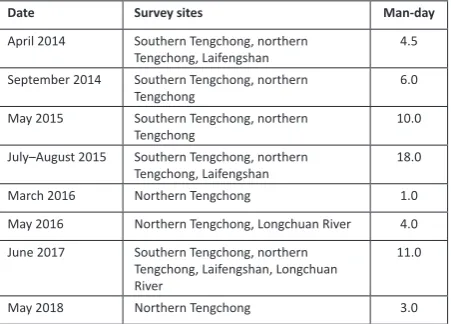
Surveys were conducted primarily in the Tengchong Section of Gaoligongshan National Nature Reserve (hereafter TC-GLGS) including all six management sections (from south to north: Zhengding, Dahaoping, Qushi, Jietou, Datang and Zizhi). In addition, lower-elevation forests of Laifengshan National Forest Park and the protected riparian forest along Longchuan River were also surveyed. Fieldwork covered elevations between 1,300m and 2,800m and was conducted during March to October, which is expected to cover the flight periods of most butterfly species in the region. A total of 57.5 man-days were spent from April 2014 to May 2018; survey details are shown in Table 1. For detail information on geography, vegetation and habitat of the study area, please refer to Chan et al. (2019, this issue).
Survey methods
Identification
Voucher materials were pinned and mounted in laboratory and a temporary catalogue number was assigned for each pinned specimen. A variety of references were used for identification (e.g., Evans 1949; Eliot & Kawazoe 1983; Chiba & Tsukiyama 1996; Koiwaya 2007; Huang 2009; Lang 2012, 2017; Wu & Hsu 2017). Higher classification arrangement follows Hsu et al.(2017). For species groups that are difficult to identify superficially, such as members of the family Hesperiidae and the genus Ypthima, male genitalia were also examined by dissection following the protocol of Hsu (2015).
RESULTS
Butterfly species richness
A total of 216 butterfly species were recorded in the survey, and these species belong to five families: Hesperiidae (41 species); Papilionidae (20 species); Pieridae (21 species); Lycaenidae (45 species); and Nymphalidae (89 species). Of the recorded species, 179 species were hitherto undocumented for Tengchong County. Some of the materials collected from the present study have been illustrated in Wu & Hsu (2017), and live adult photographs of selected species are illustrated by Lo (2016). A list of the butterfly species collected in the present survey is provided in Appendix 1. For reference purpose, a list of butterflies that were recorded in Tengchong in earlier studies but absent in the present survey is listed in Appendix 2.
Regarding species richness at genus level, the most speciose genuswas Lethe (Nymphalidae) with 16 species recorded in the study area. Papilio (Papilionidae) and Neptis (Nymphalidae) were the second and third richest genera represented by nine and eight species, respectively. In addition, 10 genera in which at least four species each were recorded in the present survey (Table 2).
Conservation status
Two species, Troides aeacus and Bhutanitis lidderdalii (Papilionidae), are listed on Appendix II of the Convention on International Trade in Endangered Species of Wild Fauna and Flora (CITES), meaning that international trade is regulated. The global conservation status of most Tengchong species have not been evaluated by the IUCN Red List of Threatened Species (2017) except
Troides aeacus (Papilionidae), Ancema ctesia, and
Dodona eugenes (Lycaenidae), which are listed as Near Threatened (NT). Meanwhile, seven and 20 species have been evaluated as Vulnerable (VU) and Near Threatened (NT), respectively, by the China Species Red List (Wang & Xie 2005). None of the butterfly species from Tengchong are included in the Lists of Wildlife under Special State Protection (conventionally known as China State Key Protected Animal List in literature, e.g., Smith & Xie 2008), which is in need of revision.
Notable findings
One-hundred-and-seventy-nine species are new records for Tengchong. Many of these species are known from adjacent areas and their occurrence in Tengchong was expected. Nevertheless, substantial range extensions of some taxa were observed, including three national and six provincial new records, and several rare and obscure species were rediscovered. Detailed information of these, and notes on other species of special interest, are provided in the following species accounts.
Selected species accounts
Celaenorrhinus morena Evans, 1949 (Image 1) New species record for China
This is an obscure species that has not been recorded since its original description. The records in Igarashi & Fukuda (2000) and Gogoi (2013) were misidentifications of other species, probably C. leucocera (Kollar, [1844]). The male genital structure of the Tengchong materials agrees with the description and illustration in Evans (1949). This species was previously only known from India’s Naga Hills, Manipur, and Sikkim (Evans 1949); Table 1. Survey sites and dates of this study (southern Tengchong
includes Zhengding, Dahaoping and Qushi sections of TC-GLGS; northern Tengchong includes Jietou, Datang and Zizhi sections of TC-GLGS).
Date Survey sites Man-day
April 2014 Southern Tengchong, northern
Tengchong, Laifengshan 4.5
September 2014 Southern Tengchong, northern
Tengchong 6.0
May 2015 Southern Tengchong, northern
Tengchong 10.0
July–August 2015 Southern Tengchong, northern
Tengchong, Laifengshan 18.0
March 2016 Northern Tengchong 1.0
May 2016 Northern Tengchong, Longchuan River 4.0 June 2017 Southern Tengchong, northern
Tengchong, Laifengshan, Longchuan River
11.0
the present discovery suggests that C. morena may also occur in similar habitat of northern Myanmar. A univoltine species was recorded only in July and August. Adults have typical behavior of the genus and often occur concurrently with C. ratna nujiangensis Huang, 2001.
Ochlodes brahma (Moore, 1878) (Image 2) New species record for China
This is primarily a Himalayan species with a disjunct population in northern Thailand (Chiba & Tsukiyama 1996). The present discovery fills the distribution gap of the species.
Thoressa pedla pedla (Evans, 1956) (Image 3)
This taxon was described based on a unique male collected in Yunnan by well-known British botanist George Forrest in 1918 without detailed locality information (Evans 1956). This mysterious skipper was rediscovered recently in Tengchong by two different groups (Huang & Wang 2016; Lo 2016). A univoltine species which only occurs in May. Males are swift flyers and often gather at puddles with other congeneric species.
Tsukiyamaia albimacula Zhu, Chiba & Wu, 2016 (Image 4)
A species of a recently established monotypic genus, described by materials from northern Myanmar, GLGS and northern Vietnam (Zhu et al. 2016). One of the males collected from the present survey in TC-GLGS was designated as a paratype. Males are active under strong
sunlight, often fly swiftly close to the ground and gather at puddles.
Polytremis gotama Sugiyama, 1999 (Image 5)
This is a poorly known skipper species that was thought to be confined to the east of the upper Mekong River (also known as Lancangjiang in China) in northwestern Yunnan (Sugiyama 1999; Fan 2006; Xue 2009; Zhu 2012). The result of this study extends the range of this rare species to the Irrawaddy Basin on the western slopes of GLGS. Males fly close to the ground and frequently perch on blades of tall grasses.
Graphium mandarinus stilwelli Cotton & Hu, 2018 (Image 6)
A recently described taxon from western Yunnan and northern Myanmar (Hu et al. 2018). Two of the males collected in the present survey in Tengchong were designated as part of the paratypes. It is a univoltine species occurring in May.
Dodona kaolinkon Yoshino, 1999 (Image 7)
Another poorly known species confined to GLGS. All previous records were restricted to the Nujiang Valley on the eastern slope (Yoshino 1999) and the materials collected in the present study represent the first record on the western slope of GLGS in the Irrawaddy Basin. It is a bivoltine species with adults being recorded in May and September. Males often fly with congeneric species along forest paths, settling on ground for long periods or puddling on moist surfaces in groups.
Table 2. The 13 most speciose butterfly genera and their associated habitat preference in Tengchong, Yunnan Province, China.
Higher classification Genus Number of species recorded species% of total associationHabitat
Nymphalidae: Satyrinae Lethe 16 7.41% Forest
Papilionidae: Papilioninae Papilio 9 4.17% Forest
Nymphalidae: Limenitidinae Neptis 8 3.70% Forest
Nymphalidae: Satyrinae Ypthima 7 3.24% Forest
Lycaenidae: Riodininae Dodona 6 2.78% Forest
Nymphalidae: Satyrinae Neope 5 2.31% Forest
Pieridae: Pierinae Pieris 5 2.31% Open
Hesperiidae: Hesperiinae Thoressa 5 2.31% Forest
Lycaenidae: Lycaeninae Chrysozephyrus 4 1.85% Forest
Nymphalidae: Satyrinae Mycalesis 4 1.85% Forest
Nymphalidae: Limenitidinae Euthalia 4 1.85% Forest
Lycaenidae: Lycaeninae Heliophorus 4 1.85% Open
Image 1. Celaenorrhinus morena Evans, 1949. © Yik Fui Philip Lo. Image 2. Ochlodes brahma (Moore, 1878). © Yik Fui Philip Lo.
Image 3. Thoressa pedla pedla (Evans, 1956). © Yik Fui Philip Lo. Image 4. Tsukiyamaia albimacula Zhu, Chiba & Wu, 2016. © Yik Fui
Philip Lo.
Image 5. Polytremis gotama Sugiyama, 1999. © Yik Fui Philip Lo. Image 6. Graphium mandarinus stilwelli Cotton & Hu, 2018. © Yik
Fui Philip Lo.
Image 7. Dodona kaolinkon Yoshino, 1999. © Yik Fui Philip Lo. Image 8. Oreolyce vardhana nepalica (Forster, 1980). © Yik Fui Philip Lo.
1cm 1cm
1cm 1cm
1cm
1cm
Oreolyce vardhana nepalica (Forster, 1980) (Image 8) This taxon was once considered a Nepal endemic (Eliot & Kawazoe 1983) until Huang (2003) reported its presence in China, based on a single female collected on the eastern slope of GLGS. Three males collected in northern Tengchong in this study represent the second record in China and an adult of Chinese material is illustrated here for the first time.
Heliophorus tamu kala Tytler, 1912 (Image 9) New species record for Yunnan Province
A Himalayan species distributed from Nepal to northern Myanmar (Yago 2002). The presence of this species in China was first reported by Evans (1915) from southeastern Tibet (Motuo area). Three males collected in this study represent the easternmost global distribution and the first record of the species in Yunnan Province of China.
Chrysozephyrus vittatus phoopan Koiwaya, 2002 (Image 10)
New subspecies record for China
The single male from Tengchong agrees well with ssp. phoopan, a taxon previously only known from northern Laos (Koiwaya 2007). The other subspecies known to occur in China, originally described as ssp.
yamanakai Fujioka, 2003 upon materials from Sichuan, was synonymized with akikoae Morita, 2002 by Koiwaya (2007).
Lethe brisanda de Nicéville, 1886 (Image 11) New species record for Yunnan Province
All previous records of this species in China were restricted to the Motuo area of southeastern Tibet (Evans 1915; Huang 2000; Lang 2017; Wu 2017). The male collected in the present survey was the first reliable record of this species in Yunnan. The Yunnan material illustrated in Chou (1994) (as L. insana brisanda) was actually a misidentification of another undetermined taxon.
Lethe tengchongensis Lang, 2016 (Image 12)
This is a recently described species endemic to Tengchong (Lang & Duan 2016, present study). A univoltine species which occurs only from August to September. They often fly near understorey bamboo growth and have typical behavior of the genus.
Neorina neosinica Lee, 1985 (Image 16)
With Tengchong as the type locality, this obscure species, apart from its original description (Lee 1985),
has only been recorded twice in Laos (D’ Abrera 1985: two males) and Vietnam (Monastyrskii 2005: 1 male). No specimen was collected in the present survey and the record is based on an unequivocal photograph taken in southern Tengchong at an elevation of 1,900m in June 2018.
Neorina hilda Westwood, [1850] (Image 13) New species record for Yunnan Province
An eastern Himalayan species, recorded in southeastern Tibet (Motuo area) by Evans (1915). It was also found in Kachin State of northern Myanmar recently (Shizuya et al. 2005a). The males collected in the present study are the first record of this species in Yunnan Province. A univoltine species which occurs in summer, and is rare throughout its range.
Symbrenthia doni Tytler, 1940 (Image 14) New species record for Yunnan Province
This Himalayan species was formerly regarded as a subspecies of S. brabira, a widespread Oriental species, and all previous Chinese records were confined to southeastern Tibet (Motuo area) (Huang 1998: as
S. dalailama; Lang, 2012). The material collected in this study represents the first record of this species in Yunnan Province and the easternmost distribution of the species.
Kallima knyvettii de Nicéville, 1886 (Image 15) New species record for Yunnan Province
There was confusion on the true identity of the
Kallima with blue bands on wings in China and two names, knyvettii de Nicéville, 1886 and alompra
Moore, 1879 have been adopted in earlier studies (e.g., Huang 2000; Lang 2012) with all records restricted to southeastern Tibet (Motuo area). Küppers (2015) clarified that the “blue” Kallima in southeastern Tibet should be called K. knyvettii, while K. alompra is a junior synonym of K. horsfieldii (Kollar, 1844) which has not been recorded in China. The male collected in present study is the first Chinese record outside Tibet.
DISCUSSION
more butterfly species than the enclaves, probably due to differences in habitat quality and altitude range.
Although the results of this survey have expanded the species list of Tengchong butterflies by over three-fold, it should not be treated as a comprehensive inventory of the butterfly fauna of the area. The flight period of adult butterflies in TG-GLGS is characterized by pronounced seasonality which complicates survey efficiency. In fact, more than one-third of the recorded species appear
to have univoltine populations in Tengchong that can only be observed in well-defined, usually short, periods of a year. With succession of butterfly assemblages throughout the warmer seasons, many species may have been overlooked in this survey. Such activity pattern increases the difficulty to assess the true species richness of GLGS because considerable survey effort will be needed in order to cover the flight seasons of all butterfly species. Another limitation of the present
Image 9. Heliophorus tamukala Tytler, 1912. © Yik Fui Philip Lo. Image 10. Philip Lo.Chrysozephyrus vittatus phoopan Koiwaya, 2002. © Yik Fui
Image 11. Lethe brisanda de Nicéville, 1886. © Yik Fui Philip Lo. Image 12. Lethe tengchongensis Lang, 2016. © Yik Fui Philip Lo.
Image 13. Neorina hilda Westwood, [1850]. © Yik Fui Philip Lo. Image 14. Symbrenthia doni Tytler, 1940. © Yik Fui Philip Lo.
1cm 1cm
1cm
1cm
Table 3. Examples of TC-GLGS butterfly taxa confined to the western slope of GLGS and eastern Himalaya.
Scientific name Sources Hesperiidae
Celaenorrhinus morena Evans, 1949 Evans 1949
Sebastonyma dolopia medoensis Lee, 1979 Huang 2009
Lycaenidae
Heliophorus tamu (Kollar, 1844) Huang 2000; Yago 2002
Nymphalidae
Lethe brisanda de Nicéville, 1886 Lang 2016
Neorina hilda Westwood, [1850] Huang 2000
Symbrenthia doni Tytler, 1940 Huang 1998; Lang 2012
Kallima knyvettii de Nicéville, 1886 Lang 2012; Küppers 2015
Image 15. Kallima knyvettii de Nicéville, 1886. © Yu Feng Hsu.
Image 16. Neorina neosinica Lee, 1985. © Zheng Bi.
survey was that habitats at higher altitude (>2,800m) were not covered because of accessibility constraints. To improve the completeness of the butterfly inventory, future fieldwork should be conducted during periods not covered by this survey, and sampling of the butterfly communities in sub-alpine habitats is necessary.
Given its high elevation, Tengchong has a more temperate climatic pattern than subtropical lowland at similar latitude. Species assemblage of Tengchong butterflies also show similar tendency as it is dominated by Oriental montane species intermixed with some Palearctic representatives. Meanwhile, a few tropical species also penetrate into the area; they are either restricted to lower elevations at the protected riparian forest along Longchuan River, or are well-known migrants (e.g., Appias spp. & Catopsilia pomona) which probably stray from the Irrawaddy lowlands.
Geographically, GLGS can be considered as an
eastern extension of the Himalaya and its western slope is categorized as part of the Himalayan southern slope region (Zhao 1986). Although majority of Tengchong butterflies are typical northern Indochina-southwestern China fauna, the present study reveals that it supports a number of taxa that are confined to the western slope of GLGS and eastern Himalaya, but absent in the rest of China (Table 3). Tengchong therefore represents the eastern distribution limit for many species of their global ranges.
With only 29 of the Tengchong species evaluated, existing international and national conservation assessments (Wang & Xie 2005; The IUCN Red List of Threatened Species 2017) are insufficient to reflect the current conservation status of butterflies in Tengchong. To identify special conservation needs for Tengchong butterflies, especially those with highly restricted distribution range, it is recommended to invest targeted efforts to assess their current status. It should be noted that there have been considerable taxonomic changes on those evaluated species since the last assessment of the China Species Red List in 2005, assessment updates following these taxonomic changes are necessary. Meanwhile, according to the definition proposed by Collins & Morris (1985), Bhutanitis lidderdalii and several other members of Papilionidae occurring in Tengchong are potential targets of “low volume/ high value” trade. These large and showy butterflies are popular items among collectors and over-collecting is a potential threat. Although no sign of commercial harvesting was detected in the study areas during the survey, any unauthorized collecting activity should be closely monitored and regulated by the authority.
REFERENCES
Anderson, J. (1878). Anatomical and zoological researches: comprising
an account of the zoological results of the two expeditions to western Yunnan in 1868 and 1875; and a monograph of the two cetacean genera, Platanista and Orcella. B. Quaritch, London. 2 vols., xxv-l-985pp., xi-I-84pp.
Atkinson, W.S. (1871). Description of three new species of diurnal
Lepidoptera from western Yunnan collected by Dr. Anderson in 1868. Proceedings of the Zoological Society of London 1871: 215– 216, pl. 12.
Chan, B.P.L., Z. Bi & S.Z. Duan (2019). Introduction to a four-year
biodiversity survey of Tengchong Section of Gaoligongshan National Nature Reserve, in the footsteps of pioneering naturalists in western Yunnan, China. Journal of Threatened Taxa 11(11): 14391–14401.
https://doi.org/10.11609/jott.4438.11.11.14391-14401
Chiba, H. & H. Tsukiyama (1996). A review of the genus Ochlodes
Scudder, 1872, with special reference to the Eurasian species (Lepidoptera: Herperiidae). Butterflies 14: 3–16.
Chou, I. (ed) (1994).Monographia Rhopalocerorum Sinensium. Henan Science and Technology Publishing House, Zhengzhou, 854pp.
Collins, N.M. & M.G. Morris (1985).Threatened Swallowtail Butterflies of the World, The IUCN Red Data Book. IUCN, Gland and Cambridge, 403pp.+ 8pl.
D’Abrera, B. (1985). Butterflies of the Oriental Region, Part II. Hill House Publishers, Melbourne, 534pp.
Evans, W.H. (1915). A list of butterflies caught by Capt. F.M. Bailey
in S.E. Tibet during 1913. Journal of the Bombay Natural History Society 23(3): 532–546.
Evans, W.H. (1949).A catalogue of the Hesperiidae from Europe, Asia and Australia in the British Museum (N.H.). British Museum, London. 502pp. + 53pl.
Evans, W.H. (1956). Revisional notes on the Hesperiidae of Europe,
Asia and Australia. Annals and Magazine of Natural History (series 12) 9: 749–752.
Eliot, J.N. & A. Kawazoe (1983).Blue butterflies of the Lycaenopsis group. British Museum (Natural History), London, 309pp.
Fan, X.L. (2006). Taxonomy of Hesperiinae and Molecular Phylogeny
of the tribe Gegenini (Lepidoptera: Hesperiidae) from China. PhD Thesis. South China Agricultural University, 213pp.
Gogoi, M.J. (2013). Notes on some skipper butterflies (Lepidoptera:
Hesperiidae) from Panbari Forest and its adjoining areas, Kaziranga-Karbi Anglong, upper Assam, India. Journal of Threatened Taxa
5(13): 4759–4768. https://doi.org/10.11609/JoTT.o3340.4759-68
Hsu, Y.F. (2015). A new species of Shaanxiana (Lepidoptera: Lycaenidae) from southern China. Zootaxa 4027(1): 130–134.
https://doi.org/10.11646/zootaxa.4027.1.6
Hsu, Y.F., J.Q. Zhu & Y. F.P. Lo (2017). The Checklist of Chinese Butterflies. The Straits Publishing House, Fuzhou, 30pp.
Hu, S.H., A.M. Cotton, F.L. Condamine, K. Duan, R.J, Wang, Y.F. Hsu, X. Zhang & J. Cao. (2018). Revision of Pazala Moore, 1888:
the Graphium (Pazala) mandarinus (Oberthür, 1879) group, with treatments of known taxa and descriptions of new species and new subspecies (Lepidoptera: Papilionidae). Zootaxa 4441(3): 401–446.
Huang, H. (1998). Research on the butterflies of the Namjagbarwa
Region, S.E. Tibet. Neue Entomologische Nachrichten 41: 207–263. Huang, H. (2000). A list of butterflies collected from Tibet During
1993–1996 with new descriptions, revisional notes and discussion on zoogeography (Lepidoptera: Rhopalocera) (part 1). Lambillionea
100(1): 141–158.
Huang, H. (2001). Report of H. Huang’s 2000 Expedition to SE. Tibet for
Rhopalocera. Neue Entomologische Nachrichten 51: 65–151.
Huang, H. (2002). Some new nymphalids from the valleys of Nujiang
and Dulongjiang, China. Atalanta 33(3/4): 339–360.
Huang, H. (2003). A list of butterflies collected from Nujiang (Lou Tse
Kiang) and Dulongjiang, China with descriptions of new species, new subspecies, and revisional notes. Neue Entomologische Nachrichten
55: 3–114.
Huang, H. (2009). Systematic and Taxonomic Study on the Tribe
Aeromachini Tutt (Lepidoptera: Hesperiidae) from China. MPhil Thesis. Shanghai Normal University, 175pp.
Huang, H. & C.H. Wang (2016). Rediscovery of Thoressa pedla (Evans, 1957) and Thoressa yingqii Huang, 2011 (Lepidoptera: Hesperiidae).
Atalanta 47: 211–215.
Igarashi, S. & H. Fukuda (2000). The Life Histories of Asian Butterflies. Vol. 2. Tokai University Press, Tokyo. 711pp.
The IUCN Red List of Threatened Species (2017). Version 2017-3.
<www.iucnredlist.org>. Downloaded on 19 June 2018.
Koiwaya, S. (2007). The Zephyrus hairstreaks of the World. Mushi-Sha, Tokyo, 300pp.
Küppers, K.V. (2015). The Leaf Butterflies of the Genus Kallima Doubleday, 1849. Goecke & Evers, Keltern, 27pp.
Lang, S.Y. (2012). The Nymphalidae of China (Lepidoptera, Rhopalocera) Part I. Tshikolovets Publication: Pardubice, 456pp.
Lang, S.Y. (2017).The Nymphalidae of China (Lepidoptera, Rhopalocera) Part II. Tshikolovets Publication: Pardubice, 200pp.
Lang, S.Y. & S.Z. Duan (2016). Description of a new species of Lethe
(Lepidoptera, Nymphalidae, Satyrinae) from western Yunnan, China. Zootaxa 4179(2): 295–300. https://doi.org/10.11646/ zootaxa.4179.2.10
Lee, C.L. (1985). Some New Species of Rhopalocera in China V. Entomotaxonomia VII (3): 191–194.
Lee, C.L. (1995).Yunnan Butterfly. China Forestry Publishing House, Beijing.
Lee, C.L. & W.C. Cao. (1987). Rhopalocera, pp. 1111–1175. In: Huang,
F.S. (eds) Forestry Insects of Yunnan. Yunnan Science and Technology Press, Kunming, China, 1622pp.
Lo, Y.F.P. (2016). Butterflies of Tengchong, pp. 116–181. In: Chan, P.L.
& Z. Bi (eds) Biodiversity of Tengchong, Gaoligongshan. Kadoorie Conservation China, Kadoorie Farm and Botanic Garden, Hong Kong, 443pp.
Monastyrskii, A.L. (2005). Butterflies of Vietnam, Vol. 1 Nymphalidae: Satyrinae. Dolphin Media, Hanoi, 162pp. + 35pl.
on butterflies of Kachin State, Myanmar (Part 2). Butterlfies 39: 29–39.
Shizuya, H., Y. Watanabe, M. Saito & T. Soe (2005b). Basic information
on butterflies of Kachin State, Myanmar (Part 3). Butterlfies 40: 38–46.
Smith, T. & Y. Xie (2008). A Guide to the Mammals of China. Princeton University Press, Princeton and Oxford, 544pp.
Sugiyama, H. (1999). New butterflies from western China (VI). Pallarge
7: 1–14.
UNESCO (2007). The MAB Programme, UNESCO – MAB Biosphere
Reserves Directory, Biosphere Reserve Information, China, Gaoligong Mountain. Downloaded from http://www.unesco.org/ mabdb/br/brdir/directory/biores.asp?code=CPR+18&mode=all on 19 June 2018.
Wang, S. & Y. Xie (eds) (2005). China Species Red List, Vol. III Invertebrates. Higher Education Press, Beijing, 891pp.
Wu, C.H. & Y.F. Hsu (eds) (2017).Butterflies of China. The Straits Publishing House, Fuzhou, 2036pp.
Wu, Z.J. (2017). Lethe, pp. 441–493. In: Wu, C.H. & Y.F. Hsu (eds),
Butterflies of China. The Straits Publishing House, Fuzhou, 2036pp.
Xue, G.X. (2009). Taxonomy and Phylogeny of Hesperiidae
(Lepidoptera: Hesperioidae) from China. PhD Thesis. Northwest Agriculture and Forestry University, 529pp.
Xue, J.R. (1995).Gaoligong Mountain National Natural Reserve. China Forestry Publishing House, Beijing.
Yago, M. (2002). Comparative morphology and identification of the
subgenus Kulua, with description of a new species from Vietnam (Lepidoptera, Lycaenidae, Heliophorus). Tijdschrift Voor Entomologie
145: 145–171.
Yoshino, K. (1995). New Butterflies from China. Neo Lepidoptera 1: 1–4.
Yoshino, K. (1997). New Butterflies from China 2. Neo Lepidoptera 2: 1–8.
Yoshino, K. (1999). New Butterflies from China 5. Neo Lepidoptera 4: 1–10.
Yoshino, K. (2008). New species and new subspecies of Lethe from Myanmar, China and Vietnam. Futao 54: 9–14.
Zhao, S.Q. (1986). Physical Geography of China. Science Press and John Wiley, Beijing and New York, 221pp.
Zhu, J.Q. (2012). A Taxonomy Study on the tribe Baorini Doherty, 1886
(Lepidoptera: Hesperiidae: Hesperiinae) of China. MPhil Thesis. Shanghai Normal University, 132pp.
Appendix 1. Butt
erflies r
ec
or
ded during the pr
esen
t sur
ve
y in T
eng
chong Section of Gaolig
ongshan Na tional Na tur e R eser ve. Loc ations: ST C = Zheng ding , Dahaoping and Qushi sections of TC-GL GS; NT C = Jie tou, Da tang and Zizhi sections of TC-GL GS; LF S = Laif engshan Na tional For es t P ark; RPF = Pr ot ect ed riparian for es t along Long chuan Riv
er; OS = Other sit
es. Not es: His toric al rec or ds: 1 = Lee & Cao 1987, 2 = Lee 1995, 3 = Xue 1995, 4 = Huang 2009, 5 = Xue 2009, 6 = Lang , 2017; Conser va tion st atus: cL C = Leas t Concern in China Species Red Lis t, cVU = Vulner able
in China Species R
ed Lis
t; L
C = Leas
t Concern in IUCN R
ed Lis
t; CITE
S II = The Con
ven
tion on In
terna
tional T
rade in Endang
er
ed Species of Wild F
auna and Flor
a, Appendix II.
Scien
tific name and higher classific
ation
Loc
ation
Fligh
t period (Mon
th) Not es Illus tr ations in W
u & Hsu (2017)
STC N TC LFS RPF OS III IV V VI VII VIII IX X HE SPERIID AE
Coeliadinae Hasora vitt
a indic a Ev ans, 1932 √ √ √ √ Hasora t aminatus bhavara Fruhs torf er , 1911 √ √ √ √
Hasora anura anura
de Nicé ville, 1889 √ √ √ √ √ √
Choaspes benjaminii japonicus
(Murr ay , 1875) √ √ √ √ Pyr ginae Coladenia maeniat a Oberthür , 1896 √ √ p.1309, fig.18
Capila pieridoides pieridoides
Moor e, 1878 √ √ Gerosis sinic a narada (Moor e, 1884) √ √ p.1318, fig.15
Gerosis phisara re
x Ev ans, 1949 √ √ √ p.1318, fig.14
Pyrgus maculatus thibe
tanus
(Oberthur
, 1891)
√
√
Celaenorrhinus ratna nujiangensis
Huang , 2001 √ √ √ √ cNT Celaenorrhinus morena Ev ans, 1949 √ √ √ Ne w t o China Celaenorrhinus tibe tana (Mabille, 1876) √ √ Sat arupa z ulla ouvrardi Oberthur , 1921 √ √ p.1327, fig.05 Pseudoc
oladenia dan f
abia (E vans,1949) √ √ Pseudoc oladenia f es ta (E vans, 1949) √ √ √ √ He ter op terinae Barc a bic olor (Oberthür , 1896) √ √ √ Cart eroc ephalus alcinoides Lee, 1962 √ √ √ √
Hesperiinae Ochlodes brahma
Scien
tific name and higher classific
ation
Loc
ation
Fligh
t period (Mon
th) Not es Illus tr ations in W
u & Hsu (2017)
STC N TC LFS RPF OS III IV V VI VII VIII IX X Erionot a t orus E vans, 1941 √ √ Halpe sp. 1 √ √ Halpe sp. 2 √ √ So via separat a magna (E vans, 1932) √ √ p.1358, fig.13 So
via grahami miliaohuae
Huang , 2003 √ √ p.1358, fig.09 Aeromachus c at ocyanea amplif ascia Huang , 2003 √ √ p.1354, fig.03
Thoressa pedla pedla
(E vans, 1956) √ √ p.1365, fig.03 Thoressa gup ta nujiangensis Huang , 2003 √ √ √ √ 4 Thoressa pandit a (de Nice ville, 1885) √ √ √ √ 4 p.1361, fig.15 Thoressa serena (E vans, 1937) √ √ √ 4 5 Thoressa baile yi (South, 1914) √ √ Sebas ton
yma dolopia medoensis
Lee, 1979
√
√
p.1356, fig.59
Tsukiyamaia albimacula
Zhu, Chiba & W
u, 2016 √ √ √ √ p.1428, fig.05 Poly tremis cf . micropunct at a Huang , 2003 √ √ Poly tremis got ama Sugiy ama, 1999 √ √ p.1433, fig.12 Poly tremis elt ola elt ola (He witson, 1869) √ √ √ 5 Parnara batt a Ev ans, 1949 √ √ Parnara bada (Moor e, 1878) √ √ Pot an
thus trachala ty
tleri (E vans, 1914) √ √ √ √ PAPILIONID AE Parnassiinae Bhut
anitis lidderdalii spinosa
Stichel, 1907 √ √ √ cVU , CITE S II
Papilioninae Troides aeacus aeacus
(C. & R
. F elder , 1860) √ √ cNT , L C ,CITE S II Byasa plut onius ty tleri E vans, 1923 √ √ √ cVU p.54, fig.07 Byasa polyeuct es polyeuct es (Doubleda y, 1842) √ √ √ √ √ p.60, fig.20
Byasa dasarada ouvrardi
(Oberthur
, 1920)
√
√
p.66, fig.05
Byasa latreillei tic
ona (T ytler , 1939) √ √ √ √ cVU p.69, fig.12 Papilio ages tor ages tor Gr ay , 1831 √ √ √ √ p.80, fig.07 Papilio boot es mindoni T ytler , 1939 √ √ √ √
p.125, fig.22; p.126, fig.23-24
Papilio helenus helenus
Linnaeus, 1758
√
√
√
Scien
tific name and higher classific
ation
Loc
ation
Fligh
t period (Mon
th) Not es Illus tr ations in W
u & Hsu (2017)
STC N TC LFS RPF OS III IV V VI VII VIII IX X Papilio prot enor prot enor Cr amer , 1775 √ √ Papilio x uthus Linnaeus, 1767 √ √ √
1 2 3
Papilio arcturus arcturus
W es tw ood, 1842 √ √ √ √ √ cNT p.161, fig.05
Papilio bianor gladiat
or Fruhs torf er , [1902] √ √ √ √ √ √
1 2 3
p.136, fig.09-10; p.137, fig.11
Papilio krishna thawgawa
T ytler , 1939 √ √ √ √ p.163, fig.09 Papilio machaon verityi Fruhs torf er , 1907 √ √ Lamprop tera meges indis tinct a (T ytler , 1912) √ √ cNT Graphium cloan thus cloan thus W es tw ood, 1841 √ √ √ √ p.185, fig.09
Graphium sarpedon sarpedon
Linnaeus, 1758
√
√
Graphium mandarinus s
tilwelli
Cott
on & Hu, 2018
√
√
p.212, fig.03
Meandrusa lachinus aribbas
(Fruhs torf er , 1909) √ √ p.230, fig.12 PIERID AE
Pierinae Delias belladonna hedybia
Jor dan, 1925 √ √ √ √ √ √ √ √ √ p.343, fig.15-16
Delias berinda c
ooperi Ty tler , 1939 √ √ Delias sanac a perspicua Fruhs torf er , 1910 √ √ √ √ √ √
Aporia agathon bifurc
at a Ty tler , 1939 √ √ √ √ √
1 2 3
p.395, fig.09-10 Aporia harrie tae paracraea (de Nicé ville, 1900) √ √ √ √ √ p.390, fig.11 Aporia gout ellei (Oberthur , 1886) √ √ Prioneris thes tylis thes tylis (Doubleda y, 1842) √ √ √ cNT p.362, fig.08 Pieris brassic ae nepalensis Gr ay , 1846 √ √ √ √ √
1 2 3
Pieris rapae yunnana
Mell, 1943 √ √ √ √ √ √
1 2 3
Pieris c anidia indic a Ev ans, 1926 √ √ √ √ √ √ √ Pieris e xt ansa bhutya Talbot, 1939 √ √ √ √ √ Pieris mele te mele te Méné triés, 1857 √ √ √ √ √ √ √ √ √ Pon
tina edusa praeclara
Fruhs torf er , 1910 √ √
Appias pandione lagela
(Moor e, [1879]) √ √ Appias galba (W allace, 1867) √ √
Coliadinae Catop
silia pomona pomona
(F abricius, 1775) √ √ √ √
1 2 3
Eurema blanda silhe
Scien
tific name and higher classific
ation
Loc
ation
Fligh
t period (Mon
th) Not es Illus tr ations in W
u & Hsu (2017)
STC N TC LFS RPF OS III IV V VI VII VIII IX X Eurema lae ta sikkima (Moor e, 1906) √ √ √ √ √ √ 3 Eurema hec abe (Linnaeus, 1758) √ √ √ √
1 2 3
Derc as lyc orias lyc orias Doubleda y, 1842 √ √ √
Calias fieldii fieldii
Méné triés, 1855 √ √ √ √ √ √ √ p.301, fig.15 LY CAENID AE
Riodininae Zemeros flegyas flegyas
(Cr amer , [1780]) √ √ √ √
Dodona ouida ouida
Moor e, 1865 √ √ √ √ √ √ √ Dodona eugenes Ba tes, 1867 √ √ √ √ √ √ LC
Dodona egeon egeon
W es tw ood, 1851 √ √ √ √ cNT Dodona dipoea He witson, 1866 √ √ √ √ √ √
1 2 3
p.1034, fig.19-20 Dodona adonira ssp. √ √ √ √ √ √ cNT Dodona k aolink on Yoshino , 1999 √ √ √ p.1033, fig.12-13 Stiboges n ymphidia n ymphidia Butler , 1876 √ √
Abisara freda daliensis
Sugiy ama, 1992 √ √ √ cNT p.1024, fig.02-03 Abisara f ylla (W es tw ood, 1851) √ √ √ √ Abisara neophron He witson, 1861 √ √ Cur etinae Cure tis acut a naga Ev ans, 1954 √ √
1 2 3 (as
bulis
)
Ly
caeninae
Zizina emelina thibe
tensis (P oujade, 1885) √ √ √ √ √ Ziz
eeria maha maha
(K
ollar
,[1844])
√
√
Everes huegelii dipora
(Moor e,1865) √ √ √ √ Lampides boe ticus (Linnaeus, 1767) √ √ √ √ √ √ √
1 2 3
Udara dilectus dilectus
(Moor e, 1879) √ √ √ √ √ √ √ √ Udara alboc aerulea alboc aerulea (Moor e, 1879) √ √ √ √ √ √ Celat oxia marginat a marginat a (de Nicé ville, [1884]) √ √ √ √ √ √ √ p.1244, fig.11 Monodon
tides musina musinoides
(S winhoe, 1910) √ √ √ √ √ Celas
trina argiolus iyn
teana (de Nicé ville, 1884) √ √ √ Celas trina lavendularis (Moor e, 1877) √ √ Celas
trina oreas yunnana
Eliot & K
Scien
tific name and higher classific
ation
Loc
ation
Fligh
t period (Mon
th) Not es Illus tr ations in W
u & Hsu (2017)
STC N TC LFS RPF OS III IV V VI VII VIII IX X Oreolyc
e vardhana nepalic
a (F or st er , 1980) √ √ Orthomiella pon tis ro vorea (Fruhs torf er , 1918) √ √ √ Cat ochr ysop s s trabo s trabo (F abricius, 1793) √ √ √ √ Acy
tolepis puspa gisc
a (Fruhs torf er , 1910) √ √ √ √ √ √
Jamides bochus bochus
(St oll, [1782]) √ √ √ √ Prosot as sp. √ √ Prosot
as dubiosa indic
a (E vans, [1925]) √ √ Heliophorus e ven ta Fruhs torf er , 1918 √ √ √ √ √ √ √ √
Heliophorus brahma mogok
a Ev ans, 1932 √ √ √ √ √ √ √ √
Heliophorus ila p
seudone xus Eliot, 1963 √ √ Heliophorus t amu k ala Ty tler , 1912 √ √ Ne w t o Y unnan p.1213, fig.30 Chr yso zeph
yrus kirbariensis machimurai
(K oiw ay a, 2002) √ √ √ p.1119, fig.50 Chr yso zeph
yrus paona paona
(T ytler , 1915) √ √ Chr yso zeph yrus vitt atus phoopan Koiw ay a, 2002 √ √ Ne w t o China Chr yso zeph yrus duma (He witson, 1869) √ √ Cheritrella truncipennis de Nicé ville, 1887 √ √ Sin thusa virgo (Elw es, 1887) √ √ √
p.1182, fig. 14-15
Sin thusa rayat a Rile y, 1939 √ √
Chliaria kina kina
(He witson, 1869) √ √ √ √ √ Rapala sp. √ √ Anc ema ct esia ct esia (He witson, 1865) √ √ LC Manec a bhot ea bhot ea (Moor e, 1884) √ √ NYMPHALID AE Danainae Paran tic a sit a sit a (K ollar , [1844]) √ √ √ √ √ √ √ Paran tic
a aglea melanoides
Moor
e, 1883
√
√
Euploea mulciber mulciber
(Cr amer , [1777]) √ √ √ √ √ √ 3 Sa tyrinae
Melanitis leda leda
(Linnaeus, 1758) √ √ p.434, fig.04 Le the sura (Doubleda y, [1849]) √ √ √ √ 2, cNT p.443, fig.11 Le
the goalpara gana
Scien
tific name and higher classific
ation
Loc
ation
Fligh
t period (Mon
th) Not es Illus tr ations in W
u & Hsu (2017)
STC N TC LFS RPF OS III IV V VI VII VIII IX X Le the oc ellat a oc ellat a (P oujade, 1885) √ √ cNT Le the neof aciat a Lee, 1985 √ √ Le the sidonis (He witson, 1863) √ √ √ √ 6, cVU Le the maitr ya thawgawa T ytler , 1939 √ √ 2, cNT p.493, fig.08 Le the k anjupk ula burmana Ty tler , 1939 √ √ √ Le the nic et as He witson, 1863 √ √ Le
the verma sin
tic a Fruhs torf er , 1911 √ √ Le the h yrania dinarbas (He witson, 1863) √ √ √ √ √ 6 Le the brisanda de Nicé ville, 1886 √ √ Ne w t o Y unnan Le the oculatissima (P oujade, 1885) √ √ cNT Le
the serbonis pallida
T ytler , 1939 √ √ √ 6, cVU Le the t engchongensis Lang , 2016 √ √ √ 6 p.489, fig.05-06 Le the lut eof asciat a (P oujade, 1884) √ √
1 2 3, cNT
Le the andersoni (A tkinson, 1871) √ √ √ √ cNT Chonala praeus ta burmana Ty tler , 1939 √ √ √ cNT
Neope muirheadii muirheadii
(C. & R
. F
elder
, 1862)
√
√
1 2 3
Neope armandii khasiana
Moor e, 1881 √ √ √ √ 6
Neope yama kinpingensis
Lee, 1962 √ √ √ √ √
1 2 3
Neope oberthueri qiqia
Huang , 2002 √ √ √ √ √ Neope ramosa Leech, 1890 √ √ √ √ Neorina neosinic a Lee, 1985 √ √
1 2 3
Neorina hilda W es tw ood, [1850] √ √ Ne w t o Y unnan
Callerebia polyphemus annadina
W
atkins, 1927
√
√
√
Orinoma damaris damaris
Gr ay , 1846 √ √ p.517, fig.01 Rhaphic era satric a k abrua (T ytler , 1939) √ √ cVU p.515, fig.05 Myc alesis francisc a sanat ana Moor e, 1857 √ √ √ √ Myc alesis got ama charak a Moor e, 1874 √ √ Myc alesis misenus seric a Leech, [1892] √ √ √ √ √ √ p.541, fig.05 Myc
alesis suaveolens k
onglua Ty tler , 1939 √ √ √ Yp thima c onjunct a mon tic ola Uemur
a & K
oiw ay a, 2000 √ √ √ √ Yp
thima sakra aus
Scien
tific name and higher classific
ation
Loc
ation
Fligh
t period (Mon
th) Not es Illus tr ations in W
u & Hsu (2017)
STC N TC LFS RPF OS III IV V VI VII VIII IX X Yp thima menpae Huang , 1999 √ √ Yp thima persimilis Elw
es & E
dw ar ds, 1893 √ √ Yp thima c onfusa Shir ôz
u & Shima, 1977
√ √ √ √ √ √ Yp thima fron tierii Uémur
a & Monas
tyr skii, 2000 √ √ √ √ √ √ √ Yp thima z odia Butler , 1871 √ √ √ p.591, fig.12
Calinaginae Calinaga davidis buphonas
Oberthür , 1920 √ √ p.682, fig.08 Char axinae Polyura narc aea thawgawa (T ytler , 1940) √ √ 1 2
Polyura dolon grandis
(R othschild, 1899) √ √ √ √
Polyura athamas athamas
(Drur y, [1773]) √ √ Cyr es tinae Cyres tis th yodamas th yodamas Boisduv al, 1846 √ √ √ √ Helic oniinae
Acraea issoria sordic
e (Fruhs torf er , 1914) √ √ √ √ √
1 2 3
Ce
thosia biblis biblis
(Drur y, [1773]) √ √ √ √ √
Cirrochroa tyche mithila
Moor e, 1872 √ √ √ √ √ √ Childrena childreni (Gr ay , 1831) √ √ √ √
1 2 3
Argyronome laodic e rudra (Moor e, [1858]) √ √ √ √ Argyreus h yperbius h yperbius (Linnaeus, 1763) √ √ √
1 2 3
Issoria lathonia isaaea
(Gr
ay
, 1846)
√
√
Nymphalinae Vanessa c
ardui (Linnaeus, 1758) √ √ √ √ Vanessa indic a indic a (Herb st, 1794) √ √ √ √ √ √ √ √ √ Kanisk a c anac e c anac e (Linnaeus, 1763) √ √ √ √ √ √ √ √ √
1 2 3
Symbren thia doni T ytler , 1940 √ √ √ √ √ Ne w t o Y unnan Symbren
thia lilaea lilaea
(He witson, 1864) √ √ √ √ Symbren
thia niphanda niphanda
Moor e, 1872 √ √ √ √ √ p.805, fig.01 Junonia orith ya ocyale Hübner , [1819] √ √ √ √ √ √
1 2 3
Aglais urtic ae chinensis (Leech, 1892) √ √ √ √ √ √ √
1 2 3
Araschnia prorsoides prorsoides
Scien
tific name and higher classific
ation
Loc
ation
Fligh
t period (Mon
th) Not es Illus tr ations in W
u & Hsu (2017)
STC N TC LFS RPF OS III IV V VI VII VIII IX X Kallima kn yve ttii de Nicé ville, 1886 √ √ Ne w t o Y unnan
Kallima inachus inachus
Do
yer
e, 1840
√
√
Pseudergolis wedah wedah
(K ollar , 1848) √ √ √ √ √ √ √ √ Stibochiona nic ea nic ea (Gr ay , 1846) √ √ √ p.881, fig.06 Limenitinae Ath
yma opalina opalina
(K ollar , [1844]) √ √ √ √ √ √ Ath
yma jina jina
Moor e, [1858] √ √ √ √ Auz
akia danava danava
(Moor e, [1858]) √ √ √ p.947, fig.09 Parasarpa z ayla (Doubleda y, [1848]) √ √
Parasarpa dudu dudu
(Doubleda y, [1848]) √ √ √ √ √ Sumalia darax a darax a (Doubleda y, [1848]) √ √ √ Nep
tis soma shania
E vans, 1924 √ √ √ √ √ √ Nep tis anan ta ochrac ea Ev ans, 1924 √ √ √ √ √ Nep tis c artic a c artic a Moor e, 1872 √ √ cNT Nep
tis sappho as
tola Moor e, 1872 √ √ Nep tis armandia ssp. √ √ √ √ √ Nep tis dejeani Oberthür , 1894 √ √ √ cNT Nep
tis nemorum nemorum
Oberthür , 1906 √ √ cVU Nep
tis themis theodora
Oberthür , 1906 √ √ Euthalia sak ot a Fruhs torf er , 1913 √ √ Euthalia dubernardi Oberthür , 1907 √ √
Euthalia nara nara
(Moor
e, 1859)
√
√
1 2 3
p.919, fig.26
Euthalia franciae raja
(C. & R
. F elder , 1859) √ √ cNT Apa turinae Hes
tina nama nama
Doubleda y, 1844 √ √ 2 Hes
tina persimilis persimilis
Appendix 2. Butterfly fauna of Tengchong County reported by earlier workers that were not found in the present study.
The butterfly fauna of Tengchong County has also been briefly investigated by different researchers and some of the species reported in their works were not detected during the present survey. These species are listed below with reference source and notes on selected taxa.
1. Potanthus lydius (Evans, 1934) — Xue 2009.
2. Parnara guttata guttata (Bremer & Grey, 1853) — Xue 2009.
3. Byasa nevilli (Wood-Mason, 1882) — Lee & Cao 1987; Xue 1995.
4. Papilio paris paris Linnaeus, 1758 — Xue 1995.
5. Delias subnubila Leech, 1893 — Lee & Cao 1987; Lee 1995; Xue 1995.
6. Delias patrua Leech, 1890 — Lee & Cao (1987); Xue (1995).
Delias lepida Lee, 1995, nomen nudum
The name Delias lepida Lee in Lee (1995) very likely referred to the record of this species because D. patrua was the only Tengchong species listed in Lee & Cao (1987) but absent in Lee (1995), and both records had identical field information (Tengchong, 1,780m). Perhaps the author intended to publish lepida formally, but no action was taken eventually. Since there was no description, reference nor indication accompanying the name lepida, it should be treated as a nomen nudum.
7. Aporia larraldei (Oberthür, 1876) — Lee & Cao (1987); Lee (1995); Xue (1995)
8. Lethe siderea Marshall, 1881 — Lang (2017).
9. Lethe lanaris Butler, 1877 — Lee & Cao (1987); Lee (1995); Xue (1995).
10. Callarge sagitta (Leech, 1890) — Wu & Hsu (2017)
Although most of the Tengchong records in Wu & Hsu (2017) originated from the present study, this species was an exception.
11. Ypthima beautei Oberthür, 1884 — Lee & Cao (1987); Lee (1995); Xue (1995);
It is likely that the records of Y. beautei in Tengchong were actually Y. frontierii Uémura & Monastyrskii, 2000, a recently described species, which is quite common in Tengchong.
12. Ypthima chinensis Leech, 1892 — Xue (1995).
13. Neptis hylas (Linnaeus, 1758) — Xue (1995).
ISSN 0974-7907 (Online) | ISSN 0974-7893 (Print)
September 2019 | Vol. 11 | No. 11 | Pages: 14391–14470 Date of Publication: 12 September 2019 (Online & Print)
DOI: 10.11609/jott.2019.11.11.14391-14470 www.threatenedtaxa.org
publishing peer-reviewed articles online every month at a reasonably rapid rate at www.threatenedtaxa.org. All articles published in JoTT are registered under Creative Commons Attribution 4.0 International License
unless otherwise mentioned. JoTT allows allows unrestricted use, reproduction, and distribution of articles in any medium by providing adequate credit to the author(s) and the source of publication.
Communications
Introduction to a four-year biodiversity survey of Tengchong Section of Gaoligongshan National Nature Reserve, in the footsteps of pioneering naturalists in western Yunnan, China
– Bosco Pui Lok Chan, Zeng Bi & Shao-Zhong Duan, Pp. 14391–14401
Mammals of Tengchong Section of Gaoligongshan National Nature Reserve in Yunnan Province, China
– Fei Li, Xiang-Yuan Huang, Xing-Chao Zhang, Xing-Xi Zhao, Jian-Huan Yang & Bosco Pui Lok Chan, Pp. 14402–14414
Current status of birds in Tengchong Section of Gaoligongshan National Nature Reserve, China – Xi Zheng, Fei Li, Zheng Bi, Xing-Chao Zhang, Ji-Guo Han & Bosco Pui Lok Chan, Pp. 14415–14433
A report on the herpetofauna of Tengchong Section of Gaoligongshan National Nature Reserve, China
– Jian-Huan Yang, Xiang-Yuan Huang, Jian-Fang Ye, Shen-Pin Yang, Xing-Chao Zhang & Bosco Pui-Lok Chan, Pp. 14434–14451
A preliminary report on butterfly fauna (Insecta: Lepidoptera) of Tengchong Section of Gaoligongshan National Nature Reserve, China
– Yik Fui Philip Lo & Zheng Bi, Pp. 14452–14470
Partner
Member
Publisher & Host
OPEN ACCESS