Building Skills in Object-Oriented Design
Step-by-Step Construction of A Complete Application
Steven F. Lott
Copyright © 2008 Steven F. Lott
This work is licensed under a Creative Commons License. You are free to copy, distribute, display, and perform the work under the following conditions:
Attribution. You must give the original author, Steven F. Lott, credit.
Noncommercial. You may not use this work for commercial purposes.
No Derivative Works. You may not alter, transform, or build upon this work. For any reuse or distribution, you must make clear to others the license terms of this work. 6/16/2008
Table of Contents
Preface
Why Read This Book? Audience
Organization of This Book Why This Subject?
Programming Style
Conventions Used in This Book Acknowledgements
1. Foundations
Problem Statement The Use Case Solution Approach
Methodology, Technique and Process
On Decision-Making On Reuse
On Design Patterns
Deliverables
I. Roulette
2. Roulette Details
Roulette Game Available Bets
Some Betting Strategies
3. Roulette Solution Overview
Preliminary Survey of Classes A Walkthrough of Roulette Questions and Answers
4. Outcome Class
Overview Design Deliverables
5. Bin Class
Overview
Questions and Answers Java Design
Python Design Deliverables
6. Wheel Class
Overview Design Deliverables
7. Bin Builder Class
Overview Algorithms Design Deliverables
Overview
Questions and Answers Design
Deliverables
9. Roulette Table Class
Overview Design Deliverables
10. Roulette Game Class
Overview Design
Questions and Answers Deliverables
11. Review of Testability
Overview
Questions and Answers Design
Deliverables
12. Player Class
Overview Design Deliverables
13. Overall Simulation Control
Overview Design Deliverables
14. Player SevenReds
Overview Design Deliverables
15. Statistical Measures
Overview
Deliverables
16. Player Random
Overview Design Deliverables
17. Player 1-3-2-6
Overview
Questions and Answers Design
Deliverables
Advanced Exercise
18. Player Cancellation
Overview Design Deliverables
19. Player Fibonacci
Overview Design Deliverables
20. Conclusion
II. Craps
21. Craps Details
Craps Game Available Bets
Some Betting Strategies
22. Craps Solution Overview
Preliminary Survey of Classes A Walkthrough of Craps Questions and Answers
23. Outcome Class
24. Throw Class
Overview Design Deliverables
25. Dice Class
Overview Design Deliverables
26. Throw Builder Class
Overview
Questions and Answers Design Light
Design Heavy Deliverables
27. Bet Class
Overview Design Deliverables
28. CrapsTable Class
Overview Design Deliverables
29. CrapsGame Class
Overview Design Deliverables
30. CrapsPlayer Class
Overview Design Deliverables
31. Design Cleanup and Refactoring
Deliverables
32. Simple Craps Players
Overview Design Deliverables
33. Roll-Counting Player
Overview Design Deliverables
34. Conclusion
III. Blackjack
35. Blackjack Details
Blackjack Game
Available Bets and Choices Betting Strategies
36. Blackjack Solution Overview
Preliminary Survey of Classes A Walkthrough
Questions and Answers
37. Card, Deck and Shoe Classes
Overview
Questions and Answers Design
Deliverables
38. Hand and Outcome Classes
Overview Design Deliverables
39. Blackjack Table Class
40. BlackjackGame Class
Overview Design Deliverables
41. Simple Blackjack Player Class
Overview Design Deliverables
42. Variant Game Rules
Overview Design Deliverables
43. Conclusion
A. Python unittest Testing B. Python doctest Testing
Develop the Class Exercise the Class Update the Docstrings Add the Test Framework Mixed unittest and doctest
C. Java JUnit Testing
D. Python Epydoc Documentation
Basic Epytext Markup Epytext Field Markup Epydoc Example
E. Java javadoc Documentation
Basic Javadoc Markup Javadoc Tags
Javadoc Example
Bibliography
List of Tables
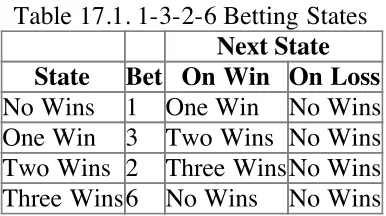
17.1. 1-3-2-6 Betting States
40.2. Blackjack Insurance Collaboration
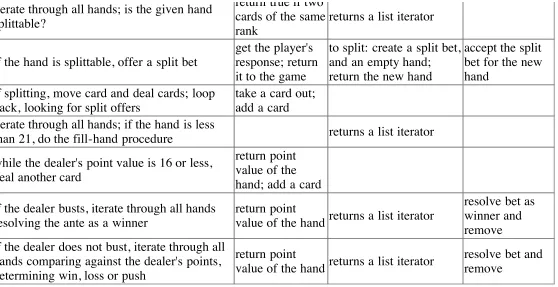
40.3. Blackjack Fill-Hand Collaboration
41.1. Blackjack Player Strategy
List of Examples
1. Typical Python Example
1.1. Sample Java Execution
1.2. Informal Python Unit Test
1.3. Informal Java Unit Test
4.1. Object Identity
4.2. Java Simple toString Implementation
4.3. Java StringBuffer toString Implementation
4.4. Java MessageFormat toString Implementation
5.1. Java Bin Construction
5.2. Python Bin Construction
5.3. Python Appending Outcomes to A Tuple
5.4. Python String Conversion of a Tuple of Outcomes
6.1. Java Subclass Declaration
6.2. Python Subclass Declaration
7.1. Python Localization
13.1. Java Explicit Iteration Through a List of Integers
13.2. Java Compressed Iteration Through a List of Integers
14.1. Java Main Program
15.1. Java Sigma Iteration
15.2. Python Sigma Iteration
15.3. Java Sample Values by Iterator
15.4. Python Sample Values by Iterator
17.1. Java instanceof 17.2. Python player Module
17.3. Python Singleton With Class Variables
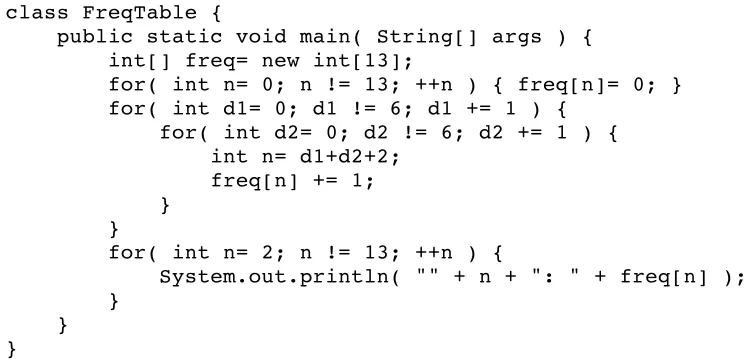
21.1. Python Frequency Distribution
21.2. Java Frequency Distribution
23.1. Java Default Method Arguments via Overloading
23.2. Python Default Method Arguments
23.3. Python Default Mutable Method Arguments
33.1. Java Creation of A Player
37.1. Python Constant Declaration
A.1. testCard.py
A.2. card.py
B.1. card.py - Initial
B.2. card.py - Revised
B.3. testCards.py
C.1. TestCard.java
C.2. Card.java
D.1. card.py
List of Equations
15.1. Basic Summation
15.2. Summation with Half-Open Interval
15.3. Summing Elements of an Array, x
15.4. Mean
15.5. Standard Deviation
Preface
Table of Contents
Why Read This Book? Audience
Organization of This Book Why This Subject?
Programming Style
Conventions Used in This Book Acknowledgements
The present letter is a very long one, simply because I had no leisure to make it shorter. --BLAISE PASCAL , Pensées, The Provincial Letters , provincial letter 16, p. 571.
Why Read This Book?
The coffee-shop answer is to provide the beginning designer with a sequence of interesting and moderately complex exercises in OO design.
Some software developers find themselves stalled when trying to do object-oriented (OO) design. As programmers, they've understood the syntax of a programming language, and pieced together small
examples. However, it is often difficult to take the next step to becoming a designer. Because this transition from guided learning of language features to self-directed design work is often ignored, programmers are left to struggle through their first design projects without appropriate skills or support. While it is critically important to examine examples of good design, a finished product doesn't reveal the author's decision-making process that created the design.
The most notable consequence of this skills gap is the creation of software that is far more complex than necessary to effectively solve a given problem. This, in turn, leads to software with high maintenance costs stemming from the low quality. It also leads to an unfair indictment of OO technology; this is usually voiced as “we tried OO programming and it failed.”
To continue this rant, we also find that some managers are entrusted with significant projects, but are uncomfortable with OO design on modern high-performance hardware. They tend to focus their design energies on the kinds of software architectures that were appropriate when the enterprise owned a single computer, when 64 megabytes of memory was all the enterprise would ever need, and centralized disk storage was charged back to end user departments at a rate of pennies per track per month. In some organizations, there are a few enduring symptoms of this mind set in some of the ways that “end-user computing” is separated from “enterprise computing”; we relegate everything non-mainframe to second class status.
Management discomfort with OO technology surfaces in many ways. One shocking comment was that “no application needs more than six classes.” A consequence of this management attitude is an unrealistic expectation for schedule and the evolution of the deliverables.
The intent of this book is to help the beginning designer by giving you a sequence of interesting and moderately complex exercises in OO design. This book can also help managers develop a level of comfort with the process of OO software development. The applications we will build are a step above trivial, and will require some careful thought and design. Further, because the applications are largely recreational in nature, they are interesting and engaging. This book allows the reader to explore the processes and artifacts of OO design before project deadlines make good design seem impossible.
We hope to prevent managers from saying the following: “We had a good design, but were forced to compromise it to meet our schedule.” As consultants, we find this to be a sad statement of management's emphasis of one near-term goal over long-term value. In one case, this was the result of a series of poorly-informed management decisions compounded on weak design skills. One of the root causes was the inability of the designers and managers to agree to a suitable course of action when a new kind of requirement made devastating changes to an existing design. We believe that more informed managers would have made a decision that created better long-term value.
Audience
Our primary audience is programmers who are new to OO programming. Have you found your first exposure to objects to be more distasteful than empowering? Why does this happen? Some instructors launch into extensive presentations on object orientation before getting to the language fundamentals,
leaving students lost as to how they will accomplish the noble and lofty goals of OO. Other instructors leave OO for last, exposing the procedural side of the language first, and treating objects as a kind of add-on. This leaves students feeling that objects are optional. Additionally, some very skilled instructors are not skilled developers, and will often show examples that don't reflect currently accepted best practices.
Our audience has an exposure to the language, but needs more time to understand objects and object-orientation. We want to provide exercises that have four key features: just complex enough to require
careful design work, just fun enough to be engaging, easy enough that results are available immediately, and can be built in simple stages.
programming language. The student is expected to know the basics of the language and tools.
Helpful additional skills include using one of the various unit test and documentation frameworks available. We've included information in the appendices.
Instructors are always looking for classroom projects that are engaging, comprehensible, and focus on perfecting language skills. Many real-world applications require considerable explanation of the problem domain; the time spent reviewing background information detracts from the time available to do the relevant programming. While all application programming requires some domain knowledge, the idea behind these exercises is to pick a domain that many people know a little bit about. This allows an instructor to use some or all of these exercises without wasting precious classroom time on incidental details required to understand the problem.
This book assumes an introductory level of skill in an OO programming language. We provide specific examples in Java (at least version 1.4) and Python (at least version 2.5). Student skills we expect include the following.
Create source files, compile and run application programs. While this may seem obvious, we don't discuss any integrated development environment (IDE). We have to assume these basic skills are present.
Use of the core procedural programming constructs: variables, statements, exceptions, functions. We will not, for example, spend any time on design of loops that terminate properly.
Some exposure to class definitions and subclasses. This includes managing the basic features of inheritance, as well as overloaded method names. We will avoid Python-unique features like multiple inheritance and callable objects, and focus on that subset of Python features that map directly to Java. For the Python equivalent of overloaded methods, we will assume that Python programmers can make use of default parameter values and named parameters.
Some exposure to the various collections frameworks. For Java programmers, this means the classes in the java.util package. For Python programmers, this means the built-in sequence and mapping types.
Optionally, some experience with a unit testing framework. See the appendices for supplemental exercises if you aren't familiar with Python's unittest or doctest or Java's JUnit.
Optionally, some experience writing formal documentation. For Java programmers, this means javadoc comments. For Python programmers, this often means Epydoc or a similar documentation
package. See the appendices for supplemental exerises if you aren't familiar with formal, deliverable documentation.
Organization of This Book
This book presents a series of exercises to build simulations of the common, popular casino table games:
The interesting degree of freedom in each of the simulations is the player's betting strategy. The design will permit easy adaptation and maintenance of the player's strategies. The resulting application program can be extended by inserting additional betting systems, which allows exploration of what (if any) player actions can minimize the losses.
For Roulette, we proceed slowly, building up the necessary application one class at a time. Since this is the simplest game, the individual classes reflect that simplicity. We focus on isolation of responsibilities,
creating a considerable number of classes. The idea is to build skills in object design by applying those skills to a number of classes.
The first chapter of the part provides details on the game of Roulette and the problem that the simulation solves. The second chapter is an overview of the solution, setting out the highest-level design for the application software. This chapter includes a technique for doing a “walk-through” of the design to be confident that the design will actually solve the problem.
Each of the remaining sixteen chapters is a design and programming exercise to be completed by the student. Plus or minus a Frequently Asked Questions (FAQ) section, each chapter has the same basic structure: an overview of the components being designed, some design details, and a summary of the deliverables to be built. The overview section presents some justification and rationale for the design. This material should help the student understand why the particular design was chosen. The design section provides a more detailed specification of the class or classes to be built. This will include some technical information on Java or Python implementation techniques.
For Craps, we build on the design patterns from Roulette. Craps, however, is a stateful game, so there is a more sophisticated design to handle the interactions between dice, game state and player. We exploit the
State design pattern to show how the design pattern can be applied to this simple situation.
The first chapter is background information on the game of Craps, and the problem that the simulation solves. The second chapter is an overview of the solution, setting out the highest-level design for the application software. This chapter also provides a “walk-through” of the design.
Each of the remaining eleven chapters is an exercise to be completed by the student. Each chapter has the same basic structure: an overview of the component being designed, some design details, and a summary of the deliverables to be built.
The most sophisticated game that we cover here is Blackjack. The game states are more sophisticated than Craps since the available betting opportunities can change with split hands. Further, the player has two kinds of choices: betting opportunities, plus play opportunities. This makes the player's strategy considerably more complex. In casino gift shops, you can buy small summary cards that enumerate all possible game states and responses. The more advanced student can tackle these sophisticated betting strategies. For the less
advanced student we will simplify the strategies down to some simpler conditions.
The first two chapters are background information on the game of Blackjack, the problem that the simulation solves, and an overview of the solution, setting out the highest-level design for the application software. Each of the remaining six chapters is an exercise to be completed by the student. Since this is more
Why This Subject?
Casino table games may seem like an odd choice of subject matter for programming exercises. We find that casino games have a number of advantages for teaching OO design and OO programming.
Casino games have an almost ideal level of complexity. If they were too simple, the house edge
would be too obvious and people would not play them. If they were too complex, people would not enjoy them as simple recreation. Years (centuries?) of experience in the gaming industry has fine-tuned the table games to fit nicely with the limits of our human intellect.
Simulation of discrete phenomena lies at the origin of OO programming. We have found it easier to motivate, explain and justify OO design when solving simulation problems. The student can then leverage this insight into other applications of OO programming for more common transactional applications.
The results are sophisticated but easy to interpret. Probability theory has been applied by others to develop precise expectations for each game. These simulations should produce results consistent with the known probabilities. This book will skim over the probability theory in order to focus on the programming. For a few exercises, the theoretical results will be provided to serve as checks on the correctness of the student's work.
This book does not endorse casino gaming. Indeed, one of the messages of this book is that all casino games are biased against the player. Even the most casual study of the results of the exercises will allow the student to see the magnitude of the house edge in each of the games presented.
Programming Style
We have to adopt a style for each of the languages we're presenting. We won't present a complete set of
coding standards; we will omit a number of issues that should be standardized. Some IT shops have documents they call “coding standards”, but are little more than descriptive style guides. What follows is not this kind of style guide; instead, it is some justification of the style we use for the examples in this book. Just to continune this rant, we find that source code examples speak louder than any gratuitously detailed “specification” of the desired style. We find that some IT organizations waste time trying to write
definitions of the preferred style. A good example trumps the description of the example. In particular, as consultants, we are often asked to provide standards to an inexperienced team of programmers. While the programmers only look at the examples (often cutting and pasting them), some managers prefer to spend money on empty verbiage peripheral to the useful example.
We use Java-centric terminology -- “field” and “method” -- throughout the book. Occaisionally, we will emphasize the differences between Java and Python by using the Python terms “attribute”, “instance variable” or “method function”.
This style of name is only appropriate for primitive types, and doesn't address complex data structures well at all. How does one name a parameter that is a LinkedList of Sets of Outcomes? In Java programs, the variables are formally declared, therefore, we find that we don't need additional cues for their data type. In some cases, prefixes are used to denote the scope of an instance variables. Variable names might include a cryptic one-letter prefix like “f” to denote an instance variable; sometimes programmers will use “my” or “the” as an English-like prefix. We prefer to reduce clutter. In Java, we have the qualifier this. available to disambiguate parameter from instance variable references. In Python, instance variables are always qualified, typically by self., making the scope very clear.
Conventions Used in This Book
Code examples will be minimal, and will include Python and Java. Here is a Python example.
Example 1. Typical Python Example
combo = { }
for i in range(1,7): for j in range(1,7): roll= i+j
combo.setdefault( roll, 0 ) combo[roll] += 1
for n in range(2,13):
print "%d %.2f%%" % ( n, combo[n]/36.0 )
This creates a Python dictionary, a map from key to value. If we initialize it with something like the following: combo = dict( [ (n,0) for n in range(2,13) ] ), we don't need the setdefault
function call below.
This assures that the rolled number exists in the dictionary with a default frequency count of 0. Print each member of the resulting dictionary. Something more obscure like [ (n,combo[n]/36.0) for n in range(2,13)] is certainly possible.
The output from the above program will be shown as follows:
2 0.03% 3 0.06% 4 0.08% 5 0.11% 6 0.14% 7 0.17% 8 0.14% 9 0.11% 10 0.08% 11 0.06% 12 0.03%
Tool completed successfully
Most of the design specifications will provide Java-style method and variable descriptions. Python doesn't use type specifications, and Python programmers will have to translate the Java specifications into Python by removing the type names.
Sidebars
When we do have a significant digression, it will appear in a sidebar, like this.
Tip
There will be design tips, and warnings, in the material for each exercise. These reflect considerations and lessons learned that aren't typically clear to starting OO designers.
Acknowledgements
We would like to thank Chuck Pyrak for putting us up to this. His idea of a One Room Schoolhouse to teach Java to an audience at multiple skill levels was a great idea. Additionally, our colleagues who collaborated through BLOKI brought infinte wisdom and insight to a complex and difficult project. Thanks to Dion Dock for detailed, thoughtful comments.
Chapter 1. Foundations
Table of Contents
Problem Statement The Use Case Solution Approach
Methodology, Technique and Process
On Quality On Rework
On Decision-Making On Reuse
On Design Patterns
Deliverables
We'll set our goal by presenting several elements that make up a complete problem statement: a context in which the problem arises, the problem, the forces that influence the choice of solution, the solution that balances the forces, and some consequences of the chosen solution.
We will summarize the approach to the solution, describing the overall strategy that we will follow. This is a kind of overall design pattern that we'll use to establish some areas of responsibility.
We will also describe the technical foundations. In this case, they are not terribly complex, but this is an important part of describing any software solution, no matter how simple.
We will dance around the methodology issue. Our intent is not to sell a particular methodology, but to provide some perspective on how we broke the work into manageable pieces.
Finally, we'll present some important parts of getting started on the solution. These are more specific, technical considerations that define common aspects of our approach.
Problem Statement
Context. Our context is the “classic” casino table games played against the house, including Roulette, Craps and Blackjack. We want to explore the consequences of various betting strategies for these casino games. Questions include “How well does the Cancellation strategy work?” “How well does the Martingale strategy works for the Come Line odds bet in Craps?” “How well does this Blackjack strategy I found on the Internet compare with the strategy card I bought in the gift shop?”
A close parallel to this is exploring variations in rules and how these different rules have an influence on outcomes. Questions include “What should we do with the 2x and 10x odds offers in Craps?” “How should we modify our play for a single-deck Blackjack game with 6:5 blackjack odds?”
Our context does not include exploring or designing new casino games. Our context also excludes multi-player games like poker. We would like to be able to include additional against-the-house games like Pai Gow Poker, Caribbean Stud Poker, and Baccarat.
Problem. Our problem is to answer the following question: For a given game, what player strategies produce the best results?
Forces. There are a number of forces that influence our choice of solution. First, we want an application that is relatively simple to build. Instead of producing an interactive user interface, we will produce raw data and statistical summaries. If we have little interaction, a command-line interface will work perfectly. We can have the user specify a player strategy and the application respond with a presentation of the results. If the results are tab-delimited, they can be pasted into a spreadsheet for further analysis.
Another force that influences our choice of solution is the need to be platform and language agnostic. In this case, we have selected an approach that works well on POSIX-compliant operating systems (i.e., Linux, MacOS, and all of the proprietary UNIX variants), and also works on non-compliant operating systems (i.e., all of the Windows versions). We have chosen two OO languages that work identically on both platform families: Java and Python.
Another force is the desire to reflect actual game play. While a long-running simulation of thousands of invidual cycles of play will approach the theoretical results, people typically don't spend more than a few hours at a table game. If, for example, a Roulette wheel is spun once each minute, a player is unlikely to see more that 480 spins in an 8-hour evening at a casino. Additionally, many players have a fixed budget, and the betting is confined by table limits. Finally, we need to address the subject of “money management”: a player may elect to stop playing when they are ahead. This structures our statistical analysis: we must simulate sessions of play that are limited in time, the amount lost and the amount won.
Solution. Our overall goal is to produce an application that allows us to experiment with different casino game betting strategies. We'll build a simple, command-line simulator that provides a reliable, accurate model of the game. We need to be able to easily pick one of a variety of player betting strategies, play a number of simulated rounds of the game, and produce a statistical summary of the results of that betting strategy.
Consequences. One of the most important consequences of our solution is that we will build an application into which new player betting strategies can be inserted. Clever gamblers invent new strategies all the time. We will not know all of the available strategies in advance, so we will not be able to fully specify all of the various design details in advance. Instead, we will find ourselves reworking some parts of the solution, to support a new player betting strategy. This forces us to take an agile approach to the design and
implementation.
The Use Case
We have a single, small use case. We have some opinions on what makes a useful use case in our Soapbox on Use Cases. There is a single actor, the “investigator”. The actor's goal is to see the expected results of using a particular strategy for a particular game. The typical scenario is the following.
Procedure 1.1. Basic Use Case
1. Actor
Specifies which game and betting strategy to test. The strategy may need additional parameters, like an initial budget, or stake. The game may require additional parameters, like betting limits.
2. System
Responds with a statistical summary of the outcomes after a fixed number of cycles (spins, or throws or hands). The number of cycles needs to be small (on the order of 200, to reflect only a few hours of play).
Soapbox on Use Cases
We feel that the use case technique is badly abused by some IT organizations. Quoting from
transactions. A use case will be a kind of system test specification. A use case will define the system's behavior, and define why an actor bothers to interact with it.
A use case is not a specification, and does not replace ordinary design. We have had experiences with customers who simply retitle their traditional procedural programming specifications as “use cases”. We hypothesize that this comes from an unwillingness to separate problem definition from solution definition. The consequence is a conflation of use case, technical background, design and programming specifications into gargantuan
documents that defy the ability of programmers or users to comprehend them.
There are a number of common problems with use cases that will make the design job more difficult. Each of these defects should lead to review of the use case with the authors to see what, if anything, they can do to rework the use case to be more complete.
No Actor. Without an actor, it's impossible to tell who is getting value from the interaction. A catch-all title like “the user” indicates a use case written from the point of view of the database or the application software, not an actual person. An actor can be an interface with other software, in which case, the actual software needs to be named. Without knowing the actor, you will have trouble deciding which classes are clients and which classes provide the lower-level services of the application.
No Value Proposition. There are two basic kinds of value: information for decision-making or actions taken as the result of decision-decision-making. People interact with software because there are decisions the software cannot make or there are actions the actor cannot make. Some use cases include value-less activities like logging in, or
committing a transaction, or clicking “Okay” to continue. These are parts of operating
scenarios, not statements of value that show how the actor is happier or more
successful. Without a value proposition, you will have no clue as to what problem the software solves, or what it eventually does for the actor.
No Interactions. If the entire body of the use case is a series of steps the application performs, we are suspicious of the focus. We prefer a use case to emphasize interaction with the actor. Complex algorithms or interface specifications should be part of an appendix or supplemental document. Without any interaction, it isn't clear how the actor uses the software.
We also try to make a distinction between detailed operating scenarios and use cases. We have seen customers write documents they call “detailed use cases” that describe the behavior of individual graphical user interface widgets or panels. We prefer to call these scenarios, since they don't describe measuable business value, but instead describe technical interactions.
This system use case is embedded in an overall cycle of investigation that forms a kind of business use case. From this overall view, the actor's goal is to find an optimal strategy for a given game. The procedure
includes the following steps.
1. Actor
Researches alternative strategies. Uses IDE to build new classes. 2. IDE
Creates new classes for the simulator. 3. Actor
Uses the Basic Use Case. Runs the simulator with selection of game and strategy. 4. Simulator
Responds with statistical results. 5. Actor
Evaluates the results. Uses a spreadsheet or other tool for analysis and visualization.
We are addressing parts of this larger business use case. While not describing the detailed “how-to” of using the IDE to build the new classes, we will address the design of those new classes. Additionally, we won't address how to analyze the results.
Solution Approach
From reading the problem and use case information, we can identify at least the following four general elements to our application.
The game being simulated. This includes the various elements of the game: the wheel, the dice, the cards, the table and the bets.
The player being simulated. This includes the various decisions the player makes based on the state of the game, and the various rules of the betting system the player is following.
The statistics being collected.
An overall control component which processes the game, collects the statistics and writes the details or the final summary.
When we look at common design patterns, the Model-View-Control pattern often helps to structure applications. A more sophisticated, transactional application may require a more complex structure.
However, in this case, the game, the player, and the statistics are the model. The command line selection of player and the reporting of raw data is the view. The overall control component creates the various objects to start the simulation.
While interesting, we will not pursue the design of a general-purpose simulation framework. Nor will we use any of the available general frameworks. While these are handy and powerful tools, we want to focus on developing application software “from scratch” as a learning exercise.
build a new version of the application program. Once the application is built, the actor can run the application from the command line, collecting the output file. The statistical results file can be analyzed using a spreadsheet application. There are at least three separate application programs involved: the IDE (including editor and compiler), the simulator, the spreadsheet used for analysis.
A typical execution of the simulator will look like the following example.
Example 1.1. Sample Java Execution
java casino.MainCrapsSim --Dplayer.name="Player1326" >details.log
We select the main simulator control using the package casino and the class MainCrapsSim. We define the player to use Player1326. The main method will use this parameter to create objects
and execute the simulation.
We collect the raw data in a file named details.log.
We are intentionally limiting our approach to a simple command-line application using the default language libraries. Avoiding additional libraries assures a “lowest-common denominator” multi-platform application. For Java, this standard is the J2SE set of libraries; we won't use any J2EE extensions. For Python, it is the base installation.
There are a number of more technical considerations that we will expand in the section called
“Deliverables”. These include the use of an overall simulation framework and an approach for unit testing. Among the topics this book deals with in a casual -- possibly misleading -- manner are probability and statitics. Experts will spot a number of gaps in our exposition. For example, there isn't a compelling need for simulation of the simpler games of Craps and Roulette, since they can be completely analyzed. However, our primary objective is to study programming, not casino games, therefore we don't mind solving known problems again. We are aware that our statistical analysis has a number of deficiencies. We will avoid any deeper investigation into statistics.
Methodology, Technique and Process
We want to focus on technical skills; we won't follow any particular software development methodology too closely. We hesitate to endorse a specific methodology; doing so inevitably alienates readers who embrace a different methodology. To continue this rant, we find that almost everyone has an existing notion of the proper way to organize software development work. This leads to the common practice of customizing methodologies, in most cases without a deep background in the methodology or the changes being made. We prefer to lift up a few techniques which have a great deal of benefit.
Incremental Development. Each chapter is a "sprint" that produces some collection of deliverables. Each part is a complete release.
Embedded Documentation. We provide appendices on how to use Epydoc or javadoc to create usable API documents.
The exercises are presented as if we are doing a kind of iterative design with very, very small deliverables. We present the exercises like this for a number of reasons.
First, we find that beginning designers work best with immediate feedback on their design decisions. While we present the design in considerable detail, we do not present the final code. Programmers new to OO design will benefit from repeated exposure to the transformation of problem statement through design to code.
Second, for iterative or agile methodologies, this presentation parallels the way software is developed. A project manager may use larger collections of deliverables. However, the actual creation of functional source eventually decomposes into classes, fields and methods. For project managers, this exposition will help them see where and how rework can occur; giving them a chance to plan for the kind of learning that occur in most projects.
Third, for project teams using a strict waterfall methodology -- with all design work completed before any programming work -- the book can be read in a slightly different order. From each exercise chapter, read only the overview and design sections. From that information, integrate the complete design. Then proceed through the deliverables sections of each chapter, removing duplicates and building only the final form of the deliverables based on the complete design. This will show how design rework arises as part of a waterfall methodology.
We try to embrace a variety of deliverables in addition to working source code. In particular, we expect unit test classes in addition to the functional classes. Further, we expect Javadoc comments or Python docstrings in each class. Additionally, we will need to write some demonstration classes in order to determine the exact sequence of random numbers that are created from a specific seed; these are not deliverable as part of the final application, but will be necessary to construct proper unit tests.
This section addresses a number of methodology or process topics: Quality, in general
Rework
Technical Decision-Making Reuse
Design Patterns
On Quality
categories reasonably well.
Need Satisfaction. Does the software meet the need? We start with a problem statement, define the use case, and then write software which is narrowly focused on the actor's needs. By developing our application in small increments, we can ask ourself at each step, "Does this meet the actor's needs?" It's fairly easy to keep a software development project focused when we have use cases to describe our goals.
Performance. We don't address this specifically in this book. However, the presence of extensive unit tests allows us to alter the implemention of classes to change the overall performance of our
application. As long as the resulting class still passes the unit tests, we can develop numerous alternative implementations to optimize speed, memory use, input/output, or any other resource.
Maintenance. Software is something that is frequently changed. It changes when we uncover bugs. More commonly, it changes when our understanding of the problem, the actor or the use case
changes. In many cases, our initial solution merely clarifies the actor's thinking, and we have to alter the software to reflect a deeper understanding of the problem.
Maintenance is just another cycle of the iterative approach we've chosen in this book. We pick a feature, create or modify classes, and then create or modify the unit tests. In the case of bug fixing, we often add unit tests to demonstrate the bug, and then fix our classes to pass the revised unit tests.
Adaptation. Adaptation refers to our need to adapt our software to changes in the environment. The environment includes interfaces, the operating system or platform, even the number of users is part of the environment. When we address issues of interoperability with other software, portability to new operating systems, scalability for more users, we are addressing adaptation issues.
We chose Python and Java to avoid having interoperability and portability issues — these platforms give admirable support for many scalability issues. Generally, a well-written piece of software can be reused. While this book doesn't focus on reuse, Java and Python are biased toward writing reusable software.
Organizational. There are some organizational quality factors: cost of ownership and productivity of the developers creating it. We don't address these directly. Our approach, however, of developing software incrementally often leads to good developer productivity.
Our approach (Incremental, Unit Testing, Embedded Documentation) assures high quality in four of the five quality areas. Incremental development is a way to focus on need satisfaction. Unit testing helps us optimize resource use, and do maintenance well. Our choices of tools and platforms help us address adaptation. The organizational impact of these techniques isn't so clear. It is easy to mis-manage a team and turn incremental development into a quagmire of too much planning for too little delivered software. It is all too common to declare that the effort spent writing unit test code is "wasted".
Ultimately, this is a book on OO design. How people organize themselves to build software is beyond our scope.
In the section called “Problem Statement”, we described the problem. In the section called “Solution Approach”, we provided an overview of the solution. The following parts will guide you through an incremental design process; a process that involves learning and exploring. This means that we will coach you to build classes and then modify those classes based on lessons learned during later steps in the design process. See our Soapbox on Rework for an opinion on the absolute necessity for design rework.
We don't simply present a completed design. We feel that it is very important follow a realistic problem-solving trajectory so that beginning designers are exposed to the decisions involved in creating a complete design. In our experience, all problems involve a considerable amount of “learn as you go”. We want to reflect this in our series of exercises. In many respects, a successful OO design is one that respects the degrees of ignorance that people have when starting to build software. We will try to present the exercises in a way that teaches the reader how to manage ignorance and still develop valuable software.
Soapbox on Rework
We consider design rework to be so important, we will summarize the idea here.
Important
The best way to learn is to make mistakes. Rework is a consequence of learning.
All of software development can be described as various forms of knowledge capture. A project begins with many kinds of ignorance and takes steps to reduce that ignorance. Some of those steps should involve revising or consolidating previous learnings.
A project without rework is suspiciously under-engineered.
For some, the word rework has a negative connotation. If you find the word distasteful, please replace every occurance with any of the synonyms: adaptation, evolution, enhancement, mutation. We prefer the slightly negative connotation of the word rework because it helps managers realize the importance of incremental learning and how it changes the requirements, the design and the resulting software.
Since learning will involve mistakes, good management plans for the costs and risks of those mistakes. Generally, our approach is to manage our ignorance; we try to create a design such that correcting a mistake only fixes a few classes.
We often observe denial of the amount of ignorance involved in creating IT solutions. It is sometimes very difficult to make it clear that if the problem was well-understood, or the solution was well-defined there would be immediately applicable off-the-shelf or open-source solutions. The absence of a ready-to-hand solution generally means the problem is hard. It also means that there are several degrees of ignorance: ignorance of the problem, solution and technology; not to mention ignorance of the amount of ignorance involved in each of these areas.
is that they find learning OO design is difficult and frustrating. Our advice is that since this is new, you have to make mistakes or you won't learn effectively. Allow yourself to explore and make mistakes; feel free to rework your solutions to make them better. Above all, do not attempt to design a solution that is complete and perfect the very first time. We can't emphasize enough the need to do design many times before understanding what is important and what is not important in coping with ignorance.
In one advanced programming course, we observed the following sad scenario. The instructor provided an excellent background in how to create abstract data type (ADT) definitions for the purely mathematical objects of scalar, vector and matrix. The idea was to leverage the ADTs to implement more complex
operations like matrix multiplication, inversion and Gaussian elimination. The audience, primarily engineers, seemed to understand how this applied to things they did every day. The first solution, presented after a week of work, began with the following statement: “Rather than think it through from the basic definitions of matrix and vector, I looked around in my drawer and found an old FORTRAN program and rewrote that, basically transliterating the FORTRAN.” We think that a lack of experience in the process of software design makes it seem that copying an inappropriate solution is more effective than designing a good solution from scratch.
Managers. For managers, experienced in non-object implementation, the design rework appears to be contrary to a fanciful expectation of reduced development effort from OO techniques. The usual form for the complaint is the following: “I thought that OO design was supposed to be easier than non-OO design.” We're not sure where the expectation originates, but good design takes time, and learning to do good design seems to require making mistakes. Every project needs a budget for making the necessary mistakes,
reworking bad ideas to make them good and searching for simplifications.
Methodology. Often, management attempts the false economy of minimizing rework by resorting to a
waterfall methodology. The idea is that having the design complete before attempting to do any
development prevents design rework. We don't see that this waterfall approach minimizes rework; rather, we see it shifting the rework forward in the process. There are two issues ignored by this approach: how we grow to understand the problem domain and providing an appropriate level of design detail.
We find that the initial “high-level” design can miss details of the problem domain, and this leads to rework. Forbidding rework amounts to mandating a full understanding of the problem. In most cases, our users do not fully understand their problem any more than our developers understand our users. Generally, it is very hard to understand the problem, or the solution. We find that hands-on use of preliminary versions of software can help more than endless conversations about what could be built.
In the programming arena, we find that Java and Python (and their associated libraries) are so powerful that detailed design is done at the level of individual language statements. This leads us to write the program either in English prose or UML diagrams (sometimes both) before writing the program in the final programming language. We often develop a strong commitment to the initial design, and subsequent
revisions are merely transliterations with no time permitted for substantial revisions. While we have written the program two or three times over, the additional quality isn't worth doubling or tripling the workload. We feel that the original workload should be managed as planned cycles of work and rework.
On Decision-Making
hand-wringning over nuances. While this is true to an extent, we need to emphasize our technique for doing appropriate hand-wringing over OO design. We call it “Looking For The Big Simple”, and find that managers don't often permit the careful enumeration of all the alternatives and the itemization of the pros and cons of each choice. We have worked with managers who capriciously play their “schedule” or “budget” trump cards, stopping useful discussion of alternatives. This may stem from a fundamental discomfort with the technology, and a consequent discomfort of appearing lost in front of team members and direct reports. Our suggestion in this book can be summarized as follows:
Important
Good OO design comes from a good process for technical decision-making.
First, admit what we don't know, and then take steps to reduce our degrees of ignorance. Which means not saying “work smarter not harder” unless we also provide the time and budget to actually get smarter. The learning process, as with all things, must be planned and managed. Our lesson learned from Blaise Pascal is that a little more time spent on design can result in considerable simplification, which will reduce development and maintenance costs. It's also important to note that no one in the real world is omniscient. Some of the exercises include intentional dead-ends. As a practical matter, we can rarely foresee all of the consequences of a design decision.
On Reuse
While there is a great deal of commonality among the three games, the exercises do not start with an emphasis on constructing a general framework. We find that too much generalization and too much
emphasis on reuse is not appropriate for beginning object designers. See Soapbox on Reuse for an opinion on reuse. Additionally, we find that projects that begin with too-lofty reuse goals often fail to deliver valuable solutions in a timely fashion. We prefer not to start out with a goal that amounts to boiling the ocean to make a pot of tea.
Soapbox on Reuse
While a promise of OO design is reuse, this needs to be tempered with some pragmatic considerations. There are two important areas of reuse: reusing a class specification to create objects with common structure and behavior, and using inheritance to reuse structure and behavior among multiple classes of objects. Beyond these two areas, reuse can create more cost than value.
The first step in reuse comes from isolating responsibilities to create classes of objects. Generally, a number of objects that have common structure and behavior is a kind of reuse. When these objects cooperate to achieve the desired results, this is sometimes called
emergent behavior: no single class contains the overall functionality, it grew from the interactions among the various objects.
them in the next revision of the application. This reduces the cost and risks associated with software change. Class definitions are the most fundamental and valuable kind of reuse. Another vehicle for OO resuse is inheritance. The simple subclass-superclass relationship yields a form of reuse; a class hierarchy with six subclasses will share the superclass code seven times over. This, by itself, has tremendous benefits.
We caution against any larger scope of reuse. Sharing classes between projects may or may not work out well. The complexity of achieving inter-project reuse can be paralyzing to first-time designers. Often, different projects reflect different points of view, and the amount of sharing is limited by these points of view. As an example, consider a product in a business context. An external customer's view of the product (shaped by sales and marketing) may be very different from the internal views of the same product. Internal views of the product (for example, finance, legal, manufacturing, shipping, support) may be very different from each other. Reconciling these views may be far more challenging than a single software
development project. For that reason, we don't encourage this broader view of reuse.
On Design Patterns
These exercises will refer to several of the “Gang of Four” design patterns in Gamma95. The Design Patterns book is not a prerequisite; we use it as reference material to provide additional insight into the design patterns used here. We feel that use of common design patterns significantly expands the
programmer's repertoire of techniques. We note where they are appropriate, and provide some guidance in their implementation.
In addition, we reference several other design patterns which are not as well documented. These are, in some cases, patterns of bad design more than patterns of good design.
Deliverables
Each chapter defines the classes to be built and the unit testing that is expected. A third deliverable is merely implied. The purpose of each chapter is to write the source files for one or more classes, the source files for one or more unit tests, and assure that a minimal set of API documentation is available.
Source Files. The source files are the most important deliverable. In effect, this is the working application program. Generally, you will be running this application from within your Integrated Development
Environment (IDE). You may want to create a stand-alone program.
In the case of Java, we might also deliver the collection of class files. Additionally, we might bundle the class files into an executable JAR file. The source is the principle deliverable; anyone should be able to produce class and JAR files using readily available tools.
In the case of Python, it's the packages of .py files. There really isn't much more to deliver. The interested
student might want to look at the Python distutils and setuptools to create a distribution kit, or possibly
a Python egg file.
addition to the classes to be built. We feel that unit testing is a critical skill, and emphasize it throughout the inividual exercises. We don't endorse a particular technology for implementing the unit tests. There are several approaches to unit testing that are in common use.
Formal Unit Tests. For formal testing of some class, X, we create a separate class, TestX, which
creates instances of X and exercises those instances to be sure they work. In Java, this is often done
with JUnit. In Python, the unittest module is the mechanism for doing formal unit tests.
Additionally, many Python developers also use the doctest module to assure that the sample code in
the docstrings is actually correct. We cover these technologies in the appendices.
Informal Unit Tests. This is often done by include a main program in the class definition file. We'll show two examples of this. By following the standard unit test naming conventions, these informal tests can be easily upgraded to more formal JUnit or PyUnit tests.
In Python, an informal is done by including the following block of code section in a module file. Each test method must have a name that starts with “test” to be compatible with the Python PyUnit module.
Example 1.2. Informal Python Unit Test
def testX():
test procedure X goes here
def testY():
test procedure Y goes here
if __name__ == "__main__": testX()
testY()
In Java, this is done by putting public static void main(String[] args); in the class source file.
Each test method must have a name that starts with “test” to be compatible with the Java JUnit package.
Example 1.3. Informal Java Unit Test
class SomeClass {
public static void main( String[] args ) { SomeClass x= new SomeClass();
x.testX(); x.testY(); }
public void testX() {
test procedure X goes here
}
public void testY() {
test procedure Y goes here
}
}
programmers can use the javadoc tool to create documentation from the program source. Python programmers can use Epydoc to create similar documentation.
Roulette
This part describes the game of Roulette. Roulette is a stateless game with numerous bets and a very simple process for game play.
The chapters of this part present the details on the game, an overview of the solution, and a series of sixteen exercises to build a complete simulation of the game, plus a variety of betting strategies. Each exercise chapter builds at least one class, plus unit tests; in some cases, this includes rework of previous deliverables.
Table of Contents
2. Roulette Details
Roulette Game Available Bets
Some Betting Strategies
3. Roulette Solution Overview
Preliminary Survey of Classes A Walkthrough of Roulette Questions and Answers
4. Outcome Class
Overview Design
Fields
Constructors Methods
Deliverables
5. Bin Class
Overview
Java Collections Python Collections
Fields
Constructors Methods
Python Design
Fields
Constructors Methods
Deliverables
6. Wheel Class
Overview Design
Fields
Constructors Methods
Deliverables
7. Bin Builder Class
Overview Algorithms Design
Constructors Methods
Deliverables
8. Bet Class
Overview
Questions and Answers Design
Fields
Constructors Methods
Deliverables
9. Roulette Table Class
Design
InvalidBet Exception Table Class
Deliverables
10. Roulette Game Class
Overview Design
Passenger57 Class Roulette Game Class
Questions and Answers Deliverables
11. Review of Testability
Overview
Questions and Answers Design
Wheel Rework
Java NonRandom Class Python NonRandom Class
Deliverables
12. Player Class
Overview Design
Player superclass Martingale Player
Deliverables
13. Overall Simulation Control
Overview Design
Fields
Deliverables
14. Player SevenReds
Overview Design
Fields Methods
Deliverables
15. Statistical Measures
Overview
Some Foundations Statistical Algorithms Design
Constructors Methods
Deliverables
16. Player Random
Overview Design
Fields
Constructors Methods
Deliverables
17. Player 1-3-2-6
Overview
Questions and Answers Design
Player1326 State Player1326 No Wins Player1326 One Win Player1326 Two Wins Player1326 No Wins Player1326
Advanced Exercise
Singleton Design in Java Singleton Design in Python
18. Player Cancellation
Overview Design
Fields
Constructors Methods
Deliverables
19. Player Fibonacci
Overview Design
Fields
Constructors Methods
Deliverables
20. Conclusion
Chapter 2. Roulette Details
Table of Contents
Roulette Game Available Bets
Some Betting Strategies
In the first section we will present a summary of the game of Roulette as played in most American casinos. We will follow this with a review the various bets available on the Roulette table in some depth. The
definition of the various bets is an interesting programming exercise, and the first four exercise chapters will focus on this.
Roulette Game
The game of Roulette centers around a wheel with thirty-eight numbered bins. The numbers include 0, 00 (double zero), 1 through 36. The table has a surface marked with spaces on which players can place bets. The spaces include the 38 numbers, plus a variety of additional bets, which will be detailed below. After the bets are placed by the players, the wheel is spun by the house, a small ball is dropped into the spinning wheel; when the wheel stops spinning, the ball will come to rest in one of the thirty-eight numbered bins, defining the winning number. The winning number and all of the related winning bets are paid off; the losing bets are collected. Roulette bets are all paid off using odds, which will be detailed with each of the bets, below.
The numbers from 1 to 36 are colored red and black in an arbitrary pattern. They fit into various ranges, as well as being even or odd, which defines many of the winning bets related to a given number. The numbers 0 and 00 are colored green, they fit into none of the ranges, and are considered to be neither even nor odd. There are relatively few bets related to the zeroes. The geometry of the betting locations on the table defines the relationships between number bets.
Note
There are slight variations in Roulette between American and European casinos. We'll focus strictly on the American version.
Available Bets
There are a variety of bets available on the Roulette table. Each bet has a payout, which is stated as n:1 where n is the multiplier that defines the amount won based on the amount bet.
A $5 bet at 2:1 will win $10. After you are paid, there will be $15 sitting on the table, your original $5 bet, plus your $10 additional winnings.
Note
Roulette Table Layout
The table is divided into two classes of bets. The “inside” bets are the 38 numbers and small groups of numbers; these bets all have relatively high odds. The “outside” bets are large groups of numbers, and have relatively low odds. If you are new to casino gambling, see Odds and Payouts for more information on odds and why they are offered.
A “straight bet” is a bet on a single number. There are 38 possible bets, and they pay odds of 35 to 1. Each bin on the wheel pays one of the straight bets.
A “split bet” is a bet on an adjacent pair of numbers. It pays 17:1. The table layout has the numbers arranged sequentially in three columns and twelve rows. Adjacent numbers are in the same row or column. The number 5 is adjacent to 4, 6, 2, 8; the number 1 is adjacent to 2 and 4. There are 114 of these split bet combinations. Each bin on the wheel pays from two to four of the available split bets. Any of two bins can make a split bet a winner.
A “street bet” includes the three numbers in a single row, which pays 11:1. There are twelve of these bets on the table. A single bin selects one street bet; any of three bins make a street bet a winner. A square of four numbers is called a “corner bet” and pays 8:1. There are 72 of these bets available. At one end of the layout, it is possible to place a bet on the Five numbers 0, 00, 1, 2 and 3. This pays 6:1. It is the only combination bet that includes 0 or 00.
The following bets are the “outside” bets. Each of these involves a group of twelve to eighteen related numbers. None of these outside bets includes 0 or 00. The only way to bet on 0 or 00 is to place a straight bet on the number itself, or use the five-number combination bet.
Any of the three 12-number ranges (1-12, 13-24, 25-36) pays 2:1. There are just three of these bets. The layout offers the three 12-number columns at 2:1 odds. All of the numbers in a given column have the same remainder when divided by three. Column 1 contains 1, 4, 7, etc., all of which have a remainder of 1 when divided by 3.
There are two 18-number ranges: 1-18 is called low, 19-36 is called high. These are called even money bets because they pay at 1:1 odds.
The individual numbers are colored red or black in an arbitrary pattern. Note that 0 and 00 are colored green. The bets on red or black are even money bets, which pay at 1:1 odds.
The numbers (other than 0 and 00) are also either even or odd. These bets are also even money bets.
Odds and Payouts
Not all of the Roulette outcomes are equal probability. Let's compare a “split bet” on 1-2 and a even money bet on red.
The split bet wins if either 1 or 2 comes up on the wheel. This is 2 of the 38 outcomes, or a 1/19 probability, 5.26%.
The red bet wins if any of the 18 red numbers come up on the wheel. The is 18 of the 38 outcomes, or a 9/19 probability, 47.4%.
Clearly, the red bet is going to win almost ten times more often than the 1-2 bet. As an inducement to place bets on rare occurences, the house offers a higher payout on those bets. Since the 1-2 split bet wins is so rarely, they will pay you 17 times what you bet. On the other hand, since the red bet wins so frequently, they will only pay back what you bet. You'll notice that the odds of winning the 1-2 split bet is 1 chance in 19, but they pay you 17 times your bet. Since your bet is still sitting on the table, it looks like 18 times your bet. It still isn't 19 times your bet. This discrepency between the actual probability and the payout odds is sometimes called the house edge. It varies widely among the various bets in the game of Roulette. For example, the 5-way bet has 5/38 ways of winning, but pays only 6:1. There is only a 13.2% chance of winning, but they pay you as if you had a 16.7% chance, keeping the 3.5% difference. You have a 5.26% chance to win a split bet, but the house pays as if it were a 5.88% chance, a .62% discrepency in the odds.
The smallest discrepency between actual chances of winning (47.4%) and the payout odds (50%) is available on the even money bets: red, black, even, odd, high or low. All the betting systems that we will look at focus on these bets alone, since the house edge is the smallest.
Some Betting Strategies
OO design exercises. Feel free to research additional betting systems or invent your own.
The Martingale system starts with a base wagering amount, w, and a count of the number of losses, c, initially 0. Each loss doubles the bet; any given spin will place an amount of w*2 c on a 1:1 proposition (for example, red). When a bet wins, the loss count is reset to zero; resetting the bet to the base amount, w. This assures that a single win will recoup all losses.
Note that the casinos effectively prevent successful use of this system by imposing a table limit. At a $10 Roulette table, the limit may be as low as $1,000. A Martingale bettor who lost six times in a row would be facing a $640 bet, and after the seventh loss, their next bet would exceed the table limit. At that point, the player is unable to recoup all of their losses. Seven losses in a row is only a 1 in 128 probability; making this a relatively likely situation.
Another system is to wait until some number of losses have elapsed. For example, wait until the wheel has spun seven reds in a row, and then bet on black. This can be combined with the Martingale system to double the bet on each loss as well as waiting for seven reds before betting on black.
Another betting system is called the 1-3-2-6 system. The idea is to avoid the doubling of the bet at each loss and running into the table limit. Rather than attempt to recoup all losses in a single win, this system looks to recoup all losses by waiting for four wins in a row. The sequence of numbers (1, 3, 2 and 6) are the
multipliers to use when placing bets after winning. At each loss, the sequence resets to the multiplier of 1. At each win, the multiplier is advanced through the sequence. After one win, the bet is now 3w. After a second win, the bet is reduced to 2w, and the winnings of 4w are “taken down” or removed from play. In the event of a third win, the bet is advanced to 6w. Should there be a fourth win, the player has doubled their money, and the sequence resets.
Another method for tracking the lost bets is called the Cancellation system or the Labouchere system. The player starts with a betting budget allocated as a series of numbers. The usual example is 1, 2, 3, 4, 5, 6, 7, 8, 9. Each bet is sum of the first and last numbers in the last. In this case 1+9 is 10. At a win, cancel the two numbers used to make the bet. In the event of all the numbers being cancelled, reset the sequence of numbers and start again. For each loss, however, add the amount of the bet to the end of the sequence as a loss to be recouped.
Here's an example of the cancellation system using 1, 2, 3, 4, 5, 6, 7, 8, 9. 1. Bet 1+9. A win. Cancel 1 and 9 leaving 2, 3, 4, 5, 6, 7, 8.
2. Bet 2+8. A loss. Add 10 leaving 2, 3, 4, 5, 6, 7, 8, 10. 3. Bet 2+10. A loss. Add 12 leaving 2, 3, 4, 5, 6, 7, 8, 10, 12. 4. Bet 2+12. A win. Cancel 2 and 12 leaving 3, 4, 5, 6, 7, 8, 10. 5. Next bet will be 3+10.
A player could use the Fibonacci Sequence to structure a series of bets in a kind of cancellation system. The Fibonacci Sequence is 1, 1, 2, 3, 5, 8, 13, .... At each loss, the sum of the previous two bets -- the next
sequence are removed. This allows the player to easily track our accumulated losses, with bets that could recoup those losses through a series of wins.
Chapter 3. Roulette Solution Overview
Table of Contents
Preliminary Survey of Classes A Walkthrough of Roulette Questions and Answers
The first section is a survey of the classes gleaned from the general problem statement in Problem Statement
as well as the problem details in Roulette Details. This survey is drawn from a quick overview of the key nouns in these sections.
Given this survey of the candidate classes, the second section is a walkthrough of the possible design that will refine the definitions, and give us some assurance that we have a reasonable architecture. We will make some changes to the preliminary class list, revising and expanding on our survey.
We will also include a number of questions and answers about this preliminary design information. This should help clarify the design presentation and set the stage for the various development exercises in the chapters that follow.
Preliminary Survey of Classes
To provide a starting point for the development effort, we have to identify the objects and define their responsibilities. The central principle behind the allocation of responsibility is encapsulation; we do this by attempting to isolate the information or isolate the processing that must be done. Encapsulation assures that the methods of a class are the exclusive users of the fields of that class. It also makes each class very
loosely coupled with other classes; this permits change without a ripple through the application. For
example, each Outcome contains both the name and the payout odds. That way each Outcome can be used to compute a winning amount, and no other element of the simulation needs to share the odds information or the payout calculation.
In a few cases, we have looked forward to anticipate some future considerations. One such consideration is the house “rake”, also known as the “vigorish”, “vig”, or commission. In some games, the house makes a 5% deduction from some payouts. This complexity is best isolated in the Outcome class. Roulette doesn't have any need for a rake, since the presence of the 0 and 00 on the wheel gives the house a little over 5% edge on each bet. We'll design our class so that this can be added later when we implement Craps.
In reading the background information and the problem statement, we noticed a number of nouns that seemed to be important parts of the game we are simulating.
Table Red Black Green Number Odds Player House
One common development milestone is to be able to develop a class model in the Unified Modeling
Language (UML) to describe the relationships among the various nouns in the problem statement. Building (and interpreting) this model takes some experience with OO programming. In this first part, we'll avoid doing extensive modeling. Instead we'll simply identify some basic design principles. We'll focus in on the most important of these nouns and de