Abstract—This study presents a method to determine
weights of objectives in multi objective linear programming without decision maker/s preference. The method is developed by modifying Belenson and Kapur’s approach under fuzziness. It is used two-person zero-sum game with mixed strategies. Degree of linear membership functions of objectives are used in pay-off matrix. The proposed method is shown with a numerical example and several fuzzy solution approaches are used to get a solution by using obtained weights. Also the results of problems that are obtained from literature are presented.
Index Terms— fuzzy multi-objective linear programming,
two persons zero sum game theory, weights of objectives.
I. INTRODUCTION
ulti-objective linear programming(MOLP) with K objectives can be described symbolically as [1]:
(1)
where is the vector of profit/cost coefficients of the kth objective function and
is the vector of total resources available. is the vector of decision variables and is the matrix of technical coefficients.
Fuzzy solution approaches have been developed to solve MOLP. Common feature is to use membership function of objectives in solution procedure and for evaluation of solution performance. A membership function of an objective determines that the objective is how close to its optimum value. Membership functions can be defined as linear, nonlinear, piecewise etc. In this study linear membership functions are used.
Linear membership function of an objective for maximizing is calculated from (2) and the linear membership function of an objective for minimizing is calculated from (3) [1].
Manuscript received February 28, 2011; revised March 23, 2011. Gulcin Dinc Yalcin is with Anadolu University, Eskisehir, Turkey.(Phone: +90-222-335 05 80/6445; fax: +90-222-323 95 01; e-mail: [email protected]).
Nihal Erginel is with Anadolu University, Eskisehir, Turkey. (e-mail: [email protected]).
where and are maximum and minimum value of objectives and they are calculated from ideal and anti-ideal values of kth objective individually or from pay-off table or are defined by decision maker/s.
Ideal and anti-ideal values of a maximization objective are calculated from (4) under the problem constraints and these values of a minimization objective are calculated from (5) under the problem constraints.
(4)
) (5)
Zimmermann [2] first proposed fuzzy approach named as max-min operator (MO) to solve MOLP. It focuses on the maximizing the minimum membership degree.
(6)
Li, Zhang and Li [3] developed min operator with adding a second phase, named as two phase approach (TPA). In the second phase, the purpose is to improve the degrees of memberships by assigning weights to objectives which are obtained from the first phase. .The second phase as:
(7)
where wk is the weight of kth objective and k(x) is
membership degree of kth objective that is obtained from first phase.
Tiwari, Dharmar and Rao [4] proposed weighted additive
Determining Weights in Multi-Objective Linear
Programming under Fuzziness
Gulcin Dinc Yalcin, Nihal Erginel
model (WAM). Its purpose is to maximizing weighted sum of membership degrees.
(8)
A weighted max-min model (WMM) is proposed by Lin [5]. It finds degree of membership functions as close as to the ratio of weights.
(9)
Objectives in a multi objective problem may have different priorities for decision maker/s. When there is no need to assign weight to objectives for min operator, for two phase approach, weighted additive and weighted max-min operator, weights should be assigned.
Generally multi-criteria decision making methods such as AHP, TOPSIS are used to determine these weights by considering several criteria. Behinds decision maker/s (DM) define/s them based on knowledge as [5], [6] and [7]’s studies, in Li et. al.’s study [3], weights are assumed to equal. In Lin‘s study [5], weights are given by DM. In Amid et. al.’s study [7], AHP is used to evaluate and assign weights to objectives.
Some methods for finding weights without decision makers preference are proposed such as [8] and [9]’s studies. By Wahed and Sinna [8], an approach for lexicographic goal programming is proposed. In their study, MOLP is converted into a lexicographic goal programming problem by fixing the priorities and aspiration levels appropriately. Also weights are determined for the objectives under the same priorities using the concept of membership functions along with the notion of degree of conflict among objectives. By Belenson and Kapur [9], two-person zero-sum game with mixed strategies is applied and in solution procedure, weighted sum of objectives is used. Value of objectives can be different such as one is between zero and one, the other is between millions. So all objectives are converted as maximization problem and normalization is needed in pay-off matrix.
In this study, the main purpose is to determine weights of objectives when decision makers do not have sufficient knowledge about objectives. A method is proposed by modifying Belenson and Kapur’s approach [9] that is used two-person zero-sum game with mixed strategies. Degree of membership functions are used in pay-off matrix. It is not important that objective functions are maximization or minimization and the values of objectives are one or million. Because for all objectives, degree of membership function shows that an objective is how close to its ideal value. Also in solution procedure fuzzy solution approaches are used by obtained weights.
In the following, firstly general description of two persons zero sum game with mixed strategies is discussed, then the proposed method for determining weights of objectives is explained. A numerical example is used for explaining steps of method. Finally some computational results for problems, which are obtained from literature, are given and conclusion remarks are presented.
II. GAME THEORY
A. Two-Person Zero-Sum Game with Mixed Strategies Game theory is useful for making decisions in cases where two or more decisions makers have conflicting interest [10]. This theory is divided into some categories. With number of people, it can be categorize as two person and n-person game. With gains, it can be categorize as zero-sum and non-zero-sum game. Among strategies, only one strategy may be used that is named as pure strategy or all strategies may be used with some proposition that is names as mixed strategies. In this study two-person zero-sum game with mixed strategies is interested.
In this type of game, there are two players. Two players have their own strategies and use all of them with different ratios. Player I has m strategies and the ratio of using them are x1, x2, …,xm; player II has n strategies and the ratio of
using them y1, y2, …, yn . Player I’s gain is equal to player
II’s loss. Table I shows pay-off matrix of the game that is formed with the player I’s gain, player II’s loss as . Player I uses own strategies to maximize own gain, player II uses own strategies to minimize own loss.
TABLEI
PAY-OFF MATRIX OF TWO PERSON ZERO-SUM GAME
Player I strategies
Player II strategies
y1 y2 … … yn
x1 a11 a12 … … a1n
x2 a21 a22 a2n
. … … aij … …
. … … … … …
xm am1 am2 … … amn
Using primal-dual linear programming, a solution is found easily [10].
(LP) subject to
(LD) subject to
B. Determining Weights of Objectives with Two-Person Zero-Sum Game
are objectives; Player II’s strategies are the best solutions of objectives under optimizing them individually under problem constraints. If problem has K objectives, two players have K strategy. Payoff table is formed as game theory.
Because of values of objectives, pay-off matrix may include both small and great values. For example maximizing product reliability-first objective is varied from one and zero, maximizing profit-second objective is varied from millions. So in game, row 2 dominates row 1. So pay-off matrix must be normalized. Some normalization techniques are developed for different cases in their study. By normalized pay-off matrix, normalized weights are determined. Then transformation on normalized weights is made to obtain weights of objectives.
III. PROPOSED METHOD
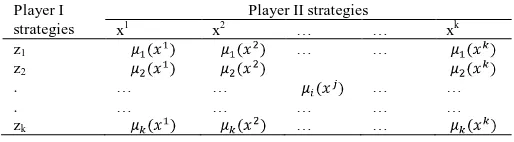
In this study, using degree of membership functions of objective is proposed to use in pay-off matrix while Player I and Player II’s strategies are the same as Belenson and Kapur’s approach. Because membership function takes value between one and zero for all objectives individually; under problem constraints with the worst value zero and the best value one. So there is no need to any normalized techniques. Pay-off table can be generated in one step. Also it shows achievement levels of objectives and value of it is commented the same whatever objective is maximization or minimization. In pay-off matrix of proposed method, values of diagonal are always equal to one, because of getting best values. Table II shows pay-off matrix of proposed method that is formed by membership functions of objectives.
TABLEII
PAY-OFF MATRIX OF PROPOSED METHOD
Player I strategies
Player II strategies
x1 x2 … … xk
z1 … …
z2
. … … … …
. … … … … …
zk … …
If are defined as weights, then linear programing of game theory is revised as follows:
Steps of the proposed method are:
STEP 1: Find ideal and anti-ideal solutions of each objective individually by using (4) or (5). Also, ideal solutions are symbolically shown as .in pay-off matrix.
STEP 2: Calculate membership functions of objectives for the all ideal values by using (2) or (3)
STEP 3: Obtain pay-off matrix as Table II
STEP 4: Set primal linear programing by using (14), solve LP to obtain weights of objectives.
STEP 5: Use one of fuzzy approaches by weights that are obtained from Step 4 and get a solution of MOLP.
A. Example
Proposed method is applied on an example that is taken from Belenson and Kapur’s study [9] and solutions are assessed. Example is:
Ideal and anti-ideal values of objectives are , and , . Ideal solutions are
and .
Table III shows pay off matrix of the example that matrix is obtained from membership functions of objectives that is shown in (13) and (14) by setting and .
TABLEIII PAY-OFF MATRIX OF EXAMPLE
Player I Player II strategies
strategies x1 x2
z1 1 0.5
z2 0.5 1
The linear programming of game theory for proposed method is calculated from using (15) to determine weights of objectives and is given in the following.
[image:3.595.40.297.458.529.2]
normalization of pay-off matrix in Belenson and Kapur’s approach. In their study, the example is solved by using weighted sum method and values of objectives are found as and ; degrees of objective functions
are found as and . The example is
solved with weights that are obtained from proposed method by using weighted sum method to compare solutions. Values
of objectives are found as and ;
degrees of objective functions are found as
and . Table IV shows the results of example that are explained below. Briefly they are values of objectives, degree of membership functions of objectives and total degree of membership functions of objectives.
The same example is solved by using several fuzzy solution approaches such as min operator, two phase approach, weighted additive operator and weighted max-min model with weights that are found by proposed method and Belenson and Kapur’s approach. Results are shown in Table IV. Weights are not need to assign to objectives in min operator. Solution that is obtained by using min operator is shown because of using the solution for comparing with other solutions. Also min operator is the first step of the two phase approach.
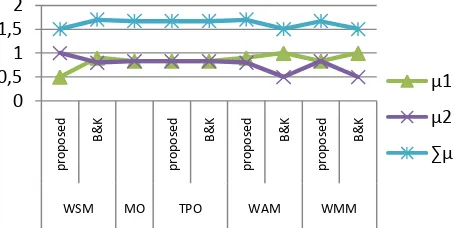
None of solutions that are obtained from different solution methods with different weights dominate the other. Two phase approach is generated the same solution as min operator. And although the weights that come from two methods are different, solutions are equal. If all solutions are compared by total degree of membership functions, the best value is 1.7 and is belong to weighted sum method with Belenson and Kapur’s approach weights and weighted additive operator with proposed method’s weights. Although the total degree of membership functions that is obtained by using Belenson and Kapur’s approach weights is greater than by using proposed method’s weights in weighted sum method, the total degree of membership functions that are obtained by using proposed method weighs are generated better results in weighted additive operator and weighted max-min approach. Also these results are shown as graphically for obtained solutions by fuzzy solution approaches with both proposed method’s weights and Belenson and Kapur’s approach’s weights in Fig. 1.
Fig. 1. Degree of membership functions of objectives by weighted sum method, min operator, two phase approach, weighted additive method and weighted max-min model with Belenson and Kapur’s approach weights and proposed method’s weights.
IV. COMPUTATIONAL EXPERIMENTS
In this section, problems that are taken from [3], [4] and [5] are solved by relevant fuzzy solution approach with both
proposed method’s weights and original weights by using linear membership functions given in (2) and (3). Family distance function is used to determine the degree of closeness of objectives to ideal solutions and weights affect family distance functions. The objective function values may be found the same by using different weights. In this case, although total degree of membership functions is equal, the family distance functions may be different.
The problems have different number of objective functions. Solutions are compared with family distance functions that are calculated from (16) [11] in addition to degree of membership functions of objectives.
p is a parameter that defines the measure of distance. In this study, p is taken as 1, 2, and ∞. So are calculated as (17), (18) and (19). shows vertical linear distance, shows Euclid distance and shows Tchebychev distance. The minimum value of family distance functions is better because of showing distance from optimum value. So the solution that has minimum value of is better.
where is the closeness value of compromise solution to ideal solution and it is calculated from (20) if objective is maximization and it is calculated from (21) if objective is minimization.
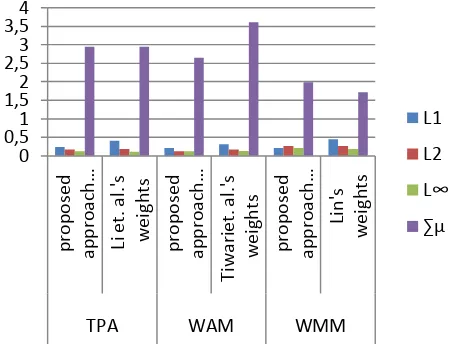
In two phase approach, solutions that are found by using both weights are equal. While the total degree of membership functions of objectives are the same, due to different weights, values of family distance functions are different. In weighted additive method, the total degrees of membership functions with Tiwari et.al.’s weights are better. But values of family distance functions with proposed method’s weights are better. In weighted max-min model, the total degrees of membership functions with proposed method’s weights and values of family distance functions are better except that shows maximum distance of objectives to ideal values.
0
0,5 1 1,5 2
p
ro
p
o
se
d
B&K
p
ro
p
o
se
d
B&K
p
ro
p
o
se
d
B&K
p
ro
p
o
se
d
B&K
WSM MO TPO WAM WMM
μ1
μ2
[image:4.595.54.283.555.669.2]TABLEIV SOLUTIONS OF EXAMPLE
TABLEV SOLUTIONS OF PROBLEMS
Two phase approach Weighted additive operator Weighted max-min model’s example Proposed
approach’s weights
Li et. al.’s weights Proposed approach’s weights Tiwari et. al.’s weights Proposed approach’s weights Lin’s weights
0.233 0.397 0.211 0.312 0.212 0.440
0.165 0.186 0.111 0.172 0.256 0.259
0.117 0.1 0.111 0.128 0.212 0.186
2.94 2.94 2.64 3.6 1.985 1.708
Table V shows values of family distance functions of objectives with different p values and total degree of membership functions for every problem that is taken from literature and Fig. I shows these all values as graphically.
Fig. 2.Total degree of membership functions of objectives and values of family distansfuntions in problems.
V. CONCLUSION
Fuzzy approaches have been applied to MOLP. Some of them are required to assign weights to objectives and some of them is assumed that all objectives are equal importance. Some approaches as AHP, TOPSIS has been proposed to determine the weights and in these approaches decision maker/s preference is needed. Little attention has paid to determine weights of objectives in MOLP without decision maker/s preference.
A novel method is proposed to determine the weights of objective functions in MOLP problems by modifying Belenson and Kapur’s approach in fuzzy environment. Since this proposed method use the structure of game theory, the
knowledge of decision maker/s is not needed. Degree of membership functions of objectives are used in pay-off and a new pay-off matrix is obtained.
The proposed method has the following features:
-- There is no need to any knowledge about MOLP problem to determine weights.
-- Normalization of pay-off matrix is made by one step whether objectives are maximization or minimization.
-- Solutions with proposed method are generated better total degree of membership functions than solution with Belenson and Kapur’s approach with several fuzzy solution approaches.
-- Solutions that are found with proposed method’s weights in fuzzy solution approaches generate better values of family distance functions.
REFERENCES
[1] Y. Lai and C. Hwang, Fuzzy multiple objective decision making:
methods and applications. Newyork : Springer, 1994.
[2] H. J.Zimmermann, "Fuzzy programming and linear programming with several objective functions", Fuzzy Sets and System, 1978, Vol. 1, pp. 44-55.
[3] X.-Q. Li, B. Zhang and H. Li,"Computing efficient solutions to fuzzy multiple objective linear programming problems", Fuzzy Sets and System, 2006, Vol. 157, pp. 1328-1332.
[4] R.N. Tiwari, S. Dharmar and J. R. Rao,"Fuzzy goal programming- An additive mode" , Fuzzy Sets and System, 1987, Vol. 24, pp. 27-54. [5] C.-C. Lin, "A weighted max-min model for fuzzy goal programming",
Fuzzy Sets and System, 2004, Vol. 142, pp. 407-420.
[6] H. Selim and I. Ozkarahan, "A supply chain distribution network design model: An interactive fuzzy goal programming-based solution approac" , International Journal of Manufacturing Technology, 2008, Vol. 36, pp. 401-418.
[7] A. Amid, S. H. Ghodsypour and C. O'Brien, "Fuzzy Multiobjective linear model for supplier selection in a supply chain" International Journal of Produztion Economics, 2006, Vol. 104, pp. 394-407. [8] W. F. A. El-Wahed and M. A. Abo-Sinna,"A hybrid fuzzy goal
programming approach to multiple objective decision making problems",2001, Vol. 119, pp. 71-85.
0 0,51 1,52 2,53 3,54 pr o po sed ap pr o ach … Li et. al .'s wei ghts pr o po sed ap pr o ach … Ti wa ri et. al .'s wei ghts pr o po sed ap pr o ach … Li n' s wei ghts
TPA WAM WMM
L1
L2
L∞
∑μ
Weighted sum method Min operator
Two phase approach Weighted additive operator Weighted max-min model
Proposed method’s weights Belenson and Kapur’s approach weights Proposed method’s weights Belenson and Kapur’s approach weights Proposed method’s weights Belenson and Kapur’s approach weights Proposed method ‘s weights Belenson and Kapur’s approach weights
0.5 0.9 0.834 0.834 0.834 0.9 1 0.834 1
50 40 41.65 41.65 41.65 40 25 41.65 25
0.5 0.9 0.834 0.834 0.834 0.9 1 0.834 1
1 0.8 0.833 0.833 0.833 0.8 0.5 0.833 0.5
[image:5.595.66.291.409.581.2][9] S. M. Belenson and K. C. Kapur, "An algorithm for solving
multicriterion linear programming problems with
examples",Operational Research Quarterly, 1973, Vol. 24, pp. 65-77. [10] W. L. Winston, Operations research, applications and algorithms.
Duxbury Pres Thomson Learning, 2004.