Analysis of Efficient Routing Protocols for
Constrained Application using COOJA Simulator
Meghana K L1, Chethana M2 1, 2
Department of I. S. E, Bangalore Institute of Technology, K. R Road, Bangalore
Abstract: Protocols are special standards or rules used for the communication between smart devices or the computers, some of the communication protocols explained in this paper are CoAP, 6LoWPAN and RPL. These protocols are used in terms of IOT, which composed of smart devices that gather and exchange the data. These smart devices composed of wireless and wired connections. CoAP is an messaging protocol that uses one-one interaction model. This protocol is a network application protocol mainly used in terms of constrained network which composed of constrained nodes.6LoWPAN is one of the protocol used in wireless sensor network which provide compatibility.
This network protocol works on adaptation layer, this has been developed to overcome the usage of IPV4 and this helps in working with IPV6 instead of IPV4.RPL protocol is the one which is designed to overcome the routing issues in LLN. This also includes wireless personal area network.
The main aim of the paper is to analyze these protocols based on Average power consumption, Average duty cycle and Average inter-packet time.
Keywords: CoAP (Constrained Application Protocol) , 6LoWPAN(IPv6 over Low-Power Wireless Personal Area Network), RPL(Routing Protocol for Lossy network), LLN(Low Power and Lossy network).
I. INTRODUCTION
Internet of Things analyze the ability of connectivity to digitally improve the objectives, usually known as smart things. An other way of defining IOT is a network of small, inexpensive, low-power, encyclopedic electronic devices where sensing and communication of data takes place.
Each system is capable to inter-operate with the existing internet and can uniquely recognized embedded systems. Enhancement of communication among objects and people are reduced operationally.
CoAP is an light weighed messaging protocol that works on that works on interaction layer, CoAP composed of constrained devises that use constrained nodes.
This protocol seamlessly works for low capacity sensors and some other components. This protocol is primarily works over UDP, that places whole implementation at low level. Many IP protocols are included in constrained devices. CoAP is designed based on IPV6 hence supports multicast. This also support effortless data transmission.
A 6LoWPAN(IPv6 over low power personal area network ) is a communication network with low power that allows wireless connectivity with limited power and lower throughput.6LoWPAN is mainly used in “zigbee” and body area network in terms of Hospital
Management. In this network during data transmission, initially it transmit data packets through high processing powered sensor network.
RPL defined as Routing protocol for low power and lossy network. This protocol uses low-power power line communication network(PLC) and wireless personal area network(WPAN) so on. In this network data loss seems to be very high hence the name lossy network. RPL protocol uses IPV6 and supports dataflow not only in upward direction but also in downward direction. This protocol network composed of DODAG(Destination Oriented Directed Acyclic Graph). Position of a node is defined by node rank in a topology or network. Node rank decreases upward and decreases by travelling downward.
Figure 1:Data flow diagram.
The rest of the paper is arranged as follows: Section II covering the related work. Section III presents the Routing protocols. Section IV provides the performance analysis. And finally concluded paper in Section V.
II. RELATEDWORK
By observing CoAP protocol, it has low packet delivery ratio when compared with other protocols which uses UDP that do not support retransmission. Here concluded that CoAP achieve higher throughput, standard bandwidth, etc. by Y. Naga Malleswara Rao and M. Srinivasa Rao [1].
The analysis of performance is done here, where contemplated and the normal output helps in determining 6LoWPAN network This output uses both temperature and humidity. Here experiences packet loss. by James AGAJO, Jonathan G. KOLO, Mutiu[2].
At this analysis method composed of various environment to test different communication modes and protocol. One of the drawback is that it uses lightweight M2M protocol. by Priyanka Thota[3].
In this case the open source software is used inorder to compare the communication protocols. The response time is measured by Paridhika Kayal and Harry Perros[4].
In this method performance of IOT protocols is determined via CoAP. Later the three quantitative measuring is demonstrated in which different outcomes are compared with IOT protocols by Yuang Chen and Thomas Kunz[5].
Here defines the feasibility of 6LoWPAN protocol using hardware environment. The testing mechanisms demonstrate the outcomes like power consumption by Varat Chawathaworn-charoen[6].
RPL protocol is the IP based protocol composed of translation gateways. RPL composed of lower energy and memory capabilities. This protocol uses distance vector and source routing protocol by Ed Winter et al[7].
III. ROUTINGPROTOCOLS
In this section Description of various Routing Protocols are done. Different architecture diagrams are defined with respect to particular protocol.
A. Constrained Application Protocol(CoAP)
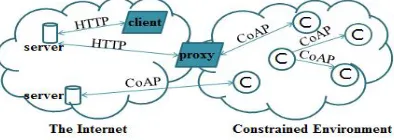
CoAP protocol is defined as constrained application protocol which works in constrained environment. The architecture is shown in Figure 2.
[image:2.612.216.413.634.704.2]The architecture composed of server, clients and proxy server placed in constrained environment. Here the HTTP protocol is used in order to exchange data between the customers. These customers are known as CoAP customers. The protocol like HTTP and CoAP protocols are also handled during messaging. Fragmentation is done at hidden layers, where objectives are kept away from fragmentation. During analysis it is found that CoAP have high throughput, low power consumption and use limited bandwidth. Comparatively CoAP is found to be a better protocol for real world environment. Features of CoAP protocol consists of the following:
1) CoAP protocol is extremely RESTfull.
2) This protocol is an open standard.
3) It is a web exchange protocol.
4) Some of the techniques like GET, POST, PUT and DELETE are used.
5) In-built components are used.
6) UDP and TCP are supported.
One of the real world example is fetching temperature, that is wireless sensors will be placed in the forest area where continuous updation of temperature is done. These information will be placed in a proxy sever via which client can get the information by using HTTP request.
B. 6LoWPAN(IPv6 over low Power Wireless Personal area Network)
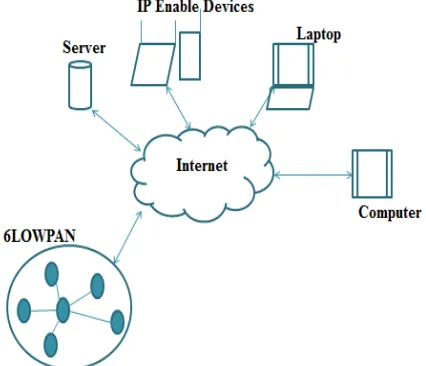
[image:3.612.207.420.346.529.2]6LoWPAN is also known as low-power wireless mesh network where each and every node have IPv6 address, which helps in direct connection with internet. This 6LoWPAN works in order to connect physical devices with real world system. This protocol can support both mesh and star topology. Figure 3 Shows the architecture of 6LoWPAN protocol.
Figure 3 Architecture of the 6LoWPAN protocol.
Architecture of 6LoWPAN composed of personal area network, some of the physical devices and a server. Data is communicated with the help of IP address, different system have different IP address. Since it support mesh network the degree of mobility have also been defined based on nodes.
The processing power is limited during transmission of data with the help of protocol. It is a low-cost communication network. 6LoWPAN allows low-powered wireless connection for easy flow of data. It is composed of low cost, low powered, low memory usage and low bit rate etc.
The need for 6LoWPAN in case of large scale deployment model includes availability, manageability, survivability, stability and mobility. This protocol is mainly designed in order to optimize power consumption.one of the disadvantage of this protocol is that, this protocol works only for low-powered devices.6LoWPAN accepts IEEE 802.15.4 standard, this standard defines MAC and PHY layers. Since these are defined in base layers.
C. RPL(Routing Protocol for Lossy network)
[image:4.612.181.431.165.296.2]RPL is defined as Routing Protocol for Lossy network, as the name suggest lossy, data loss is high in this network. It is a distance vector and source routing protocol. The main component of RPL is that it acts as an routing resolution for lossy network. RPL determines a network inorder to distribute data over a network. During RPL protocol analysis as the network size increases it is found that nodes consume less energy. Figure 4 Shows topology of RPL protocol, composed of different routing paths. Where data path is defined both in upward and downward direction that is shown in Figure 4.
Figure 4: Topology of RPL Protocol.
The Topology composed of Destination Oriented Directed Acyclic Graph(DODAG). Node Rank is defined by node singular position with respect to other nodes in the topology. Rank of a node increase while travelling downward and rigorously decrease while travelling upward. The DODAG root takes an incharge to define different parameters that are promoted interns of choice in DIO message. The proper rank is defined by objective function(OF).
One of the drawback of RPL protocol is that this works only for fixed configuration which is one of the main disadvantage of RPL, this leads to the development of BRPL that support variable configuration. Features of RPL are Auto-configuration, self-healing, loop avoidance and detection, Independency and Transparency and Multiple edge routing.
Real world example of RPL routing protocol is Smart City, where data or information like air quality, noise level and traffic congestion is measured and stored.
IV. PERFORMANCEANALYSIS
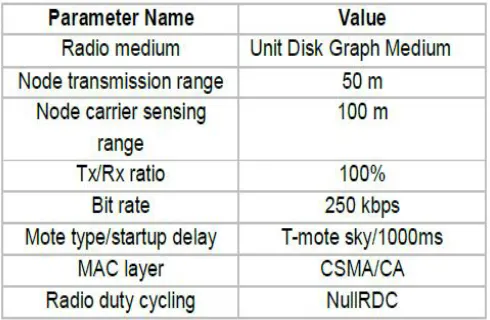
In this section the performance analysis of three different protocols like CoAP, 6LoWPAN and RPL is carried out. Table 1 composed of different simulation parameters, these parameters are used to simulate and produce the data based on which the graph can be plotted.
The Simulation parameters have shown inorder to examine the protocols they are CoAP, 6LoWPAN and RPL with respect to performance using Cooja Simulation. RDC in the defines the Radio Duty Cycle that is measured further, bit rate is measured in terms of kbps. Hence these are the basic parameters used in terms of simulation.
[image:4.612.184.429.550.710.2]Above Topology and Architectures are examined by using different protocols and transmitting data, during this information storing power consumption, duty cycle and Inter-packet time is calculated, later the graph is plotted based on those data values.
The main aim of performance analysis is to measure power consumption, average radio duty cycle and average inter-packet time. All these are measured based on some parameters shown in Table 1. The table composed of multiple parameters, among which only few parameters are used they are bit-rate, startup delay and duty cycles.
Graph 1 Shows the Average Power Consumption, it is defined as the amount of power consumed during data transmission at nodes, here the power consumption is measured between CoAP, 6LoWPAN and RPL
Graph 1: Shows Average power consumption.
The overall power consumption is analyzed and the graph has been plotted. Based on the behavior the data is measured and graph is plotted. Based on the graph plotted CoAP consumes less power compared to RPL and 6LoWPAN.Graph 2 Shows Average Duty Cycle. As shown in Graph 2 Average Duty Cycle is measured, Duty cycle is defined as the number of times the data transmission carried out between the devices that is between device to device or between machine to machine.
Number of cycles are measured with respect to nodes, as a result CoAP performs higher number of duty cycles compared to RPL and 6LoWPAN. These two protocols consumes high power but performs lower number of duty cycles.
Graph 2: Shows Average Duty Cycle.
Hence in this scenario C0AP works better compared to other protocols. Graph 3 shows Average Inter-packet time, which is defined as the number of data packets transferred at a given time in terms of delay.
This Graph 3 shows the average inter-packet time where the delay or the time between data transmission is calculated in terms of seconds. By analyzing the above graph CoAP have lower delay or inter-packet time, comparatively.
The delay can also be examined by changing the distance of the nodes. Each and every criteria keeps on changing based on the protocols used. All these three protocols are analyzed based on three criterias as shown before.
V. CONCLUSION
The Protocols that can be used to interact with Internet of Things are defined briefly. In this paper the analysis CoAP, 6LoWPAN and RPL protocols are defined based on three different criterias namely Average power consumption, Average duty cycle and Average inter-packet time. The graphs are plotted to know the efficient protocol based on it performance. However, CoAP provide better result compared to 6LoWPAN and RPL. This protocol can further be used incase of IOT.
REFERENCES
[1] Y. Naga Malleshwara Rao and M. Srinivasa Rao in “Implementation and Performance Evaluation of COAP Data Protocol of Internet of Things”.
[2] James AGAJO, Jonathan G. KOLO, Mutiu ADEGBOYE, Bello NUHU, Lukman AJAO, Ibrahim ALIYU in “Experimental Performance Evaluation And
Feasibility Study of 6LoWPAN Based Internet of Things”.
[3] Priyanka Thota in “Implementation and Analysis of Communication Protocol in Internet of Things”.
[4] Paridhika Kayal and Harry Perros in, “A Comparison of IOT application layer protocols through a smart parking implementation”.
[5] Yuang Chen, Thomas Kunz. Performance Evaluation of IOT Protocols under Constrained Wireless Acess NMetwork. International Conference on Selected
Topics in Mobile & Wireless Networking, 2016.
[6] Varat Chawathaworncharoen, Vasaka Visoottiviseth and Ryousei Takano in “Feasibility Evaluation of 6LoWPAN over Bluetooth Low Energy”.