Abstract—This paper presents a simulation analysis of the impact of mobility on concurrent transaction processing over a mixture of mobile and fixed transactions. Our results show that the traditional concurrency protocol yield low throughput in mixture mobile and fixed environments due to the fact that traditional protocol cannot discriminate implications of restart of both types of transactions. As a result, the number of restarts can be unbounded and the ongoing mobile transactions that share the same wireless resources will be affected. We investigate adaptive adjustment the serialization order of transactions such that a conflict resolution should be give more rooms for mobile transaction. We show that by effectively capitalizing this information, the number of unnecessary restarts can be highly reduced. Based on the simulation analysis, we show that this protocol provide a significant performance gain in mixed transaction environments.
Index Terms—concurrency control, mixed transaction, mobile computing, performance Evaluation.
I. INTRODUCTION
HIS document is a template for Word (doc) versions. If you are reading a paper version of this document, so you can use it to prepare your manuscript. Concurrency control protocols proposed in the previous works [2], [3], [4] and [5] mainly focused on homogeneous environments. That is, there is only one type of transactions present in the system, either fixed transactions or mobile transactions. However, it is not uncommon to have mobile applications that consist of both types of transactions. Due to the high expensive resources used by mobile transactions, it will be a serious problem for mobile transactions to suffer from restarts caused by other fixed or mobile transactions. As a result, the conflict resolution should be in favour of mobile transaction. In MDBS, transaction restart has two negative implications. First, since the number of restarts can be unbounded, resources and time spent on the restarted transactions will be wasted. Second, reserving extra resources and time to process restarted mobile transactions may seriously affect other ongoing mobile transactions that share the same wireless resources. In view of these two factors, it is very important to reduce the number of transaction restarts which negatively affect amount of resources wasted in this aspect, save the expensive resources
Ahmad Alqerem Internet Technology Department Zarqa University P.O.Box 132222 Code No. 13132 ZarqaJordan ([email protected] )
of the wireless environment and improves the overall system performance. In this paper, to reduce the number of restarts, a new optimistic based concurrency control protocol, called OCCMix, is proposed. By deferred adjustment the serialization order of transactions, the OCCMix protocol can successfully resolve many conflicts between the validating transaction and the executing transactions. Consequently, the number of unnecessary restarts can be highly reduced. The characteristics of these protocols have been examined in detail by simulation. The results show that the performance of these protocols is consistently better than the pure OCC protocol over a wide range of system settings. In particular, these protocols provide a more significant performance gain in mixed transaction environments. The remainder of this paper is organized as follows: Section 2 describe the mixed system model. Section 3 discusses the differences between fixed timestamp and timestamp interval. The OCCMix approach is described in Section 4. In Section 5, we discuss the performance results and we conclude the study in Section 6.
II. MIXED SYSTEM MODEL.
This section is to define a mixed system model Fig. 1; it is assumed that the system consists of stationary and mobile part. Stationary units are classified as either fixed hosts, base stations BS or mobile support station MSS. Fixed host are database server connected to the existing wired network, this server is accessible by two types of users, users whom used the wired reliable network and the second type of users are not capable to connect directly to these information servers. A MSS is equipped with a wireless interface and work as a coordinator and communication interface between the mobile unit and the database server through BSC. Transactions involved in this system consist of a sequence of read and writes operations, and ends with a commit or an abort operation. This transaction considers an atomic process. That is, translate a database from a consistent state into another consistent state. There are two types of transactions in this environment: fixed or wired (FT) transactions and mobile transactions. A fixed transaction is submitted directly to a database on the same host while the mobile transaction submitted by mobile device. Like in [3], an (MT) is a mobile transaction which issued by a mobile host. The participation of an MH introduces dimensions inherent to mobility such as: movement, disconnections and variations on the quality of communication.
Impact of Mobility on Concurrent Transactions
Mixture
Ahmad Alqerem
Fig 1 Mixed System Environment III. APPROACH DETAILS
Our OCCMix is an optimistic approach based on the dynamic adjustment of serialization order. Like OCCTI [7 ], OCCMix uses the notion of timestamp intervals to record and represent serialization orders induced by concurrency dynamics. Timestamps are associated with both transactions and data items. Each data item has a read and a write timestamps, where the read and the write timestamps are the timestamps of last committed transactions that have read or written to the data item, respectively. For each transaction, OCCMix associates with each active transaction a timestamp interval expressed as a [lower bound (lb), upper bound (ub)] pair. The timestamp interval denotes the validity interval of a transaction. The timestamp intervals are also used to denote serialization order between transactions. For example, if Ti (with timestamp interval [lbi,ubi]) is serialized before Tj (with timestamp interval [lbj ,ubj]), denoted Ti à Tj, then the following relation must hold: ubi < lbj .
1) Adjustment of timestamp interval
Each transaction at the start of execution is assigned a timestamp interval of [0, ∞], i.e., the entire timestamp space. As the transaction proceeds through its lifetime in the system, its timestamp interval is adjusted to reflect serialization dependencies as they are induced. Serialization dependencies may need to be reflected while transaction is accessing data items in its read phase or by being in the conflict set of a different validating transaction.
a) Adjustment at the read phase
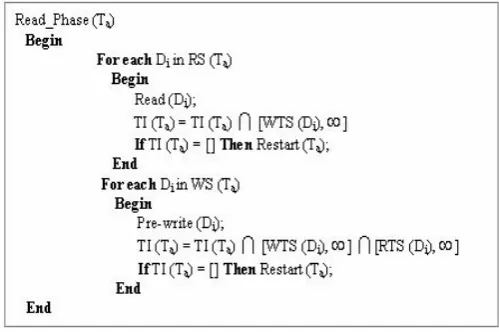
In this case, the timestamp interval is adjusted with regard to the read and write timestamps of the data item read or updated. In the process of adjusting, the timestamp interval may ‘shut out’, i.e., become empty. In that case, the transaction cannot be successfully serialized and needs to be restarted. Note that this is one of the major differences
between conventional protocols and protocols based on dynamic adjustment of serialization order. In conventional OCC algorithms, restarts can only occur at validation times. In our case, however, transactions can restart at other times if a timestamp interval shut out is detected. The exact mechanics for these adjustments are shown in the procedures given in Fig. 2. In the remainder sections, we use the notation TI(Ti ) to denote the timestamp interval of transaction Ti and RTS (Di ) and WTS(Di ) to denote the read and write stamps of data item Di ,respectively. As a transaction successfully validates, a final timestamp is assigned to it.
Fig 2: Adjustment of TI (Ta) at the read phase
b) Adjustment at the validation phase
In the case of being in the conflict set of a different validating transaction, the timestamp interval of the active transaction is modified to dynamically adjust the serialization order. The adjustment of the serialization order for both mobile and fixed transactions implemented with timestamp intervals creates a partial order between transactions based on conflicts and transaction type. Suppose we have a validating transaction Tv and an active transaction Ta. Let TS (Tv) be the final timestamp of the validating transaction Tv and TI (Ta) the timestamp interval of the active transaction Ta. Let TI (Tv) be the timestamp interval of the validating transaction and type (Ti) be the transaction type where type (Ti)
Î
{mobile, fixed}. We assume here that there is no blind write. So, there are two possible types of conflicts which are resolved using adjustment of serialization order between Tv and Ta: (1) read write conflict which occur when the RS (Tv)Ç
WS (Ta)¹
j
which can be resolved by forward adjustment (2) writeread conflict which occur when the RS (Ta)Ç
WS (Tv)¹
j
and resolved by backward adjustment.The adjustment of timestamp intervals (TI) in Fig. 3 iterates through the read set (RS) and write set (WS) of the validating transaction (Tv). First we check that the validating transaction has read from committed transactions. This is done by checking data item’s read timestamp (RTS) and write timestamp (WST).These values are fetched when the read/write operation to the current data item is made. Then the algorithm iterates the set of active conflicting MH
MH MH
MH
MH FH
FH FH
MH
MH MH
DB
B
S
C
MSS
MSS
BSC Base Station controller Wireless Communication
Wired Communication MSS Mobile Support Station
[image:2.595.304.554.226.392.2]transactions. When access has been made to the same objects both in the validating transaction and in the active transaction, the temporal time interval of the active transaction is adjusted. Non serializable execution is detected when the timestamp interval of an active transaction becomes empty. If the timestamp interval is empty the transaction is restarted.
Fig 3: Iterate Readset/Writeset of Validating Transaction
(1) Forward adjustment
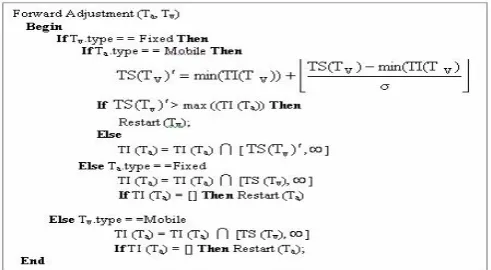
A readwrite conflict between Tv and Ta can be resolved by adjusting the timestamp interval of the active transaction forward (i.e. Tv à Ta). If the validating transaction is a mobile transaction and the active transaction is a fixed host transaction, forward adjustment is correct. If the validating transaction is a fixed host transaction and has a conflict with a mobile transaction, we should favour the mobile transaction. This is achieved by reducing the timestamp interval of the validating fixed host transaction and selecting a new final timestamp earlier in the timestamp interval see section 4. Normally, the current time or the maximum value from the timestamp interval is selected but now a different value is selected based on a predefined
s
value. As the
s
value increases, the opportunity for the active mobile transaction to commit is increases on account of the fixed host transaction. When the
s
value = 2 this means that the validating fixed host transaction reduces by half of its interval to the advantage of active mobile transactions. Forward adjustment can be described by procedure in Fig. 4.
Fig 4: Forward adjustment
(2) Backward adjustment
[image:3.595.307.550.358.508.2]A readwrite conflict between Tv and Ta can be resolved by adjusting the timestamp interval of the active transaction backward, (i.e. Ta à Tv). If the validating is a mobile transaction and the active conflicting is a fixed transaction, backward adjustment is correct. If the validating is a fixed transaction and the active conflicting transaction is mobile, then backward adjustment is done if the active transaction is not aborted in backward adjustment. Otherwise, the validating transaction is restarted. This is wasted execution, but it is required to ensure the execution of the mobile transaction. In backward adjustment, we cannot move the validating transaction to the future to obtain more space for the mobile transaction. We can only check if the timestamp interval of the mobile transaction would become empty. In forward ordering we can move the final timestamp backward if there is space in the timestamp interval of the validating transaction. Again we check if the timestamp interval of the mobile transaction would shut out. We have chosen to abort the validating transaction when the timestamp interval of the mobile transaction shuts out. Thus, this protocol favours the mobile transaction that uses scarce and expensive resources. Backward adjustment can be described by procedure in Fig. 5.
Fig 5: Backward Adjustment
2) Final timestamp selection
In the OCCMix protocol we should select the final (commit) timestamp TS (Tv) in such a way that room is left for backward adjustment. In our validation algorithm we set TS (Tv) as the validation time if it belongs to the time interval of Tv or the maximum value from the time interval otherwise.
IV. Performance evaluation
We have constructed and conducted a series of simulation experiments to evaluate and compare the performance of our concurrency control approaches on mixed transactions environment. In the following sections, we will discuss the simulation model, the workload being used, performance metrics, and finally present our research findings in these experiments.
[image:3.595.46.292.606.741.2]The simulation model consists of two major components: the transaction manager (TM) and data manager (DM). TM maintains a transaction table to record the execution status of both mobile and fixed host transactions in the system. TM includes two components: scheduler and data manger. The scheduler is responsible for concurrency control. When the scheduler receives an operation, it determines whether the operation should be processed, blocked, or rejected. If an operation is rejected, the corresponding transaction will be restarted. In the system, different data structure has been used for different approaches. The scheduler maintains an accessstatus table to detect any possible data conflicts. For example, if Locking protocol is adopted for concurrency control, the scheduler maintain a lock table to record the locking status of any data items accessed by all executing transactions (and the collection of the blocked transactions due to lock conflicts).
Fig 6: Simulation Model
We also did the same for the optimistic protocols, a data object table and a transaction table are maintained. The data object table keeps a read timestamp and a write timestamp for each data object in the database and the transaction table maintains the read set, the write set and the timestamp interval of each transaction.
Two generators are implemented. The fixed host generator is responsible for the generation of the fixed host transactions. The second generator is for mobile transactions with specific attribute that imitate both the mobile device and the wireless environment. Submitted transaction from the mobile host is sent to a base station through a wireless link and then sends to the database via existing wired network. During the execution time, a transaction may need the user’s interaction to the input data. Many studies have pointed out that the cost of communication setup is very expensive [1] and [6]. To avoid reestablishing the communication each time the transaction needs the user‘s interaction, we assume that the communication must be kept during the execution of the mobile transaction. Transactions are generated from both transactions generators the fixed and mobile are lined up in the CPU queue according to the first in first out scheduling discipline. When the CPU is available, the transaction at the front of the CPU queue will be submitted to the CPU for
processing. To read a data object, transactions need to line up in the disk queue for data access. The transactions will repeat these steps until all operations are processed.
[image:4.595.304.554.265.697.2]A. Parameter Setting
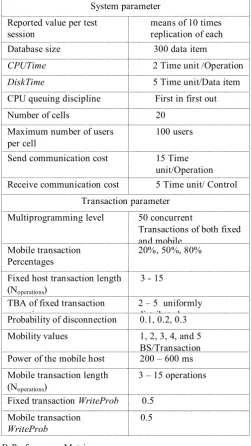
Table 1 gives the parameters that control system resources. The parameters, CPUTime and DiskTime capture the CPU and disk processing times per data item. Table 1 also summarizes the key parameters that characterize system workload and transactions. The numbers of data objects accessed by a transaction are determined uniformly from the database. A data object that is read is updated with the probability, WriteProb.
Table 1: summary of workload used for baseline experiment System parameter
Reported value per test session
means of 10 times replication of each
Database size 300 data item
CPUTime 2 Time unit /Operation
DiskTime 5 Time unit/Data item
CPU queuing discipline First in first out
Number of cells 20
Maximum number of users per cell
100 users
Send communication cost 15 Time unit/Operation
Receive communication cost 5 Time unit/ Control message
Transaction parameter
Multiprogramming level 50 concurrent
Transactions of both fixed and mobile
Mobile transaction Percentages
20%, 50%, 80%
Fixed host transaction length (Noperations)
3 15
TBA of fixed transaction operations
2 – 5 uniformly distributed Probability of disconnection 0.1, 0.2, 0.3
Mobility values 1, 2, 3, 4, and 5 BS/Transaction Power of the mobile host 200 – 600 ms
Mobile transaction length (Noperations)
3 – 15 operations
Fixed transaction WriteProb 0.5
Mobile transaction WriteProb
0.5
B. Performance Metrics
[image:4.595.50.289.287.458.2]restarts experienced by a mobile host transaction before it can commit. This measure also indicates the amount of resources spent on restarted transactions. Reducing the restart cost not only saves resources, but also helps to soothe resource and data contention. The mobile transaction rollback frequency and the fixed transaction rollback frequency help to analyze the source of transaction restarts. The frequencies can reflect the proportion of data conflict between mobile and fixed transactions and that among mobile transactions as the utilization of mobile transactions varies. The last performance measure specifically for the OCCMix approach is the adjustment ratio, which is the number of serialization order adjustment made per transaction. This ratio can help to understand the effectiveness of the OCCMix approach in different parameter settings. The formulas of the main performance measures are listed below.
Power consumption ratio (PCR) =
initial final initial
P P
P -
Fixed transaction rollback frequency =
committed restart fixed N
N ,
Mobile transaction rollback frequency =
committed restart mobile N
N ,
Where
Nrestart: number of restarted transaction of both types. Ncommitted: number of committed transactions of both types. Nmobile, restart: number of committed mobile transaction which caused other mobile transaction to be restarted.
Nfixed, restart: number of committed mobile transaction which caused other fixed transaction to be restarted.
C. Experiments and Results
We have performed three sets of experiments. In the first set, mobile transactions percentage is 20%. For the second and the third sets, the utilizations of the mobile transactions are approximately 50 percent and 80 percent, respectively. We can therefore observe whether the domination of any one kind of transaction will have any impact on the performance of the implemented approaches. All these experiments show that the OCCMix approach outperforms both the pure OCC protocol and the 2PL protocol for a wide range of parameter settings.
a) Impact of Mobility
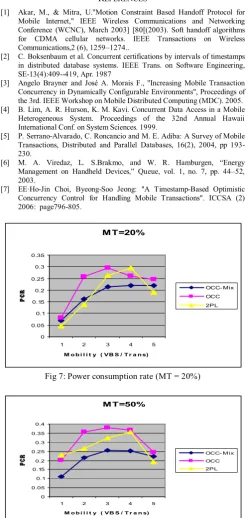
Fig. 7 gives the PCR as a function of the mean mobility value when 20% of transactions present in the system are mobile transaction. Since the number of base station crossed over by a mobile transaction increase when the mobility increase, the delay between mobile transaction operations increase And the average numbers of active transactions increase, the blocking of 2PL protocol badly affect the PCR. For the OCC protocol, there is no blocking overhead. But the PCR reduction problem still exist because of mobile transaction restarts, the improvement made by OCCMix approach over other protocols is clear especially when the percentage of mobile and fixed transactions are equal as we can see in Fig. 8. This is because of OCCMix have no blocking overhead compared
to the 2PL and have less number of restarts than OCC. Fig. 9 shows the PCR under all protocols when the mobile transaction are dominated, since the increase of PCR under OCC and OCCMix are mostly caused by the restart frequency, the difference between these protocols is reduced as we see in Fig. 9 when the percentage of mobile transaction is 80%. So the best improvement which can be gained by the OCCMix when the percentages of mobile and fixed transactions are equals in the system.
b) Impact of
s
value
Sigma value can highly affect the nature of interactions between fixed and mobile transactions. A larger
s
value means a little opportunity for fixed transactions to commit in their time intervals. Fig. 10 shows the fixed rollback frequency FRF for different values ofs
. This measure determines the number of fixed transactions aborted because they are in conflict with other mobile transactions. As we can see in Fig. 11, the number of fixed transactions roll backed by other mobile transactions increase as thes
value increase. A choice ofs
value =2 leads to the smallest value of FRF. Smallers
value leads to more restarts in mobile transactions as we can see in the Fig. 11. For mobile rollback frequency MRF which mean that the adjustments of an active mobile transaction that is in conflict with a validating fixed transaction whose timestamp interval bigger will short the timestamp intervals of other mobile and fixed transactions which may be in conflict in the future. As we shown in Fig. 10 and 11, intermediate value ofs
leads to the best reduction of both fixed and mobile rollback frequency.V. CONCLUSION
approach. It is found that the proposed protocols outperform the traditional optimistic concurrency protocol for a wide range of workload parameters. The first order improvement can be observed in decreasing the number of mobile transaction restarts that leads to a significant saving of resources. The second order improvement can be observed in the reduction of power consumption rate that is crucial to the mobile computing environments.
REFERENCES
[1] Akar, M., & Mitra, U."Motion Constraint Based Handoff Protocol for Mobile Internet," IEEE Wireless Communications and Networking Conference (WCNC), March 2003] [80[(2003). Soft handoff algorithms for CDMA cellular networks. IEEE Transactions on Wireless Communications,2 (6), 1259–1274..
[2] C. Boksenbaum et al. Concurrent certifications by intervals of timestamps in distributed database systems. IEEE Trans. on Software Engineering, SE13(4):409419, Apr. 1987
[3] Angelo Brayner and José A. Morais F., "Increasing Mobile Transaction Concurrency in Dynamically Configurable Environments", Proceedings of the 3rd. IEEE Workshop on Mobile Distributed Computing (MDC). 2005. [4] B. Lim, A. R. Hurson, K. M. Kavi. Concurrent Data Access in a Mobile Heterogeneous System. Proceedings of the 32nd Annual Hawaii International Conf. on System Sciences. 1999.
[5] P. SerranoAlvarado, C. Roncancio and M. E. Adiba: A Survey of Mobile Transactions, Distributed and Parallel Databases, 16(2), 2004, pp 193 230.
[6] M. A. Viredaz, L. S.Brakmo, and W. R. Hamburgen, “Energy Management on Handheld Devices,” Queue, vol. 1, no. 7, pp. 44–52, 2003.
[7] EE∙HoJin Choi, ByeongSoo Jeong: "A TimestampBased Optimistic Concurrency Control for Handling Mobile Transactions". ICCSA (2) 2006: page796805.
M T=20%
0 0.05 0.1 0.15 0.2 0.25 0.3 0.35
1 2 3 4 5 M o b i l i t y ( VB S / T r a n s)
[image:6.595.308.547.87.233.2]OCC Mix OCC 2PL
Fig 7: Power consumption rate (MT = 20%)
M T=50%
0 0.05 0.1 0.15 0.2 0.25 0.3 0.35 0.4
1 2 3 4 5
M o b i l i t y ( VB S / T r a n s)
OCC M i x
OCC
[image:6.595.45.295.198.718.2]2PL
Fig 8: Power consumption rate (MT = 50%)
M T=80%
0 0.1 0.2 0.3 0.4 0.5 0.6
1 2 3 4 5
M o b i l i t y ( V B S / T r a n s)
OCC Mi x
OCC
2P L
Fig 9: Power consumption rate (MT = 80%)
M T=50%, Wr ite Pr ob=0.5
0 0 .1 0 .2 0 .3 0 .4 0 .5 0 .6 0 .7 0 .8 0 .9 1
2 0 4 0 6 0 8 0 1 0 0
Wor k load (Tr ans /S)
F
ix
e
d
R
o
ll
b
a
c
k
F
re
q
Sigma=1
Sigma=2
Sigma=3
[image:6.595.303.547.264.597.2]Sigma=4
Fig 10: Fixed rollback Frequency
M T=50%, Wr ite Pr ob=0.5
0 0.0 5 0 .1 0.1 5 0 .2 0.2 5 0 .3 0.3 5 0 .4 0.4 5
2 0 4 0 6 0 8 0 1 0 0
Wor k load (Tr ans /S)
M
o
b
il
e
R
o
ll
b
a
c
k
F
re
q
Sigma=1
Sigma=2
Sigma=3
Sigma=4
[image:6.595.49.288.417.565.2]