Abstract— In this paper a new way to face the threshold of Human Error is presented. It explains the mean of threshold from the neuroscience discipline and how it must be applied in maintenance tasks for Nuclear Power Plants. This paper proposes incorporate tools of augmented reality and presents a framework that defines the rules and bounds for its implementation in maintenance tasks. An overview of Human Error is presented to introduce the main issues in the right context. Finally a discussion on the proposed application is carried out on a number of maintenance tasks in nuclear facilities.
Index Terms— augmented reality, human error, maintenance, nuclear power plant
I. INTRODUCTION
HE maintenance tasks include a complex set of the tasks on the plant structures, systems and components (SSCs) that have a bearing on safety or not. Follow [1] there are five main areas and the major topics addressed in each of these areas are:
Increasing Production
- Maintaining good plant materiel condition - Reducing the duration of planned outages
- Performing on-line maintenance, where appropriate - Reducing the frequency of forced outages.
Reducing Workload
- Avoiding unnecessary regulatory burden
- Monitoring the condition of plant equipment as a basis for preventive maintenance
- Using reliability centered maintenance. Improving Processes
- Better planning and scheduling
- Using information management systems - Applying graduated work controls
Manuscript received March 23, 2012; revised April 15, 2012. This work was supported in part by the CONICET (Consejo Nacional de Investigaciones Científicas y Técnicas) and SeCTyP (Secretaría de Ciencia, Tecnolgía y Posgrado) of the Universidad Nacional de Cuyo, Argentina.
J.E. Núñez Mc Leod is with CONICET and Engineering Faculty of the Universidad Nacional de Cuyo, Mendoza, CO KFA5502, Argentina (phone: +54 261 4135000 ext. 2135; fax: +54 261 4380120; email: [email protected]).
S.S. Rivera is with Engineering Faculty of the Universidad Nacional de Cuyo, Mendoza, CO KFA5502, Argentina (phone: +54 261 4135000 ext. 2135; fax: +54 261 4380120; email: [email protected].
J.E. Núñez Mc Leod and S.S. Rivera are IAENG members.
- Post-maintenance testing. Improving productivity
- Improving human performance - Better teamwork
- More sharing of resources - Outsourcing/contracting
- Improving radiation management Measuring Performance
- Performance measures - Benchmarking.
Note that the safety, reliability or quality do not explicitly address above. The general consensus shows that these aspects are the result of the work in the items detailed previously.
Safety is commonly associated with those SSCs whose failure would lead to damage to the reactor core. Examples such as the Fukushima´s reactors however caution about the need to look more complex accidental sequences [2]. Such sequences incorporated individual failures on SSCs which in the beginning do not affect the safety in a straight line.
Various attempts to model the maintenance of the installations have been carried out for more than two decades [3]-[13] with partial focus or more integrated approaches [14]-[16].
This paper will focus on human errors. In this sense, maintenance tasks require cooperative efforts from several areas of maintenance to accomplish their objectives. From [17] human errors at Korean Nuclear Power Plants (NPPs) from 1999 to 2008 accounted for 19% of accident causes, where the human error of maintenance were 45% of the total human errors.
Human error can be reduced with training, supervision, support systems, checklist and so on. This paper shows how a threshold for human error exists and this threshold must be highlighted. Used properly, augmented reality may be useful in this action..
II. HUMAN ERROR SELFDECTECTION
A. Introduction
Human error could be classified in Error of Omission (EOO) and Error of Commission (EOC) [18]. The first implies the loss of one or more steps in a procedure. The last is when a different procedure was made (e.g. selection error, sequence error, timing error and/or qualitative error). The main issue in both of them is that the human is unconscious
Working on the Threshold of the Human Error
in Maintenance Tasks
Jorge E. Núñez Mc Leod and Selva S. Rivera, Members, IAENG
of the error. The personnel believe that the procedure is complete (in EOO) or better than the original procedure (in EOC).
In both cases, there is a need to warn that there is an error. The lack of understanding of the error, if there is no obvious negative implications, leads to a positive reinforcement of the behavior of the staff. This can even lead to the development of ways of work and make-decision wrongs; but firmly accepted [19].
B. The Error Detection Hypothesis
An error detection system was postulated [20]-[22]. This system compare the actions planned with the actions executed and it decide if the action was right or wrong and attempt to a correction. This perceptual-motor system may be stressed by context, tasks, timeline, etc. and therefore may be possible breakdown their performance in different ways [20]. In [23] was noted that “processes necessary for conscious and deliberate choice or err-signaling responses and for subsequent recall or errors require more than 150 ms to complete and may be interrupted by onset of new signals occurring earlier than 800 to 1000 ms after completion of an incorrect response”.
C. The Conflict Monitoring Hypothesis
This hypothesis proposes that the demand for control may be evaluated in part by monitoring for conflicts in information processing [24]. The conflict monitoring system evaluates current levels of conflict, and then centers that do the control make adjust.
D. Hierarchical Error Processing
In [25] was demonstrate that “tracking error elicit temporally distinct error-related event-related brain potentials over frontal and posterior regions of the scalp, suggesting an interaction between the subcomponents of a hierarchically organized system for error processing”. This hypothesis proposes “that frontal error system assesses high-level errors (i.e. goal attainment) whereas the posterior error system is responsible for evaluating low-level errors (i.e. trajectory deviations during motor control)”. This study conclude that frontal error system send the response to the posterior error system to adjust the final behavior (i.e. both systems work in a hierarchical organized system).
E. Conclusions
The hypothesis presented above have been built in environments distant from an industrial facility and with evidence dissociated of the maintenance tasks. However they allow understanding the weaknesses of the mistake detection made during the realization of a task. They also allow discerning the aspects that should be strengthened to improve the performance of maintenance personnel.
The ability to detect an error in a task is given by a number of concurrent factors such as: the time available for the completion of the task, the motivation of the operator to
understanding of the importance of the various objectives in the work, the possibility of interruptions during the task by other activities, etc. Furthermore, the study in [26] identifies the twelve most common causes of judgment interference for maintenance personnel. The causes are: lack of communication, complacency, lack of knowledge, distraction, lack of teamwork, fatigue, lack of resources, pressure (e.g. to unstop the production), lack of assertiveness, stress, lack of awareness, norms (e.g. to allow an error as an acceptable practice).
III. MAINTENANCE
There are various conceptual approaches for the definition of the maintenance. However only focus on their main activities: preventive and corrective maintenance. Following [27]:
1) Preventive maintenance should include periodic, predictive and planned maintenance activities performed prior to failure of an SSC so as to maintain this service life by controlling degradation or preventing its failure.
a) Periodic maintenance activities should be accomplished on a routine basis and may include any combination of external inspections, alignments or calibrations, internal inspections, overhauls, and replacements of components or equipment.
b) Predictive maintenance should involve continuous or periodic monitoring and diagnosis in order to predict equipment failure. Not all equipment conditions and failure modes can be monitored, however; predictive maintenance should therefore be selectively applied where appropriate. Predictive techniques may include condition monitoring, reliability centered maintenance and similar techniques.
c) Planned maintenance activities should be performed prior to unacceptable degradation or equipment failure and may be initiated on the basis of results of predictive or periodic maintenance, vendor recommendations or experience.
2) Corrective maintenance includes actions that, by means of repair, overhaul or replacement, restore the capability of a failed SSC to perform its defined function within the acceptance criteria.
The main activities of maintenance are performed during the refueling shutdown. Another periodic and corrective maintenance will be performed during the normal operation if is possible.
IV. ERROR TOLERANT SYSTEMS
The design of error tolerant systems has been proposed by various authors. In [28] cited [29] where was proposed: 1) Provide user with appropriate information at the
appropriate time to minimize the opportunity for system induced erroneous actions.
interpretation).
4) Contain provisions for detecting erroneous actions and for instigating corrective procedures.
5) Allow easy correction and recovery of erroneous actions by providing a forgiving environment.
The following guidelines for designing system interfaces that tolerate human error are provided in [28] cited [30]: 1) Make limits of acceptable performance visible while still
reversible.
2) Provide feedback on the effects of actions to help cope with time delays.
3) Make latent conditional constraints on actions visible. 4) Make cues for actions, and represent necessary
preconditions for their validity.
5) Supply operators with tools to perform experiments and test hypotheses.
6) Integrate cues for action.
7) Support memory by externalizing effective mental models.
8) Present information at the most appropriate level for decision making.
9) Present information embedded in a structure that serves as an externalized mental model.
10) Support memory of items, acts, and data that are not integrated into the task.
Compliance with the proposed guidelines is warned of enormous complexity. In the era in which they were proposed there was no even the technological capacity to comply fully with them.
Today however the technology has advanced enough to make the implementation of those guidelines seem reasonable.
V. AUGMENTED REALITY
A. Introduction
Augmented Reality (AR) [17] is a term used to define the overlay of virtual elements on images of a real physical environment. In this way, it´s created a mixed reality in real time that primarily combines the image of the environment with virtual elements.
The difference between Virtual reality (VR) and the AR is that in the first the real environment is completely replaced by a virtual environment.
AR allows to augment the information about the world by improving people´s senses and skills. The maintenance is an important area to apply this technology [32].
B. AR Hardware and Software
The hardware used for the AR applications are basically as follows:
1) Head Mounted Display. This is a small portable display used as glasses. The cons are the small display can only show a few information and the weight [31].
2) Tablet. The new models allow high definition in a 10.1”. The use of a tablet must be the right election nowadays.
Fig. 1.System architecture of the AR-based Maintenance Tools (with GPS System)
3) Tracking system. The tracking system allows you to geographically locate the subject and determine where to look. The software accesses a database and determines that virtual information shall be affixed on the screen (Fig. 1). The system is based on geolocation by GPS (i.e. satellite). This system in closed environments or with high building not allows the acquisition of the signals from the satellites. A solution to this problem consists in the location in the installation of AGPS (assisted GPS) devices or the use of infrared technology or laser for precise locations.
Another way is to acquire images of the surroundings and recognize especial markers (Fig. 2). These markers to determine that information should be displayed on the screen. However the use of these markers requires maintenance and the technician to get clear pictures of them.
4) Software. There are several packages for building applications; but none satisfies currently the requirements for its implementation in maintenance of nuclear facilities.
VI. CONCEPTUAL PROTOTYPE
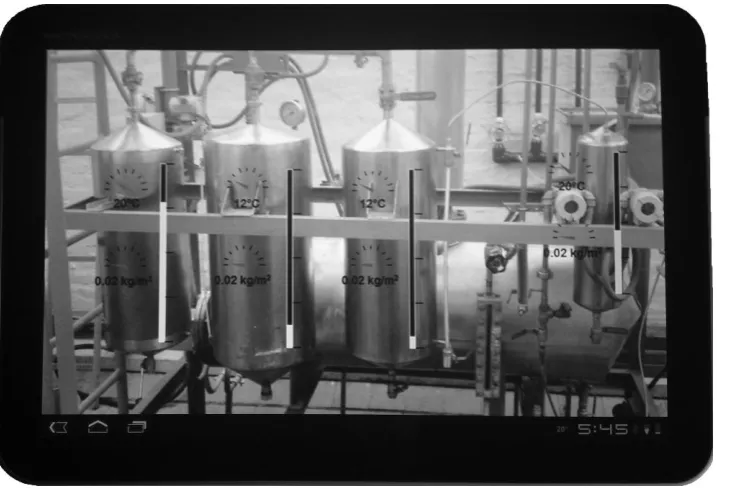
We worked on the development of a conceptual prototype allowing assistance to the technician of maintenance. The approach of the augmented reality used in the training of personnel, requires that the technical take the image of video continuously over the equipment of your interest. Being that the development is aimed at the Tablet type devices, leave aside that approach. We developed a system using the geolocation to identify the equipment in front of the technician. Then the Tablet shows a static image of the equipment with virtual objects overlapping to showing information in real time. This allows total freedom the technician did not force him to focus the equipment with the video camera. The technicians are interested in receiving and identify information easily and quickly in real-time that will help them in their maintenance tasks.
[image:4.595.95.508.334.478.2]Fig. 3 shows the system architecture of the AR-based Maintenance Tool and Fig. 4 shows a photography with the application of the conceptual prototype over a discontinuous distillation plant.
Fig. 3. System architecture of the AR-based Maintenance Tool (Conceptual prototype).
[image:4.595.120.486.506.750.2]Fig. 4 shows an example of the type of information that can be deployed on screen. In particular this stage of the maintenance is interesting because it can also be useful to the facility operation staff during their rounds of control.
When maintenance personnel intervenes the equipment displayed information is directly related to the own maintenance activity (e.g. schemas from disarmed, identification of parts, etc.).
When the activity of maintenance ends again is useful the information similar to Fig. 4. In this last step is controlled that the equipment has been correctly installed and ready for operation. Again at this stage of operation staff can be affected positively by the developed conceptual prototype.
VII. CONCLUSION
An innovative way to use the augmented reality in maintenance tasks was development. Made development can complement the maintenance tasks with a tool that works on the threshold of the human error in maintenance tasks. This prototype is useful to provide to the user the appropriate information at the right time. Provides information in redundant and simplified forms and presents information at the most appropriate level. The information is embedded in a structure that serves as an externalized mental model and the right information is showed linked with the right equipment without ambiguity.
ACKNOWLEDGMENT
The authors thank the discontinuous distillation plant staff of the Engineering Faculty at the Universidad Nacional de Cuyo for their collaboration.
REFERENCES
[1] International Atomic Energy Agency, “Good practices for cost effective maintenance of nuclear power plants”, IAEA-TECDOC-928, Vienna: IAEA, 1997, pp 7-64.
[2] International Atomic Energy Agency, “IAEA international fact finding. Expert mission of the FUKUSHIMA DAI-ICHI NPP accident following the great east Japan earthquake and tsunami”, IAEA Mission
Report, Vienna: IAEA, 2011, pp 39-58.
[3] R. Dekker, "On the use of operations research models for maintenance decision making". Microelectronics and Reliability, 35(9-10), pp. 1321-1331, 1995.
[4] R. Dekker, "Applications of maintenance optimization models: a review and analysis". Reliability engineering & system safety, 51(3), pp. 229-240, 1996.
[5] W.P. Pierskalla, J.A. Voelker, “A survey of maintenance models: The control and surveillance of deteriorating systems”. Naval Research
Logistics Quarterly, 23, pp. 353-388, 1976.
[6] P. Scarf, "On the application of mathematical models in maintenance".
European Journal of Operational Research, 99(3), pp. 493506, 1997.
[7] H. Wang, "A survey of maintenance policies of deteriorating systems".
European Journal of Operational Research, 139(3), pp. 469-489,
2002.
[8] R. Luus, “Optimization of System Reliability by a New Nonlinear Integer Programming Procedure,” IEEE Transactions on Reliability, 1975, 24(1): p. 14-16.
[9] A.K.Dhingra, “Optimal Apportionment of Reliability & Redundancy in Series Systems Under Multiple Objectives,” IEEE Transactions on Reliability, 1992, 41(4): p. 576-582.
[10] Z.Xu, W. Kuo, and H.-H. Lin, “Optimization limits in improving system reliability,” IEEE Transactions on Reliability, 1990. 39(1): p. 51-60.
[11] R.Dekker, “Applications of maintenance optimization models: a review and analysis,” Reliability Engineering and System Safety, 1996(51): p. 229-240.
[12] M. Harunuzzaman and T. Aldemir, “Optimization of standby safety system maintenance schedules in nuclear power plants,” Nuclear Technology, 1996, 113: p. 354-367.
[13] C.M.F. Lapa, C.M.N.A. Pereira, and A.C.d.A. Mol, “Maximization of a nuclear system availability through maintenance scheduling optimization using a genetic algorithm,” Nuclear Engineering and Design, 2000, 196: p. 219-231.
[14] M.Cantoni, M. Marseguerra, and E. Zio, “Genetic algorithms and Monte Carlo simulation for optimal plant design,” Reliability Engineering and System Safety, 2000(68): p. 29-38.
[15] J.E. Núñez Mc Leod, S.S. Rivera & J.H. Barón, “Optimizing Designs based on Risk Approach,” Proceedings of the World Congress on Engineering 2007, 2, pp 1044-1049.
[16] International Atomic Energy Agency, Application of Reliability Centred Maintenance to Optimize Operation and Maintenance in Nuclear Power Plants, IAEA-TECDOC-1590, Vienna:IAEA, 2007. [17] H.B. Yim and P.H. Seong, “Heuristic guidelines and experimental
evaluation of effective augmented-realitiy based instructions for maintenance in nuclear power plants”, Nuclear Engineering and
Design, Elsevier, 240(2010), pp 4096-4102, 2010.
[18] A. Swain and H. Guttman, Handbook on Human Reliability Analysis with Emphasis on nuclear Power Plant Applications. UREG/CR-1278, ed. N.R. Commission. 1983, Washington, USA.
[19] M. Ullsperger, D. Von Cramon, “Neuroimaging of performance monitoring: Error detection and beyond”, Cortex, Elsevier, vol 40(4-5), pp 593-604, 2004.
[20] Rabbitt, P.M.A., “Errors and error correction in choice-response tasks”, Journal of Experimental Psychology, 71:264-272, 1966. [21] J.R. Higgins and R.W. Angel, “Corrections of errors without sensory
feedback”, Journal of Experimental Psychology, 84, pp 412-416, 1970.
[22] P. Rabbitt and B. Rodgers, “What does a man do after he makes an error? An analysis of response programming”, Quarterly Journal of
Experimental Psychology, 30, pp 319-332, 1977.
[23] P. Rabbitt, “Consciousness is slower than you think”, Quarterly
Journal of Experimental Psychology,55(4), pp 1081-1092, 2002.
[24] M.M Botvinick, T.S. Braver, D.M. Barch, C.S. Carter and J.D. Cohen, “Conflict monitoring and cognitive control”, Psychological Review,
108, pp 624-652, 2001.
[25] O.E. Krigolson and C.B. Holroyd, “Evidence for hierarchical error processing in the human brain”, Neuroscience, 137, pp 13-17, 2006. [26] B. Foyle,, G. Duponnt, ”Maintenance errors and their prevention”,
Proceedings of the Flight Safety Foundation International Federation
of Airworthiness 48th Annual International Air Safety Seminar. Flight
Safety Foundation,Arlington, VA, pp. 353-357, 1995.
[27] International Atomic Energy Agency, “Maintenance, Surveillance and In-service Inspection in Nuclear Power Plants”, IAEA Safety
Standards Series, NS-G-2.6, Vienna: IAEA, 2002.
[28] K. Latorella and P. Prabhu, “A review of human error in aviation maintenance and inspections”, International Journal of Industrial Ergonomics, 26, pp 133-161, 2000.
[29] E. Hollnagel, “The design of error tolerant interfaces”, Proceedings of The First International Symposium on Ground Data Systems for
Spacecraft Control. Darmstadt, Germany, June 26-29, 1990.
[30] J. Rasmussen, K. Vicente, “Coping with human errors through system design: implications for ecological interface design”, International
Journal of Man-Machine Studies, 31, pp. 517-534, 1989.
[31] B. Schwald and B. de Laval, “An Augmented Reality System for Training and Assitance to Maintenance in the Industrial Context”,
Journal o WSCG, 11 (1), pp. 1-8, 2003.
[32] S. Lee and O. Akin, “Augmented reality-based computational fieldwork support for equipment operations and maintenance”,