ISSN Online: 2151-4771 ISSN Print: 2151-4755
DOI: 10.4236/ce.2019.1013250 Dec. 5, 2019 3270 Creative Education
Research on the Curriculum Design of the
Computer Public Course Oriented to the
Cultivation of Computational Thinking Ability
Xiulin Ma
1, Jingjing Liu
1, Sheng Li
2, Chenyu Fan
1*, Jing Liang
11Faculty of Education, Beijing Normal University, Beijing, China 2Ministry of Education, China Mobile Joint Laboratory, Beijing, China
Abstract
The traditional university computer public class emphasizes the “instru-mentality” of computers, and aims to improve students’ operation skills and ability to solve specific problems in life. Teaching practice has found that the tool-oriented instructional design ignores the impact of computer science on students’ thinking quality and scientific research ability, which is not conducive for students to grasp the principle of computer operation comprehensively. Based on the analyzation of existing research, this paper put forward a Computational Thinking Content Framework that integrates the teaching of computer basic courses in university from a macro perspec-tive. On the other hand, the teaching mode aiming for the cultivation of Computational Thinking was designed. Under the guidance of the prob-lem-based learning, the instructional design is carried out from three levels: comprehension and understanding, simple application and comprehensive application to impart Computational Thinking knowledge, skills, disposi-tion and strategy. Progressive design teaching activities are carried out around teaching practice and group discussion, practice by oneself, and comprehensive task, then evaluated by self-port and performance. Finally, the effectiveness of the teaching mode was verified, which brings the ideas and methods of Computational Thinking training to the ground. The re-search demonstrates that the computer basic course targeted at cultivation of Computational Thinking has a significant effect on improving students’ innovative ability and comprehensive quality.
Keywords
Computational Thinking, Computer Public Course, Information and Communication Technology, Framework, Computer Science
How to cite this paper: Ma, X. L., Liu, J. J., Li, S., Fan, C. Y., & Liang, J. (2019). Re-search on the Curriculum Design of the Computer Public Course Oriented to the Cultivation of Computational Thinking Ability. Creative Education, 10, 3270-3285. https://doi.org/10.4236/ce.2019.1013250
Received: November 12, 2019 Accepted: December 2, 2019 Published: December 5, 2019
Copyright © 2019 by author(s) and Scientific Research Publishing Inc. This work is licensed under the Creative Commons Attribution International License (CC BY 4.0).
DOI: 10.4236/ce.2019.1013250 3271 Creative Education
1. Introduction
1.1. Background
1) The tool-oriented computer public course teaching in university faces challenges
Aiming to cultivate operation skills, the computer public class emphasizes the “instrumentality” of computers. Students are encouraged to solve specific prob-lems in life by the usage of computer. With the development of Internet, compu-ting science has become universal for crowd, which called the necessity of com-puter teaching into question. Lots of people just view comcom-puter science as pro-gramming, and neglect the scientific significance of computer. And the rational-ity and necessrational-ity of computer education are questioned.
In China, the Computer Public Course is set for students of all majors to en-hance the Information and Communication Technology (ICT) and information literacy. As the threshold of technology gets lower than it used to be, there has been some argues saying that it is unnecessary to set the Computer Public Course in university. On the other hand, the connotation of computer science has been diluted gradually since more and more people equated it with pro-gramming purely. Students were being overwhelmed by Java and C++, which resulted in cheating and plagiarism as ways to pass these courses, and 35% - 50% drop out prematurely (Denning, 2003). Obviously, the joy of computing was neglected, which includes the interplay between the great principles, the ways of algorithmic thinking, and the solutions of interesting problems.
2) Computer science has spawned the computational thinking
With the popularity of computer and network applications, computer science has intersected with other disciplines, mainly reflected in research tools and methodology. On the one hand, quantitative research in the field of empirical has developed a set of formal language theory, compilation theory, test theory and optimization theory. On the other hand, tools applied to ana-lyze texts have emerged in the field of qualitative research. In addition, the methodology of computer science has also made substantial contributions to the scope, mode and method of disciplinary (Zhong & Maliyamu, 2013). Un-der this circumstance, the argument about Computational Thinking (CT) has been brought into focus, which exerted significant influence on talent cultiva-tion from then on.
3) Cultivating computational thinking in computer courses has become a hot topic
DOI:10.4236/ce.2019.1013250 3272 Creative Education the educator, but also the scientists. In 2010, the value of computational thinking for computer education was unanimously recognized by the C9 League (nine universities selected in the first batch of 985 Project, including Peking Universi-ty, Tsinghua UniversiUniversi-ty, Fudan UniversiUniversi-ty, Shanghai Jiao Tong UniversiUniversi-ty, Nanjing University, Zhejiang University, University of Science and Technology of China, Harbin Institute of Technology, and Xi’an Jiaotong University) in the summit about Computer Basic Teaching Development Strategy. Furthermore, the Department of Higher Education of the Ministry of Education launched the project of reforming computer curriculum in university and started 22 projects in 2012, which marks the germination of Computer Public Course teaching for the cultivation of computational thinking ability.
The consensus to integrate CT into Computer Public Course render the computer education see the dawn. It is urgent to explore the methods and strat-egies to cultivate CT and give students chance to feel the charm of computer science.
1.2. Research Problems
Based on the Computer Public Course in Beijing Normal University (BNU), in response to the call to integrate CT with computer science teaching, this study focuses on the following issues.
1) Constructing the framework of CT content by reviewing the literature, and analyzing the fitness between components of CT and content of computer science for all majors, to instruct the reform of Computer Public Course in BNU.
2) Applying Problem-based Learning (PBL) to carry out teaching practice from teaching strategy, activity and content design, so as to explore the model of cultivating CT in Computer Public Course.
3) Based on the teaching practice, demonstrating the effectiveness and prin-ciples of computer public course aiming for cultivation of CT.
2. Related Work
2.1. Definition of Computational Thinking
As a way to solve problem, design systems, and understand human behavior, by drawing on the concepts fundamental to computer science, CT was first coined
by (Wing, 2006), which gave rise to a wave of research in the world. Later in
ge-DOI: 10.4236/ce.2019.1013250 3273 Creative Education neralization (Shute, Sun, & Asbell-Clarke, 2017).
2.2. Literature Review on Computational Thinking
In China, the study of computational thinking begins with the transformation of computer science (Wang, 2007). As one of the most fundamental and long-term issues in computer science (Sun, 2009), a number of studies have emerged to promote the CT in the teaching of computer courses in higher education under the impetus of government. On the other hand, the content and strategies at the macro level was explored from the perspective of CT (Chen & Dong, 2011; Li, 2012). Additionally, the consensus that integrates CT into the teaching of ICT in the Computer Public Course has been popular (Zhan & Nie, 2013). Conse-quently, the standard of CT in computer science course has been established, which was divided into three dimensions (Zhong, 2015). And the content of CT was classified into six dimensions to guide the cultivation of CT in Computer Public Course combining the teaching practice of Beijing Normal University (Ma, Wu, & Liu, 2015).
In abroad, the CSTA launched a project called Computational thinking: a problem-solving tool for every classroom, which treated CT as a required skill for 21st Century success that teachers can foster using subject-specific simula-tions and modeling. Learning activities that allow students to discover and ex-plain scientific relationships, predict events, and learn procedural skills will ena-ble them to better understand these subjects, to predict behavior, and to build computational thinking skills (Philips, 2008). In higher education, practical re-search on teaching CT skills continues largely to take place within computer science (Czerkawski & Lyman, 2015).
2.3. Literature Review on the Components of CT
1) View of Jeannette M. Wing
By looking for talks and publications by Jeannette Wing, and her Viewpoint paper from Communications of the ACM, a comprehensive analysis was con-ducted. In order to express more intuitively, the components or definition of CT mentioned in her study was organized to form 6 dimensions and 19 items, as shown in Table 1.
2) View of ISTE and CSTA
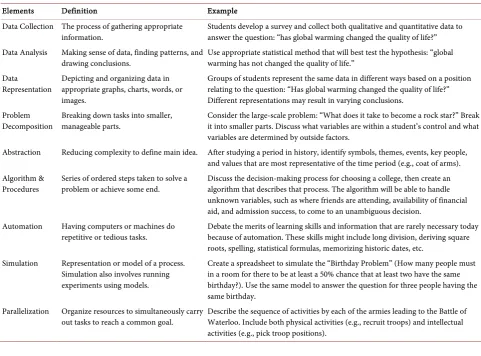
In 2011, International Society for Technology in Education (ISTE) and Com-puter Science Teachers Association (CSTA) jointly launched the operational de-finition of CT, which declared that the CT includes data collection, data analysis, data representation, problem decomposition, abstraction, algorithm and proce-dures, automation, simulation and parallelization (CSTA & ISTE, 2011). The de-finition and example of each element see Table 2.
3) View of Chinese scholars
DOI:10.4236/ce.2019.1013250 3274 Creative Education Table 1. Components of computational thinking (Jeannette M. Wing).
Components of Computational Thinking (Jeannette M. Wing)
Computational Thinking
Dimensions Items
Materialization reduction
flushbonading transformation simulation Multidimensional Analysis and
Generalization recursion concurrency
System Protection prevention
protection redundancy
fault-tolerant computing error correction system recovery
Complex system design abstraction
isolation
Heuristic Reasoning programming
dispatch modeling
Rapid Calculation time-space trade-off
patrol algorithm
Table 2. Components of computational thinking (ISTE & CSTA).
Elements Definition Example
Data Collection The process of gathering appropriate
information. Students develop a survey and collect both qualitative and quantitative data to answer the question: “has global warming changed the quality of life?” Data Analysis Making sense of data, finding patterns, and
drawing conclusions. Use appropriate statistical method that will best test the hypothesis: “global warming has not changed the quality of life.” Data
Representation Depicting and organizing data in appropriate graphs, charts, words, or images.
Groups of students represent the same data in different ways based on a position relating to the question: “Has global warming changed the quality of life?” Different representations may result in varying conclusions.
Problem
Decomposition Breaking down tasks into smaller, manageable parts. Consider the large-scale problem: “What does it take to become a rock star?” Break it into smaller parts. Discuss what variables are within a student’s control and what variables are determined by outside factors.
Abstraction Reducing complexity to define main idea. After studying a period in history, identify symbols, themes, events, key people, and values that are most representative of the time period (e.g., coat of arms). Algorithm &
Procedures Series of ordered steps taken to solve a problem or achieve some end. Discuss the decision-making process for choosing a college, then create an algorithm that describes that process. The algorithm will be able to handle unknown variables, such as where friends are attending, availability of financial aid, and admission success, to come to an unambiguous decision.
Automation Having computers or machines do
repetitive or tedious tasks. Debate the merits of learning skills and information that are rarely necessary today because of automation. These skills might include long division, deriving square roots, spelling, statistical formulas, memorizing historic dates, etc.
Simulation Representation or model of a process. Simulation also involves running experiments using models.
Create a spreadsheet to simulate the “Birthday Problem” (How many people must in a room for there to be at least a 50% chance that at least two have the same birthday?). Use the same model to answer the question for three people having the same birthday.
Parallelization Organize resources to simultaneously carry
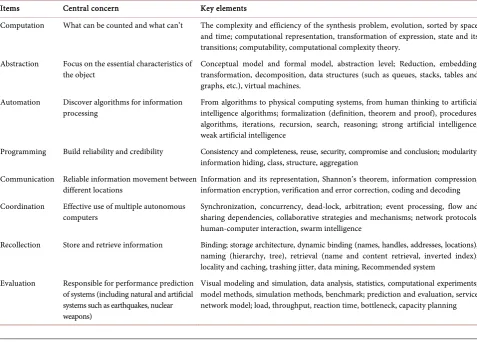
[image:5.595.56.538.379.735.2]DOI: 10.4236/ce.2019.1013250 3275 Creative Education which derived from the “Great Principles of Computing” (Denning, 2003). With computation as the core, abstraction, automation, design, communication, col-laboration, memory, and evaluation as the basic concepts, a hierarchical frame-work was constructed as shown in Table 3.
2.4. The Computer Public Course in Beijing Normal University
(BNU)
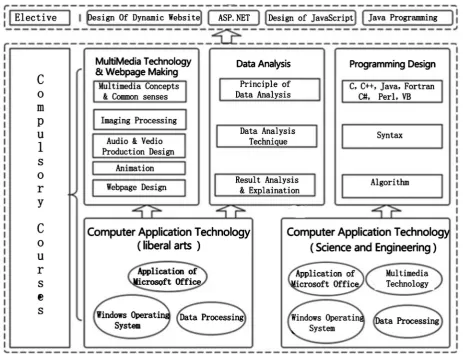
In BNU, the computer course varies from different majors, and mainly divided into liberal art and science. For the sake of personalization, alternative courses were offered in addition to compulsory. As freshman, students are required to take the compulsory course to learn about Windows, Internet and Office and so on. After that, students need to take course from the Multimedia Technology, the Programming, the Data Analysis and Application in the second semester according to their major. In sophomore or junior year, alternative courses are provided to impart advanced application of information technology, such as Sta-tistics Analysis, Database, ASP.NET. The structure of Computer Public Course in BNU is shown in Figure 1.
3. The Framework of CT in Computer Public Course
[image:6.595.58.536.399.741.2]The cultivation of CT based on the Computer Public Course is central to critical
Table 3. Computational thinking system framework.
Items Central concern Key elements
Computation What can be counted and what can’t The complexity and efficiency of the synthesis problem, evolution, sorted by space and time; computational representation, transformation of expression, state and its transitions; computability, computational complexity theory.
Abstraction Focus on the essential characteristics of
the object Conceptual model and formal model, abstraction level; Reduction, embedding, transformation, decomposition, data structures (such as queues, stacks, tables and graphs, etc.), virtual machines.
Automation Discover algorithms for information
processing From algorithms to physical computing systems, from human thinking to artificial intelligence algorithms; formalization (definition, theorem and proof), procedures, algorithms, iterations, recursion, search, reasoning; strong artificial intelligence, weak artificial intelligence
Programming Build reliability and credibility Consistency and completeness, reuse, security, compromise and conclusion; modularity, information hiding, class, structure, aggregation
Communication Reliable information movement between
different locations Information and its representation, Shannon’s theorem, information compression, information encryption, verification and error correction, coding and decoding Coordination Effective use of multiple autonomous
computers Synchronization, concurrency, dead-lock, arbitration; event processing, flow and sharing dependencies, collaborative strategies and mechanisms; network protocols, human-computer interaction, swarm intelligence
Recollection Store and retrieve information Binding; storage architecture, dynamic binding (names, handles, addresses, locations), naming (hierarchy, tree), retrieval (name and content retrieval, inverted index); locality and caching, trashing jitter, data mining, Recommended system
Evaluation Responsible for performance prediction
of systems (including natural and artificial systems such as earthquakes, nuclear weapons)
DOI:10.4236/ce.2019.1013250 3276 Creative Education Figure 1. The structure of computer public course in BNU.
thinking. In this part, the framework was initially constructed by analyzing the components of CT. Then, according to the knowledge system of computer science, it was modified to integrate the teaching objectives with the cultivation of CT. Finally, combined with the system of Computer Public Course in BNU, the framework was put forward.
3.1. The First Version of CT Content Framework
DOI: 10.4236/ce.2019.1013250 3277 Creative Education Figure 2. Computing thinking content framework (V1.0).
It is obviously that the overlaps exist between different categories, and the items involved are ambiguous. To be more concise, the framework needs to be modified from other perspectives.
3.2. The Modified CT Content Framework from the Perspective of
Computer Course
1) The modified CT content framework
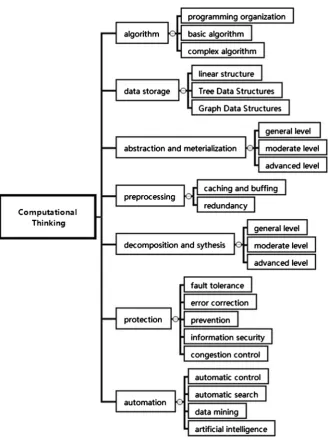
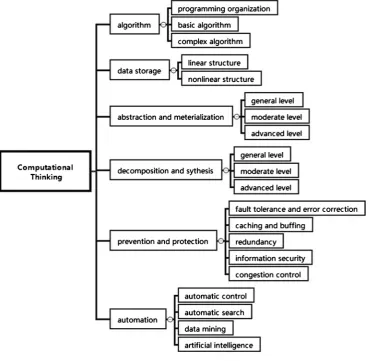
DOI:10.4236/ce.2019.1013250 3278 Creative Education framework was established after rounds of supplementary and modification, which is shown in Figure 3.
In this framework, algorithm, data storage, abstraction and crystallization, decomposition and synthesis, prevention and protection, automation, each of which is represented by corresponding knowledge and has different difficulty levels. It basically reflects the CT that students should master and suitable for computer course.
2) Interpretation of the framework
To further illustrate the fitness between the CT content framework and the computer course, a brief description of each dimension is as following.
a) Algorithm
Using a series of instruction, it describes the process of computing in com-puter accurately, which is a succinct way of programming, and an indispensable element in CT.
b) Data storage
[image:9.595.171.540.354.715.2]Recording data that generated during the processing of data streams or in-formation needed among the procedure in memory or external in a format means data storage, which can be divided into linear structure and nonlinear
DOI: 10.4236/ce.2019.1013250 3279 Creative Education structure depending on whether the physical structure in the memory is conti-nuous. The linear structure includes array, stack, queue and linear list, and the structure of tree, graph are nonlinear.
c) Abstraction and materialization
Abstraction, or logical thinking, is the main element undergirding CT (Wing, 2008), where people glean relevant information (and discard irrelevant data) from complex systems to generate patterns and find commonalities among dif-ferent representations (Wing, 2010). It generates effect and solves problems in a specific way. The Symbol in Macromedia Flash, the Slide Master in PowerPoint and the Styles in Word, etc. all embody the abstraction and materialization.
d) Decomposition and synthesis
Problem decomposition means break the problem down into manageable units to make it tractable. Without understanding its every detail, a large com-plex system can be safely used, modified and influenced. The Layers in Photo-shop, the structural design and modularization in programming, the task composition and schedule in project development, etc. are reflections of de-composition and synthesis.
e) Prevention and protection
Preventing and preparing for threatens and potential hazards, and adopting protection mechanisms to minimize the damage or lift the danger once the er-rors happened, are applied to caching and buffering, redundancy, fault tolerance and error correction mechanisms, also electronic encryption, congestions con-trol in the network, etc. called prevention and protection.
f) Automation
It refers the realization of expected goal by means of automatic detection, in-formation processing, analysis and manipulation, under the circumstances where no person or little participates. The automatic control, data mining, artifi-cial intelligence, etc. in the computer field are all products of automation.
3.3. The Computer Public Course in BNU
The reform of teaching system on Computer Public Course in BNU has been conducted since 2014, which was characterized for hierarchical classification. For the sake of personalization, alternative courses are offered in addition to compulsory, which means there are three levels, with the skills required to mas-ter increasingly complex. On the other hand, the compumas-ter course varies from different majors, and is divided into liberal art and science.
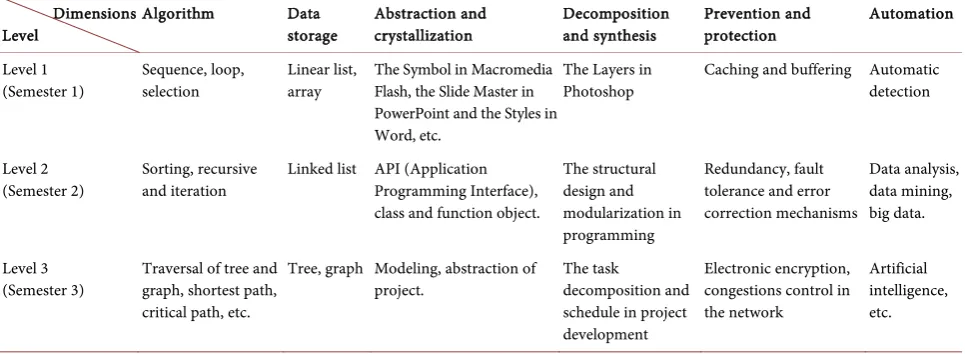
1) Computer Public Course System for different levels
DOI:10.4236/ce.2019.1013250 3280 Creative Education 2) Computer Public Course system for different majors
For the sake of personalization, the curriculum reform and teaching should be stratified according to subjects. Considering the professional needs of students, a hierarchical classification based on the framework of computational thinking content was set. Due to computing science has higher standards for students majoring in computer, the “computer” is listed separately in the disciplines column, while the non-computer major is divided into liberal arts and science. As shown in Table 5.
4. Exploration and Effect of Computer Public Course Teaching
for the Cultivation of Computational Thinking Ability
Led by Xiulin Ma, the teaching of computer public course has undergone the reform aiming for cultivation of CT since 2011. The teaching practice of nearly 8 years tells that weakening the instrumentality of software and organizing teach-ing activities from the perspective of CT have great impact on talent cultivation.
4.1. The Reform of Computer Public Course Teaching
[image:11.595.57.540.390.567.2]1) Design of teaching strategies from the perspective of CT cultivation CT is reformulating a seemingly difficult problem into one we know how to
Table 4. Cultivation of CT for different level.
Dimensions
Level Algorithm Data storage Abstraction and crystallization Decomposition and synthesis Prevention and protection Automation Level 1
(Semester 1) Sequence, loop, selection Linear list, array The Symbol in Macromedia Flash, the Slide Master in PowerPoint and the Styles in Word, etc.
The Layers in
Photoshop Caching and buffering Automatic detection
Level 2
(Semester 2) Sorting, recursive and iteration Linked list API (Application Programming Interface), class and function object.
The structural design and modularization in programming
Redundancy, fault tolerance and error correction mechanisms
Data analysis, data mining, big data.
Level 3
(Semester 3) Traversal of tree and graph, shortest path, critical path, etc.
Tree, graph Modeling, abstraction of
project. The task decomposition and
schedule in project development
Electronic encryption, congestions control in the network
Artificial intelligence, etc.
Table 5. Cultivation of CT for different disciplines.
Disciplines Computational thinking content
Non-computer Liberal arts The templates, styles and documents in Word, the Slide Master in PPT, the Layers in Photoshop, the Symbols in Flash, etc.
Science The templates, styles and documents in Word, the Slide Master in PPT, the Layers in Photoshop, the Symbols in Flash, task decomposition and linear programming. The basic control structure of the program, sorting, recursion, iterative thinking, traversal of tree, API, class, and objects in object-oriented programming, etc.
Computer Structured thinking, modular thinking, task decomposition and scheduling, sorting, recursion, iterative
[image:11.595.54.549.600.732.2]DOI: 10.4236/ce.2019.1013250 3281 Creative Education solve, perhaps by reduction, embedding, transformation, or simulation. Limited by duration of class and prior knowledge of students, the cultivation of CT in Computer Public Course need refer to thinking teaching. According to the prin-ciple of thinking cultivation, computer public course should basically implement in accordance with the “three-step” strategy, corresponding to classroom teach-ing, on-machine operation and comprehensive tasks, respectively for compre-hension and understanding, simple application and comprehensive application. In terms of the content, there are four dimensions, namely CT knowledge, CT skills, CT consciousness and problem solving ability. Not only can they be an overall part to express CT, but also exist in the process of teaching respectively. Specifically, the CT knowledge are imparted by teacher, CT skills get promoted through the practice by oneself, and the CT disposition and strategy are the key role in the process of solving comprehensive problems (Ma, Liu, & Liang, 2019).
2) Design of teaching mode base on PBL
Regarding the learning about some software, under the premise of mastering necessary operational skills, students should be coached to grasp the mechanism and principles. As a student-centered instructional approach, problem-based learning is suitable for computer classes, which provides students problems that derives from reality and relevant with teaching content (Dolman, Loyens, Marcq, & Gijbels, 2016).
In the design of problem-based learning, the subject is the problem, which should come from real life and embody the learning content. Besides, in the process of problem solving, it should imply subject knowledge and computa-tional thinking consciousness, knowledge, skill and problem solving strategies and thinking process monitoring. As for the problem, it should derive from stu-dents’ life. There are two types of problem. The first one is from teacher to create a certain situation from the perspective of cultivation CT and the curriculum teaching goal. The other is from students, on the basis of analyzing the situation of the subject and defines the problem with the help of the teacher.
4.2. Teaching Practice for the Cultivation of CT
1) Teaching activity
In Beijing Normal University, the Computer Public Course teaching reform for CT cultivation is a gradual process. In early 2010, only one course was started in one class. In 2015, three courses participated in the pilot, and 8 parallel class participated. By 2019, all teaching classes were required to consciously integrated into the thinking and strategy of CT in the teaching activities (see 3.2 for specific content and strategies).
2) Data analysis
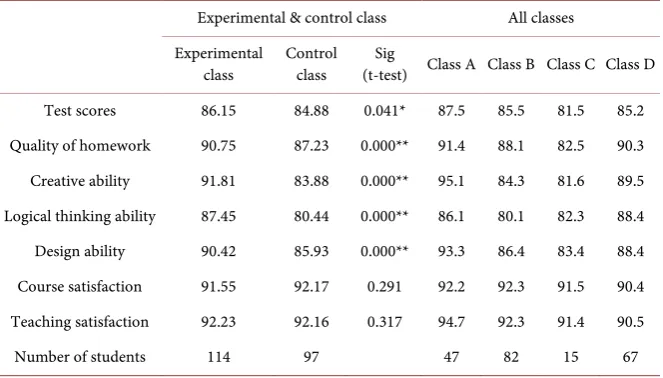
DOI:10.4236/ce.2019.1013250 3282 Creative Education are control classes. In experimental classes, the teacher consciously emphasized the knowledge and methods related to CT in the teaching process. While, in control classes, the teacher only focused on the teaching skills and the teaching steps.
After the final exam, the author evaluated students objectively from five di-mensions including quality of homework, test scores, creative ability, logical thinking ability and design ability. The creative ability mainly refers to the ability to quickly give computer-based solutions about problems; the design ability is applying computer technology to realize creativity, which is the evaluation index of computer application technology; and the logical thinking ability is the inves-tigation of the inherent logic and structure of the work. The questionnaire was used to invite students to evaluate course and teaching satisfaction. The results are shown in Table 6.
It can be seen from Table 6 that the difference between the experimental class and the control class mainly reflects the four aspects of the quality of the home-work, creative ability, logical thinking ability and design ability. There is also a significant difference in the test scores of the control class. However, there is no significant difference in students’ satisfaction with the course and teaching.
“The Independent Sample T-test” was run on the data of Class A, Class B and Class C, which shows the same result as the output of “experimental class & control class”. While the comparative of Class A and Class D displays no signi-ficance on all dimensions.
Therefore, the instructional design for CT cultivation has a significant role in promoting the development of logical ability and design ability. And the forma-tion of these abilities has something to do with the consciously strengthened the abstract, decomposition and synthesis during the teaching of template and style of Word, symbol in Flash, layers in Photoshop.
3) Results
[image:13.595.208.540.521.710.2]Based on the teaching practice and data, the following conclusions can be drawn:
Table 6. Results of students’ CT ability in four classes.
Experimental & control class All classes
Experimental
class Control class (t-test) Class A Class B Class C Class D Sig
Test scores 86.15 84.88 0.041* 87.5 85.5 81.5 85.2
Quality of homework 90.75 87.23 0.000** 91.4 88.1 82.5 90.3
Creative ability 91.81 83.88 0.000** 95.1 84.3 81.6 89.5
Logical thinking ability 87.45 80.44 0.000** 86.1 80.1 82.3 88.4
Design ability 90.42 85.93 0.000** 93.3 86.4 83.4 88.4
Course satisfaction 91.55 92.17 0.291 92.2 92.3 91.5 90.4
Teaching satisfaction 92.23 92.16 0.317 94.7 92.3 91.4 90.5
Number of students 114 97 47 82 15 67
DOI: 10.4236/ce.2019.1013250 3283 Creative Education First of all, the teaching of CT has greatly improved students’ logical thinking ability. Judging from their homework and test scores, the logical thinking has got enhanced after teachers consciously strengthen the cultivation of CT in the classroom, and make the idea of CT explicit. The impact is more significant for liberal arts.
Secondly, the data of questionnaire demonstrates that by strengthening CT thinking in the teaching of Word, Photoshop, and Flash, the important concepts such as synthesis and decomposition, abstraction, modelling got clearer in stu-dents’ mind, especially for students of liberal arts. Also it is of great importance to form scientific creative ability and design thinking.
Third, the awareness and skills to solve problems using computer have greatly improved. Based on the improvement of logical thinking ability and the mastery of abstraction and modeling methods, most students can actively use computer technology to solve problems in the face of problems in life, no matter in thought or action. The data confirms that the consciousness and strategy of CT have gradually been rooted in mind and will have an impact on later life.
5. Summary
The traditional Computer Public Course emphasizes the “operability” and “in-strumental” characteristics of the computer. Although it helps students to solve practical problems with computers, the thinking characteristics and principles contained in computer science were neglected, which decreases the quality of Computer Public Courses in university and does harm to students’ in-depth un-derstanding of computer. This research proposed that the concept and thinking mode of CT should be consciously infiltrated into the teaching process, so that students not only use computer as a tool, but also grasp the rules of thinking contained in computer science to guide their own learning and research.
Acknowledgements
We are grateful to Beijing Normal University for embracing this research.
Conflicts of Interest
The authors declare no conflicts of interest regarding the publication of this pa-per.
References
Chen, G. L., & Dong, R. S. (2011). Computational Thinking and University Computer Basic Education. China University Teaching, No. 1, 7-11+32.
http://kns.cnki.net/kcms/detail/detail.aspx?FileName=JXCY201101001&DbName=CJF Q2011
Chen, G. L., & Dong, R. S. (2013). Computational Thinking System. China University Teaching, No. 12, 22-26.
DOI:10.4236/ce.2019.1013250 3284 Creative Education CSTA, & ISTE (2011). Operational Definition of Computational Thinking for K-12
Edu-cation.
http://www.iste.org/docs/pdfs/Operational-Definition-of-Computational-Thinking.pdf Czerkawski, B., & Lyman, C. (2015). Exploring Issues about Computational Thinking in
Higher Education. TechTrends, 59, 57-65.https://doi.org/10.1007/s11528-015-0840-3
Denning, P. (2003). Great Principles of Computing. Communications of the ACM, 46, 15-20.https://doi.org/10.1145/948383.948400
Dolmans, D., Loyens, H., Marcq, J., & Gijbels, M. (2016). Deep and Surface Learning in Problem-Based Learning: A Review of the Literature. Advances in Health Sciences Education, 21, 1087-1112.https://doi.org/10.1007/s10459-015-9645-6
Li, L. (2012). Computational Thinking—Definitions and Challenges. China University Teaching, No. 1, 7-12.
http://kns.cnki.net/kcms/detail/detail.aspx?FileName=JXCY201201003&DbName=CJF Q2012
Ma, X. L., Liu, J. J., & Liang, J. (2019). Instructional Design and Practice of Data Analysis Course for the Cultivation of Computational Thinking Ability. Education Journal, 8, 249-258.
Ma, X. L., Wu, T., & Liu, L. C. (2015). Computational Thinking: The Combination of Thinking Ability Cultivation and Information Technology Basic Course Teaching. The Chinese Journal of ICT in Education, No. 2, 22-25.
http://kns.cnki.net/kcms/detail/detail.aspx?FileName=JYXX201502013&DbName=CJF Q2015
National Science Foundation (2009). CISE Pathways to Revitalized Undergraduate Com-puting Education. https://www.nsf.gov/pubs/2009/nsf09528/nsf09528.pdf
Philips, P. (2008). Computational Thinking: A Problem-Solving Tool for Every Class-room.
http://www.csta.acm.org/Resources/sub/ResourceFiles/ComputationalThinking.pdf Shute, V., Sun, C., & Asbell-Clarke, J. (2017). Demystifying Computational Thinking.
Educational Research Review, 22, 142-158.
https://doi.org/10.1016/j.edurev.2017.09.003
Sun, J. G. (2009). Revolution of Computer Science. Communication of CCF, 5, 25-28. Wang, F. Y. (2007). From Computational Thinking to Computational Culture.
Commu-nication of CCF, 3, 81-82.
Wing, J. M. (2006). Computational Thinking. Communications of the ACM, 49, 33-35.
https://dl.acm.org/ft_gateway.cfm?id=1227378&dwn=1
https://doi.org/10.1145/1118178.1118215
Wing, J. M. (2008). Computational Thinking and Thinking about Computing. Philo-sophical Transactions of the Royal Society A: Mathematical, Physical and Engineering Sciences, 366, 3717e3725.https://doi.org/10.1098/rsta.2008.0118
Wing, J. M. (2010). Computational Thinking: What and Why? Unpublished Manuscript, Pittsburgh, PA: Computer Science Department, Carnegie Mellon University.
https://www.cs.cmu.edu/~CompThink/resources/TheLinkWing.pdf
Zhan, D. C., & Nie, L. S. (2013). The Basic Thinking of Computational Thinking and University Computer Course Reform. China University Teaching, No. 2, 56-60.
http://kns.cnki.net/kcms/detail/detail.aspx?FileName=JXCY201302019&DbName=CJF Q2013
Teach-DOI: 10.4236/ce.2019.1013250 3285 Creative Education ing, No. 7, 51-55+84.
http://kns.cnki.net/kcms/detail/detail.aspx?FileName=JXCY201507011&DbName=CJF Q2015
Zhong, K. D., & Maliyamu, Y. (2013). The Computational Thinking Ability Form and Orientation of “University Computer” Course. China University Teaching, No. 5, 43-46.