Self-Regulated Learning in Virtual Worlds
–
An Exploratory Study in OpenSim
Indika PERERAa,1 and Colin ALLISONb a
Dept. of Computer Science and Engineering, University of Moratuwa, Sri Lanka b
School of Computer Science, University of St Andrews, United Kingdom
Abstract. Computer technologies are increasingly used in education to give the student more autonomy, referred to as student centred learning. One of the assumptions often made in this situation is that students will self-regulate to ensure they achieve the intended learning outcomes. Learning in immersive environments is popular as they are engaging, entertaining and flexible. However, a potential tension exists between configuring a multi-user environment to prohibit actions that can disrupt learning and maintaining the freedom and flexibility that generates learner engagement. This research investigates the importance of student self-regulation for learning in OpenSim. The outcome suggests self-self-regulation is one of the most important factors needed for successful learning within OpenSim as it preserves engagement while dissuading disruptive behaviour. Moreover, the need for suitable user support is identified as key for promoting student self-regulation within OpenSim.
Keywords. OpenSim, self-regulation, immersive environments, managed learning
1.Introduction
Virtual 3D environments that support multiple users are referred to as 3D Multi User Virtual Environments (MUVEs), or virtual worlds. These have proved sufficiently successful in educational applications to be seriously considered for mainstream use [1]. However, MUVE management can be challenging: academics can find that the underlying system functionalities and use cases are less cohesive than conventional online facilities, while students can be overwhelmed by the rich and engaging nature of 3D immersion and might focus more on environment features rather than the intended learning outcomes. To address the challenge of managed learning in virtual worlds this research investigates the self-regulation of learners within a MUVE. The findings suggest that appropriate management of MUVEs and the provision of suitable user support can promote educationally beneficial self-regulatory behaviour by students.
This research refers to the common understanding of MUVEs that allows users to interact and explore a 3D environment without predefined goals or story plots. Problems in this domain are investigated using two widely used and closely related MUVEs: Second Life (SL) [2] and Open Simulator (OpenSim) [3]. The research provides its recommendations and contributions with respect to these MUVEs. There are many previous studies and literature on using SL/OpenSim for education, but for brevity, those are not included into this discussion.
1
Corresponding Author. D. Preuveneers (Ed.) © 2015 The Authors.
This article is published online with Open Access by IOS Press and distributed under the terms of the Creative Commons Attribution Non-Commercial License.
In the common didactic educational mode students expect the teacher to tell them what to do, how and when to do it, and when to stop doing it – an approach that is open to the criticism that it relies solely on a behaviourist pedagogy where information is transferred from teacher to student rather than cultivating critical, creative and original thinking skills in the learner. Similarly, too much external regulation (forced) can introduce negative results in student centred learning [4]. This is a crucial factor for OpenSim based learning since the advantages of MUVEs that facilitate a range of modern pedagogies recommend only adequate levels of guidance and control and allow students to regulate their learning. Too much external regulation can inhibit the advantage of MUVEs while too little can fail in achieving the learning goals. The research focus of this paper is on this unexplored area in the quest to support academics and students having an effective learning experience in immersive environments.
Section 2 of the paper presents background literature and related work. Section 3 elaborates on system features of OpenSim that can affect user self-regulation during learning. Section 4 presents findings of an exploratory study examining avatar self-regulation within OpenSim based learning sessions and Section 5 concludes the paper.
2.Background and Related Work
Self-regulation is a behavioural trait suggesting individuals behave with self-control according to the context and environmental factors of their work. This concept of students behaving with a restrained approach imposed by their desire to achieve learning objectives has been developed as a learning paradigm and widely researched in traditional and e-learning environments. Self-regulated learning has been described in [5] as a collection of self-generated thoughts, feelings, and actions, which are systematically oriented toward attainment of student goals. Pintrich defines self-regulation as “an active, constructive process whereby learners set goals for their learning and then attempt to monitor, regulate, and control their cognition, motivation, and behaviour, guided and constrained by their goals and the learning environment contextual features” [6]. This is important when promoting self-regulated learning in virtual worlds. The consideration of environmental context and its attributes are significant for supporting learner engagement and effective learning in MUVEs.
Schunk [7] has suggested that there is a need for more research aimed at improving students' self-regulatory skills and to examine how learning environment contexts affect the amount and type of self-regulation displayed. In a study [8] of immersive learning activities authors reported distractions from learning when students behaved as if they had forgotten what their ultimate learning goal was e.g. they repeated actions without any particular meaning. This may have been because the students had forgotten their learning tasks. Virtual worlds can provide a better learning experience when students self-regulate as the activities are learner centric [9]. Students with higher self-regulatory skills tend to be more academically motivated and display better learning [10]; this is relevant to learning in MUVEs since students often follow exploratory and collaborative forms of learning.
conventional self-regulatory learning model which is based on the individual student should be extended for MUVE learning since student avatars are part of the community. Students are not only responsible for their individual learning goals but also for the community that they are part of [12]. This indeed supports the validity of this research where self-regulation should be part of MUVE based learning, not only in the focus on learning but also for the environment interactions and avatar behaviours in-world.
3.Management Functions and Implications for Self-Regulation in OpenSim
An OpenSim environment can be managed through the following functional areas: land, content, avatar activities, groups and user access control.
For OpenSim, land management is the most important function category. User roles in OpenSim are often defined in terms of different levels of land ownership and access to land within virtual regions (a region is 256m x 256m size of virtual land). Multiple regions can be put together and form estates with estate owners and estate managers whereas a region can be subdivided into multiple parcels with parcel owners.
Content management is the next most crucial management area in OpenSim with functions for managing content objects and their permissions on different content related user roles. The Land-related permissions often get prominence over content-related permissions when manipulating and executing content objects, although these two permission models are defined in completely different contexts. As a result, land owners at different levels can manipulate the content related functions such as script execution, content creation, media streaming and content access inside their lands, provided that there are no conflicts between the content related functions at land levels. OpenSim content management follows a complex rule set for determining the effective permission level considering all applicable permissions and is also subject to unique permission models such as fair ownership, composite permission and cyclic permission loss; previous research has identified these models [1, 13].
Avatar activities are the ways users interact with MUVEs. Although the functions available in other categories can also be seen as these, avatar activities have a subtle difference in their nature. That is, there is a limited facility to regulate most of these activities, and even if controlled, this can severely affect the engagement generated by freedom of interaction. Avatar appearance change is unrestrictedly available for users to perform at their discretion - it is not expected to be managed by the land owners or the system administrators. For example, avatar mobility activities such as flying and teleporting can be controlled as part of land management. Extreme levels of control on avatars are also available such as freezing (disable all avatar actions), or kicking it off a simulation.
Group management allows avatars to perform in-world tasks as a group. Three default roles were identified: group owner, officer, and member; details about how group management interacts with other functions are discussed in [14].
3.1.Implications for learning with self-regulation
One of the most significant means of promoting student behaviour with self-regulation is to link their avatars names to their real identities. Messinger (et al.) [15] have discussed the effect of avatar naming practices on user behaviour: “Individuals who “hide” behind their avatars cannot be easily identified, allowing virtual worlds to provide a certain degree of anonymity” [15]. Depending on the self-regulation level displayed by the students avatar anonymity can be completely harmless or extremely disturbing to the intended learning activity. The most significant challenge in managing land is to determine how land management affects the other management areas: user, content, group and avatar activity. Furthermore, conflicting conditions at different land levels (estate, region or parcel) can cause confusion for the users. Although, having more parcels may provide a good granularity to plan for more space with unique controls, such arrangements can bring an unprecedented level of complex management; students that show a high level of self-regulation can be a relief as they might not tend to exploit mistakes made by educators within an OpenSim setup.
Content management becomes important when learning activities are linked to assessments. It is important to understand the composite permission model when managing SL supported learning activities. For example, the student activities that involve scripting on their created content can affect the composite permission settings if there are conflicting permissions for the object and the scripts associated with it. In the cyclic permission loss scenario a creator of an object who transferred it to students to support their learning may not get the same permissions when the modified object is returned for assessment since students altered the permissions [13]. Fair ownership can let students accidently delete objects (and these are irreversible deletes, always). A high level of self-regulation can help prevent these actions and thereby reduce the adverse impact on the learning experience.
As Tay [16] observed, the functions available for managing groups are not designed to support group-based learning in formal education. However, roles and memberships are the two generic areas which academics can use for supporting group based teaching. One possible option is to define roles for the context of a learning activity and then delegate abilities to suit the requirements. However, there can be conflicting abilities at land, content and group levels, which with appropriate self-regulation can be managed without being exploited.
4.Self-regulation in Learning in OpenSim – A Case Study
Importantly, engagement with the OpenSim environment may not necessarily represent engagement with learning, although there can be a positive correlation if the learning tasks are in constructive alignment [18]. However, if students do not engage with the simulated environment, there is a high likelihood that they will have low engagement with their other learning activities as well. Schunk [7] has suggested that there is a need for more research aimed at improving students' self-regulatory skills and to examine how learning environment contexts affect the amount and type of self-regulation displayed.
Wireless Island [19], a dedicated region for wireless communication education, was used for a case study in self-regulation. It provides interactive simulations for students to explore and also includes supplementary learning content such as lecture notes, lecture media streams and a museum of the history of wireless communication. 59 participants from two credit bearing modules, Data Communications and Networks (31 undergraduates) and Advanced Networks and Distributed Systems (28 postgraduates) took part; the study focused on student self-regulation within the environment.
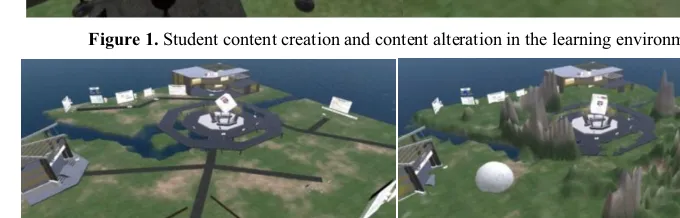
Figure 1. Student content creation and content alteration in the learning environment
Figure 2. A region compared at the end of the session: left – original layout and right - the terrain modified and content altered region
4.1.Questionnaire and Analysis
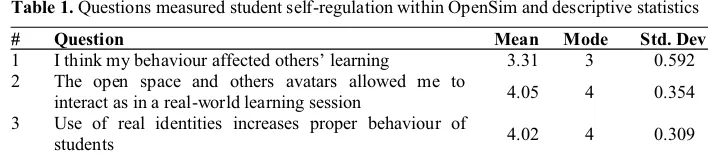
Although students had different levels of the same learning task, both samples were similar with respect to the study measures, hence analysed as a single sample (n=59). Four questions were given to the students at the end of the learning sessions:
Q1: I think my behaviour affected others’ learning
Q2: The open space and others avatars allowed me to interact as in a real-world learning session
Q3: Use of real identities increases proper behaviour of students Q4: Students should use the learning environment responsibly
[image:6.595.65.405.202.311.2]student view on having their real identity (first name and last name) as their avatar username.
Table 1. Questions measured student self-regulation within OpenSim and descriptive statistics
# Question Mean Mode Std. Dev Std. Err
1 I think my behaviour affected others’ learning 3.31 3 0.592 .104 2 The open space and others avatars allowed me to
interact as in a real-world learning session 4.05 4 0.354 .064 3 Use of real identities increases proper behaviour of
students 4.02 4 0.309 .056
4 Students should use the learning environment
responsibly 4.10 4 0.296 .051
Avatar anonymity and its impact on student learning has been researched previously in various contexts [15]; the majority of students agreed (mode = 4 & mean = 4.02) that there is a positive effect from using their real identities. Q4 elicits the student’s reflection on being a responsible participant in the learning session. The responses indicated the majority of the students agreed that they must use the environment responsibly; a positive indication of self-regulated interaction as an acceptable practice.
An open ended discussion was carried out with each student after their learning session. Among the common responses such as learning was fun, flexible and easy, a notable response was that user support and training were needed to shape their interactions within OpenSim; it was indicated by 57.6% participants with similar expressions. This view was reinforced when some students justified their low self-regulation actions (such as in Fig. 1 and 2) as being due to a lack of knowledge about OpenSim functions and their effects; they claimed that had they been given a prior training and adequate support they would not have behaved in such manner.
Due to the nature of the research, the study sample was limited to a particular set of students. These students have provided their feedback and answers based on their experiences, which were validated through observation. The questions used were appropriately designed; they have yet to be examined for psychometric measures, partly because it is a challenge to find an accepted set of suitable measures as this field of study is still growing.
5.Conclusion
Virtual world based learning environments can be highly effective. A learner is represented by an avatar which interacts with, and explores, the environment, thereby creating a high degree of engagement and intrinsically achieving student-centred learning. However, one of the main assumptions behind the success of student-centred learning is self-regulation. This is particularly important in virtual worlds as the very freedom to explore and interact can also result in distraction from, and disruption to, intended learning outcomes. Yet locking down aspects of the environment to avoid these potential problems also reduces its attractiveness and basis for learner engagement.
One of the main policy implications of this research is the need for suitable user support and training as a means for promoting student self-regulation. This need was further investigated and a specially designed set of OpenSim islands aiming at fulfilling different levels (introductory and advanced) of user training needs was later developed [20]; these training islands were evaluated for their efficacy for training with actual course modules and are now used as starting places for new OpenSim users. The research findings indicate that when learning in immersive environments such as OpenSim it is important to promote and maintain a high level of student self-regulation not only to achieve the intended learning outcomes but also to avoid disturbance to other students thereby supporting them in achieving their learning goals.
References
1. Allison, C., et al. Educationally Enhanced Virtual Worlds. in 40th ASEE/IEEE Frontiers in Education Conference (FIE). 2010. IEEE.
2. Linden_Labs. Second Life. 2003; Available from: www.secondlife.com [cited November 2009 ]. 3. The_Open_Simulator_Project. Open Simulator 2007; Available from:
http://opensimulator.org/wiki/Main_Page, [cited December 2009].
4. Boekaerts, M., Self-regulated learning: where we are today. International Journal of Educational Research, 1999. 31 p. 445-457.
5. Zimmerman, B.J. and D.H. Schunk, Self-regulated learning and academic achievement: Theory, research, and practice. 1989, New York Springer.
6. Pintrich, P., The role of goal orientation in self-regulated learning, in Handbook of self-regulation, M. Boekaerts, P. Pintrich, and M. Zeidner, Editors. 2000. p. 452-502.
7. Schunk, D.H., Commentary on self-regulation in school contexts. Learning & Instruction, 2005. 15(2): p. 173-177.
8. Virvou, M. and G. Katsionis, On the usability and likeability of virtual reality games for education: The case of VR-ENGAGE. Computers and Education, 2008. 50(1): p. 154-178. 9. Shea, P. and T. Bidjerano, Learning presence: Towards a theory of self-efficacy, self-regulation,
and the development of a communities of inquiry in online and blended learning environments. Computers and Education, 2010. 55(4): p. 1721-1731.
10. Pintrich, P., A motivational science perspective on the role of student motivation in learning and teaching contexts. Educational Psychology, 2003. 95: p. 667-686.
11. Hetzner, S., et al., Adult Self-regulated Learning through Linking Experience in Simulated and Real World: A Holistic Approach. Lecture Notes in Computer Science LNCS, 2011. 6964: p. 166-180
12. Wàn, J. and M. Reddy, The Self Regulated Community of Learning within 3D Virtual Learning Environments, in ViWo2009 workshop - ICWL 2009. 2009: Germany. p. 1-6.
13. Perera, I., C. Allison, and A. Miller. Secure Learning in 3 Dimensional Multi User Virtual Environments – Challenges to Overcome. in In Proceedings of the 11th PGNet symposium. 2010. Liverpool.
14. Perera, I., An Evaluation of User Support Strategies for Managed Learning in a Multi User Virtual Environment. 2013, University of St Andrews.
15. Messinger, P., et al., On the Relationship between My Avatar and Myself. Journal of Virtual Worlds Research, 2008. 1(2): p. 1-17.
16. Tay, W.-Y., Examining the ways in which people learn in social groups in second life: an ethnographic study, in 16th ACM international conference on Supporting group work, GROUP'10. 2010, ACM: New York. p. 339-340.
17. Schroeder, R., Social interaction in virtual environments: Key issues, common themes, and a framework for research, in The social life of avatars: Presence and interaction in shared virtual environments, R. Schroeder, Editor. 2002, Springer: London. p. 1-18.
18. Biggs, J.B., Enhancing teaching through constructive alignment. Higher Education, 1996. 32(3): p. 347-364.
19. Sturgeon, T., C. Allison, and A. Miller, 802.11 Wireless Experiments in a Virtual World. ACM SIGCSE Bull., 2009. 41(3): p. 85-89.