G. J. Sreejith1 and Stephen Powell1, 2
1Nordita, KTH Royal Institute of Technology and Stockholm University, Roslagstullsbacken 23, SE-106 91 Stockholm, Sweden 2School of Physics and Astronomy, The University of Nottingham, Nottingham, NG7 2RD, United Kingdom
We study critical behavior in the classical cubic dimer model (CDM) in the presence of a finite density of monomers. With attractive interactions between parallel dimers, the monomer-free CDM exhibits an unconven-tional transition from a Coulomb phase to a dimer crystal. Monomers acts as charges (or monopoles) in the Coulomb phase and, at nonzero density, lead to a standard Landau-type transition. We use large-scale Monte Carlo simulations to study the system in the neighborhood of the critical point, and find results in agreement with detailed predictions of scaling theory. Going beyond previous studies of the transition in the absence of monomers, we explicitly confirm the distinction between conventional and unconventional criticality, and quantitatively demonstrate the crossover between the two. Our results also provide additional evidence for the theoretical claim that the transition in the CDM belongs in the same universality class as the deconfined quantum critical point in the SU(2) JQ model.
PACS numbers: 64.60.De, 64.60.F-, 75.40.Mg
I. INTRODUCTION
According to the Landau paradigm, the critical behavior occurring near a second-order phase transition can be under-stood through the long-wavelength fluctuations of the order parameter.1Cases where such a picture does not correctly
de-scribe the critical properties, termed non-Landau or simply “unconventional” transitions, present an interesting extension of the established theory of thermal and quantum criticality.
Recent interest in this idea was sparked by the theoretical prediction of such a quantum phase transition in certain two-dimensional antiferromagnets.2 In these systems, a
continu-ous transition of the Landau paradigm is excluded by the pres-ence of distinct order parameters in the two adjacent phases. It has been argued that the critical behavior is instead governed by “spinons”, quasiparticles carrying spin of 1
2~, that are de-confined only at the critical point.2Evidence for the existence
of such “deconfined quantum criticality” has been provided by quantum Monte Carlo studies of certain spin models.3–7
A conventional Landau transition is also excluded for some thermal transitions, when the “disordered” high-temperature phase has some kind of topological order.8 This can occur in
constrained statistical systems, and leads to a second set of un-conventional transitions that are, on the surface, only remotely connected to deconfined quantum criticality. Such examples are particularly interesting when the low-temperature phase has broken symmetry, and so the transition separates phases with distinct types of order, topological above the critical tem-perature and symmetry-breaking below.
It is remarkable that unconventional criticality of the lat-ter variety is exhibited by one of the simplest conceivable constrained classical systems, the close-packed dimer model on the cubic lattice.8 This model describes the statistics of
“dimers”, objects that occupy pairs of neighboring sites of a lattice. In a close-packed dimer model, the allowed configu-rations are constrained so that every site is covered by exactly one dimer; we also consider here the case when “monomer” defects, where a site’s occupation number deviates from unity, are permitted with a large but finite energy cost∆.
In the constrained limit, ∆ = ∞, and with no other
in-teractions, the cubic dimer model (CDM) exhibits a liquid-like phase with strong correlations but no static order.9,10This
can be interpreted as the Coulomb phase of an effective lat-tice gauge theory, in which the monomers act as charges (“monopoles”). A pair of test monomers inserted into the con-strained system is subject to an effective interaction, induced by the fluctuations of the dimers. In the Coulomb phase, this interaction obeys a Coulomb law for large separation, imply-ing that the defects can be separated to infinity with finite en-ergy cost, and are hence deconfined.
In the presence of additional interactions between the dimers, a transition can occur into a phase where monomers are instead confined, by an effective potential proportional to their separation. With attractive interactions v2 between
neighboring parallel dimers, the phase at low temperatureT
has columnar order [see Fig. 1(a)] that breaks the rotation and translation symmetries of the lattice.8,11While a conventional
order parameter can be identified, the critical behavior at this “confinement transition” is modified by the fluctuations of the gauge theory, in ways that cannot be described by a conven-tional Landau theory.10,12–14
In this work, we study the critical properties of this transi-tion beyond the constrained limit. Reducing∆/T from∞
al-lows a finite density of monomers in the dimer model, screen-ing the long-range interactions between test monomers and rendering the confinement criterion invalid. The confinement transition at∆ = ∞is therefore replaced by a conventional
phase transition, described by Landau theory. For sufficiently large∆/T, however, the behavior is still strongly influenced by the presence of the nearby confinement critical point. We study this behavior using large-scale Monte Carlo simulations, to test predictions of scaling theory.
In particular, previous work15,16has presented general
the-oretical arguments that the fugacityz = e−∆/T is a relevant
scaling field under the renormalization group (RG) at the fixed point corresponding to the confinement transition. This result provides quantitative predictions for the behavior at nonzero monomer density, including for example, the shape of the phase boundary atz>0. These applications of scaling theory
have previously been tested in certain confinement transitions in spin ice,15,16in which spontaneous symmetry breaking was
absent. The present case is more demanding computationally, but also displays considerably richer phenomena, with sym-metry breaking coinciding with deconfinement at the transi-tion, and the phase boundary extending toz>0.
This alternative perspective is complementary to those ex-ploited in previous Monte Carlo studies of the CDM, which have been restricted to the fully constrained limit.8,11,13,14,17,18
Our numerical results are entirely consistent with both the qualitative and quantitative predictions of scaling theory. They demonstrate a clear distinction between the critical be-havior atz =0 andz>0, and thereby provide a particularly stringent test of the interpretation of the transition through confinement.
An additional interesting feature of the CDM transition is that its universality class is expected to be the same as that of the original deconfined critical point in quantum spin models.2
This allows us to compare our results for this transition with those for the critical point in the JQ model.3 (Limited
com-parisons have already been made using results atz = 0.18)
Agreement is again found, within the limits of accuracy that are inherent in such comparisons. Since the evidence for a continuous, non-Landau transition in the CDM is substantial, these results provide quite strong support for the theoretical scenario of deconfined quantum criticality.
Outline
In Section II, we review the cubic dimer model and its phase structure, first in terms of the original dimer degrees of free-dom and then through the language of an effective gauge the-ory and the associated concept of confinement. We then focus, in Section III, on the phase transitions from the dimer crys-tal, reviewing the critical theories for the transitions and then, in Sections III B 1–III B 8, presenting a number of predictions for behavior in their neighborhood. These are tested in de-tail in Section IV, using numerical results from large-scale Monte Carlo simulations of the dimer model. We conclude in Section V with a restatement of our main results and a brief discussion of their significance for the dimer model and for unconventional transitions more broadly. Some details of the Monte Carlo algorithm are given in an Appendix.
II. MODEL AND PHASE DIAGRAM
A. Cubic dimer model
We consider a classical statistical model in which the ele-mentary degrees of freedom are dimers, defined on the links of a cubic lattice. Labeling each site by a vectorrof integers,
one can define an occupation number dµ(r) ∈ {0,1}, giving
the number of dimers on the link joiningrandr+δµ, where
µ ∈ {x,y,z}andδµ is a unit vector. The number of dimers
touching siteris given by
n(r)=X
µ
[dµ(r)+dµ(r−δµ)] . (1)
In a close-packed hard-core dimer model, one constrains
n(r) = 1 on every site r; instead, we also allow monomers,
where a site has either no dimer or multiple dimers. We are in-terested in the case where the elementary defects, withn(r)=
0 or 2, cost a large energy∆, and so occur at low density. Larger deviations, wheren(r)>2, are expected to be
negligi-ble near the transition, and are excluded. Defining the on-site energyE(n), we therefore setE(1)=0,E(0)=E(2)= ∆, and E(n)=∞otherwise.
The transition to an ordered state is driven by an attrac-tive interaction between pairs of nearest-neighbor parallel dimers,8whose number is
N2=
X
r X
µ,ν,µ
dµ(r)dµ(r+δν) . (2)
It is also necessary (see Refs. 17 and 18 and the final para-graph of Section II B) to include additional interactions, and we follow Charrier and Alet18by using a term that counts the
number of parallel dimers around cubes of the lattice,
N4=
X
r X
µ,ν,µ
ρ,µ,ν
dµ(r)dµ(r+δν)dµ(r+δρ)dµ(r+δν+δρ) . (3)
The full configuration energy can then be written as
E=X
r
E(n(r))+Edimer
Edimer=v2N2+v4N4.
(4)
We are interested in the case of attractive interactions,v2<0,
and in the following we choose units wherev2=−1.
The partition function is given by
Z= X
{dµ(r)}
e−E/T. (5)
We use a lattice with periodic boundary conditions and an even numberLof sites in each direction.
B. Phase structure
Considering first the case where v4 = 0, the energy is
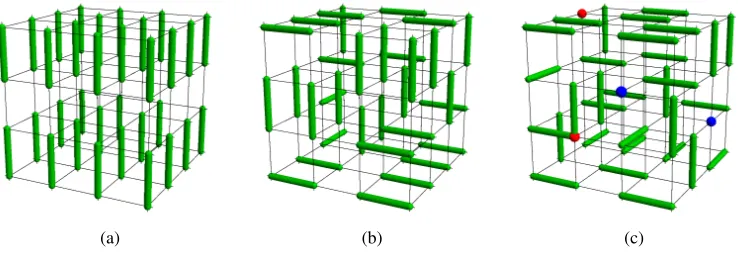
globally minimized by a columnar dimer crystal, as shown in Fig. 1(a). The dimers are aligned with a particular cubic axis, and form sheets in which each dimer has four parallel neighbors. There are six such configurations—one example hasdµ(r)=1 forµ=zandrzeven, anddµ(r)=0 otherwise— with energyE=Edimer=−L3.
The broken symmetry in these configurations is character-ized by the “magnetization” (per site),
mµ= 2
L3
X
r
(−1)rµd
(a) (b) (c)
FIG. 1. Illustrations of three phases of dimers (green) occupying the links of a cubic lattice. (a) Columnar dimer crystal, with all dimers aligned with the vertical direction and arranged in layers, maximizing the numberN2of plaquettes with parallel dimers. (b) Coulomb phase, where dimers are not ordered, but are constrained so that the dimer numbern(r) is fixed to unity for every site of the lattice. (c) Thermally disordered phase, with a nonzero density of defects in the dimer constraint. Sites with zero or two dimers cost energy∆, and act as charges in the effective gauge theory. The sign of the charge (indicated with red and blue spheres) depends on both the sign of the deviation,n(r)−1, and on the sublattice.
The 6 minimal-energy configurations maximize |m|, having m∈ {±δx,±δy,±δz}. The order parameter|hmi|is reduced by
fluctuations forT > 0 but it remains nonzero until a critical temperatureTc, at which point it vanishes and the system
en-ters a phase without order. This phase boundary, between a columnar dimer crystal and a disordered phase, is illustrated in Fig. 2 (which shows results of Monte Carlo simulations; see Section IV).
This description of the phase structure, based on the or-der parameter, is essentially identical whether∆is infinite or merely large. (Decreasing∆from infinity has the quantita-tive effect of reducing the order–disorder transition temper-atureTc, because it favors disorder in the dimer degrees of
freedom.) From the point of view of the Landau criterion for phases and transitions, there is no distinction between these two cases.
In fact, the two phases atT > Tc, illustrated in Fig. 1(b)
and (c) and occurring when∆is, respectively, infinite and fi-nite, are qualitatively distinct. As we will argue, and as our numerical results explicitly demonstrate, there is an important distinction between the transitions in these two cases, based on topological order and deconfinement. To clarify this dis-tinction, we review in Section II C the gauge-theoretical de-scription of the dimer model.9
The three phases of interest are not qualitatively affected by nonzero v4, although for large positive v4 the columnar
states no longer minimize the energy and an additional or-dered phase (“Crystal II”) can appear at lowT.18More
impor-tantly, the transition from the columnar dimer crystal into the higher-temperature phases changes from continuous to first order as v4 is decreased below a valuev4c . 0.18 The
tri-critical point separating these two types of transition appar-ently strongly influences the effective critical properties near
v4 = 0.8,17,18 In our numerical results, we therefore use the
valuev4 = +1, which allows us to access the critical behavior
of the continuous confinement transition, while being small enough to avoid complications from additional ordered phases
0.4 0.6 0.8 1.0
T
0.000 0.015 0.030 0.045 0.060
z crystal-II disordered phase
columnar dimer-crystal
FIG. 2. Phase diagram for the cubic dimer model of Eq. (4), with v2 =−1 andv4 = +1, as a function of temperatureT and monomer fugacityz=e−∆/T. Points show results of Monte Carlo simulations,
while the lines are guides to the eye. The columnar dimer crystal and thermally disordered phase are illustrated in Fig. 1(a) and (c) respectively, while the Coulomb phase, Fig. 1(b), is the limitz→0 of the disordered phase. The phase labeled Crystal II18has a more complicated ordered structure, and is not of direct interest here. For z≥0.05, we can resolve only a single first-order transition directly into this phase as temperature is reduced.
(see Fig. 2 and Section IV A).
C. Effective gauge theory
In the limit∆ =∞, the dimer model is constrained to have
[image:3.612.322.560.296.481.2]of a Gauss law by defining a “magnetic field”9,10
Bµ(r)=ηr "
dµ(r)−1 z
#
, (7)
wherez=6 is the coordination number, andηr =(−1)
P
µrµ is
±1 on the two sublattices. The lattice divergence, defined by
divrB≡ X
µ
[Bµ(r)−Bµ(r−δµ)] , (8)
obeys
divrB=ηr[n(r)−1] , (9)
and so monomers act as charges (“magnetic monopoles”), with sign depending on the sublattice.
In these terms, the partition function can be rewritten as
Z= X
{Bµ(r)}
|divrB|≤1
e−Edimer/TY r
z(divrB)2, (10)
wherez=e−∆/T is the monomer fugacity. In particular, when
∆ =∞,z=0, and so
Z= X
{Bµ(r)}
divrB=0
e−Edimer/T. (11)
The configurations to which the system is constrained at
z=0, viz. those of close-packed, hard-core dimers, satisfy a lattice Gauss law, divrB =0. Such a constraint is preserved by an appropriately chosen RG procedure, and is therefore ex-pected to have important consequences for the long-distance physics, qualitatively distinguishing the cases withz=0 and
z>0.
More explicitly, the result of such a procedure is to replace
Bµ(r) by a coarse-grained continuum vector field B(r) with a corresponding constraint on its continuum divergence,∇·B=
0. In the Coulomb phase atT > Tc, where B(r) continues
to fluctuate subject to this constraint, the effective continuum action density is
Lgauge=1
2K|B|2= 1
2K|∇×A|2, (12) where B = ∇×A. This is a (Gaussian) fixed point under
the RG, at which all other analytic terms are irrelevant, and at which correlations are algebraic.9,10
While higher-order terms are irrelevant, and a mass term for Ais forbidden by gauge invariance, monomer fugacity is
a relevant perturbation at the Coulomb-phase fixed point. For any nonzeroz, the algebraic correlations are cut offat a length scale∝z−1/dset by the monomer separation.
D. Confinement and deconfinement
The magnetizationmis a local quantity that provides a
con-ventional order parameter for the low-temperature phase. At
z=0, the phase transition can alternatively be characterized through the concept of confinement.
Consider first the partition function of Eq. (11), but evalu-ated in the presence of a set of charges at fixed positions,
Z[Qr]= X
{Bµ(r)}
divrB=Qr
e−Edimer/T. (13)
The “monopole distribution function”Gmcan then be defined,
in terms of a test pair of oppositely charged monomers atr±,
as
Gm(r+,r−)=
Z[δr,r+−δr,r−]
Z . (14)
The functionGmcan be considered as the correlation function
corresponding to the monomer fugacity.16 It is related to the
effective interaction,Um=−TlnGm(r+,r−) induced between
the monomers as a result of the fluctuating dimers.
To understand the behavior of Gm, imagine starting in a
defect-free system and taking out a single dimer. This leaves two vacant sites, which are on opposite sublattices and hence carry opposite gauge charge. One can move each monomer by rearranging the dimers; all local rearrangements preserve the signs of the charges. In the ordered phase, attempting to sep-arate the monomers in this way leaves behind a trail of distur-bance, costing an energy (at least) proportional to its length, so
Um∝R=|r+−r−|. In the Coulomb phase, there is no order
and so moving the monomers simply scrambles an already-disordered background, leaving no such trail. The scrambling induces only an entropic interaction; the monomers act like point charges in the effective magnetic field, andUm obeys
the Coulomb law,Um∝R−1.
Forz=0, the large-separation limit ofGmis therefore
qual-itatively distinct in the phases on either side ofTc. In the
or-dered phase atT <Tc, the monomers are confined, costing an
unbounded energy to be separated to infinity, and soGm→0.
In the Coulomb phase atT >Tc,Umhas a finite limit, and so
they are deconfined, with a nonzero limit forGm.
This distinction applies only for z = 0; for nonzero monomer fugacity, charges are screened in the limit of large separation, and Um always approaches a finite constant for
large separation.
III. PHASE TRANSITIONS
A. Critical theories
We are interested in the phase transition from the dimer crystal, with order parameterhmi , 0, into phases in which
the magnetization vanishes.
At z = 0, symmetry-breaking order appears simultane-ously with the confinement of monomers, and both of these effects must be incorporated in a critical theory. It has pre-viously been argued12–14that the transition is described by a
SU(2)-symmetric matter fieldsϕ. The action density is
Lcritical=Lgauge+Lmatter+Lmatter–gauge
Lmatter=s|ϕ|2+u(|ϕ|2)2 Lmatter–gauge=|(∇−iA)ϕ|2;
(15)
the pure-gauge part of the actionLgaugeis as given in Eq. (12).
Note that the matter fieldϕis minimally coupled to Aand so,
in the language where B =∇×Ais the magnetic field, has
electric charge.19
The transition occurs when sis tuned through its critical valuesc. Fors<sc, corresponding to the lower-temperature
phase, ϕ condenses and A acquires an effective mass term
by the Anderson–Higgs mechanism. This in turn eliminates the algebraic correlations and confines the monomers (mag-netic charges) through the Meissner effect. Symmetry ar-guments show that the magnetization order parameter obeys
mµ ∼ ϕ†σµϕ, whereσµ is a Pauli matrix, and so becomes
nonzero whenϕcondenses. The continuous SU(2) symmetry ofLcriticalis broken by an eighth-order (inϕ) term,
Lcubic=−ucubicX
µ
m4
µ, (16)
which is irrelevant at the critical point, but fors< scselects
states wherehmiis aligned with one of the 6 cubic directions
(ucubic>0).
Forz > 0, we instead expect the transition, between the ordered dimer crystal and the thermally disordered phase, to be described by a conventional Landau theory. The order pa-rameter is the 3-component vectorhmi, which preferentially
aligns with one of the six cubic directions. The Landau action is therefore given by
LLandau=|∇m|2+sm|m|2+um(|m|2)2+Lcubic, (17) whereLcubic is the cubic-anisotropy term given in Eq. (16),
again withucubic >0.20This theory can be viewed as the
re-sult of adding a nonzero density of magnetic monopoles to Eq. (15), suppressing the algebraic correlations of the gauge fieldAand confining the matter fieldϕinto the charge-neutral
bilinearm.
In this case, the anisotropyLcubicis only quartic in the
crit-ical fieldm, and is known to be relevant. Forucubic =0, the
transition would be continuous and in the Heisenberg univer-sality class, butucubic>0 is expected to drive it first order.21
(In fact, this transition appears to be at most very weakly first-order; see Sections III B 4 and IV A.)
B. Scaling
The presence of the continuous confinement transition at
z = 0 and T = Tc(z = 0) implies that the behavior in its
neighborhood is governed by the properties of the correspond-ing RG fixed point. This includes along the transition line at
T =Tc(z>0), and in particular determines the shape of the
phase boundary as a function ofz. In addition, the first-order nature of the transition atz > 0 is apparently weak enough
that, as we argue in Section III B 4, scaling theory can be ap-plied to this transition. These observations lead to a number of quantitative predictions that we are able to test in our sim-ulations.
1. Scaling near confinement transition
Previous work15,16 has shown that, in addition to the
re-duced temperature
t=TT−Tc(0)
c(0) , (18)
there is a relevant scaling field at the confinement-transition fixed point given by the monomer fugacityz. The reduced free-energy density f = −L−dlnZ therefore has a singular
part obeying22
fs(t,z,h,L)≈ |t|2−αΦ±(z/|t|φ,L|t|ν,h/|t|2−α−β) , (19)
whereΦ± is a universal function, with the subscript±
indi-cating dependence on the sign oft. For completeness an ap-plied fieldhcoupling to the magnetization has been included; unless stated otherwise we seth = 0 in the following. The exponentsα,β,ν, andφare related to the RG eigenvaluesyt,
yz, andyhby
α=2− d
yt (20)
β=d−yh
yt (21)
ν= 1
yt (22)
φ=yz
yt . (23)
2. Phase boundary
The phase boundary at T = Tc(z) is a nonanalyticity of
the free energy (forL =∞), and hence ofΦ−[sinceTc(z) < Tc(0)]. According to Eq. (19), this boundary has the form
|Tc(z)−Tc(0)| ∼z1/φ. (24)
While this result is asymptotically exact, there are sub-stantial corrections for nonzeroz that must be incorporated for a correct interpretation of the numerical data. The most important comes from the leading irrelevant scaling variable at the fixed point, which we denoteu, with RG eigenvalue
yu =−ω <0. Incorporating the unknown, nonuniversal
con-stantuinto Eq. (19), while settingL =∞for simplicity, we
can write
fs(t,z)≈ |t|2−αΦ±(z/|t|φ,uzωφ/ν) . (25)
The valueζcofζ =z/|t|φat whichΦ−has a nonanalyticity is
forζcexists aroundu=0 and dropping corrections of higher order inzωφ/νgives
|Tc(z)−Tc(0)| ∼z1/φ(1+Czωφ/ν) , (26)
whereCis a nonuniversal constant.
A functional-RG study23 of the Higgs theory, Eq. (15),
found a small value of the correction exponent,ω'0.3. This
implies that the second term in Eq. (26), as well as omitted higher-order corrections, should be significant, and our results are qualitatively consistent with this. It has in fact been argued that there may be logarithmic corrections to scaling in the JQ model,5,6 which would imply thatω = 0 at this fixed point;
we are unable to exclude this possibility.
3. Scaling of monopole distribution function
The monopole distribution function defined in Eq. (14) is the correlation function corresponding to the scaling fieldz, and so forz=0 has scaling form
Gm(R;T,L)≈R−2(d−yz)Γ
m±(R|t|ν,R/L) , (27)
whereR=|r+−r−|is the separation24andΓm±is a universal
function. This expression allows one to determine the RG eigenvalueyz, and hence the exponent φ, by measuring the
monopole correlation function at the critical point,t=0 and
z = 0. Together with Eq. (24), this provides a quantitative prediction for the phase boundary atz>0.
4. Scaling near order–disorder transition
The order–disorder transition atz >0 is described by the Landau theory of Eq. (17), an O(3) vector model with cu-bic anisotropy, ucubic > 0. At the Heisenberg-class fixed
point, ucubicis relevant with RG eigenvaluey0cubic > 0,
caus-ing flow to a discontinuity fixed point, describcaus-ing a first-order transition.21,22
An argument based on RG theory, however, implies that, for smallz, this first-order behavior requires inaccessibly large
L. For smallz > 0 and T ' Tc, the trajectory of the RG
flow is initially through the neighborhood of the confinement-transition fixed point. The cubic anistropy is irrelevant at this point, with RG eigenvalue ycubic < 0, and is consequently
renormalized to a smaller valueu0
cubic ∼ucubice`ycubic, where`,
the “RG time” spent in this part of the trajectory, depends on
zas e` ∼z−1/yz. The RG flow subsequently passes through the neighborhood of the Heisenberg fixed point, requiring time e`0
∼(u0
cubic)1/y
0
cubicto reach the outflow trajectory leading to the discontinuity fixed point. The required length scale to reach the latter fixed point, and hence to see a first-order transition, is therefore∼e`e`0 ∼z−yz1(1−ycubic/y0cubic). (This additional length scale is a consquence of the dangerous irrelevant scaling vari-ableucubicat the confinement fixed point. The same result can equivalently be derived using only scaling theory, following similar logic to that in Section III B 7.)
Cubic anistropy is apparently only very weakly relevant at the Heisenberg fixed point, withy0
cubic ' 0.01,21 and so the
length scale grows extremely rapidly with decreasingz. In our numerical results (see Section IV A), we indeed find no clear signatures of a first-order transition at smallz, and instead see results consistent with scaling up to the largest accessible sys-tem sizes.
On moderate length scales, one expects behavior governed by the Heisenberg fixed point, at which the relevant scaling fields are the reduced temperaturet0∝T−T
c(z), defined with
respect toTc(z), and the applied fieldh. Since this transition
belongs in a different universality class from the confinement transition, the corresponding RG eigenvalues and critical ex-ponents are different. We defineν0(
, ν) as the
correlation-length exponent at the order–disorder transition.
Near the order–disorder fixed point, the fugacity z deter-mines only nonuniversal quantities, such as the values of irrel-evant scaling fields. Aszis reduced, one expects a crossover to behavior described by the confinement transition, and hence a breakdown of the order–disorder criticality. On general grounds, this should occur when the characteristic length scale for monomers,16λ
m∼z−ν/φ, exceeds the system size.
5. Binder cumulant
The magnetization hmi provides an order parameter for
symmetry breaking at both the confinement transition (z=0) and the order–disorder transition (z>0). The corresponding Binder cumulant,25
B=1− h|m| 4i
3h|m|2i2 , (28)
therefore provides a particularly useful quantity for studying the crossover between the two critical behaviors.
The scaling dimension ofBvanishes at the fixed points
cor-responding to both transition classes, giving
B ≈ΦB(tL1/ν,z/|t|φ) (confinement) (29)
B ≈ΨB(g(z)[T−Tc(z)]L1/ν0) (order–disorder), (30)
where the functiong(z) incorporates the dependence onzof the nonuniversal constant of proportionality. Near the transi-tion for small nonzeroz, both Eqs. (29) and (30) apply, and the requirement that they be consistent fixes
g(z)∼z(ν−ν0)/(φν0). (31)
6. Binder cumulant crossings
According to Eqs. (29) and (30),Bis independent ofLat
the transition, implying that plots of the Binder cumulant ver-sus temperature for differentLcross atT =Tc(z). Corrections
order–disorder transition replaces Eq. (30) by
B ≈ΨB(g(z)[T−Tc(z)]L1/ν0)
+L−ω0
u(z) ˜ΨB(g(z)[T−Tc(z)]L1/ν
0
), (32)
where ˜ΨBis an unknown function,−ω0is the RG eigenvalue
of the leading irrelevant scaling operator, andu(z) expresses the dependence of its coefficient onz. Again requiring consis-tency with Eq. (29), we find
u(z)∼z−ω0ν/φ. (33)
At this order, the Binder cumulants atL=L1andL2have a
crossing atT =T×(L1,L2) given by25,26
T×(L1,L2)−Tc(z)∼ u(z)
g(z)
L−ω0
2 −L−ω
0
1 L1/ν0
1 −L1/ν
0
2
. (34)
In applying this result to numerical data, it is convenient to fix the ratioρ = L2/L1; incorporating thezdependence ofg(z)
andu(z) then gives
T×(L, ρL)−Tc(z)∼z−(1+ω
0ν−ν/ν0)/φ
L−ω0−1/ν0
. (35)
For the confinement transition, one similarly finds
T×(L, ρL)−Tc(0)∼L−ω−1/ν (z=0) . (36)
7. Slope of Binder cumulant at crossing
The derivative of the Binder cumulant, taken with respect toTand evaluated atT =Tc(z), can be used to determine the
correlation-length exponentsνandν0. Atz=0, one finds the
scaling result
∂B ∂T
T=Tc(0)
∼L1/ν. (37)
Similarly, forz>0, the slope is
∂B ∂T
T=Tc(z)
≈ g(z) Tc(0)
h Ψ0
B(0)L1
/ν0
+u(z) ˜Ψ0
B(0)L1
/ν0−ω0i , (38)
where the correction term from Eq. (32) has been included. In both cases, the slope is proportional toL1/ν(0)
in the limit of largeL.
The corrections in Eq. (38) have magnitude proportional to
u(z) and therefore become more significant for smallerz. In agreement with the general considerations of Section III B 4, breakdown of order–disorder scaling occurs for system sizeL
belowλm∼z−ν/φ, when the “correction” becomes larger than
the zeroth-order term.
8. Flux stiffness
An additional quantity of interest at the confinement transi-tion is the flux stiffness,8,27
K−1= 1
3L2
X
r⊥,µ
h[φµ(r⊥)]2i, (39)
where
φµ(r⊥)=
X
r
rµ=r⊥
Bµ(r) (40)
is the net “magnetic flux” through a closed surface, spanning the periodic boundaries, normal toδµ. The flux stiffnessK−1 vanishes in the thermodynamic limit forz = 0 andT < Tc,
while it approaches a constant in the Coulomb phase. At the confinement phase transition, the quantityLK−1has
zero scaling dimension,8and hence shows a similar crossing
point to the Binder cumulant and a scaling form
LK−1(t,z,L)≈Φ
K(tL1/ν,z/|t|φ) . (41)
The scaling dimension of the flux stiffness is not similarly fixed at the order–disorder transition and so, in contrast to the case of the Binder cumulant, the crossing points ofLK−1do
not converge forz>0.
IV. NUMERICAL RESULTS
We have studied the dimer model defined in Section II A using a Monte Carlo method based on the directed loop algorithm28 but adapted to allow for violations of the dimer
constraint. An update within the set of constrained dimer con-figurations can be performed by shifting dimers along a closed loop. To change the number of monomers, one shifts dimers along an open path, creating or annihilating monomers at each end. (This corresponds to adding a string of magnetic flux with a monopole at each end.) Details of the algorithm are given in the Appendix.
Simulations were performed on lattices with periodic boundary conditions and L3 sites, with system sizes up to L=144.
A. Phase structure
The phase structure of the model at z = 0 has previously been studied extensively using Monte Carlo simulations.8,11,13,14,17,18 For v4 = 0, one finds only the
Coulomb phase and the columnar dimer crystal, while for
v4 > 0 an additional crystalline phase, denoted Crystal II,
occurs at low T.18 We are mainly interested in the phase
boundary between the Coulomb and columnar phases, which is shifted by nonzerov4but qualitatively unaffected.
The phase structure at nonzerozandv4 = +1 is shown in
Fig. 2. The transition temperature to the columnar dimer crys-tal is reduced aszincreases, while the transition into Crystal II is largely unchanged. At largerz=zmax'0.5, the two phase
boundaries merge into a single first-order transition between the disordered phase and Crystal II. This sets an upper limit of
zmaxon the values ofzat which the transition to the columnar
dimer crystal can be studied.
FIG. 3. Energy histograms from Monte Carlo simulations atz =0 (left) andz=10−2(right). There is no indication of a double-peak structure, which would indicate a first-order transition, within the accuracy obtained in the simulations.
noted in Sections III A and III B 4, we expect that the transi-tion atz>0 is first order, but only very weakly so for smallz. Energy histograms close to the critical temperature, shown in Fig. 3, exhibit no signs of the double-peak structure that would indicate a first-order transition. The latent heat, if nonzero, should grow withz, but only a single peak is resolvable (for our largest available system sizes) up to the maximum acces-siblez=zmax.
By contrast, for v4 = 0, a first-order transition is clearly
seen even forz'10−2. In this case, the effects of the tricritical
point at z = 0 andv4 = v4c are likely important18 and our
scaling conclusions are less reliable.
B. Confinement transition
We begin by reporting our results for the transition atz=0 (andv4 = +1), which has previously been studied in Ref. 18.
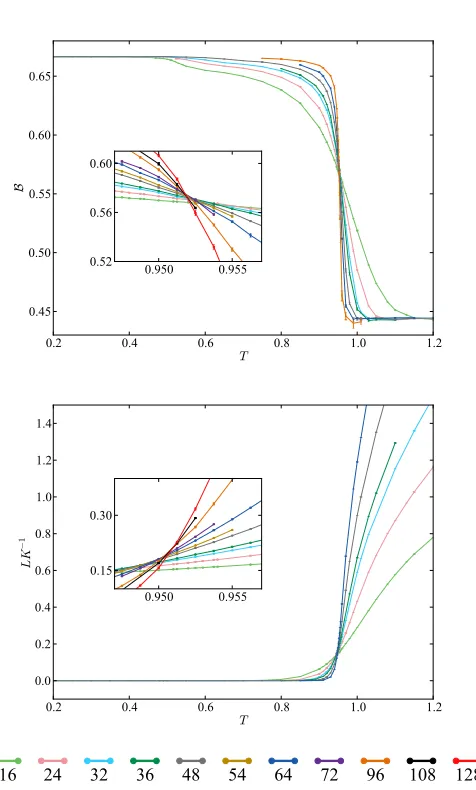
The Binder cumulant Band flux stiffness K−1 atz = 0 are
shown in Fig. 4 for various system sizes. The crossover be-tween the low- and high-temperature values becomes steeper for largerL, with a sharply defined crossing point appearing. The crossing temperatures for sizesLin the ratioL2/L1 =2
are shown in Fig. 5, along with fits to Eq. (36) and the cor-responding expression for the stiffness. These fits give val-ues for the critical temperatures ofTc(0) = 0.9517±0.0002
(Binder) andTc(0)=0.95118±0.00004 (stiffness).
The close agreement between the two methods of calcu-latingTc(0) provide evidence that the ordering, measured by
the Binder cumulant, and confinement, measured by flux stiff -ness, occur at a single transition. The remaining discrepancy,
δTc =0.0005±0.0002, suggests either that our estimates of
statistical errors are somewhat optimistic or that small system-atic errors remain. (For eachL, the crossing temperatures of
BandLK−1bound the true critical temperature.29)
The value ofνcan be determined from the derivative of the Binder cumulant at the critical temperature, as described in Section III B 7, or equivalently using the flux stiffness. The slope ofBandLK−1atTc(0) are shown in Fig. 6, as functions
ofL, along with fits to Eq. (37) and a similar expression for the stiffness. We findν=0.64±0.01 using the Binder cumulant
0.2 0.4 0.6 0.8 1.0 1.2
T
0.45 0.50 0.55 0.60 0.65
B
0.950 0.955
0.52 0.56 0.60
0.2 0.4 0.6 0.8 1.0 1.2
T
0.0 0.2 0.4 0.6 0.8 1.0 1.2 1.4
LK
−
1
0.950 0.955
0.15 0.30
FIG. 4. Confinement transition atz = 0 located using the Binder cumulantBand flux stiffnessK−1. The quantitiesB(top panel) and LK−1 (bottom) are plotted versus temperatureT for various system
sizesL. Both quantities show crossing points at the critical tempera-ture in the limit of largeL.
andν=0.61±0.01 using the stiffness.
Our results at z = 0 are consistent with previous results in the CDM withv4 = +1: Charrier and Alet18 foundTc =
0.953±0.001,ν=0.60±0.04 (Binder) andν=0.61±0.04
(stiffness).
C. Monopole distribution function
As discussed in Section III B 3, the scaling behavior of the monopole distribution functionGm(R = |r+−r−|;Tc,L) at z = 0 can be used to determineyz = φ/ν. To calculateGm,
defined in Eq. (14), we require the partition function in the presence of a monopole–antimonopole pair,Z[δr,r+ −δr,r−].
[image:8.612.56.300.53.155.2]FIG. 5. Crossing points ofB(upper, blue points) andLK−1(lower, red points) at z = 0, for pairs of systems sizes L in the ratio L2/L1=2. The solid lines are fits to Eq. (36) and the corresponding expression for the stiffness, including points withL1≥36, with only the critical temperatureTc(z=0) and the constant of proportionality as fitting parameters. The exponent−ω−1/ν=−1.9 is fixed using
ν=0.6 (Ref. 18) andω=0.3 (Ref. 23). (The fitted critical tempera-ture is not particularly sensitive to the value of the exponent; one can alternatively fit to this parameter, which gives a consistent value of Tcbut larger errors.)
FIG. 6. Temperature-derivative ofB(lower, blue points) and ofLK−1 (upper, red points) evaluated atTc(z=0), versus system sizeL. Both are proportional, for largeL, toL1/ν, giving valuesν=0.64±0.01
(Binder cumulant) andν =0.61±0.01 (stiffness). (In both cases, the fit includes only points withL ≥48. The error bars include the uncertainty onTc.)
16 32 64 128
L
7 6 5 4
lo
g
G
(L
)
y
z=2.421±0.008FIG. 7. Log–log plot ofG(L), the normalized value of the monopole distribution functionGm (see Section IV C), evaluated at the crit-ical temperature. According to Eq. (27), this ratio is asymptoti-cally proportional toL−2(d−yz); the line is a fit (to L ≥ 48) with yz=2.421±0.008.
appearing during the construction of a loop involve a pair of inserted monomers.28
Since the partition function can be calculated in Monte Carlo simulations only up to anL-dependent factor, we cal-culate the ratio
G(L)=Gm(Rmax,L)
Gm(Rmin,L), (42)
withRmax/LandRminboth fixed and of order unity. This ratio,
[image:9.612.326.543.53.235.2]which is asymptotically proportional toL−2(d−yz), is shown in Fig. 7, along with a fit giving yz = 2.421 ±0.008. Using
our estimate ofνfrom the Binder cumulant gives a crossover exponentφ=yzν=1.55±0.02 (with the error dominated by
that onν).
D. Order–disorder transition
Figs. 8 and 9 show the Binder cumulantBacross the order–
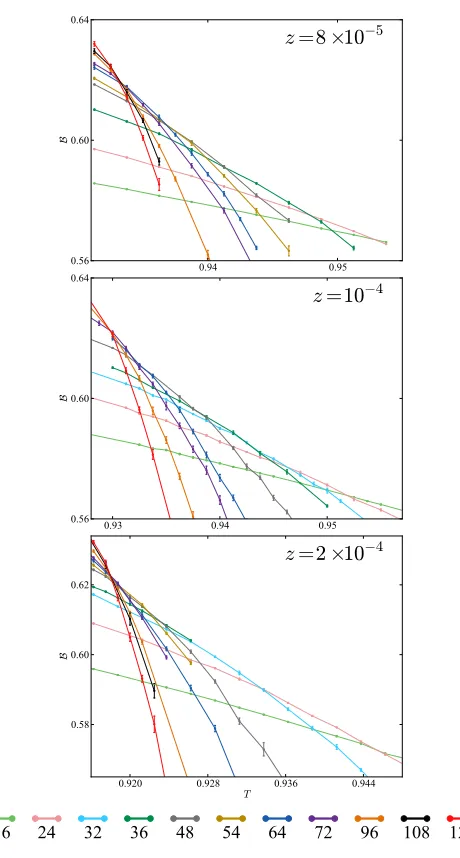
disorder transition for several values ofz. Consistent with an apparently continuous transition, the crossing points converge for the largest values ofL; the convergence is slower (requir-ing largerL) for smaller z, in agreement with Eq. (35). For each value of z, polynomial interpolations are used to find the crossing points for pairs of system sizes L in the ratio
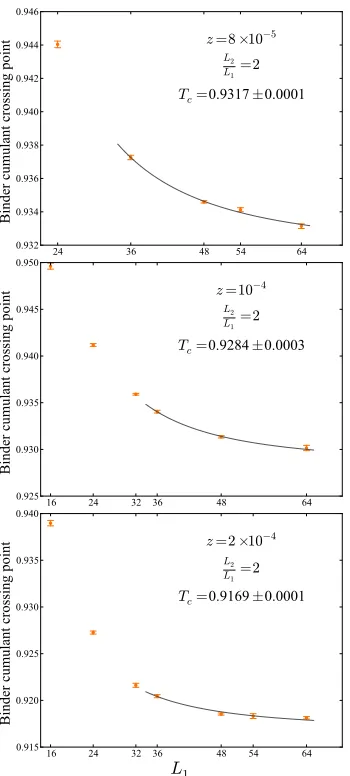
L2/L1 = 2. These are then fit to Eq. (35) in order to find Tc(z); examples are shown in Fig. 10. Note that the fits use
fixed values ofω0andν0appropriate to the Heisenberg
uni-versality class.30 (The fitted values ofT
care not particularly
sensitive to these values; consistent results with larger error bars are found by fitting to the exponent.)
The dependence of the transition temperature Tc on
[image:9.612.55.299.418.616.2]0.4 0.6 0.8 1.0
T
0.48 0.54 0.60 0.66
B
z
=10
−30.86 0.88
T
0.600 0.625
[image:10.612.324.554.44.473.2]B
FIG. 8. Binder cumulantBas a function ofT forz=10−3. As for z=0 (Fig. 4), curves for differentLcross at the critical temperature (forL&48), consistent with a continuous transition.
to give a power-law dependence ofTc(z), indicating that the
corrections to scaling are substantial. A power-law fit to the smallest threezvalues, withz≤10−4, givesφ=1.46±0.08,
which is in good agreement with the valueφ = 1.55±0.05
found using calculations atz=0.
To incorporate leading-order corrections, we use Eq. (26), with the value of the correction exponentω=0.3 found in a functional-RG study23of the critical action, Eq. (15). This
in-creases the range of zover which a reasonable fit is found; we find a consistent value, φ = 1.43±0.04, by including z ≤ 10−3. (While the nominal error of the fit is reduced by
including data at largerz, the quoted value is not necessarily reliable: The small magnitude ofω implies that significant higher-order corrections should also be expected.)
E. Effective correlation-length exponent
The effective value of the correlation-length critical expo-nentν0, determined using the slope ofBatT
c(z), is shown as
a function of zin Fig. 12. While a clear distinction is seen between the exponents forz = 0 andz > 0, confirming the different universality classes for these two cases, it is difficult to draw further conclusions about the nature of the transition atz>0.
According to the scenario outlined in Sections III B 4 and III B 7, one would expect ν0 to take the value30 ν
Heis. =
0.7112±0.0005 appropriate to the 3D Heisenberg universality
class, at least for intermediate values ofz: For very smallz, the influence of the confinement fixed point gives corrections (for even quite largeL), described by Eq. (38); for largerz val-ues the true first-order nature of the transition should become apparent, causing complete breakdown of scaling. The large
FIG. 9. Binder cumulantBas a function ofT for severalz>0. In each case, a well-defined crossing point develops for largeL, but the convergence is slower for smallerz.
uncertainty inTc(z), caused by slow convergence of the
cross-ings of the Binder cumulant, makes refinement ofν0difficult.
V. CONCLUSIONS
Our central result, illustrated in Fig. 11, is the quantitative relationship, derived using the scaling theory and confirmed in large-scale Monte Carlo simulations, between the monopole distribution function atz=0 and the phase boundary atz>0. The connection between the two follows from their common dependence on the RG eigenvalueyzof the monomer fugacity
[image:10.612.57.301.51.262.2]char-FIG. 10. Crossing points of Binder cumulants for severalz > 0 (shown in Fig. 9), for pairs of systems sizesLin the ratioL2/L1=2. In each case, the solid line is a fit to Eq. (35), using fixed exponent −ω0−1/ν0=−2.2, appropriate to the Heisenberg universality class.30 (Only sizesL1≥36 are included in each fit.)
acterized by confinement.
As illustrated in Fig. 12, we also directly observe a diff er-ence between the correlation-length critical exponents at the confinement (z = 0) and order–disorder (z > 0) transitions. This is a direct demonstration of the distinct critical behavior in the generic case, where Landau theory is expected to apply, and in the constrained limit, where it is violated. Related pre-vious examples include the unconventional critical behavior observed in a topologically constrained Heisenberg model31
and recent studies of the square-lattice dimer model at finite hole density.32
Consistently with previous work on the CDM, we see no sign of first-order behavior forz =0 andv4 ≥0.8,11,13,14,17,18
As discussed in Section III B 4, we expect a very weak first-order transition for smallz>0, with Heisenberg-like critical behavior on moderate length scales. Our results atz>0 and
v4= +1 are indeed broadly consistent with a continuous
tran-0.0001 0.0004 0.0016
z
0.02 0.04 0.08 0.16 0.32
Tc
(0
)
−
Tc
(
z
)
Tc
(0
)
Fit to z≤10−4 using Tc(z)−Tc(0)
Tc(0) =cz
1
φ giving φ=1.46±0.08
Fit to six data points using Tc(z)−Tc(0)
Tc(0) =c1z
1
φ(1−c
[image:11.612.91.266.48.436.2]2zωz) giving φ=1.43±0.04
FIG. 11. Dependence of transition temperatureTcon monomer fu-gacityz. For eachz,Tc(z) is determined as illustrated in Fig. 10. The red line is a fit to the scaling resultTc∼z1/φ, using only the 3 small-est values ofz(z ≤10−4), givingφ=1.46±0.08. The blue curve
fitsz ≤10−3 to Eq. (26), which includes the leading corrections to scaling, givingφ=1.43±0.05.
0.000 0.002 0.004 0.006 0.008 0.010
z
0.60 0.65 0.70 0.75 0.80 0.85 0.90
ν
0
FIG. 12. Effective correlation-length exponentν0 as a function of
monomer fugacityz. For each value ofz, the correlation-length ex-ponent is found using the temperature-derivative ofBat the critical temperature, as in Fig. 6.
sition in the Heisenberg universality class, including (1) the absence of a double-peak structure in the energy histogram (Fig. 3), (2) well-defined crossing points of the Binder cu-mulant (Fig. 8), and (3) good fits to the finite-size behavior of the Binder crossings, using the exponents of the Heisen-berg universality class (Fig. 10). We also observe reasonable finite-size scaling of the temperature-derivative of the Binder cumulant, but we are unable to determine the exponentν0
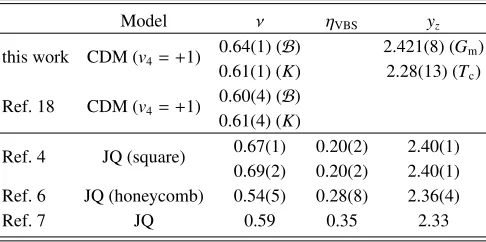
[image:11.612.321.560.49.232.2] [image:11.612.327.544.344.518.2]TABLE I. Comparison of critical exponents for the cubic dimer model and the JQ model3with SU(2) symmetry, on square and hon-eycomb lattices. For the CDM, two values ofνare reported in each case, calculated using the Binder cumulantBand the stiffnessK. In this work, two values ofyz are found, using the test-monopole
dis-tributionGmatz=0 and the phase boundaryTc(z>0). For the JQ model, the monopole scaling dimensionyzis found using the
anoma-lous dimension of the VBS operator2η
VBS=d+2−2yz(denotedηd
in Ref. 4 andηΨin Ref. 7). The two sets of values for the JQ model
on the square lattice correspond to two choices for the Q term.4In Ref. 7 good finite-size scaling is observed for both square and hon-eycomb lattices (for system sizesL ≤96), but no uncertainties are quoted.
Model ν ηVBS yz
this work CDM (v4= +1) 0.64(1) (B) 2.421(8) (Gm) 0.61(1) (K) 2.28(13) (Tc) Ref. 18 CDM (v4= +1) 0.60(4) (B)
0.61(4) (K)
Ref. 4 JQ (square) 0.67(1) 0.20(2) 2.40(1) 0.69(2) 0.20(2) 2.40(1) Ref. 6 JQ (honeycomb) 0.54(5) 0.28(8) 2.36(4)
Ref. 7 JQ 0.59 0.35 2.33
putative first-order transition atz > 0 may never be visible with realistic system sizes. Given the substantial corrections to scaling exhibited by this transition, however, such argu-ments should not be considered definitive. Indeed, atv4 =0,
where corrections due to the tricritical point atv4=v4care
sig-nificant, clear first-order behavior is seen atz= 10−2. More
work, including studies at intermediatev4, are needed to
clar-ify this picture.
Universality and deconfined criticality
The zero-temperature ordering transition in certain 2D quantum antiferromagnets, such as the [SU(2)] JQ model,3is
claimed2 to be described by the same critical theory as given
in Eq. (15), and should therefore belong in the same universal-ity class. Universaluniversal-ity is one of the most remarkable features of critical behavior, and a clear demonstration in the context of non-Landau criticality would be a striking result. Since the confinement transition in the dimer model necessarily occurs at zero monomer density, it would also provide direct evidence for deconfinement at the quantum critical point.
In the JQ model, the formation of a valence-bond solid (VBS) is a consequence of the condensation of monopoles.2
The exponentηVBS describing the appearance of VBS order is therefore related to the monopole scaling dimensionyz by
ηVBS =d+2−2yz. Values foryzand for the critical exponentν,
displayed in Table I, show reasonable agreement, albeit with large error bars.
While quantitative comparison of exponents is always chal-lenging, it is made even more so in this case by the presence of large corrections to scaling. Significant corrections are ob-served in all cases,5providing a further, qualitative indication
of universality. This indicates the presence of a weakly irrele-vant scaling variable at the fixed point, an observation consis-tent with a recent functional-RG study23of the critical action
Eq. (15), which found a small correction-to-scaling exponent,
ω'0.3.
Although scaling behavior is visible over a range of length scales,33 the possibility remains that the transition in the JQ
model is first order.34 (This should not be confused with the
weak first-order transition expected in the CDM at z > 0. Berry phases suppress singly-charged monopoles in the JQ model,2so the transition is effectively at zero fugacity,z=0.)
Indeed, a drift in the effective exponent values with increasing system sizes was observed by Harada et al.,7consistent with
a weak first-order transition. Universality between different models and different lattices, as suggested by Table I, would nonetheless imply that the RG flow is through the neighbor-hood of a critical fixed point. In this case, one might expect that, as in the CDM,17,18additional perturbations could drive
the JQ transition truly continuous, or at least extend the length scale over which scaling can be observed.
ACKNOWLEDGMENTS
The simulations were performed on resources provided by the Swedish National Infrastructure for Computing (SNIC) at the National Supercomputing Centre (NSC) and High Perfor-mance Computing Center North (HPC2N).
Appendix: Monte Carlo algorithm
In this Appendix, we give a brief description of the numer-ical methods used for the calculation.
The Monte Carlo routine is based on the directed loop algorithm,28 adapted to allow for violations of dimer
con-straints. The system consists of a three dimensional cubic lattice withL sites, or nodes, in each direction and periodic boundary conditions. The dimers can occupy the links of the lattice subject to the dimer constraints described in Sec-tion II A. The Monte Carlo algorithm samples the equilibrium thermodynamic distribution of dimer configurations∝exp−ET
where the energyEof a configuration is given by Eq. (4). Two kinds of updates are used for sampling the configura-tions; the first has a high acceptance rate but does not alter the number of monomers, while the second can generate and annihilate monomers.
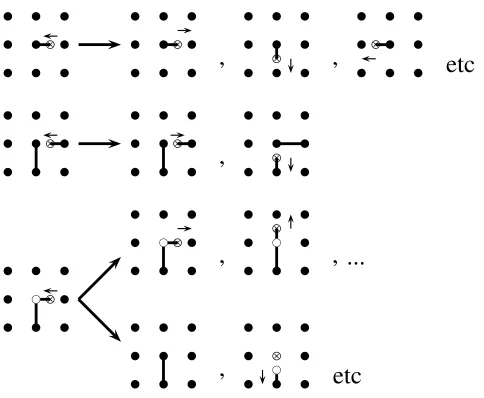
The first kind of update begins by randomly picking a monomer-free nodeP. The node is accepted with a proba-bility (specified below) that depends only on the local config-uration aroundP. If accepted, the system transitions into a configuration in which there are two monomers—one on the nodePand one on a link connected toP. This is accompanied by addition or removal of half a dimer as shown in the exam-ple in Fig. 13. The link monomer has a “direction” attribute, which serves to identify one of the two nodes connected to the link as the node “ahead”, and which initially points away from
b b b
b b b
b b b
b b b
b ⊗ b
b b b
b b b
b bc b
b b b
⊗
b
c
b b b
b bc b
b b b
⊗
,
,
etc
[image:13.612.57.299.188.387.2]P P P P
FIG. 13. First stage of a Monte Carlo update. After a nodeP is selected, a sequence of dimer rearrangements is performed, starting with creation of a pair of monomers of opposite charges—one onP and one on a link connected toP. Half a dimer is added or removed depending on the occupancy of the link.
b b b
b b b
b b b
⊗ b b b b b b b b b ⊗ b b b b b b b b b ⊗
b b b
b b b
b ⊗b b
,
,
etc
b b b
b b b
b b b
⊗
b b b
b b b
b ⊗b b
,
b b b
b b b
b b b
⊗
b b b
b bc b
b b b
b b b b b b b b ⊗
b b b
b bc b
b b b
⊗
,
, ...
⊗
b
c
b b b
b b b
b b b
[image:13.612.327.562.483.538.2]b b b b ⊗ b b b b b c
,
etc
FIG. 14. Examples of propagation of link monomer. Monomer prop-agation in the first kind of update proceeds without changing the monomer count on the nodes. If the node ahead has a monomer on it (bottom), the update sequence can terminate with the link-monomer annihilating the one on the node.
The link monomer can hop to one of the six links connected to the nodeP1 ahead of it, erasing or creating dimers in the
process as shown in Fig. 14. Any such hopping that does not result in a change in the number of monomers on P1 is
al-lowed. If the link monomer hops back to the same edge, the direction of propagation is flipped. IfP1has a monomer, the
link monomer can annihilate with the one on the node, thereby terminating the update process.
The probability of a transition from configurationktoqis given by
p(k→q)= w¯Pq−δkqmin( ¯w)
¯
w−min( ¯w) , (A.1)
where ¯wi =exp−ET¯iwith ¯Eithe energy of the configuration
without considering the two monomers created by the update
process. The energy of the half dimer is taken to be half that of a full dimer at the same edge.
The second kind of update is similar to the first, but can start on any node, including ones with monomers. Such an update can terminate with the absorption of the link monomer into a node, creating or annihilating a node monomer. The propagation of the link monomer proceeds similarly to the first update, with probability of transition from k to q of
p(k → q) = wPq−wδ−kqmin(min(ww)) wherewi = exp
−Ei
T
. Since the number of monomers can change after the update, the energy
Eis calculated with the energy of every node monomer added by the process.
The relative frequency of the two kinds of update was chosen to minimize the convergence time but otherwise did not affect the outcomes. Thermalization of the system from a monomer-free, fully ordered configuration was achieved by performing the updates until approximately 6000× L3
forward-propagation steps of the link monomer had been achieved. Configuration samples were subsequently taken once every∼L3forward propagation steps. Averages and
er-ror estimates of thermal expectation values and their combina-tions (e.g., Binder cumulants) were obtained by the blocking method.
The crossing point of Binder cumulants B(L1,T) and B(L2,T) for systems of size L1 and L2 was obtained by
first finding an approximate crossing point ˜T×from a
piece-wise linear interpolation of the data. A better estimate T×
was obtained by fitting the data in the temperature interval ˜
T×±0.00375 to quadratics,
B(L1,T)=B0+M1(T−T×)+A1(T−T×)2 B(L2,T)=B0+M2(T−T×)+A2(T−T×)2
(A.2)
(with fit parametersB0,A1,2,M1,2, andT×).
TheT-derivative of the binder cumulant was found using a fluctuation–response relation, ∂B ∂T ! z= − 1
3T2 h|m|4i
h|m|2i2
"h(E
dimer− hEdimeri)|m|4i h|m|4i
−2h(Edimer− hEdimeri)|m| 2i
h|m|2i
#
, (A.3)
whereEdimer is the energy excluding the contribution from
monomers.
The Monte Carlo algorithm and its implementation were tested using comparisons with previously published results and, for small system sizes, simple alternative methods. For
L=2, results were compared with the exact averages obtained from the enumeration of all possible microscopic states. For system sizeL =4 and parametersv4 = 0 andz = 0.05, the
1 L. D. Landau and E. M. Lifshitz,Statistical Physics, Butterworth– Heinemann, New York (1999).
2 T. Senthil, A. Vishwanath, L. Balents, S. Sachdev, and M. P. A. Fisher, Science303, 1490 (2004); T. Senthil, L. Balents, S. Sachdev, A. Vishwanath, and M. P. A. Fisher, Phys. Rev. B70, 144407 (2004).
3 A. W. Sandvik, Phys. Rev. Lett.98, 227202 (2007).
4 J. Lou, A. W. Sandvik, and N. Kawashima, Phys. Rev. B 80, 180414(R) (2009).
5 A. W. Sandvik, Phys. Rev. Lett.104, 177201 (2010).
6 S. Pujari, K. Damle, and F. Alet, Phys. Rev. Lett.111, 087203 (2013).
7 K. Harada, T. Suzuki, T. Okubo, H. Matsuo, J. Lou, H. Watanabe, S. Todo, and N. Kawashima, arXiv:1307.0501 (unpublished). 8 F. Alet, G. Misguich, V. Pasquier, R. Moessner, and J. L. Jacobsen,
Phys. Rev. Lett.97, 030403 (2006).
9 D. A. Huse, W. Krauth, R. Moessner, and S. L. Sondhi, Phys. Rev. Lett.91, 167004 (2003).
10 C. L. Henley, Ann. Rev. Cond. Matt. Phys.1, 179 (2010). 11 G. Misguich, V. Pasquier, F. Alet, Phys. Rev. B78, 100402(R)
(2008).
12 S. Powell and J. T. Chalker, Phys. Rev. Lett.101, 155702 (2008); Phys. Rev. B80, 134413 (2009).
13 D. Charrier, F. Alet, and P. Pujol, Phys. Rev. Lett.101, 167205 (2008).
14 G. Chen, J. Gukelberger, S. Trebst, F. Alet, and L. Balents, Phys. Rev. B80, 045112 (2009).
15 S. Powell, Phys. Rev. Lett.109, 065701 (2012). 16 S. Powell, Phys. Rev. B87, 064414 (2013).
17 S. Papanikolaou and J. J. Betouras, Phys. Rev. Lett.104, 045701 (2010).
18 D. Charrier and F. Alet, Phys. Rev. B82, 014429 (2010). 19 The dual language is used in Ref. 14, so our electric charges are
there referred to as magnetic monopoles.
20 A term (∇·m)2is also consistent with symmetry, but is irrelevant at the Heisenberg fixed point.21
21 J. M. Carmona, A. Pelissetto, and E. Vicari, Phys. Rev. B61, 15136 (2000).
22 J. Cardy, Scaling and Renormalization in Statistical Physics (Cambridge University Press, Cambridge, UK, 1996).
23 L. Bartosch, arXiv:1307.3276 (unpublished).
24 This result is asymptotically correct forRlarge compared to the lattice scale. The form of Eq. (15) implies thatGmis then isotropic and sublattice independent.
25 K. Binder, Z. Phys. B43, 119 (1981).
26 A. M. Ferrenberg and D. P. Landau, Phys. Rev. B44, 5081 (1991). 27 Forz=0, the lattice Gauss law implies thatφ
µ(R) is independent
ofRand so the sum overRis redundant.8
28 A. W. Sandvik and R. Moessner, Phys. Rev. B73, 144504 (2006). 29 Reduced size (with periodic boundaries) tends to increase the or-dering temperature, and hence the Binder crossing point, because it restricts fluctuations to those commensurate with the system period.22The stiffness is sensitive to only those fluctuations that change the total magnetic flux through the system. Threading a unit of flux is easier for a smaller system, and so one needs lower temperature to suppress such fluctuations for smallerL.
30 M. Campostrini, M. Hasenbusch, A. Pelissetto, P. Rossi, and E. Vicari, Phys. Rev. B65, 144520 (2002).
31 O. I. Motrunich and A. Vishwanath, Phys. Rev. B70, 075104 (2004).
32 S. Papanikolaou, D. Charrier, and E. Fradkin, arXiv:1310.4173 (unpublished).
33 K. Chen, Y. Huang, Y. Deng, A.B. Kuklov, N.V. Prokof’ev, and B.V. Svistunov, Phys. Rev. Lett.110, 185701 (2013).