DEVELOPMENT
OF
REAL TIME
NAVAL STRATEGIC
ADVANCED WARFARE SYSTEMS DIVISION
NAVAL ANALYSIS GROUP OFFICE OF NAVAL RESEARCH DEPARTMENT OF NAVY.
,
COMMAND
and
COMPUTER COMMAND AND CONTROL COMPANY
DLVELOPi1ENl' OF REAL TIME
NAVAL STRATEGIC COMMAND AND CONTROL SYSTI11S
Report No. 31-102-6
Contract NOnr 4366(00)
Submitted to
OFFICE OF NAVAL RESEARCH NAVAL ANALYSIS GROUP
ADVANCED WARFARE SYSTEMS DIVISION Washington, D. C. 20360
TABLE OF CONTENTS
List of Figures List of Tables Preface
Summary
Conclusions and Recommendation
1. Introduction 1.1
1.2
1.3
1.4
Characteristics of Real Time Strategic Command and Control
Facilities and Requirements of Newly-Mechanized Commands
1.2.1 Facilities 1.2.2 Requirements General Development Plan 1.3.1
1.3.2 1.3.3
Equipment Growth Phases System Program Growth Phases Functional Program Growth Phases Phase 1 System Characteristics
1.4.1 Capacity for Real Time Activity 1.4.2 MUltiprogramming
1.4.3 Memory and Display Technology 1.5 Expected Benefits
2 • Requirements 2.1 General
2.2 Ocean Surveillance
2.3 Continuity of Operations 2.4 Antisubmarine Warfare (ASW)
2.5 Ocean, Clearance, Dispersal of Forces and Naval Control and Protection of Shipping
2.6 Search and Rescue
2.7 Control of Combat Forces 2.8 Logistics
2.9 Planning for Current and Contingency Operations 2.10 Summary of Requirements
3. Hardware Development by Stages for a Real Time Cormnand and Control Processing Center
3.1 Devices for a Real Time System
3.2 Initial and Eventual Families of Computers 3.3 A Phase Development Plan
Report No. 31-102-6 12/15/65
4.
5.
6.
TABLE OF CONTENTS (Cont' d)
System Programs
4.1 Storage and Retrieval of Information
l~-l
4-1
4.1.1 File System 4-1
4.1.2 File Organization 4-2
4.1.3 Retrieval of Items from the List Structured
File 4-5
4.1.4 Real Time Updating of the List Structured
File 4-6
4.1.5 File Protection, Rearrangement and Purging 4-7
4.2 The System Executive 4-7
4.2.1 Functions of the Executive 4-7 4.2.2 Block Diagram of the Executive System 4-9 4.2.3 Past TImplementation Experience 4-13
4.3 General Message Interpreter 4-13
4.3.1 Message Preprocessor 4-13
4.3.2 Query Language 4-14
4.3.2.1 Descriptions 4-15
4.3.2.2 Statements and Procedures 4-15 4.3.2.3 Explanatory and Concise Ouery Modes 4-20
4.3.2.4 Header Information 4-22
4.3.2.5 Query Language Interpreter 4-22
4.4 Input/Output 4-24
Functional Programs
5.1 List of Phase 1 Functional Programs 5.2 Program Descriptions
5.2.1 Updating Programs 5.2.2 Retrieval Programs
5.2.3 Services for Programmers 5.2.3.1
5.2.3.2 5.2.3.3 5.2.3.4
On-Line Assembler Debugging Aids
Machine Language Interpreter Compilers 5-1 5-1 5-2 5-2 5-4 5-5 5-6 5-7 5-8 5-8 5.2.4 File Translator and Other Special Programs 5-8
5.3 Expansion of Functional Programs
5.3.1 5.3.2
Data Base Management Programs Strategic Planning Programs
Operational Characteristics
6.1 General Overall Operations 6.2 Typical Update Operations
TABLE OF CONTENTS (Cont'd)
6.3 Typical Information Retrieval for Operations 6.4 File Translation for Operations
7. TImp1ementation Plan
7.1 Characteristics of the TImplementation Phase. 7.2 TImp1ementation Effort
8 • Accrued Benefits Distribution List Form DD 1473
"
6-3 6-7 7-1 7-1 7-2 8-1
Report
No.
31-102-6LIST OF FIGURES
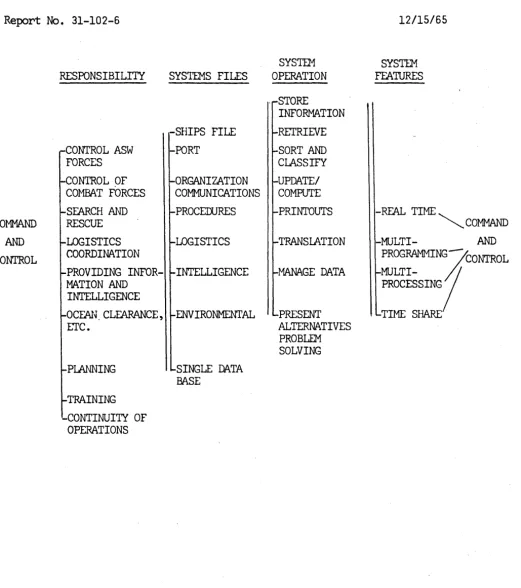
Fig. 1-1 Transformation of Command Responsibilities to Computer System Features
3-la Phased Hardware Development
3-lb Phased Hardware Development
4-1 Sample Hultilist File
4-2 The r;xecutive System
4-3 The Format of a Statement
4-4 A Simple Sample Procedure
4-5 Sample Query Mode Substitutions
4-6 A Sample Query in Two Modes 4-7 Stratified Sort Output
4-8 Columnar Sorted Output
4-9 Stratified Sort with Count
4-10 Columnar Sort with Count Sum Output
4-11 Output Example of Matrix Tabulation with Count
12/15/65
1-6
3-5
3-6
1~-4
4-10
4-17
4-19
4-20
4-21
4-28
4-29
4-30
4-31
LIST OF TABLES
Table 1-1 Equipment, Programs, and Functions in the Three
Phases 1-8
2-1 Tasks of Ocean Surveillance 2-5
2-2 Continuity of Operations 2-7
2-3 Antisubmarine Warfare 2-10
2-4 Ocean Clearance, Dispersal of Forces and Naval
Control and Protection of Shipping (NCAP) 2-11
2-5 Search and Rescue 2-13
2-6 Control of Combat Forces 2-15
2-7 Logistics 2-16
2-8 Planning for Current and Contingency Operations 2-19
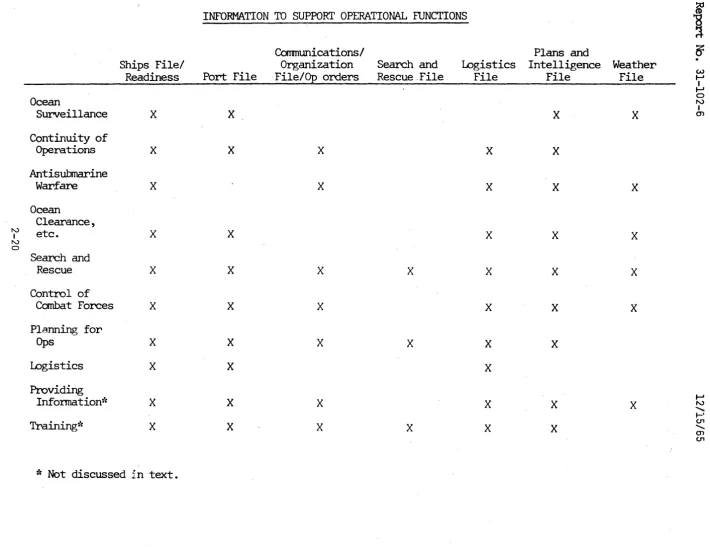
2-9 Information to Support Operational Functions 2-20
3-1 Console Usage 3-3
3-2 Alternative Interface Implementation for the USQ-20B 3-8
3-3 Summary Cost and Quantity Chart for Additional
Peripheral Equipment 3-12
4-1 Examples of Keys and Formats 4-3
4-2 Syntax of QL-l Description 4-16
4-3 I/O Functions by Device 4-26
Report
No.
31-102-6 December 15, 1965PREFACE
l~is document reports the results of a study of the essential operations
that must be undertaken to develop a Real Time Strategic Command and Control
for
a Newly-Mechanized Naval Command.SUMMARY
The existence of the technological explosion makes it necessary to
reexamine strategic command and control for possible application, and to find effective ways to implement the applications which are identified.
This report presents a plan for early achievement of real time in Naval strategic command and control; it includes provisions for a first step in the conversion to an integrated Navy-wide real time system.
In a previous task* in this study the concept for such an integrated system was developed and described, including the required existing technology. The concept, which is the end point of the phased development plan, included real time multiprogrammed computers at all major command sites and computer-to-computer interchange of queries and information for a world-wide Naval data base. The present report presents a development plan for newly mechanized commands, showing how they can develop their capability to participate in the Navy-wide system. It augments the previous task by presenting the technical and operational characteristics of the system with special attention to the all-important first step of development. The technical description includes
equipment characteristics; system programs for control of job priority, execution, information retrieval, interrupt and recovery; functional programs for a variety of corranand responsibilities; a flexible file structure, a powerful query language and specific means for achieving flexibility and growth capacity. The operational description first reviews the requirements for such systems in detail and then describes the operational effects of implementing the Phase 1 technical plan.
The system will have a number of important advantages: rapid response, ease of use, more effective data management, high efficiency, and a number of new services which contribute significantly to a command's problem solving capability.
* Computer Corrnnand and Control Company Report 21-102-4, "A'Concept for a Real Time Naval Strategic Conmand and Control System", April 1965, portion of Office of Naval Research program of the Advanced Warfare Systems Division (Code 493),
Report No. 31-102-6 December 15, 1965
1m approach based on existing USQ-20B computer configurations (at CINCUSNAVEUR
and NAVDEFEASTPAC) is recommended. The implementation plan indicates that the
system could be implemented with a software effort of about 21.5 man years
(including 7 man years for a general file translator, which can be delayed) and
an elapsed time of approximately fifteen months • Additional peripheral equipment
CONCLUSIONS
1) The real time system will give the command a greater capability to carry out its responsibilities under wartime conditions and thus increase the effectiveness of the command.
2) The real time system can be developed now and serve as a follow-on system to the presently planned system at COMNAVDEFEASTPAC or CINCUSNAVEUR. The development of the new system will not interfere with presently planned
operations. At the time of switch over, both systems can be operated alternately in the same computer during test operation. The enhancement of functions will continue thereafter.
3) The real system will utilize the entire computerized data base presently· in existence.
4)
An
effective basic capability real time system can be placed in operation and replace the presently planned system in 12 to 15 months.5) The basic cost of implementation of the programming effort is estimated as 21.5 man years (including 7 man years of general file translation, which may be delayed). This is exclusive of the additional peripheral hardware which
would cost about $174,000 per installation, however the software will be useful in more than one installation.
RECOMMENDATION
Report No. 31-102-6 December 15, 1965
DEVELOPMENT OF RFAL TIME
NAVAL STRATEGIC COMMAND AND CONTROL SYSTEMS
1. INTRODUCTION.
This report describes interim results of a study of real time Naval strategic command and control systems. A previously reported task in this study* described a system concept for an integrated, world-wide Naval command and control system which would sUbstantially overcome many of the operational deficiencies of present systems. While this concept was described in great detail, the means for conversion from present practice to the integrated system was not described. $ince the conversion process depends on the present practice and responsibilities of the subject command, and since each command is different, the teChnical planning for the conversion must be investigated separately for various classes of commands, and, ultimately, for each command.
The purpose of this report is to describe the results of studying a part of the conversion process for one class of commands, called newly mechanized commands here. Specifically, the report deals with the first major step of a phased conversion from essentially manual processes to the previously-described integrated system.
l~l Characteristics of Real Time Strategic Command and Control.
For the reader's convenience, a number of the salient features of the integrated system are described below. For a more complete description the reader should consult the report of the previous task.*
1) Real time operation - The system operates in real time, that is, with the computers responding within the attention span of the users. Commanders, senior staff officers or other users are able to query the system and receive immediate responses (nonnally, complete responses). Similarly, input
of infonnation occurs at the time of its coding with all machine verification being performed as soon as the infonnation is entered at a console. This feature leads to significant improvements in the management of the data base, with improvements in quality, timeliness and effort of assembly and maintenance.
2) World-wide Corrnnon Data Base and Access - All files, except certain priv&leged files, are available to any qualified user at any of the conmands served. Each corranand holds a part of the system data base in its computers (with some overlap for survivability and ease of canmunication) and can query any of the files, either local or remote, in real time.
3) Direct User Access - The system is designed for use by Commanders, senior staff officers and others with operational responsibilities without the necessity for intervention by programmers, analysts or other intermediaries. The query language and associated programs will accommodate unfamiliarity with the system file. structure and content. The query language uses English language terms and relations extensively.
The fmmediate response of the system and its ease of use make new uses for effective machine-aid possible. In particular, the user can turn over a much larger amount of detailed manipUlation of infonnation to the machine without losing control. He can make use of long series of dependent queries, using some queries to discover file structure and information availability and others for retrieval and manipulation. The system is thus able to act as a problem-solving tool rather than simplY a processor of anticipated questions and programs without min~zing the usefulness of the latter function.
4) Structured Files - The information files of the system are held in random access mass 'memories accessible through a retrieval system held in common for all programs and all users. The file structure which facilitates this retrieval has several important properties:
Report
No.
31-102-6 12/15/65b) The set of descriptive tenms is open ended and may be expanded or contracted at any t~e.
c) The set of descriptive terms is rich enough to accommodate both routine processes and non-routine search); it includes both quantitative and symbolic terms.
d) For selected classes of descriptive terms, the indexing includes threaded lists of descriptors, so that the records having a particular descriptor can be searched selectively without examining irrelevant records whiCh do not have that descriptor.
e) The file structure is general and cornnon to all files. The file organization described in this report lends itself to the flexible, highly varied kind of processing expected with real t~e personal control by the user. The threaded lists give a high efficiency of search, and the rich descriptor structure allows the use. of many easy, natural relations in the search and manipUlation processes.
5) MUltiprocessing and MUltiprogramming - The changing responsibilities of Naval cornnands and changing stock of available technology require that systems' be extremely flexible in order to avoid early obsolescence. Partly in response to this need, the portion of the system at each installation is a multiprocessor, with the capacity to accept or release computers as needed. The programming system is modular and relatively machine-independent, so that new computers can be added without rendering the older computers ineffective.
Command and control computing requirements characteristically include extensive reference to large files, so that the efficient use of computer time in conjunction with frequent use of mass storage input and output is a
significant technical problem. A well-planned mUltiprogramming system can make effective use of input/output equipment and still keep the central processors busy nearly all the time with available computing.
1.2 . Facilities and Requirements of Newly-MeChanized Commands.
In considering possible configurations of equipment, programs and methods for the newly-mechanized camnand, every item considered· must contribute
in some way to achievement of effective participation in the integrated system previously discussed. In order to Choose facile combinations for the various stages of conversion, addi tiona! bases for justification are needed. The
purpose of this section is to describe the basis for the selection of equipment programs and methods. This task considered only the problems of an individual newly-mechanized command and did not consider the real time interaction with other mechanized commands. For this purpose an outline description of the system under consideration follows.
The newly-mechanized command system ie one which until recently has not used automatic data processing for the bulk of its work. It has limited experience and.stock of computer programs to aid in 'prosecuting its responsibili-ties. It facilities and requirements are assumed initially to include the
following.
A typical newly-mechanized command environment is one that is anticipated to prevail at COMNAVEASTPAC in the near future.
1.2.1 Facilities.
The restrictions on realtime communications have been described in Technical COtTmunications Corporation report, ttltrJ. Anal vRis of the Impact of
Naval Carmunications of ADP' and Real Time Data Transmissions", Interim Report ~.R65-100, prepared for the Office of Naval Research, Advanced Warfare Systems Division (Code 493).
1) Communication facilities adequate for carrying out its emergency and wartime responsibiltiies using manual methods.
2) A moderately powerful computer, such as the USQ-20, with a naninal set of input/output devices, (i.e., magnetic_and. paper tape facilities, card facilities and printers, but no mass memories or user consoles are asst.D1ied .• )
1.2.2 Requirements.
A representative set of responsibilities prevailing at COMNAVEASTPAC and to a lesser extent, those at CINCUSNAVEUR, have been used as guidelines. These responsibilities are such that they will make a contribution to the overall responsibilities of the Naval establishment by being served by an
integrated command and control system. These responsibilities are listed in the first column in Fig. 1-1. These are translated in column 2 into the necessary data base, and in column 3 into specific functions. The necessary system features are listed in the fourth column in Fig. 1-1.
A major question posed during the study was whether the first step toward real time should involve a new family of computers, or may the existing equipment be utilized.
The study indicated that, a) mechanization is possible with the presently planned equipment, b) the additions that were indicated were of relatively small cost, c) the life 'of a system will be extended through the
new programs and added peripherals. Therefore in this report, the implementation is envisaged in ter.ms of utilization of the presently available computer, the USQ-20.
As a basic principle, emergency and wartime needs and functions are assumed to dominate the system. Peacetime processing rates and needs are therefore not paramount except as they are related to emergency and wartime processing rates and needs or in the unlikely event that they exceed emergency and wartime needs.
A number of pervasive difficulties with manual and automated methods in current Naval systems for dealing with infonmation were identified
in the first task of this study. Several of these apply particularly to the newly mechanized corrnnand, and should therefore be considered strongly in choosing a Phase 1 configuration. They include:
COMMAND
AND
CONTROL
SYSTD1
SYSTEM
RESPONSIBILITY
SYSTEMS FILES
OPERATION
FEATURES
STORE
INFORMATION
-SHIPS FILE
CONTROL ASW
. -PORT
SORT AND
FORCES
CLASSIFY
CONTROL OF
ORGANIZATION
COMBAT FORCES
COMMUNICATIONS
SEARCH AND
PROCEIlJRES
PRINTOUTS
-RFAL
TIME~RESCUE
COMMAND
LOGISTICS
LOGISTICS
TRANSlATION
-MULTI-
ANDCOORDINATION
PROGRAMMING]CONTROLPROVIDING INFOR-
INTELLIGENCE
MULTI-1
MATION AND
PROCESSING
INTELLIGENCE
OCEAN, CLEARANCE, ENVIRONMENTAL
PRESENT
TIME SHARE
ETC.
ALTERNATIVES
PROBLEM
SOLVING
PLANNING
SINGLE DATA
BASE
TRAINING
[image:17.620.39.560.58.646.2]-CONTINUITY OF
OPERATIONS
Report No. 31-102-6 12/15/65
2) Backup capacity - The acceptance of backup responsibilities involves major changes in the requirements of a command for information, including new requirements to accept major portions of the data base of the commands being backed up. Particularly if the commands being backed up are
using computers, the manual command system is often unable to use the information effectively. Similar difficulties arise if the linked commands do not provide for compatibility between their computer systems by means of translation programs or adequate technical standards.
3) Untimely information - The process of manually digesting strategic information for the commander's use typically takes hours or days for all but the most urgent messages. The same processes at an external
information source often make arriving information unt~ely. One of the major reasons for introducing computers is to ~prove the accessability and capacity to provide timely information for internal use and timely external reports.
4) Insufficient information base - The difficulties cited above prevent T~y kinds of infor.mation from ever being incorporated in a manual command's information base. The resulting base is often inadequate for
infor.med decision making. The computerized system should therefore allow for an expanded data base.
1.3 General Development Plan.
This report presents a development of three phases (outlined'in paragraph 1.3.1) leading toward an integrated world-wide system. This section outlines the development in tenms of hardware configurations, programs required, operational functional improvement, and the implementation.
Table 1-1 shows the specific recommendation based on the use of the
AN/USQ-20B computer.
EQUIIMENT, PROGRAMS, AND FUNCTIONS IN THE THREE PHASES
DEVELOPMENT TIME EQUIPMENT ADDED PROGRAMS ADDED f PROGRAMS ADDED DURING
.
&
AND USEFUL LIFE TO INITIATE TO INITIATE
I
PHASE TO PERFORMbS~Y~S~TIM~==~~O~F~P~HA~SE~======~PHA~S~E~==========9FP~HA~~SE===========F!C=O=~======FUN=C=T=IO=N=S==~~rnm===CT=I=O=N=S========~r
I
DEVELOIMENT TIME: IUSQ-20B COMPUTER MULTIPROGRAMMINGI
PROGRAMS FORRESPECTI~E
SEA SURVEILIANCE~
INITIAL
PHASE 1
I
12-15 MOS. 12 : 8 MILLION I EXECUTIVEI
FUNCTIONS: (SAR, OTA, ASW, b,I
USEFUL LIFE:i
CHARACTERS (8M) ,j.i FQUIELERYSySYSTEMSTIM : OCEAN CLFARANCE NAVIGATION)I
TO PHASE 2 I DISCS ! PLANS GENERATOR, LOGISTICS: CASREPSI
116 TELETYPEI
GENEPAL AND SFAI
ETC.I
CONTINUITY OFI
I
CONSOLES (LOCAL)i
SURVEILlANCEI
FILE TRANSIATIONI
OPERATIONS,
1.1
I
i
UPDATINGI
lAND AVOIDANCE UPDATEI
CONTROL OF COMBATI
I
I
AIRCRAFT SCHEDULING FORCES~
I-I-NTE--RIM-:--+I-D-fN-ELQ--PME--NT--T-IME'-:--+-iU--~-;-~~~-;-;~~--lDI;;~~-~NTROL.
;MULTI-RE~-;~;---
I
OCEAN C-L-FARA---N-C-E---I! 12-15 MOS. I,,'; 4: CRT I PROGRAMS 1 PlANNER
I
PIANNING FUNCTION! USEFUL LIFE: DISPLAYS
I
!
ASW MULTI-CONTACTI
I
TO PHASE 3i
8: TELETYPESI
! PROSECUTION PLANNINGI
INTELLIGENCE'
I
Ii (WIlli L O N G i ! 'I" AIDSI
TRAININGDISTANCE II
PHASE 2
I
TELEPHONEI
i
I
~_--L
_______
--+--I _______
LI~~_+--_
... _ _ _ _ _-+I _________
--+-_ _ _ _ - - - - IFULL
I
DEVELOIMENT TIME: UP TO 4: 8M DISCSI
COMPUTER lANGUAGEI
DATA BASE COMPARISON ENHANCEMENT OF AU.OPERATION: I 18 MOS. 4: CRT TRANSIATION REMOTE REQUEST REPORT OF ABOVE FUNCTIONS
PHASE 3
I
USEFUL LIFE: DISPLAYS EXTERNAL QUERY GENERATOR5 YRS •. OR MORE 2: MAPPING lANGUAGE
DISPLAYS TRANSLATION
ON-LINE ACCESS TO
OTHER CO~S
_ *
These may be aaaed during Phase 1 or 2 as needed.EXCEPTION REPORTING TESTS
COMBINED PIANS CONSISTENCY TEST
Report No. 31-102-6 12/15/65
1.3.1 Equipment Growth Phases.
The phased growth of hardware accommodates, first, local real time activity, second extended consoles on long distance telephone lines for remote query and update and third, general on-line computer-to-computer comudnication.
Phase 1 consists of a real time, time-shared, integrated file local operations.
Growth of display capability is expected in Phase 2 in order to provide more convenient means for man-maChine interaction in the input process, for on-line programming, for query and response and for computer-aided manipUla-tion of situamanipUla-tion and plan representamanipUla-tions. The CRT displays in Phase 2 are able to provide more convenient and rapid inputloutput and editing than teletype printers greatly speeding up the input process and allowing the scanning of
larger volumes of query output.
. Also in Phase 2 an initial set of 8 distantly located consoles
will be connected through telephone land lines for coordination between commands. They are tentatively allocated as follows:
Direct Superior Command
Other Commands Being Backed Up (2 each) Parallel Command
1
4
3
8
They would be used primarily for remote updating and querying rather than for other computer services.
The mapping displays in Phase 3 are for situation representation and for manipUlating computer representations of comb~ned plans.
In Phase 3 the computer-to-computer on-line communication would be used for a variety of services. It provides a basis for development of an integrated data base and shared data base maintenance out of the separate parts maintained by separate commands. In Pllase 3 the integrated data base is
After Phase 3 capabilities are fully utilized, which we anticipate being five or more years away, further growth should incorporate a new generation of computers. Phase 3 capabilities will serve adequately until a new generation of computers is needed •.
1.3.2 System Program Growth Phases.
The basic Phase 1 development produces an effective set of system programs which are useful for the remaining phases in their entirety. Specific additions to the system programs include 1/0 for the CRT display control programs in Phase 2 and for the map display in Phlase 3.
1.3.3 Functional Program Growth Phases.
The functional programs added in the particular phases are not strictly identified with a specific phase, since the system's open-ended acceptance of programs allows it to incorporate them at any time after the system programs' are complete. A wide variety of new services is made available during the usage periods of Phases 2 and 3 as shown in the 4th column of Table 1-1. A general purpose file translator may be included in Phase 1 or added at any
time thereafter.
1.4 Phase 1 System Characteristics.
The Phase 1 configuration will be entirely local, extending no new services or operational requirements beyond the installation of the particular command which it serves. No other command will interact in real time with the subject command since in this phase the capability does not exist.
Specific characteristics which are chosen on the basis of these considerations are discussed below:
1 ) Capacity for real time acti vi ty • 2) Multiprogramming.
Report No. 31-102-6 12/15/65
1.4.1 Capacity for Real Time Activity.
Real time operation has a number of important advantages. Real
time system operation is a mode of interaction between the system user and the
machine which he uses. When the answers to queries are made available within
the ~ediate attention span of the user the system is a real time system.
While this subjective view of real time does not allow a precise statement of
the maximum time intervals involved, a number of currently operating real time
systems respond to request for computation in less than half a minute.*
Real time operation also introduces significant improvements over the more
common batch computing in the capability provided for the commander and his
staff, in the information input process and in the efficiency of machine usage.
The most striking feature of a real time corrmand and control system
is its ease of use as an operational problem solving tool. The user normally
deals wit~ the system through a personal console by which he is able to make
queries and request processing and display information which results from such
requests. The irrnnediate response of the system means that machine aid can be
applied many times in succession on an individual problem. Alternative courses
of action can be chosen. Their implications can be investigated. The results
can be evaluated, and the problem can be refonnulated if necessary. This
facility in locating and manipulating-information allows the commander or
staff officer to concentrate his attention on the most relevant information
and the most promising alternatives. When decisions are made, they are likely
to be more knowledgeable, to be based on greater detail of information and on
consideration of more alternatives than would in fact be considered without the
aid of a real time tool.
The information input process is significantly aided by making it
a real time process. Information to be filed is coded, verified, and entered into the data base piece by piece, with any necessary corrections being made
~ediately, before the next entry is processed.* This ability to do the entire input process at one place and at one time makes the input process more efficient than it would be otherwise. Particularly with a flexible set of semi-autonomous display consoles, the real time input system can speedup the rate of input significantly, thereby providing additional input capacity for wartime or emergency situations. The information in the data base is kept more timely since entry errors are corrected immediately and since it is not necessary to wait for an economic batch of inputs to build up.
Real time operation allows a drastic improvement in the efficiency of machine usage. The use of structured random access mass storage allows . the computer to search selectively through the relevant filed infonmation without processing large volumes of irrelevant information (as is normally necessary in tape-based systems.) It is this efficient search wnich makes real time machine response possible even when large diverse files are used, and which leads to the high relative efficiency of real time command and control systems.
The efficiency of updating processes is extremely high for similar reasons. Records to be updated can be located quickly and treated individually without waiting for economic batches and without relocating large numbers of records.
Real time operation makes on-line programming convenient and effective. This mode of programming allows the programmer to build and test parts of programs freely during the development process. It has proved to be a major improvement in prograrmning technique for its present users, the chief improvements are in the speed and cost of program development.
* Conventional filing of information in an electronic data base is essentially a batch process. Each piece of infonnation to be filed is coded in a sui table format and incorporated into batches. Each batch is then checked in a number of ways, with the portions found erroneous being rejected or returned for correction. Finally the batch is used to produce a new file (typically on tape) from an old one, again with some rej ection of errors. Each step is taken outside of the context of t-he others, and each time a person's attention is required, he must reassess and reidentify the action sought.
Report No. 31-102-6 12/15/65
1.4.2 Multiprogramming.
The real time system activity requires a real time executive program for its control. The integrated system has as one of its basic features the simultaneous operations of programs (mul tiprograrrnning) • The obj ecti ve is to allow the USQ-20B to handle the largest number of simultaneous on-line users. Multiprogramming achieves this through 1) maximum utilization of I/O channels,
2) through overlapping processing and I/O and 3) through accorronodating a number
of user jobs simultaneously in the memory.
Conversion to a mUltiprogram executive at a later date would involve considerable duplication of effort in the construction of any non-multiprogram executive which would precede it. The reasonable point for orderly introduction of multiprogramming is at the beginning of the phased development, as part of the Phase 1 configuration.
1.4.3 Memory and Display Technology.
The recent development of computer related technology makes a number of significant new capabilities available for command and control. The.provision for their inclusion in any significant new development is absolutely necessary. Briefly, the relevant technologies include:
1) Mass Memory Hardware and Software - The available information storage capacity for rapid, so-called "random access" has increased several orders of magnitude in the past few years, primarily through the develo~ent of magnetic disc and drum equipment, and more recently in certain developments using photographic memory or small flexible magnetic surfaces. Recent program control techniques for organizing, representing and gaining access to massed information in such media provide efficient ways to deal with large volumes of information which is of primary concern to improvements in corronand and control.
2) Information Display - A variety of new information input and
degree of man-machine interaction which has previously been impractical; furthermore they have demonstrated ways to work which make even the simple consoles into effective tools.
The existence of such technology makes i~ necessary to reexamine strategic command and control for possible application and to find effective ways to implement the applications which are identified. Such an overall ' examination was performed in a previous study period, and a system concept for a greatly improved Naval comnand and control capability was developed. The present study outlines steps by which the improvements can be achieved, wi th emphasis on the character of the all-important first step.
1.5 Expected Benefits.
The expected benefits which motivate the use of new technology include: 1) More effective data management - Storage of a given piece of
information in·one place in a corrrnon file rather than in the files of several users allows the effects of errors to be controlled. This form of storage and immediate access to storage assure the user that he has the latest information, that others on whom he depends have the latest information, and that their information agrees with his. Each of these three assurances can eliminate significant delays and uncertainties which are the basis for much communication in other kinds of systems. The availabili ty of the final, filed information during the input process is expected to eliminate many of the errors which occur in changing information from form to form without feedback. In addition, real time updating will provide more timely information asa firm basis for coordinated action.
2) Efficiency - The efficiency of machine usage is expected to increase drastically through the use of recent technology. The savings of machine
Report No. 31-102-6 12/15/65
These efficiencies taken together are expected to increase the capacity of the
system drastically, thus providing an opportunity for effective use of more
computer aid and greater emergency capability.
3) New Services - New system programs with the capacity to accept
programs in an open-ended fashion will permit new services to aid in meeting
specific areas of command responsibility. For example, identification aid
programs for ASW and logistics files of command ~portance could be added
without disturbing the existing file organization or programs.
In addition, the ability to investigate files in depth with a
dependent set of queries and programs is expected to be a particularly powerful
new service.
4) Growth and Flexibility - The use of recent technology in the
hardware and software of mass storage provides a capability for growth without
the constraints inherent in older systems. Specifically, the provision of a rich,
open-ended file structure and program set allows for free adaptation of files
to new uses and easy programmipg with respect to the available files. The
availability of an easy-to-use retrieval system will enhance both of these
capabilities.
The remainder of this report presents a plan for ~plementing real
t~e strategic command and control in the operating environment previously
described. Section 6 demonstrates that these benefits can be obtained and
2.1 General.
The mission of a Naval command evolves from laws set forth by the Congress, directives issued by the Department of Defense and instructions set forth by the Secretary of the Navy and the Chief of Naval Operations. The mission statement indicates various functions which the Command must perform. These missions are derived from various functions papers and inter-service agreements which parcel out the responsibilities for defending the interests of the United States. In order to carry out its mission the Command has a nunber of requirements for authority, resources, and procedures necessary to fulfill the imposed responsibilities. Since the resources of the Navy are limited, an overabundance in one command will lead to deficiency in another. Likewise, if procedures are not adequate, efficient and simple, they will lead to requirements for additional resources.
The requirements of each command must be enumerated, analyzed and
understood. Also, they must be reflected in the General Operational Requirements. There are a nunber of classification systems currently in existence which
indicate the types of mission requirements in a mutually exclusive set of categories or classes. Each requirement presents considerable overlap with others. In general terms, the corrnnander of a command and control organization must have detailed knowledge of several entities. First is environmental
information, second is enemy force or potential enemy force information, third is friendly force and capability information, fourth is logistic information, and fifth is communications plans, techniques, liaison, and procedural information. It should be noted that these entities are included in the listing of requirements in Sect. 1.1
It is·the purpose of this section to discuss missions responsibilities or requirements of the command and to explain in later' sections how they could be perfor.med more effectively and more efficiently with a real time Automatic
Data Pn:>cessing System. The assumption is made that the command is a Frontier Command and having approximately the same responsibilities as Commander Naval Defense Forces Eastern Pacific or Commander in Chief, U. S. Naval Forces, Europe.
Report No. 31-102-6 12/15/6-5
When the responsibilities of the commander are analyzed it becomes apparent that the same tasks are elements of each of the responsibilities. The same information is required for performance of virtually all functions. Any arbitrary group of classification systems presents overlap and have considerable redundancy. A conclusion that must be drawn from the analysis is that file integration into a single data base is mandatory.
The analysis further reveals that many tasks not adequately performed now or performed manually could be performed economically and efficiently
with the computer system. The system recommended in this report takes into consideration both of these conclusions providing for a single data base and for greatly expanded computer efforts.
2.2 Ocean Surveillance.
For the purpose of this study, Ocean Surveillance is defined as the capability to locate, track, identify, and report all surface and subsurface contacts which can activate a sensor. The sensor' is based on ',visual, electro-magnetic or sonic phenomena. An ocean surveillance system must be able to react
to information prior to the activation of an applicable sensor. Information from sources such as MOVREPS, SUBNOTS, MEREPS, MSTSMR, and Ship Wx Reports and other sources must be acceptable. This information must be augmented by input information from the various sensors. In an ideal situation the
It should be obvious that Ocean Surveillance is not an end objective in itself but is an extremely essential function to help the Department of the Navy control the high seas, and to make necessary secondary contributions in any conflicts either defensive or offensive in nature. Ocean surveillance provides crucial inputs to decision makers. The adequacy of these decisions will be proportional to the accuracy and completeness of ocean surveillance. In search and rescue operations, ocean surveillance is a dominating function# None of the various naval warfare functions, can be adequately performed without an adequate ocean surveillance system. The capability to perform this function is so important that a highly efficient, reliable and sophisticated ocean
surveillance system is mandatory.
The ocean surveillance and reconnaissance system now being implemented in the Atlantic could have validity in the Pacific. In the Pacific this is a prime responsibility of CINCPACFLT and the designated successor to CINCPACFLT is COMFIRSTFLT. In the event of catastrophe, if it becomes necessary for the Defense Commander to assume this responsibility then he must have an adequate data processing system to undertake this responsibility.
Ocean traffic accounting is actually a subfunction of an ocean surveillance system. Within the area of responsibility of COMNAVEASTPAC* reference data must be maintained on Naval ships, Naval Units, Merchant Ships and ship routes. Active files must be maintained on Naval ShipS underNay, merchant ships, Bloc Merchant ships, Naval Ships in port and Merchant ships
in port. In the event of emergency condi tions this requirement further increases and in the event of general war conditions, and assuming currently designated successorcorrnnand functions, it would be necessary to store
reference data on more Naval ships, more Naval units, more Merchant ships and more ship routes. Ultimate purpose would be to minimize location data on all ships in the Pacific and adjacent areas.
As new and improved sensors are developed the capability to conduct ocean surveillance will increase. Additional contacts must be classified. Due
Report
No.
31-102-6 12/15/65to multiple reporting~verification of reports will be necessary. Tolerable
/
limits of accuracy within a sensor system can create problems of target classification.
The information available to the commander and to the forces which he must employ or coordinate is only as good as the input information which he receives. Erroneous or late information can cause the system to be overburdened, in a minimum of time. Timely reports and instructions must be issued to
personnel or forces that will react. Table 2-1 indicates the tasks to be performed in ocean surveillance.
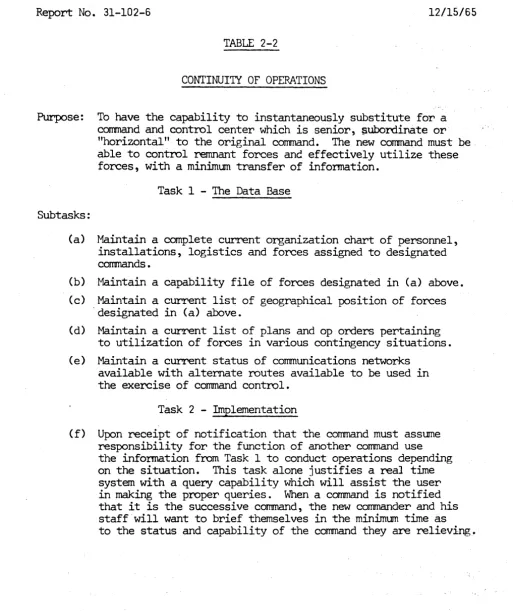
2.3 Continuity of Operations.
The Navy must have a positive capability to maintain continuous command and control in the event of disas,ter, or in the event it becomes desirous to ·transfer this function instantaneously toa new geographical location ·for any reason. Positive control must be continuous even with the destruction of a commander and his staff. The command and control capability must suffer minimum degradation in efficiency and effectiveness when geographical changes are made. Redundancy in command and control capability is a requisite to conduct of nuclear warfare.
These requirements can be best met if each command and control center is an integral and integrated part of the overall Navy-wide command and control system. The development of functional compatibility and near-identiccil.
TABLE 2-1
TASKS OF OCEAN SURVEILLANCE
Purpose: To locate, track, identify, and report all surface and subsurface contacts which can activate a sensor.
Task 1 - Developing the Data Base
Subtasks:
(a) Enter MOVREPS, SUBNOTS, MEREPS, MSTSMR, and Shj.ps Wx RPrS into the file as soon as they are received, i.e., real t:ime. (b) Enter information reports concerning ship sailings into file.
These reports cane from sources such as Tug Pilots, port directors offices, newspapers, insurance companies and any other source including intelligence reports. Some of these entries are to be made in real t:ime, others could be "batch" processed (if they are received in BATCHES.)
(c) Enter visual sightings reports from Naval surface ships and . reconnaissance aircraft· into the file when received, in real
time.
(d) Enter sensor reports (SOSUS and others) into the computer as soon as they are received, in real time.
Task 2 - Evaluation and Classification
(e) "Note" all sensor reports which can be positively identified as known ships.
(f) Enter in computer all reports of sightings of unidentified or enemy ships. Entry to be made in real time.
(g) Use gross correlation techniques to determine identification of unidentified ships.
(h) Send search/reconnaissance units in order to identify all contacts which still remain unknown.
Task 3 - Track and Display
(i) Track all known contacts. This includes both identified and unidentified ships/SSe
(j) Continuously compare tracks of ships to sailing routes to determine destination and time of arrival at destination. (k) Maintain a plot of all ships and tracks either in display form
[image:31.621.59.534.150.711.2]Report No. 31-102-6 12/15/65
TABLE 2-1 (Cont.)
TASKS OF OCEAN SURVEILLANCE
Task 4 - Reports
(1) Report all enemy and those that are still unidentified to
competent senior authority and to forces that will take action.
Task 5 - Statistical
(m) Gather statistical information regarding surveillance
[image:32.621.37.565.49.754.2]TABLE 2-2
CONTINUITY OF OPERATIONS
Purpose: To have the capability to instantaneously substitute for a corrmand and control center which is senior, ~uboroinate or "horizontal" to the original corrnnand. The new cormnand must be able to control remnant forces and effectively utilize these
forces, with a minimum transfer of information.
Task 1 - The Data Base
Subtasks:
(a) Maintain a complete current organization chart of personnel, installations, logistics and forces assigned to designated commands.
(b) Maintain a capability file of forces designated in (a) above. (c) Maintain a current list of geographical position of forces
"designated in (a) above.
(d) Maintain a current list of plans and op orders pertaining to utilization of forces in various contingency situations. (e) Maintain a current status of corrnnunications networks
available with alternate routes available to be used in the exercise of command control.
Task 2 - ]mplementation
[image:33.618.53.566.64.675.2]Report No. 31-102-6 12/1S/6S
2.4 Antisubmarine Warfare (ASW).
Defending continental United States from missile launching submarines and protecting United States and friendly shipping from torpedo launching
submarines are formidable tasks. The conduct of ASW is a paramount concern to the Navy. Any action a commander performs to reduce the threat is worthy of performance, yet a commander's resources can be squandered if he
indiscriminantly tries to counter all unidentified contacts with military forces. As stated previously, one of the primary purposes for the ocean
surveillance system is to be able to identify various contacts and to determine if they are friendly or enemy. By jUdicious use of an ocean surveillance
system, including ocean accounting and other sources of information, a commander can greatly reduce the number of contacts which require at-the-scene investigation .•
The ASW function can be illustrated by the specific duties of COMNAVDEFEASTP~C as a typical command and control center. The Ocean Traffic Accounting system (OTA) is charged with providing Oceanographic System Pacific
(OSP) with the position, identification and, if possible, additional description of both friendly and unfriendly ships in the area where a contact may be
suspected. The success of Oceanographic System Pacific would depend in many cases on the accuracy and completeness of the information provided to it by OTA. In prosecuting unidentified ship and unidentified submarine contacts, the cycle of updating of separate Navy, Merchant and Bloc files and retrieval from these files. may approach two hours. . This is inadequate since a submarine could change position by thirty to forty-five nautical miles in that period of time. In some cases the investigation may require reconnaissance flight.
It is necessary to provide a reconnaissance flight with an accurate list, including description and position of all ships which it should encounter enroute to the area.
aware of the possibility of an identified contact, and necessary changes in convoy routing or changes in tracks. Table 2-3 lists task'requirements for ASW operations.
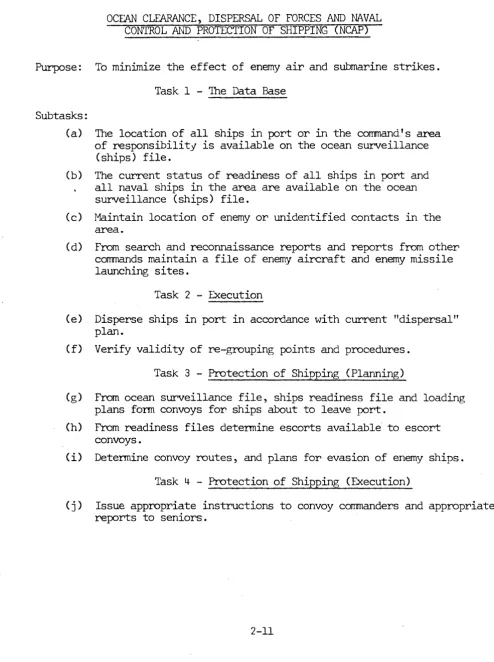
2.5 Ocean Clearance, Dispersal of Forces and Naval Control and Protection of Shipping.
1m essential resource of the Navy is its mobility. By use of mobility,
military force can be brought to bear on a single (or multiple) concentration. Conversely, forces can be dispersed to make them less vulnerable to enemy action. In particular it is prudent to disperse ships when the enemy is expected to
strike a port. The administration of this function can be time consuming if performed manually but fortunately it is of a type which can be readily mechanized. The ··corranander must know the pres~nt location of all forces and the current state of readiness. For ships in port he must know the repair status and time necessary to get a ship underway. The commander must have a dispersal plan for most contingencies and he must issue instructions', .to . the various units indicating how they should proceed to the various dispersal areas. Additional instructions for rejoining and for command relationships are required. All these instructions are dynamic inputs to the overall functions which are continually changing. The location of ships, the status of repair and even
relative seniority of commanding offic€rs are never static. It is a never-ending task to keep this infonnation current. It can be done with ease with a computer system.
It is of interest to note that no use is made of Automatic Data ..
Processing equipment in this function by COMNAVDEFEASTPAC. Occasional practice is made by conducting exercises in which vessels clear ports. Plans for
ocean clearance are only in the form~tive stage. Supporting ADP should be developed with files that include ship, cargo and fuel status. Routing plans must be performed which give realistic wartime considerations.
Report
No.
31-102-6 12/15/65TABLE 2-3
ANTISUBMARINE WARFARE
Purpose: To neutralize enemy or potentially enemy submarines.
Subtask: (a)
Task 1- Location - Detection
Search ocean surveillance files by eliminating known contacts, locating positions of all unidentified contacts which may be enemy or potent~lly enemy 'submarines.
Task 2 - Classification
(b) Using correlation techniques, classify and as far as possible identify all unidentified contacts.
(c) Order appropriate suveillance ~ reconnaissance forces to scene to assist in classification.
Task 3 - Reporting
(d) Report to canpetent senior authority and to forces which will
be used in utilization, and to forces which are to be dispersed location, identification, capability and probable intention of enemy or potentially enemy submarines.
Task 4 - Neutralization
(e) Search ocean surveillance files to determine forces in position which have capability of neutralizing submarines.
[image:36.618.41.569.59.761.2]TABLE 2-4
OCEAN CLEARANCE, DISPERSAL OF FORCES AND NAVAL CONTROL AND PROTECTION OF SHIPPING (NCAP)
Purpose: To minimize the effect of enemy air and submarine strikes.
Task I - The Data Base
Subtasks:
(a) The location of all ships in port or in the corrmand!s area of responsibility is available on the ocean surveillance
(ships) file.
(b) The current status of readiness of all ships in port and all naval ships in the area are available on the ocean surveillance (ships) file.
(c) Maintain location of enemy or unidentified contacts in the area.
(d) From search and reconnaissance reports and reports from other corrmands maintain a file of enemy aircraft and enemy missile launching sites.
Task 2 - Execution
(e) Disperse ships in port in accordance with current "dispersal" plan.
(f) Verify validity of re-grouping points and procedures.
Task 3 - Protection of Shipping (Planning)
(g) From ocean surveillance file, ships readiness file and loading plans form convoys for ships about to leave port.
(h) From readiness files determine escorts available· to escort convoys.
(i) Determine convoy routes, and plans for evasion of enemy ships.
Task 4 - Protection of Shipping (Execution)
[image:37.615.56.551.107.769.2]Report No. 31-102-6 12/15/65
2.6 Search and Rescue.
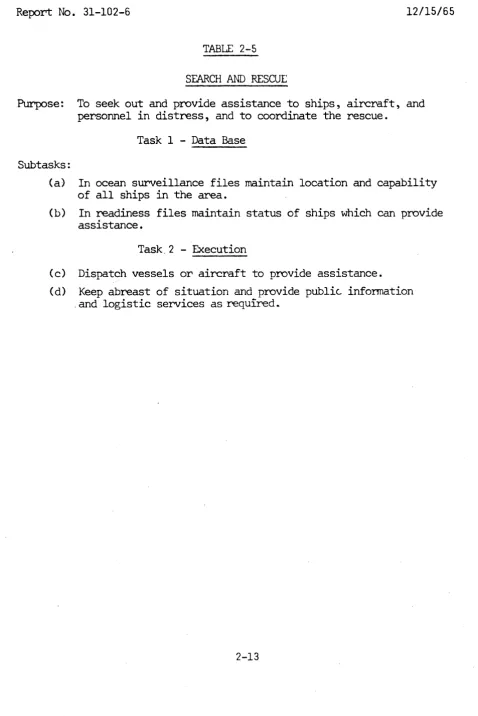
Search and rescue operations occur at irregular and unplanned intervals both in peace and in wartime... Experience indicates that they generally occur when least expected and to the detr~ent of other planned operations. They are generally performed 'in an environment of considerable confusion. They can be the source of embarrassment to the Navy Department due to the loss of life, and create considerable discomfort to individuals. On the other hand, if performed efficiently and successfully they can accrue good will and good publicity to the Navy and to the commander performing the search and rescue. In wart.i.me·"~ search and rescue operations must be done
in a routine manner, and if successfully accomplished extremely valuable resources can be conserved.
By providing accurate, timely and complete information the commander of a corrrnand control organization can set the stage and almost provide for a successful search and rescue 'I: if; it: is within the realm of possibility. The
information is, again, the same information required in the previously discussed functions. That is, information provided by the ocean surveillance files, and information provided by the readiness and capabilities files. These three types of information in reality can be integrated into a ships file. Regardless of the nature of the file this information must be available to the commander and his staff in real time. He must be able to assure himself with proper queries that he has the complete and accurate information.
It should be noted that in normal peacetime operations the Coast Guard has primary responsibility for search and rescue. In wartime this-function will be performed by the Navy. Table 2-5 indicates the tasks to be performed in search and rescue operations.
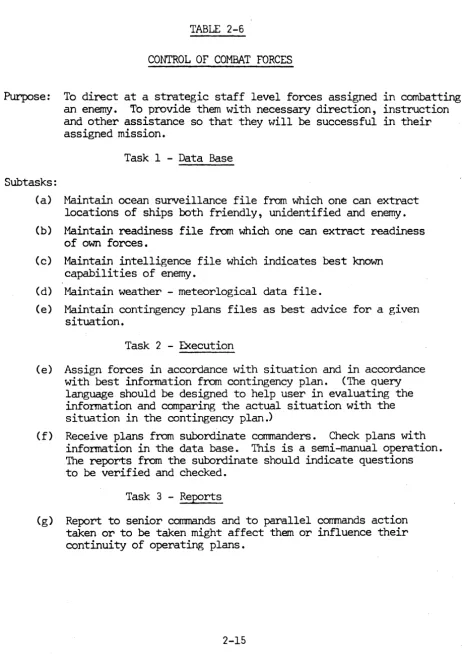
2.7 Control of Combat Forces.
TABLE 2-5
SEARCH AND RESCUE
Purpose: To seek out and provide assistance to ships, aircraft, and personnel in distress, and to coordinate the rescue.
Task 1 - Data Base
Subtasks:
(a) In ocean surveillance files maintain location and capability of all ships in the area.
(b) In readiness files maintain status of ships which can provide assistance.
Task. 2 - Execution
(c) Dispatch vessels or aircraft to provide assistance. (d) Keep abreast of situation and provide publi~ information
[image:39.615.73.552.62.779.2]Report No. 31-102-6 12/15/65
However, the exceptions and the isolated cases are not trivial. During World War II the Chief of Naval Operations directly controlled units which were canbating the German submarines in the Atlantic Ocean. It is very likely that
other instances will .arise wherein it will be necessary for the staff to
actually control and direct tactical units. In the main it is necessary to
have mechanisms, procedures, plans, and instructions so that subordinate staffs can be given appropriate but minimum instructions to meet various
military situations that arise. The various functions to be performed are
focused on maximizing the readiness and effectiveness of the tactical units
Ii"
subordinate to the intervening staff. These are concerned with planning,
training, repair of major inoperative systems: morale and evaluation. ~'1any of these functions are day-to-day routines of the staff officer which will
necessarily be left undone during .emergency or under warti~e conditions •.
Planning, administration of training, and evaluation requires considerable
data and information. The data must be manipulated so that it is meaningful.
In some cases many routine computations are required. Table 2-6 indicates the
tasks involved in control of combat forces.
2.8 Logistics.
lhis function is one of coordinating planning of specific agencies
involved in logistics. It is necessary to review and approve some logistic support plans prepared by these agencies. In actual practice the commander
of a command and control center will only be directly involved in logistics in unusual circumstances. This will usually be in periods of high tension
when adminstrative and operational personnel are extremely busy and their
time is at a premium. The unusual circumstances will be in matters such as
arranging to airlift men and materials during a crisis, or providing logistic
support during a search and rescue operation. The staff need not know the
many details such as quantities of supplies except in special cases. However, they must have a knowledge of the logistics system operation so that as a mea$ure
of expedience they can circumvent established procedures and provide logistic
support in a minirm..un of time. They must have a detailed knowledge of the
mission procedures, location, and capabilities of the various supply and
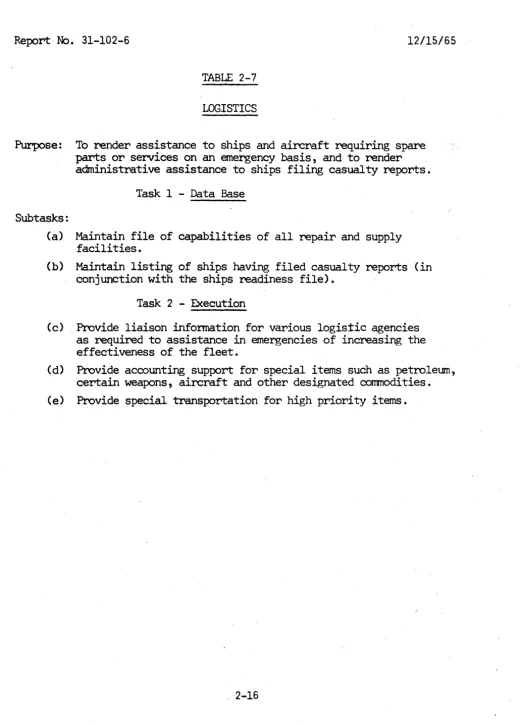
logistic organizations in the area. Table 2-7 indicates the types of tasks
TABLE 2-6
CONTROL OF COMBAT FORCES
Purpose: To direct at a strategic staff level forces assigned in combatting an enemy. To provide them with necessary direction, instruction and other assistance so that they will be successful in their assigned mission.
Task 1 - Data Base
Subtasks:
(a) Maintain ocean surveillance file from which one can extract locations of ships both friendly, unidentified and enemy. (b) Maintain readiness file from which one can extract readiness
of own forces.
(c) Maintain intelligence file which indicates best known capabilities of enemy.
(d) Maintain weather - meteorlogical data file.
(e) Maintain contingency plans files as best advice for a given situation.
Task 2 - Execution
(e) Assign forces in accordance with situation and in accordance with best information from contingency plan. (The query
language should be designed to help user in evaluating the information and comparing the actual situation with the situation in the contingency plan.)
(f) Receive plans from subordinate commanders. Check plans with information in the data base. This is a semi-manual operation. The reports from the subordinate should indicate questions to be verified and checked.
Task 3 - Reports
[image:41.618.88.551.88.743.2]Report"
No.
31-102-6 12/15/65TABLE 2-7
LOGISTICS
Purpose: To render assistance to ships and aircraft requiring spare parts or services on an emergency basis, and to render administrative assistance to ships filing casualty reports.
Task 1 - Data Base Subtasks:
(a) Maintain file of capabilities of all repair and supply facilities.
(b) Maintain listing of ships having filed casualty reports (in conjunction with the ships readiness file).
Task 2 - Execution
(c) Provide liaison information for various logistic agencies as required to assistance in emergencies of increasing the effectiveness of the fleet.
[image:42.618.53.574.38.764.2]2.9 Planning for Current and Contingency Operations.
The day-to-day work of the staff officer centers around planning. The effectiveness and efficiency of the command is directly related·· to the ability of the staff to do completed staff work, that is, perform fully their planning function. Yet there are many distractions to this central function. Accounting must be made of equipment ar.d publications, reports must be made to seniors, training exercises must be evaluated, personnel must be administered. Planning is done in a piecemeal fashion amidst all the distractions. It becomes a laborious, drawn out task with many loose threads. Much of the information is not available at a central location and long delays ensue while the information is being gathered.
Planning consists of 1) searching publications and instructions promulgated by seniors, 2) gathering statistical information from various
documents.promulgated by technical organizations such as the Naval Oceanographic Office, and 3) applying this information to data gathered from staff publications. After these three steps it is necessary to analyze the planning data to select all possible alternatives, solve problems to make compromises and then to present it in a meaningful fashion. Planning is a difficult operation even without
distractions. With routine distractions the efficiency of planning is reduced and the effectiveness of the command is degraded.
The quality of planning depends on the ability to foresee, predict and get an overall picture; normally the planner has either too little or too much detailed information which is not properly classified or digested. It is difficult to get adequate detail with effective summarization and explicit internal relationships. In general a planner needs both simplified and highly abstracted data and an abundance of detailed data. The minimum figure pe~its easy manipulation and ease of. arriving at a decision. The abundance of data permits verification of results and gives the planner a higher degree of confidence in his work.