Manuscript version: Author’s Accepted Manuscript
The version presented in WRAP is the author’s accepted manuscript and may differ from the published version or Version of Record.
Persistent WRAP URL:
http://wrap.warwick.ac.uk/109303
How to cite:
Please refer to published version for the most recent bibliographic citation information. If a published version is known of, the repository item page linked to above, will contain details on accessing it.
Copyright and reuse:
The Warwick Research Archive Portal (WRAP) makes this work by researchers of the University of Warwick available open access under the following conditions.
© 2018 Elsevier. Licensed under the Creative Commons Attribution-NonCommercial-NoDerivatives 4.0 International http://creativecommons.org/licenses/by-nc-nd/4.0/.
Publisher’s statement:
Please refer to the repository item page, publisher’s statement section, for further information.
Electrolyte Cation Dependence of the Electron Transfer Kinetics
Associated with the [SVW
11O
40]
3-/4-(V
V/IV) and [SVW
11O
40]
4-/5-(W
VI/V) Processes in
Propylene Carbonate
Jiezhen Lia, Cameron L. Bentleyc, Tadaharu Uedad, Alan M. Bonda,* and Jie Zhanga,b,*
aSchool of Chemistry, Monash University, Clayton, Vic 3800, Australia
bARC Centre of Excellence for Electromaterials Science, Monash University, Clayton, Vic
3800, Australia
cDepartment of Chemistry, University of Warwick, Coventry, CV4 7AL, U.K. dDepartment of Applied Science, Kochi University, Japan
Abstract
Changing the supporting electrolyte cation from tetrabutylammonium to
1-butyl-3-methylimidazolium is known to significantly increase the apparent heterogeneous electron
transfer rate constants (𝑘0 value at the formal reversible potential (𝐸𝐹0)) associated with the [SVW11O40]3−/4− (VV/IV) and [SVW11O40]4−/5− (WVI/V) processes in aprotic organic media. In
this study, supporting electrolytes containing 7 different cations, namely
1-ethyl-3-methylimidazolium ([EMIM]+), 1-butyl-3-methylimidazolium ([BMIM]+),
1-butyl-1-methylpyrrolidinium ([Py14]+), tetraethylammonium ([TEA]+), tetrapropylammonium
([TPA]+), tetrabutylammonium ([TBA]+) and tetrahexylammonium ([THA]+), have been
investigated in order provide a systematic account of the influence of electrolyte cations on the
rate of polyoxometalate (POM) electron transfer at a platinum disk electrode. Fourier
transformed alternating current (FTAC) voltammetry has been used for the measurement of
fast kinetics and DC cyclic voltammetry for slow processes. The new data reveal the formal
reversible potentials and electron-transfer rate constants associated with the VV/IV (𝑘V0) and
WVI/V (𝑘W0 ) processes correlate with the size of the supporting electrolyte cation. 𝑘V0 and𝑘W0 values decrease in the order, [EMIM]+ > [BMIM]+ > [Py14]+ ≈ [TEA]+ > [TPA]+ > [TBA]+ >
[THA]+ for both processes. However, while 𝑘
V0 decreases gently with increasing cation size (k0
= 0.1 and 0.002 cm s-1 with [EMIM]+ and [THA]+ electrolyte cations, respectively), the
decrease in 𝑘W0 is much more drastic (k0 = 0.1 and 2 × 10‒6 cm s-1 for [EMIM]+ and [THA]+, respectively). Possible explanations for the observed trends are discussed (e.g., ion-pairing,
viscosity, adsorption and the double-layer effect), with inhibition of electron-transfer by a
blocking “film” of electrolyte cations considered likely to be the dominant factor, supported
by a linear plot of ln(k0) vs. ln(d) (where d is the estimated thickness of the adsorbed layer on
Graphical abstract
Keywords: electron transfer kinetics, polyoxometalates, propylene carbonate, cation
Introduction
It is of fundamental importance in electrochemistry to understand the factors that
govern the rate of heterogeneous electron transfer. For an electrode reaction, this typically
involves the transfer of charge (electrons) across an interface between a solid electrode and
liquid electrolyte. It follows that the rate of electron transfer is governed by both the
physicochemical properties of the electrode/electrolyte interface and the nature of the
redox-active species. For an outer-sphere one electron transfer processes such as the reduction of
[Ru(NH3)6]3+ to [Ru(NH3)6]2+ or the oxidation of ferrocene (Fc) to ferrenium cation (Fc+), very
similar electrochemical behavior is observed at Pt, Au, and carbon electrodes.[1, 2] However,
the kinetics of the Fe2+/3+ process, also considered to be an outer-sphere reaction in some
studies, is much slower and differs markedly at these electrode materials.[3, 4]
The effects of the nature of the solvent (donor/acceptor or acid/base properties),
supporting electrolyte and electrode material on electrode kinetics have been studied
extensively.[5-12] For example, if the outer-shell contribution to the activation energy is the
major factor governing the rate of electron transfer, the heterogeneous electron-transfer rate
constant (k0) exhibits a strong dependence on the properties of the solvent (dielectric
constant).[13, 14] In addition, the rates of electrode reactions can be profoundly affected by
the identity of the ions present in the supporting electrolyte[15-19]. For example, Peover and
Davies[20] reported that the highly irreversible (kinetically sluggish) second step for reduction
of 9,10-anthraquinone in dimethylformamide (DMF) can be made reversible (kinetically
facile) through the addition of alkali metal ions. This effect was attributed to interactions
(ion-pairing) between the semiquinone anion and the alkali metal cations.
Polyoxometalates (POMs) are anionic oxoclusters containing early transition metals in
high oxidation states. They are nano-sized and display a wide variety of compositions and
diverse fields such as medicine, photochromic materials, solar energy, and so forth.[21-23] In
particular, POMs can undergo fast, reversible and stepwise multielectron-transfer reactions
without significant structural change, meaning they can be employed as catalysts for many
redox reactions.[24-27] Furthermore, the properties of a POM, such as solubility, redox
potential, and acidity can be finely-tuned by varying the constituent elements.[28]
The thermodynamic properties (formal reversible potentials, 𝐸F0) of POMs have been studied extensively.[28-30] For example, the electrochemical behaviour of [Co2W12O42]8- was
found to be highly solvent dependent.[31] The reversible potentials associated with these
W-based redox centres shift negatively in a 50% mixed solvent aqueous electrolyte of
dimethylformamide/water, acetonitrile/water or acetone/water compared to a pure aqueous
electrolyte solution, while in dioxane/water mixtures, the processes shifted positively. The
acidity of the media (proton availability) also influences the thermodynamic properties of
POMs. Thus, while [PMo12O40]3- undergoes successive one-electron transfer processes in
acetonitrile, the addition of acid causes a substantial change in reversible potential, so that
when a high concentration is present, overall two-electron processes are detected.[32]
The kinetic properties (standard electron transfer rate constant, k0 at 𝐸
𝐹0, and electron
transfer coefficient, α) of POMs remain much less explored than the thermodynamic ones.
Recently, we have reported a series of studies on the electrode kinetics of POMs.[33-36] In
aqueous media, the k0 values of the Keggin-type silicon tungstate POMs, [SiW
12O40]4- and
[SiW12O40]5-, were found to be electrode material dependent.[33, 34] Much slower rate
constants were found with boron-doped diamond (BDD) electrode compared to use of glassy
carbon (GC) as the electrode material.[33] The effect of the electrolyte cation (Li+, Na+, K+
and NH4+) on the electrode kinetics of these processes has also been studied[34]. In organic
media (dimethylformamide) containing supporting electrolyte, the electrode kinetics
material as well as the ionic strength.[35] In our most recent study, we showed that changing
the electrolyte cation from tetrabutylammonium to 1-butyl-3-methylimidazolium can
significantly increase the electron-transfer kinetics of the [SVW11O40]3−/4−/5− processes at Pt,
Au and BDD electrodes. We attributed this and other trends obvious to double layer effects
and the nature of the electron-transfer processes (outer-sphere for the VV/IV reaction vs.
inner-sphere for the WVI/V one).[36]
In the present study, our previous work is expanded systematically to provide a general
account of the influence of electrolyte cations on the rate of POM electron transfer, using the
[SVW11O40]3−/4−/5− reductive reactions as exemplar processes. The structure of [SVW11O40]
3-[37] shown in Figure 1 shows the location of the V and W metal constituents. [SVW11O40]
3-exhibits three well-defined one-electron reduction processes in molecular solvent (electrolyte)
media.[37] The two initial processes, which are the focus for the current study, correspond to
the reduction of VV to VIV (eq. 1) and WVI to WV (eq. 2).
[SVVW
11VIO40]3−+ e− ⇌ [SVIVW11VIO40]4− (1)
[SVIVW
[image:7.595.178.438.427.646.2]11VIO40]4−+ e− ⇌ [SVIVWVW10VIO40]5− (2)
Figure 1. The structure of [SVW11O40]3-. Color code: S (red), V (orange), W (yellow).[37]
Seven different electrolyte cations were used in this study, including imidazolium and
tetraalkylammonium based cations (structures shown in Scheme 1). Salts containing large
in dipolar aprotic solvents due to their relatively high solubility and weak tendency to form ion
associates with anions in these systems. However, a number of studies has been reported which
demonstrate that the electrode kinetics of can depend on the nature (size or structural
symmetry) of the tetraalkylammonium cations.[38-41] For example, the rate constants (k0
values) of a series of organic molecules have been shown to decrease with increase in the size
of the alkyl group.[38] The solvent chosen in this study is propylene carbonate (PC), which has
a high dielectric constant (64.9 at 25℃[42]), reducing the influence of ion pairing effects. Supporting electrolytes were added at a concentration of 0.5 M to provide a well-defined
double layer. As is the case in our previous study, fast electrode kinetics were measured using
large-amplitude Fourier-transformed alternating current (FTAC) voltammetry, which exhibits
superior kinetic sensitivity in comparison with the conventional dc voltammetry[43] and slow
processes were quantified by DC cyclic voltammetry using DigiElch digital simulation
Scheme 1. Names, abbreviations and structures of the electrolyte cations used in this study.
EXPERIMENTAL SECTION
Chemicals. Propylene carbonate (PC, 99.7%, Sigma-Aldrich), acetonitrile (CH3CN,
97%, Sigma-Aldrich), ethanol (96%, Merck), 1-ethyl-3-methylimidazolium tetrafluoroborate
([EMIM][BF4], 98%, Sigma-Aldrich), 1-butyl-3-methylimidazolium tetrafluoroborate
([BMIM][BF4], 99%, IoLiTec), 1-butyl-3-methylimidazolium hexafluorophosphate
([BMIM][PF6], 99%, IoLiTec), 1-butyl-1-methylpyrrolidinium tetrafluoroborate ([Py14][BF4],
99%, IoLiTec), tetraethylammonium tetrafluoroborate ([TEA][BF4], 99%, Sigma-Aldrich),
tetrabutylammonium hexafluorophosphate ([TBA][PF6], 99%, Sigma-Aldrich) and
tetrahexylammonium perchlorate ([THA][ClO4] ], 99%, Sigma-Aldrich) were used as received
from the manufacturer. Ferrocene (Fc, Sigma-Aldrich, ≥ 98 %) was recrystallized from n
-pentane (Merck) prior to use. Tetrapropylammonium tetrafluoroborate ([TPA][BF4]) was
prepared by a metathesis reaction between sodium tetrafluoroborate (Na[BF4], Sigma-Aldrich)
and tetrapropylammonium bromide ([TPA]Br, Sigma-Aldrich) in CH3CN.
All electrochemical studies were carried out at 22 ± 2 °C using a standard three
Anton Paar automated microviscometer (AMVn).The working electrode was platinum (Pt,
nominal diameter = 1.0 mm) or glassy carbon (GC, nominal diameter = 1.0 mm). Platinum
wire was used for the auxiliary and reference electrodes. The quasi-reference electrode
potential was calibrated against the recommended Fc0/+ process.” in the experimental section.
Other experimental details are as reported elsewhere[36] and are summarized in the Supporting
Information.
RESULTS AND DISCUSSION
DC Cyclic Voltammetric Characterization of the VV/IV and WVI/V Processes. The
[SVW11O40]3−/4− (VV/IV) and [SVW11O40]4−/5− (WVI/V) processes were initially characterized by
DC cyclic voltammetry at a Pt electrode. Verification of the first process as reduction of VV to
VIV and the second more negative one to reduction of WVI to WV is given in reference.[37]
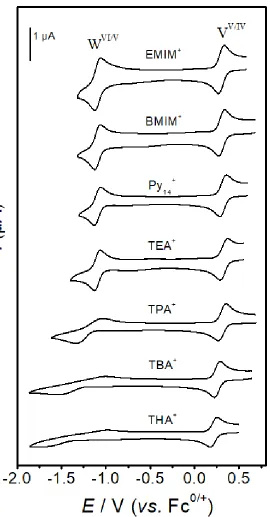
Figure 2 shows a comparison of the DC cyclic voltammograms obtained from 1.0 mM
[SVW11O40]3- in PC containing 0.5 M electrolytes outlined in Scheme 1, at a scan rate (ν) of
0.1 V s-1. Clearly, the formal reversible potentials (𝐸
F0) of the VV/IV and WVI/V processes, 𝐸V0 and 𝐸W0 , are dependent upon the nature of the electrolyte. Slightly more positive 𝐸V0 and 𝐸W0
values are observed from [EMIM][BF4] (0.316 V and -1.085 V, respectively) compared to
[BMIM][BF4] (0.306 V and -1.093 V, respectively). A larger variation is observed when using
tetraalkylammonium cation as the cation constituent of the supporting electrolyte, with 𝐸V0 and
𝐸W0 shifting towards more negative potentials in the order of [Py
14]+ ≈ [TEA]+ > [TPA]+ >
[TBA]+ > [THA]+. The negative shift in the 𝐸
F0 values, as well as the increased potential gap
separating the VV/IV and WVI/V processes (∆𝐸
F0) is attributed to increasingly strong interactions
between the electrolyte cation and the reduced form of the POM (e.g., [SVW11O40]4-) compared
to the oxidized form of the POM (e.g., [SVW11O40]3-). It should be noted that because
[SVW11O40]3−/4−/5− are all highly negatively charged species, the identity of the anion (e.g.,
confirmed by the fact that negligible differences in both reversible potentials and peak-to-peak
separations was detected when using either [BMIM][BF4] or [BMIM][PF6] as the supporting
[image:11.595.122.475.233.423.2]electrolyte.
Table 1. DC cyclic voltammetric data derived at 22 ± 2 °C from the reduction of 1.0 mM [SVW11O40]3- in PC (0.5 M electrolyte) at a Pt macrodisk (diameter = 1.0 mm) electrode with
a scan rate of 0.1 V s-1.
Electrolyte 𝐸V0(V) (ΔEp)V(V) 𝐸
W0(V) (ΔEp)W(V) ∆𝐸F0(V) [EMIM][BF4] 0.316 63 -1.085 65 1.400
[BMIM][BF4] 0.306 67 -1.093 66 1.399
[BMIM][PF6] 0.303 66 -1.090 68 1.393
[Py14][BF4] 0.333 76 -1.079 75 1.412
[TEA][BF4] 0.342 79 -1.079 67 1.421
[TPA][BF4] 0.309 82 -1.182 303 1.491
[TBA][PF6] 0.254 88 -1.260 520 1.514
[THA][ClO4] 0.214 110 -1.355 745 1.569
Another clearly evident feature is the electrolyte dependence of the DC voltammetric
peak-to-peak separations, ∆Ep (= EpOx - EpRed). Both VV/IV and WVI/V processes display similar trends in ∆Ep in the order [EMIM]+ ≈ [BMIM]+ > [Py14]+ ≈ [TEA]+ > [TPA]+ > [TBA]+ > [THA]+. Notable, ∆
Ep values associated with the VV/IV process changes gradually, with the lowest and highest values being 63 and 110 mV for [EMIM]+ and [THA]+, respectively,
whereas, in the case of the WVI/V process, ∆E
p changes significantly when changing the
electrolyte cation from [TEA]+ to [TPA]+, [TBA]+ and [THA]+, with values of 67, 303, 520 and 745 mV, respectively. Even after considering differences in the uncompensated resistance
(Ru) (e.g., Ru = 415 and 1153 Ω with [EMIM]+ and [THA]+, respectively), a smaller ∆Ep reflects
a larger k0 value, as described in the classical theoretical treatment of dc cyclic voltammetric
kinetics of the WVI/V process appear to be more sensitive to the nature of electrolyte compared
to the VV/IV one.
Full details of the 𝐸F0 and ∆Ep values associated with the VV/IV and WVI/V processes in
the different electrolyte media at a Pt electrode, along with the separation between the 𝐸F0
values associated with the two processes (∆𝐸F0) are provided in Table 1. Finally, diffusion coefficients (D) calculated from the Randles-Sevcik relationship[35] based on the peak current
associated with the reversible VV/IV process at a GC macrodisk electrode,[36] are included in
Table 2. Interestingly, the value of D decreases by about 70% when changing the electrolyte
cation from [EMIM]+ to [THA]+. The diffusion coefficient is governed by the Stokes-Einstein relationship[45],
𝐷 = 𝑘𝐵𝑇
6π𝜂𝑎 (8)
where kB is the Boltzmann constant, η is the viscosity of the medium and 𝑎 is the hydrodynamic
radius of the diffusing particle. Clearly, according to this equation, the value of D depends on
the viscosity of the media as well as the size of the ion paired [SVW11O40]3-. If it is assumed
that the size term (𝑎) is independent on the nature of electrolyte, the D value of each electrolyte
medium is expected to be inversely proportional to η values of corresponding media and the
produced [D·η] is expected to be constant. However, there is no such relationship between D
and η values as shown in Table 2. On this basis, both the size of the ion paired [SVW11O40]
Figure 2. Dc cyclic voltammograms obtained at a Pt macrodisk electrode (ν = 0.1 V s-1) from
the reduction of [SVW11O40]3- in PC containing 0.5 M electrolyte with constituent cations
Table 2. Summary of the D values for the reduction of 1.0 mM [SVW11O40]3- in PC (0.5 M
electrolyte) at a Pt macrodisk (diameter = 1.0 mm) electrode.
Electrolyte η (cP) D (×106 cm2 s-1) [D·η] (×1013 m kg s-2)
[EMIM][BF4] 3.07 1.3 4.0
[BMIM][BF4] 3.21 1.1 3.5
[Py14][BF4] 3.44 0.93 3.2
[TEA][BF4] 3.12 0.93 2.9
[TPA][BF4] 3.58 0.77 2.8
[TBA][PF6] 3.90 0.60 2.3
[THA][ClO4] 4.98 0.42 2.1
Determination of k0 for fast processes by FTAC Voltammetry and slow ones by
DC cyclic voltammetry. The k0 values associated with the VV/IV (𝑘V0) and WVI/V (𝑘W0 ) processes in PC containing 0.5 M electrolyte were determined at a Pt macrodisk electrode by
FTAC voltammetry using a sine wave perturbation (ΔE = 80 mV and f = 9.02 Hz or 27.01 Hz)
and scanning the DC potential over the range where both the VV/IV and WVI/V reduction
processes are present in the voltammogram. The parameters used in the simulations to define
the electron transfer process, E0, k0, α, electrode area (A), R
u and double-layer capactitance
(Cdl), were derived using the Bulter-Volmer model of electron transfer as described in the
Supporting Information and are provided in Table 1 and 3. Since the electrode kinetics of the
VV/IV and WVI/V processes in PC containing [EMIM][BF4] and [BMIM][BF4] are essentially
reversible with a frequency of 9.02 Hz, a higher frequency (f = 27.01 Hz) AC perturbation was
used to shorten the time scale of the measurement so that adequate kinetic sensitivity was
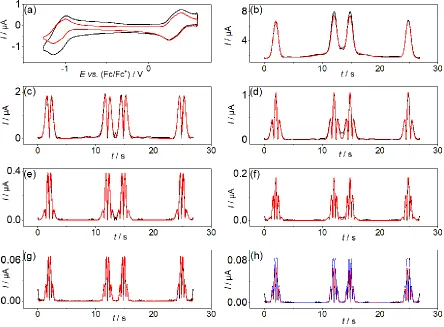
available. A representative FTAC voltammogram (f = 27.01 Hz) obtained in PC containing
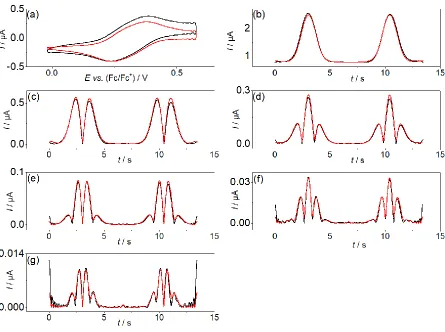
[EMIM][BF4] as the supporting electrolyte is shown in Figure 3. For the other four electrolytes
(see Table 1), the VV/IV and WVI/V processes were found to be far from reversible allowing the
voltammogram (f = 9.02 Hz) obtained in PC containing [TPA][BF4] as the supporting
electrolyte is shown in Figure 4.
Figure 3. Comparison of simulated (—) and experimental (—) FTAC voltammetric data
obtained for the VIV/V and WVI/V processes in PC containing 1.0 mM [SVW11O40]3− and 0.5 M
[EMIM][BF4] at a 1 mm diameter Pt macrodisk electrode with T = 295 K, ΔE = 80 mV, f =
27.01 Hz and ν = 0.137 V s−1. (a) aperiodic DC component, (b–g) 1st to 6th AC harmonic
components, and (h) simulated 6th harmonic component for the reversible case (—). Simulated
[image:15.595.78.522.129.456.2]Figure 4. Comparison of simulated (—) and experimental (—) FTAC voltammetric data
obtained for the VIV/V process in PC containing 1.0 mM [SVW11O40]3− and 0.5 M [TPA][BF4]
at a 1 mm diameter Pt electrode with T = 295 K, ΔE = 80 mV, f = 9.02 Hz and ν = 0.089 V s−1.
(a) aperiodic DC component, (b–g) 1st to 6th AC harmonic components. Simulated kinetic data
[image:16.595.76.521.70.402.2]Figure 3 provides a simulation-experiment comparison for the VV/IV and WVI/V
processes in PC containing 0.5 M [EMIM][BF4]. In the 6th harmonic component, both
processes can be treated as quasi-reversible rather than reversible on this timescale (see Figure
3h), since the current magnitude for this harmonic is significantly smaller than predicted for a
reversible process (blue curve). Excellent agreement between the simulated and experimental
data was achieved for all harmonic components with 𝑘V0 and 𝑘W0 both estimated to be 0.10 cm s-1. α was reasonally assumed to be 0.50 in all simulations in accordance with the highly
symmetric shapes of all AC harmonics.
Since the electrode kinetics of the WVI/V process when using [TPA][BF4], [TBA][PF4]
and [THA][ClO4] as the electrolyte are so slow, higher order harmonic components are almost
absent, only the narrowed potential range associated with the VV/IV process was quantified by
FTACV under these conditions. The FTAC voltammogram (f = 9.02 Hz) obtained for the VV/IV
process in PC containing 0.5 M [TPA][BF4] is shown in Figure 4. Excellent agreement
between the simulated and experimental data was achieved using the measured A, D, C and Ru
values to give a 𝑘V0 value of 0.0075 cm s‒1. For the WVI/V process, it should be noted that when using [TPA][BF4], [TBA][PF4] and [THA][ClO4] as the electrolyte, the DC cyclic
voltammograms obtained from the first cycling scan give larger peak-to-peak separations than
those obtained from the following ones. Furthermore, the shapes of the reduction and oxidation
peaks are not fitted perfectly with simulated ones obtained based on Butler-Volmer theory
(Figure S1(a)). For slow electrode kinetics such as the WVI/V process, the differences between
Butler-Volmer theory and Marcus-Hush theory in simulation are expected to be
distinguishable. Better fitting was found when comparing the experimental data and simulated
one based on Marcus-Hush theory (Figure S1(b)). However, a large deviation between
experimental and simulated data still exists. All the discussions above indicate there are
[THA][ClO4] as the electrolyte. Therefore, in this study the electrode kinetics of this process
were estimated by comparing the peak-to-peak separations of the experimental DC cyclic
voltammograms obtained from the first cycling scan with those obtained by DigiElch digital
simulation based on Butler-Volmer theory, taking into account the effect of uncompensated
resistance (Ru). A 𝑘W0 value of 1.2×10⁻⁴cm s-1 was estimated when using [THA][ClO4] as the electrolyte. The heterogeneous electron transfer kinetics of the VV/IV and WVI/V processes were
measured in PC with the 7 different electrolytes outlined in Scheme 1; the FTAC voltammetric
data obtained for [BMIM]+, [Py14]+, [TEA]+, [TBA]+ and [THA]+ are included in the
Supporting Information (see Figures S2 to S6) and the measured k0 values are summarized in
Table 3.
FTAC voltammetric data were also acquired with a lower bulk concentration of 0.20
mM [SVW11O40]3- in order to lessen the influence of the IRu drop. The results obtained at a Pt
macrodisk electrode in PC (0.5 M electrolyte) at this lower bulk concentration are also
summarized in Table 3. Comparisons of experimental and simulated data are presented in
Figures S7 to S13 in the Supporting Information. As expected, since the IRu drop has been
correctly accommodated for in all simulations, the determined 𝑘0 values are essentially independent of the [SVW11O40]3- concentration. This concentration independence also implies
that the contribution from specific adsorption is not significant.
The data summarized in Table 3 reveal that 𝑘V0 and 𝑘W0 are both affected by the nature of the supporting electrolyte, with increasing size of the electrolyte cation causing a decrease
in the measured value. For example, for the VV/IV process, 𝑘0 decreases by approximately
three orders of magnitude when the electrolyte cation is changed from [EMIM]+ to [THA]+. As
discussed previously,[36] the length of the imidazolium based cations ([EMIM]+ and
[BMIM]+) are similar to the diameter of ammonium based cations ([TPA]+ or [TBA]+).
orientation to be parallel rather than perpendicular to the electrode surface. With this in mind,
we can conclude that the 𝑘V0 values are dependent on the size of the electrolyte cation, decreasing in the order; [EMIM]+ > [BMIM]+ > [Py14]+ ≈ [TEA]+ > [TPA]+ > [TBA]+ >
[THA]+. The same trend in k0 is also observed for the WVI/V process, however with a more significant decrease (approximately two orders of magnitude) from [TEA]+ to [TPA]+, namely, [EMIM]+ > [BMIM]+ > [Py14]+ ≈ [TEA]+ >> [TPA]+ > [TBA]+ > [THA]+. It should be noted
that the impact of the thermodynamically favourable cross redox reaction between
[SVW11O40]3- and [SVW11O40]5- on the voltammetric characteristics is insignificant, as
[image:19.595.38.581.349.714.2]demonstrated in a previous study.[35]
Table 3. Electrode kinetic parameters derived at a 1 mm dimeter Pt macrodisk electrode for the [SVW11O40]3-/4-/5- processes in PC (0.5 M electrolyte).
Electrolyte C (mM)
Rua
(Ω)
Cdla (c0, c1, c 2, c 3, c 4)
(μF cm-2)
𝐸V0 (V)
𝑘V0 (cm s-1)
𝐸W0 (V)
𝑘W0 (cm s-1)
[EMIM][BF4] 1.0 415 16.1, -2.1, -5.3, -4.9, -1.1
0.316 0.10 -1.085 0.10
0.20 430 13.2, 1.5, 6.1, 4.8, 1.4 0.10 0.10
[BMIM][BF4] 1.0 535 20.9, 0.2, -4.0, -4.3, -1.2
0.306 0.040 -1.093 0.038
0.20 515 14.6, 1.0, -1.5, -3.6, -1.3 0.050 0.045
[Py14][BF4] 1.0 470 28.5, 0.5, -4.5,-3.7, -0.9
0.333 0.016 -1.079 0.016
0.20 502 14.3, 0.7, 0.2, -0.1, -0.1 0.018 0.017
[TEA][BF4] 1.0 550 31.2, -2.8, -16.9, -14.6, -3.9
0.342 0.015 -1.079 0.020
0.20 543 16.0, 1.11, -2.9, -4.3, -1.4 0.012 0.020
[TPA][BF4] 1.0 530 21.5, -0.6, 8.2, 28.8, 24.5
0.309 0.0075 -1.182 1.2×10
-4 b
0.20 630 13.4, 0.6, -0.2, 8.0, 12.3 0.0085 c
[TBA][PF6] 1.0 730 22.0, -0.5, 10.1, 7.3, -12.4
0.254
0.0040
-1.260
1.2×10⁻⁵ b
0.20 750 12.4, 1.1, -4.1, 7.0, 19.5 0.0033 c
[THA][ClO4] 1.0 1330 12.0, -0.5, 10.1, 7.2, -12.4 0.214 0.0018 -1.355 1.7×10⁻⁶ b
0.20 1270 13.9, 2.4, 0.6, -3.1, -1.1 0.0016 c
a See supporting information for detailed measurement.
The solvent chosen in this study, PC, has a relatively high dielectric constant (64.9 at
25 ℃[42]), which is expected to minimise the extent of ion pairing. For example, a measurable amount of ion pairing between the electrolyte cation and nitromesitylene radicals has been
reported in acetonitrile and dimethylformamide[46] (with dielectric constants of 36 and 36.7,
respectively), while negligible ion pairing between the same anion radical and the electrolyte
cation has been suggested in PC.[47] Nevertheless, owing to the high negative charge of POM
anions, the occurrence of electrolyte cation-POM ion pairing in the present study is expected
(the electrolyte cation dependence of the 𝐸0 values (see Table 3) implies that ion pairing is significant). In this case, the electrode kinetics have been measured at apparent formal
potentials (𝐸app0 ) rather than formal potential 𝐸F0, so 𝑘0 should be more appropriately
considered as an apparent rate constant (𝑘app0 ). In this situation, the kinetics of the overall
electron transfer reaction scheme can be described by the square reaction given in Eq. 3,
A + e- B (E10, 𝑘10)
𝐾1 X + X+ 𝐾 2
XA+ + e- XB+ (E
20, 𝑘20) (3)
In this scheme, the symbols A and B are used to represent [SVW11O40]3- and [SVW11O40]4-,
respectively so that 𝐾1 = [X[XA+][A]+] and 𝐾2 = [X[XB+][B]+] are the equilibrium constants for the
ion-pairing reactions involving either the oxidised or the reduced forms, E10 and E20 are the relevant
identical to a simple one-electron transfer process in Eq. 4 if the ion pairing reactions are
reversible on the voltammetric timescale.
A' + e- B' (kapp0, αapp, Eapp0) (4)
where
𝑘app0 = 𝑘1
0(𝐾
2⁄ )𝐾1 𝛼𝑎𝑝𝑝 + 𝑘20([X+] 𝐾⁄ )1
[1 + ([X+] 𝐾 1
⁄ )]1−𝛼app[(𝐾2⁄ ) + (𝐾1 [X+] 𝐾⁄ )]1 𝛼app (5)
Since a higher charge density is associated with the species B, K2 is expected to be smaller than
K1. It is also reasonable to assume that both K1 and K2 are smaller than unity due to relatively
strong association between highly charged POMs and electrolyte cations. Consequently, the
relationships 𝐾2/𝐾1 ≪ [𝑋+]/𝐾1 and 𝑘10(𝐾2/𝐾1)1/2 ≪𝑘20([𝑋+]/𝐾1) are expected to be valid under the experimental conditions employed as noted in other studies.[48, 49] On this
basis, Eq. 5 can be simplified to give Eq. 6 with αapp taken to be 0.5,
𝑘app0 =
𝑘10(𝐾2⁄ )𝐾1 1/2+ 𝑘
20([X+] 𝐾⁄ )1
[1 + ([X+] 𝐾 1
⁄ )]1/2[(𝐾
2⁄ ) + (𝐾1 [X+] 𝐾⁄ )]1 1/2≈
𝑘20([X+] 𝐾 1)
⁄ 1/2 [1 + ([X+] 𝐾
1
⁄ )]1/2
= 𝑘2
0
[1 + (𝐾1/[𝑋+])]1/2 (6)
As the size of the cation increase ([TEA]+ > [TPA]+ > [TBA]+ > [THA]+), the ion pairs formation become weaker and K1 is expected to increase. Assuming 𝑘20 is insensitive to the identity of the electrolyte cation, kapp0 is therefore predicted to decrease in the order of [TEA]+ > [TPA]+ > [TBA]+ > [THA]+.
The apparent formal potentials 𝐸𝑎𝑝𝑝0 is also a function of 𝐸10, 𝐾1, 𝐾2 and [X+][49]
(𝐹/𝑅𝑇)(𝐸app0 − 𝐸10) = ln [
1 + ([X+] 𝐾 1)
⁄ 1 + ([X+] 𝐾
2
⁄ )] (7)
Rearrangement gives
(𝐹/𝑅𝑇)(𝐸app0 − 𝐸10) = ln(
𝐾2+[X+]
𝐾1+[X+] ∙
𝐾1
As 𝐾1 and 𝐾2 are much smaller than 1, it is reasonable to assume 𝐾2+[X +]
𝐾1+[X+] ≈ 1. Therefore,
(𝐹/𝑅𝑇)(𝐸app0 − 𝐸10) ≈ ln(
𝐾1
𝐾2) (9)
When the electrolyte cation is small, ion pair formation is stronger, and the difference between
𝐾1 and 𝐾2 is larger than that when using a larger cation. Since 𝐾1 is expected to be larger than
𝐾2 as explained above, the values of ln(𝐾𝐾1
2) are predicted to increase with the size of electrolyte
cation which decrease in the order [THA]+ < [TBA]+ < [TPA]+ < [TEA]+
. Consequently, on
the basis of Eq. (9), we can deduce that 𝐸𝑎𝑝𝑝0 values are expected to follow the order [THA]+
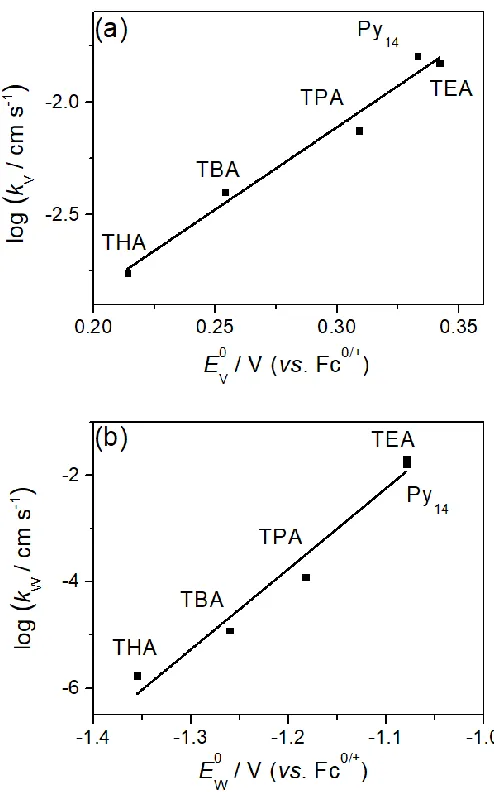
< [TBA]+ < [TPA]+ < [TEA]+. Figure 5 provides a plot of 𝑘
app0 values associated with the VV/IV
and WVI/V processes as a function of their formal reversible potential, which indeed confirms
𝑘V0 and 𝑘
W0 values decrease, and the 𝐸𝑉0 and 𝐸𝑊0 shift towards more negative potentials as the size of electrolyte cations increase as predicted. However, ion pairing cannot be the sole reason
for the electrolyte cation dependence of the 𝑘0 values, as this does not account for the
dramatically different 𝑘V0 and 𝑘
Figure 5. Plots of the logarithm of 𝑘0 for the (a) VV/IV and (b) WVI/V processes vs. formal reversible potential in PC containing 0.5 M electrolyte.
In the Marcus Theory of electron transfer, the heterogeneous rate constant associated
with a simple outer sphere electrode process is inverse proportional to the activation Gibbs
energy, 𝛥𝐺∗.[14] The total activation energy 𝛥𝐺∗ can be divided into inner 𝛥𝐺
𝑖∗ and outer 𝛥𝐺𝑜∗ components of the reorganization energies. The inner component of reorganization energy
reflects the bonds between the centered metal and the ligands. The outer component of
reorganization energy corresponds to the interaction of the complex with the molecules or ions
[image:23.595.80.327.75.471.2]is reasonable to assume that Δ𝐺o∗ makes a dominanth contribution. On this basis, the 𝑘0 values are expected to descrease with increase in the viscosity of the solvent (electrolyte), which is
the case for both 𝑘V0 and 𝑘 W
0 when the electrolyte cation is changed from [TEA]+ to [THA]+.
However, the viscosity of PC containing 0.5 M [TEA][BF4] is only 1.5 times smaller than that
containing 0.5 M [THA][ClO4], while the 𝑘V0 values decrease approximately by a factor of 10
and 𝑘W0 values decrease more significantly (approximately four orders of magnitude). Therefore, the contribution from media change in viscosity are not the major factor.
Significant electrolyte cation dependence of the 𝑘0 values also may arise from specific
adsorption of [SVW11O40]3-, [SVW11O40]4- and/or [SVW11O40]5-. However, since the 𝑘V0 and 𝑘W0 values found at the two [SVW
11O40]3- concentrations (1 mM and 0.2 mM) are almost
identical, a specific adsorption effect is unlikely, as this is expected to give rise to concentration
dependence.
In general, if it is assumed that the reaction plane is coincident with the outer Helmholtz
plane, the electrolyte cation dependence of 𝑘0 may be consequence of the double layer effect.[50] However, as highlighted in previous studies, it appears that the double layer effect
alone cannot account for the magnitude of the electrolyte cation size effect observed herein.
Gamber, et al.[51] found that at negative potentials, tetraalkylammonium cations are adsorbed
at a mercury electrode/electrolyte interface in acetonitrile, with the extent of adsorption
becoming more extensive with increasing length of the constituent alkyl chain of the cation.
Evans, et al.[52] studied the inhibiting effect of large tetraalkylammonium cations on the
electrode kinetics for a wide variety of electrode reactions. In their study, these authors showed
that the k0 values became smaller when [THA]+ replaced [TEA]+ as the electrolyte cation. This
suggested that at negative potentials, the electrode is extensively covered with adsorbed
Simply, it can be assumed that 𝑑 = 2𝑟+ (𝑑 is the thickness of the “film” and 𝑟+ is the diameter of the electrolyte cation). However, since the alkyl arms of the larger tetraalkylammonium
cations (n ≥ 3) can bend under the influence of an electric field, the charge center at the nitrogen
atom is able to approach the surface at a distance of 0.37 nm.[47] This necessitate the
introduction of correction factor to the thickness of the “film” for the larger
tetraalkylammonium cations:[47]
𝑑 = 2𝑟+ 𝑛 ≤ 3 (10) 𝑑 = 𝑟++ 0.37 𝑛 ≤ 3 (11)
Table 4 shows the crystallographic radius (𝑟+) and the calculated thickness of the
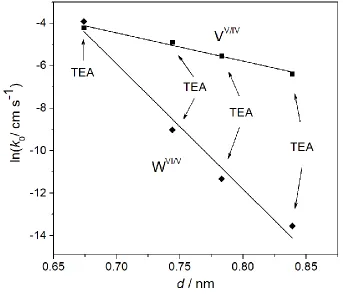
coverage (𝑑) for each of the tetraalkylammonium cations. A plot of ln 𝑘0 measured in PC solutions containing the range tetraalkylammonium cations used versus 𝑑 (calculated using Eqs. 10 and 11) is shown in Figure 6. Reasonable linear correlations (r2 = 0.99 and 0.98 for
VV/IV and WVI/V processes, respectively) between are obtained for both the VV/IV and WVI/V
processes.
In our previous studies,[35,36] the electrode kinetics of VV/IV and WVI/V processes were
found to be dependent on the electrode material, which is consistent with the prediction of
Marcus theory. In Marcus theory, the adsorbed layers on the electrode/electrolyte interface can
impede electron transfer.[50, 53-55] When electron tunneling occurs from an electrode which
is covered by an adsorbed layer to a redox active species in the solution phase, the standard
rate constant is proportional to thickness of adsorbed layer:[47]
𝑘0 = 𝑘0′𝑒−𝛽𝑑 (12)
where k0’ is the standard rate constant for the uncovered electrode and 𝛽 is the tunneling
parameter. Reasonable linear correlations between ln 𝑘0 and 𝑑 were obtained for both VV/IV
and WVI/V processes, which is consistent with that predicted by Marcus theory. The slopes of
and 58.9 nm-1 for the WVI/V process, which suggests the latter has a higher barrier height.
Lipkowski et al.,[53] who studied the electrode kinetics of redox processes at mercury
electrodes coated with monolayers of quinolone, iso-quinoline and 3-methyl-iso-quinoline
found that the monolayers existed as concentrated liquid-like films or compact solid-like films
depending on the magnitude of the electrode potential. While the former has a significant
inhibitive effect, the latter can decelerate the electrode reaction much more effectively, by up
to 6-7 orders of magnitude. On this basis, the results in our study can be attribute in part to
inhibiting effect of adsorbed tetraalkylammonium cations on the electrode surface that form a
blocking layer which reduces the probability of electron transfer through the layer; the
thickness of the layer increases with the size of electrolyte cation. In the potential region where
the VV/IV process occurs (close to the potential of zero charge, pzc), the monolayer acts as a
liquid-like film, and as a result, the 𝑘V0 values decrease gently with an increase in the electrolyte cation size. For the WVI/V process, which appears in a much more negative potential region
(significantly negative of the pzc), the monolayer becomes more compact and acts as a
solid-like film, particularly when using the larger tetraalkylammonium cations. Consequently, a
more significant drop in 𝑘W0 is observed when changing the electrolyte cation from [TEA]+ to [TPA]+, [TBA]+ and [THA]+.
Although the dimensions of [EMIM]+ and [BMIM]+ are known, it is problematic to
estimate the thickness of the layer for these two cations, since these center of charge is able to
approach the electrode surface at a closer distance than spherical ammonium cations, due to
their planar structure. For this reason, 𝑘0 data for these two cations are not included in the plot
shown in Figure 6. However, it is important to note that comparison of these 𝑘0 values also reveals a decrease with increase in the length of the alkyl chain (see Table 3). Furthermore,
given that the structure of [Py14]+ is similar to that of [TEA]+, in terms of the length of the alkyl
experimentally (𝑘V0 = 0.016 cm s-1, 𝑘
W0 = 0.016 cm s-1 with [Py14]+ and 𝑘V0 = 0.015 cm s-1, 𝑘W0
= 0.02 cm s-1 with [Py
14]+). On the basis of the above analysis, the observed cation dependent 𝑘V0 and 𝑘
W0 (Figure 6) is consistent with the prediction based on the Marcus theory.
Figure 6. Plot of the natural logarithm of k0 for the VV/IV () and WVI/V () processes
measured at a Pt electrode in the presence of designated tetraalkylammonium cations versus
the thickness of the coverage (d), calculated from the crystallographic radius of the relative
[image:27.595.127.470.162.456.2]cations (see Eqs. 11 and 12).
Table 4. Cation Crystallographic radii (r+) and calculated thickness of the coverage (d) of the
tetraalkylammonium cations employed in this study.
Electrolyte Cation crystallographic radius
𝑟+ (nm)[56]
Thickness of the coverage
𝑑 (nm)
[TEA][BF4] 0.337 0.674
[TPA][BF4] 0.372 0.744
[image:27.595.77.476.646.751.2][THA][ClO4] 0.469 0.839
Conclusions
The heterogeneous electron transfer kinetics associated with the [SVW11O40]3−/4−/5−
processes at a platinum electrode have been investigated in PC containing seven different
supporting electrolyte cations using large amplitude FTAC voltammetry to quantify very fast
kinetics and DC cyclic voltammetry for slow kinetics. The formal reversible potentials and
electron-transfer rate constants associated with the VV/IV and WVI/V processes were found to
correlate with the size of the supporting electrolyte cation. k0 values decrease in the order,
[EMIM]+ > [BMIM]+ > [Py14]+ ≈ [TEA]+ > [TPA]+ > [TBA]+ > [THA]+ for both processes
even though they occur at very different potentials, and while 𝑘V0 decreases more gently with
increasing cation size, changing by approximately three orders of magnitude, the decrease in
𝑘W0 is more drastic, changing by approximately five orders of magnitude from [EMIM]+ to
[THA]+. Possible explanations for the electrolyte cation depedence were considered (e.g.,
ion-pairing, viscosity, adsorption and the double-layer effect), with inhibition of electron-transfer
by a blocking “film” of electrolyte cations being proposed as the dominant factor, supported
by the linear plot of ln(k0) vs. ln(d) for both the VV/IV and WVI/V electron transfer processes.
The nature of the cation “film” is thought to change from liquid-like (moderately inhibiting) in
the potential region where the VV/IV process occurs, to solid-like (strongly inhibiting) in the
potential region where the WVI/V process occurs, thereby explaining the different sensitivities
of the respective processes to the nature of the supporting electrolyte cations.
Acknowledgements
J.L. acknowledges Monash University for provision of postgraduate publication award support.
References
[1] J. Velmurugan, P. Sun, M.V. Mirkin, Scanning electrochemical microscopy with gold nanotips: the effect of electrode material on electron transfer rates, The Journal of Physical Chemistry C, 113 (2008) 459-464.
[2] R.K. Jaworski, R.L. McCreery, Laser activation of carbon microdisk electrodes: Surface oxide effects on Ru(NH3)63+/2+ kinetics, Journal of Electroanalytical Chemistry, 369 (1994)
175-181.
[3] Z. Samec, J. Weber, The effect of the double layer on the rate of the Fe3+/Fe2+ reaction on
a platinum electrode and the contemporary electron transfer theory, Journal of Electroanalytical Chemistry and Interfacial Electrochemistry, 77 (1977) 163-180.
[4] C.A. McDermott, K.R. Kneten, R.L. McCreery, Electron Transfer Kinetics of Aquated Fe3+/2+, Eu3+/2+ and V3+/2+ at Carbon Electrodes Inner Sphere Catalysis by Surface Oxides,
Journal of The Electrochemical Society, 140 (1993) 2593-2599.
[5] S. Sahami, M.J. Weaver, Solvent effects on the kinetics of simple electrochemical reactions: Part I. Comparison of the behavior of Co (III)/(II) trisethylenediamine and ammine couples with the predictions of dielectric conitnuum theory, Journal of Electroanalytical Chemistry and Interfacial Electrochemistry, 124 (1981) 35-51.
[6] A. Kapturkiewicz, B. Behr, Solvent effect on electrode reaction kinetics of transition metal salene complexes, Journal of electroanalytical chemistry and interfacial electrochemistry, 179 (1984) 187-199.
[7] G.E. McManis, M.N. Golovin, M.J. Weaver, Role of solvent reorganization dynamics in electron-transfer processes. Anomalous kinetic behavior in alcohol solvents, The Journal of Physical Chemistry, 90 (1986) 6563-6570.
[8] K. Hsueh, E. Gonzalez, S. Srinivasan, Electrolyte effects on oxygen reduction kinetics at platinum: a rotating ring-disc electrode analysis, Electrochimica Acta, 28 (1983) 691-697. [9] C. Beriet, D. Pletcher, A microelectrode study of the mechanism and kinetics of the ferro/ferricyanide couple in aqueous media: The influence of the electrolyte and its concentration, Journal of Electroanalytical Chemistry, 361 (1993) 93-101.
[10] S.K. Cook, B.R. Horrocks, Heterogeneous Electron‐ Transfer Rates for the Reduction of Viologen Derivatives at Platinum and Bismuth Electrodes in Acetonitrile, ChemElectroChem, DOI (2016).
[11] T. Iwasita, W. Schmickler, J. Schultze, The influence of metal adatoms deposited at underpotential on the kinetics of an outer-sphere redox reaction, Journal of electroanalytical chemistry and interfacial electrochemistry, 194 (1985) 355-359.
[12] T. Iwasita, W. Schmickler, J. Schultze, The influence of the metal on the kinetics of outer sphere redox reactions, Berichte der Bunsengesellschaft für physikalische Chemie, 89 (1985) 138-142.
[13] M.J. Weaver, T. Gennett, Influence of solvent reorientation dynamics upon the kinetics of some electron-exchange reactions, Chemical physics letters, 113 (1985) 213-218.
[14] C. Lagrost, L. Preda, E. Volanschi, P. Hapiot, Heterogeneous electron-transfer kinetics of nitro compounds in room-temperature ionic liquids, Journal of Electroanalytical Chemistry, 585 (2005) 1-7.
[15] M.D. Ryan, D.H. Evans, Effect of metal ions on the electrochemical reduction of benzil in non-aqueous solvents, Journal of Electroanalytical Chemistry and Interfacial Electrochemistry, 67 (1976) 333-357.
[17] M.J. Hazelrigg, A.J. Bard, Electrohydrodimerization Reactions IV. A Study of the Effect of Alkali Metal Ions on the Hydrodimerization of Several 1, 2‐ Diactivated Olefins in DMF Solutions by Chronoamperometry and Chronocoulometry, Journal of The Electrochemical Society, 122 (1975) 211-220.
[18] W. Fawcett, A. Lasia, The influence of ion pairing on the electroreduction of nitromesitylene in aprotic solvents. 2. Kinetic aspects, The Journal of Physical Chemistry, 82 (1978) 1114-1121.
[19] R. Andreu, J.J. Calvente, W.R. Fawcett, M. Molero, Role of ion pairing in double-layer effects at self-assembled monolayers containing a simple redox couple, The Journal of Physical Chemistry B, 101 (1997) 2884-2894.
[20] M. Peover, J. Davies, The influence of ion-association on the polarography of quinones in dimethylformamide, Journal of Electroanalytical Chemistry (1959), 6 (1963) 46-53.
[21] M.T. Pope, A. Müller, Polyoxometalate chemistry: an old field with new dimensions in several disciplines, Angewandte Chemie International Edition in English, 30 (1991) 34-48. [22] D.-L. Long, E. Burkholder, L. Cronin, Polyoxometalate clusters, nanostructures and materials: from self assembly to designer materials and devices, Chemical Society Reviews, 36 (2007) 105-121.
[23] P. Special, issue: L. Cronin and A. Müller (guest eds.), Chem. Soc. Rev, 41 (2012) 7325-7648.
[24] M.V. Vasylyev, R. Neumann, New heterogeneous polyoxometalate based mesoporous catalysts for hydrogen peroxide mediated oxidation reactions, Journal of the American Chemical Society, 126 (2004) 884-890.
[25] K. Kamata, K. Yonehara, Y. Sumida, K. Yamaguchi, S. Hikichi, N. Mizuno, Efficient epoxidation of olefins with≥ 99% selectivity and use of hydrogen peroxide, Science, 300 (2003) 964-966.
[26] H. Lü, J. Gao, Z. Jiang, F. Jing, Y. Yang, G. Wang, C. Li, Ultra-deep desulfurization of diesel by selective oxidation with [C18H37N(CH3)3]4[H2NaPW10O36] catalyst assembled in
emulsion droplets, Journal of Catalysis, 239 (2006) 369-375.
[27] C.L. Hill, Progress and challenges in polyoxometalate-based catalysis and catalytic materials chemistry, Journal of Molecular Catalysis A: Chemical, 262 (2007) 2-6.
[28] M. Sadakane, E. Steckhan, Electrochemical properties of polyoxometalates as electrocatalysts, Chemical Reviews, 98 (1998) 219-238.
[29] M. Zhou, L.P. Guo, F.Y. Lin, H.X. Liu, Electrochemistry and electrocatalysis of polyoxometalate-ordered mesoporous carbon modified electrode, Analytica chimica acta, 587 (2007) 124-131.
[30] Z. Han, Y. Zhao, J. Peng, Y. Feng, J. Yin, Q. Liu, The electrochemical behavior of Keggin polyoxometalate modified by tricyclic, aromatic entity, Electroanalysis, 17 (2005) 1097-1102. [31] K.K. Kasem, Electrochemical behavior of sodium 12-tungstodicobaltoate in aqueous and mixed solvent electrolytes, Electrochimica acta, 41 (1996) 205-211.
[32] K. Maeda, S. Himeno, T. Osakai, A. Saito, T. Hori, A voltammetric study of Keggin-type heteropolymolybdate anions, Journal of Electroanalytical Chemistry, 364 (1994) 149-154. [33] K. Bano, J. Zhang, A.M. Bond, P.R. Unwin, J.V. Macpherson, Diminished Electron Transfer Kinetics for [Ru(NH3)6]3+/2+, [α-SiW12O40]4–/5– and [α-SiW12O40]5–/6– Processes at
Boron-Doped Diamond Electrodes, The Journal of Physical Chemistry C, 119 (2015) 12464-12472.
[34] J. Li, A.M. Bond, J. Zhang, Probing Electrolyte Cation Effects on the Electron Transfer Kinetics of the [α-SiW12O40]4–/5– and [α-SiW12O40]5–/6– Processes using a Boron-Doped
Diamond Electrode, Electrochimica Acta, 178 (2015) 631-637.
[SVW11O40]4−/5− (WVI/V) Processes in Dimethylformamide, Electrochimica Acta, 201 (2016)
45-56.
[36] J. Li, C.L. Bentley, A.M. Bond, J. Zhang, T. Ueda, Influence of 1-butyl-3-methylimidazolium on the electron transfer kinetics associated with the [SVW11O40]3−/4−
(VV/IV) and [SVW11O40]4−/5− (WVI/V) processes in dimethylformamide, Journal of
Electroanalytical Chemistry, DOI (2016).
[37] T. Ueda, J.-i. Nambu, J. Lu, S.-X. Guo, Q. Li, J.F. Boas, L.L. Martin, A.M. Bond, Structurally characterised vanadium (v)-substituted Keggin-type heteropolysulfates [SVM11O40]3− (M= Mo, W): voltammetric and spectroscopic studies related to the V (v)/V (iv)
redox couple, Dalton Transactions, 43 (2014) 5462-5473.
[38] A. Baranski, W. Fawcett, Medium effects in the electroreduction of cyanobenzenes, Journal of Electroanalytical Chemistry and Interfacial Electrochemistry, 100 (1979) 185-196. [39] D.A. Corrigan, D.H. Evans, Cyclic voltammetric study of tert-nitrobutane reduction in acetonitrile at mercury and platinum electrodes: Observation of a potential dependent electrochemical transfer coefficient and the influence of the electrolyte cation on the rate constant, Journal of Electroanalytical Chemistry and Interfacial Electrochemistry, 106 (1980) 287-304.
[40] C. Rüssel, W. Jaenicke, Heterogeneous electron transfer to quinones in aprotic solvents: Part II. The dependence on solvent and supporting electrolyte, Journal of electroanalytical chemistry and interfacial electrochemistry, 180 (1984) 205-217.
[41] A. Kapturkiewicz, M. Opałło, Medium effect in the electroreduction of nitromesitylene, Journal of electroanalytical chemistry and interfacial electrochemistry, 185 (1985) 15-28. [42] J. Barthel, F. Feuerlein, Dielectric properties of propylene carbonate and propylene carbonate solutions, Journal of solution chemistry, 13 (1984) 393-417.
[43] A.M. Bond, D. Elton, S.-X. Guo, G.F. Kennedy, E. Mashkina, A.N. Simonov, J. Zhang, An integrated instrumental and theoretical approach to quantitative electrode kinetic studies based on large amplitude Fourier transformed ac voltammetry: A mini review, Electrochemistry Communications, 57 (2015) 78-83.
[44] R.S. Nicholson, Theory and Application of Cyclic Voltammetry for Measurement of Electrode Reaction Kinetics, Analytical Chemistry, 37 (1965) 1351-1355.
[45] C.C. Miller, The Stokes-Einstein Law for diffusion in solution, Proceedings of the Royal Society of London. Series A, Containing Papers of a Mathematical and Physical Character, 106 (1924) 724-749.
[46] B. Chauhan, W. Fawcett, A. Lasia, The influence of ion pairing on the electroreduction of nitromesitylene in aprotic solvents. 1. Thermodynamic aspects, The Journal of Physical Chemistry, 81 (1977) 1476-1481.
[47] W.R. Fawcett, M. Fedurco, M. Opallo, The inhibiting effects of tetraalkylammonium cations on simple heterogeneous electron transfer reactions in polar aprotic solvents, The Journal of Physical Chemistry, 96 (1992) 9959-9964.
[48] Y. Liu, S.-X. Guo, A.M. Bond, J. Zhang, Y.V. Geletii, C.L. Hill, Voltammetric Determination of the Reversible Potentials for [{Ru4O4(OH)2(H2O)4}(γ-SiW10O36)2]10– over
the pH Range of 2–12: Electrolyte Dependence and Implications for Water Oxidation Catalysis, Inorganic chemistry, 52 (2013) 11986-11996.
[49] S.-X. Guo, S.W. Feldberg, A.M. Bond, D.L. Callahan, P.J. Richardt, A.G. Wedd, Systematic Approach to the Quantitative Voltammetric Analysis of the FeIII/FeII Component of the [α2-Fe(OH2)P2W17O61]7-/8- Reduction Process in Buffered and Unbuffered Aqueous
Media, The Journal of Physical Chemistry B, 109 (2005) 20641-20651.
[51] R. Gambert, H. Baumgärtel, The influence of cations on the interface between the mercury electrode and non-aqueous CH3CN, Journal of electroanalytical chemistry and interfacial
electrochemistry, 183 (1985) 315-328.
[52] R.A. Petersen, D.H. Evans, Heterogeneous electron transfer kinetics for a variety of organic electrode reactions at the mercury-acetonitrile interface using either tetraethylammonium perchlorate or tetraheptylammonium perchlorate electrolyte, Journal of electroanalytical chemistry and interfacial electrochemistry, 222 (1987) 129-150.
[53] J. Lipkowski, C. Buess-Herman, J. Lambert, L. Gierst, Mechanism of electron transfer through monomolecular films of neutral organic species adsorbed at an electrode surface, Journal of electroanalytical chemistry and interfacial electrochemistry, 202 (1986) 169-189. [54] C. Miller, P. Cuendet, M. Graetzel, Adsorbed. omega.-hydroxy thiol monolayers on gold electrodes: evidence for electron tunneling to redox species in solution, The Journal of Physical Chemistry, 95 (1991) 877-886.
[55] H.O. Finklea, D.D. Hanshew, Electron-transfer kinetics in organized thiol monolayers with attached pentaammine (pyridine) ruthenium redox centers, Journal of the American Chemical Society, 114 (1992) 3173-3181.
![Figure 1. The structure of [SVW11O40]3-. Color code: S (red), V (orange), W (yellow).[37]](https://thumb-us.123doks.com/thumbv2/123dok_us/9430302.448476/7.595.178.438.427.646/figure-structure-svw-color-code-red-orange-yellow.webp)
![Table 1. DC cyclic voltammetric data derived at 22 ± 2 °C from the reduction of 1.0 mM [SVW11O40]3- in PC (0.5 M electrolyte) at a Pt macrodisk (diameter = 1.0 mm) electrode with a scan rate of 0.1 V s-1](https://thumb-us.123doks.com/thumbv2/123dok_us/9430302.448476/11.595.122.475.233.423/table-voltammetric-derived-reduction-electrolyte-macrodisk-diameter-electrode.webp)
![Table 2. Summary of the D values for the reduction of 1.0 mM [SVW11O40]3- in PC (0.5 M](https://thumb-us.123doks.com/thumbv2/123dok_us/9430302.448476/14.595.76.523.127.275/table-summary-d-values-reduction-mm-svw-pc.webp)
![Table 3. Electrode kinetic parameters derived at a 1 mm dimeter Pt macrodisk electrode for the [SVW11O40]3-/4-/5- processes in PC (0.5 M electrolyte)](https://thumb-us.123doks.com/thumbv2/123dok_us/9430302.448476/19.595.38.581.349.714/electrode-kinetic-parameters-derived-macrodisk-electrode-processes-electrolyte.webp)