Original citation:
Behle, Heike and Maher, Sunil (2018) Measuring “Teaching Excellence” and “Learning Gain”
in the UK. Beiträge zur Hochschulforschung, 40 (2). pp. 48-67.
Permanent WRAP URL:
http://wrap.warwick.ac.uk/106416
Copyright and reuse:
The Warwick Research Archive Portal (WRAP) makes this work by researchers of the
University of Warwick available open access under the following conditions. Copyright ©
and all moral rights to the version of the paper presented here belong to the individual
author(s) and/or other copyright owners. To the extent reasonable and practicable the
material made available in WRAP has been checked for eligibility before being made
available.
Copies of full items can be used for personal research or study, educational, or not-for-profit
purposes without prior permission or charge. Provided that the authors, title and full
bibliographic details are credited, a hyperlink and/or URL is given for the original metadata
page and the content is not changed in any way.
Publisher’s statement:
Published version:
http://www.bzh.bayern.de/63/?tx_ttnews%5Btt_news%5D=1768&cHash=4df03486e3c877ff
7d80356e308fcaaf
A note on versions:
The version presented here may differ from the published version or, version of record, if
you wish to cite this item you are advised to consult the publisher’s version. Please see the
‘permanent WRAP URL’ above for details on accessing the published version and note that
access may require a subscription.
Measuring “Teaching Excellence” and
“Learning Gain” in the United Kingdom
Heike Behle, Sunil Maher
In the United Kingdom’s (UK) higher education system, teaching and learning are currently under review to evaluate both social and individual investment to tertiary education. The UK government introduced the Teaching Excellence Framework and Student Outcomes Framework to assess the quality of undergraduate teaching in universities and other higher education providers. There are 14 research projects which are identifying multiple ways to measure Learning Gain, a key component of the Teaching Excellence Framework and Student Outcomes Framework. Teaching Excel-lence encompasses Teaching Quality, the Learning Environment as well as Student Outcomes and Learning Gain, it uses both core metrics and a narrative to evaluate individual universities performance. Current research evaluate methodologies to measure Learning Gain and determine the potential suitability and scalability of pos-sible measures across the sector. This paper describes the current state of policy and research against the specific background of the UK higher education sector.
1 Introduction: Measuring Learning Gain in Higher Education
Measurement of higher education outcomes is a part of the political agenda in many countries and international organisations. For example, the OECD carried out a feasi-bility study for the Assessment of Higher Education Learning Outcomes (AHELO), aimed to test methods to assess students’ level of knowledge and skills graduation, and in the USA, the Wabash National Study focused on teaching and learning in liberal arts education. However, while in some countries there is a huge effort to identify indicators to measure learning gain across different institutional settings and in differ-ent subjects this is not the case in most other countries. Currdiffer-ently, the level of research on learning gain in various other countries has been described as not sufficient, and most previous studies concentrate on local settings with a small group of participants to determine prerequisites for admissions tests, gather data on learning opportunities,
and use self-report measures of outcomes (Zlatkin-Troitschanskaia, Shavelson & Kuhn,
2015).
The engagement with higher education outcomes is usually justified as an exercise to understand if the tertiary education sector is providing the right kind of skills and
knowledge to cater for the future. It is the intention “to recognise excellent
reason is the lack of comparability of classes of degrees across different higher
educa-tion institueduca-tions and across different subjects and courses (Arum & Roksa, 2011;
Zlatkin-Troitschanskaia, Shavelson and Kuhn, 2015). One particular aspect in this regard is the identification of skills and knowledge needed in a future labour market.
Policy-makers in the UK are concerned with allocation of existing resources to
“pro-duce” the skills, knowledge and attitudes future employees require (Clarke, 2017). In
order to do so, it will be required to understand what it is that a tertiary study does, how individuals and the society benefits from it, and crucially, how excellence in teaching and learning can be identified. This knowledge is required not only for policy makers and employers but also for potential applicants to higher education. In the shift from elite education to a highly diverse provision of a mass higher education system, graduates need to be able to identify and document the skills, knowledge and com-petences they acquired during their tertiary studies. Methodologically, this results in
a shift in the assessment of students’ achievement. “Higher education globally has
moved from an era of elite intake and stability of cohorts in which assessment was used to judge students against each other, to one that is slowly becoming outcomes-based, using explicit standards against which each student is judged” (Boud, 2017).
In the UK, the focus is mainly on learning gain which compares performance at two
points in time, as opposed to learning outcome (Schleicher 2015) which concentrates
exclusively on the output level. Learning gain in higher education measures the
“dis-tance travelled” with regards to skills, competencies, content knowledge and personal
development demonstrated by students at two points in time (Hoareau McGrath et
al., 2015). The “distance-travelled model” needs to be differentiated to the “value-added model”. The first compares between two measures of actual student perfor-mance, while the latter is based on the comparison between performance predicted
at the outset of studies and actual performance achieved (Hoareau McGrath et al.,
2015). Initially, these points in time refer to the start of higher education and
gradua-tion, however, a long-term approach could also account for further development after graduation.
This paper reports on current policy in England1 to measure teaching excellence, as
an example of ongoing attempts to measure learning gain. We describe the procedure to measure teaching excellence, the so-called Teaching Excellence and Student Out-comes Framework, and on-going research to measure learning gain. The UK has the most marketised higher education system within Europe, with students as consumers who see higher education as a direct investment which renders the outcome of higher
education to potential achievements on the labour market (Tomlinson, 2017). This
1 The Teaching Excellence and Student Outcomes Framework is for England only. Wales, Scotland and
human capital approach has exacerbated the urgent need for (potential) students, as investors, to understand their expected return. Furthermore, it has sharpened the need to understand the provision of teaching and learning which has resulted in the imple-mentation Higher Education Research Act (2017) and the Teaching Excellence and Student Outcomes Framework.
This paper will first introduce the specialities of the UK Higher Education Sector, fol-lowed by a description of the Teaching Excellence and Student Outcomes Framework. A third section will introduce both the themes covered in the learning gain projects and the methodological considerations followed by an early conclusion.
2 The Higher Education Sector in the United Kingdom
Higher education in the United Kingdom (UK) can be described as a marketised higher education system, characterised by three features:
(1) Relatively high tuition fees in a European context: Currently, UK domiciled students entering in higher education in 2017 are charged up to £9,250 annually, depending
on their domicile status and the higher education provider2, with international
students charged considerably more. The level of tuition fees are politically con-tested and it is unclear whether tuition fees will remain at current levels.
(2) An exceedingly diversified network of providers: Applicants to higher education can choose their course providers from a much diversified higher education system ranging from the highly reputable Russell Group Universities to smaller Further Education Colleges with degree awarding powers. A wide variety of different higher education providers are expected to cater for a highly diverse student population and the current government plans to further diversify it.
(3) Customer-orientated students: Finally, tuition fees have changed students’ attitude to their studies, their choice of courses and the providers. A previous study found that students have become more instrumental in their choice of courses and many were likely to give an employment-related main reason for applying to higher
education at the start of their courses (Purcell et al 2008:35ff). Higher education
courses are marketed as investment commodities (Naidoo and Jamieson 2005),
and higher education is increasingly seen as an investment into future employment opportunities.
2 At today’s rate, £9,250 are equal to approximately €10,500. A breakdown of the different levels of tuition
Despite the high labour-market orientation of students and a high rate of employment
after graduation per se, many graduates work in non-graduate jobs for which a degree
is not necessary (Elias & Purcell, 2004). A recent study (Behle, 2016) found that of all
employed graduates, approximately 30 per cent from three year courses and approx-imately 40 per cent from four year courses worked in non-graduate employment indicating that higher education remains a high risk financial investment and higher
education studies cannot guarantee a graduate job (Brynin 2013). Employment in
non-graduate jobs, however, is more likely for graduates from specific subjects, lower
access providers and regional location (Behle, 2016). The graduate premium which
measures the difference between graduates’ achieved salary and that of someone who could have attended higher education but choose not to, exists but the growth of earnings of graduates in their early careers has slowed down in recent years relative
to the increase in average earnings across the UK economy (Purcell et al., 2013).
In this contradictory context, students’ high expectations for a career in their chosen career path after graduating with a large debt and, at the same time, a high proportion of graduates working in non-graduate jobs has resulted in a revision of teaching and learning in higher education, and in 2016, the government implemented the Teaching Excellence and Student Outcomes Framework to measure the differences in perfor-mance between higher education providers. At approximately the same time,
follow-ing findfollow-ings from the USA (Arum & Roksa, 2011) where authors found a lack of progress
in the critical thinking of students, the Higher Education Founding Council for England commissioned research to pilot and evaluate a range of approaches for measuring learning gain. This paper describes the Teaching Excellence Framework and Student Outcomes Framework and the work of various research projects to measure Learning Gain in Higher Education in the UK. It is important to note that the Teaching Excellence and Student Outcomes Framework, being new legislation, is undergoing further development, and this paper, written in autumn 2017, reviews the previous assessment of Teaching Excellence and Student Outcomes Framework 2 and governmental guid-ance referring to the upcoming Teaching Excellence Framework and Student Outcomes Framework 3.
3 The Teaching Excellence and Student Outcomes Framework (TEF)
The Teaching Excellence and Student Outcomes Framework (TEF) was introduced in the academic year 2015/2016 to provide students with additional information about the kind or level of teaching and learning they can expect from a provider of tertiary
education. It was branded as a “new scheme for recognising excellent teaching, in
teach-ing, and measures performance at an institutional level only, however, it is anticipated that it will become compulsory and will also cover the subject level. The TEF aims to help students to be better informed and find information about what and where to study, to raise esteem for teaching, to recognise and reward excellent teaching, and to narrow the gap between the skills, knowledge and competencies students gain and
the needs of employers, business, industry and the professions (Department for
Education, 2017). The TEF includes all undergraduate provision of higher education as well as degree apprenticeships or integrated Master’s degrees irrespective of delivery mode (such as part-time, or as distance learning course).
The TEF assessment framework has been developed to take into account diverse forms of teaching and learning excellence. UK universities are traditionally divided into pre-1992 universities, which tend to be more research-oriented, and post-1992 uni-versities, often former polytechnic colleges, which gained their university status in a national effort to widen participation in degree-level education. However, further divisions exist, for example between the 24 research-intensive older universities (the Russell Group) and other groups (such as the Million+ or the University Alliance), with some universities concentrating solely on specific courses only, for example in Arts or Medicine. Additionally, it should be noted that in the application process, universities select students according to their achievements at secondary schools which further diversify institutions according to their student population.
3.1 Assessment criteria
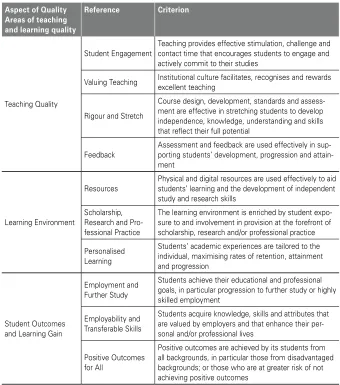
The Teaching Excellence Framework and Student Outcomes Framework (TEF) con-centrates on three aspects of quality. “Student Outcomes and Learning Gain”, “Teach-ing Quality” and the “Learn“Teach-ing Environment”. “Student Outcomes and Learn“Teach-ing Gain”
measures the achievement of positive outcomes, including “acquisition of attributes
Table 1: Teaching Excellence Framework and Student Outcomes Framework assess-ment criteria
Aspect of Quality Areas of teaching and learning quality
Reference Criterion
Teaching Quality
Student Engagement
Teaching provides effective stimulation, challenge and contact time that encourages students to engage and actively commit to their studies
Valuing Teaching Institutional culture facilitates, recognises and rewards excellent teaching
Rigour and Stretch
Course design, development, standards and assess-ment are effective in stretching students to develop independence, knowledge, understanding and skills that reflect their full potential
Feedback
Assessment and feedback are used effectively in sup-porting students’ development, progression and attain-ment
Learning Environment
Resources
Physical and digital resources are used effectively to aid students’ learning and the development of independent study and research skills
Scholarship, Research and Pro-fessional Practice
The learning environment is enriched by student expo-sure to and involvement in provision at the forefront of scholarship, research and/or professional practice
Personalised Learning
Students’ academic experiences are tailored to the individual, maximising rates of retention, attainment and progression
Student Outcomes and Learning Gain
Employment and Further Study
Students achieve their educational and professional goals, in particular progression to further study or highly skilled employment
Employability and Transferable Skills
Students acquire knowledge, skills and attributes that are valued by employers and that enhance their per-sonal and/or professional lives
Positive Outcomes for All
Positive outcomes are achieved by its students from all backgrounds, in particular those from disadvantaged backgrounds; or those who are at greater risk of not achieving positive outcomes
Source: Adapted from Department for Education (2017), Teaching Excellence and Student Outcomes Framework Specification, p. 25/26.
A key element of all aspects of quality is the extent to which positive outcomes are achieved for all students, including those from disadvantaged backgrounds such as mature or disabled students, those from Black or Minority Ethnic groups, or other aspects leading to disadvantages such as family background. In England, universities are legally required to invest in activities designed to widen the participation for dis-advantaged and under-represented groups, often abbreviated as WP (Widening
All Teaching Excellence Framework and Student Outcomes Framework (TEF)
submis-sions from the second assessment (TEF 2) are now available online3, with regards to
student outcomes and learning gain. The following examples illustrate how narrative submission were evidenced, these reflect different higher education institutions.
“[University] takes pride in being an inclusive and diverse community. (…) This diversity allows all students to encounter, be challenged by, and learn from a wide range of views and experiences.”
“Students often enter [University] with comparatively low social capital.”
Once the level of diversity is established, the outcome for graduates and specific ways to enhance students’ employability are described, as these examples show.
“Over 70 % of [University] students take a placement in the third year of their course, or engage in the equivalent through clinical practice. (…)Every student on placement has a contract or learning agreement with their employer, and job descriptions are jointly agreed with employer and the University. All students are required to keep a reflective workbook, as well as submitting an academic assignment based on their experiences.”
“[University] students develop significant transferable skills during their studies. In supervisions students develop the ability to engage in an academic discussion and debate with an expert on a regular basis, producing skills that employers value highly, such as the ability to formulate and respond to arguments, assim-ilate complex ideas and information rapidly and accurately, and apply information in new contexts.”
“Many [University] students are very actively involved in enterprise and entre-preneurship through clubs and societies.”
“Support and advice to students is provided by our Careers Service, which is one of the largest and best resourced in the UK, providing students and gradu-ates up to two years post-graduation with access to thousands of career opportunities, both in the UK and overseas.”
“Employability modules are embedded in many of our undergraduate pro-grammes, and over a fifth of our undergraduates undertake one or more of these modules while studying with us (…) These modules address ‘readiness to work’ and ‘employability skills’ in a focused way, supporting a higher propor-tion of successful outcomes for the students engaging with them.”
The narrative supplements the achieved core metrics score of teaching excellence, as described in the next chapter.
3.2 Core metrics
The Core Metrics to assess the three aspects of quality use data from the National Students’ Survey and on students and graduates collected by the Higher Education Statistics Agency.
Table 2: Core Metrics Assessment Framework
Aspect of Quality Areas of teaching and learning quality
Teaching Quality Learning
Environment
Student Outcomes and Learning Gain
Core Metrics
Teaching on my course (NSS) Assessment and feed-back (NSS)
Academic support (NSS)
Continuation (HESA)
Employment/ further study (DLHE)
Highly-skilled employment/ further study (DLHE) Source: Adapted from Department for Education (2017), Teaching Excellence and Student Outcomes Framework Specification, p. 23. The surveys on which the core metrics are based on are the National Students’ Survey (NSS), Higher Education Statistics Authority (HESA), and the Destination of Leavers of Higher Education (DLHE) survey.
Introduced in 2005, the National Students’ Survey (NSS) was aimed at final year students, it seeks students’ views on various aspects of teaching, assessment and support provided by their university its courses, and ultimately to produce league tables
of university performance (Douglas et al., 2006). According to the NSS website4, nearly
three million students have responded to the NSS which represents more than 70 per cent of all final-year students in 2016. The NSS asks students to respond to 27 state-ments using Likert scales from “definitely agree” to “definitely disagree”, with a “not applicable” option.
For the Teaching Excellence and Student Outcomes Framework, the following state-ments were identified as relevant to teaching quality and the learning environment
(2016 NSS survey5):
■ Statements to “The teaching on my course”
Staff are good at explaining things. Staff have made the subject interesting. The course is intellectually stimulating.
4 More information about the NSS can be found here www.thestudentsurvey.com
5 The NSS questions used from 2005–2016 were published here www.bristol.ac.uk/academic-quality/ug/
■ Statements to “Assessment and feedback”
The criteria used in marking have been made clear in advance. Assessment arrangements and marking have been fair. Feedback on my work has been prompt.
I have received detailed comments on my work.
Feedback on my work has helped me clarify things I did not understand.
■ Statements to “Academic support”
I have received sufficient advice and support with my studies. I have been able to contact staff when I needed to.
Good advice was available when I needed to make study choices.
The Higher Education Statistics Authority holds both student records and organises
the Destination of Leavers of Higher Education (DLHE)6 survey.
The Higher Education Statistics Agency collects personal data together with informa-tion about their courses from all UK Higher Educainforma-tion Instituinforma-tions forming an individual “Student Record”, the Teaching Excellence Framework and Student Outcomes Framework (TEF) includes continuation/non-continuation rate as part of the framework. The current DLHE is a survey of graduates and focusses on students’ activities six months after leaving university. Both general employment and further study are included in the Teaching Excellence Framework and Student Outcomes Framework calculations.
Supplementary metrics, introduced for Teaching Excellence and Student Outcomes Framework 3, refer to the Longitudinal Education Outcomes dataset, to describe the sustained employment or further study or the above median earnings threshold. The LEO dataset links students’ personal data and information about their education with employment and income, and any benefits claimed using administrative data from the tax office and the Department for Work and Pensions. In addition, contextual data on the body of students such as level of study, age, gender, ethnicity, disability, entry qualification or the domicile can also be taken into account for the TEF assessment.
3.3 Benchmarking and assessing
In contrast to existing quality assurance and ranking exercises, and in the context about the specific mix of students and subjects taught at that provider, the Teaching Excel-lence Framework and Student Outcomes Framework (TEF) uses benchmarks to allow interpretation of a provider’s metrics. For each provider and each core metric, an
6 The current DLHE will be replaced in the next years with a new survey named ‘Graduate Outcomes’, where
individual benchmark is calculated. “The benchmark is a weighted sector average where weightings are based on the characteristics of the students at the provider” (Department for Education, 2017, p. 38/39). The benchmarking prevents a comparison between unequal types of universities, for example, the performance of a vocationally-orientated former polytechnic college with a large number of students with lower achievements at secondary schools cannot be compared with a high reputable uni-versity which attracts and selects only the best students.
Each provider will be “flagged” in the specific core metric, where the results are at least two percentage points above or below its benchmark and that difference is statistically significant. The positive or negative differences are marked by “+” and “-”, causing different results (“+” for 2 percentages above the benchmark, “++” for 3 or more percentages above the benchmark, with “-” for 2 percentages below the bench-mark, “--” for 3 or more percentages below the benchmark). Based on this flagging exercise, for each provider the amount of positive and negative flags are calculated as follows; “Teaching on my course”, “Assessment and feedback” and “Academic sup-port” are entered with a weight of 0.5, and the other core metrics are weighted by a 1.0. The method of calculation was not used for the TEF 2, but will be implemented for TEF 3.
“A provider with positive flags (either “+” or “++”) in core metrics that have a total value of 2.5 (…) or more and no negative flags (either “-” or “- -” ) should be considered initially as Gold. A provider with negative flags in core metrics that have a total value of 1.5 or more (…) should be considered initially as Bronze, regardless of the number of positive flags. All other providers, including those with no flags at all, should be
considered initially as Silver.” (Department for Education, 2017, p. 58). This initial rating
is then adjusted depending on the University’s performance in “split metrics” where the same measures were split among different groups of students according to char-acteristics like gender, ethnicity and social background. Finally, the results are reviewed against Universities’ narrative submissions and contextual evidence provided.
3.4 Reception of the Teaching Excellence Framework and Student Outcomes Frame work 2
The Teaching Excellence Framework and Student Outcomes Framework (TEF) is currently being coordinated by Higher Education Founding Council for England but will
transfer to the Office for Students (OfS) on 1st April 2018. From October 2017, and
alongside provider delivery TEF, subject-level TEF is now being piloted.
A “Gold” rating is evidence of provision of outstanding and highest quality in the UK Higher Education sector and was received by 45 colleges and universities. “Silver” indicates high quality and consistently exceeding the national quality requirements for UK, with 67 Higher Education Institutions were awarded with this rating. 25 institutions were awarded “Bronze” which means that the provision meets the national quality
requirements for UK Higher Education (Department for Education, 2017; Times Higher
Education, 2017). While in many cases the TEF repeated previous rankings and many highly reputable institutions received a “Gold” standard, some world-renowned univer-sities received a bronze award indicating that they might have prioritised excellence in
research over teaching and student experience7. An appeal is only permitted on a very
narrow set of grounds (i. e. formality) and excluded for the nature of the rules and processes. A few institutions legally challenged their TEF award, however only one University (University of East Anglia) successfully upgraded their “Silver” to a “Gold” award.
One of the critique points refers to the lack of knowledge about implications of the TEF, and many expect that there will be a connection between the TEF results and institutions’ opportunities to raise tuition fees. While the linkage between TEF and
tuition fees were removed by an amendment from the House of Lords8, students’
boycott of the National Students’ Survey, organised by Students’ union bodies, went
ahead9. As described above, the results are partially based on direct responses from
students (“Teaching on my course”, “Assessment and feedback” and “Academic support”), for TEF 3 the weighting of the student-led responses has been reduced by
50 per cent, this has been widely criticised as diminishing the student voice10.
4 Learning Gain in Higher Education – ongoing research
In an evaluation of the Teaching Excellence Framework and Student Outcomes Frame-work (TEF) (Beech, 2017), Chris Husbands, the first TEF panel Chair, acknowledges
7 http://wonkhe.com/blogs/tef-results-how-do-ref-and-tef-results-compare/
8 http://wonkhe.com/blogs/government-defeated-in-the-lords-over-tef-and-fees/
9 https://www.nusconnect.org.uk/articles/the-time-to-act-is-now-boycott-the-nss/
that “the TEF will not stand still” (p. 3). It is anticipated that current research to meas-ure learning gain in higher education will be used to revise the TEF and to fine-tune existing instruments. Across the Higher Education sector, many research projects are currently engaged in developing new measures of learning gain in order to better evidence student outcomes of the TEF. Learning gain, in this context, is defined as the “distance travelled” from higher education entry through to graduation, or the improvement in knowledge, skills, work-readiness and personal development
demon-strated by students at two points in time (Hoareau McGrath et al., 2011). A specific
interest, in this respect, is the development of students’ employability, defined as the
ability to find, retain and progress in employment (Green et al., 2013).
The Learning Gain Pilot Programme11, funded by Higher Education Founding Council
for England, invited English Higher Education Institutions and Further Education Col-leges to submit proposals to pilot and evaluate methodologies to measure learning
gain and determine potential validity, suitability and scalability12 of possible measures
across the sector. A total of 13 pilot projects13 were awarded funding to investigate
existing or new methods. The projects use different methodologies in their approaches to investigate this area of work, more specifically a range of grades, surveys, stand-ardised tests, other qualitative methods or mixed methods approaches are used to further their investigations. Some proposed methods account for psycho-social, behavioural, and cognitive components and explore study abroad, early intervention, student engagement, self-efficacy, critical thinking and virtual learning environments.
The following section will discuss two aspects from the Learning Gain Pilot Pro-gramme, different themes to students’ learning and employability gain, and methodo-logical considerations.
4.1 Themes covered in the Learning Gain projects
Most pilot projects have identified various themes which will need to be considered for wide-scale implementation. Learning gain projects are conducted by research-orientated as well as vocationally-research-orientated Higher Education Institution’s, and addi-tionally, some specialist Higher Education Institution’s such as Conservatoires of Music and Dance or the distance-learning Open University are included as the Higher
Educa-11 http://www.hefce.ac.uk/lt/lg/
12 Scalability, in this context, is seen as wide application across England’s’ HE Sector. Moreover, it explores
the “appropriateness, practicality and value for money of extending the use of measures of learning gain” (Kandiko Howson, 2018, p. 9). The scalability of metrics used to measure the outcome is a particular chal-lenge as the HE sector is diverse. Therefore, scalability refers to the comparability of Learning Gain across disciplines and HE Institutes.
tion Founding Council for England intended to represent the diversity of students and the Higher Education sector.
The engagement with students at an early stage of entry into higher education could provide a baseline for students’ level of skills, knowledge and attitudes, it could also be used as a proxy for their preparedness to study at a higher level. For example, the Careers Registration project led by the University of London has partnered with 16 Higher Education Institutions, it asks students to respond to set questions, integrated as part of the annual registration process, to determine their career and work readiness. Students are requested to select pre-determined statements to best describe the attitudes and actions taken on their career aspirations and possible employment experience. Such an approach allows other functional areas of institutes, such as the career service to gauge students’ expectations and inform planning, and other depart-ments, of their needs, expectations or requirements. The net effect will be develop-ment, creation or enhancement of services that will (further) support and inform students of possible opportunities and, importantly, how to realise them. The provision of such data will identify socio-economic, “at risk” and Widening Participation groups that require more prescribed support services.
The assessment of both transferable and subject-related skills and knowledge together with students’ strengths and weaknesses by self-assessment or psychometric tests is the focus of other projects who will further track the development over the time. Whilst psychometric tests are predominantly used within an employer’s recruitment process to determine an individual being a “good fit” to a working environment, there are advantages to students possessing such self-awareness at an earlier stage, potentially assisting them in identifying any development needs. One example is the analysis of changes in employability after specific interventions to increase students’ self-efficacy, as demonstrated in the Realise 2 Strengths (or R2Strengths) of the
LEGACY project14. The R2Strengths tests if students’ changes in employability can
be traced after participation in an online careers’ guidance tool (Wilson et al, 2018, in
preparation). R2Strengths uses students’ responses to specific questions to identify their strengths, categorised as “realised strengths”, “unrealised strengths”, “weak-nesses” and “learned behaviours”. Changes in students’ level of career readiness and self-efficacy are analysed using a mixed method design. The rationale is that individu-als with a greater degree of self-awareness demonstrate an improved and more accurate articulation, they demonstrate focus, confidence and positivity which can be recognisable during recruitment phases and could be more successful in their career. First results indicate that mainly qualitative methods yield valid and reliable findings to measure changes in students’ employability.
Other projects have captured student experiences using a combination of qualitative data extracted from participants with some projects linking to alternative data sources facilitating further data analysis. One example for this approach is the pilot project at
Ravensbourne to “Measure Learning Gain from Practice and Work-based Learning
Programmes”. Ravensbourne is a University Sector college which a vocational focus on design and digital media industries. With seven collaborative research partners also specialising in creative arts, the learning gain research programme specifically aimed to “understand the potential to measure the [learning gain] from work-based learning and work preparation activities learning as part of a course of study and the effects of these activities on employability, primarily using existing data held by partner institutions15“. It
is well established that industrial experience gained in some disciplines/sectors can improve graduates employability by providing a useful insight of industry expectations, operational activity and building up networks. The Ravensbourne project further con-cludes that longitudinal engagement is necessary, preferable at multiple points through any academic period, furthermore this regular contact with individuals proved beneficial to understanding “career trajectory”, “maintain alumni relations” and “work preparation”.
Similarly, another strand of the LEGACY project focusses on students’ employability gain following international experience gained by students electing to participate in a “work abroad” or “study abroad” scheme. These are compared against a reference group of students that remain “on campus” and their exposure to the diverse student base that are reflected in the student populations. The strand will identify motivations and learning aims, record pre-conceptions of their proposed activity, and perceived benefits of participating in such schemes as well as document any risk averse behav-iour. It is anticipated that through this evidence, it will better inform the self-perceived employability gain(s) students achieve from participating in such an experience, improve such schemes for future participating cohorts as well as enhance any pre/post
resources. Impact study and analysis of programmes such as ERASMUS (European
Commission, 2016) have identified there are improvements to a number of perceived skills when participating in such schemes, these are not simply about living in another country, meeting new people, improve/widen career prospects or to learn and improve a foreign language. At a baseline, the scheme is known to improve student’s cultural awareness, but the tangible experiences identify skills such as communications, plan-ning and organisational skills, team working, ability to adapt to different situations and problem solving skills.
4.2 Methodological considerations
The use of existing instruments to measure the learning gain achieved have yielded
some interesting results, for example in Arum & Roksa’s (2011) ground-breaking work
on students’ lack of learning gain in the USA. However, consideration must be made on how measurement instruments are implemented, whether they are voluntary or whether they are integrated as part of teaching and learning assessments. Students will want to know the purpose of the measurement and how this would benefit them personally. Whilst the Collegiate Learning Assessment (CLA+) and Grade Point Aver-age (GPA) methods might be appropriate to the needs of the USA education landscape, this does raise questions whether adaptation of this approach would yield an appropri-ate measurement of learning gain which would be representative of the UK education system. The projects that are testing this approach will need to consider how the calculation of scores reflect the learning gain achieved and what this means to an individual student. It may be advantageous to provide an appropriate explanation of the score achieved, what this means in terms of learning and identification of support services that could improve certain skills, providing a score might be meaningless without appropriate contextual information about the learning gain achieved.
Some pilot projects implement self-assessment tests, these are a recognised form of assessment. Self-assessment can assist in the measurement of meta-cognitive skills and provide an indication of a student’s understanding of subject matter. There is flexibility in the range of skills that can be tested and virtual learning environments can assist in ease of assessment. However, there are other considerations such as admin-istration efforts, especially on large-scale deployment and consistency of questions across subjects and different institutions. Early indication in one particular pilot project, which looks specifically at self-efficacy assessment, identifies a link with learning gain and confidence levels being positively correlated where students have been asked to
self-assess their performance through multiple choice questions (Brandriet & Bretz,
2014; Aurah, 2013).
Some pilot projects have developed new methods bringing together several different dimensions to measure learning gain. The Manchester College is analysing the data of students undertaking higher level courses in a further education setting, combining data from a bespoke learning gain survey and management information system data to determine measurable outcomes of learning gain. Furthermore, it also aims to identify the factors that could affect the measures that have been selected to identify
the learning gain. The University of East Anglia16 are assessing three methods, student
marks and GPA, self-efficacy assessment indicators and concept inventories. Some early results in relation to self-efficacy have already been noted within this report. The
University of Manchester are investigating three ways of measuring the “distance travelled” by students, by analysing a) standardisation of entry/exit qualifications, b) design and validation of new dispositions and critical skills and c) modelling change in learning outcomes. It is anticipated that through quantitative analysis of data, admin-istrative and obtained through longitudinal self-reporting, appropriate assessment will be possible, this is complemented further with interviews and students that have participated in this research allowing for qualitative input to also be analysed accord-ingly.
Another strand of the LEGACY project, led by the University of Cambridge, has devel-oped a bespoke measurement tool to measure learning gain across disciplines. A three stage approach is used, stage 1 has explored and focussed on students understand-ing of learnunderstand-ing gain through a series of interviews, leadunderstand-ing to the (second stage of) development, testing and administration of the tool across a number of consortium partners. The tool is currently applied across two academic years engaging with stu-dents who respond to a series of questions that relate to cognitive, meta-cognitive, affective and socio-communicative dimensions; analyses will investigate the relation-ship between different dimensions and their sub-components to determine the measurement of learning gain. The third stage will involve further meta-analysis of gathered data linked to individual student records. Initial analysis has determined that there is a correlation between deeper patterns of learning and positive attitudes, individuals displaying such behaviours engage more in self-regulatory behaviours. Whilst there will be further student engagement and analysis undertaken to provide a more comprehensive assessment of the different tools and their results, considera-tion must be paid to factors that are not being measured in any of the new or existing tools which affect a students’ experience and consequently their learning gain.
5 Challenges to transfer research findings to policies – a preliminary conclusion
In a market-oriented higher education system such as the UK, the assessment of teaching and learning needs to meet a high level of interest in both academia and policy. The paper discussed how teaching excellence is currently assessed by the Teaching Excellence and Student Outcomes Framework (TEF), and summarised cur-rent approaches and methods to measure learning gain which are anticipated to be considered for an implementation of the current practise. The need to measure the “value-added” of tertiary education is justified by a contrast between students’ and
societal investment in higher education with its employment outcome (Behle et al.,
2015) and the need to understand more about the potential return to investment. While
The broad variation of institutes, methods employed, and expected results will inevi-tably yield wide-ranging results which is deliberate and challenging at the same time. It is deliberate as the results represent the breadth of the higher education sector and its diverse body of students. Higher education policy makers will be challenged to integrate proposed methods into existing infrastructure of organisations that have and will make future submissions to the TEF.
As with most pilot programmes, maintaining consistent engagement and retention with participating students requires a specific approach allowing them to remain interested in the project. Whilst some projects have offered incentives to participants, student retention remains a challenging aspect of most pilot projects as many of the projects are longitudinal in their scope. Other methodological drawbacks could be identified with the formation of bespoke or other psychometric tests as, in general, significant financial and resource investment are required for wide implementation.
Despite the ongoing discussions of different ways to measure learning gain and the debate to improve the TEF, the UK example can be seen as a further push towards a larger body of empirical research in the identification of competency in higher
educa-tion, as demanded by Zlatkin-Troitschanskaia, Shavelson & Kuhn (2015). It will remain
problematic, however, to agree on a procedure to measure teaching excellence within the UK, and, on an international level, the identification of learning gain from tertiary study will be even more challenging. In contrast to existing approaches for secondary schools such as the Programme for International Student Assessment (PISA), there is no overall agreement on the level of skills and knowledge that can be expected as
an outcome to higher education per se. Professional bodies might have established
specific levels of skills and knowledge for their particular occupations (e. g. nursing, architecture, engineering), nevertheless, there is no common higher education cur-riculum that explains the kind and the level of subject-specific and generic skills and
knowledge which also results in the lack of transferability of degrees (Tzanakou &
Behle, 2017). In order to understand and compare different sectors of higher education, agreement on the intellectual outcome of higher education is inevitable.
References
Arum and Roksa (2011): Academically Adrift. Limited Learning on College Campuses. University of Chicago Press
Aurah, C. M. (2013): The Effects of Self-Efficacy Beliefs and Metacognition on Aca-demic Performance: A Mixed Method Study, Am. J. Ed. Res, vol 1, no. 8, p334–343
Behle, H., Atfield, G., Elias, P., Gambin, L., Green, A., Hogarth,T., Purcell,K., Tzanakou Ch. and Ch. Warhurst (2015): Reassessing the employment outcomes of higher educa-tion. J Huisman and J. Case (eds.) Investigating Higher Educaeduca-tion. International per-spectives on theory, policy and practice. Oxon and New York, Routledge Press: 114–131
Behle, H. (2016): Graduates in non-graduate occupations. http://www.hefce.ac.uk/ pubs/rereports/year/2016/gradoccup/
Boud, D. (2018): “Assessment could demonstrate learning gains, but what is required for it to do so?” Higher Education Pedagogies 3(1): 1–3
Brandriet, A. R., Bretz, S. L (2014): Measuring Meta Ignorance through the Lens of Self Confidence: Examining Students’ Redox Misconceptions about oxidation Num-bers, Charge and Electron Transfer, Che. Educ. Res. Pract., 15, p729–746
Brynin, M. (2013): “Individual Choice and Risk: The Case of Higher Education.” Sociol-ogy 47(2): 284–300
Clarke, M. (2017): Rethinking graduate employability: the role of capital, individual attributes and context, Studies in Higher Education, DOI: 10.1080/03075079.2017.1294152 (online first)
Department for Education (DfE) (2017): Teaching Excellence and Student Outcomes Framework Specification https://www.gov.uk/government/uploads/system/uploads/ attachment_data/file/658490/Teaching_Excellence_and_Student_Outcomes_Frame work_Specification.pdf
Douglas, J., Douglas, A. and B. Barnes (2006): “Measuring student satisfaction at a UK university.” Quality assurance in education 14(3): 251–267
Elias, P. and Purcell, K. (2004) SOC (HE): A classification of occupations for studying the graduate labour market. http://www2.warwick.ac.uk/fac/soc/ier/research/ completed/7yrs2/rp6.pdf
European Commission (2016): The Erasmus Impact Study. Regional Analysis http:// ec.europa.eu/dgs/education_culture/repository/education/library/study/2016/erasmus-impact_en.pdf
Green, A., de Hoyos, M., Barnes, S-A., Owen, D., Baldauf, B. and Behle, H. (2013):
‘Literature Review on Employability, Inclusion and ICT, Report 1: The Concept of Employability, with a Specific Focus on Young People, Older Workers and Migrants’, JRC Technical Report (Report EUR 25794 EN), Editors: Institute for Prospective Technological Studies, Joint Research Centre, European Commission, Luxembourg: Publications Office of the European Union, http://ipts.jrc.ec.europa.eu/publications/ pub.cfm?id=6059
Hoareau McGrath, C., Guerin, B. Harte, E. Frearson, M. and C. Manville (2015): Learn-ing Gain in Higher Education, RAND http://www.hefce.ac.uk/media/HEFCE,2014/ Content/Pubs/Independentresearch/2015/Learning,gain,in,HE/Learning_gain.pdf (accessed 2017-10-01)
Kandiko Howson, C. (2018): Evaluation of HEFCE’s Learning Gain Pilot Projects Year 2. Report to HEFCE by King’s College London https://www.officeforstudents.org.uk/ media/1386/evaluation-of-hefce-s-learning-gain-pilot-projects-year-2.pdf (accessed 2018-04-25)
Naidoo, R. and Jamieson, I. (2005): ‘Empowering participants or corroding learning? Towards a research agenda on the impact of student consumerism in higher education’, Journal of Educational Policy, 20(3), pp. 267–281
Purcell, K., Elias, P., Ellison, R. , Atfield, G., Adam,D. and Livano, I. (2008): ‘Futuretrack: Applying for Higher Education – Career Choices and Plans, Advance Stage 1 Report’, http://www2.warwick.ac.uk/fac/soc/ier/futuretrack/findings/futuretrack_2006_stage1_ full_report_2008.pdf (accessed 2017-10-01)
Purcell, K., Elias, P., Atfield, G. Behle, H., R. Ellison and D. Luchinskaya (2013): Trans-itions into employment, further study and other outcome https://warwick.ac.uk/fac/ soc/ier/futuretrack/findings/stage_4_report_final_06_03_2013.pdf
Schleicher, A. (2015): Value-Added. How do you measure whether universities are delivering for their students? HEPI 2015 Annual Lecture. . H. E. P. Institute. HEPI Report 82
Times Higher Education THE (2017): Teaching excellence framework (TEF) results 2017 https://www.timeshighereducation.com/news/teaching-excellence-framework-tef-results-2017 (accessed 2017-11-20)
Tomlinson, M. (2017): “Student perceptions of themselves as ‘consumers’ of higher education.” British Journal of Sociology of Education 38(4): 450–467
Tzanakou, Ch. and H. Behle (2017): The intra-European transferability of graduates’
skills gained in the U.K. Journal of Ethnic and Migration Studies, Vol 43 (8) pp.1379–
1397
Wilson, A., Behle, H. and A. Tassinari (2018, in preparation): Measuring employability gain after R2 Strengths. Research Report
Zlatkin-Troitschanskaia, O., Shavelson, R. J, and Ch. Kuhn (2015): The international state of research on measurement of competency in higher education, Studies in Higher Education, 40:3, 393–411
Address of authors:
Dr. Heike Behle Sunil Maher
University of Warwick UK Coventry CV4 7AL
Email: [email protected] [email protected]
Dr. Heike Behle works at the University of Warwick at the Institute for Employment Research and is currently on a secondment to the LEGACY project. Her main research focuses on the employability gain of graduates.