© 2019, IRJET | Impact Factor value: 7.211 | ISO 9001:2008 Certified Journal
| Page 1797
COMPARATIVE STUDY OF DIFFERENT BRACING SYSTEMS IN RCC
BUILDINGS USING STAAD.ProV8i
Pratik Patel
1, Sandip Patel
2,
Tejasvee Patel
3, Kamlesh Damdoo
41,2,3
Students, Department of Civil Engineering, VIEAT-Kim, Gujarat, India
4
Assistant Professor, Department of Civil Engineering, VIEAT-Kim, Gujarat, India
---***---
Abstract: - In India provision of bracing system in rcc structures is a very rare feature although it is a high-rise structure or a low-rise public building or residential building. This feature is very much desirable in structures built in seismically active areas. This study gives a solution to eliminate or reduces the effects of earth quake caused due to the discontinuity in load path and non-uniformity of stiffness and to hold the structure under the bracing system using with other strengthening systems. This feature is useful in provision of open storey at the ground floor or first floor and to eliminate the internal columns which are hindering in open space. To resist the lateral load acting on building, different types of steel or RCC bracing systems are provided. The use of RCC bracing has potential advantages than any other bracings like higher stiffness and stability. This study aimed the comparison of normal building and building with different RCC bracing system under seismic behavior in high rise buildings. The bracing systems provided on periphery of the building. The frame models are analyzed as per IS: 1893-2000 using STADD.ProV8i. The parameters which will be considered in this paper for comparing seismic effect of buildings are base shear and storey displacement. The probable results showed that X- braced frames are more efficient and safe at time of earthquake when compared with moment resisting frames and V-braced frames.1. INTRODUCTION: - 1.1 General:
Generally, the purpose of high-rise buildings is to transfer the primary gravity load safely. The common gravity loads are dead load, live load. Also, the structure should withstand the lateral loads caused by earthquake, blasting, and wind depending on terrain category. The lateral loads reduce stability of structure by producing sway moment and induce high stresses. So, in such cases stiffness is more important than strength to resist lateral loads.
There are various ways of providing bracings to improve seismic performance of buildings. The different bracing configurations typically used are: Diagonal bracing, Cross bracing(X) and V -bracing. Each bracing configurations has its own merits and demerits as compared to other.
1.2. Objective of Study:
To find out seismic response of both the models by using response spectrum analysis in STAAD.PROV8i software.
To find out effects on various parameters of RC building under seismic events due to presence of bracing system.
To determine which structure is superior to another in higher earthquake zones.
To determine which bracing system is superior to another in higher earthquake zones.
To increase the base shear at bottom of building during earth quake.
To reduce the storey drift and storey displacement during earth quake.
1.3. Literature Review:
Ali Hemmati and Ali Kheyroddin (1) Analyzed 20 story steel frame with different arrangement of bracing systems and Linear and static nonlinear (push-over)analyses are carried out. For this the Analytical results show that, the large-scale bracing is more adequate system under the lateral loads.
© 2019, IRJET | Impact Factor value: 7.211 | ISO 9001:2008 Certified Journal
| Page 1798
Felix C. Bleboand and David A. Roke (3) studied on a suite of 44 DBE-level ground motions used in FEMA P695 is numerically applied to several FDBF-BRCs to demonstrate the seismic performance of the system. The results show that the FDBF-BRC system has high ductility and energy dissipation capacity, and is an effective seismic resistant system.K.K. Wijesundara, and D. Bolognini (4) studied on the local and global seismic performances of fully restrained brace-to-beam/column connections through numerical analyses. The global performance is examined using a 4, 8 and 12 storey concentrically braced proto type frames modelled in OpenSees, while the local performances are examined through the detailed finite element model of a single storey single bay frame located at the ground floor of the four storey brace frame using the finite element program MIDAS.
Maryam Boostani and Majid Gholhaki (5) studied on the OGrid-I and OGrid-H bracing systems have more ductility and have great distance between relative deformation of the structure in yield strength level and the maximum relative deformation of structure after entering the plastic region, which cause to dissipate much lateral loads, and there is a great distance between first hinge formation and the moment that structure collapses.
R.Montuori and E.Nastri (6) compared a present work with a given design approaches, the different seismic performances resulting from the use of the four different bracing scheme proposed by codes.
2. Methodology: 2.1 Data input
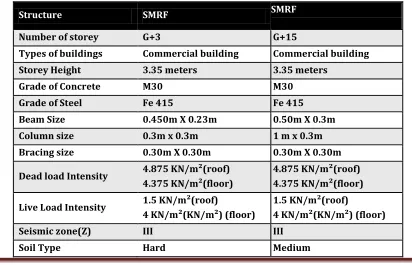
The data shown in the side table are considered same for all the models shown in figure. All mentioned data for RCC buildings is analysed as per Indian code which are IS:456-2000 and IS: 875-1987. The seismic load and response spectrum analysis of different models are carried out using STAAD.Pro. V8i. The load combinations considered in seismic analysis are done as per Indian code which is IS:1893-2002.
1. Moment resisting frame (MRF)
[image:2.612.98.510.467.732.2]2. RCC Building with X bracing system (XBF) 3. RCC Building with V bracing system (VBF) 4. RCC Building with Diagonal bracing system (DBF)
Table 1 Structure Parameter
Structure SMRF SMRF
Number of storey G+3 G+15
Types of buildings Commercial building Commercial building
Storey Height 3.35 meters 3.35 meters
Grade of Concrete M30 M30
Grade of Steel Fe 415 Fe 415
Beam Size 0.450m X 0.23m 0.50m X 0.3m
Column size 0.3m x 0.3m 1 m x 0.3m
Bracing size 0.30m X 0.30m 0.30m X 0.30m
Dead load Intensity 4.875 KN/m²(roof) 4.375 KN/m²(floor)
4.875 KN/m²(roof) 4.375 KN/m²(floor) Live Load Intensity 1.5 KN/m²(roof)
4 KN/m²(KN/m²) (floor)
1.5 KN/m²(roof)
4 KN/m²(KN/m²) (floor)
Seismic zone(Z) III III
© 2019, IRJET | Impact Factor value: 7.211 | ISO 9001:2008 Certified Journal
| Page 1799
2.1.1 Modeling in STAAD.Pro. V8i version 5:
a) MRF b) X Bracing
© 2019, IRJET | Impact Factor value: 7.211 | ISO 9001:2008 Certified Journal
| Page 1800
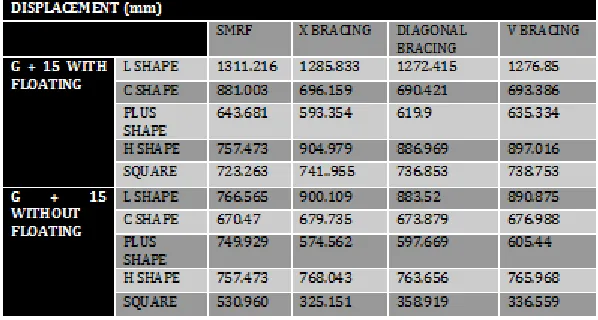
3) Result and Discussions: [image:4.612.156.455.161.321.2] Storey displacement: -
Table for Maximum Displacement
Axial Force: -
Table for Maximum Axial Force
Base Shear: -
Table for Maximum Base Shear
AXIAL FORCE (KN)
SMRF X BRACING DIAGONAL
BRACING V BRACING G + 15 WITH
FLOATING L SHAPE C SHAPE 1415.319 833.556 1202.805 1412.732 1246.901 1427.401 1208.371 1401.128 PLUS
© 2019, IRJET | Impact Factor value: 7.211 | ISO 9001:2008 Certified Journal
| Page 1801
From the above tables it is observed that the displacement is considerably decreased and axial force resistance and base shear are considerably increased after provision of bracing systems. It is also observed that X bracing system is more superior than other two types of bracing systems.[4] Conclusions: -
In this paper, the different types of bracing system are checked in RCC Buildings during earthquake and then compared a base shear and storey displacement. The following conclusions are made:
A Base Shear of the building with bracing system is increased as compared to buildings without bracing system.
The Storey Displacement is reduced in buildings after providing a bracing system.
The X braced system give a well performance as compared to the v braced and diagonal braced system.
After analysis we find that storey displacement is considerably increased after provision of floating column.
From the results we find that square shape and plus shape are more superior than other shapes.
After provision of bracing system, we can eliminate the columns which are hindering in open space in low rise structures.
[5] Reference: -
- Ali Hemmati & Ali Kheyroddin “Behavior Of Large-Scale Bracing System In Tall Buildings Subjected To Earthquake Loads” Journal of Civil Engineering and Management,[2013]
- A Rahimi, Mahmoud R.Maheri “The effects of retrofitting RC frames by X-bracing on the seismic performance of columns” Engineering Structures173 813–830,[2018]
- FelixC. Blebo and David A. Roke “Seismic- Resistant Friction- Damped Braced Frame System with Buckling Restrained Columns” Structures Congress ,[2015]
- K.K. Wijesundara1, G.A. Rassathi, R.Nascimbene and D. Bolognini “Seismic Performanceof Brace, Beam & Column Connections in Concentrically Braced Frames” Structures Congress,[2010]
- Maryam Boostani,Omid Rezaifar, Majid Gholhaki “Introduction and seismic performance investigation of the proposed lateral bracing system called OGrid” archives of civil and mechanical engineering18 1024 – 1041,[2018]
- R. Montuori, E. Nastri ,V. Piluso “Influence of the bracing scheme on seismic performances of MRF-EBF dual systems” Journal of Constructional Steel Research132 179–190, [2017]
- R. Montuori, E. Nastri ,V. Piluso “The influence of moment resisting beam-to-column connections on seismic behavior of chevron concentrically braced frames” Soil Dynamics and Earthquake Engineering113 136–147,[2018]
-G + 15
WITHOUT FLOATING
L SHAPE 1205.377 1619.609 1600.076 1579.906 C SHAPE 1309.922 1366.27 1378.998 1354.045 PLUS