RESEARCH
Biosynthesis of phlorisovalerophenone
and 4-hydroxy-6-isobutyl-2-pyrone
in
Escherichia coli
from glucose
Wei Zhou
1,2,3, Yibin Zhuang
1,2, Yanfen Bai
1,2,3, Huiping Bi
1,2*, Tao Liu
1,2*and Yanhe Ma
1Abstract
Background: Type III polyketide synthases (PKSs) contribute to the synthesis of many economically important natural products, which are typically produced by direct extraction from plants or synthesized chemically. For exam-ple, humulone and lupulone (Fig. 1a) in hops (Humulus lupulus) account for the characteristic bitter taste of beer and display multiple pharmacological effects. 4-Hydroxy-6-methyl-2-pyrone is a precursor of parasorboside contributing to insect and disease resistance of plant Gerbera hybrida, and was recently demonstrated to be a potential platform chemical.
Results: In this study, we achieved simultaneous biosynthesis of phlorisovalerophenone, a key intermediate of humulone biosynthesis and 4-hydroxy-6-isobutyl-2-pyrone in Escherichia coli from glucose. First, we constructed a biosynthetic pathway of isovaleryl-CoA via hydroxy-3-methylglutaryl CoA followed by dehydration, decarboxylation and reduction in E. coli. Subsequently, the type III PKSs valerophenone synthase or chalcone synthase from plants were introduced into the above E. coli strain, to produce phlorisovalerophenone and 4-hydroxy-6-isobutyl-2-pyrone at the highest titers of 6.4 or 66.5 mg/L, respectively.
Conclusions: The report of biosynthesis of phlorisovalerophenone and 4-hydroxy-6-isobutyl-2-pyrone in E. coli adds a new example to the list of valuable compounds synthesized in E. coli from renewable carbon resources by type III PKSs.
Keywords: Isovaleryl-CoA, Phlorisovalerophenone, 4-Hydroxy-6-isobutyl-2-pyrone, Valerophenone synthase, Escherichia coli
© 2016 The Author(s). This article is distributed under the terms of the Creative Commons Attribution 4.0 International License (http://creativecommons.org/licenses/by/4.0/), which permits unrestricted use, distribution, and reproduction in any medium, provided you give appropriate credit to the original author(s) and the source, provide a link to the Creative Commons license, and indicate if changes were made. The Creative Commons Public Domain Dedication waiver (http://creativecommons.org/ publicdomain/zero/1.0/) applies to the data made available in this article, unless otherwise stated.
Background
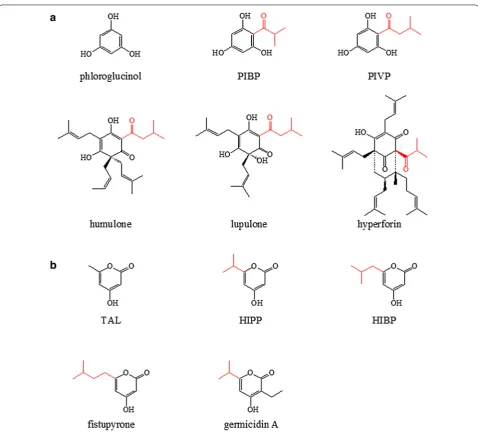
A large number of natural products are synthesized by type III polyketide synthases (PKSs). These compounds play an important role in human nutrition and health, and have recently expanded their roles as platform chem-icals. Acylphloroglucinol derivatives have been isolated from a number of plants [1–3]. Their chemical struc-tures and intriguing biological activities have attracted increasing attention in recent years. Humulone and lupu-lone (Fig. 1a) in hops (Humulus lupulus) account for the characteristic bitter taste of beer and display multiple
pharmacological effects [4]. Hyperforin (Fig. 1a) is one of the main active constituents in extracts of Hypericum perforatum used for the treatment of depression [5]. The 4-hydroxy-2-pyrone analogues display multiple biological activities and are valuable pharmaceutical precursors [6]. 4-Hydroxy-6-methyl-2-pyrone, also known as triacetic acid lactone (TAL, Fig. 1b) is a precursor of gerberin and parasorboside, which could protect Gerbera hybrid from fungal pathogens and attack by insects [7]. Fistupy-rone (4-hydroxy-6-isovaleryl-2-pyFistupy-rone) (Fig. 1b) was isolated from Streptomyces sp. TP-A0569 and showed inhibition of the infection of Chinese cabbage by a fun-gus Alternaria brassicicola [8]. Germicidin homologs (Fig. 1b) arisen from streptomyces inhibit spore ger-mination and Na+/K+ ATPase [9, 10]. More recently,
Open Access
*Correspondence: [email protected]; [email protected] 1 Tianjin Institute of Industrial Biotechnology, Chinese Academy of Sciences, Tianjin 300308, China
4-hydroxy-2-pyrones were reported to be potential plat-form chemicals (Additional file 1: Figure S1a) [11–13].
Advances in synthetic biology and metabolic engineer-ing greatly promoted biosynthesis of a variety of valuable compounds, for instance, flavonoids produced by type III PKSs [14, 15] in microbial hosts. Biological production of phloroglucinol (Fig. 1a) and TAL (Fig. 1b) from glu-cose has also been accomplished using genetically modi-fied microorganisms [6, 16–19]. However, biosynthesis of acylphloroglucinols and TAL analogues from renew-able feedstocks in Escherichia coli has not been well investigated.
The acylphloroglucinol cores, phlorisovalerophenone (PIVP) and phlorisobutyrophenone (PIBP) are formed by condensation of three malonyl-CoA-derived acetate units with isovaleryl-CoA or isobutyryl-CoA as the starter units [4, 20]. The enzyme valerophenone synthase (VPS) involved in the formation of PIVP in the biosynthesis of humulone has been characterized [21–23]. VPS is a homologue of chalcone synthase (CHS). They share the same reaction mechanism namely claisen condensation, but differ in substrate specificity. CHS catalyzes conden-sation of one molecule of p-coumaroyl-CoA and three molecules of malonyl-CoA to form naringenin-chalcone.
Fig. 1 Examples of phloroglucinols (a) and 2-pyrones (b) synthesized by type III PKS. PIBP phlorisobutyrophenone; PIVP phlorisovalerophenone; TAL
However, VPS preferentially uses isovaleryl-CoA or isobutyryl-CoA instead of p-coumaroyl-CoA as the starter unit to condense with three molecules of malo-nyl-CoA to form PIVP [21, 23]. Recently, dual functional CHS/VPS have also been reported. A CHS, FvCHS2-1 from strawberry (Fragaria vesca) was identified to be responsible for acylphloroglucinols synthesis in straw-berry fruit [3]. Intriguingly, in vitro experiments demon-strated that type III PKSs such as VPS and CHS usually also synthesize TAL analogues, 4-hydroxy-6-isobutyl-2-pyrone (HIBP) and 4-hydroxy-6-isopropyl-4-hydroxy-6-isobutyl-2-pyrone (HIPP) (Fig. 1b), carrying isobutyl or isopropyl at posi-tion 6 with isovaleryl-CoA or isobutyl-CoA as the starter unit and malonyl-CoA as the extender unit.
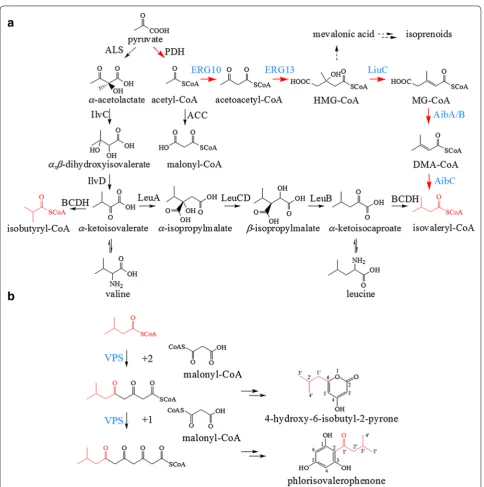
In this work, we engineered the synthesis of isovaleryl-CoA in E. coli by recruiting a biosynthetic pathway via hydroxy-3-methylglutaryl CoA (HMG-CoA), an inter-mediate of the mevalonate pathway (Fig. 2a) [24]. The VPS from hops (Humulus lupulus) HlVPS, the CHS from strawberry (Fragaria vesca) FvCHS2-1 and a newly cloned CHS from H. perforatum HpCHS were intro-duced into the isovaleryl-CoA producing E. coli strain separately, led to the simultaneous production of PIVP and HIBP at different ratios. The highest titers of PIVP and HIBP produced by the recombinant strains reached 6.4 and 66.5 mg/L, respectively. This work adds new products to the list of valuable compounds biosynthe-sized in E. coli using type III PKSs and lays a foundation for microbial synthesis of not only acylphloroglucinol derivatives, but also potential platform chemicals.
Methods
Strains, plasmids and medium
Strains and plasmids used in this study are listed in Table 1. Luria–Bertani (LB) medium was used for the propagation of E. coli cells for plasmid construction. Ter-rific Broth (TB) medium (12 g/L tryptone, 24 g/L yeast extract, 4 mL/L glycerol, 2.3 g/L KH2PO4, and 12.5 g/L K2HPO4) and modified M9 medium (1 × M9 minimal salts, 20 g/L glucose, 10 g/L yeast extract, 2 mM MgSO4, and 0.1 mM CaCl2) were used for protein expression and PIVP production, respectively. Ampicillin (100 mg/L) and streptomycin (100 mg/L) were added to the medium as needed.
Construction of plasmids
Oligonucleotide primers used in this study are sum-marized in Additional file 1: Table S1. AibA, aibB, aibC and liuC were PCR-amplified from Myxococcus xanthus (CGMCC 1.3865) genome with primer pairs aibA-F/ aibA-R, aibB-F/aibB-R, aibC-F/aibC-R or liuC-F/liuC-R, respectively. The amplified gene products of aibA, aibB and aibC were digested with restriction enzyme and
simultaneously subcloned into the multiple cloning sites (MCS) 1 of pETDuet-1 by Golden Gate [25] clon-ing usclon-ing AarI. Subsequently, the gene product of liuC was digested and ligated into the above resulting plas-mid using HindIII/AflII to yield the final plasmid pET-A. Here, the sequences of T7 promoter, lac operator and ribosome binding site (RBS) from pETDuet-1 were incorporated into the primer design, so each gene was driven by a single T7 promoter. ERG10 and ERG13 were PCR-amplified from Saccharomyces cerevisiae BY4742 genome with primer pairs ERG10-F/ERG10-R or ERG13-F/ERG13-R, respectively. First, the ERG13 fragment was digested and cloned into NcoI/BamHI sites of pCDF-Duet-1. The ERG10 fragment was digested and ligated into the above plasmid via NdeI/XhoI sites, generating the recombinant plasmid pCDF-E. The HlVPS gene from hops (GenBank: AB015430.1) was codon optimized for expression in E. coli and synthesized by Shanghai Gen-eray Biotech Co., Ltd. (Shanghai, China), designated as HlVPSsyn (Additional file 1: Table S2). HlVPSsyn was
PCR-amplified with primer pair VPS-F/VPS-R, and cloned into pET28a through NdeI/AflII sites generat-ing the intermediate expression vector pET28a-HlVPS. The T7-HlVPSsyn fragment with a T7 promoter and an
N-terminal His tag was PCR-amplified from pET28a-HlVPS with primer pair T7VPS-F/T7VPS-R, digested and ligated into pCDF-E via NotI/AflII to generate the final recombinant plasmid pCDF-EV1. FvCHS2-1 from strawberry (GenBank: XM_004306495.1) was codon optimized for expression in E. coli and synthesized by Shanghai Generay Biotech Co., Ltd. (Shanghai, China), designated as FvCHS2-1syn (Additional file 1: Table S2).
HpCHS was obtained from the mRNA of H. perforatum by RT-PCR. RNA of H. perforatum callus was isolated by RNAprep pure Plant Kit from Tiangen Biotech Co., Ltd. (Beijing, China). Reverse transcription was performed using the First Strand cDNA Synthesis Kit from Toyobo Co., Ltd. (Osaka, Japan). PCR reactions were performed using High Fidelity PCR system (Fermentas, Germany) with primer pair HpCHS-F/HpCHS-R. The HpCHS sequence was submitted into NCBI database (GenBank: KU180217). FvCHS2-1syn and HpCHS were ligated into
E individually using the same method as pCDF-EV1 construction, yielding pCDF-EV2 and pCDF-EV3, respectively.
Biosynthesis of isovaleryl‑CoA in E. coli
cultivated at 37 °C, 200 rpm with shaking. When OD600 of the culture reached 0.6, 0.1 mM isopropyl-β-D-thiogalactoside (IPTG) was added to induce recombinant
protein expression at 30 °C for 12 h. Subsequently, the cells were centrifuged (4000 rpm, 30 °C, 10 min), washed and resuspended in 50 mL modified M9 medium and
Fig. 2 The biosynthetic pathway of phlorisovalerophenone (PIVP) and 4-hydroxy-6-isobutyl-2-pyrone (HIBP) constructed from glucose in E. coli. a The biosynthetic pathway of isovaleryl-CoA. Red arrows represent the constructed isovaleryl-CoA biosynthetic pathway via HMG-CoA followed by dehydration, decarboxylation and reduction. Black arrows represent the biosynthesis of isovaleryl-CoA catalyzed by the BCDH complex. Dotted arrows represent the mevalonate-dependent pathway of isoprenoid. b The formation of PIVP and HIBP catalyzed by VPS. PDH pyruvate dehydro-genase complex, ACC acetyl-CoA carboxylase, ERG10 acetyl-CoA acetyltransferase, ERG13 HMG-CoA synthase, LiuC HMG-CoA dehydratase, AibA/B
MG-CoA decarboxylase, AibC DMA-CoA reductase, Als acetolactate synthase, IlvC ketol-acid reductoisomerase, IlvD dihydroxy-acid dehydratase, LeuA
cultured at 30 °C for 3 h. The cell culture was chilled on ice for 10 min. Cells were harvested by centrifugation (4000 rpm, 4 °C, 10 min) and resuspended in 1.5 mL extraction buffer (methanol:acetonitrile:water = 2:2:1,
v/v, with 0.1 % formic acid). After sonication and centrif-ugation, 50 μL of the supernatants were used for HPLC and LC–MS analysis.
Biosynthesis of PIVP and HIBP in E. coli
Escherichia coli strain BL21 (DE3) was transformed with plasmids pET-A and pCDF-EV1, pET-A and pCDF-EV2 or pET-A and pCDF-EV3 to generate the recombinant strains APG-1, APG-2 or APG-3, respectively. Two stage fermentation processes were applied to achieve the pro-duction of PIVP and HIBP. The first stage is for pathway genes overexpression, and recombinant strains were cul-tivated in TB medium. Single colonies were cultured in 3 mL LB medium with antibiotics at 37 °C for 7 h as seed culture, 1 mL of which was transferred into 50 mL TB medium with antibiotics and cultured in a shake flask at 37 °C until an OD600 of 1.2 followed by addition of 0.1 mM IPTG. To determine optimal temperature for fermentation conditions at the stage, the culture was incubated at 16, 23 or 30 °C for 16 h. Different concen-trations of IPTG (0.01, 0.05, 0.1, 0.2 or 0.3 mM) were also added in the TB medium to determine the opti-mal concentrations. The cell pellets were harvested by
centrifugation and resuspended in an equal volume of modified M9 medium and fermented at 30 °C, 200 rpm for secondary metabolite production as the second stage. Time course for production of PIVP and HIBP by strain APG-1 was determined for 12, 24, 36, 48 and 60 h. Subsequently, the culture broth was centrifuged at 4000 rpm for 10 min. The supernatants were extracted with an equal volume of ethyl acetate twice, concen-trated by rotary evaporator, and re-dissolved in 1.5 mL methanol. To extract the intracellular metabolites, cell pellets were resuspended in 10 mL 80 % acetone, soni-cated, centrifuged and the supernatant was evaporated to remove the acetone. The procedure was repeated once. Subsequently, the remaining water phase was also extracted with an equal volume of ethyl acetate twice and re-dissolved in 1.5 mL methanol as the supernatant of the fermented broth. Then 20 µL extraction samples of the fermentation broth or the cell pellets were ana-lyzed by HPLC–MS separately.
Compounds purification
2 L fermentation broth of the recombinant strain APG-1 was centrifuged to separate into supernatant and cell pellets. After crude extraction using the above protocol, purification of HIBP and PIVP was conducted by semi-preparative HPLC performed on a Shimadzu LC-6 AD with SPD-20A detector. The HPLC conditions were as follows: solvent A = H2O; solvent B = methanol; flow rate: 4 mL/min, 0–5 min 90 % A and 10 % B, 6–40 min 90 % A and 10–100 % B (linear gradient), 41–45 min 100 % B. A YMC-pack ODS-A (10 × 250 mm; particle size, 5 μm) was used as the stationary phase.
Chemical analysis and quantification
HPLC–MS was performed on an Agilent 1260 system with 1260 Infinity UV detector and a Bruker microQ-TOF II mass spectrometer equipped with an ESI ioni-zation probe. The innoval C18 column (4.6 × 250 mm; 5 μm particle size) was used in this study. The HPLC con-ditions for isovaleryl-CoA, HIBP and PIVP were as fol-lows: solvent A = H2O (containing 20 mM ammonium acetate for the analysis of isovaleryl-CoA, or containing 0.1 % formic acid for the analysis of HIBP and PIVP); solvent B = methanol; flow rate = 1 mL/min; 0–5 min 95 % A and 5 % B, 6–45 min 95 % A and 5 % B to 100 % B (linear gradient). All these products were detected at 254 nm. Standard calibration curve of isovaleryl-CoA was generated with a series of known concentrations of the isovaleryl-CoA standard purchased from Sigma-Aldrich (Milwaukee, WI, USA). Standard calibration curves of HIBP and PIVP were generated with a series of known concentrations of the purified compounds from large scale fermentation. All experiments were carried
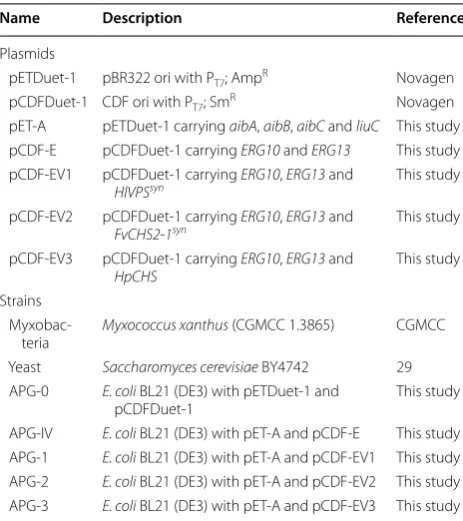
Table 1 Bacterial strains and plasmids
CGMCC China general microbiological culture collection center
Name Description Reference
Plasmids
pETDuet-1 pBR322 ori with PT7; AmpR Novagen
pCDFDuet-1 CDF ori with PT7; SmR Novagen
pET-A pETDuet-1 carrying aibA, aibB, aibC and liuC This study pCDF-E pCDFDuet-1 carrying ERG10 and ERG13 This study pCDF-EV1 pCDFDuet-1 carrying ERG10, ERG13 and
HlVPSsyn This study
pCDF-EV2 pCDFDuet-1 carrying ERG10, ERG13 and
FvCHS2-1syn This study
pCDF-EV3 pCDFDuet-1 carrying ERG10, ERG13 and
HpCHS This study
Strains
Myxobac-teria Myxococcus xanthus (CGMCC 1.3865) CGMCC Yeast Saccharomyces cerevisiae BY4742 29 APG-0 E. coli BL21 (DE3) with pETDuet-1 and
pCDFDuet-1 This study
out in triplicate and repeated at least twice. The titer was presented as mean ± SD.
NMR analysis
NMR experiments were performed on a Bruker Avance 400 (Karlsruhe, Germany). The sample were dried by evaporation and dissolved in 500 µL of DMSO-d6 and transferred into 2.5 mm NMR tube. Chemical shifts were expressed in δ (ppm) and coupling constants (J) were given in Hertz (Hz) (Additional file 1: Figure S2).
HIBP 1H-NMR (DMSO-d
6, 400 MHz) δ 5.94 (d,
J = 2.1 Hz, 1H), 5.21 (d, J = 2.1 Hz, 1H), 2.30 (d, J = 7.2 Hz, 2H), 1.93 (m, 1H), 0.89 (d, J = 6.6 Hz, 6H);
PIVP1H-NMR (DMSO-d
6, 400 MHz), δ 5.79 (s, 2H), 2.86 (d, J = 6.8 Hz, 2H), 2.13 (m, 1H), 0.91 (d, J = 6.7 Hz, 6H).
Results
Engineered synthesis of isovaleryl‑CoA in E. coli
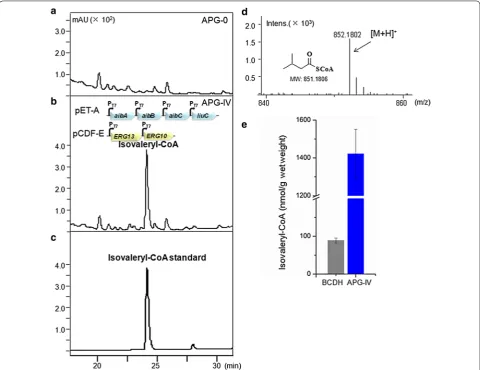
First, we generated isovaleryl-CoA in E. coli cells employing a pathway from M. xanthus via hydroxy-3-methylglutaryl CoA (HMG-CoA), a key intermediate of mevalonate pathway in the biosynthesis of isopre-noids [24]. Short branched-chain acyl-CoAs are usu-ally derived from the branched-chain amino acids as a mixture via transamination and subsequent oxida-tive decarboxylation catalyzed by the branched-chain α-keto acid dehydrogenase complex (BCDH) [26]. In current work, acetyl-CoA is converted into HMG-CoA as in the mevalonate pathway (Fig. 2a). Enzymes ERG10 (acetyl-CoA acetyltransferase) and ERG13 (HMG-CoA synthase) from S. cerevisiae were used for efficient bio-synthesis of HMG-CoA, as these two enzymes yielded enhanced levels of mevalonate in E. coli [27–29]. The three enzymes from M. xanthus, including LiuC (HMG-CoA dehydratase), AibA/B (3-methylglutaconyl-(HMG-CoA (MG-CoA) decarboxylase) and AibC (3,3-dimethylacry-lyl CoA (DMA-CoA) reductase), were used to transform HCoA into isovaleryl-CoA consecutively via MG-CoA and DMA-MG-CoA in the above E. coli strain (Fig. 2a). Acyl-CoAs were extracted from the engineered E. coli strain APG-IV harboring pET-A and pCDF-E and ana-lyzed by HPLC–MS with strain APG-0 harboring pET-Duet-1 and pCDFpET-Duet-1 as the negative control (Fig. 3). This procedure confirmed the production of isovaleryl-CoA by comparing the retention time (tR = 24.5 min)
and the molecular ion [(M + H)+ = 852.1802] with those of the isovaleryl-CoA standard (Fig. 3b, c). The titer of isovaleryl-CoA from this new pathway was 1421.8 ± 129.2 nmol/g wet weight, about sixteen times higher than the titer of our previous engineered E. coli strain using the BCDH complex under the same fermen-tation and detection conditions (Fig. 3d) [26].
Engineered synthesis of PIVP and HIBP in E. coli carrying HlVPSsyn and optimization of fermentation conditions
The HlVPSsyn from hops was synthesized and
intro-duced into the isovaleryl-CoA producing E. coli strain, generating the recombinant strain APG-1. After fer-mentation, the broth supernatants and cell pellets were analyzed by HPLC–MS. As shown in the chromato-gram, the recombinant strain APG-1 produced two new compounds (Fig. 4c, d), compared with the control strain APG-0 (Fig. 4a, b). The first compound with a tR
of 35.6 min was initially identified as HIBP by LC–MS (Additional file 1: Figure S2a, c; [M + H]+ = 169.0763).
In the previous enzymatic studies, the production of HIBP was confirmed only by LC–MS analysis probably due to no enough products for NMR analysis [3, 23]. In this work, about 74.9 mg HIBP was isolated from 2 L scale culture, and we were able to confirm the structure by 1D-NMR spectroscopy analysis (Additional file 1: Figure S2a, c). The second product with a tR of 39.7 min
was identified as PIVP (Additional file 1: Figure S2b, [M + H]+ = 211.0925). About 6.5 mg HIBP was isolated
from 2 L culture, and the PIVP structure was further con-firmed by 1H-NMR spectroscopy analysis (Additional file 1: Figure S2d). The localization of the two products was also tested. PIVP mainly accumulated in the cell pel-lets (Fig. 4c), while HIBP was distributed in the fermenta-tion broth as well as the cell pellets (Fig. 4c, d).
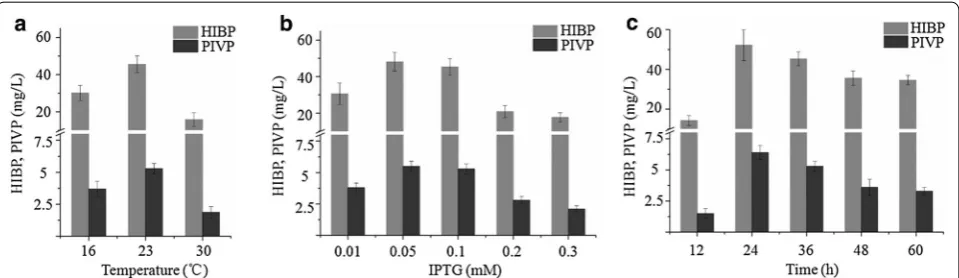
We further optimized the production of PIVP and HIBP by varying fermentation conditions for the recom-binant strain APG-1 such as temperature and IPTG concentration at the first stage. The recombinant strain APG-1 was incubated in TB medium for 16 h at varying temperature (16, 23 or 30 °C) with a fixed IPTG concen-tration of 0.1 mM. The cell pellets were harvested and resuspended in modified M9 medium and incubated at 30 °C for 36 h. Combining both the fermentation broth and cell pellets, the titerss of PIVP and HIBP exhibited best at 23 °C (Fig. 5a). After that, different concentra-tions of IPTG, 0.01, 0.05, 0.1, 0.2 and 0.4 mM were used to induce protein expression at 23 °C. The titers of PIVP and HIBP were highest when the concentration of IPTG was 0.05 mM as shown in Fig. 5b. Furthermore, we moni-tored titers of PIVP and HIBP produced by APG-1 culti-vated in modified M9 medium at different fermentation time. The results are summarized in Fig. 5c. The titers of HIBP and PIVP reached the highest in 24 h, which were 52.0 ± 7.9 and 6.4 ± 0.6 mg/L, respectively. Under these
concentrations, no inhibition on cell growth by the com-pounds HIBP and PIVP was observed.
Biosynthesis of HIBP and PIVP in E. coli using CHSs
enzyme [3]. We performed codon optimization for the FvCHS2-1 gene, synthesized and introduced the FvCHS2-1syn into the isovaleryl-CoA producing E. coli strain, generating APG-2 and fermented under the opti-mized conditions. The protein expression was induced at 23 °C for 16 h with 0.05 mM IPTG, and then the fermen-tation was conducted in modified M9 medium at 30 °C for 24 h. HPLC analysis showed that the strain APG-2 also produced HIBP and PIVP, although the titer of PIVP was much lower than that carrying HlVPSsyn, only
1.4 ± 0.2 mg/L (Fig. 4e, f, j). However, the titer of HIBP
reached 53.3 ± 9.0 mg/L, which was similar to that of the
strain harboring HlVPSsyn (Fig. 4i).
VPS was involved in the formation of PIVP in the bio-synthesis of humulone and could also produce PIPB using isobutyryl-CoA as the starter unit [21–23]. PIBP
is the core structure of hyperforin, an antidepressant extracted from Hypericum species. The enzyme catalyz-ing formation of PIBP is still unknown. It was assumed that there may be a VPS-like or dual functional CHS/VPS enzyme in the Hypericum species responsible for the for-mation of PIBP, and more than likely, this enzyme could also use isovaleryl-CoA as the starter molecular to form PIVP and HIBP. Based on the reported type III PKSs gene sequences of the Hypericum species [30] in the NCBI database, several candidate genes were amplified from the callus of H. perforatum by homology cloning. Among these genes, a suspected CHS gene showing 96.2 % simi-larity with FvCHS2-1 at the amino acid level was desig-nated as HpCHS (GenBank: KU180217), and introduced into the above isovaleryl-CoA producer. The recombi-nant E. coli strain APG-3 harboring the isovaleryl-CoA
pathway genes and HpCHS was fermented as described above. The HIBP titer produced by this strain reached 66.5 ± 13.1 mg/L, which was the highest among all the three producers (Fig. 4g–i). The PIVP titer in APG-3 was 2.8 ± 0.5 mg/L, which was lower than that of the APG-1 harboring HlVPSsyn (Fig. 4g, h, j).
Discussion
Short branched-chain acyl-CoAs are important build-ing blocks for a large number of valuable compounds [5, 24, 31]. However, native E. coli metabolism does not produce these short branched-chain acyl-CoAs, which hampers the heterologous production of those eco-nomically important chemicals in this host. Previously engineered short branched-chain acyl-CoA producing E. coli strains usually biosynthesized isobutyryl-CoA, isovaleryl-CoA and 2-methyl-butyryl-CoA as a mixture derived from the metabolic pathways of branched-chain amino acids catalyzed by the BCDH complex [26, 32, 33]. In this study, we successfully demonstrated the feasibility of synthesizing isovaleryl-CoA in E. coli via HMG-CoA (Fig. 2a) recruiting five enzymes from yeast and myxo-bacteria [24]. Isovaleryl-CoA was the only product in this pathway which makes the engineered E. coli strain more suitable for producing compounds such as humu-lone and lupuhumu-lone with isovaleryl-CoA as the building block. In the BCDH dependent pathway, isovaleryl-CoA and isobutyryl-CoA are derived from α-ketoisocaproate
or α-ketoisovalerate directly, and α-ketoisovalerate is an intermediate for the formation of α-ketoisocaproate. Thus the formation of isobutyryl-CoA competes with isovaleryl-CoA in the pathway (Fig. 2a). Meanwhile short branched-chain keto acids would also be transformed into corresponding amino acids such as leucine, isoleu-cine and valine beyond acyl-CoAs (Fig. 2a). HMG-CoA formation with ERG10 and ERG13 derived from acetyl-CoA has been well established in the mevalonate pathway (Fig. 2a) in E. coli [27–29]. By recruiting LiuC, AibA/B and AibC, the HMG-CoA was further uniquely diverted into the formation of isovaleryl-CoA via MG-CoA and DMA-CoA. This engineered strain represents a novel “factory” for biosynthesis of a series of valuable chemicals with isovaleryl-CoA as the building block, including fatty acids, biofuels and natural products [26, 32, 33].
Introduction of VPS from hops, CHSs from strawberry or H. perforatum to the above isovaleryl-CoA produc-ing E. coli strain resulted in the biosynthesis of PIVP and HIBP. PIVP was detected in hop extracts [34], and is the key intermediate of humulone, which contribute the characteristic bitter flavor of beer and display multiple pharmacological effects [4, 31]. The work described here may pave the way for synthesis of humulone and other derivatives. HIBP has not been isolated from any natural resources [11–13]. As an analogue of TAL, HIBP could be used as a potential platform chemical to produce vari-ous chemical intermediates and end products with short
Fig. 5 Optimization of fermentation conditions. a The titers of PIVP and HIBP by strain APG-1 at different protein induction temperature. b The titers of PIVP and HIBP by strain APG-1 at different IPTG concentration. c The titers of PIVP and HIBP by strain APG-1 at different fermentation time (See figure on previous page.)
Fig. 4 Engineered synthesis of 4-hydroxy-6-isovaleryl-2-pyrone (HIBP) and phlorisovalerophenone (PIVP) by E. coli strains. a, b Strain APG-0 harbor-ing empty vectors as negative control. c, d Strain APG-1 harborharbor-ing plasmids pET-A and pCDF-EV1. e, f Strain APG-2 harborharbor-ing plasmids pET-A and pCDF-EV2. g, h Strain APG-3 harboring plasmids pET-A and pCDF-EV3. a, c, e, g HPLC analysis of metabolites extracted from cell pellets.
branched-chains (Additional file 1: Figure S1a, b) [11–13,
35]. More experiments are needed to test whether HIBP itself has any antibacterial or fungicidal activity or not.
In this study, the VPS from hops was the best enzyme for PIVP formation. The newly cloned CHS from H. per-foratum was the most appropriate enzyme for the synthe-sis of HIBP. The ratios of HIBP and PIVP were calculated based on the titers produced by strains APG-1 (52.0 over 6.4 mg/L), APG-2 (53.3 over 1.4 mg/L) and APG-3 (66.5 over 2.8 mg/L), which were about 8:1, 37:1 and 24:1, respectively. In the in vitro enzyme activity analysis of HlVPS and FvCHS, PIVP was the major product, instead of HIBP [3, 22]. It was reported that the PIVP and HIBP content was affected by the relative ratio of isovaleryl-CoA/malonyl-CoA in the in vitro experiment [3]. In our recombinant E. coli, the production of isovaleryl-CoA and malonyl-CoA both derived from acetyl-CoA, and there may be a dynamic balance between the concentra-tion of isovaleryl-CoA and malonyl-CoA in vivo (Fig. 2a), which may affect the ratio of HIBP and PIVP.
Amino acids sequence alignment of HlVPS, FvCHS2-1 and HpCHS showed high similarity (Additional file 1: Figure S4). The three essential catalytic amino acids Cys-His-Asn, the active site loop of CHS enzymes GFGPG, and two Phe residues, important in determining the sub-strate specificity of CHS are all well conserved in these three proteins (Additional file 1: Figure S4). However, ratios between PIVP and HIBP produced by these three enzymes are quite different (Fig. 4). Several protein engi-neering studies have elucidated the basis of starter mol-ecule selectivity and the control of polyketide length of type III PKSs. For example, Jez and colleagues reported that a triple mutant (T197L/G256L/S338I) of CHS, gen-erated an enzyme that was functionally identical to 2-PS, catalyzing the synthesis of the TAL from an acetyl-CoA starter molecule and two malonyl-CoAs [36]. In 2005, Abe and co-workers reported that a point mutation (M207G) in a pentaketide chromone synthase (PCS) expanded the volume of the catalytic cavity, to con-vert PCS into octaketide synthase [37]. Thus, modeling analyses and site-directed mutagenesis experiments are needed to improve the product specificity and increase the synthesis of PIVP or HIBP.
Directed evolution may be also used to increase the activity of HlVPS, FvCHS2-1 or HpCHS. Using directed evolution, Rao and colleagues obtained a series of ther-mostable PhlD mutants with improved phloroglucinol productivity [19]. Recently, Tang and colleagues engi-neered the E. coli regulatory protein AraC to activate gene expression in response to TAL, developed an endog-enous TAL reporter system in E. coli. Using this system, they conducted in vivo directed evolution of 2-PS in E. coli, and obtained a 2-PS variant conferring ~20-fold
higher TAL production [6]. Similar reporter systems may also be constructed in our recombinant E. coli to facili-tate high throughput screening of HlVPS, FvCHS2-1 or HpCHS for improved productivity of HIBP or PIVP. At the same time, precursor supply including isovaleryl-CoA and malonyl-CoA may be improved for the production of HIBP and PIVP. The availability of intracellular malonyl-CoA may be enhanced by over-expressing the acetyl-malonyl-CoA carboxylase (Acc) and acetyl-CoA synthase (Acs) genes and deletion of competing pathways, which was applied in improving phloroglucinol productivity by engineered E. coli strain [19, 38]. In the case of HIBP and PIVP, as both substrates isovaleryl-CoA and malonyl-CoA were derived from acetyl-CoA, there may be a dynamic bal-ance between these two substrates and may need more elaborate regulation.
Conclusions
In this work, we firstly constructed a biosynthetic path-way of isovaleryl-CoA in E. coli by recruiting a route via hydroxy-3-methylglutaryl CoA, and then investigated the potential of bio-renewable production of PIVP and HIBP with E. coli as the host using type III PKSs. Even though still in infancy, the work described here may pave the way for microbial synthesis of not only acylphloroglucinols derivatives, but also “unnatural” TAL analogues.
Abbreviations
2-PS: 2-pyrone synthase; BCDH: branched-chain α-keto acid dehydrogenase complex; CHS: chalcone synthase; DMA-CoA: 3,3-dimethylacrylyl CoA; HIBP: 4-hydroxy-6-isobutyl-2-pyrone; HIPP: 4-hydroxy-6-isopropyl-2-pyrone; HMG-CoA: hydroxy-3-methylglutaryl CoA; IPTG: isopropyl-β-d-thiogalactoside; MG-CoA: 3-methylglutaconyl-CoA; PCS: pentaketide chromone synthase; PIBP: phlorisobutyrophenone; PIVP: phlorisovalerophenone; PKSs: polyketide synthases; TAL: triacetic acid lactone; VPS: valerophenone synthase.
Authors’ contributions
TL, HB, WZ, YZ, YB and YM designed the project. WZ, HB, YZ and YB performed the experiments. WZ, HB, YZ and TL analyzed the data. TL, HB, WZ and YZ wrote the manuscript. All authors read and approved the final manuscript.
Author details
1 Tianjin Institute of Industrial Biotechnology, Chinese Academy of Sciences, Tianjin 300308, China. 2 Key Laboratory of Systems Microbial Biotechnology, Chinese Academy of Sciences, Tianjin 300308, China. 3 University of Chinese Academy of Sciences, Beijing, China.
Acknowledgements None.
Additional file
Competing interests
The authors declare that they have no competing interests.
Availability of data and materials
Codon-optimized sequences generated in this project are listed in Additional file 1: Table S2. The HpCHS sequence was submitted into Genbank (http:// www.ncbi.nlm.nih.gov/) and the accession number was indicated in the “Methods” section.
Ethics approval and consent to participate
This manuscript dose not report data collected from humans or animals.
Funding
This work was supported by grants from the 973 Program of China
(2012CB721100), the National Natural Science Foundation of China (31300040 and 21302214).
Received: 20 June 2016 Accepted: 22 August 2016
References
1. Bohr G, Gerhauser C, Knauft J, Zapp J, Becker H. Anti-inflammatory acylphloroglucinol derivatives from Hops (Humulus lupulus). J Nat Prod. 2005;68:1545–8.
2. Crispin MC, Hur M, Park T, Kim YH, Wurtele ES. Identification and biosyn-thesis of acylphloroglucinols in Hypericum gentianoides. Physiol Plant. 2013;148:354–70.
3. Song C, Ring L, Hoffmann T, Huang FC, Slovin JP, Schwab W. Acylphloro-glucinol biosynthesis in strawberry fruit. Plant Physiol. 2015;15:00794. 4. Clark SM, Vaitheeswaran V, Ambrose SJ, Purves RW, Page JE.
Transcrip-tome analysis of bitter acid biosynthesis and precursor pathways in hop (Humulus lupulus). BMC Plant Biol. 2013;13:12.
5. Barnes J, Anderson LA, Phillipson JD. St John’s wort (Hypericum perfora-tum L.): a review of its chemistry, pharmacology and clinical properties. J Pharm Pharmacol. 2001;53:583–600.
6. Tang SY, Qian S, Akinterinwa O, Frei CS, Gredell JA, Cirino PC. Screening for enhanced triacetic acid lactone production by recombinant Escherichia coli expressing a designed triacetic acid lactone reporter. J Am Chem Soc. 2013;135:10099–103.
7. Eckermann S, Schroder G, Schmidt J, Strack D, Edrada RA, Helariutta Y, Elomaa P, Kotilainen M, Kilpelainen I, Proksch P, et al. New pathway to polyketides in plants. Nature. 1998;396:387–90.
8. Igarashi Y, Ogawa M, Sato Y, Saito N, Yoshida R, Kunoh H, Onaka H, Furu-mai T. Fistupyrone, a novel inhibitor of the infection of Chinese cabbage by Alternaria brassicicola, from Streptomyces sp. TP-A0569. J Antibiot (Tokyo). 2000;53:1117–22.
9. Petersen F, Zahner H, Metzger JW, Freund S, Hummel RP. Germicidin, an autoregulative germination inhibitor of Streptomyces viridochromogenes
NRRL B-1551. J Antibiot (Tokyo). 1993;46:1126–38.
10. Aoki Y, Matsumoto D, Kawaide H, Natsume M. Physiological role of germicidins in spore germination and hyphal elongation in Streptomyces coelicolor A3(2). J Antibiot (Tokyo). 2011;64:607–11.
11. Chia M, Schwartz TJ, Shanks BH, Dumesic JA. Triacetic acid lactone as a potential biorenewable platform chemical. Green Chem. 2012;14:1850–3. 12. Dumesic JA, Chia M. Production of 2,4-diones from
4-hydroxy-6-substituted-2-pyrones. 2013; United State Patent Application, No. 20120283477A1.
13. Schwartz TJ, O’Neill BJ, Shanks BH, Dumesic JA. ChemInform abstract: bridging the chemical and biological catalysis gap: challenges and out-looks for producing sustainable chemicals. ChemInform. 2014;45:2060–9. 14. Mora-Pale M, Sanchez-Rodriguez SP, Linhardt RJ, Dordick JS, Koffas MA.
Metabolic engineering and in vitro biosynthesis of phytochemicals and non-natural analogues. Plant Sci. 2013;210:10–24.
15. Trantas EA, Koffas MA, Xu P, Ververidis F. When plants produce not enough or at all: metabolic engineering of flavonoids in microbial hosts. Front Plant Sci. 2015;6:7.
16. Xie D, Shao Z, Achkar J, Zha W, Frost JW, Zhao H. Microbial synthesis of triacetic acid lactone. Biotechnol Bioeng. 2006;93:727–36.
17. Achkar J, Xian M, Zhao H, Frost JW. Biosynthesis of phloroglucinol. J Am Chem Soc. 2005;127:5332–3.
18. Cardenas J, Da Silva NA. Metabolic engineering of Saccharomyces cerevisiae for the production of triacetic acid lactone. Metab Eng. 2014;25:194–203.
19. Rao G, Lee J-K, Zhao H. Directed evolution of phloroglucinol synthase PhlD with increased stability for phloroglucinol production. Appl Micro-biol Biotechnol. 2013;97:5861–7.
20. Adam P, Arigoni D, Bacher A, Eisenreich W. Biosynthesis of hyperforin in
Hypericum perforatum. J Med Chem. 2002;45:4786–93.
21. Novák P, Matoušek J, Bříza J. Valerophenone synthase-like chalcone synthase homologues in Humulus lupulus. Biol Plant. 2003;46:375–81. 22. Okada Y, Ito K. Cloning and analysis of valerophenone synthase gene
expressed specifically in lupulin gland of hop (Humulus lupulus L.). Biosci Biotechnol Biochem. 2001;65:150–5.
23. Paniego NB, Zuurbier KW, Fung SY, van der Heijden R, Scheffer JJ, Ver-poorte R. Phlorisovalerophenone synthase, a novel polyketide synthase from hop (Humulus lupulus L.) cones. Eur J Biochem. 1999;262:612–6. 24. Li Y, Luxenburger E, Muller R. An alternative isovaleryl CoA biosynthetic
pathway involving a previously unknown 3-methylglutaconyl CoA decar-boxylase. Angew Chem Int Ed Engl. 2013;52:1304–8.
25. Engler C, Marillonnet S. Golden Gate cloning. Methods Mol Biol. 2014;1116:119–31.
26. Bi H, Bai Y, Cai T, Zhuang Y, Liang X, Zhang X, Liu T, Ma Y. Engineered short branched-chain acyl-CoA synthesis in E. coli and acylation of chloram-phenicol to branched-chain derivatives. Appl Microbiol Biotechnol. 2013;97:10339–48.
27. Martin VJ, Pitera DJ, Withers ST, Newman JD, Keasling JD. Engineering a mevalonate pathway in Escherichia coli for production of terpenoids. Nat Biotechnol. 2003;21:796–802.
28. Steen EJ, Chan R, Prasad N, Myers S, Petzold CJ, Redding A, Ouellet M, Keasling JD. Metabolic engineering of Saccharomyces cerevisiae for the production of n-butanol. Microb Cell Fact. 2008;7:36.
29. Zhu F, Zhong X, Hu M, Lu L, Deng Z, Liu T. In vitro reconstitution of meva-lonate pathway and targeted engineering of farnesene overproduction in Escherichia coli. Biotechnol Bioeng. 2014;111:1396–405.
30. Karppinen K, Hokkanen J, Mattila S, Neubauer P, Hohtola A. Octake-tide-producing type III polyketide synthase from Hypericum perfo-ratum is expressed in dark glands accumulating hypericins. FEBS J. 2008;275:4329–42.
31. Van Cleemput M, Cattoor K, De Bosscher K, Haegeman G, De Keukeleire D, Heyerick A. Hop (Humulus lupulus)-derived bitter acids as multipotent bioactive compounds. J Nat Prod. 2009;72:1220–30.
32. Atsumi S, Hanai T, Liao JC. Non-fermentative pathways for synthesis of branched-chain higher alcohols as biofuels. Nature. 2008;451:86–9. 33. Howard TP, Middelhaufe S, Moore K, Edner C, Kolak DM, Taylor GN, Parker
DA, Lee R, Smirnoff N, Aves SJ, Love J. Synthesis of customized petroleum-replica fuel molecules by targeted modification of free fatty acid pools in
Escherichia coli. Proc Natl Acad Sci USA. 2013;110:7636–41.
34. Zuurbier KWM, Fung S-Y, Scheffer JJC, Verpoorte R. Formation of aromatic intermediates in the biosynthesis of bitter acids in Humulus lupulus. Phytochemistry. 1995;38:77–82.
35. Burns MJ, Ronson TO, Taylor RJ, Fairlamb IJ. 4-Hydroxy-6-alkyl-2-pyrones as nucleophilic coupling partners in Mitsunobu reactions and oxa-Michael additions. Beilstein J Org Chem. 2014;10:1159–65.
36. Jez JM, Austin MB, Ferrer J, Bowman ME, Schroder J, Noel JP. Structural control of polyketide formation in plant-specific polyketide synthases. Chem Biol. 2000;7:919–30.
37. Abe I, Utsumi Y, Oguro S, Morita H, Sano Y, Noguchi H. A plant type III polyketide synthase that produces pentaketide chromone. J Am Chem Soc. 2005;127:1362–3.