https://dx.doi.org/10.22161/ijels.4.2.40 ISSN: 2456-7620
Enhancing Reflective Practice in Teaching
Language with Assistance of Information
Technology
Nguyen T. H. Thu
Hanoi Law University, Viet Nam
Abstract— With the reflective teaching approach, teachers are able to change students’ thinking way and learning style more positively and actively. English, as a result, will not be a constraint and certainly become a really big motivation for learning and personal professional development. It is conscious reflection on experience that is a pivotal factor to bring theory and practice closer effectively. In this paper, the writer will clarify benefits and challenges of using information technology in Reflective Practice to enhance sk ills for English major students and find out some technology-assisted strategies to support this. A set of questionnaire and open questions were administered among 60 students K42 majoring in English at Hanoi law university and 15 teachers from 3 universities in Viet Nam. The findings showed that Reflective Practice helped learners in solving their learning problems and learners were able to enhance four English sk ills with their conscious reflection. The respondents admitted that although they have the challenges in using information technology (IT) in reflective teaching, they can overcome them thank s to the strategies. The respondents were, moreover, of the opinion that reflective practice can mak e a lot of contribution to becoming a successful learner and to bringing improvement in the behavior of learners.
Keywords— Reflective practice, reflection, technology, reflective learning, reflective teaching.
I. INTRODUCTION
“Learning is not a spectator sport... They must talk about what they are learning, write reflectively about it, relate it to past experiences, and apply it to their daily lives.” Chickering & Gamson assert (1997, p.43). In essence, learning is a reflection of the experience. Through reflection a person is able to not just look on the past experience and its interpretation, but is take a deliberate look at what were learned in the past in order to reach a new understanding as well as deal with the problems in the best way. Teachers should consider the best model of
reflection to apply in teaching English effectively to boost their active learning and critical thinking. There are many different possible resources and materials to su pport the reflective approach. It is likely that individuals will have strong preferences for particular tools such as online resources including audio and video, mind map, blogs, google sites, wikis, Skype, iCloud and real materials consisting of portfolio, worksheets, storyboards, diaries. Teacher should give the students more opportunities to apply the reflection in the learning process in order to stimulate the creativity and ability to solve problems, to turn students themselves into their own actual teachers who are willing to learn from their mistakes and improve their practice to have a best result.
Thanks to the innovations in education, learning and teaching English has recently changed significantly from methodology to content, from perception to behavior with the aim of making teaching and learning more effective. Strategies and techniques of learning have also been created in order to bring about positive changes. Reflective practice (RP) might be supposed as one of the effective ways to orient students to a positive and active learning method which contributes an essential part to implementing the mission “three in one” of education: learning- practicing-assessing as well as to help students meet four skills “4Cs” of the 21st century education that have been identified by the United States -based Partnership for 21st Century Skills: critical thinking, communication, collaboration and creativity. Through reflection, teachers and students are able to take a conscious look at what they had performed in classroom in order to deal with the problems in the best way, then make suitable changes, which leads them to a new stage in learning process: learning basing on critical thinking capacity.
https://dx.doi.org/10.22161/ijels.4.2.40 ISSN: 2456-7620
responses to the problems is not really as good as expected. Besides, the frequent interactive learning from each others and cooperation in learning between teachers and students; between students and students is low. Thus, modern education needs to build a modern learning environment in which students have more chances to practice, assess and self-assess. In recent years, the development of information technology has brought about a lot of positive changes in methods of language teaching and made significant innovations in terms of educational quantity and quality. Reflective practice in teaching English has been, also, supported a lot and become a big motivation for teachers and learners. Today's technology tools are not just mechanical ones but essential teaching aids to enhance the education quality. Applying technology can help learners expand their learning experience by removing classroom walls, allowing the interaction and connectivity to enter a diverse learning environment. According to the study of Microsoft Asia EduTech Survey 2016 [1] based on a survey of nearly 200 teachers in the Asia Pacific region, Educational specialists asserted the importance of technology in transforming education with the innovative pedagogical strategies and motivated students with the significances: improving the learning experience in the classroom; enhancing effectiveness of teaching and helping students communicate better. Morgan, Seaman and Tinti-Kante [2] explored the application of social media for teaching, learning, and sharing at the university level and found that social media was an effective tool for collaboration and a great deal of support for teaching.
It is apparent that most teachers still hesitate to make a decision on using IT in RP in classroom with the doubt about the effectiveness and technological capacity . So, it is pedagogically pivotal to reflect on how these technology tools can be used to teach effectively. The key issue is not simply the uses of technology, but how technology supports effective reflective practices. There is a consensus that teachers should be aware of the reflective practices and methodologies that they choose to employ and to develop a set of reflective strategies to determine if these practices and methodologies are effective. Therefore, there is a need for more research about reflective teaching practice and using technology to reflect on teaching and learning to help teachers carry out technology-based reflection effectively. The barriers to using technologies for teaching and reflection were also identified. The purpose of this study was to inquire into benefits, challenges and strategies of using IT in reflective practice. More specifically, the following research questions will be under investigation:
1. What are the student and teacher’s perceptions of the impacts of reflective practice learning English and using technology in reflective practice?
2. What are the challenges and technology- assisted strategies of technology in reflective practice in classroom?
II. THEORETICAL FRAMEWORK Definition of Terms
The theory of reflective practice derived from Dewey’s work on reflective practice, in which John Dewey (1933, p.6) stated: “Active, persistent, and careful consideration of any belief or supposed form of knowledge in the light of the grounds that support it, and the further conclusions to which it tends…”. In the context of present study, reflection refers thinking of teachers and learners about their own class room practices, actions and results of their own actions during teaching process, after class or before class. Reflective practice refers to the active process of examining one’s own experiences to create opportunities for professional learning in teaching context. Self-efforts of prospective teachers and teacher educators to improve their own teaching practices or skills.
According to Woerkom, (2003),
reflection is a mental activity aimed at investigating one's own action in a certain situation and involving a review of the experience, an analysis of causes and effects, and the drawing of conclusions concerning future action. Mezirow (1990) understands reflection as an assessment of how or why we have perceived, thought, felt, or acted. Moon (2008) stated that critical thinking involves reflection, and reflection may likewise involve some critical th inking activities. In essence, reflection is an action -oriented internal learning process in which individuals:
• reflect on their prior experience
• achieve new insights and deeper understandings
• examine an inquiry thoroughly to plan action
https://dx.doi.org/10.22161/ijels.4.2.40 ISSN: 2456-7620
Significance of Reflection in Learning and Teaching
Reflection brings about a lot of benefits which makes learning more meaningful for students.Bauer, K. and Fisher, F. (2007) stated that reflection can shorten the research–practice gap, reduce the relevance of research findings to particular practices and classrooms. This is a valuable means which help students can adapt and fix their personal knowledge in to a large picture of current learning practical environment. Reflection contributes to “developing of critical thinking, problem-solving, and decision-making;” Rolheiser et al. (2000), as well as promotes student self-monitoring and self-regulation. Reflective practice is also considered as an effective way to move the learners and teachers beyond basic theories, lead them to a new horizon of new knowledge and great creation in perception and a new practice stage where they are able to modify their skills to suit specific contexts and situations, and eventually to invent new strategies (Larrivee, Barbara, 2000)
Peter Brown, (2014) reminds us that reflection involves rigorous processing that makes it more likely that students will be able to absorb, remember, and master what they are learning. It can enhance student interest and engagement in their learning and encourage students’ motivation and cognitive engagement. Last but not least, reflection is an optimal avenue for teachers to improve their teaching. Without reflection, teachers are not able to look objectively at their actions or take into account the emotions, experience, or consequences of actions to improve their practice.
Self-reflection facilitates teachers to learn: (i) How to slow down the influence of their own reasoning on their practices? (ii) Understanding of conscious ways to respond the students. (iii) Which personal beliefs influence their relations with students? And (iv) Why they showed intolerance in specific situations? (Larrivee & Cooper, 2006).
Many others any specific benefits of reflective practices have appeared in previous literature. Branch & Paranjape, (2002) have counted the following specific benefits o f reflective practices:
1. Better understanding of own strengths and weaknesses.
2. Identification of underlying values and beliefs. 3. Acknowledgment of possible challenges.
4. Understanding of possible assumptions on which teachers ideas, feelings and actions based.
5. Reorganization of areas of potential bias or discrimination.
6. Acknowledgement of professional fears.
7. Identification of possible inadequacies and areas need improvement.
(Branch & Paranjape, 2002).
Reflective teachers may get greater self-awareness about their teaching style and bring positive changes in their practices. Teachers can use reflective practice as a tool to evaluate their teaching practices by raising questions.
Smart Education in Industrial Evolution 4.0
Smart education offers learners additional opportunities to diversify the approaches to access the knowledge and skills with the assistance of IT systems. Smart classroom has been long associated with electronic functions of technological devices. Smart education represents the effectiveness of students in performing technical activities in various fields. Smart education is considered the application of information and communication technology (ICT) in knowledge acquisition and teaching methodology. Smart education is able to be performed in a virtual or physical learning environment or blended one. Smart education has addressed the pedagogical problems the traditional approach could not figure out. According to Smartness levels of Smart Learning Environment by Uskov et.al (2015), there are a number of stages to acquire knowledge with technological assistance.
1. Adapt: The capacity to flexibly make use of personal interaction to get used to the modern learning environments.
2. Sense: the capacity to realize or notify the signals of the existence of hi-tech learning components. 3. Infer: The capacity to work out reasonable
implication and conclusion throughout the process of conducting research
4. Learn: The capacity to acquire new knowledge to implement in one’s performance to accelerate the efficiency and productivity
5. Anticipate: The capacity to forecast future problems or uncertain issues.
6. Self-organize: The capacity of technological application to re-format or change to fit the necessary conditions via Artificial Intelligence without external intervention.
It can be inferred that the increase of Smart levels is closely associated with the requirements for learners to own certain mandatory skills to integrate the technology with learners’ process of knowledge acquisition.
III. METHODOLOGY
https://dx.doi.org/10.22161/ijels.4.2.40 ISSN: 2456-7620
and 14 teachers from 3 universities in Ha Noi. The survey was delivered to 20 teachers but 14 accepted to give answers (eight teachers from Hanoi Law University, six teachers from Hanoi University and ten belonging to University of Languages and International Studies). The research lasted from beginning of August to the end of September. Out of 14 respondents, 10 are female and the left are male. The youngest is 26 and the oldest is 51. Most of these teachers have acquired an English proficiency equal to C1 level in the CEF and over 50% have less than ten years of teaching experience at university.
The current study was conducted in a mixed approach in which the data were collected quantitatively and qualitatively. The study is open in the aim to investigate the benefits and challenges of using information technology in Reflective Practice to enhance skills for English major students and find out some technology-assisted strategies to support this. A set of questionnaire and open questions were administered among 56 students. We used a series of questions asking students about their experiences in reflective practice in classroom with the aid of technology . Participants were asked to respond to 4 questionnaires with a variety of items related to benefits, challenges an frequency of RP and using IT in RP. Only 50 questionnaires collected from students were properly answered, among the
rest, some had missing items and some were incorrectly filled in. The questionnaire was designed on five point rating scale from strongly agree to strongly disagree. In addition to these Likert scale items, students were also asked to respond to an open-ended question designed to collect the strategies in using IT in RP: “What technology-based strategies do teachers use to support RP in learning and teaching English?”
IV. FINDINGS
Analysis revealed five major themes in the choice and statements of the participants: (a) Benefits students can get from RP in classroom (b) Types of Reflective teaching methods, (c) Significance of using IT in RP, (d) The frequency of applying IT in RP, (e) technology-based strategies to enhance the effectiveness of learning and teaching English, (f) challenges of applying IT in RP.
Theme 1. Benefits of Using RP in Learning English
A questionnaire with ten items related to benefits of using RP in learning English was conducted and collected from 50 students. The items were answered basing on 5 point Likert Scale of agreement- Strongly Agree (SA), Agree (A), Neither agree nor disagree (NAD), Disagree (DA), Strongly disagree (SD). The following table clearly illustrates the students’ opinions.
Table.1: Benefits of RP in Learning English
No. Statements SA A NAD DA SD
1 To shorten the research–practice gap 22% 40% 36% 2% 0%
2 To remotes students ’ self-monitoring and self-regulation 20% 48% 32% 0% 0 %
3 To develop critical thinking, 16% 68% 10% 6% 0%
4 To modify their skills to suit specific situations 10% 16% 20% 2% 0%
5 To invent new strategies 2% 56% 36% 6% 0%
6 To have effects on students’ performance in classroom 22% 64% 14% 0% 0% 7 To encourage students’ motivation and cognitive
engagement
8% 50% 30% 10% 2%
8 To more frequently connect with teacher and classmates 18% 38% 36% 6% 2%
9 To boost decision-making ability to change 30% 41% 28% 0% 0%
10 To enhance their learning in future 14% 58% 24% 2% 2%
It can be seen from the table 1 that the respondents took high interest in expressing their views and perceptions towards the benefits of using reflective practice. Most of students agree that reflective practice brings about a lot of significances supporting them in their learning. Related to the performance of students in classroom with the support of RP, The data shows that 62 %, 86% and 58 % respectively agreed and strong agreed that RP can shorten the research–practice gap, have effects on students’
https://dx.doi.org/10.22161/ijels.4.2.40 ISSN: 2456-7620
found that RP can makes it possible to promote student self-monitoring and self-regulation, 72% responses showed that reflective practice in the classroom helps students overcome their learning problems to enhance their future learning. Some respondents manifested that reflective practice can help students in resolving their learning problems. However, 36% neither agreed nor disagreed with the opinion “more frequently connect with teacher and classmates”. This means that there was still a doubt in interaction capacity between teachers and students with the aid of RP.
Types of Reflective Methods
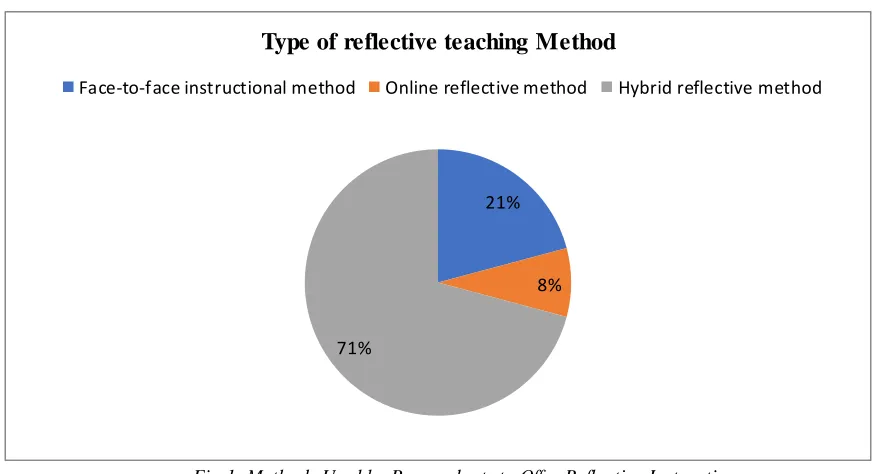
Next, the respondents were asked to clarify the reflective methods used to teach their course(s). This is shown in figure 1. The methods ranged from face-to-face to a variety of totally on-line options. Five of the respondents indicated that they taught a traditional correspondence course. Two showed that online reflective method is applied for RP in their classroom. Most of respondents chose hybrid one as the most suitable and effective method for their reflective learning. In short, most teachers made use of the advantages of technology to instruct their students to learn with the support of RP.
Fig.1: Methods Used by Respondents to Offer Reflective Instruction
Theme 3: Significance of Using IT in RP
To investigate the benefits of using IT in RP, a questionnaire with 11 items was delivered to the students. The items were answered basing on 5 point Likert scale of agreement- Strongly Agree (SA), Agree (A), Neither agree nor disagree (NAD), Disagree (DA), Strongly disagree (SD). The following table shows the data collected from the questionnaire.
Table.2: Significance of Using IT in RP 21%
8%
71%
Type of reflective teaching Method
Face-to-face instructional method Online reflective method Hybrid reflective method
No. Statements SA A NAD DA SD 1 Integrating intercultural education in the process of learning; 8.4% 58.8% 29.4% 0% 0%
2 Using a large variety of methods of learning/training; 4.2% 63% 29.4% 4.2% 0%
3 Combining individual and group's work activities; 21% 50.4% 16.8% 12.6% 0%
4 Promoting students’ ability of critical thinking and
problem-solving
8.4% 58.8% 29.4% 4.2% 0%
5 Creating the clips and record to enhance experiments 21% 67.2% 8.4% 4.2% 0%
6 Using technology media as a form of open and transparent assessment
https://dx.doi.org/10.22161/ijels.4.2.40 ISSN: 2456-7620
Table 2 shows that majority of participants agreed that applying IT in RP brings about a lot of benefits, some of which were strongly agreed by a great number of respondents such as 46.2% for “recording as an effective way for students to self-assess their progress in learning and self-study”, 29.4% for “using soft wares and webs with games to increase students’ interest”, 29.4% for using technology media as a form of open and transparent assessment. 4.2%, 8.4%, 25.2% of respondents in the similar statements were uncertain in their responses, while 0%, 4.2% and 8.4% respectively disagreed.
In terms of developing skills, 67.2% manifested the agreement with the statement “promoting students’ ability of critical thinking and problem-solving” while 4.2%
disagreed. With the highest number of agreement and strong agreement (88.2%) , helping students have experiments thanks to recording and handmade videos and increasing students’ interest in learning are the significant benefits of using IT in RP however there was still 12.6 % showing the disagreement. In short, most of participants admitted that benefits of IT in RP are apparent and not many showed the disagreement.
Theme 4: Frequency of Using IT in RP
In order to answer the question “How often do you use technology to support reflection in your teaching? Please describe how”, the writer collected the data and showed them in table 3 and figure 2.
Fig.2: Frequency of Using IT in RP
The table 2 describes the frequency of using IT in RP from participants. 14% respondents replied that they do not use technology tools for reflection. 23% responded “seldom,” while 45% teachers said that IT is sometimes used in RP and they tried to apply as often as possible. 9% considered IT as a frequent teaching tool in classroom for RP. Two
people didn’t give any answer. The 10 respondents indicated that they sometimes use technology for reflection and two members considered IT as a frequent teaching technique.
Theme 5: IT- assisted Strategies to Support RP in
14%
23%
45% 9% 0%
9%
Frequency of using IT in RP
Never
Seldom
Sometimes
Frequently
Always
No answer
7 Recording is an effective way for students to self-assess their progress in learning and self-study
46.2% 50.4% 4.2% 0% 0%
8 self- evaluating teaching activities 16.8% 46.2% 21% 12.6% 4.2%
9 Using Skype and Zoom in teaching to offer unlimited interaction in the world
4.2% 37.8% 33.6% 16.8% 8.4%
10 Using the networks such as Blog, Face book Twitter… to build
a online community of learning
25.2% 63% 12.6% 0% 0%
11 Using soft wares and webs with games to increase students’
interest in learning
https://dx.doi.org/10.22161/ijels.4.2.40 ISSN: 2456-7620
Teaching and Learning English
The following specific sub-themes were analyzed from the statements of the respondents to the open question “How do the teachers use IT to support RP in teaching and learning English?”
Item 1: How to Use IT to Help Students Self-assess their Progress in Learning and Self-study
Respondents gave their opinions on the ways to use IT in RP effectively in which they mentioned e-portfolio, blogs, Face book and other social network as the best tools supporting students to self-study and self-assess. These tools supplied more ability for students to look back to the knowledge to revise, think more new ideas. In addition, the e-portfolios students did every week, would make them know how well they progressed, know what they should continue and what should change. Respondent examples included how technology facilitated recording of personal notes to oneself, using electronic journals, blogging about experiences, blogging to reflect publicly for the class, reflecting by keeping ongoing logs, recording musings, and twittering about their experiences for review and providing information and insights for improving teaching.
Item 2: How to Use Soft wares to Enhance Experiments, Experiences and Critical think ing
Some respondents said that they took advantage of recording images and sound of some media to create the clips in order to ask students to make videos or short films of scenarios about the content of the subject with introductory remarks such as playing role, talk shows, telling story…. After completing the clips, students will post them on YouTube, Face book, Blog for other people to watch and give comments. This will make the content of th e lesson more interesting, enhance the experiments and experiences for students when they themselves take part in the authentic activities. They could perform the roles , boost the interaction between the learners and develop the capacity of critical thinking when students have to solve the situation. The soft wares are extremely useful for making video including Adobe Premier, Filmora 8.2.2, Youtub e, iMovie or photo-to-video as Proshow Producer, Window Movie Maker, Sony Vegas Pro, Proshow Gold, PhotoStage Slideshow.
Item 3: How to Use a Variety of Technologies to Monitor Student Progress
Some participants indicated that IT is very suitable and effective in monitoring student progress and reviewing student understanding through participation, exercises,
contributions to discussions, and grades. This included scoring quizzes games, calculating grades automatically, participation in online group, uploading materials and assignments onto webs , monitoring quality of student work, using self-quizzes to identify muddiest points, and providing web assignments for review. As one respondent said, “When I use Kahoot game for reviewing knowledge, I can see the first runner and the what student are bad at.” Another respondent said, “I based on the number of views , comments, downloads to consider the participation and contribution of students.”
Item 4: How to Use IT to Support Feedback s together The strategies that respondents can use to give evaluation included providing feedback to students via emails, reflecting before responding to students, using communication tools, and using blogs to reflect publicly for the class, gathering feedback from colleagues, and using online surveys ...In addition, students can incorporate to give online feedback together in RP by clicking “like” and commenting immediately on Blogs, Wikis, face books, twitter or peer correcting on Google drive. One teacher said, “Students' assessment partly make a contribute to the last evaluation of the subject. I analyzed all student comments and integrated them with my own ideas to give score”.
Item 5. How to Use IT to Self- evaluate Teaching Activities Mak ing Adjustments
This is one of the best way of reflective practice for both teachers and students. For teachers, they can record the lessons and reflect what they teach to make the suitable changes in the future. Especially it can be made for each subject with many teachers teaching the same subject. They will create a group Facebook for the same subject with some teachers, in which they will upload their own materials, lectures and information. As a result, teachers will rely on the amount of students ’ comments and "like" to improve themselves and constantly create more lectures to their students.
https://dx.doi.org/10.22161/ijels.4.2.40 ISSN: 2456-7620
teachers of English in the Skype user community. After identifying the time, teachers and students in two classes will connect online through Zoom or Skype. Teachers can ask students to make an introduction about a topic for the others to gain knowledge and then inquire to get more information. During the lesson, students of two classes can be provided with the same situations, then discuss in groups to find the solutions and present them.” One other said that students can ask any questions or respond the answers through messages on the screen. Students and teachers also can answer and talk to the other class.
Item 7. How to Use Soft wares and Online Systems to Archive and Organize Curricular Information
Respondents indicated how they used technology to archive and organize curricular information for reflection . This
included calculating and reviewing grades, using computer to score tests, storing course materials so they could compare materials and grades from previous years to today, using curriculum mapping software, using Learning Management System reports of student progress and course refinement, lesson planning, managing data, updating teaching portfolios, and using websites for housing teaching materials and student projects.
Theme 5: Challenges in Using IT in RP
When the respondents were also asked about the challenges of computer-mediated interaction in Intercultural Communication pedagogy, all teachers agreed that they have a lot of difficulties in using IT in which some take majority. The figure 3 illustrates the teachers’ specific opinions on the challenges of using IT in RP.
.
Fig.3: Challenges in Using IT in RP
It is clear from the figure that most of teachers agreed that technical difficulties are considered as the biggest challenges the teachers had to face. The exchanges between two classrooms connected with each other through Skype or zoom will run smoothly if the quality of the technology conditions are reliable. If not, there will be a lot of paces interrupted, which causes a lot of problems about the time, proceeding, content of the lesson. One respondent complained that it was too time-consuming. The language
barrier has also been cited as a challenge for online because not all the guests are invited to the classroom directly come from the English speaking countries. Time differences in class times is also an issue. Other challenges included students’ lack of willingness to communicate and previous experience with the use of new media, availability of international partners, and lack of sufficient time to make arrangements.
0% 10% 20% 30% 40% 50% 60% 70% 80% 90% 100%
Challenges in using IT in RP
strongly disagree
disagree
neither agree nor disagree
agree
https://dx.doi.org/10.22161/ijels.4.2.40 ISSN: 2456-7620
V. DISCUSSION AND IMPLICATIONS
It can be seen from the study, majority of teachers are aware of incorporating IT in teaching and a lot of teachers have applied Internet -based technologies for RP in class. More significantly, students will be motivated with the interesting creative activities and real projects in the online community. According to these lecturers, it is not difficult for them to organize the activities in online classroom, they still, however in addition to the challenges mentioned above, have some certain problems about how to manage and draw attention and participation of the
whole class. So, teachers should have both the strict compulsory policy and suitable encouragement to built an
effective learning environment. As clearly stated in the findings of the study, there
are a variety of IT tools and technology-based strategies teachers use to enhance the effectiveness of reflection. A variety of smart classroom systems could be used in learning language in order to create an active and modern learning environment and enhance reflective practice. The devices were shown in Table 3.
Table.3: Technologies for RP to be used in teaching language
No Scope Technology items
1 Hardware Smart boards for students to practice tasks with the automatic recognition mode
Internet enabled devices like cell phones and laptops to involve students in the group activities, discuss, interaction, exchanging, games….
Cameras to record the performance, plays, activities, discussion students take part in TV and student boards to display the images, clips and shows from the different areas Projectors with a big size screen to show lectures, presentation, clips, films
Network equipment such as Wi-Fi, 3G and 4G mobile network transmitter Types of speakers and lights
Microphones Technology items
2 Software
Microsoft Office 365, Violet , Lecture Maker, Adobe Presenter, ISpring Presenter, V-ISpring Suit, Microsoft Produce, Google slides, Google Docs, Google Sites, to design the lectures, presentations on culture
VivaVideo, Proshow Producer, Sony Vegas Pro, Adobe Premiere Elements, Adobe After Effect, to create simple video or to make movies in which students play roles with the content related to culture
Audacity, Audio Recorder Pro, Wavosaur, Free Sound Recorder, iGetting Audio, EOP Audio Recorder to record the lectures, talks and discussion
Potatoes, Kahoot, Blackboard to design exercises and games in interaction
Oniver, FaceWork, Unica, VT eLearning, MyClass, ProofHub, Twitter, Skype, and Zoom to allow students to follow online training experts, participate in a topic discussion integrate Twitter with the learning management system to communicate with other studen ts
Microsoft Office 365, SMAS, School Sevrer, VietSchool, SSM, Nsoft.PMS,
to manage the process of processing and evaluating the gradation students, integrating many convenient functions to ensure a closed management cycle from the first enrollment stage to the end of the study program at school
3 Webs
and networks
Instagram, MySpace, Tumblr, Google Plus, Twitter, Flickr, Blog, Wiki, Facebook, Youtube…to share knowledge, videos, to provide instructions, documents or films and so on in order to enhance collaboration and exchanging
Suggested IT-based Pedagogical Strategies for RP in Teaching Language
In pedagogical approach, there is a focus that RP in teaching language should take IT into consideration for
https://dx.doi.org/10.22161/ijels.4.2.40 ISSN: 2456-7620
classroom. With the aid of IT, the strategies listed in Table 5 were useful for teachers to apply in teaching
language to enhance RP.
Table.5: Suggested IT-based pedagogical strategies in teaching culture
No Approaches Pedagogical strategies
1 Collaborative Learning
Collaborating all the members from different areas via digital aids that enable learners to join the activities as a team, communicating directly from remote areas, increasing interaction
2 Experiential learning
Using the IT applications to display photos, audio clips and videos, encouraging students to be engaged in experiments and local field trips outside classroom. After the discovery, students have the experiences and apply what are learnt into practice such as playing roles to solve problems, joining competitions, making news etc.
3 Social Learning
Encouraging learners to take part in social activities via social networks to discover the cultures of different areas. Digital communications is an approach for students to develop knowledge and skills.
4 Evidence-Based Teaching
Sharing and modelling concepts on language via visual aids such as clips, advertisements, films to explain and then demonstrate how students do tasks
5 Flipped pedagogy
Asking students to watch lectures on video/ Google drive/ Google class, then to school to do the tasks instead they traditionally learn at school, then do exercises at home
6 Project-Based Learning
Having students engage in problems . Through these explorations, students develop content knowledge, in addition develop solutions to problems.
7 Inquiry-based instruction
Using the context or movies including the questions that provoke the students to think deeply and give the understanding on language
8 e-learning pedagogy
Using technology to design the lectures on language and presentations to show or teach
VI. CONCLUSION
This study involved a group of 50 students and teachers at universities to look into their perspectives on using IT in RP. The results of quantitative and qualitative data indicated that although the participants appreciated the importance of IT in language reflective teaching and believed that there are suitable strategies for teaching, it is still challenging for them to integrate IT in teaching language generally and RP particularly. It cannot be deniable that the IT of 4.0 revolution make a great contribution to help teachers reach a higher level in perception of changing teaching methods. We might be able to promote interactions between learners with the assistance of information technology transformations to break the physical walls, easily bring the real world into classroom to enhance experience and boost incorporation. Thanks to the benefits of IT in teaching, every teachers should study more in order to apply IT in teaching and assessment effectively. In the impending researches, hopefully, there will be more specific investigation on implication of IT tools in education generally and in teaching language particularly.
REFERENCES
[1] Bauer, K. and Fisher, F., 2007. The education research–practice interface revisited: a scripting perspective. Educational research and evaluation, 13, 221–236.10.1080/ 13803610701626150
[2] Branch, W. T., & Paranjape, A. (2002). Feedback and reflection teaching methods for clinical settings. Academic Medicine, 77(12, Part 1), 1185–1188. Doi:
[3] Chickering, A., & Gamson, Z. (1987). Seven principles for good practice in undergraduate education. . AAHE Bulletin, 39(7), 3-7.
[4] Dewey, J. (1933). How we think, a restatement of the relation of reflective think ing to the educative process. Boston, New York etc.: D. C. Heath and Company.
[5] Johns, C. (1995). Becoming a Reflective Practitioner. Oxford: Blackwell.
https://dx.doi.org/10.22161/ijels.4.2.40 ISSN: 2456-7620
(PDF). Reflective Practice: International and Multidisciplinary Perspectives. 1 (3): 293–307. [7] Larrivee, B. & Cooper, J.M. (2006). An educator's
guide to teacher reflection. Stamford, CT: Cengage Learning.
[8] Mezirow, Jack(Summer 1997). "Transformative learning: theory to practice" (PDF). New Directions for Adult and Continuing Education. 74: 5– 12. doi:10.1002/ace.7401
[9] Moon, J. (2008). Critical Think ing: An Exploration of Theory and Practice. London and New York: Routledge, Taylor & Francis Group.
[10] Moran, M., Seaman, J., and Tinti-Kane, H., Teaching, learning, and sharing: How today's higher education faculty use social media, Babson Survey Research Group and New Marketing Labs, 2011. Retrieved 20 December 2016 from: http://www.pearsonlearningsolutions.com/educato rs/pearson-social-media-survey-2011-bw.pdf
[11] Peter C. Brown, Henry L. Roediger III, Mark A. McDaniel-Mak e It Stick _ The Science of Successful Learning-Belknap Press (2014).epub
[12] Rolheiser, C., Bower, B., & Stevahn, L. (2000). The Portfolio Organizer. Alexandria, Virginia USA: Association for Supervision and Curriculum Development
[13] Schön, D. (1987). Educating the Reflective Practitioner. Jossey-Bass: San Francisco
[14] Woerkom, M. (2003). Critical Reflection at Work. Bridging individual and organizational learning . PhD thesis, University of Twente, Print Partners Ipskamp, Enschede.
[15] Uskov, V L., Howlett, R J., Jain L C. (eds.), Smart Education and Smart e-Learning (Smart Innovation, Systems, and Technologies, 41) (Springer, London, 2015)
[16] Microsoft Survey Shows Asian Educators Aim to Improve Technology Use in Classroom and Training - Microsoft News Center Hong Kong. (2019). Retrieved from