Available Online at www.ijpret.com 11
INTERNATIONAL JOURNAL OF PURE AND
APPLIED RESEARCH IN ENGINEERING AND
TECHNOLOGY
A PATH FOR HORIZING YOUR INNOVATIVE WORK
AN EVALUATION OF BINDING ENERGY OF NANO DOT AS A FUNCTION OF
DOT RADIUS AT DIFFERENT CONCENTRATIONS
NARENDRA KUMAR SINGH1 AND L. K. MISHRA2 1. Department of Physics, S. N. Sinha, College, Jehanabad (Bihar)
2. Department of Physics, Magadh University, Bodh-Gaya-824234 (Bihar)
Accepted Date: 11/06/2017; Published Date: 01/07/2017
\
Abstract: - We have evaluated the binding energy of spherical GaAs/Ga1-xInSb quantum dot
as a function of dot radius at different composition x using the theoretical formalism of T. Prem Kumar et. al. (2011). We observed that binding energy decreases with increase of dot radius with fixed concentration x. we also observed that if dot radius is kept fixed then binding energy increases with composition x. These observations are consentient with observations of other theoretical workers.
Keywords: Nano dot, Quantum Well, Variational ansatz, effective mass approximation,
Shallow impurity, molecular beam epitaxial, Quantum dot, band gap semiconductor, metal organic chemical vapour deposition method.
Corresponding Author: MR. NARENDRA KUMAR SINGH Access Online On:
www.ijpret.com
How to Cite This Article:
Narendra Kumar Singh, IJPRET, 2017; Volume 5 (11): 11-22
Available Online at www.ijpret.com 12 INTRODUCTION
Recent advance is crystal growth techniques like fine line lithography, metal organic chemical vapor deposition (MOCVS) and molecular beam epitaxial (MBE) have made possible the fabrication of low dimensional semiconductor structures such as quantum well, quantum wires and quantum dots1-5. A quantum well (QW) is formed when a thin layer of lower band gap
semiconductor is sandwiched between two longer of higher band gap semiconductor6,7. In the
quantum well structure, electrical and optical properties of the semiconductor are totally different from those of the both material due to quantum effect8,9. Due to modulation doping
in QW structure, carriers are separated from ionized impurity. This increases the mobility of carrier due to reduced ionized impurity scattering. The carrier concentration in QW is high and the coulomb scattering is also reduced with sufficient thickness of space layer10.
Quantum dots are semiconductor monocrystals that exhibit unique optical properties due to combination of their material band energy gap and quantum well phenomenon. Due to their extremely small size, on the order of few nonometer, the dot behaves similarly to three dimensional Quantum well. When an electron is excited by photon, striking the quantum dot, it behaves as a particle confined in an infinite potential well, since the electron cannot escape from the quantum dot. The hole created by the excited electrons behaves in the same fashion11-13.
Theoretical calculations for binding energy of the ground state of GaAS QW’s’ infinite quantum well wires14 (QWW’s) and quantum dots (Q’D’s)15 have been performed. Their studies show
that for an infinite confinement potential the binding energy increases as the finite dimension (length or radius) is reduced. On the other hand for finite confinement potential the binding energy increases up to maximum and then begins to decrease. It has also been observed in the case of donor doped QW’s and infinite QW’s14 that the binding energy is maximum when the
impurity is located at the centre of the structure and decreases for position close to the edges. It has also been anticipated that the semiconductor quantum structure with zero dimension such as GaAlAs/GaAs nanostructure will show discrete electronic states because of electronic confinement16. These impurities play a very important role in optical and transport
phenomenon at low temperature. The binding energy and density of states of shallow impurities in cubic17 and spherical quantum dot18 have been calculated as a function of dot size.
Available Online at www.ijpret.com 13
Using the variational method, Porras – Montenegro19 studied a hyderogenic impurity in
spherical QD systems with both finite and infinite barriers. They calculated the binding energy of the impurities increases and for finite barrier the increase is maximum al – a poured and then sharply decreases. They also observed that binding energy increases with the reduction of dot size20. T. Prem Kumar etal21 have performed a calculation for binding energy of donor
impurity in GaAs plased at the curve. They observed that the binding energy decreases as dot size increases. They also observed that increase of donor binding energy when the variation of construction is included for all dot size.
In this paper, following the same procedure adopted by T. Prem Kumar etal.21 we have
evaluated the binding energy as a function of dot size for different concentrations. Our theoretically evaluated result shows that binding energy decreases with increase of dot radius with fixed concentration. In another calculation, binding energy of quantum dots increases linearly with concentration x with fixed dot radius. These observations are compared with other theoretical workers.22-25
MATERIALS AND METHODS
The Hamiltonian of a single hyderogenic shallow donor impurity in the effective mass approximation for spherical GaAs quantum dot is given by
2 2
2
* ( )
2 o D
e
H V r
m r
(1)
Where o is the static dielectric constant of GaAs
2
2
( ) o
D j
V r V r
R
for | |r R
| )
D j o
V r V
for | |r R
R is the dot radius.
Vo is the barrier height of the periodic dot given by
( ) ( )
D C g
V r Q E x
Available Online at www.ijpret.com 14 Eg is the band gap difference between GaAs and GaxIn1-xSb which is given by26
Eg(x) = 0.235 +1.653x+0.431x2 eV (2)
The units of length and energy used throughout the paper are the Bore radius R* and effective Rydberg Ry*
* 2 2
/ *
o
R m e
* 4 2 2
* / 2 o
Ry m e
o
is the dielectric constant and m* is the effective mass of electron in conduction band
minimum of GaAs with values R*=103.7Ao and Ry*=5.29 meV
By using above units, Hamiltonian given in equation (1) assumes the form
2 2 ( )
H V r
r
(3)
Here, one has used a donor impurity in quantum dot of GaAs. Since an exact solution of the Hamiltonian in equation (1) is not possible, a variational method has been adopted.
The following wave functions are used to obtain the lowest state energies.
2 ( )
SinKr
A r R
r
BExp K r r R
(4)
where A and B are the normalization constants. Hence
*
1 2
2m E
k
*
2 2
2m E V( )
k
(5)
Available Online at www.ijpret.com 15 1
1 1
2 2 1
( )
( ) ( )
SinK r
N Exp r r R
r
N Exp K r Exp r r R
(6)
Where 1 is the variational parameter and N1 and N2 are normalization constants. The
ionization energy is given by
Eion = Esub - <H>min (7)
Where Esub is the lowest sub band energy
2 2 * 2 , sub k E m where k R (8)
RESULTS AND DISCUSSION
In this paper, using the theoretical formulation of T. Prem Kumar et. al21, we have evaluated the
donor binding energy of the spherical quantum nano dot GaAs/Ga1-xInxSb as a function of dot
radius with different composition. The work has been performed using a variational ansatz within the effective mass approximation. The evaluated results are shown in table T1 to table
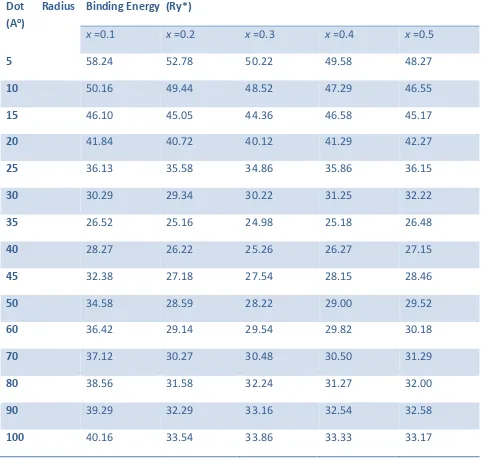
T5. In table T1, we have shown the evaluated results of binding energy of spherical GaAs/Ga
1-xInxSb quantum dot as a function of dot radius (Ao) for different composition x starting with
x=0.1, 0.2, 0.3, 0.4 and 0.5. Our theoretically evaluated results show that binding energy decreases with the increase of dot radius keeping composition x fixed. The binding energy is large for small dot radius and for x=0.1. In table T2, we repeated the calculations for quantum
dot size (R<100 Ao). Here again we observed the similar trend. The binding energy decreases
with increase of dot radius for all the composites x=0.1 to 0.5. In table T3, we have presented
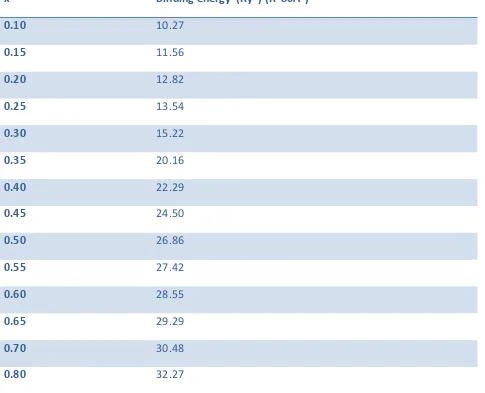
the theoretically evaluated results of binding energy of quantum dot as a function of concentration x for fixed value of dot radius R=80Ao. Here the binding energy increases as a
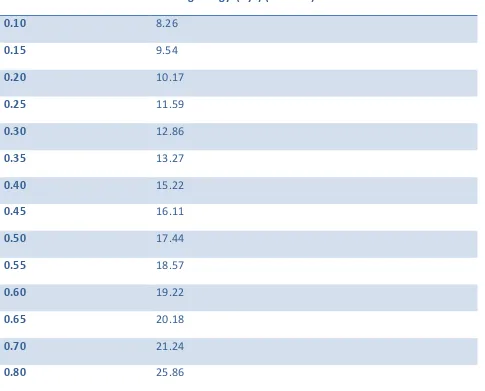
function of composition x. The increase is linearly with respect to the composition. We repeated the same calculation for another value of dot radius R=150Ao. Here again, we noticed
the similar observation of increase of binding energy as a faction of composition x. However, the magnitude of the binding energy is lower at R=150Ao than to R=80Ao for x=0.1 to x=0.8. The
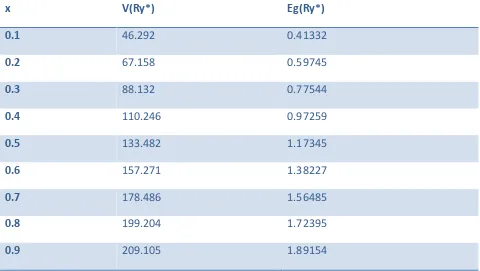
results are shown in table T4. In table T5, we have given the values of barrier height V(Ry*),
Available Online at www.ijpret.com 16
energy of spherical quantum dot GaAs/Ga1-xInxSb. Some recent calculations on quantum dot
also reveal the similar type of observervation27-35.
CONCLUSION
From the above theoretical analysis and evaluation, we come across the following conclusions:
(i)The concentration plays a significant role in the binding energy of quantum structure.
(ii)Effective mass approximation with variational and perturbation approaches is useful in the evaluation of binding energy of spherical quantum dot.
TableT1
An evaluated results of binding energy of spherical GaAs/Ga1-xInxSb quantum dot as a function
of the dot radius for different concentration x
Dot Radius
(Ao)
Binding Energy (Ry*)
x =0.1 x =0.2 x =0.3 x =0.4 x =0.5
50 58.24 52.78 50.22 49.58 48.27
100 40.56 39.29 37.12 36.19 35.86
150 28.24 26.15 25.54 24.99 23.18
200 23.16 20.58 19.18 18.75 17.59
300 14.44 13.29 12.86 11.59 10.86
400 12.18 11.43 10.75 10.86 10.22
500 11.56 10.27 9.86 9.75 9.67
600 10.22 9.86 9.22 9.10 9.02
700 9.58 9.05 8.89 8.78 8.88
800 8.72 8.88 8.25 8.16 8.22
Available Online at www.ijpret.com 17
1000 7.85 7.58 7.42 7.18 7.22
Table T2
An evaluated results of binding energy of spherical GaAs/Ga1-xInxSb quantum dot as a function
of dot size (quantum level) for different concentration x
Dot Radius
(Ao)
Binding Energy (Ry*)
x =0.1 x =0.2 x =0.3 x =0.4 x =0.5
5 58.24 52.78 50.22 49.58 48.27
10 50.16 49.44 48.52 47.29 46.55
15 46.10 45.05 44.36 46.58 45.17
20 41.84 40.72 40.12 41.29 42.27
25 36.13 35.58 34.86 35.86 36.15
30 30.29 29.34 30.22 31.25 32.22
35 26.52 25.16 24.98 25.18 26.48
40 28.27 26.22 25.26 26.27 27.15
45 32.38 27.18 27.54 28.15 28.46
50 34.58 28.59 28.22 29.00 29.52
60 36.42 29.14 29.54 29.82 30.18
70 37.12 30.27 30.48 30.50 31.29
80 38.56 31.58 32.24 31.27 32.00
90 39.29 32.29 33.16 32.54 32.58
Available Online at www.ijpret.com 18 Table T3
An evaluated results of binding energy of spherical GaAs/Ga1-xInxSb quantum dot as a function
of different constants for parameter dot radius R=80A.o
x Binding energy (Ry*) (R=80Ao)
0.10 10.27
0.15 11.56
0.20 12.82
0.25 13.54
0.30 15.22
0.35 20.16
0.40 22.29
0.45 24.50
0.50 26.86
0.55 27.42
0.60 28.55
0.65 29.29
0.70 30.48
Available Online at www.ijpret.com 19 Table T4
An evaluated results of binding energy of spherical GaAs/Ga1-xInxSb quantum dot as a function
of different constants for parameter dot radius R=150A.o
x Binding energy (Ry*) (R=150Ao)
0.10 8.26
0.15 9.54
0.20 10.17
0.25 11.59
0.30 12.86
0.35 13.27
0.40 15.22
0.45 16.11
0.50 17.44
0.55 18.57
0.60 19.22
0.65 20.18
0.70 21.24
Available Online at www.ijpret.com 20 Table T5
For finite barrier, barrier height V (Ry*) and band gap energy Eg(Ry*) is given for different constants.
x V(Ry*) Eg(Ry*)
0.1 46.292 0.41332
0.2 67.158 0.59745
0.3 88.132 0.77544
0.4 110.246 0.97259
0.5 133.482 1.17345
0.6 157.271 1.38227
0.7 178.486 1.56485
0.8 199.204 1.72395
0.9 209.105 1.89154
REFERENCES
1. S. K. Sarkar and D. Chattopadhyay, Phys Rev B 56, 264 (2000)
2. R. Akimoto, B.S.Li, K. Akite and T Hasana, Appl. Phys. Lett 87, 181104 (2005)
3. C. Fujihashi, T.Yukiya and A. Asenor, I.E.E.E. Transactions on Nano Technology 6, 320 (2007)
4. G. Dewey, M. K. Hudait, K. Lee, R. Pillarisetty and R. Chan, I.E.E.E. Electron device letters 29,1094 (2008)
5. A. Gold, Appl. Phys. Lett. 92, 082111 (2008)
6. D. N. Quarg and N. H. Tung, Phys. Rev. B 77, 125335 (2008)
Available Online at www.ijpret.com 21
8. D. N. Quarg, N. G. Tung, N.T. Hong, and T.T. Hai, Communication in Phys. 20, 193 (2010)
9. G.C. Ber, G.E. Pikus and T.D. Huan, Appl. Phys. Lett. 95, 031210 (2009)
10. S. Hooyong, K.J. Soak, K. E. Key and H. S. Mei, Nanotechnology 21, 134026 (2010)
11. D. Englaud etal., Nature 450, 857 (2007)
12. F. Holbauer etal., Appl. Phys. Lett. 91, 201111 (2007)
13. F. P. Lausy etal., Phys. Rev. Lett. (PRL) 101, 083601 (2008)
14. J. W. Brown and H. N. Spcetor, J. Appl. Phys. 59, 1179 (1986)
15. N. Porras – Montinegro, J. Lo-piz-gondon and L. E Oliviery, Phys. Rev. B43, 1824 (1991)
16. M. A. Reed, J. N. Randav, R.J. Aggrawal, R.J.Matyi, T.M.Morre and A.E.Wetsel, Phys. Rev. Litt (PRL) 60,535 (1988)
17. F.J.Ribeiro and A. Latge, Phys. Rev. BJo, 4913 (1994)
18. J.L. Zhu, J.J.Xiong and B.L.Gu, Phys. Rev. B41, 6001 (1990)
19. N. Porral – Motenyro-and S.T. Perez – Merchencano, Phys. Rev. B46, 9780 (1992)
20. Chayanika Bose, J. Appl. Phys. 83, 3089 (1998)
21. T. Prem Kumar, P. Ramesh and S. Gopal Ram, Digest Journal of Nanomaterials and Biostructure, 6, 683 (2011)
22. A. J. Peter, K. Ghass Rehan and K. Navaneitha Krishnan, Env. Phys. J. 53, 283 (2006)
23. V. Mliner, M. Tadic, B. Partones and F. M. Peeters, Phys. Rev. B71, 205308 (2005)
24. S. T. Perz, R. Franeo, J. S. VValenico, J. Microelcetronics, 39, 387 (2008)
25. J. D. G.Aevsta, E. O. Ospino and J. B. Oretga, Mictroelectronics Journal 40, 1286 (2009)
26. P. G. Baranow, S. B. Orlinskin, C. D. Mallo Doneya and J. Schmidt, App. Magn. Reson. 39, 151 (2010)
27. E. G. Barbagiovanni, L. V. Gonchanro and P. G. Simpton, Phys. Rev. B83, 035112 (2011)
Available Online at www.ijpret.com 22
29. L. Novotuy and N. Van Hubt, Nat. Photonic, 5, 83 (2011)
30. P. Biajioni, J. S. Huang and B. Hecht, Rep. Prog. Phys. 75, 024402 (2012)
31. C. D. Andree, J. Bochterle, A. Toma, C. Huke and A. Pucci, ACS Nano 7, 352 (2013)
32. C. Huke, F. Neubreach, A. Toma and A. Pucci, ACS Nano 8, 21908 (2014)
33. M. Chiruamamilla etal., Adv. Meter, 25, 2533 (2014)
34. A. V. Tsukano and I.Yu Kateiv, Rassian Microelectronics, 44, 61 (2015)