Available Online at www.ijpret.com 1704
INTERNATIONAL JOURNAL OF PURE AND
APPLIED RESEARCH IN ENGINEERING AND
TECHNOLOGY
A PATH FOR HORIZING YOUR INNOVATIVE WORK
A NOVEL APPROACH FOR CONSTRUCTION OF EFFICIENT ATTRIBUTE BASED
ENCRYPTION WITH VERIFIABLE OUTSOURCED DECRYPTION
MR. M. D. GHODESWAR, DR. S. S. SHEREKAR, DR. V. M. THAKARE
SGBAU Amravati, India.
Accepted Date: 15/03/2016; Published Date: 01/05/2016
\
0
Abstract: Cloud computing is the technique which supports flexible, on-demand and low cost usage of computing resources but the various privacy concerns emerge from it. Attribute Based Encryption scheme with outsourced decryption enables sharing of encrypted data, but also overcomes efficiency drawback in terms of decryption cost of standard ABE scheme. In this paper a novel approach for construction of efficient Multi-authority ABE with verifiable outsourced decryption is proposed, which helps to reduce the computation time required for the decryption.
Keywords: Attribute-Based Encryption, Outsourced Decryption, Multi-Authority, Verifiability
Corresponding Author: MR. M. D. GHODESWAR Access Online On:
www.ijpret.com
How to Cite This Article:
Available Online at www.ijpret.com 1705 INTRODUCTION
Attribute based encryption provides flexible access control and data confidentiality functionalities; it has become a promising technique for building secure access in practical distributed systems. The drawback of existing ABE scheme is decryption which involves expensive pairing operations and the number of such operation leads to the complexity of the access policy. Various techniques are proposed to protect the data contents privacy via access control.
This paper discusses the few techniques to improve the efficiency of decryption in anonymous ABE. These techniques reduce the computation time required for the decryption operation. But these methods also have some problem so to overcome such problems improved version of ABE scheme is proposed.
I) Background
To protect the data contents privacy via access control various techniques have been proposed. Identity-based encryption (IBE) was introduced first, in which the sender of a message can specify an identity such that only a receiver with matching identity can decrypt it. Few years later, Fuzzy Identity-Based Encryption is introduced, which is also known as Attribute-Based Encryption (ABE). In such encryption scheme, an identity is viewed as a set of descriptive attributes and decryption is possible if a decryptor’s identity has some overlaps with the one specified in the ciphertext. Soon after, more general tree-based ABE schemes, Key-Policy Attribute-Based Encryption (KP-ABE) and Ciphertext-Policy Attribute-Based Encryption (CP-ABE), are presented to express more general condition than simple ‘overlap’. They are counterparts to each other in the sense that the decision of encryption policy is made by different parties.
Available Online at www.ijpret.com 1706 attributes in the private key satisfy the access tree specified in the ciphertext. By doing so, the encryptor holds the ultimate authority about the encryption policy. Also, the already issued private keys will never be modified unless the whole system reboots.
This paper introduces some techniques which provide efficient and verifiable outsourced decryption these are organized as follows. Section I Introduction. Section II discusses Background. Section III discusses previous work. Section IV discusses existing methodologies. Section V discusses attributes and parameters and how these are affected. Section VI proposed method and outcome result possible. Finally section VII Conclude this review paper.
II) Previous Work Done
In research literature, to improve the efficiency of decryption in anonymous ABE different techniques are studied. Junzuo Lai et al. (2013) [1] has proposed original model of ABE with outsourced decryption to allow for the verifiability of the transformations. After describing the formal definition of verifiability, author has proposed a new ABE model and construct a new model called concrete ABE with verifiable outsourced decryption. This scheme does not rely on random oracles. Yingui Zhang et al. (2013) [2] has proposed a new technique match-then-decrypt in to the decryption of anonymous ABE, in which match-then-decrypt phase is added. Taeho Jung et al. (2015) [3] has proposed AnonyControl and AnonyControl-F to allow cloud servers to control users access privileges without knowing their identity information. The proposed schemes are able to protect user’s privacy against each single authority. Partial information is disclosed in AnonyControl and no information is disclosed in AnonyControl-F. Baodong Qin et al. (2015) [4] have proposed an efficient method to verify the correctness of the transformed ciphertext in an ABE system with outsourced decryption. This scheme works in the key encapsulated mechanism (KEM). Suqing Lin et al. (2015) [5] has proposed a novel technique to build an ABE with verifiable outsourced decryption based on a AB-KEM, a symmetric key encryption scheme and a commitment scheme. This scheme provides VO-ABE which can be considered in both key-policy and ciphertext-policy setting.
III) Existing Methodologies
Available Online at www.ijpret.com 1707 In the first scheme CP-ABE scheme with outsourced decryption consists of seven algorithms:
Setup, Key Gen, Encrypt, Decrypt, and Gen TK out, Transform out, Decrypt out. In this model Decrypt
out includes the original ciphertext and the transformed ciphertext. User needs to know only the
small part of the original ciphertext to verify the correctness of the transformation done by the
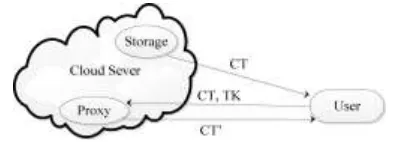
cloud in the algorithm Decrypt out. Following fig shows the ABE system with outsourced
decryption. In this scheme, re-encryption is done with the help of proxy. But there is no way to verify the proxy’s transform. Since the proxy is untrusted and hence verifiable outsourced decryption is needed.
Fig 1: ABE system with Outsourced Decryption
In second scheme anonymous CP-ABE consists of four algorithms: Setup, Key Gen, Encrypt and Decrypt where Decrypt algorithm involves two phases i.e. attribute matching detection and decryption phase.
In the third scheme analysis on security and performance is given to show feasibility of the scheme AnonyControl and AnonyControl-F. In this scheme multi-authority based encryption AnonyControl and AnonyControl-F is implemented.
In the fourth scheme, underlying outsourced ABE system work in the KEM setting i.e. it encrypts a random key rather than real message. Instead of using the random key to symmetrically encrypt data intermediate verification key is computed and then extractor is used to derive a symmetric key. Finally, symmetric encryption scheme is used to hide the real message and verification key is computed. The later implicitly guarantees the correctness of the recovered random key. Following fig shows the system model for the proposed method. In this scheme a separate cloud storage server and the ciphertext transformation server is used.
Available Online at www.ijpret.com 1708 In the fifth scheme, the model of CP-ABE with outsourced decryption consists of seven algorithms
(Setup, Key Gen, Encrypt, Decrypt, Gen TK out, Transform out, Decrypt out ). A trusted party
generates the public parameters and a master secret key by running the algorithm Setup, and a user obtains a private key generated by the trusted party running Key Gen. After taking the ciphertext, the user decides whether to outsource decryption of the ciphertext. If the user wants to outsource decryption, he can execute the algorithm Gen TK out and use his private key to generate the transform key by himself. Taking as input the transform key and a ciphertext, the proxy is able to change the ciphertext into a constant-size ciphertext by the algorithm transform out if the set of attributes associated with the private key satisfies the access structure associated with the ciphertext.
IV) Analysis and Discussion
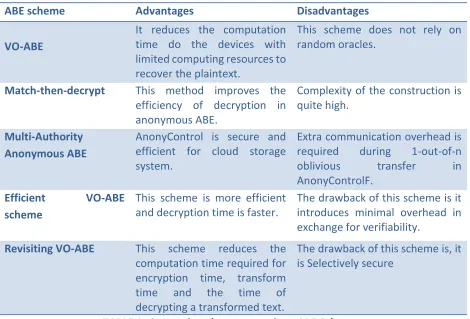
The ABE ciphertext size and decryption/transformation time increase linearly as the ciphertext policy’s complexity grows. Outsourcing substantially reduces the computation time required for devices with limited computing resource to recover the plaintext. The bulk of the decryption operation is now handled by the proxy. The transformed ciphertext is not only much efficient to decrypt but also much smaller in size.
Match then decrypt presents the security comparison with respect to the complexity assumption, the security model and anonymity. This scheme achieves the goal of protecting users’ privacy and they have the same access policy.
Semi anonymous privilege control scheme AnonyControl to address not only the data privacy, but also the user identity privacy in existing access control schemes. AnonyControl decentralizes the central authority to limit the identity leakage and thus achieves semi anonymity. AnonyControl-F fully prevents the identity leakage and achieves the full anonymity.
Available Online at www.ijpret.com 1709 The computation cost for the third-party service to transform a standard ABE ciphertext in our scheme is half of that in Therefore; ABE with verifiable outsourced decryption is more efficient than the existing scheme.
ABE scheme Advantages Disadvantages
VO-ABE
It reduces the computation time do the devices with limited computing resources to recover the plaintext.
This scheme does not rely on random oracles.
Match-then-decrypt This method improves the
efficiency of decryption in anonymous ABE.
Complexity of the construction is quite high.
Multi-Authority Anonymous ABE
AnonyControl is secure and efficient for cloud storage system.
Extra communication overhead is
required during 1-out-of-n
oblivious transfer in
AnonyControlF.
Efficient VO-ABE
scheme
This scheme is more efficient and decryption time is faster.
The drawback of this scheme is it introduces minimal overhead in exchange for verifiability.
Revisiting VO-ABE This scheme reduces the
computation time required for encryption time, transform
time and the time of
decrypting a transformed text.
The drawback of this scheme is, it is Selectively secure
TABLE 1: Comparison between various ABE Schemes
V) Proposed Methodology
Multi-Authority VO-ABE algorithms
Available Online at www.ijpret.com 1710 Data Owner
CSS
CTS
user
Fig3: System Model of Multi-Authority ABE
Abbreviation used in Fig 3
CSS – Cloud Storage Server
CTS: Ciphertext Transformation Server
1. Setup
This algorithm takes nothing as input. Attribute authorities execute this algorithm and compute public key as well as authority wise public parameter for individually computing a master key.
2. Key Gen
This algorithm enables user to interact with every attribute authority and obtain a private key.
3. Encrypt
This algorithm takes public key and message as input and outputs ciphertext Cloud
Available Online at www.ijpret.com 1711 4. Decrypt
This decryption algorithm takes public key, private key, ciphertext and returns a message.
5. Gen TK
The transform key generation algorithm takes as input public key, ciphertext and private key then outputs a transformed key
6. Transform out
The transform algorithm takes as input public key, ciphertext, transform key the outputs a transformed ciphertext
7. Verify
The verification algorithm takes input as public key, a transformed ciphertext and secret value and then outputs a bit and status value.
8. Decrypt
The decryption algorithm takes as input public key, ciphertext and secret value then run verify algorithm. To obtain bit ans status value
If b= 1
Outputs message
Else return error symbol
VI) Outcome Possible Result
The proposed method, multiauthority based VO-ABE will successfully improves the efficiency of decryption test. Also it achieves verifiability and security.
VII) Conclusion
Available Online at www.ijpret.com 1712 IX) FUTURE SCOPE:
The efficient user revocation mechanism must be introduced as the future work
REFERENCES:
1. Junzuo Lai, Robert H Deng, Chaowen Guan, Jian Weng, “Attribute-Based Encryption with
Verifiable Outsourced Decryption”, IEEE TRANSACTIONS ON INFORMATION FORENSICS AND SECURITY, Vol . 8, No. 8, PP. 1343-1354, AUGUST 2013.
2. Yinghui Zhang, Xiaofeng Chen, Jin Li, Duncan Wong, Hui Li, “Anonymous Attribute-Based
Encryption Supporting Efficient Decryption Test”, In Proc of ASIA CCS’13, Hangzhou, China, PP. 511-516 ACM Press. 2013.
3. Taeho Jung, Xiiang-Yang Li, Zhiguo Wan, Meng Wan, “Control Cloud Data Access Privilege and
Anonymity with Fully Anonymous Attribute-Based Encryption”, IEEE TRANSACTIONS ON INFORMATION FORENSICS AND SECURITY, Vol. 10, No. 1, January 2015.
4. Baodong Qin, Robert H. Deng, Shengli Liu, and Siqi Ma, “Attribute-Based Encryption With
Efficient Verifiable Outsourced Decryption”, IEEE TRANSACTIONS ON INFORMATION FORENSICS AND SECURITY, VOL. 10, NO. 7, JULY 2015.
5. Suqing Lin, Rui Zhang, Hui Ma, and Mingsheng Wang, “Revisiting Attribute-Based Encryption