Available Online at www.ijpret.com 34
INTERNATIONAL JOURNAL OF PURE AND
APPLIED RESEARCH IN ENGINEERING AND
TECHNOLOGY
A PATH FOR HORIZING YOUR INNOVATIVE WORK
A NOVEL METHOD FOR ITERATIVE TRI-CLASS THRESHOLDING TECHNIQUE
IN IMAGE SEGMENTATION
A. ARCHANA1, N. RAMANJULU2
1. M. Tech, DECS.MJR College of Engineering and Technology, Agraharam, Chittoor, (Affiliated To J.N.T. University, Anantapur), Piler. 2. M. Tech, Assistant professor, MJR College of Engineering and Technology, Agraharam, Chittoor, (Affiliated To J.N.T. University, Anantapur), Piler.
Accepted Date: 08/01/2016; Published Date: 01/02/2016
\
Abstract: - We display another system in picture division that is in light of Otsu's strategy however iteratively hunt down sub locales of the picture for division, rather than regarding the full picture in general area for handling. The iterative technique begins with Otsu's limit and registers the mean estimations of the two classes as isolated by the edge. Taking into account the Otsu's edge and the two mean values, the system isolates the picture into three classes rather than two as the standard Otsu's strategy does. The initial two classes are resolved as the frontal area and foundation and they won't be handled further. The second rate class is signified as a to-be-resolved (TBD) district that is handled at next cycle. At the succeeding emphasis, Otsu's system is connected on the TBD area to compute another limit and two class implies and the TBD district is again isolated into three classes, in particular, closer view, foundation, and another TBD locale, which by definition is littler than the past TBD areas. At that point, the new TBD locale is prepared in the comparative way. The procedure stops when the Otsu's limits figured between two cycles is not as much as a preset edge. At that point, all the transitional frontal area and foundation locales are, separately, joined to make the last division result. Tests on manufactured and genuine pictures demonstrated that the new iterative system can accomplish preferable execution over the standard Otsu's strategy in numerous testing cases, for example, distinguishing powerless protests and uncovering fine structures of complex articles while the included computational expense is insignificant Index.
Keywords: Binarization, Otsu’s method, segmentation, threshold, triclass segmentation.
Corresponding Author: MS. A. ARCHANA
Access Online On:
www.ijpret.com
How to Cite This Article:
A. Archana, IJPRET, 2016; Volume 4 (6): 34-42 S
Available Online at www.ijpret.com 35 INTRODUCTION
Available Online at www.ijpret.com 36 picture into three classes in light of the two class means determined. The three classes are characterized as the closer view with pixel qualities are more noteworthy than the bigger mean, the foundation with pixel qualities are not exactly the littler mean, and all the more significantly, a second rate class we call the "to-be-resolved" (TBD) area with pixel qualities fall between the two class implies. At that point at the following emphasis, the system keeps the past frontal area and foundation areas unaltered and re-applies Otsu's technique on the TBD district just to, once more, separate it into three classes in the comparable way. At the point when the cycle stops in the wake of meeting a preset measure, the last TBD district is then isolated into two classes, forefront and foundation, rather than three areas. The last forefront is the coherent union of all the already decided closer view areas and the last foundation is resolved comparatively. The new strategy is just about parameterfree with the exception of the ceasing principle for the iterative process and has negligible included computational burden. We tried the new iterative technique on engineered and genuine pictures and observed that it can accomplish prevalent execution in portioning pictures, for example, zebrafish and cores pictures obtained by magnifying lens. Results demonstrate that the new technique can portion powerless protests or fine structures that are commonly missed by the standard Otsu's.
II. EXISTING METHOD
A. Otsu’s Method
Available Online at www.ijpret.com 37 idea of "separation proportion" which we characterize as the proportion of the separation in mean between the frontal area.
B. Iterative Method
The thought of isolating a picture's histogram iteratively into three classes is represented at the base of Fig. For a picture u, at the first emphasis, Otsu's system is connected to discover a limit T [1] where the superscript signifies the quantity of cycle. We then discover and signify the method for the two classes isolated by T [1] as μ [1] 0 and μ [1] 1 for the foundation and forefront, separately. At that point we group districts whose pixel qualities are more prominent than μ[1] 1 as frontal area F[1] and areas whose pixel qualities are not exactly μ [1] 0 as foundation B[1]. For the remaining pixels u(x, y) such that μ [1] 0 ≤ u(x, y) ≤ μ [1] 1 we indicate them as the TBD class _ [1]. So our iterative procedure accept that the pixels that are more noteworthy than the mean of the "likely" decided forefront are the genuine oreground. Additionally, pixels with values not exactly μ0 are for sure the foundation. In any case, the pixels in the TBD class, which are the ones that commonly cause mis-groupings in the standard Otsu's strategy, are not chose on the double and will be further prepared. By our definition, we have
F(x)= F[2] ∪ B[2] ∪
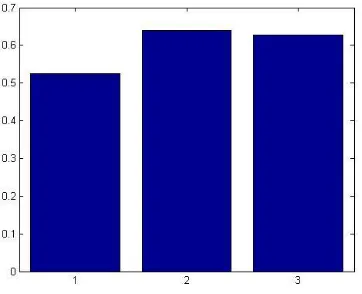
Available Online at www.ijpret.com 38 the separation proportion one would get by applying the standard Otsu's technique overall picture. The plot demonstrates that by concentrating on the TBD districts every time, the new calculation is less influenced by the high intra-class change and in this way accomplishes better results. Next we tried the calculation on a manufactured picture comprising of four items with differing sign intensities, Fig. 2. The foundation of the picture is commotion with a uniform dispersion. To start with, the standard Otsu's technique is connected on the test picture to get the outcome demonstrated in Fig. 3. In spite of the fact that the two items with high flag intensities are effectively portioned, the two feeble articles are not totally fragmented and one of them is missed. We then test the new calculation on the same picture. The outcomes acquired after the in the first place, third, fifth and seventh cycles are indicated in Fig.1-3, separately. We additionally inspected how the separation proportion of this picture changed as an element of emphasis. The plot demonstrates that the separation proportion at first diminished from cycle one to two, which is affirmed by the way that Fig. 1 is not on a par with Fig. 2, the separation proportion then continues expanding and surpasses that of cycle one, showing that as the iterative procedure continues, the TBD locales turn out to be more positive to be portioned by Otsu's strategy. When we consider we noticed that at the initial couple of cycles, the separation proportions given by the new system is lower than that of Otsu's technique.
III. RESULT
Available Online at www.ijpret.com 39 Figure 1: A zoomed-in portion of muscular nuclei acquired by fluorescence microscopy.
Figure 2: The result given by Otsu’s method.
Available Online at www.ijpret.com 40 sufficient to correctly separate the two classes as some pixels in the signal class may appear closer to the noise class.
Figure 3: Results after the fourth iteration of the new method. There was a nucleus missed by Otsu’s method and segmented by the proposed method. It demonstrates that our method.
Figure 4: The histogram iterative process proceeds, the TBD regions become more favorable to be segmented by Otsu’s method.
IV. CONCLUSION
Available Online at www.ijpret.com 41 conditions, raising trouble for algorithms like Otsu's strategy to effectively section them. Without a powerful division results, more refined handling, for example, following and highlight examination turn out to be exceedingly difficult. In this paper, we proposed to exploit Otsu's limit by characterizing pictures into three speculative classes rather than two perpetual classes in an iterative way. The three classes are assigned as the genuine frontal area and foundation, and a third TBD locale that is to be further prepared at the following cycle. At every cycle, the tri-class methodology keeps locales that are resolved to be frontal area and foundation unaltered and concentrates on the third TBD district. At every succeeding emphasis, the region of the TBD locale diminishes and more pixels are allocated to the closer view and foundation classes. The emphasis stops until the change in edges of two sequential cycles is not as much as an edge. To help on assessing the execution of the new calculation we presented the idea of separation proportion which measures a posteriori how good a picture or district is for Otsu's technique to section. The execution of the new calculation is assessed on both engineered and genuine minute pictures. By allocating exceptionally solid and extremely frail pixels to the conditional frontal area and foundation classes, the new technique is less one-sided toward the class with an expansive change than Otsu's strategy does. Exploratory results show that the proposed calculation can accomplish unrivaled execution in fragmenting frail questions and fine subtle elements. The new technique is likewise very nearly sans parameter aside from the preset limit to end the iterative procedure. The included computational expense is negligible as the procedure for the most part stops in a couple of cycles and every emphasis just procedures a monotonically contracting TBD locale.
V. REFERENCES:
1. L. Herta and R. W. Schafer, “Multilevel threshold using edge matching,” Comput. Vis., Graph.,
Image Process., vol. 44, no. 3, pp. 279–295, Mar. 1988.
2. R. Kohler, “A segmentation system based on thresholding,” Comput. Graph. Image Process., vol. 15, no. 4, pp. 319–338, Apr. 1981.
3. X. Xu, “A method based on rank-ordered filter to detect edges in cellular image,” Pattern
Recognit. Lett., vol. 30, no. 6, pp. 634–640, Jun. 2009.
Available Online at www.ijpret.com 42 5. M. J. Carlotto, “Histogram analysis using scale-space approach,” IEEE Trans. Pattern Anal.
Mach. Intell., vol. 9, no. 1, pp. 121–129, Jan. 1987.
6. J. Kittler and J. Illingworth, “Minimum error threshold,” Pattern Recognit., vol. 19, no. 1, pp. 41–47, Jan. 1986.
7. P. Sirisha, C. N. Raju, and R. P. K. Reddy, “An efficient fuzzy technique for detection of brain tumor,” Int. J. Comput. Technol., vol. 8, no. 2, pp. 813–819, 2013.
8. C. H. Bindu and K. S. Prasad, “An efficient medical image segmentation using conventional OTSU method,” Int. J. Adv. Sci. Technol., vol. 38, pp. 67–74, Jan. 2012.
9. P. Gupta, V. Malik, and M. Gandhi, “Implementation of multilevel threshold method for digital images used in medical image processing,” Int. J., vol. 2, no. 2, Feb. 2012.
10.R. Farrahi Moghaddam and M. Cheriet, “AdOtsu: An adaptive and parameterless
generalization of Otsu’s method for document image binarization,” Pattern Recognit., vol. 45, no. 6, pp. 2419–2431, 2012.
11.Y. Zhang and L. Wu, “Fast document image binarization based on an improved adaptive Otsu’s method and destination word accumulation,” J. Comput. Inf. Syst., vol. 7, no. 6, pp. 1886–1892, 2011.