Organized by S.V.B.I.T., Gandhinagar. Available Online at www.ijpret.com237
INTERNATIONAL JOURNAL OF PURE AND
APPLIED RESEARCH IN ENGINEERING AND
TECHNOLOGY
A PATH FOR HORIZING YOUR INNOVATIVE WORK
IMPROVEMENT OF COMPRESSIVE STRENGTH AND REDUCTION OF SPACE
CONSUMPTION OF CONCRETE WITH VULNERABLE MATERIALS WITH THE
CONCEPTOF BUBBLE DECK
MAAZ MALIK1, KRISHNA PANDEY1, JAY KAPADIA1, ISMAIL VOHRA1,JAYKUMAR SONI2,
TIMIR CHOKSHI2
1. Civil Engineering Department, L.J. Institute of Engineering and Technology, Ahmedabad, Gujarat -382210 2. Civil Engineering Department, L.J. Institute of Engineering and Technology, Ahmedabad, Gujarat -382210
Accepted Date: 22/12/2018; Published Date: 01/02/2019
Abstract:Bubble deck concrete wall (partition wall and compound wall) is a method of virtually eliminating some concrete from the middle of a wall, thereby dramatically reducing structural dead weight. High-density rubber hollow spheres replace the in-effective concrete in the centre of the wall, thus decreasing the dead weight and increasing the efficiency of the wall. Introducing air gaps leads to a 20 to 25% lighter slab which reduces the loads on the columns, walls and foundations of the entire building. The advantages are less energy consumption - both in production, transport and carries out less emission - exhaust gases from production and transport, especially CO2. This paper aims to discuss various properties of the Bubble deck wall.
Keywords: Bubble deck concrete walls, Hollow walls, Hollow rubber balls, Concrete, Aggregate, Strength, Quality, Properties.
Corresponding Author: MAAZ MALIK
Access Online On:
www.ijpret.com
How to Cite This Article:
Maaz Malik, IJPRET, 2019; Volume 7 (6): 237-242 PAPER-QR CODE
SPECIAL ISSUE FOR
2
ndNATIONAL CONFERENCE ON
"Recent Trends and Development in
Organized by S.V.B.I.T., Gandhinagar. Available Online at www.ijpret.com238
INTRODUCTION
It is a method of virtually eliminating some concrete from the middle of a wall not performing any structural function, thereby dramatically reducing structural dead weight.[1]Bubble deck slab is a patented technique of linking air, steel and concrete in a two-way structural slab.[2]Void forms in the middle of a wall using rubber spheres which eliminates 20% of the wall’s self-weight, removing constraints of high dead loads.
Its flexible layout easily adapts to irregular and curved plan configurations. The system allows for the realization of more rapid and less expensive erection. Bubble deck wall can reduce total project costs by two percent. Bubble deck wall is a new innovative and sustainable floor system to be used as a self-supporting concrete wall. The bubble deck wall system can be used for compound walls, partition wall, slabs, etc.[3]
Spherical shapes with thread and possibly a thin concrete shell as precast walls are supplied to the construction site, they are installed on site and are assembled by installing in concrete rods as shown in fig. 1.This is not the last of the advantages of the bubble deck wall system because of the lower weight of the wall itself. Also the supporting constructions such as columns and foundations can be lessbulky.
Fig.1 PRECAST CONCRETE WALL
Organized by S.V.B.I.T., Gandhinagar. Available Online at www.ijpret.com239
LITERATURE REVIEW
1. THE CONCEPT OF BUBBLE DECK:
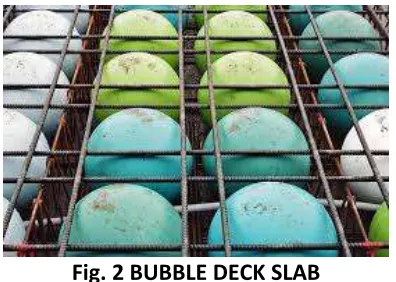
Bubble deck technology uses less concrete by filing the slab with beach balls. Concrete is massive, and 5% of the world's CO2is created during cement manufacturing[4].Then, there is the aggregate that is dug out and the trucks that carry it. Not only that, but most of the concrete that is in a slab is not even needed it is just a spacer between the bottom, where the reinforcing steel is in tension and the top, where the concrete is in compression [3].Bubble deck is a clever solution to this problem it fills the slab with plastic balls that are held in place in prefabricated assemblies of reinforcement.
Fig. 2 BUBBLE DECK SLAB
Bubble Deck is a biaxial technology that increases span lengths and makes floors thinner by reducing the weight while maintaining the performance of reinforced concrete slabs.
Fig. 3 PRECAST REINFORCED CONCRETE SLAB
Organized by S.V.B.I.T., Gandhinagar. Available Online at www.ijpret.com240 Once the steel lattice/void “sandwich” is concreted, it is then forecasted into panels of various sizes and craned into position onshoring. Once the concrete is poured over the balls in the panels, the bubble deck system effectively becomes, and behaves like a monolithic two-way slab that distributes force uniformly and continuously [3].
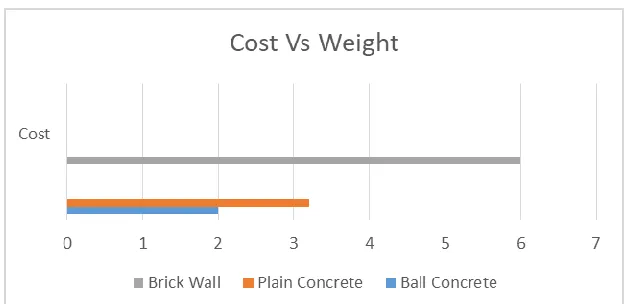
From graph one we can see that the cost& weight of the brick wall is almost double than the bubble deck wall
Graph 1: COMPARISION OF BRICK WALL, CONCRETE WALL, HOLLOW CONCRETE
2. METHODOLOGY:
Fig. 4 METHODOLOGY
Organized by S.V.B.I.T., Gandhinagar. Available Online at www.ijpret.com241 2) Solution generation: To decrease this dead load one of the methods used is bubble deck. This method is time effective as lighter walls meanlesser beams and columns needed. Another method to decrease the weight is by adding fibers of glass, rubber, etc in the concrete.
3) Mix design: Designing of concrete mix for use with bubble deck was done with IS 10262-2009. Aggregates of 20mm and 10mm size and cement of grade 53 was used.
Detailed analysis on M20 = 1:1.5:3
Ratio Sum = 1+1.5+3=5.5
Shrinkage or Safety factor =1.57
So Total volume of wet concrete required is = 1.57m3
Volume of aggregate required = (3/5.5) x 1.57 = 0.856 m3
Volume of sand required = (1.5/5.5) x 1.57 = 0.471 m3
Volume of cement required = (1/5.5) x 1.57 = 0.285 m3
Total weight of cement required = 0.285 x1440 = 411 kg
For 1m3 of M20; aggregate = 0.856 m3, Sand = 0.472 m3, Cement = 8.22 bag.
4) Casting of cubes: 24 total cubes of 15mm x 15mm were cast using this mix where 12 cubes contained bubble in the middle, rest 12 were virgin cubes. Compressive tests were performed after 7, 14 and 28 days respectively.
3. COMPRESSION STRENGTH TEST RESULTS: Strength of hollow concrete is 10 % lesser than
that of virgin concrete, but its weight will decrease by 20 % which will directly affect the thickness of beam and column and foundation making its economic structure.
Table 1: Compressive Test of Concrete
Days Virgin Cube Average(N/mm2) Bubble deck cube average (N/mm2)
7 13.55 8.9
14 18.2 14
28 19.7 17.5
CONCLUSION:
After conducting through investigations; It can be said that the concept of ‘Bubble-Deck’ can be effectively utilized and implemented with the idea of using standard rubber balls of the diameter of 6-7 cm and it can give useful results as far as compressive strength of the concrete is concerned. This innovative method can be utilized where the requirements for tensile strength compatibility is less and in the structural elements like, i.e., Compound Wall, Shallow-Height Shell Structures, Flat Slab, and Paver Blocks.
Organized by S.V.B.I.T., Gandhinagar. Available Online at www.ijpret.com242
REFERENCES
1. B. G. Bhade and S. M. Barelikar, “AN EXPERIMENTAL STUDY ON TWO WAY BUBBLE DECK
SLAB WITH SPHERICAL HOLLOW BALLS,” Off. Publ. Int. J. Recent Sci. Res. Off. Publ. Int. J. Recent
Sci. Res., vol. 7, no. 6, 2016.
2. M. Shafiq Mushfiq, P. Student, A. Shikha Saini, and A. Nishant Rajoria, “Experimental Study
on Bubble Deck Slab,” Int. Res. J. Eng. Technol., no. 04, pp. 2395–56, 2017.
3. P. Prabhu Teja, P. Vijay Kumar, S. Anusha, C. H. Mounika, and P. Saha, “Structural behavior of
bubble deck slab,” Adv. Eng. Sci. Manag. (ICAESM), 2012 Int. Conf., no. March, pp. 383–388, 2012.
4. H. Varshney, N. Jauhari, and H. Bhatt, “A Review Study on Bubble Deck Slab,” vol. 5, no. X,
pp. 2136–2139, 2017.
5. Lloyd Alter, “Bubble Deck Technology Uses Less Concrete by Filing The Slab With Beach Balls