Quality of Life after Reconstructive Surgery
for Intestinal Fistulas
Milan Kaška
1,*, Milan Chobola
2, Hana Skalská
2, Jan Maňák
3, Luboš Sobotka
3ABSTRACT
Background: This retrospective clinical study would like to objectively denote a quality of life of persons afflicted by an abdominal catastrophe and managed by an extensive surgery can be almost as well conformable as those of healthy people in a similar age group. Methods: A set of eighteen patients who were successfully surgically treated and cured enjoyed a relatively good convalescence after their surgery and returned to a satisfactory standard of life from the point of view of organ function and psychosomatic state. Statistical analysis of the data collected over a period of 1 to 6 years after this complex therapy using special questionnaire for QOL assessment SF-36 was performed.
Results: Almost half of the patients evaluated their state similarly to the rest of the population of comparable age and general health status. The remainder of the patients declared significantly worse evaluations in the majority of the observed domains of the questionnaire. Conclusion: Therapy of these patients was and must be complex: it included preparation for surgery at a special metabolic internal site, careful diagnostics of the digestive tract state, suitable surgery and good quality care after the surgery.
KEYWORDS
intestinal fistulas; reconstructive bowel surgery; quality of life; questionnaire SF-36
AUTHOR AFFILIATIONS
1 Department of Surgery, Teaching Hospital, Hradec Králové and Academic Department of Surgery, Charles University, Faculty of Medicine
in Hradec Králové, Hradec Králové, Czech Republic
2 Department of Informatics and Quantitative Methods, University of Hradec Králové, Czech Republic
3 Department of Gerontology and Metabolism, Teaching Hospital Hradec Králové, Charles University, Faculty of Medicine in Hradec Králové,
Hradec Králové, Czech Republic
* Corresponding author: Academic Department of Surgery, Medical Faculty Hradec Králové, Teaching Hospital Hradec Králové,
Sokolská 581, 500 05 Hradec Králové; e-mail: [email protected]
Received: 10 August 2018 Accepted: 22 September 2018 Published online: 12 December 2018
Acta Medica (Hradec Králové) 2018; 61(3): 103–107 https://doi.org/10.14712/18059694.2018.126
INTRODUCTION
Disintegration of the surgical wound or intestinal anasto-moses complicated by intestinal fistulas can be classified as so-called abdominal catastrophe. These conditions are encountered as postoperative complications of elective as well as of urgent abdominal operations (1–3) or as a result of abdominal traumas (4). Although these surgical prob-lems occur relatively less frequently, they endanger the life of the patient, their solution is very expensive and they always significantly influence the quality of life of the affected person. In addition to that, the treatment itself of abdominal catastrophes is associated with high morbidity and mortality. It takes a long time, is complex, and con-sists of several stages: stabilization of the patient, therapy of septic complications, optimisation of nutrition, special local care of the wound, diagnosis of the intestinal tract state, repair of the bowel itself and postoperative care (1, 5, 6).
Even after successful bowel repair following abdominal catastrophe, patients struggle with many problems which significantly influence the quality of their future lives. In the past, published papers concerning quality of life (QOL) in various fields of medicine have used special question-naires, indices and scales which seek to quantify QOL in such a way that comparison can be made with other sets of patients or with healthy people. Methodology in chiro-practic can be cited as an example: visual analogous scale, Oswestry pain/disability Index, Roland-Morris Low Back Pain, Disability Questionnaire, SF-36 (7). For surgical and non-surgical obesity treatment IWQOL is cited (8). The status of patients after kidney transplant or requiring di-alysis due to kidney lesion has been evaluated through the perceived health status (PHS) with the use of SF-36 and SSLDQ (9, 10). For anorectal malformations paediatricians use PedsQLI (11). For analysis of the status of patients suf-fering inflammatory diseases of the gastrointestinal tract following radiotherapy in the pelvic area, IBDQ, SOMA, etc. have been used (12).
The quality of life of patients following surgery for en-tero-cutaneous fistula is determined largely by the extent of loss of intestine, with problems of metabolism and an uncomfortable personal life for the patient. There is sig-nificant weakening of the abdominal wall as a result of repeated operations prior to the actual bowel repair itself. The patients can suffer weight loss, frequent diarrhoeic stool, disorders of intestinal passage and the possibility of large ventral ruptures. All this significantly influences the quality of life in terms of physical and organ function, re-sulting in emotional, social and psychological difficulties. Evaluation of patient status after bowel repair follow-ing abdominal catastrophes can be carried out tentative-ly by personal questionnaires according to the capabil-ities of the therapeutic institution, or by quantification of the overall state of the patient with the help of special methods for measuring quality of life. This can be done using techniques which quantify subjective information in various fields of life for individual patients. One such questionnaire in which the answers can be quantified is the previously-mentioned SF-36, which was used for eval-uation of the general status of our patients. Several sets
of patients have been processed (5, 13–15), and these can be used as a standard for comparison with findings in our patients.
The aim of this paper is to judge whether and how the states of patients affected by abdominal catastrophes fol-lowed by bowel repair differ in the main fields of quality of life from those in the general population of corresponding age and regular health state (HRQOL).
PATIENTS AND METHODS
20 patients with extensive defects of the abdominal wall with the complication of one or more intestinal fistulas underwent surgery. In all cases there was a fistula of the small intestine in the area of an abdominal wall defect. Three cases were complicated by a vast loss of intestine: in two cases the ileum together with about half of the jejunum was removed, leading to short bowel syndrome. In one case there was resection with jejuno-rectal anas-tomosis. The majority of patients had previously under-gone surgery at other abdominal sites including repeated surgical revisions for intra-abdominal septic complica-tions.
Therapy of these serious cases was carried out accord-ing to our internal standards and in compliance with rec-ommended procedures. With the patients transferred to our hospital, therapy was initiated at the 3rd Department of Internal Medicine – Metabolic Care and Gerontology. The therapy was carried out in the stages described above, with emphasis on solving septic complications, improve-ment of the nutritional status of the patient, stabilization of the internal state and special care of the wound. Prior to each operation a detailed examination of the gastroin-testinal tract had been carried out to localize the fistula precisely within the frame of the intestinal tract (x-ray using contrast medium, plus endoscopy). Bowel repair was always carried out at least three months after the oc-currence of the fistula or the previous operation. Imme-diately after the operation the patients were returned to the 3rd Department of Internal Medicine – Metabolic Care and Gerontology, where intensive postoperative therapy was delivered in cooperation with the surgeon. It also in-cluded special care for the wound in cases of laparostoma. General rehabilitation of the patient was an integral part of the therapy.
The final question is aimed at the perceived change of the state of general health, and in the evaluation is included as the 6th question in the field of GH. Answers to individual questions are translated into a score achieved in each par-ticular domain. The worst possible score in each domain is zero, and the best is 100 points (15). As a reference group the specific age group 55–64 from sample according to Jen-kinson et al. (14) was used. Means and standard deviations (men and women together) were compared with our set of patients in individual dimensions of SF-36.
The results of the questionnaire were processed by sta-tistical methods. Clusters were identified by a cluster anal-ysis (k–cluster), with test of the equality of their means by a multidimensional Hotteling test. Comparison with the reference group was carried out by unpaired t-test, which was preceded by a Levene’s test of equality of variances. Statistically significant results are based on Bonferroni correction and family wise error rate 0.05. Confidence limits (CL) for estimate of the proportions of patients in both categories (clusters differing in their health percep-tion) were settled as exact 95 per cent confidence limits for parameter p of the binomial distribution. The results are presented in the form of figures and tables.
This published research and its methodology comply with the guidelines for human studies and animal welfare regulations.
RESULTS
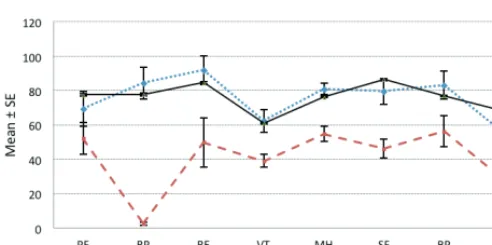
A cluster analysis on the set of patients identified two in-ternally homogeneous groups of patients (Table 1) which were statistically significantly different in the mean val-ues of domains investigated by the SF-36 qval-uestionnaire (p < 0.05). The group with the more favourable evaluation (Cluster 1) consisted of 8 patients, 44.4 per cent of the total set, with 95 per cent confidence limits from 21.5 to 69.2 per cent of patients. The second group (Cluster 2) consist-ed of the remaining 10 patients. The processconsist-ed question-naire data and their statistical interpretation proved that patients included in Cluster 1 did not differ statistically significantly in quality of life from the reference set ac-cording to Jenkinson et al. (14). They differed only in the GH domain which for these patients was significantly low-er (worse). The patients of Clustlow-er 2 achieved significantly lower (worse) values than the reference set in all 8 meas-ured domains (Table 2, Figure 2).
The analysis of the set of patients as a whole can be summarized (Table 2):
a) Perception of PF (p < 0.01), RP (p < 0.01), SF (p < 0.01) and GH (p < 0.01) was significantly worse within the framework of the observed indices.
b) RE, MH, VT and BP did not differ statistically sig-nificant from the same indices in the population of men
Tab. 1 Domains of SF-36 in two groups of patients identified by cluster analysis.
Patients: Cluster 1 Patients: Cluster 2
Mean n SD SE Mean n SD SE
PF 69.4 8 28.84 10.20 52.0 10 29.27 9.26
RP 84.4 8 26.52 9.38 2.5 10 2.50 0.79
RE 91.6 8 23.58 8.34 49.9 10 45.14 14.27
VT 62.5 8 18.71 6.61 39.0 10 11.74 3.71
MH 81.0 8 9.26 3.27 54.8 10 13.73 4.34
SF 79.6 8 21.06 7.45 46.1 10 17.73 5.61
BP 83.1 8 23.29 8.23 56.2 10 28.61 9.05
GH 55.0 8 21.55 7.62 27.8 10 12.56 3.97
n = size of the sample, SD = standard deviation, SE = standard error of mean
Tab. 2 Domains of SF-36 in patients compared with the set of reference values according to Jenkinson (14).
Patients HK Reference set – Jenkinson 55–64 p-value
Mean n SD SE Mean n SD SE
PF 59.7 18 29.58 6.97 PF 77.4 1365 22.98 0.62 0.0013 RP 38.9 18 38.00 8.96 RP 77.7 1474 36.55 0.95 0.0000 RE 68.4 18 41.97 9.89 RE 84.5 1470 31.31 0.82 0.0321 VT 49.4 18 17.74 4.18 VT 60.9 1470 20.98 0.55 0.0215 MH 66.4 18 21.61 5.09 MH 76.1 1439 18.03 0.48 0.0238 SF 61.0 18 25.32 5.97 SF 86.4 1512 22.62 0.58 0.0000 BP 68.2 18 29.02 6.84 BP 76.8 1503 24.48 0.63 0.1443 GH 39.9 18 19.01 4.48 GH 68.0 1456 22.46 0.59 0.0000
and women of comparable age without serious morbidity (p < 0.01) as shown in Table 1 and Figure 1.
DISCUSSION
Processing of data from postoperative answers to the SF-36 questionnaire can provide certain information about the general health state of our patients in comparison with a similar population group of comparable age and without signifi cant co-morbidity (14). It is without doubt diffi cult to obtain an objective view of the whole problem since questionnaires cannot be structured to elicit feel-ings across the whole spectrum of quality of life, nor can measurement and interpretation of responses be made entirely consistent. As discussed in the Introduction sec-tion of this paper, objective evaluasec-tion of quality of life is usually achieved through questionnaires which use direct or multiple-choice questions to assess personal perception in various fi elds of life.
For assessment of the quality of life of our patients we used the SF-36 questionnaire, which is widely used in various branches of medicine and is highly regarded for its ability to capture also the social dimension of life (15). Based on currently published information it is obvious that the quality of life of surgical patients can be quan-tifi ed for the purpose of objective evaluation of the work of the surgeon. However, it is a matt er of discussion with which subset of the population the results should be com-pared. Th ere are published fi ndings for young and healthy groups (13), or for groups suff ering from certain co-mor-bidities (9), and the results can be also compared to the subset of population of similar age without signifi cant co-morbidity. Such a subset has been selected for our clin-ical study (14).
When using statistical tests to compare individual do-mains of health between patients and a reference set it is desirable to reduce the level of signifi cance of the individual tests so that the overall (familywise) level of signifi -cance (alpha) of the whole presentation is 0.05 (Table 2). Th en, according to the Bonferroni correction in each test a p-level of 0.00625 should be considered, and according to the Sidak test a p-level of 0.006391 should be consid-ered. Using these criteria the probability is below these values in domains PF, RP, SF and GH, and hence there are signifi cant diff erences between the compared groups in
these domains; in the other domains there is no signifi -cant diff erence.
Cluster analysis identifi ed two clusters of patients with diff erent mean characteristics as measured by the SF-36 questionnaire, and their proportions were estimated. Cluster 1 comprised 44.4 per cent (21.5–69.2 per cent) of the patients; with the exception of the GH domain their characteristics were wholly comparable with our refer-ence set of persons of similar age and without co-mor-bidity. However, in the GH domain this group does score signifi cantly worse. Th e remainder of the patients could all be assigned to Cluster 2, which in general diff ers signif-icantly from Cluster 1 as well as from the reference set; it comprised 55.6 per cent of the total patients with interval of reliability between 30.8 and 78.5 per cent.
Several other papers have dealt in a similar way with evaluation of the quality of life of patients: obese patients looking or not looking for surgical solutions, patients with anorectal malformations (11), patients with gastrointesti-nal symptoms aft er irradiation (12), those with permanent ileostomy, and patients aft er operation for Crohn disease (6). It is the task of the authors to make objective assess-ment of both comfortable and uncomfortable phases in the life of a patient in a particular pathological state, and to search for the causes of problems; the task is thereaft er to apply the results of such analyses of treated patients in or-der for example to show whether an amended therapeutic methodology leads to improvement in the quality of life.
CONCLUSIONS
From the surgical point of view we can claim that the func-tional states of the repaired bowels and abdominal walls were fully satisfactory in all 18 patients. Th e cosmetic im-pact of the operation is certainly signifi cant, but with re-spect to the patient’s return to a relatively active life it is less important.
Statistical processing of SF-36 questionnaire results has revealed that the general state of the patients aft er ex-tensive surgery and demanding complex therapy follow-ing abdominal catastrophes endangerfollow-ing their lives may be either quite satisfactory or worse (see the division of the set into clusters) in comparison with the population without signifi cant chronic disease. Physical functions and their restrictions, mental state and general health Fig. 1 SF-36: Comparison of Jenkinson’s sample characteristics with
evaluated for the whole set of patients are statistically significantly worse than for the reference set of the popu-lation of similar age without significant health difficulties. In the fields of emotional state, vitality, psychological state and pain state there is either no significant difference from the same-age group or are insignificantly worse. With-in the set of patients was identified a subset of 44.4 per cent (21.5–69.2 per cent) whose mean values differ from the reference set only in the domain of GH; in the other domains there was no significant difference from the ref-erence population of comparable age. However, a second subset of patients (55.6 per cent) (30.8–78.5 per cent) ex-hibited significantly worse characteristics in all measured domains than those in the reference set.
ACKNOWLEDGMENTS
This work was supported by research project PROGRES Q40/04, Charles University, Prague, Czech Republic.
The authors are grateful to Ian McColl, MD, for assis-tance with the manuscript.
REFERENCES
1. Draus JM, Huss SA, Harty NJ, Cheadle WG, Larson GM. Enterocutane-ous fistula. Are treatments improving? Surgery 2006; 140(4): 570–6.
2. Evenson AR, Fischer JE. Current management of enterocutaneous fistula. J Gastrointest Surg 2006; 10(3): 455–64.
3. Visschers RGJ, Olde Damink SWM, Winkens B, Soeters PB, van Ge-mert WG. Treatment strategies in 135 consecutive patients with en-terocutaneous fistulas. World J Surg 2008; 32: 445–53.
4. Fischer PE, Fabian TC, Magnotti LJ, et al. A ten-year review of entero-cutaneous fistulas after laparotomy for trauma. J Trauma – Injury Infect and Crit Care 2009; 65(7): 924–8.
5. Sobotka L, Manak J, Vyroubal P, et al. Successful treatment of surgi-cal abdominal wounds complicated by multiple bowel fistulas with a combination of total parenteral nutrition, hyaluronan-iodine com-plex and delayed surgery: results of a monocentric experience. Nu-tritional Therapy & Metabolism 2008; 26: 1–7.
6. Sobotka L, Maňák J, Vyroubal P, et al. Komplexní léčba abdominál-ních katastrof. Interní Med 2008; 10: 291–4.
7. Khorsan R, Coulter ID, Hawk C, Choate CG. Measures in chiropractic research: Choosing patient-based outcome assessments. J Manipula-tive Physiol Therapeut 2008; 31(5): 355–75.
8. van Nunen AMA, Wouters EJM, Vingerhoets JJM, Hox JJ, Geenen R. The health-related quality of life of obese persons seeking or not seeking surgical or not-surgical treatment: a meta-analysis. Obesity Surgery 2007; 17: 1357–66.
9. Rosenberger J, Van Dijk JP, Nagyova I, et al. Predictors of perceived health status in patients after kidney transplantation. Transplanta-tion 2006; 81(9): 1306–10.
10. Rosenberger J, van Dijk JP, Nagyova I, et al. Do dialysis- and trans-plantation-related medici factors affect perceived health status? Nephrology Dialysis Transplantation 2005; 20(10): 2153–8.
11. Goyal A, Williams JM, Kenny SE, et al. Functional outcome and quali-ty of life in anorectal malformations. J Pediatr Surg 2006; 41: 318–22.
12. Olopade FA, Norman A, Blake P, et al. A modified inflammatory bow-el disease questionnaire and the Vaizey incontinence questionnaire are simple ways to identify patients with significant gastrointestinal symptoms after pelvic radiotherapy. Br J Cancer 2005; 92(9): 1663– 70.
13. Skalská H, Sobotík Z, Jezberová D, Mareš J. Use and evaluation of the Czech version of the SF-36 questionnaire self-reported health status of medical students. Cent Eur J Publ Health 2000; 2: 88–93.
14. Jenkinson C, Coulter A, Wright L. Short form 36 (SF 36) health survey questionnaire: normative date for adults of working age. BMJ 1993; 306: 1437–40.