35
RELATIONSHIP BETWEEN MANAGEMENT INFORMATION
SYSTEMS (MIS) AND LEAN MANAGEMENT
Farhang Khallaghdoost Nejati, Kourosh Rajeiyan, Reza Hajati, Hamid Reza Safari, Mohammad Rashed
1,2,3,4
M.A. Student of Business Management, Rasht Branch, Islamic Azad University, Rasht, Iran
Abstract
In today's world of information technology effectiveness and efficiency of the information made possible. Studies and research show that information technology increases the ability of organizations and facilitate the administrative process and increase efficiency of labor and management. The research method used in this study is descriptive –correlation and in term of objective is applied. The statistical population included all active industries in the industrial city of Rasht that are 150 units of industrial activity that 76 industrial units were introduced as entrepreneurial unit. Results of this research indicate that there is significant and positive relationship between Lean management and information systems management. Also stepwise regression method tries to predict the five variables of MIS on the variable of Lean management.
Keywords: Information Systems Management, Lean management, Six Sigma
1. INTRODUCTION
Since any decision-making and policy for development organization in use of management information systems requires awareness of current fitness level in organizations. Thus it requires a model to assess the level readiness in organizations moving towards information systems. Management information systems provide a general framework that other information systems are compatible with each other based on it. Now management information system is considered as a collection of sub-systems that In case of need be performed. But it is according to the general plan, standards and procedures for information systems management. So instead of a management information system single and total, organization can have a lot of relevant information systems that management needs provide in different ways and in different levels. Experience shows that establishment of a fully integrated system is very difficult and perhaps impossible. Because there are many factors that must be considered simultaneously and combined and maintenance of such a system is difficult (Eslami, 2008, p7).
The current field of business provides the new image of the organization that with this new approach, the organization is set of processes that their goal is to create value for the customer and creating value for customers requires creating value in their organizations. Enterprise application that wants to follow above approach is in first step to enter the Sigma field and the next step is process of improvement to achieve the Six Sigma level, means 4/3 error in million
opportunities. Basic concepts of lean management hide in eradicate waste and the value
making. Lean management is an approach to increase productivity and value making
consistently and minimize costs and losses;in this way a gateway to the land of the Sigma can
be removing defects, wastes and errors evidenced by rapid methods, such as lean management
concepts and techniques.Because to increase the rate of Sigma is a need exponential increase
36
relationship between establishment of management information systems and lean management in industries of industry city in Rasht.
2. STATEMENT OF PROBLEM
One of the names the current period of human life is the information age and or the age of information and communication. The reason for naming is very attention and a wide range of activities that at the time in the field of collection, processing and transfer of information was done and is done (Bahan, 2008, p 119). Management information systems reform and develop for compliance with the requirements of managers. Finally, position of management information systems as a major field using computers was strong. Management information system helps in two major ways in problem solving: a source of information provide in the organization region and also helps to identify and understanding problem. The main weakness of the management information system is that anyone special needs do not solve estimated the problem. Often management information system does not provide the detailed information required. The concept of decision support systems is created in response to such a need (Mak Lloyd's, 2008). When the product is first defined, the most important task in the determination of value is based on the amount of resources and energy needed to manufacture a product that meets specifications and features of certain target cost to be determined, if only the waste of two visible and the process is omitted(Colum,2009).Management Information System is a system that environmental data collected and data exchange and enterprise operation records and then filter, organize, and select them and to provide information to managers and provide tools for managers that produce information needed (Kraft et al, 2004). First Infrastructure action for the institutionalization of Lean management in an organization is to teach these concepts to its staff (Mostajeran, 2008). The model of lean system is based on the main three columns leadership, structure and culture that all of them are focused satisfaction and demands of stakeholders such as customer and employees. Lean leadership: finds the problem and notifies others of it. With their consultation can cause aims to overcome the problems and others free to find a solution for the problem. Lean culture: all employees are aware of vision that organization has been drawn from their future and all in it involved. Their vision is on customer and their wants and expects. Lean structure: flat organizational structure, staff cooperation away from the task, and the formation of multi-professional team. Organizations to become lean economic entity should provide suitable field for the institutionalization of lean thinking at all levels , institutionalization of this thinking is closely related to attitudes and values of the organization and its employees. Lean thinking must become a culture in the organization and understand how commitment of members to the fundamental values and basic of the organization (such as lean thinking) is greater and most members are believed to these values, thus culture and values is stronger and has more impact on behavior of the organization's members, There is more agreement about the mission of the organization in a strong culture and unity of purpose is caused correlation, loyalty, organizational commitment and reduction of service abandonment. In a strong culture, management to guide staff behavior has less need rules and formal procedures because when employees accept the organization's culture, behavior guidelines will be internal. However, because people of organizations accept cultural values they should know them (Melan, 2007).
37
3. RESEARCH HYPOTHESES
Main Hypothesis
There is relationship between establishment of management information systems and lean management.
This hypothesis has been converted into five separate sub-hypothesis as follows:
1- There is relationship between empowerment of human resources and establishment of management information systems.
2- There is relationship between engineering and restructuring and establishment of management information systems.
3- There is relationship between organizing IT infrastructure and establishment of management information systems.
4- There is relationship between use of information systems and establishment of management information systems.
5- There is relationship between open communication channels and establishment of management information systems.
4. RESEARCH METHODOLOGY
Present methods in terms of objective are applied and methods of data collection are descriptive (non-pilot) and are considered the branches of field studies. The field environment of this research is active companies in Rasht Industrial City. As noted the statistical population is 150 companies in industrial city of Rasht. If the population size is 150, according to Morgan, should be a minimum of 108 samples. But because of the 150 companies in the industrial city of Rasht, only 76 companies based on government company (companies in industrial town of Guilan province) are as active companies, some factors considered these companies include: high employment, creating economic and social movement in society, new technology transfer from developed countries, creating new industries, identifying and developing new markets and ... that almost each 76 companies have relative these features.
5. DATA ANALYSIS
Testing the Main Hypothesis of The Research
H: there is relationship between establishment of management information systems and lean management.
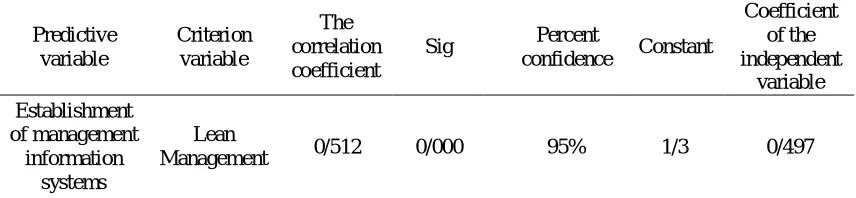
To investigate the relationship between variables of this hypothesis was used the Pearson correlation test according to qualitative variables that the results of it are presented in the following tables.
Table 1 - Correlation of management information systems and Lean Management Coefficient
of the independent
variable Constant
Percent confidence
Sig The
correlation coefficient Criterion
variable Predictive
variable
0/497 1/3
95% 0/000
0/512 Lean
Management
Establishment of management
information systems
38
in government organizations in Guilan province. In other words in 95% confidence the main hypothesis is confirmed. Also based on the results obtained of Pearson's correlation coefficient and P-Value of less than 0/05 have been determined that there is positive and
direct relationship between two variables. Thus it can be said based on R2 that amount of 49/7
percent of lean management changes in addressed industry can describe and predict by changing the establishment of management information systems in the present study.
Testing First Sub- Hypothesis of the Research
H1: there is relationship between empowerment of human resources and establishment of
management information systems.
Table 2 - Correlation of Empowerment of human resources and Establishment of management information systems
Coefficient of the independent
variable Constant
Percent confidence
Sig The
correlation coefficient Criterion
variable
Predictive variable
0/329 1/2
95% 0/000
0/402 Establishment
of management
information systems Empowerment
of human resources
According to the above results, there is a direct relationship between empowerment of human resources as amount of 40/2% and the variability of establishment of management information systems in government organizations in Guilan province. In other words in 95% confidence first sub-hypothesis is confirmed. Also based on the results obtained of Pearson's correlation coefficient and P-Value of less than 0/05 have been determined that there is positive and direct relationship between two variables. Thus it can be said based on R2 that amount of 32/9 percent of establishment of management information systems changes in addressed industry can describe and predict by changing empowerment of human resources in the present study.
Testing Second Sub- Hypothesis of the Research
H2: there is relationship between engineering and restructuring and establishment of
management information systems.
Table 3 - Correlation of engineering and restructuring and establishment of management information systems
Coefficient of the independent
variable Constant
Percent confidence
Sig The
correlation coefficient Criterion
variable
Predictive variable
0/652 3/2
95% 0/000
0/703 Establishment
of management
information systems Engineering
39
According to the above results, there is a direct relationship between engineering and restructuring as amount of 70/3 % and the variability of establishment of management information systems in government organizations in Guilan province. In other words in 95% confidence second sub-hypothesis is confirmed. Also based on the results obtained of Pearson's correlation coefficient and P-Value of less than 0/05 have been determined that
there is positive and direct relationship between two variables. Thus it can be said based on R2
that amount of 65/2 percent of establishment of management information systems changes in addressed industry can describe and predict by changing engineering and restructuring in the present study.
Testing Third Sub- Hypothesis of the Research
H3: there is relationship between organizing IT infrastructure and establishment of
management information systems.
Table 4 - Correlation of organizing IT infrastructure and establishment of management information systems
Coefficient of the independent
variable Constant
Percent confidence
Sig The
correlation coefficient Criterion
variable Predictive
variable
0/679 3/2
95% 0/000
0/779 Establishment
of management
information systems Organizing
IT infrastructure
According to the above results, there is a direct relationship between organizing IT infrastructure as amount of 77/9 % and the variability of establishment of management information systems in government organizations in Guilan province. In other words in 95% confidence third sub-hypothesis is confirmed. Also based on the results obtained of Pearson's correlation coefficient and P-Value of less than 0/05 have been determined that there is positive and direct relationship between two variables. Thus it can be said based on R2 that amount of 67/9 percent of establishment of management information systems changes in addressed industry can describe and predict by changing organizing IT infrastructure in the present study.
Testing Fourth Sub- Hypothesis of the Research
H4: there is relationship between use of information systems and establishment of
management information systems.
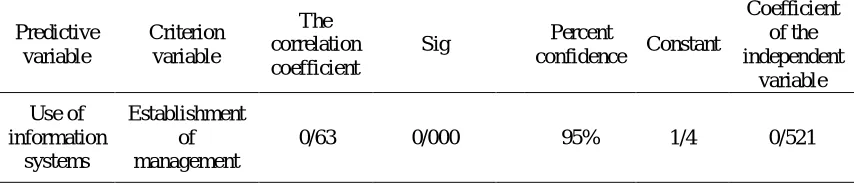
Table 5 - Correlation of use of information systems and establishment of management information systems
Coefficient of the independent
variable Constant
Percent confidence
Sig The
correlation coefficient Criterion
variable
Predictive variable
0/521 1/4
95% 0/000
0/63 Establishment
of management Use of
40
information systems
According to the above results, there is a direct relationship between use of information systems as amount of 63 % and the variability of establishment of management information systems in government organizations in Guilan province. In other words in 95% confidence fourth sub-hypothesis is confirmed. Also based on the results obtained of Pearson's correlation coefficient and P-Value of less than 0/05 have been determined that there is positive and direct relationship between two variables. Thus it can be said based on R2 that amount of 52/1 percent of establishment of management information systems changes in addressed industry can describe and predict by changing use of information systems in the present study.
Testing fifth sub- hypothesis of the research
H5: there is relationship between open communication channels and establishment of
management information systems.
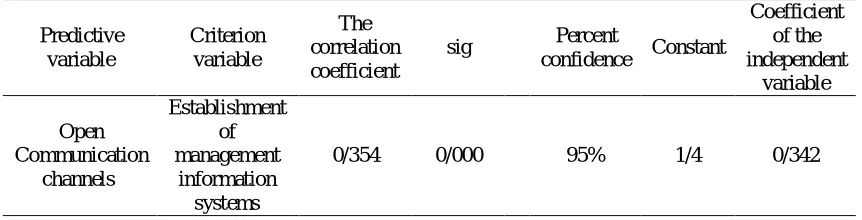
Table 6 - Correlation of open communication channels and establishment of management information systems
Coefficient of the independent
variable Constant
Percent confidence
sig The
correlation coefficient Criterion
variable
Predictive variable
0/342 1/4
95% 0/000
0/354 Establishment
of management
information systems Open
Communication channels
According to the above results, there is a direct relationship between communication channels open as amount of 35/4 % and the variability of establishment of management information systems in government organizations in Guilan province. In other words in 95% confidence fifth sub-hypothesis is confirmed. Also based on the results obtained of Pearson's correlation coefficient and P-Value of less than 0/05 have been determined that there is positive and direct relationship between two variables. Thus it can be said based on R2 that amount of 34/2 percent of establishment of management information systems changes in addressed industry can describe and predict by changing Communication channels open in the present study.
6. CONCLUSIONS AND RECOMMENDATIONS
41
or service delivery. Therefore this process for leader organization seems inevitable. The following recommendations are In order to prove hypotheses:
Given managers towards designers and operators has the central role in the development of management information systems in organizations. Change their attitudes and beliefs about computer information systems and management information systems are recommended especially. For this purpose, government and organizations managers should create these changes in attitudes during a short time in their managers with the predictions of a set of provisions (Use of information systems).
- Training of managers (users) and system operators are important in the process of management information systems. System designers must predict appropriate training according to the characteristics system managers and operators to provide the possibility of their most satisfying (Engineering and restructuring).
- Attention to positive impact of skills, expertise and knowledge power of leaders in success the use of these systems in organizations, on the one hand and The low levels of this characteristic in operators (MIS) in organizations, on the other hand, Development and training of operators to ensure completion and enhancement in their recommended (organizing IT infrastructure and Empowerment of human resources).
- Insufficient attention to documenting all stages in the process of creation (MIS) prevents future problems. The method of prototyping is a tool of major and appropriate for applying management information systems in organizations of Iran. With these tools can provide a good communication between designers, operators and users (managers) as visual and practical. At the time by this method can be developed Application of information management systems to comply with the basic principles of lean management (establishment of Lean culture of thinking) in government organizations (Communication channels open).
REFERENCES
Behan, Kate; Holmes, Diana.(2008). Understanding information Technology, translate to Persian by Majid Azerakhsh Mehrdad, publication of Samt,Tehran.
Colum, Shelly,(2009), Social capital and leadership development Building stronger leadership through enhanced relational skills, Leadership & Organization Development Journal, Vol. 30 No. 2, pp. 152-166.
Islam,Y; Feizi, , K. (2008), designed to improve the efficiency of models, emphasizing the role of information technology, Journal of Daneshvar, No. 32.
Kraft, Donald; Boyce, Bert R(2004), “Operations research for libraries and information agencies…. Sandiego”, academic press.
Melan, Eugene H, (2007) , “Process Management, A unifying framework for improvement”, National Productivity Review 8, No 4 (Autumn).
Mostajeran, Ali, (2008), Management Information Systems, Journal Accountants, Institute of Certified Accountants, No. 113.