Copyright © 2013 (Alcides Velasquez, [email protected]). Licensed under the Creative Commons Attribution Non-commercial No Derivatives (by-nc-nd). Available at http://ijoc.org.
Digital Divide in Colombia: The Role of Motivational
and Material Access in the Use and Types of Use of ICTs
ALCIDES VELASQUEZ
1Pontificia Universidad Javeriana
Many individuals are currently excluded from the benefits that ICTs might bring (Selwyn, 2004), as the differences in access to these technologies, known as the digital divide, can hinder individuals’ acquirement of different resources (DiMaggio, Hargittai, Celeste, & Shafer, 2004). The first studies on the digital divide defined it as a lack of physical access to these technologies (Yu, 2006). That research interpreted this concept in terms of access to the infrastructure and content of the producers (Colby, 2001), and measured the concept as connected or not connected to the Internet (Selwyn, 2004).
Further conceptual developments (Di Maggio et al., 2004; Selwyn, 2004; Van Dijk & Hacker, 2003; Warschauer, 2002) advocated for a broadening of the concept, arguing that access should not be considered as a dichotomous variable and that physical access was just one of the stages in the process of access to ICTs. Such conceptualization argues that in the process of access, other additional aspects might influence the use and the type of use of these technologies. Van Dijk (2005) suggested the notion of motivational access, and that it can be considered as an antecedent in the process of ICTs use and adoption. The present study takes into account these considerations and examines, using a randomly selected sample of Colombian respondents, how different characteristics of material access, such as the speed of connection and the opportunities of access, as well as motivational variables, affect whether and how individuals use ICTs.
The relationship between material access and types of use is relevant in the Colombian context. Although the penetration of the Internet in Colombia has increased greatly, there is little scholarly attention regarding how ICTs are currently used in Latin America (Pick, Garcia, & Navarrete, 2007). Furthermore, starting in the 1990s and up until today, successive Colombian governments have implemented policies with the aim of increasing connectivity levels in the country. After the turn of the century, several government programs were designed to increase and improve people’s access to the
Internet, which included projects with the goal of encouraging the use of ICTs in education, businesses, and interaction with the government (Tamayo, Delgado, & Penagos, 2007, p. 38).
At first, these policies focused on the infrastructure, since material access to the technology is fundamental for any policy aimed at the popularization of the use of the Internet. However, although the different government programs aimed at offering public access to the Internet, such as cybercafés, public libraries, or telecenters, have played an essential role in ICT policies, the issue of access has started to become secondary to the problem of the use and types of use of this technology (Barón & Gomez, 2012).
Therefore, successive elected governments in Colombia have begun to combine different strategies to ensure access to ICTs and encourage their use. The current plan is to have, by 2019, all citizens connected to the Internet and using ICTs to improve the country’s competitiveness and social inclusion (Paz Martinez, 2009). Therefore, studies that broaden the concept of access and relate it to the use and types of use of the Internet can provide worthwhile information for the assessment and design of government programs.
Literature Review
Motivational Access
The concept of motivation is defined in this case as the reasons that move an individual to access, use, and engage with ICTs. Some theories such as uses and gratifications (Palmgreen, Wenner, & Rosengren, 1985) have conceptualized motivations in terms of needs and gratifications, while others, such as Social Cognitive Theory (SCT) (Bandura, 1986), propose the notion of expected outcomes and behavioral incentives in place of motivations. In any case, motivations have been generally ignored in digital divide theory. It was assumed that people would actually want to use the technology and would naturally identify a need for using it. However, Van Dijk (2005) suggested motivational access as an antecedent for other dimensions of access, such as physical or material access and usage access. In this sense, motivational access would be one of the antecedents of the subsequent phases that take part in a process of access and use of ICTs.
According to Van Dijk (2005), several factors affect and shape the existence of motivations to use ICTs, some of which are a lack of interest, time, or money, low computer skills, or lack of self-confidence. Once an individual’s motivation for using ICTs has been established, the next phases of the process can take place.
The present study examines motivational access as the value that individuals give to the Internet as a source of information, in other words, in terms of expected outcomes, much as Bandura’s SCT proposes (1986, 1997). Other studies (Rojas & Puig-i-Abril, 2009) have examined antecedents to Internet access—including demographic factors—in Colombia. The present study explores the relationship between motivational access and Internet usage. The following research question is set forth:
Types of Internet Use
Several researchers have pointed out an important distinction between material or physical access and actual use of ICTs. Access to technology does not necessarily imply use of ICTs and, furthermore, there are different types of use of ICTs (Selwyn, 2004). According to Hargittai (2008), differences in the uses of ICTs have important implications for life outcomes. The examination of how ICTs are used among those who have “crossed the digital divide fault line to the land of the connected” (Hargittai, 2008, p. 939) is of central importance, since the interest of research on the digital divide is focused largely on inequalities regarding access and use of ICTs. An approach that examines the different range of activities, without distinguishing between “those who go on line for no more than checking sports scores or TV schedules, and those who use the medium for learning new skills, finding deals and job opportunities, participating in political discussions, interacting with government institutions, and informing themselves about health matters” (p. 939) will not be able to identify where the differences lie.
Livingstone and Helsper (2007) proposed an interval scale for the “use” construct, with gradations from non-use, to low, to frequent use, but they take into account the opportunities taken by users. The authors analyzed findings from a survey of children and young Internet users in the United Kingdom, and how the quality of access and use were related to inequalities by age, gender, and socioeconomic status. The study focused on inequalities in the take up of online opportunities. DiMaggio et al. (2004) also took into account the uses dimension, although they termed the concept as “variation in use,” and differentiated between recreational and welfare, political, and social capital-enhancing uses. Hargittai and Hinnant (2005) approached the subject in a similar way. They suggested a distinction between recreational and capital-enhancing uses of the Internet, and argued that capital-enhancing activities online were more likely to offer users the possibility of social mobility.
Although it makes sense to distinguish uses that might enhance the human, social, and financial capital resources of individuals, it can be argued that all types of uses can bring positive life outcomes, as they might improve the skills of users and serve as entry points for a wider variety of uses. For example, Kolko and Putnam (2009) found evidence to suggest that playing computer games, a form of use for mere entertainment, was an entry point for using the Internet and acquiring computer skills. They studied how ICTs were first accessed, used, and appropriated by users of Internet cafés in Central Asia. Their findings suggest a process in which meaningful and entertainment uses interrelate and affect one another through skills and motivational access.
Rojas and Puig-i-abril (2009) found that the most prevalent activities of Internet users in Colombia were checking e-mail, consuming entertainment content, chatting with friends, and consuming news and information. The present study examines these activities, looking for common factors among the activities in order to identify the different types of Internet use in which people engage. The following research question is formulated:
Physical Access
The first digital divide studies defined the concept as “having”/“not having” access to the Internet. The purpose of these studies was to determine the penetration levels of the Internet in the United States by tracking access at home. However, these studies did not consider other possible access points such as libraries, schools, or workplaces (Bertot, 2003).
DiMaggio et al. (2004) and Hargittai (2008) conceptualized access as “autonomy of use,” and defined it as the freedom of choice to use digital media at the moment and place one decides to. Home access provides more freedom than having to access the Internet at a telecenter or Internet café. Likewise, having to access the Internet from a public library is qualitatively different from accessing it from home. People who access from a place different from home have to drive, walk, or use the public transportation system; compete with others for time on the Internet; and take into account other limitations (Hargittai, 2008). Therefore, inequality in autonomy of use is another dimension of access that should be considered when addressing the issue of information inequality. The following research question is posed:
RQ3: What is the relationship between autonomy of use and types of Internet use?
Another aspect related to physical access is the technical characteristics of the Internet, such as the connection speed. According to DiMaggio et al. (2004), previous research studies found that technical differences such as connection speed, quality, the version of the software, and hardware capacity are related to the benefits users get from their access to the Internet. Issues of accessibility to certain websites and experience during navigation can have an impact on people’s use of the Web, with the result that they may spend less time spent online and have lower skills. For example, Warschauer (2003) found that in Egypt, although technology could benefit educational opportunities for the poor population, mere material access to computers and the Internet did not help advance educational opportunities. We propose the following research question:
RQ4: What is the relationship between technical access and types of Internet use?
Methods
Data and Sample
Colombia and the University of Wisconsin – Madison. Response rate was 83% for 1,064 completed surveys. Participants were offered a style pen as compensation for their participation.
Variable Measurements
Dependent variables. Internet use was measured as a dichotomous variable by asking participants whether they had used the Internet or not during the past 12 months (Yes = 54.7%; No = 45.3%).
Type of Internet use was measured by asking respondents about how frequently they performed a set of 13 activities online, such as using e-mail to keep in touch with friends and family, using e-mail to discuss politics, making purchases online, reading news online, discussing news online with others, chatting in discussion forums, visiting political blogs, paying utilities, looking for entertainment, looking at government information, and making transactions with government institutions, among others.
Independent variables. Autonomy of use was measured as an ordinal variable by asking participants whether they had used the Internet at home, work, or in a public place. The variable was calculated by adding the values for the individual responses corresponding to each of the places from which people might have accessed the Internet. The higher the number, the more autonomy of access they had.
Technical access was measured as a nominal variable by asking respondents about the type of Internet connection they used when connecting from home. Options included high-speed Internet or dial-up connection (High-speed = 76.5%; Dial-dial-up = 23.5%).
Expected outcomes were assessed with only one question that asked participants to rate on a five-point scale how much importance they placed on the Internet for getting information and news (M = 2.35, S.D. = 2.08).
Analysis and Results
The first research question, which asked about the role played by expected outcomes—measured in terms of the value given to the Internet for getting information—was examined through a logistic regression. In this way, we were able to understand the influence that the expected outcomes and a set of demographic variables had on using or not using the Internet.
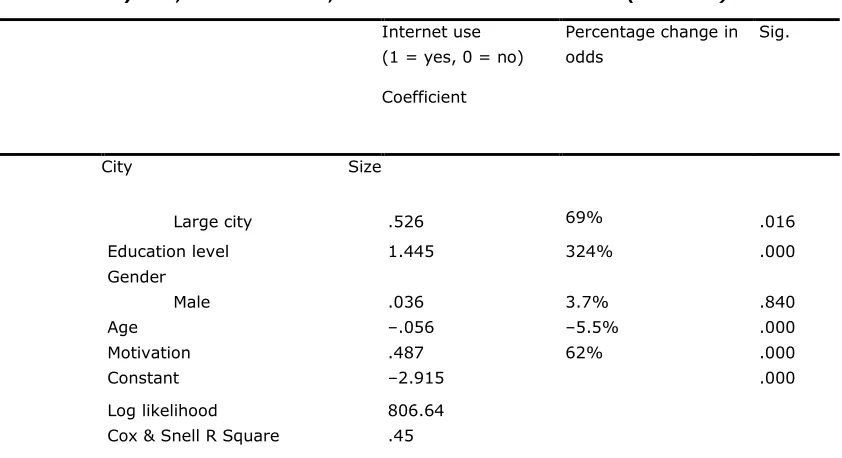
[image:6.612.99.520.347.576.2]Results of the logistic regression showed that the model explained 45% of the variance in the outcome variable. The analysis suggested that significant predictors of Internet use included living in a large city ( = .52, p < .05), education ( = 1.44, p < .001), age ( = –.056, p < .001), and expected outcomes ( =.487, p < .001). Living in a large city increased the odds of using the Internet by 69%. Individuals who had a higher level of education were more likely—odds increased by 324%—to use the Internet. Respondents who said they valued the Internet as a source of information and news had 62% higher odds of using the Internet. No significant difference was found between males and females in their odds of using the Internet.
Table 1. Logistic Regression Coefficients for the Effect of Age, Gender, City Size, Education Level, and Motivation on Internet Use (N = 1064).
Internet use (1 = yes, 0 = no)
Percentage change in odds
Sig.
Coefficient
City Size
Large city .526 69% .016
Education level 1.445 324% .000
Gender
Male .036 3.7% .840
Age –.056 –5.5% .000
Motivation .487 62% .000
Constant –2.915 .000
Log likelihood Cox & Snell R Square
The second research question was explored using an exploratory factor analysis. The scree-plot generated by the principal components analysis, and the results of this statistical test suggested the existence of three factors with eigenvalues larger than 1.0. The first factor explained 24.1% of the variance, the second 13.4%, and the third 13.1%. These three factors explained over 50% of the variance.
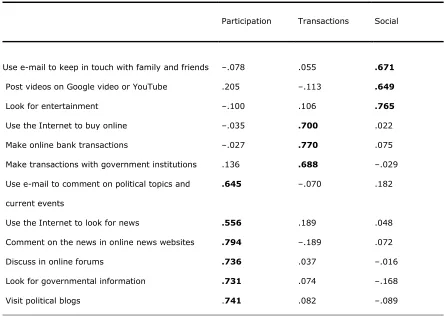
[image:7.612.83.528.265.581.2]A promax rotation was used for the final solution of the factors structure. One item (maintaining a blog or website) was eliminated because it had a cross loading above .3 in two factors. A principal components factor analysis using promax rotation of the remaining 12 items showed that three factors explained 52.8% of the variance. Factor loading matrix for the final solution is presented in Table 2.
Table 2.Rotated Factor Solution of Types of Internet Use.
Participation Transactions Social
Use e-mail to keep in touch with family and friends –.078 .055 .671
Post videos on Google video or YouTube .205 –.113 .649
Look for entertainment –.100 .106 .765
Use the Internet to buy online –.035 .700 .022
Make online bank transactions –.027 .770 .075
Make transactions with government institutions .136 .688 –.029 Use e-mail to comment on political topics and
current events
.645 –.070 .182
Use the Internet to look for news .556 .189 .048
Comment on the news in online news websites .794 –.189 .072
Discuss in online forums .736 .037 –.016
Look for governmental information .731 .074 –.168
Visit political blogs .741 .082 –.089
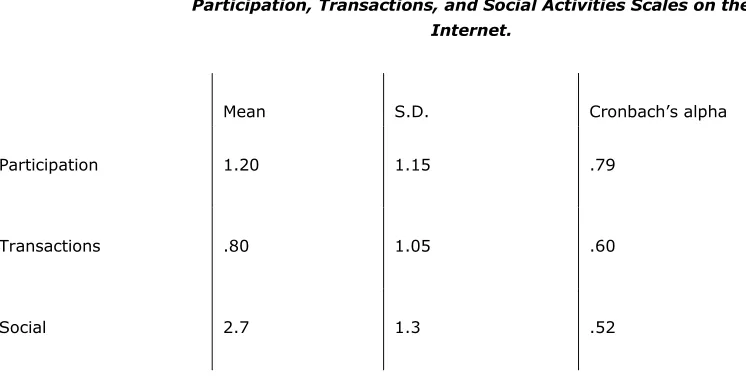
The three factors that resulted from the analysis were labeled “Participation,” which pertains to uses of the Internet that were related to political and civic engagement and that included activities such as online political discussion, retrieving of political and government-related information, and so forth; “Transactions,” which is related to online economic or financial transactions with private organizations or government institutions; and “Social,” which is comprised of activities such as posting videos online, looking for entertainment, and interacting with friends and family. Composite scores for each factor were created, based on the mean of the items that had the primary loading in each factor. Table 3 illustrates means, standard deviations, and alpha scores for each composite scale.
Table 3. Means, Standard Deviations, and Reliability for Participation, Transactions, and Social Activities Scales on the
Internet.
Mean S.D. Cronbach’s alpha
Participation 1.20 1.15 .79
Transactions .80 1.05 .60
Social 2.7 1.3 .52
Table 4. Regression Models of Autonomy of Use as Predictor of Types of Internet Use
(N=582).
Social Transactions Participation
Model 1 Model 2 Model 1 Model 2 Model 1 Model 2
City size
Large city -214*** -.205*** -.048 -.034 -.054 -.043
Education level .095** .070 .236*** .200*** .264*** .232***
Age -.351*** -.317*** -.107** -.057 -.150** -.108**
Gender (Male) .058 .045 .065 .046 .087 .071
Motivation .211*** .187*** .146** .110** .247*** .217***
Autonomy of use .104** .201*** .172**
R2 24% 26% 10% 13% 18% 19.3%
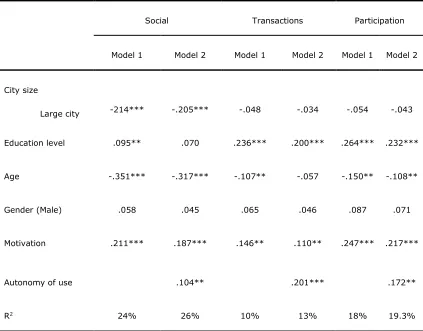
The first model explained 26% of the variance in social uses of the Internet. The first block included size of the city (= –.214, p < .001), education level ( = .095, b = p < .05), age ( = –.351, p < .001), and expected outcomes ( = .211, p < .001). However, no evidence for a significant difference between males and females was found. In the second block, education did not continue to be significant in the model. City size (b = –.205, p < .001), age ( = –.317, p < .001), expected outcomes ( = .187, p < .001), and autonomy of use (= .104, p < .001), which is our variable of interest, were all significant. By including this variable the model increased 2% in the explained variance of social uses of the Internet, thereby suggesting that autonomy of use has an effect on this type of Internet use.
The second model explained a total of 13% in the variance of transaction uses of the Internet. In the first block, only education ( = .236, p < .001), age ( = –.107, p < .05), and expected outcome ( = .146, p < .05) were significant predictors of the dependent variable. In this model, city size and gender did not influence the type of Internet use that was examined. In the second model, only education ( = .200, p < .001) and expected outcome (= .110, p < .05) continued to be significant. Autonomy of use had a significant effect (= .201, p < .001), and increased 3% in the variance explained.
The third model predicted participatory uses of the Internet and explained 19% of the variance in this type of Internet use. Significant variables were education ( = .264, p < .001), age (= –.150, p < .05), and expected outcomes ( = .247, p < .001). In the second model, the same variables remained significant, while autonomy of use ( = .172, p < .001) added 1% to the variance explained on participatory uses.
No significant difference existed among the subjects located in larger and less-populated cities regarding how they used the Internet, except for social uses of the Internet. Individuals who live in larger cities use the Internet for social purposes significantly less than individuals living in smaller towns. Education and age were important factors in all different types of use, showing that the more educated and the younger individuals are, the more ways in which they will use the Internet. The expected outcomes of Internet use, measured as the value given to the Internet as a source of information and news, also proved to be a significant factor when examining all types of Internet use. Although this variable only examined the value given to the Internet as a source of information and news, findings suggest that this particular attitude toward the Internet influences all types of use that were measured. Finally, those individuals who had more opportunities to access the Internet from different locations tended to use the Internet in more different ways. Results show that the autonomy of use increased with each of the different types of Internet use that were examined. Those individuals who accessed the Internet from more locations were more likely to use the Internet for social, participatory, and transactional purposes.
Table 5. Regression Models Examining Technical Access as Predictor of Types of Internet Use (N = 387).
Social Transactions Participation
Model 1 Model 2 Model 1 Model 2 Model 1 Model 2
City size
Large city –216*** –.218*** –.049 –.050 –.057 –.057
Education level .124** .126** .282*** .282*** .323*** .315***
Age –.347*** –.344*** –.095 –.095 –.137** –.143**
Gender (Male) .054 .053 .058 .046 .078 .071
Motivation .206*** .207*** .136** .136** .235*** .217***
Technical access –.025 –.002 .172
R2 24% 24% 11% 11% 20% 20%
The first model explained 24% of the variance. However, technical access, which is the variable of interest in this analysis, did not have any significant effect on the outcome variable. The first block in this model showed that city size (= –.216, p < .001), education ( = .214, b = p < .05), age ( = –.347, p < .001), and the expected outcome ( = .206, p < .001) had a significant effect on social uses. When technical access was added, the variance explained did not change, and the coefficients did not change drastically.
The second model explained only 11% of the variance of transactional uses. In the first block, only education ( = .282, p <.001) and expected outcomes ( =.136, p <.05) were significant predictors. When including technical access—measured in terms of the speed of the connection at home—the variance explained remained unaffected. The variable did not have a significant influence over transactional uses.
The third model examined participatory uses of the Internet and explained 20% of the variance of this type of Internet use. The only significant variables were education ( = .323, p < .001), age (= – .137, p < .05), and the value given to the Internet as a source of information ( = .235, p < .001). In the second model, the same variables remained significant, while technical access did not have a significant effect on this specific type of use.
In sum, results from the three previous models showed that education, age, and expected outcome were significant predictors of all types of Internet use. However, technical access (the connection speed used by individuals from their home to access the Internet) did not have a significant effect on the type of Internet use. No evidence was found that the type of connection, like high-speed connections such as broadband, influenced how individuals used the Internet. While having more opportunities of access influenced how the Internet was used, the speed of connection did not seem to affect how individuals used it.
Discussion
Based on the assumption that access to and use of the Internet can act as facilitators of economic, political, and social opportunities for individuals, this study examined the role that motivational variables, such as the value that individuals give to the Internet as a source of information, and variables related to the autonomy of Internet use—measured in terms of the opportunities to access these technologies from different places—and technical access (that is, the actual speed of the connection), play in the use and types of uses of the Internet. Findings suggest that motivations, defined as the expected outcome of using the Internet (getting information and news), acted as a significant predictor of whether an individual used the Internet or not. Additionally, this factor also influenced the three types of Internet use identified in this study through factor analysis. Motivational access also influenced not only whether but also how an individual might use the Internet.
individuals have regarding a technology might also play an important role in their use of it. In this study, the perception that the Internet is an important source of information and news had a significant effect on the actual use of this technology. This might suggest that individuals who decide to use the Internet most likely believe that it will serve a valuable function as a source of news and information. If this is the case, the public’s attitudes toward the Internet should be explored when the government implements policies directed toward offering opportunities of access to the public, especially when evidence that suggests that this attitude is also important for predicting all types of Internet use identified in the study.
Autonomy of use, which was measured as the number of places from which individuals accessed the Internet and which assessed the opportunities of access that individuals have, also seems to influence positively how the Internet is used. All types of use that were identified (that is, social, transactional, and participatory uses) are influenced by the number of places from which individuals can access the Internet. While those who have access from fewer places will employ the Internet less for each of the types of use, those who have more autonomy of access will employ it more for all three types of use. This points to an important research gap regarding how access to ICTs influences how technologies are actually used. Individuals who have more opportunities will expand more on the different types of use, and this might affect how people benefit from actual access to these technologies. While providing public access to the Internet in public libraries or telecenters can offer an improvement, the gap continues to exist when comparing those who have more opportunities of access. This divide suggests that while we assume that the Internet brings financial, educational, and social benefits to individuals, when we look at the amounts in types of use, more opportunities of access imply greater benefits.
Additionally, the influence of autonomy of use on how the Internet is used adds more evidence suggesting that access as a binary concept might not be enough to examine how the gaps in use are configured. An alternative to a “have/have not” dichotomy in the definition of the digital divide is the concept of autonomy of use. The results of this study might imply that while actual access to a computer might make a difference, more access translated into more autonomy can also have an important impact on how the Internet is used.
Limitations and Future Studies
References
Bandura, A. (1986). Social foundations of thought and action. Englewood Cliffs, NJ: Prentice Hall.
Bandura, A. (1997). Self-efficacy: The exercise of control. New York, NY: W. H. Freeman.
Barón, L. F., & Gómez, R. (2012). De la infraestructura a la apropiación social: Panorama sobre las políticas de las tecnologías de información y comunicación (TIC) en Colombia [From infrastructure to social appropriation: An overview of the information and communication technologies policies in Colombia ]. Revista Signo y Pensamiento, 31(61), 38–55.
Bertot, J. C. (2003). The multiple dimensions of the digital divide: More than the technology “haves” and “have nots.” Government Information Quarterly, 20(2), 185–191.
doi:10.1016/S0740-624X(03)00036-4
Colby, D. (2001). Conceptualizing the “digital divide”: Closing the “gap” by creating a postmodern network that distributes the productive power of speech. Communication Law and Policy, 6(1), 123–173. doi:10.1207/S15326926CLP0601_04
DiMaggio, P., Hargittai, E., Celeste, C., & Shafer, S. (2004). Digital inequality: From unequal access to differentiated use. In K. Neckerman (Ed.) Social inequality (pp. 335–400). New York, NY: Russell Sage Foundation.
Hargittai, E. (2002). Second-level digital divide: Differences in people’s online skills. First Monday, 7(4). Retrieved from http://firstmonday.org/issues/issue7_4/hargittai/index.html
Hargittai, E. (2008). The digital reproduction of inequality. In D. Grusky (Ed.), Social Stratification (pp. 936–944). Boulder, CO: Westview Press.
Hargittai, E., & Hinnant, A. (2005). New dimensions of the digital divide: Differences in young adults’ use of the Internet. Paper presented at the annual meeting of the International Communication Association, New York, NY. Retrieved from
http://www.allacademic.com/meta/p14980_index.html
Kolko, B., & Putnam, C. (2009). Computer games in the developing world: The value of non-instrumental engagement with ICTs, or taking play seriously. Paper presented at the 3rd International Conference on Information and Communication Technologies and Development, Doha, Qatar. Retrieved from http://ieeexplore.ieee.org/xpl/articleDetails.jsp?arnumber=5426705
Palmgreen, P., Wenner, L. A., & Rosengren, K. E. (1985). Uses and gratifications research: The past ten years. In K. E. Rosengren, L. A. Wenner, & P. Palmgreen (Eds.), Media gratifications research: Current perspectives (pp. 11–37). London, UK: SAGE Publications.
Paz Martinez, O. (2009). Reporte de politicas TIC en Colombia 2008 [Report of the ICTs policies in Colombia in 2008]. COLNODO. Retrieved from
http://www.colnodo.apc.org/documento.shtml?apc=f-xx-1-&x=188
Pick, J. B., Murillo, M. G., & Navarrete, C. J. (2007). Information technology research in Latin America: Editorial introduction to the special issue. Information Technology for Development, 13, 207–216. doi:10.1002/itdj.20070
Selwyn, N. (2004). Reconsidering political and popular understandings of the digital divide. New Media and Society, 6(3), 341–362. doi:10.1177/1461444804042519
Tamayo, C., Delgado, J. D., & Penagos, J. E. (2007). Hacer real lo virtual: Discursos del desarrollo, tecnologías e historia del internet en Colombia [Making real the virtual: Discourses of
development, technologies and history of the Internet in Colombia]. Bogotá, Colombia: CINEP, COLCIENCIAS, Editorial Pontificia Universidad Javeriana.
Van Dijk, J. (2005). The deepening divide: Inequality in the information society. Thousand Oaks, CA: SAGE Publications.
Van Dijk, J., & Hacker, K. (2003). The digital divide as a complex and dynamic phenomenon. The Information Society, 19(4), 315–326. doi:10.1080/01972240309487
Warschauer, M. (2002). Reconceptualizing the digital divide. First Monday, 7(7). Retrieved from http://firstmonday.org/issues/issue7_7/warschauer/index.html
Warschauer, M. (2003). Dissecting the “digital divide”: A case study in Egypt. The Information Society, 19(4), 297–304. doi:10.1080/01972240309490
Yu, L. (2006). Understanding information inequality: Making sense of the literature of the information and digital divides. Journal of Librarianship and Information Science, 38(4), 229–252.