pretreatment and enzymatic hydrolysis of
switchgrass
Li
et al.
R E S E A R C H
Open Access
Scale-up and evaluation of high solid ionic liquid
pretreatment and enzymatic hydrolysis of
switchgrass
Chenlin Li
1, Deepti Tanjore
1, Wei He
1, Jessica Wong
1, James L Gardner
1, Kenneth L Sale
2,3, Blake A Simmons
2,3and Seema Singh
2,3*Abstract
Background:Ionic liquid (IL) pretreatment is receiving significant attention as a potential process that enables fractionation of lignocellulosic biomass and produces high yields of fermentable sugars suitable for the production of renewable fuels. However, successful optimization and scale up of IL pretreatment involves challenges, such as high solids loading, biomass handling and transfer, washing of pretreated solids and formation of inhibitors, which are not addressed during the development stages at the small scale in a laboratory environment. As a first in the research community, the Joint BioEnergy Institute, in collaboration with the Advanced Biofuels Process
Demonstration Unit, a Department of Energy funded facility that supports academic and industrial entities in scaling their novel biofuels enabling technologies, have performed benchmark studies to identify key challenges associated with IL pretreatment using 1-ethyl-3-methylimidazolium acetate and subsequent enzymatic
saccharification beyond bench scale.
Results:Using switchgrass as the model feedstock, we have successfully executed 600-fold, relative to the bench scale (6 L vs 0.01 L), scale-up of IL pretreatment at 15% (w/w) biomass loading. Results show that IL pretreatment at 15% biomass generates a product containing 87.5% of glucan, 42.6% of xylan and only 22.8% of lignin relative to the starting material. The pretreated biomass is efficiently converted into monosaccharides during subsequent enzymatic hydrolysis at 10% loading over a 150-fold scale of operations (1.5 L vs 0.01 L) with 99.8% fermentable sugar conversion. The yield of glucose and xylose in the liquid streams were 94.8% and 62.2%, respectively, and the hydrolysate generated contains high titers of fermentable sugars (62.1 g/L of glucose and 5.4 g/L cellobiose). The overall glucan and xylan balance from pretreatment and saccharification were 95.0% and 77.1%, respectively. Enzymatic inhibition by [C2mim][OAc] at high solids loadings requires further process optimization to obtain higher
yields of fermentable sugars.
Conclusion:Results from this initial scale up evaluation indicate that the IL-based conversion technology can be effectively scaled to larger operations and the current study establishes the first scaling parameters for this
conversion pathway but several issues must be addressed before a commercially viable technology can be realized, most notably reduction in water consumption and efficient IL recycle.
Keywords:Scale-up, Pretreatment, Saccharification, Ionic liquid, High solid loading, Viscosity, Inhibition
* Correspondence: [email protected]
2Deconstruction Division, Joint BioEnergy Institute, Emeryville, CA, USA 3
Biological and Materials Science Center, Sandia National Laboratories, Livermore, CA, USA
Full list of author information is available at the end of the article
Background
The state of technology for the conversion of agricul-tural residues, perennial grasses, woody perennials and forest products for the production of biofuels is rapidly advancing [1,2]. Production of clean fermentable sugars for biofuel production requires pretreating the biomass to overcome the recalcitrance of lignocellulose and render the polysaccharides within the plant cell walls amenable to enzymatic saccharification [2-5]. Among the leading pretreatment technologies, certain ionic liquids (ILs) have recently been shown to efficiently fractionate biomass and provide clean sugar substrate for the production of etha-nol and other advanced biofuels [6-11].
Previous work has illustrated several favorable proper-ties of IL pretreatment for biomass deconstruction at the laboratory scale. These include efficient biomass dis-solution and disruption, reduced cellulose crystallinity and lignin content in the recovered product, enhanced biomass saccharification, and low toxicity and environ-mental impact [7,9-15]. However, most of the IL pretreat-ment data to date were obtained at low solid loading (3-10%) and at the 10 to 50 mL level of operation [16-18], which cannot be directly translated to industrially relevant scales. Thus, liter-scale experiments are a necessary inter-mediate step between bench- and pilot-scale in order to identify operational parameters and potential problems as-sociated with scale-up prior to pilot-scale and full-scale commercial operations. This is especially true as IL pre-treatment is a relatively new prepre-treatment technology and no scale-up systems have been described in the scientific literature.
The advantages of using high-solid loadings (≥15%) in the unit operations of lignocellulose conversion include increased sugar and ethanol concentrations and de-creased production and capital cost [4]. However using high-solids in the IL process at large-scale is still relatively unexplored, and more research is required to overcome certain challenges, including high quantity materials hand-ling, equipment mass transfer limitations, rheological problems, and solvent usage for washing, that are not as apparent at low solids loadings. In addition, high solid en-zymatic saccharification has been suggested to increase the initial conversion rate and final fermentable sugar con-centrations [19], but can exacerbate enzyme inhibition and pose rheological challenges that must be taken into account. Cellulase and hemicellulase inhibitors include products such as glucose and xylose, intermediates such as cellobiose, degradation products arising from pretreat-ment, solvents such as IL and ethanol (the latter used for precipitation or washing, as well as lignin due to non-specific binding and solubilized phenolics) [20-23]. De-toxification of lignocellulosic hydrolysates via biological, chemical and physical conditioning processes have been used to remove inhibitors prior to or after enzymatic
hydrolysis [23,24]. For IL pretreatment, post-washing of recovered materials with water or other solvents to dilute the IL to non-inhibitory levels and to remove other biomass-derived products has been investigated [20,22]. Other options include developing IL-tolerant enzymes and microorganisms to conduct single pot configuration for enzyme hydrolysis and microbial fermentation [25,26], or using lower IL concentration (20-50%, w/v) in water to pretreat biomass and potentially reduce the amount of washing required prior to enzymatic saccharification [21,27]. To date, all these potential alternatives have been limited to the lab-scale level of development and require more in-vestigation before scale-up can occur.
As a first in the research community, the Joint BioEnergy Institute (JBEI), in collaboration with the Advanced Biofuels Process Demonstration Unit (ABPDU), a Department of Energy (DOE)-funded facility that supports academic and industrial entities in scaling their novel technologies, have performed benchmark studies to iden-tify the key large-scale process issues associated with IL pretreatment and subsequent saccharification. Building on the small scale optimization data, the scope of the current study encompasses the following aims relevant to asses-sing IL pretreatment for biofuel production: 1) evaluating IL pretreatment and subsequent enzymatic saccharifica-tion for high-solids loading at liter scales; 2) understand-ing the rheological properties of IL pretreated biomass that affect material handling during process integration; 3) identifying the critical requirements of the washing unit operation to minimize inhibition; 4) tracking the material and energy flow for product/solvent and en-ergy recovery.
Results and discussion Scale up of IL pretreatment
Certain ILs, such as 1-ethyl-3-methylimidaolzium acetate ([C2mim][OAc]), can dissolve a wide range of feedstocks
at solids loadings less than 5% (w/w) ([9,16]. However, the large amounts of relatively expensive [C2mim][OAc])
required for effective reduction of biomass recalcitrance to improve subsequent rates and yields of enzymatic hy-drolysis is a major concern [18]. Thus, higher solid load-ings that require lower volumes of IL/water/solvent and smaller reactors would reduce capital and production costs and would be a significant step toward practical lig-nocellulosic IL pretreatment strategies [4,10,18,28].
For the current study, 0.9 kg of milled switchgrass was mixed with [C2mim][OAc] and processed at 6 L scale at a
solid loading of 15% (w/w) in a 10 L Parr reactor. Figure 1 presents the biomass morphologies at different stages of the IL pretreatment process. At this solid loading, switch-grass was observed to be significantly solubilized in [C2mim][OAc] after 3 h reaction at 160°C, which is similar
small-scale studies [15,20]. We attribute this finding to the ef-fective and uniform mixing provided by the anchor impel-ler. Unlike other pretreatment methods that preserve the fibrous structure of the biomass in the slurry [4,29], the switchgrass/IL mixture has a morphology that is highly viscous with no visible signs of fibrous material remaining (Figure 1C).
Figure 1D depicts the formation of a gel phase when water is added into the [C2mim][OAc]-switchgrass slurry.
This has been observed at biomass loadings as low as 3% (w/w) and has several consequences [20,30]. First, mixing gel phases, which are quite stiff at high solid loadings, can be problematic. Second, if the gel phase is not completely dispersed in the solvents, separation of precip-itated solids from the IL is more difficult and may re-sult in increased losses of the IL and exacerbated toxicity to downstream saccharification and fermenta-tion processes utilizing enzymes and microorganisms [22]. Many reports in the literature on IL pretreat-ment utilize low biomass loadings of 3-5% and large quantities of precipitating solvent or use mixtures of acetone and alcohol for precipitation and washing [7,9,11,20]. These practices minimize the formation of the gel phase but increase solvent consumption and other processing costs. In light of these observations, we chose water as the precipitating and main washing solvent due to its cost and relative ease of use. The gel materials were homogenized with a laboratory blender to
mechanically break down the gel and facilitate complete dispersion in water.
The efficient recovery of pretreated materials is an im-portant unit operation in all pretreatment techniques. Similarly, the efficient recovery of pretreated biomass and removal of residual solutes is a key step in the scaled-up IL process. In this study, after precipitation and homogenization, the biomass went through 3× water, 1× ethanol, 2× ethanol/water and 1 final water washing steps (Figure 1E) to obtain clean pretreated switchgrass that is readily saccharified to fermentable sugars. After precipita-tion, extensive washing and filtraprecipita-tion, the wet recovered switchgrass displays a porous structure (Figure 1F). Small-scale studies commonly use dried pretreated materials for physiochemical characterization and low loading levels for saccharification [6,11,15,16]. Drying might greatly change the characteristics of cellulosic materials. For example, air drying reduces substrate reactivity due to collapse of the supramolecular structure, whereas freeze drying better preserves the substrate morphology but still decreases the substrate accessibility compared to the samples that were never dried [29]. Enzymatic hydrolysis of cellulose re-quires hydrated conditions and in practice drying of mate-rials may not be desired in a biorefinery that continuously requires substrate for fermentation. Thus, a unit operation for material drying was not employed in this process de-velopment and all pretreated materials were kept wet and stored at 4°C before enzymatic saccharification.
Figure 1[C2mim][OAc] pretreatment of switchgrass at 6 L scale.Images depicting(A)switchgrass straw,(B)switchgrass flour after size reduction (2 mm screen),(C)expansion and solubilization of switchgrass in [C2mim][OAc] after 3 h reaction at 160°C,(D)gel formation upon
Viscosity of [C2mim][OAc] pretreated materials
At high solids, lignocellulosic biomass is typically fibrous and hygroscopic and requires special mixing and hand-ling techniques at large-scale. Rheology of biomass can significantly influence the progress of chemical and bio-logical conversion of biomass to monomeric sugars [31]. Rheological measurements have been conducted to in-vestigate the behavior of dilute acid pretreated softwood [32] and corn stover [31,33], but very limited studies have been devoted to the rheological characteristics of IL pretreated lignocellulosic feedstocks [28]. In this study, we measured the rheological properties of the switchgrass slurry before pretreatment (15% w/w insoluble solids in [C2mim][OAc]), after pretreatment (15% w/w insoluble
solids in [C2mim][OAc]), and after washing (12% w/w
in-soluble solids in water). The elastic (or storage) moduli (G’, Pa), viscous (or loss) moduli (G”, Pa), and complex vis-cosities (η*, Pa · s) within a frequency range of 0.1 to 100 Hz at a constant stress of 10 Pa were measured and shown in Figure 2. The three viscoelastic parameters, η* (104to 102Pa · s), G’(5 × 10⁴Pa), and G”(5 × 10³Pa), ob-tained from switchgrass/[C2mim][OAc] mixtures after
pretreatment were similar to those reported for dilute acid pretreated corn stover (20% w/w insoluble solids) [31], indicating that both pretreatment technologies have a similar influence on the rheological properties of biomass. These results are interesting because [C2mim][OAc]
has a much higher viscosity (9.3 × 10⁻²Pa · s) than water (1 × 10⁻³ Pa · s) at 25°C. The high viscosity of [C2mim]
[OAc] didn’t increase the viscosity of biomass-ionic liquid mixture and possibly led to a reduced requirement of mix-ing due to improved solvation of biomass. A recent study reported rheological properties of [C2mim][OAc]
pre-treated switchgrass at the 10 mL scale, where biomass was only pre-mixed with [C2mim][OAc] prior to the
pretreat-ment but not throughout the process [28]. Interestingly, the shear thinning behavior and viscoelastic properties of the pretreated biomass from this 10 mL scale were similar to the results obtained from this study at 6 L scale (Figure 2), where a Parr reactor system with continuously stirring at 50 rpm was used.
To further evaluate the requirements of mixing and handling techniques for high solid loadings, it is critical to obtain a fundamental understanding of the biomass flow properties under various unit operations. In this study, we observed that the η* (5 × 10⁵ to 103 Pa · s) of switchgrass/IL slurry before pretreatment was almost 100-fold higher than that after pretreatment (Figure 2A and 2B). Washing effectively removed [C2mim][OAc] and
lignin, and also led to a significant drop inη* (5 × 101to 10-1 Pa · s) (Figure 2C). This continuous decrease in vis-cosity from before pretreatment to after pretreatment and eventually after washing indicates that the unit operations of IL pretreatment and washing are capable of making
biomass more “fluid-like” and material handling more amenable in large-scale processes.
Solids recovery and changes of chemical composition
Based on the results of 6 L scale runs, 55.3% of the start-ing material was recovered as solids after pretreatment with [C2mim][OAc]. This amount of solids recovered at
the 6 L scale is similar to previous value of 49.3% for switchgrasss pretreated at 3% (w/w) loading at the 10 mL
A
B
C
scale [16], suggesting that solids recovery is comparable with scaling to higher biomass loadings and larger vol-umes. The slight differences observed are likely attributed to the solid loading, mixing and cellulose regeneration method at the larger scale. Similarly, a recent study ob-tained a higher solid recovery of 64.9% from mixed feed-stocks under the same reaction conditions but at 10% biomass loading at the 200 mL scale [17]. The mass loss is attributed to the solubilization of components such as xy-lan, lignin and other extractives during pretreatment with [C2mim][OAc], and it should be noted that there are
pro-cesses in place to recover the solubilized sugars and are not considered lost to the overall conversion process [34,35]. Our recent lab scale study has demonstrated that the application of liquid-liquid extraction achieved over 90% glucose and xylose recovery from [C2mim][OAc] water
mixture, whereas lignin was fractionated into streams with different molecular weight after pretreatment and sacchar-ification, offering the possibility for lignin recovery and subsequent valorization [26,35].
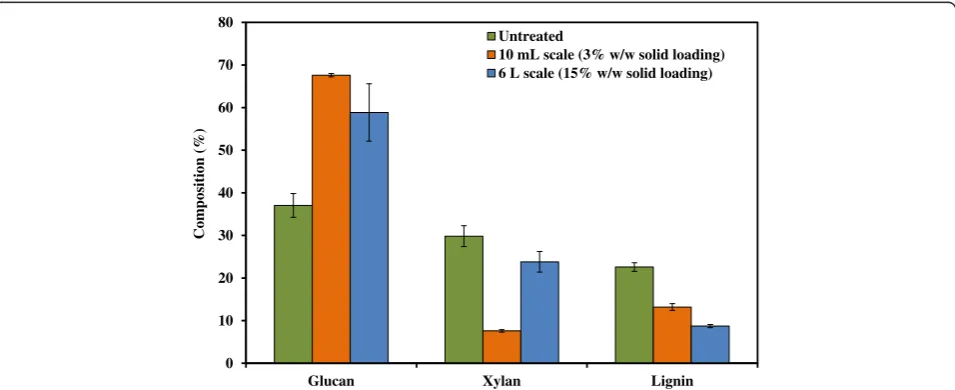
Figure 3 illustrates the scale-up and loading effects on the changes of three major biomass components, glucan, xylan and lignin, of pretreated switchgrass in compari-son to the results obtained at the 10 mL scale data from previous studies [7]. Unlike the significant removal of both xylan and lignin observed at 10 mL scale and 3% solids loading, at the 6 L scale there is significantly less lignin content (8.7% vs 13.2%) but much higher xylan content (23.8% vs 7.6%). This is likely due to the loading used in the current study, and indicates that this process configuration favorably preserves the structural carbohy-drates for subsequent enzymatic saccharification and fermentation.
Hemicellulose in the liquid fractions
IL pretreatment can remove significant amounts of hemicellulose and small quantities of amorphous cellu-lose depending on the severity of reaction conditions [15], and, under some pretreatment conditions, hemicel-lulose can be depolymerized to oligosaccharides [7]. To understand the effect of washing on hemicellulose re-moval, a complete analysis on sugar released during eight washing steps was conducted using High Perform-ance Anion Exchange Chromatography (HPAEC) after trifluoroacetic acid (TFA) digestion (Figure 4). These re-sults show that the pattern of hemicellulose release, as measured by the xylose, arabinose and galactose con-tents, depends on the washing steps and the solvent used. The second wash liquor removed much higher xy-lose (21.4%), arabinose (34.8%) and galactose content (27.8%). This result is likely due to major fractions of three polymers still being bound to the solid in the first washing step and being released into the liquid when water was added for the 2nd wash. The third and fourth washes were also effective in removing the three sugars. The last water wash released more sugars than the pre-vious ethanol and ethanol-water washes. This could be attributed to the ethanol wash steps (5, 6 and 7) that re-moved more IL and made hemicellulose less bound to the cellulose, and with the last water wash, the loosely bound hemicellulose readily dissolved into water. Small amounts of glucose were also observed in the first four water washes, which were likely released from the amorphous cellulose initially present in switchgrass. Re-sults also show that the total loss of the initial glucan frac-tion in all the washing steps was 12.6% at 6 L scale, lower than the loss of 15.6% in previous small scale studies [16],
0 10 20 30 40 50 60 70 80
Glucan Xylan Lignin
Com
p
osition (%)
Untreated
10 mL scale (3% w/w solid loading) 6 L scale (15% w/w solid loading)
further suggesting high solids loading may help retain the structural carbohydrates in the recovered solid stream.
IL content and its impact on enzymatic saccharification
Residual IL in the solids have been found to inhibit both commercial cellulases and microbial fermentation in
Saccharomyces cerevisiae [22], requiring extensive wash-ing after IL pretreatment. In this study, the [C2mim][OAc]
content in both the liquid and solid fractions was mea-sured to track the efficiency of washing steps. As shown in Table 1, the amount of [C2mim][OAc] in the liquid stream
was significantly reduced from 43.43% (w/v) after the first water wash to 0.03% (w/v) after the final water wash. However, a certain amount of IL residue is hypothesized to stay in the solid fraction and may not be easily re-moved. To investigate the effects of [C2mim][OAc] in the
solid fraction on enzymatic saccharification, a separate
small-scale study was conducted to track the residual [C2mim][OAc] remaining in the solids after pretreatment.
Samples of the solids remaining after each water washing step were taken and completely solubilized using excess concentrations of Cellic® HTec2 and CTec2 for five days to liberate the [C2mim][OAc]. The [C2mim][OAc]
con-centration in the liquid phase following complete solubilization was then used as a measure of the residual [C2mim][OAc] in the solids at each wash step. In parallel,
solid samples after each wash were hydrolyzed (54 mg/g glucan of CTec2, 6 mg/g glucan HTec2, 50°C, pH 5.5) for 72 hours to determine sugar yields. Figure 5 clearly shows that the reduction of IL in the solids as a function of the number of washes yields significant increases in sugar re-lease. At [C2mim][OAc] concentrations of 16.6-46.6%, all
sugar yields were less than 60%, indicating the glycoside hydrolase enzymes in the commercial cocktails have re-duced activity [25]. After the 4th water wash, all sugar yields in the hydrolysates reached 70-80% as the [C2mim]
[OAc] concentration dropped to 5.7%. After the final water wash, the inhibition on the sugar yields was not sig-nificant at the IL concentration of 3.5%. Both Table 1 and Figure 5 do not show significant IL removal efficiency by ethanol washing steps as indicated by the slight decrease of [C2mim][OAc] in liquid and solid streams. It is evident
that this pretreatment configuration requires extensive washing of the biomass post-pretreatment to remove the residual [C2mim][OAc], which is known to inhibit
downstream saccharification and fermentation [22]. The excessive use of water and waste disposal associated with washing poses challenges for the scale-up of IL 0
5 10 15 20 25 30 35 40
Saccharides r
eleased
in w
a
sh
(%
)
Arabinose Galactose Glucose Xylose
Figure 4Pattern of saccharides released (based on untreated compositions) from [C2mim][OAc] pretreated switchgrass into the liquid phase and its dependence on the number of washes.
Table 1 Amount of [C2mim][OAc] present as a function of
the wash process
Wash no. Solvent [C2mim][OAc] content (%, w/v)
1 Water 43.43 ± 0.72
2 Water 7.56 ± 0.15
3 Water 2.06 ± 0.09
4 Water 0.48 ± 0.02
5 Ethanol 0.20 ± 0.01
6 Ethanol/water 0.12 ± 0.01
7 Ethanol/water 0.06 ± 0.00
pretreatment technology. Alternative options to reduce water usage have been recently reported, including the de-velopment IL-tolerant cellulase cocktails (i.e., JTherm cock-tail recently developed at JBEI) that are compatible with a“single-pot”(pretreatment + saccharification), wash-free bioprocessing approach [25,26], use of lower IL concentration (25-50%, w/v) in water for biomass pre-treatment that eliminates washing prior to enzymatic sac-charification altogether [27,35], and the development of enzyme free, acid catalyzed IL hydrolysis process [36]. So far these alternative technologies are all limited to the lab-scale level of development and require more investigation before scale-up can occur.
Scale-up of enzymatic hydrolysis
Enzymatic hydrolysis at high solids loadings is another key to scale-up of lignocellulosic biochemical conversion processes, because of potentially higher sugar and etha-nol titers and low hydraulic loads. However, high solids loading can pose rheological challenges, reduce mass and heat transfer efficiency, and increase the concentra-tion of enzyme inhibitors in the system, resulting in lower conversion of glucan and xylan into fermentable sugars. Previous reports have simulated different oper-ational scenarios and compared them in terms of prod-uctivity, yield, and numbers of stages and unit operation for materials from steam explosion, dilute acid, alkali pretreatment processes [19,37-41]. So far, there is limited information on large-scale enzymatic hydrolysis of IL pretreated material, especially at high solids loading as most of the saccharification data were obtained at
laboratory scales with 1-2% loading of IL pretreated materials [16-18], which cannot be directly translated to industrially relevant scales. Thus, focused scale-up studies at high solid loadings are required to fit in the intermediate scale levels in the current study.
Figure 6 shows the typical fermentable sugar profile for a 72 h enzymatic saccharification of pretreated switchgrass at 10% solid loading in a 2 L reactor with 1.5 L working volume. It is observed that the concentrations of glucose, xylose and cellobiose increase rapidly in the first 30 mi-nutes. The glucose concentration then continues to rap-idly increase, whereas the xylose concentration follows a fairly steady increase until about 24 h, and then a very slow, almost negligible increase up to 72 h. The cellobiose level reached a plateau at 2 h and started to decrease after about 24 h, indicating that the β-glucosidases are highly active and are not being inhibited by product formation. The rapid initial increase for all three sugar concen-trations coincided with a significant reduction in biomass solubilization and slurry viscosity. This is attributed to the highly disrupted cellulose structure, increased por-osity and accessibility in the IL pretreated fiber [7]. Furthermore, the easily solubilized xylo-oligosaccharides generated from the pretreated switchgrass promoted rapid xylose release, whereas the second stage of xy-lan conversion, from approximately 3 h to 24 h reflects the hydrolysis of xylan polymers in the biomass. Unfortu-nately, this process essentially leveled off after 24 h with little further production of xylose in spite of the fact that only 65.0% of available xylan in the pretreated solids had been hydrolyzed.
0 10 20 30 40 50 60
0 20 40 60 80 100 120
1 2 3 4 5
IL
concentration in r
ecov
er
ed biom
ass (%
w
/w
)
n
o
de
s
a
b
r
o
u
qil
si
s
yl
or
d
y
h
ni
dl
ei
y
r
a
g
u
S
untr
eated com
p
osition
(%
)
Water washes
Arabinose Glucose
Xylose IL Content
The evolution of glucose is more sustained, proceeding at a very fast kinetic rate from 1 h to 24 h, and then at a relatively lower rate from 24 to 72 h, at which point 99.8% of available glucan in the IL pretreated solids has been hydrolyzed to glucose. High contents of glucose at 62.1 g/L combined with 5.4 g/L of cellobiose demonstrate high titers of sugar concentration. The glucan digestibility is consistent with previous reports demonstrating the equal effectiveness of [C2mim][OAc] pretreatment at 3%
loading and saccharification at 15% loading at small scales of 5 to 25 mL [16,18], suggesting a successful 60 fold scale up. However, the xylan digestibility was lower than that reported for small-scale studies, suggesting the follow-ing possibilities: 1) enzymes in the HTec2 cocktail may be deactivated/inhibited by residual [C2mim][OAc] or
end-product accumulation at high biomass loading, 2) [C2mim][OAc] pretreatment at larger scales produces
xylan that is less accessible to enzymes than the xylan pro-duced at smaller scales. Thus further optimization of the enzyme cocktail may be required to obtain maximal sugar production.
Mass balance and energy flow
An analysis of the mass balance and energy flow of the ionic liquid pretreatment, the subsequent enzymatic sac-charification, and their resultant composition of the products generated is summarized in Figure 7 to develop a clear overview of the technology scale up. On the 900 g basis of untreated switchgrass, 497.5 g of pre-treated solids were recovered that retain 87.5% of glucan, 42.6% of xylan and 22.8% of lignin. On the same basis,
25.2 g of glucose olignomers, 87.6 g of xylo-oligomers, plus 26.5 arabinan and 16.1 g of galactan, respectively, were recovered post hydrolysis. Approximately 322.8 g of glucose, 67.2 of xylose and 11.4 g of arabinose, respect-ively, were recovered from enzymatic hydrolysis of the re-covered solids. Furthermore, of the 5100 g of ionic liquid used, 4721 g was detected in the liquid fraction and avail-able for further recovery and recycling. A small portion of IL (6.5 g) was retained with pretreated switchgrass, and potentially posed inhibitory effects for the subsequent en-zymatic hydrolysis and microbial fermentation. The over-all IL balance closure is higher than 92%.
The material balance indicates some mass loss during pretreatment and enzymatic hydrolysis, yet the overall glucose recovery in the liquid stream remains over 94%, confirming that IL pretreatment can preserve most of the sugars and substantially enhance the effectiveness of enzymatic hydrolysis. The overall glucan balance closure on the basis of the recovered solids after pretreatment (95.0%) is higher than xylan (77.1%), which is attributed to the greater chemical robustness of glucose during the IL pretreatment [17]. A fraction of the hemicellulose remained in the liquid stream after pretreatment as well as in the residual solid after saccharification but is not lost to the overall conversion process [35]. During pre-treatment, a significant amount of lignin was also solubi-lized into the liquid stream, causing the lignin reduction in the pretreated solids. However, the residual solids after en-zymatic saccharification are also rich in lignin content, in-dicating potential opportunities for lignin valorization. For a long-term development of biorefinery, lignin supply will
0 20 40 60 80 100
0 10 20 30 40 50 60 70
0 20 40 60 80
Glucan digestibility
(%
)
Sug
a
r r
el
ea
sed
(g
/L)
Time (h)
Glucose Arabinose Galactose Xylose Cellobiose
progressively increase as many types of lignocellulosic feedstocks are implemented in the future. Adding value to the lignin rich residue will significantly enhance the com-petitiveness of biomass-to-biofuels conversion [42].
One of the considerations that must be taken into ac-count is the energy density of the feedstock itself. Energy density plays an important role in the overall energy and cost balance of the biofuel production process. A bio-mass feedstock with low energy density is less energy ef-ficient to convert into a biofuel than one with a higher energy density due to the relatively high energy required for transportation, storage and distribution of the feed-stock from the field to the biorefinery gate [17,43,44]. Lignin contains the higher energy content than cellulose and hemicellulose, and can be combusted to provide heat and/or power for the biorefinary process, and pro-vide some excess power to generate additional revenue [45,46]. To understand how the IL pretreatment affects lignin recovery and energy flow, lignin content and en-ergy density analysis of untreated, pretreated and sac-charified switchgrass were conducted and are presented in Table 2. Results clearly show that, compared with 22.6% in untreated material, the lignin content was sig-nificantly decreased to 9.33% after IL pretreatment, how-ever, after enzymatic hydrolysis, the residual solids are rich in lignin (49.08%) due to the efficient conversion of
polysaccharides into soluble sugars. Correspondingly, energy density of untreated (18.37 KJ/g), pretreated (16.62 KJ/g) and saccharified switchgrass (21.72 KJ/g) tracks well with their respective lignin content. Details about the energy density analysis and the relative correl-ation with three major components in various feedstocks are currently under investigation. The overall lignin re-covery from solid stream is 21.6%, indicating a large amount of lignin has dissolved in IL upon pretreatment and requires further separation. The material energy flow is also summarized in Figure 7 based on the energy density data from Table 2, and the overall recovery is 38.3% with high energy contents left in liquid stream, suggesting further energy recovery is highly warranted.
It should be addressed that due to their current high cost, recovery and recycle of ILs has been given more and more attentions for the requirements of commercial use in biomass pretreatment. These include using
anti-Figure 7Mass balance and energy flow during [C2mim][OAc] pretreatment and subsequent enzymatic hydrolysis.
Table 2 Lignin content and energy density in three types of starting and recovered solids
Biomass solids Lignin (%) Energy density (KJ/g)
Untreated 22.58 ± 1.01 18.37 ± 0.03
Pretreated 9.33 ± 0.38 16.62 ± 0.74
solvent such as acetone followed by distillation/evapor-ation for separdistillation/evapor-ation [9,47], biphasic system with addition of an aqueous solution containing kosmotropic anion, such as phosphate, carbonate or sulfate [48,49], and se-quential membrane filtration and vacuum evaporation post sugar extraction from aqueous IL hydrolysate. Al-though these results show that separation and recovery of IL can be achieved by various methods, to date, all these potential alternatives have been limited to the lab-scale level of development and require more investigation before scale-up can occur. The process employed in the current report doesn’t involve IL recovery, optimization for washing method, separation method, and removal of the remaining water, however, as a continuation of this study, JBEI and ABPDU are working together on the scale up demonstration of newly developed wash-free IL pro-cesses [26,35] and liquid-liquid extraction and filtration based IL recycle technologies. The present work provides an essential first step to understand and evaluate the scale up effect and important parameters, and requires to be further developed for a commercially scalable and cost competitive process.
Conclusions
To the best of our knowledge, this is the first demonstration in the scientific literature for the scale-up of IL pretreat-ment by 600-fold and subsequent enzymatic saccharifica-tion by 60-fold at solid loadings up to 15% (w/w). The results generated are consistent with those from the small-scale experiments that have been conducted at JBEI and elsewhere, and indicate there are no fundamental issues in terms of performance associated with the scale-up of an IL-based conversion technology. High solids loading dur-ing pretreatment and enzymatic hydrolysis offers several industrial advantages, including decreased reactor size, in-creased sugar titer and hydrolysis rate, and dein-creased water consumptions. The results also provide clear evi-dence of enzymatic inhibition, which is magnified by the fact that pretreated materials were not washed completely prior to hydrolysis, and thus, the inhibitors generated dur-ing pretreatment and washdur-ing will persist into hydrolysis and the downstream steps. Thus, the optimization and en-gineering of the IL tolerant enzyme cocktail and scale up design/operation of more effective IL pretreatment and post separation system must be realized before a commer-cially viable process is realized. The knowledge gained from this initial scale-up study is an essential first step in demonstrating the commercial viability of this promising pretreatment technology.
Materials and methods Raw materials
Switchgrass (Panicum virgatum) was kindly provided by Dr Putnam’s lab at University of California, Davis. The
samples were air dried first until the moisture was less than 10%, and then grounded with Thomas Wiley Mill fitted with a 2 mm screen (Model 4, Arthur H. Thomas Co., Philadelphia, PA, USA). The samples were stored at 4°C cold room for use in all experimentation. The par-ticle size distribution of this material after grinding was de-termined by following ASTM D1511-10 using a sieve shaker (Vibratory Sieve Shaker AS 200, Retsch, Newtown, PA, USA) and the biomass materials passing sieves of spe-cific mesh sizes was measured (ASTM International, 2010). The majority of the materials by weight (54%) have particle sizes ranging from 0.1 to 0.6 mm. Cellulase (Cellic® CTec 2) and hemicellulase (Cellic® HTec2) were generously pro-vided by Novozymes (Davis, CA). 1-Ethyl-3-methyl-limida-zolium acetate ([C2mim][OAc]), BASF, purity ≥90%) was
used as the ionic liquid for the pretreatment experiments. Trifluoroacetic acid (TFA), ethanol, acetic acid, sodium acetate, sulfuric acid, sodium hydroxide, and the mono-saccharides including arabinose, galactose, xylose, glu-cose, and cellobiose were purchased from Sigma-Aldrich (St. Louis, MO).
Reactor setup and operation for large scale IL pretreatment
Optimal pretreatment temperature (160°C) and resi-dence time (3 h) using ionic liquid and switchgrass for fermentable sugar production were chosen from previous small scale studies [7,15]. In this scale up study, 15% (w/w) biomass/IL solution was prepared by combining 900 g (dry basis) of switchgrass with 5.1 kg [C2mim][OAc] in the 10 L Parr reactor (Model 4558, Parr
Instrument Company, Moline, Illinois, USA) in triplicates. For each run, the reactor was sealed and the reactants were heated at 160°C for 3 h with a stirring speed of 50 rpm from an anchor impellor. Temperature ramping (to 160°C) and cooling (to 60°C) times were approximately 30 and 20 min, respectively. After 3 h incubation, the reactor was cooled down to 60°C with chilled water through the cooling coils inside the reactor. The reactor was open to sample 25 gram of biomass/IL slurry for viscosity measurement, and then 6 L of preheated hot water (60°C) was slowly pumped into the reactor, causing precipitation of the biomass into large chunks. Both solids and liquids were transferred into a 50 L bucket for overnight soaking. This was followed by a 2-min homogenization step to obtain the uniform dispersion of small particles in the solutions with a laboratory blender (LBC 15, Waring Laboratory, Torrington, CT).
Biomass washing
dewatered through cheesecloth to remove IL and dissolved byproducts such as lignin and hemicellulose that might inhibit enzymes in the subsequent enzymatic hydroly-sis. The washing steps included 3 water washes (12 L), 1 ethanol wash (6 L), 2 ethanol/water (1:1, v/v, 6 L) washes, and 1 final water wash (12 L) at room temperature. Each time water or ethanol was squeezed extensively from the biomass through cheesecloth [50]. All water wash effluent were collected separately and stored for further analysis of IL concentration and soluble sugar contents. The washed solids were collected to determine moisture content and calculate the solid recovery from IL pretreat-ment. About 10 g (dry basis) of the pretreated biomass was dried in the vacuum oven at 45°C to constant weight for composition and energy density analysis, and the rest was stored in sealed containers at 4°C for enzymatic hydrolysis.
Chemical characterization of switchgrass
Acid-insoluble lignin, and structural carbohydrates, i.e., glu-can, xylan, arabinan and galactan, of switchgrass before and after pretreatment were determined according to analytical procedure of the National Renewable Energy Laboratory (NREL) by a two-step sulfuric acid hydrolysis [51,52]. Car-bohydrates were analyzed by high performance anion ex-change chromatography (HPAEC) on an ICS-3000 system (Dionex, Sunnyvale, CA), equipped with an electrochemical detector and a 4 × 250 mm CarboPac PA20 analytical col-umn. Elution was initiated with 97.2% (v/v) water and 2.8% (v/v) 1 M NaOH for first 15 min, with 20μL injection vol-ume. Elute concentration was then switched to 55.0% (v/v) water and 45.0% (v/v) 1 M NaOH for next 20 min and returned to 97.2% (v/v) water and 2.8% (v/v) 1 M NaOH for the last 10 min to equilibrate the column. The flow rate was 0.5 mL/min. The monosaccharides including arabin-ose, galactarabin-ose, xylose and glucarabin-ose, were used as the external standards for HPAEC and prepared at levels of 0 to 100 mM before use. Absorbance reading of acid soluble lignin was taken at 205 nm using a UV–Vis spectropho-tometer (Shimadzu UV-2401) with high purity quartz cu-vettes with a 1 cm pathlength. The extinction coefficient of 110 L/g cm was used for the calculation of acid soluble lignin for switchgrass [53].
To obtain the sugar balance from dissolution of hemi-celluloses during IL pretreatment, a TFA hydrolysis was performed. The supernatants from the water wash steps were collected and concentrated, 30 μL of solution was diluted 10-fold with water and treated with 150 μL of TFA at 120°C for 1 h. The hydrolyzed solution was cen-trifuged at 10,000 g for 10 min, and the supernatant was analyzed using HPAEC for the monosaccharide analysis after evaporation of the TFA residues in a Centri-Vap Vacuum Concentrator (Labconco Corp, MO) at 30°C overnight.
Large scale enzymatic saccharification
To investigate the washing efficiency on the IL re-moval in the recovered solids and the effect of IL content on enzymatic saccharification, a small scale study was first conducted by hydrolyzing the solid sam-ples recovered from each washing step. The experi-ments were run at 2% (w/w) in duplicate at 50°C and 150 rpm in a reciprocating shaker. The total batch vol-ume was 25 mL with cellulase (CTec2) concentration of 54 mg protein/g glucan and endoxylanase (HTec2) concentration of 6 mg protein/g glucan to ensure fast hydrolysis. The protein concentrations of the two com-mercial enzyme mixtures (CTec2 190 g/L, HTec2 174 g/L) were determined by the Bradford assay (Bio-Rad, Hercules, CA) using bovine serum albumin as a standard.
After 72 h, the hydrolysates were analyzed on HPAEC for the monosaccharides release and their correlation with IL contents. For the scale up experiment of enzym-atic hydrolysis, the IL pretreated switchgrass samples from final washing step were fed into 2 L IKA reactor (IKA LR-2.ST, IKA Works, Wilmington, NC) in tripli-cates. The samples were kept at 10% (w/w) biomass loading in water with a working volume of 1.5 L and continuously mixed at 150 rpm for enzymatic hydrolysis using an anchor impeller. The Novozymes cocktails were added into each reactor with cellulase (CTec2) concen-tration of 54 mg protein/g glucan and endoxylanase (HTec2) concentration of 6 mg protein/g glucan. The reaction was monitored by taking samples from 0, 0.5,1,2,3, 6, 9, 24, 48 and 72 h of time intervals and measuring monomeric sugar production. After the hy-drolysis time elapsed, the hydrolysates were immediately transferred into the plastic containers and placed at 4°C to avoid further reaction.
IL measurement
The C2mim+ content was determined using a Dionex
UltiMate 3000 UHPLC (Dionex, Sunnyvale, CA) with UV–vis detecter at 240 nm wavelength. A Dionex ac-claim 120 C18 column achieved the separation by iso-cratic elution with a mobile phase consisting of 20 mM ammonium acetate and 1% acetic acid at 1.0 mL/min and 20°C. The IL supernatant taken from various washing steps were directly measured for IL content after proper dilu-tions. To measure the residual [C2mim][OAc] remaining
in the biomass after various wash steps, the recovered solids were saccharified for 120 hours using an extreme excess of enzymes (540 mg/g glucan of CTec2, 300 mg/g glucan of HTec2) at 50°C and pH 5.5 to completely solubilize the solids and ensure the [C2mim][OAc]
Viscosity measurement
The rheological properties of switchgrass-IL slurry were investigated for samples before pretreatment, after pre-treatment, and after pretreatment and washing (removal of IL) using stress controlled Malvern Kinexus Rheometer (Worcestershire, UK) a with 40 mm diameter parallel plate geometry. A gap height of 5 mm was used and care was taken to avoid air bubbles being trapped in the sample by obtaining a bulge of the sample at the edges of the plate. Oscillatory stress sweeps were conducted at 25°C from 0.01 to 1000 Pa under a constant frequency of 5 Hz. A clear viscoelastic region was observed between 1 and 100 Pa. Accordingly, an oscillatory frequency sweep was conducted at 25°C between 0.01 to 150 Hz at a constant stress of 10 Pa. Viscoelastic properties including elastic modulus (G’, Pa), viscous modulus (G”, Pa), and complex viscosity (η*, Pa-s) were measured and reported in this study.
Energy density measurement
The solid samples before and after IL pretreatment were subjected to a standard bomb calorimeter (C2000 Oxygen Bomb Calorimeter, IKA Works, Wilmington, NC) for en-ergy density measurement. All samples were dried in a vacuum oven at 40°C until the moisture content is lower than 4%, ball milled to pass a 20 mesh screen and then compressed into pellets using a hydraulic pelletizer (MTI 12 T pelletizer, MTI, Richmond, CA) prior to being weighed. Heat content was determined by burning the samples with excess of oxygen at a pressure of 435 psi in a sealed steel bomb, which is regarded as a near-adiabatic system.
Abbreviations
IL:Ionic liquid; JBEI: Joint bioenergy institute; ABPDU: Advanced biofuels process demonstration unit; [C2mim][OAc]: 1-ethyl-3-methylimidaolzium
acetate; HPAEC: High performance anion exchange chromatography; TFA: Trifluoroacetic acid; NREL: National renewable energy laboratory.
Competing interests
The authors declare that they have no competing interests.
Authors’contributions
CL and DT conducted the pretreatment and saccharification experiments. CL conducted data analysis and drafted the manuscript. DT carried out the viscosity measurement and contributed to the viscosity related part of the manuscript. WH and JLG performed the energy density and IL measurement. JW performed the compositional and hydrolysate analysis. SS, BAS and KS contributed to the original experimental design and modifications of the draft. SS, BAS, JLG and KS coordinated and supervised the collaboration project. All authors read and approved the final manuscript.
Acknowledgements
ABPDU would like to acknowledge the funding support from Office of Biomass Program within the US DOE’s Office of Energy Efficiency and Renewable Energy, and also the funding support from the American Recovery and Reinvestment Act. JBEI would like to acknowledge the funding support from US DOE’s Office of Science, Office of Biological and
Environmental Research, through contract DE-AC02-05CH11231 between Lawrence Berkeley National Laboratory and the US DOE. The authors would like to thank the Laboratory of Dr. Daniel Putnam from the University of
California at Davis for providing the switchgrass, and Novozymes for the gift of the enzyme cocktails used in this work.
Author details
1Advanced Biofuels Process Demonstration Unit, Lawrence Berkeley National
Laboratory, Emeryville, CA, USA.2Deconstruction Division, Joint BioEnergy Institute, Emeryville, CA, USA.3Biological and Materials Science Center, Sandia
National Laboratories, Livermore, CA, USA.
Received: 20 May 2013 Accepted: 7 October 2013 Published: 25 October 2013
References
1. Johnson JM, Coleman MD, Gresch R, Jaradat A, Mitchell R, Reicosky D, Wilhelm WW:Biomass-bioenergy crops in the united states: a changing paradigm.Am J Plant Sci Biotechnol2007,1(1):1–28.
2. Alvira P, Tomás-Pejó E, Ballesteros M, Negro MJ:Pretreatment technologies for an efficient bioethanol production process based on enzymatic hydrolysis: a review.Bioresour Technol2010,101(13):4851–4861.
3. Banerjee G, Car S, Liu TJ, Williams DL, Meza SL, Walton JD, Hodge DB: Scale-up and integration of alkaline hydrogen peroxide pretreatment, enzymatic hydrolysis, and ethanolic fermentation.Biotechnol Bioeng2012, 109(4):922–931.
4. Modenbach AA, Nokes SE:The use of high-solids loadings in biomass pretreatment-a review.Biotechnol Bioeng2012,109(6):1430–1442. 5. Yang B, Dai Z, Ding S-Y, Wyman CE:Enzymatic hydrolysis of cellulosic
biomass.Biofuels2011,2(4):421–450.
6. Dadi AP, Varanasi S, Schall CA:Enhancement of cellulose saccharification kinetics using an ionic liquid pretreatment step.Biotechnol Bioeng2006, 95(5):904–910.
7. Li C, Knierim B, Manisseri C, Arora R, Scheller HV, Auer M, Vogel KP, Simmons BA, Singh S:Comparison of dilute acid and ionic liquid pretreatment of switchgrass: biomass recalcitrance, delignification and enzymatic saccharification.Bioresour Technol2010,101(13):4900–4906. 8. Singh S, Simmons BA, Vogel KP:Visualization of biomass solubilization
and cellulose regeneration during ionic liquid pretreatment of switchgrass.Biotechnol Bioeng2009,104(1):68–75.
9. Sun N, Rahman M, Qin Y, Maxim ML, Rodriguez H, Rogers RD:Complete dissolution and partial delignification of wood in the ionic liquid 1-ethyl-3-methylimidazolium acetate.Green Chem2009,11(5):646–655.
10. Lee SH, Doherty TV, Linhardt RJ, Dordick JS:Ionic liquid-mediated selective extraction of lignin from wood leading to enhanced enzymatic cellulose hydrolysis.Biotechnol Bioeng2009,102(5):1368–1376.
11. Li C, Cheng G, Balan V, Kent MS, Ong M, Chundawat SPS, Sousa L, Melnichenko YB, Dale BE, Simmons BA,et al:Influence of physico-chemical changes on enzymatic digestibility of ionic liquid and AFEX pretreated corn stover.Bioresour Technol2011,102(13):6928–6936.
12. Tan SSY, MacFarlane DR, Upfal J, Edye LA, Doherty WOS, Patti AF, Pringle JM, Scott JL:Extraction of lignin from lignocellulose at atmospheric pressure using alkylbenzenesulfonate ionic liquid.Green Chem2009, 11(3):339–345.
13. Sun L, Li C, Xue Z, Simmons BA, Singh S:Unveiling high-resolution, tissue specific dynamic changes in corn stover during ionic liquid
pretreatment.RSC Adv2013,3(6):2017–2027.
14. Cheng G, Varanasi P, Li CL, Liu HB, Menichenko YB, Simmons BA, Kent MS, Singh S:Transition of cellulose crystalline structure and surface morphology of biomass as a function of ionic liquid pretreatment and its relation to enzymatic hydrolysis.Biomacromolecules2011,12(4):933–941.
15. Arora R, Manisseri C, Li C, Ong M, Scheller HV, Vogel K, Simmons BA, Singh S:Monitoring and analyzing process streams towards understanding ionic liquid pretreatment of switchgrass (Panicum virgatum L.). BioEnergy Research2010,3:134–145.
16. Li C, Sun L, Simmons B, Singh S:Comparing the recalcitrance of eucalyptus, pine, and switchgrass using ionic liquid and dilute acid pretreatments.BioEnergy Research2013,6(1):14–23.
17. Shi J, Thompson VS, Yancey NA, Stavila V, Simmons BA, Singh S:Impact of mixed feedstocks and feedstock densification on ionic liquid pretreatment efficiency.Biofuels2013,4(1):63–72.
19. Di Risio S, Hu CS, Saville BA, Liao D, Lortie J:Large-scale, high-solids enzymatic hydrolysis of steam-exploded poplar.Biofuels Bioprod Biorefin2011,5(6):609–620.
20. Dibble DC, Li CL, Sun L, George A, Cheng ARL, Cetinkol OP, Benke P, Holmes BM, Singh S, Simmons BA:A facile method for the recovery of ionic liquid and lignin from biomass pretreatment.Green Chem2011,13(11):3255–3264. 21. Fu D, Mazza G:Aqueous ionic liquid pretreatment of straw.Bioresour Technol
2011,102(13):7008–7011.
22. Ouellet M, Datta S, Dibble DC, Tamrakar PR, Benke PI, Li C, Singh S, Sale KL, Adams PD, Keasling JD,et al:Impact of ionic liquid pretreated plant biomass on Saccharomyces cerevisiae growth and biofuel production. Green Chem2011,13(10):2743–2749.
23. Kim Y, Ximenes E, Mosier NS, Ladisch MR:Soluble inhibitors/deactivators of cellulase enzymes from lignocellulosic biomass.Enzyme Microb Technol 2011,48(4–5):408–415.
24. Qi BK, Chen XR, Wan YH:Pretreatment of wheat straw by nonionic surfactant-assisted dilute acid for enhancing enzymatic hydrolysis and ethanol production.Bioresour Technol2010,101(13):4875–4883. 25. Park JI, Steen EJ, Burd H, Evans SS, Redding-Johnson AM, Batth T, Benke PI,
D'Haeseleer P, Sun N, Sale KL,et al:A thermophilic ionic liquid-tolerant cellulase cocktail for the production of cellulosic biofuels.Plos One2012, 7(5):e37010.
26. Shi J, Gladden J, Sathitsuksanoh N, Kambam P, Sandavol L, Mitra D, Zhang S, Singer S, George A, Simmons B,et al:One-pot ionic liquid pretreatment and saccharification of switchgrass.Green Chem2013.
27. Fu DB, Mazza G:Optimization of processing conditions for the pretreatment of wheat straw using aqueous ionic liquid.Bioresour Technol2011,102(17):8003–8010.
28. Cruz A, Scullin C, Mu C, Cheng G, Stavila V, Varanasi P, Xu D, Mentel J, Chuang Y-D, Simmons B,et al:Impact of high biomass loading on ionic liquid pretreatment.Biotechnology for Biofuels2013,6(1):52.
29. Sathitsuksanoh N, Zhu ZG, Wi S, Zhang YHP:Cellulose solvent-based biomass pretreatment breaks highly ordered hydrogen bonds in cellulose fibers of switchgrass.Biotechnol Bioeng2011,108(3):521–529. 30. Aaltonen O, Jauhiainen O:The preparation of lignocellulosic aerogels
from ionic liquid solutions.Carbohydr Polym2009,75(1):125–129. 31. Stickel JJ, Knutsen JS, Liberatore MW, Luu W, Bousfield DW, Klingenberg DJ,
Scott CT, Root TW, Ehrhardt MR, Monz TO:Rheology measurements of a biomass slurry: an inter-laboratory study.Rheol Acta2009,48(9):1005–1015. 32. Wiman M, Palmqvist B, Tornberg E, Liden G:Rheological characterization of dilute acid pretreated softwood.Biotechnol Bioeng2011,108(5):1031–1041. 33. Viamajala S, McMillan JD, Schell DJ, Elander RT:Rheology of corn stover
slurries at high solids concentrations - effects of saccharification and particle size.Bioresour Technol2009,100(2):925–934.
34. Brennan TCR, Datta S, Blanch HW, Simmons BA, Holmes BM:Recovery of sugars from ionic liquid biomass liquor by solvent extraction. BioEnergy Research2010,3(2):123–133.
35. Sun N, Liu H, Sathitsuksanoh N, Stavila V, Sawant M, Bonito A, Tran K, George A, Sale K, Singh S,et al:Production and extraction of sugars from switchgrass hydrolyzed in ionic liquids.Biotechnology for Biofuels2013, 6(1):39.
36. Binder J, Raines R:Fermentable sugars by chemical hydrolysis of biomass. Proc Natl Acad Sci U S A2010,107:4516–4521.
37. Yang J, Zhang XP, Yong QA, Yu SY:Three-stage enzymatic hydrolysis of steam-exploded corn stover at high substrate concentration. Bioresour Technol2011,102(7):4905–4908.
38. Ouyang J, Li ZJ, Li X, Ying HJ, Yong Q:Enhanced enzymatic conversion and glucose production via two-step enzymatic hydrolysis of corncob residue from xylo-oligosaccharides producer's waste.BioResources2009, 4(4):1586–1599.
39. Thomsen MH, Thygesen A, Jorgensen H, Larsen J, Christensen BH, Thomsen AB:Preliminary results on optimization of pilot scale pretreatment of wheat straw used in coproduction of bioethanol and electricity. Appl Biochem Biotechnol2006,130(1–3):448–460.
40. Martin C, Thomsen MH, Hauggaard-Nielsen H, BelindaThomsen A:Wet oxidation pretreatment, enzymatic hydrolysis and simultaneous saccharification and fermentation of clover-ryegrass mixtures. Bioresour Technol2008,99(18):8777–8782.
41. Zhang Y, Liu YY, Xu JL, Yuan ZH, Qi W, Zhuang XS, He MC:High solid and low enzyme loading based saccharification of agricultural biomass. BioResources2012,7(1):345–353.
42. Varanasi P, Singh P, Auer M, Adams P, Simmons B, Singh S:Survey of renewable chemicals produced from lignocellulosic biomass during ionic liquid pretreatment.Biotechnology for Biofuels2013,6(1):14.
43. Sokhansanj S, Mani S, Turhollow A, Kumar A, Bransby D, Lynd L, Laser M: Large-scale production, harvest and logistics of switchgrass (Panicum virgatum L.) - current technology and envisioning a mature technology. Biofuel Bioprod Bior2009,3(2):124–141.
44. Sokhansanj S, Hess JR:Biomass supply logistics and infrastructure #.T Biofuels 2009,581:1–25.
45. Novaes E, Kirst M, Chiang V, Winter-Sederoff H, Sederoff R:Lignin and biomass: a negative correlation for wood formation and lignin content in trees.Plant Physiol2010,154(2):555–561.
46. Mendu V, Shearin T, Campbell JE, Stork J, Jae J, Crocker M, Huber G, DeBolt S:Global bioenergy potential from high-lignin agricultural residue. Proc Natl Acad Sci U S A2012,109(10):4014–4019.
47. Dibble D, Li C, Sun L, George A, Cheng A, Cetinkol O, Benke P, Holmes B, Singh S, Simmons B:A facile method for the recovery of ionic liquid and lignin from biomass pretreatment.Green Chem2011,13:3255–3264. 48. Gutowski K, Grant A, Willauer H, Huddleston J, Swatloski R, Holbrey J, Rogers
R:Controlling the aqueous miscibility of ionic liquids: aqueous biphasic systems of water-miscible ionic liquids and water-structuring salts for recycle, metathesis, and separations.J Am Chem Soc2003,125:6632–6633. 49. Shill K, Padmanabhan S, Xin Q, Prausnitz JM, Clark DS, Blanch HW:Ionic
liquid pretreatment of cellulosic biomass: enzymatic hydrolysis and ionic liquid recycle.Biotechnol Bioeng2011,108(3):511–520.
50. Abbas C, Beery K, Dennison E, Corrington P:Thermochemical Treatment, Separation, and Conversion of Corn Fiber to Ethanol.InLignocellulose Biodegradation. vol. 889.American Chemical Society; 2004:84–97. 51. Sluiter A, Hames B, Ruiz R, Scarlata C, Sluiter J, Templeton D:Determination
of structural carbohydrates and lignin in biomass.LAP-002 NREL analytical procedure.Golden, CO: National Renewable Energy Laboratory; 2004. 52. Sluiter A, Hames B, Ruiz R, Scarlata C, Sluiter J, Templeton D:Determination
of ash in biomass: LAP-005 NREL analytical procedure.Golden, CO: National Renewable Energy Laboratory; 2004.
53. Suryawati L, Wilkins MR, Bellmer DD, Huhnke RL, Maness NO, Banat IM: Effect of hydrothermolysis process conditions on pretreated switchgrass composition and ethanol yield by SSF with Kluyveromyces marxianus IMB4.Process Biochem2009,44(5):540–545.
doi:10.1186/1754-6834-6-154
Cite this article as:Liet al.:Scale-up and evaluation of high solid ionic liquid pretreatment and enzymatic hydrolysis of switchgrass.
Biotechnology for Biofuels20136:154.
Submit your next manuscript to BioMed Central and take full advantage of:
• Convenient online submission
• Thorough peer review
• No space constraints or color figure charges
• Immediate publication on acceptance
• Inclusion in PubMed, CAS, Scopus and Google Scholar
• Research which is freely available for redistribution
![Figure 1 [Creduction (2 mm screen),2mim][OAc] pretreatment of switchgrass at 6 L scale](https://thumb-us.123doks.com/thumbv2/123dok_us/415897.2039052/4.595.57.539.88.344/figure-creduction-screen-mim-oac-pretreatment-switchgrass-scale.webp)
![Figure 2 Rheological characterization of switchgrass slurry at[Cvarious stages of the pretreatment unit process (A) switchgrass/[C2mim][OAc] mixture before pretreatment, (B) switchgrass/2mim][OAc] mixture after pretreatment, and (C) switchgrass/water mixture after washing.](https://thumb-us.123doks.com/thumbv2/123dok_us/415897.2039052/5.595.305.539.89.556/rheological-characterization-switchgrass-pretreatment-switchgrass-pretreatment-pretreatment-switchgrass.webp)
![Figure 4 Pattern of saccharides released (based on untreated compositions) from [C2mim][OAc] pretreated switchgrass into the liquidphase and its dependence on the number of washes.](https://thumb-us.123doks.com/thumbv2/123dok_us/415897.2039052/7.595.58.538.88.314/saccharides-released-untreated-compositions-pretreated-switchgrass-liquidphase-dependence.webp)
![Figure 5 Impact of residual [C2mim][OAc] in terms of saccharification inhibition. Sugar yields were measured after saccharification (54 mg/gglucan of Cellic CTec2, 6 mg/g glucan Cellic HTec2, 50°C, pH 5.5 for 72 hours) of solids taken after each wash step](https://thumb-us.123doks.com/thumbv2/123dok_us/415897.2039052/8.595.60.537.88.307/figure-residual-saccharification-inhibition-measured-saccharification-cellic-cellic.webp)
![Figure 6 Sugar released from 2L scale enzymatic hydrolysis of [C2mim][OAc] pretreated switchgrass.](https://thumb-us.123doks.com/thumbv2/123dok_us/415897.2039052/9.595.58.537.89.323/figure-sugar-released-scale-enzymatic-hydrolysis-pretreated-switchgrass.webp)