Material
Modification
for Flexible Pavement
Rakesh R Nayaka
1, Dr. K. Kumar
2, Dr.Sridhar.R
3*(Department of civil engineering, Nagarjuna College of Engineering &Technology, Bengaluru, India) ** (Professor & Dean R&D, Department of Civil Engineering, Nagarjuna College of Engineering &Technology,
Bengaluru, India)
*** (Professor, Department of Civil Engineering, Nagarjuna College of Engineering &Technology, Bengaluru, India)
1.
INTRODUCTION
Today, a world without roads, cars motorcycles and bicycles is almost impossible. India is having second largest road network of over 5.4 lakh KM in the world. . In recent years cost of bitumen in India has raised very rapidly due to hike in the crude oil price. Due to extreme climatic conditions, growth of traffic and increasing maintenance expenditure on roads in India there is a necessity to develop sustainable technologies and economical road construction. The question is therefore not so much whether there will still be a road infrastructure in the future, but rather how will society view these mobility facilities in, say, thirty or forty years’ time. Comparing the road infrastructure and means of transport of today with those of forty years ago, it becomes clear that in the next forty years’ time everything will again look a lot different to how it looks today. Societies are constantly developing and, consequently so are people’s requirements regarding the use, structure and design of the road infrastructure − not just roads in urban areas (urban roads), but also the motorways (interurban roads) between the major European cities. It is also quite conceivable that the future construction and design of infrastructure constructions such as bridges and tunnels will be subject to different requirements. In view of the lengthy time span of 10 to 15 years between planning infrastructure facilities and its actual completion, followed by an operational period of at least 25 years, more clarity of these future needs, demands and requirements becomes essential in order to make the right choices for today. Making the future more identifiable and tangible reveals the gaps of knowledge and indicates which new technologies will have to be developed to meet the future demands and requirements.
2.
LITREATURE REVIEW
Malagavelli and Paturu (2011) has carried out an experimental investigation on the performance of the concrete using solid waste fibers and found that the increase in the load carrying capacity of concrete. It was further reported that the maximum 2% of fibers could be used for strength purpose and that up to 6%, for disposal purpose. Sultana and Prasad (2012) observed the improvement in the properties of aggregates with the
Abstract
:
Plastic is highly toxic in nature. The plastic wastes which are produced are non-bio degradable in nature. Hence experiments have been carried out to use these plastic wastes in construction of roads. The use of these wastes in road construction is based on Economic, Technical and Ecological criteria. The bitumen can be modified with plastic waste pieces forming a mix which can be used as a top layer of flexible pavement, showing better binding property, stability, density and which is more resistant to water. The plastic main ingredients such as polyamide and acrylic granules are used to increase the strength of flexible pavements. . The quantity of bitumen is varied by 5%, 10%, 15%, 20%, & 25% of weight of bitumen.It has been observed that the specimen with 20% of polyamide granules has higher strength when compared to other percentages of polyamide granules. Also in case of acrylic granules the specimen with 10% of acrylic granules has higher strength than the other percentages of acrylic granules. Both these plastic granules showed increase in strength when compared to controlled specimen.
When the strength of polyamide granules and acrylic granules are compared with each other it is seen that polyamide granules shows higher strength than that of the acrylic granules. Further it has been found that such roads were not subjected to stripping when come in contact with water.
utilization of waste plastic as a coating over the aggregates and further, reported the optimum percentage of plastic to be 6-8 percent based on the stability values. Kumar (2012) found that Fly ash and fly ash based products have been established for economic, durable and eco-friendly construction and development in rural sector. Suryawamshiet al. (2012) reported that fly ash cement concrete does not gain appreciable strength in the initial 7-14 days’; but in 28-days, the cement constituents and pozzolanic reaction results in rapid hardening properties, with 25% replacement of cement with fly ash. Chaudhary (2012) found that the compressive strength with 50% fly ash as admixture showed the improvement over conventional concrete. Bindraet al. (2003) found and reported 15%-20%of recycled aggregates by volume can be used to achieve all the properties of normal concrete. Barai (2005) suggested for correction in water content is necessary to obtain properties of
normal concrete. Dhir and Kevin (2010) reported that Recycled and secondary aggregates maximum 20%-30%
by volume can be used without changing w/c ratio for achieving all the required characteristics of normal concrete. Desai (2010) reported that the use of recycled aggregates in construction is beneficial; with a certain limit of 3 %- 40% by volume without altering the properties of concrete. Marius et al. (2011) found that the lab tests proved the recycled aggregates (maximum 30%) had similar performance characteristics with crushed gavel as chipping sand used in rigid pavement construction. Surajitet al. (2005) reported not significant improvement in strength of concrete in 7 and 28 days, but revealed the much improvement in the compressive strength at the age of 90 days in respect of blast furnace slag aggregate concrete (10.71%) that of stone aggregates. Raju et al. (2003) found that the concrete cubes exposed to 0.1%, 1.0%, and 5% Sulphuric acid concentration, the cubes containing 10% Silica fume are performed better than cubes for M50, M60 and M70 grades.
3.
MATERIALS USED
3.1 BITUMEN
Ordinary Bitumen of 80/100 grade used in construction of road is used.
Property / Unit Specification Test method
Density,250C, 100 gr, 5 S, (1/10mm)
80-100/85-100 ASTM D5
Ductility, 250C, (mm/10) >100 ASTM D113
Softening point (0C) 42-52 / 45-52 ASTM D36
Loss On Heating (1630C-5H) (wt. %)
>0.5 Max ASTM D6
Drop in penetration After Heating %
20 Max ASTM D6805
Loss of Weight (%) <0.8 ASTM D1754
After Thin Film
Retained Penetration (%)
Oven Test
Ductility 250C >100 ASTM D113
(1630C, 5H
150C >100 ASTM D92
Flash Point (0C) 2300C ASTM D4
Bitumen Content (wt. %) >99.5 ASTM D2042
Solubility in T.C.E (wt. %) >99 ASTM D4
Density, 250C (kg/m2) >1.000/1.050 ASTM D71 or 3289
Temperature (0C) Max 90-100 above the soft
3.2 COARSE AGGREGATES
No replacement was made for coarse aggregates, except the selection of size, Material passing 12.5mm and 10mm retained aggregates were based on properties mentioned in IS: 383-2016.The Flakiness and Elongation Index were maintained well below 15%.
S No. Property Experimental Results IS limiting values
1 Specific Gravity 2.63 2.7
2 Particle Shape Angular Angular
3.3 POLYAMIDE GRANULES
A polyamide is a macromolecule with repeating units linked by amide bonds. Polyamides occur both naturally and artificially. Examples of naturally occurring polyamides are proteins, such as wool and silk. Artificially made polyamides can be made through step-growth polymerization or solid-phase synthesis yielding materials such as nylons, aramids, and sodium poly(aspartate). Synthetic polyamides are commonly used in textiles, automotive applications, carpets and sportswear due to their high durability and strength. The transportation manufacturing industry is the major consumer, accounting for 35% of polyamide (PA) consumption.
Property Value
Mass density 1.42 g/cc
Young's modulus 2.5 GPa
Poisson ratio 0.34 @ 23°C
Tensile strength 231 MPa @ 23°C
139 MPa @ 200°C Residual stress on
silicon
35MPa @5 μm , on 8” wafer, 375°C cure
0.261 cal/(g*°C) Thermal
conductivity
0.12 W/(mK) 2.87e-4 cal/(cm*sec*°C)
Dielectric constant 3.4 @ 25 μm, 1kHz
Index of refraction 1.70
Electrical
conductivity 1.5e17 Ωcm
Piezoelectricity Coefficient
3.8e-12c/N (in abstract) 3.8e-3c/N in table in body of paper
Wet etching method
TMAH developer can be used to develop exposed photoresist and
etch unmasked underlying polyamidein one step.
Hydrophobicity 82 degrees
3.4 ACRYLIC GRANULES
Acrylic also known as Poly (methyl methacrylate) (PMMA),or Acrylic glass as well as by the trade names Plexiglas, Acrylite, Lucite, and Perspex among several others is a transparent thermoplastic often used in sheet form as a lightweight or shatter-resistant alternative to glass. The same material can be utilized as a casting resin, in inks and coatings, and has many other uses. Although not a type of familiar silica-based glass, the substance, like many thermoplastics, is often technically classified as a type of glass (in that it is a non-crystalline vitreous substance) hence it’s occasional historic designation as acrylic glass. Chemically, it is the synthetic polymer of methyl methacrylate. The material was developed in 1928 in several different laboratories by many chemists, such as William Chalmers, Otto Röhm and Walter Bauer, and was first brought to market in 1933 by the Rohm and Haas Company under the trademark Plexiglas.
Physical Properties Value
Density 1.15 ‐ 1.19 g/cm3
Water Absorption 0.3 – 2 %
Moisture Absorption at Equilibrium 0.3 ‐ 0.33 %
Linear Mould Shrinkage 0.003 ‐ 0.0065 cm/cm
Melt Flow 0.9 – 27 g/10 min
Mechanical Properties Value
Hardness, Rockwell M 63 ‐ 97
Tensile Strength, Ultimate 47 ‐ 79 MPa
Elongation at Break 1 ‐ 30 %
Tensile Modulus 2.2 ‐ 3.8 GPa
Flexural Modulus 3 ‐ 3.5 GPa
Izod Impact, Notched 1.2 – 20k J/m2
Izod Impact, Unnotched 11kJ/m2
Tensile Creep Modulus, 1 h 1800 ‐ 2700 MPa
Tensile Creep Modulus, 1000 h 1200800 MPa
4.
METHODOLOGY AND TESTING
Weigh out the appropriate amounts of the required aggregate size fractions and combine in a bowl to the proper batch weight. According to the design course aggregates and bitumen are taken in the ratio 1:11 i.e. for every 100grams of course aggregates, 11 grams of bitumen is required.
4.1 SPECIMEN HAVING POLYAMIDE GRANULES
Specimen No Constituents
Specimen 1: bitumen + aggregates+5% polyamide
Specimen 2: bitumen + aggregates+10% polyamide
Specimen 3: bitumen + aggregates+15% polyamide
Specimen 4: bitumen + aggregates+20% polyamide
Specimen 5: bitumen + aggregates+25% polyamide
4.2 SPECIMEN HAVING ACRYLIC GRANULES
Specimen No Constituents
Specimen 1: bitumen + aggregates+3% acrylic
Specimen 2: bitumen + aggregates+5% acrylic
Specimen 3: bitumen + aggregates+7% acrylic
Specimen 4: bitumen + aggregates+10% acrylic
Specimen 5: bitumen + aggregates+15% acrylic
Specimen 6: bitumen + aggregates+20% acrylic
Specimen 7: bitumen + aggregates+25% acrylic
5.
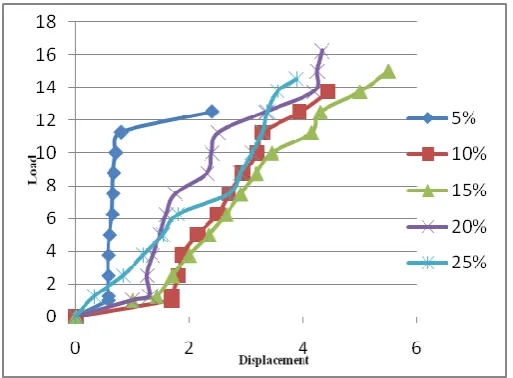
EXPERIMENTAL OBSERVATIONS 5.1 TESTING OF SPECIMENS HAVING POLYAMIDE GRANULESThe specimens are tested under UTM and the results are tabulated. Then a graph showing Load vs. Displacement is plotted. Load is in kilo newton & Displacement is in millimeter
Figure 1: Load vs. Displacement for polyamide granules
Here in this figure we can see that the specimen with 20% of polyamide granules takes more loads when compared to other specimen.
5.2 TESTING OF SPECIMENS HAVING ACRYLIC GRANULES
Figure 2: Load vs. Displacement for acrylic granules
Here in this figure we can see that the specimen with 10% of acrylic granules takes more loads when compared to other specimen.
6.
CALCULATIONS FOR STRESS AND STRAINDeflection is calculated by formulae:
Def = ( 𝑀 + 𝐷
100)
Where M = main scale reading D = vernier scale reading or divisions
Stress is calculated by formulae: Stress = 𝑃
𝐴 Where P = load A = area
Strain is calculated by formulae:
Strain = ∆𝐿 𝐿
Where ∆𝐿 = deflection L = Length
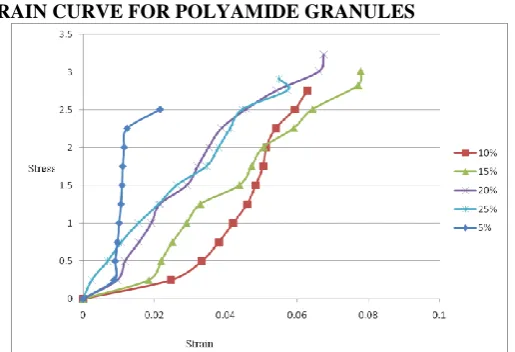
6.1 STRESS AND STRAIN CURVE FOR POLYAMIDE GRANULES
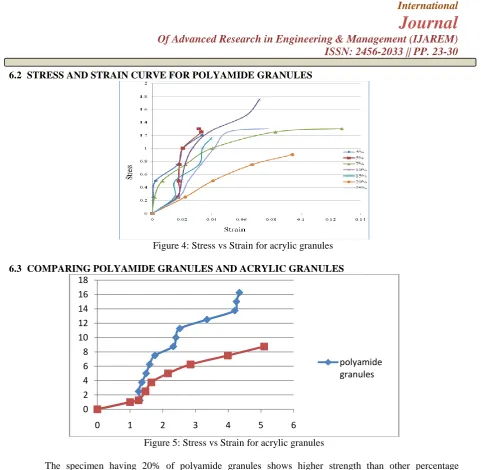
6.2 STRESS AND STRAIN CURVE FOR POLYAMIDE GRANULES
Figure 4: Stress vs Strain for acrylic granules
6.3 COMPARING POLYAMIDE GRANULES AND ACRYLIC GRANULES
Figure 5: Stress vs Strain for acrylic granules
The specimen having 20% of polyamide granules shows higher strength than other percentage variations. Similarly the specimen having 10% of acrylic granules shows higher strength than other percentage variations. When these two specimens were compared (i.e. 20% polyamide and 10% acrylic granules), the specimen having 20% of polyamide granules shows more strength.
7.
RESULTS AND DISCUSSIONS
The durability of flexible pavement based on bituminous binder depends on stress strain behaviour. Most of the failure is due to fatigue and shear failure as in the literature. The fatigue depends on the tensile strength. If binder composition has higher tensile strength it also possesses higher shear strength. Different types of bituminous binders 20/80, 30/70, 40/50 have been used as binder in making flexible pavements. To enhance the tensile strength of binder it is proposed to adduct to different thermo plastic polymers.
The elastic modulus of each component is obtained from the stress strain curve. The behaviour of specimen is as like the traditional stress strain behaviour of flexible pavement. Based on the composition the maximum load carrying capacity is increased and elastic modulus is also increased. It is evidenced that the polyamide composition and acrylic granules composition altered the properties of bituminous solution to have more Elastoplastic properties.
0 2 4 6 8 10 12 14 16 18
0 1 2 3 4 5 6
8.
CONCLUSION
1. The optimum temperature in bituminous composite is 1100±100c
2. The bituminous solution has not made the binding property and it has got complete wetting of aggregates surface.
3. The bituminous composite with Polyamide granules at 20% addition showed
16.25 KN of compression strength.
4. In the case of acrylic granules, addition of 10% acrylic granules acted as optimum dosage and the strength obtained was 8.75 KN.
5. The polyamide mixed bituminous composite performed better in compressive strength.
6. The viscosity of the bitumen increases with addition of plastic granules to it. Both polyamide and acrylic granules addition increases the viscosity of the bitumen.
7. The penetration value of normal bitumen was 95mm. The addition of 10% of acrylic granules reduced the
penetration value to around 87mm. The addition of 20% of Polyamide granules reduced the penetration value to around 80mm.
8. The softening point of normal bitumen was found to be 450c. When 10% of acrylic granules were added the softening point was around 800c and when 20% of Polyamide granules were added the softening point was found to be 930c... This shows that there is increase in softening point which increases the durability to a great extent.
9. The acrylic polymer composite will be useful for ultraviolet resistance. Thus this will be highly useful for durable pavement.
REFERENCES
[1]. ASTM, 2015. ASTM D 5710 - Standard Specification for Trinidad Lake Modified Asphalt. American
Society of the International Association for Testing and Materials (ASTM). Designation: D5710/D5710M – 15
[2]. ASTM, 2015. ASTM D 6927 - Standard Test Method for Marshall Stability and Flow of Asphalt Mixtures. American Society of the International Association for Testing and Materials (ASTM). Designation: D6927 – 15
[3]. Carreira, D.J., and K.H. Chu. 1985. Stress-Strain Relationship for Plain Concrete in Compression. Journal of the American Concrete Institute 82(6), 797-804.
[4]. Government of the Republic of Trinidad and Tobago (GORTT), 2000. Hot Asphalt Mixtures for Use in
Road Paving – Schedule 20. Central Tenders Board Standard Specifications. No. CTB: HAM-R 2000
[5]. Hsu, L.S., C. Hsu. 1994. Complete Stress-Strain Behaviour of High-Strength Concrete under
Compression. Magazine of Concrete Research 46(169), 301-312.
[6]. Starodubsky, S., Blechman, I., Livneh, M. 1994. Stress-strain relationship for asphalt concrete in compression. Materials and Structures 27 (8),474-482.
[7]. Wang, P., S. Shah, A. Naaman. 1978. Stress-Strain Curves of Normal and Lightweight Concrete Compression. American Concrete Institute 75(11), 603-611.
[8]. Wang, J., Molenaar, A.A, Van De Ven, M. F. C., Wu, S. 2015. Behaviour of asphalt concrete mixtures
under tri-axial compression. Construction and Building Materials. 105, 269-274.
[9]. Zheng, J., Tuo, H., 2015. Study on Triaxial Test Method and Failure Criterion of Asphalt Mixture. Journal of Traffic and Transportation Engineering (English Edition). 2 (2), 93-106.