Progress in Biological Sciences
Vol. 6, Number 2, Summer/Autumn 2016/139-150 - DOI: 10.22059/PBS.2016.590016
Optimization for high level expression of cold and pH
tolerant amylase in a newly isolated
Pedobacter
sp.
through Response Surface Methodology
Razie Ghazi-Birjandi1, Bahar Shahnavaz 1,2*, Maryam Mahjoubin-Tehran1,3
1
Department of Biology, Faculty of Science, Ferdowsi University of Mashhad, Mashhad, Iran
2
Institute of Applied Zoology, Faculty of Sciences, Ferdowsi University of Mashhad, Mashhad, Iran
3
Department of Medical Biotechnology, School of Medicine, Mashhad Univerity of Medical Science, Mashhad, Iran
Received: January 08, 2016; Accepted: August 7, 2016
Amylase is one of the most widely used enzymes in the industry. Cold environments are the most ubiquitous environments in the world that have been occupied by cold tolerant microorganisms. The enzymes of these microorganisms have a wide range of applications in various areas of biotechnology. The aim of this study was to isolate cold-active amylase producing bacteria. A total of 64 cold-tolerant bacteria producing amylase were isolated from Binaloud Mountain soil, Iran. An isolate (Pedobacter sp. BTR84) registered under accession number KM459538 with the highest enzyme productivity was selected for production optimization. The production of amylase was evaluated via One-factor-at-a-time method and RSM (Response Surface Methodology). The enzyme production was optimized at 20°C, pH 9, starch 2% (w/v), and inoculation level 3% (v/v) by One-factor-at-a-time method. Then, in order to investigate the interaction between these variables and determine the final optimal conditions, optimization was carried out through the response surface methodology (RSM). Four variables were evaluated at three levels using the Box-Behnken design. Starch concentration and inoculation level variables had a significant effect on amylase production (p<0.05). The final optimum conditions for amylase production in the isolates were temperature 25°C, pH 7, starch concentration 2.5% (w/v), and inoculation level 3% (v/v). The current study suggests that Psychrotrophic local bacteria are capable of producing extracellular hydrolytic enzymes that have a good potential to be applied in biotechnological industries.
Keywords: Enzyme production; Biotechnology; Psychrotrophic bacteria.
Introduction
Bacterial enzymes are widely used in various industries, due to their low cost, high production,
chemical stability, and environmental safety (1). Bacterial amylase is one of the most important and useful enzymes, which is utilized in many industries, such as food and textile, as well as in medical and
pharmaceutical fields. Various types of eukaryotes, bacteria, and archaea can produce this enzyme (2-4). Bacterial amylase comprises approximately 20-30% of total annual sales of the enzymes. There is an increasing trend regarding detection of amylase-producing bacteria with novel and more suitable features for use in different industries because of the increasing demand in this regard (5-7).
Psychrophiles are cold-loving bacteria or archaea that have an optimal growth temperature at about 15˚C or lower, a maximal growth at about 20˚C. However, psychrotrophs are cold-tolerant micro-organisms that have optimal and maximal growth temperatures of above 15 and 20˚C, respectively (8)
Cold-resistant bacteria produce enzymes that work efficiently in low or moderate temperatures. More-over, the specific activity of these enzymes at low temperatures is higher than their mesophilic and thermophilic counterparts (9). Psychrophilic and psychro trophic enzymes have flexible catalytic region while other noncatalytic regions may be even more rigid than mesophilic and thermophilic enzymes. Flexibility of the molecular structure in psychrophiles and psychrotroph microorganism causes a better interaction between substrate and enzyme with low energy cost, which explains the high specific activity of cold-adapted enzymes (8, 10). The potential of these microorganisms to produce enzymes that have higher specific activity at low temperatures has made them good candidates for use in a large variety of industries, mainly in the detergent, textile and paper industries as well as laboratory reagents in molecular biology or medical research and biomolecules and as food additives such as dietary supplements for use in aquaculture, livestock and human diets (11). Accord-ingly, a particular and increasing interest has been developed in recent years toward cold-acting bacteria and their enzymes (12).
Production of extracellular enzymes is affected by different experimental conditions such as culture medium ingredients, especially sources of nitrogen and carbon, or physical conditions such as temper-ature, pH, dissolved oxygen, and inoculation level (13). So far extensive studies have been carried out in the field of amylase production optimization and effects of different variables on amylase production
by One-factor-at-a-time method (14-16). Due to the limitations of One-factor-at-a-time approaches, other optimization methods such as the response surface methodology (RSM) are currently used. RSM is a set of experimental and mathematical methods and statistical analyses for designing experiments, modeling, determining the optimal conditions for each variable, and evaluating interactions between different variables (17).
The aim of this study was to: 1) isolate and identify bacteria producing amylase from cold mountain soils, 2) optimize some conditions of amylase production in Pedobacter sp. BTR84 through the One-factor-at-a-time method, and 3) evaluate interactions between variables via optimization by the Box-Behnken design.
Material and Methods
Soil sampling and isolation of bacteria
Soil samples were collected from Binaloud Mountain in the northeast of Iran (58° 50' 57" E, and 36° 25' 35" N). The diluted soil was cultured on tryptic soy broth containing agar (TSA medium) and incubated at 4, and 20°C. Cold tolerant bacteria were identified by growth of isolates at 4°C and 20°C but not at 37°C. Isolates growing at 20 and 37°C were considered as mesophilic (18, 19).
Amylase producing bacteria
For early verification of amylase activity, the isolate with the defined concentration (1.5×10⁸ cfu/ml) was inoculated into TSA medium containing 1% starch and kept at 20°C for 7–10 days. Observation of a clear halo around the colony is indicative of amylase activity with decomposition of starch when lugol was added.
Amylase activity assay
Amylase was produced in 20 ml TSB medium con-taining 1% (w/v) starch. Two hundred microliter of standard bacterial suspension was added to the culture medium and incubated in 150 rpm.
Razie Ghazi-Birjandi et al
Progress in Biological Sciences / Vol. 6 (2) 2016 / 139-150
141
enzyme. Amylatic activity was measured through Brenfeld assay (20) as follows; 250 µl cell-free en-zyme solution was added to 250 µl starch dissolved in sodium phosphate buffer 50 mM (pH 6.9) and in-cubated at 30°C for 15 min. Then, 500 µl DNS reagent (3,5-dinitrosalicylic acid) was added and incubated at boiling water bath for 10 min to stop the reaction. The reaction mixture was centrifuged at 12000 rpm for 10 min and the absorbance of supernatant was read at 540 nm. One unit of amylase enzymatic activity is defined as the amount of enzyme that releases 1 mg maltose within 1 min.
Bacterial growth
In order to measure bacterial growth, a standard concentration of the desired bacteria was added to 20 ml of broth culture media. The time of bacterial inoculation was regarded as the zero time. The growth of the bacteria was determined by a spectrophoto-meter device at a wavelength of 600 nm with three replications.
Morphological, biochemical and molecular identification
Microscopic identification and biochemical character-ization were performed as basic morphological and biochemical examinations (Table 1). The genomic DNA was extracted using the FastDNA® SPIN Kit (MP Biomedicals, Qbiogene) according to the manu-facturer’s instructions. The bacterial species were identified based on amplification and sequencing of 16S rRNA using universal primers, namely, 27F AGAGTTTGATCMTGGCTCAG) and 1492R (TAC-GGYTACCTTGTTACGACTT) corresponding to po-sitions 8-27 and 1492-1507 in the Escherichia coli 16S rRNA sequence , respectively (21). Gene ampli-fication of 16S rRNA was performed using 1.5 mM MgCl2, 30 mM KCl, 10 mM Tris-HCl, 2.5 mM of each dNTP, 5–10 pmol of each primer, and 1U of Taq polymerase. Polymerase chain reaction (PCR) was carried out using the following program: initial de-naturation at 95°C for 2 min, 30 cycles of dede-naturation at 95°C for 30s, annealing at 57°C for 30s, the extension at 72°C for 30s, and final elongation at 72°C for 7 min. The PCR products were sequenced at Macrogen, South Korea.
Table 1. Biochemical characteristics of amylase producing bacteria isolated from Binaloud Mountain, NE Iran
ATR2051 (Agromyces) BTR821 (Pseudomonas) ATR812 (Janthinobacterim) BTR209 (Flavobacterium) BTR84 (Pedobacter) Colony morphology smooth smooth smooth mucoid smooth Surface orange reddish pink purple light Yellow pink Pigments Positive Negative Negative Negative Negative Gram’s reaction rods rod-coccus rods rods rod-coccus Shape single diplo diplo single single Arrangement -+ + Motility + + + + +
Growth at 4°C
+ +
+
+
+
Growth at 20°C
-Growth at 37°C
1000 2000 1000 2000 2000 Altitude (m) 6 12 12 10 6 Clear Zone (mm)
Phylogenetic analysis and comparison of sequences
The partial 16S rRNA sequences of the isolates were compared with the NCBI and Ez-Taxon databases. Multiple sequence alignments were performed using online tools (http://www.arb-silva.de/aligner/) (22). The Kimura 2-parameter method was used to calculate evolutionary distances, cladograms were constructed by Maximum Likelihood method, and the branches gained in the phylogenetic tree were eval-uated by performing bootstrap analysis of 1,000 replicates using MEGA (23).
Optimization by One-factor-at-a-time method
In the One-factor-at-a-time method, all variables are kept constant on a contract basis at any stage of optimization, and only the effect of one variable is studied and its optimal level is determined. In the next step, the optimized variable in the previous step is used as a basis. In this research, to optimize the con-ditions of the culture medium, the effect of factors such as temperature, pH, carbon sources, nitrogen sources, starch concentration, inoculums sizes were investigated. In order to examine the best time for amylase production, the amylatic activity was mea-sured after 24, 48, 72, 96, and 120 hrs. Amylase activity was determined at various temperatures of 15, 20, 25, 30, 37°C. The effect of pH on the enzyme activity was measured in the pH range of 4-9 at 20°C. The effect of various sources of carbon (glucose, maltose, sucrose, starch, and glycerol) and inorganic and organic nitrogen sources (peptone, tryptone, yeast
extract, skim milk, and ammonium sulfate) at 1% w/v on amylase production was determined. The effect of various starch concentration on amylase production was determined through incubation of the samples in different starch concentration of 0.5, 1, 1.5, 2 and 2.5 % w/v. In order to examine the effect of the inoculum sizes, 0.5, 1, 2, and 3% v/v of the bacteria-containing suspension were used with an initial concentration of 1.5 × 10⁸ cell.ml-1.
Optimization by Response surface methodology
In the single factor variation optimization method, every single variable is optimized as independent of another variable, while their interactions are neg-lected. In the RSM, a set of statistical analyses are considered for experimental designing, modeling, and determining the optimal conditions for every variable and investigating the interactions between various variables (17). RSM includes two types of designs: Central Composite Design and Box- Behnken (24). In this research, Box Behnken method was used which has a quadratic design with three levels. The variables studied in the single factor variation method were temperature, pH, starch concentration, and inoculum sizes, all of which had the highest impact on amylase production. By using the mathematical (statistical) model the optimum levels of the significant parameters and the interaction effects between variables can be calculated to enhance the production of amylase.
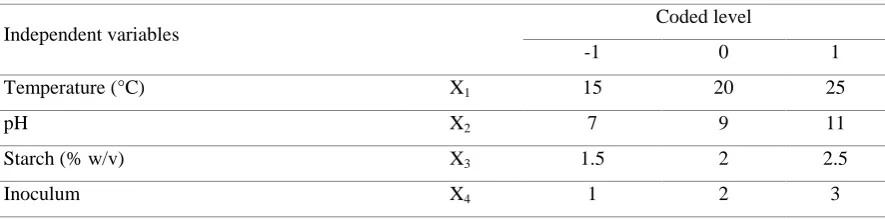
Table 2. Range of the values for the response surface method. The zero level of values of the variable in the single factor variation method is obtained as the optimal surface, where the levels of (-1) and (1) are the minimum and
maximum levels for each variable, respectively.
Coded level Independent variables
1 0
-1
25 20
15 X1
Temperature (°C)
11 9
7 X2
pH
2.5 2
1.5 X3
Starch (% w/v)
3 2
1 X4
Razie Ghazi-Birjandi et al
Progress in Biological Sciences / Vol. 6 (2) 2016 / 139-150
143
In order to amylase production, using Minitab software (ver. 16), three levels of (1), (0), and (-1) were investigated through Box Behnken design (Table 2). The zero level of values of the variable in the single factor variation method is obtained as the optimal surface, where the levels of (-1) and (1) are the minimum and maximum levels for each variable, respectively.
In this method, a quadratic polynomial model has been considered for response prediction. The model proposed for predicted response (Y) is stated in the following Equation:
Y=β0+β1X1+β2X2+β3X3+β4X4+β11X2 2
+β22X2 2
+β33X3 2
+ β44X4
2
+β12X1X2+β13X1X3+β14X1X4+β23X2X3+ β24X2X4+ β34X3Xs
Where β0 is the intercept term; β1, β2, β3 and β4 are coefficient for direct effect; β11, β22, β33 and β44 are coefficient for quadratic effect.
Statistical analysis
All experiments were done in triplicate. The enzyme activity of the strains and the significance of impact of each variable on amylase production were analyzed by Tukey’s HSD test (SPSS software) at the confidence level of 95%.
Results
Isolation and selection of Psychrotrophic amylase producing bacteria
A total of 202 isolates were selected and purified. Most bacteria fell into the Psychrotrophic category (25). To continue the experiment, psychrotrophic bacteria were chosen. Psychrotrophic isolates were cultured on a medium containing starch. 64 (51%) out of 124 psychrotrophic isolates were amylase pro-ducers. Table 1 categorizes isolates based on clear zone diameter, altitude isolation, Maximum enzyme production and biochemical features of selected isolates.
Phylogenetic analysis of 16S rDNA sequences obtained
Five isolates were selected for 16S rRNA gene
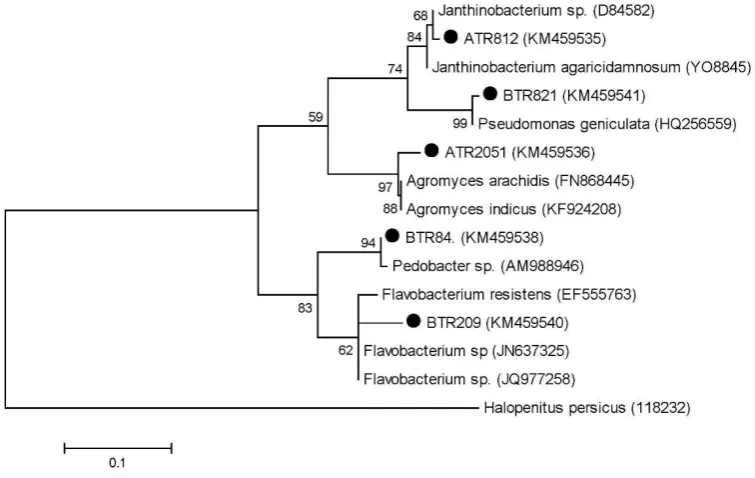
identification. The obtained sequence results showed that isolates belonged to four main groups: Beta-proteobacteria, Gamma-Beta-proteobacteria, Bacteroidetes and Actinobacteria (Figure 1).
The results of the analysis revealed that strains of ATR812, BTR821, BTR84, BTR209 and ATR2051 were related to Janthinobacterium, Pseudomonas, Pedobacter, Flavobacterium and Agromyces genera, respectively. The GenBank accession numbers of the sequences are KM459535, KM459541, KM459538, KM459540 and KM459536.
Quantification of amylase production
Amylase activity was measured every 24 h for 120 h with three replicates (Figure 1). Agromyces sp. ATR2051 (0.071 U/ml), Pedobacter sp. BTR84 (0.072 U/ml), Flavobacterium sp. BTR209 (0.051 U/ml), and Janthinobacterium sp. ATR812 (0.051 U/ml) also displayed the highest amylase activity. Maximum observed amylase production period varied according to the studied strains. The period of maximum amylase activity were 120 h for Agromyces sp. ATR2051, 96 h for Janthinobacterium sp. ATR812 and Flavobacterium sp. BTR209, and 72h for Pedobacter sp. BTR84 and Janthinobacterium sp. ATR812. The production of amylase depended on the grow stage in Pedobacter sp. BTR84, Janthino-bacterium sp. ATR812, and Flavobacterium sp. BTR 209 (Figure 2).
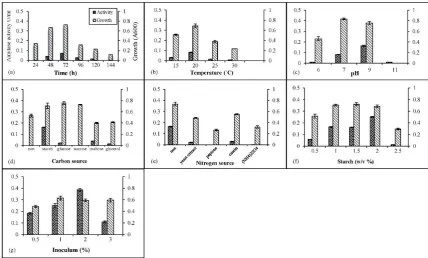
One-factor-at-a-time optimization method for Pedobactersp. BTR84
occur-red after 72 hrs in the stationary phase (Figure 3a). The highest rate of growth and enzyme production in this isolate was observed at 20°C (Figure 3b). The highest enzyme production in this isolate was ob-served at pH 9 (Figure 3c). Regarding carbon source, the highest production of the enzyme occurred in the presence of starch (Figure 3d), while, there was no
amylase activity in the control sample which had no external carbon source. In the absence of an external source of nitrogen, strain Pedobacter sp. BTR84 showed the highest growth and enzymatic activity (Figure 3e). Figure 3f and 3g show that 2% (w/v) starch and 2% (v/v) inoculum had the greatest impact on the enzyme production.
Figure 1. The phylogenetic tree of strains obtained. Phylogenetic analysis is performed using Maximum Likelihood method with 1,000 bootstrap replicates. Black circles indicate the sequences generated in the present analysis.
Figure 2. The amylase activity of given strains. The assessment of the production of amylase by isolates was performed over a 144 h, at 24 h intervals with three replications. The amount of amylase enzyme units per milliliter was calculated according to this
Razie Ghazi-Birjandi et al
Progress in Biological Sciences / Vol. 6 (2) 2016 / 139-150
145
Figure 3. The effect of different variables on growth and amylase production in Pedobacter sp.
Optimization through response surface methodology for Pedobactersp. BTR84
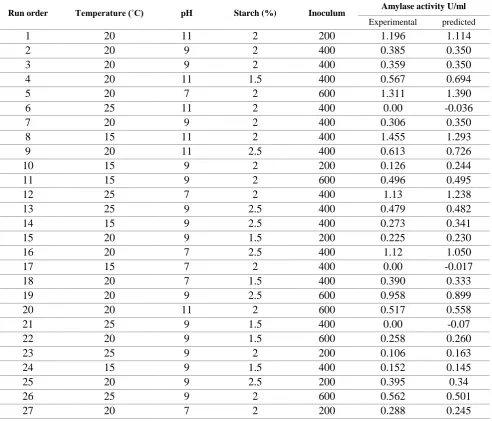
In the present study the Box-Behnken design was used to evaluate the interactions between the selected variables and to determine the optimal conditions for production of amylase in Pedobacter sp. BTR84. The temperature, pH, starch concentration, and inoculation level variables which had significant impacts on amylase production were selected for more accurate study using RSM (Table 2).
Table 3 depicts the Box-Behnken design and the measured and the predicted responses. The total pre-dictive ability of the model can be described by R2 which is a measure of the versatility of the obtained results with the predicted ones. The corresponding analysis of variance (ANOVA) is presented in Table 4. The ANOVA of the quadratic regression model was highly significant. The high value of R2 (0.9709) indi-cated that only 2.91% of the total variation was not explained by the model. The high value of R2 for en-zyme production and insignificance of lack-of-fit (0.115) indicated compliance with the model. Poly-nomial equation obtained from regression analysis, in which the activity of amylase (Y) is a function of the independent variables, is as follows:
Ypedobacter = 0.350 + 0.187X3+ 0.147X4- 0.103X 2
1 + 0.372X22 + 0.104X
2
4 - 0.646X1X2 - 0.173X2X3 -0.425X2X4+ 0.132X3X4
Where Y is the enzymatic activity, and X1 to X4 are the variables temperature, pH, starch concen-tration, and inoculation level, respectively, which had the greatest impact in the One-factor-at-a-time method.
Multivariate optimization through the Box-Behnken design was performed to study the inter-action between variables and to determine the opti-mum conditions.
Table 3. Design of experiments to optimize the production of amylase using Box-Behnken
design for strain Pedobacter
Amylase activity U/ml Inoculum Starch (%) pH Temperature (˚C) Run order predicted Experimental 1.114 1.196 200 2 11 20 1 0.350 0.385 400 2 9 20 2 0.350 0.359 400 2 9 20 3 0.694 0.567 400 1.5 11 20 4 1.390 1.311 600 2 7 20 5 -0.036 0.00 400 2 11 25 6 0.350 0.306 400 2 9 20 7 1.293 1.455 400 2 11 15 8 0.726 0.613 400 2.5 11 20 9 0.244 0.126 200 2 9 15 10 0.495 0.496 600 2 9 15 11 1.238 1.13 400 2 7 25 12 0.482 0.479 400 2.5 9 25 13 0.341 0.273 400 2.5 9 15 14 0.230 0.225 200 1.5 9 20 15 1.050 1.12 400 2.5 7 20 16 -0.017 0.00 400 2 7 15 17 0.333 0.390 400 1.5 7 20 18 0.899 0.958 600 2.5 9 20 19 0.558 0.517 600 2 11 20 20 -0.07 0.00 400 1.5 9 25 21 0.260 0.258 600 1.5 9 20 22 0.163 0.106 200 2 9 25 23 0.145 0.152 400 1.5 9 15 24 0.34 0.395 200 2.5 9 20 25 0.501 0.562 600 2 9 25 26 0.245 0.288 200 2 7 20 27
Table 4. Analysis of variance (ANOVA) for regression
Probability (p) > F F-value
Mean squares DF
Sum of squares Source 0.000 28.56 0.31597 14 4.42360 Model 0.01106 12 0.13278 Residual 0.115 8.05 0.01296 10 0.12956 Lake of fit
0.00161 2 0.00322 Pure error 26 4.55638 Corrected total
R2 adj =0.9369 R2 Pred = 0.8346
Razie Ghazi-Birjandi et al
Progress in Biological Sciences / Vol. 6 (2) 2016 / 139-150
147
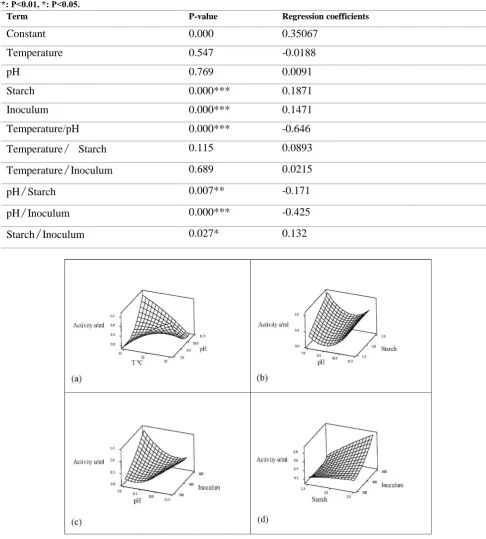
Table 5. Effect of different variables on amylase production. The significant of count estimates is shown as follow: ***: P<0.001, **: P<0.01, *: P<0.05.
Regression coefficients P-value
Term
0.35067 0.000
Constant
-0.0188 0.547
Temperature
0.0091 0.769
pH
0.1871 0.000***
Starch
0.1471 0.000***
Inoculum
-0.646 0.000***
Temperature/pH
0.0893 0.115
Temperature
/
Starch0.0215 0.689
Temperature
/
Inoculum-0.171 0.007**
pH
/
Starch-0.425 0.000***
pH
/
Inoculum0.132 0.027*
Starch
/
InoculumFigure 4. Three-dimensional diagrams of response surface: (a) Temperature and pH; (b) pH and starch concentration; (b) pH and inoculums size and (d) starch concentration and inoculums.
Figure 4 shows the three-dimensional charts of response surface for variables with interactions. In each graph, two variables were assumed constant at their optimal levels, and interactions between two other variables were examined at different levels. Figure 4
represents interactions between temperature/pH, pH/starch concentration, pH/inoculation level, and starch concentration/inoculation level.
amylase production. The regression coefficient for these two variables was negative (-0.646) which suggests that the variables had a countercurrent relationship with each other. In other words, to increase amylase production in the bacteria, the temperature should be increased to about 25°C at a neutral pH. The interaction between variables’ pH and starch concentration was significant and had a negative regression coefficient (-0.171) (Figure 4b). The enzyme production increased when the amount of starch increased by 2.5% and pH adjusted at 7. Figure 4c shows that the interaction between the variables’ pH and inoculation level was significant. The production of amylase was also increased when the inoculation level increased to 3% and pH adjusted at a neutral range. According to Figure 4d, the interaction between the starch concentration and inoculation level was significant. An inoculation level of 3% and starch concentration of 2.5% increased amylase production. Positive regression coefficient for the interaction between these two variables represents the concurrent impact of these variables on amylase production.
Discussion
In this study the ecology of cold tolerant bacteria in mountain soils of Iran is investigated. We were able to isolate 64 samples producing amylase enzymes. Among these, five isolates had the highest enzyme production. The optimum production of enzyme in Pedobacter sp. BTR84 was observed in the stationary at 20°C. Kuddus et al. found similar results for two new strains of Microbacterium and Bacillus cereus (15). Lu et al. showed that the optimum conditions for production of amylase in strain Pseudoalteromon was 20°C and alkaline pH (16). Among physical parameters, pH of the culture medium is the most important variable which can affect enzymatic reactions, enzyme production and stability (26). While, the amylase activity was reduced with in-creasing pH in numerous studies (27, 28), Pedobacter sp. BTR84 have a suitable activity in alkaline pH. These results show that this strain is a candidate source of psychrotrophic and alkaline amylase pro-duction in detergent and textile industry. The enzyme production was negligible in the absence of starch
which indicates an inactive expression. This was confirmed by decreased production of amylase in the presence of glucose. A research performed on Pseudoalteromonas (16) also confirms our results. In Arthrobacter, the highest amylase production was observed in the presence of starch as the carbon source, and amylase production were highly declined in the presence of glucose, which can be due to the inhibitory effect of glucose on amylase production in these bacteria (9). Some studies have shown that inorganic nitrogen sources, yeast extract, and casein may reduce amylase production (16, 29). This was observed in the present study as well. It was reported that adding an external nitrogen source in some strains could inhibit amylase production. The earlier results showed that inoculum sizes had a significant impact on the enzyme production. Mulimani et al. stated that inoculation level is one of the main variables which can affect amylase production in the fungus Gibberella (30).
So far many studies have been conducted to optimize the production of various microbial enzymes through the response surface methodology (RSM). The results show that Pedobacter sp. BTR84 syn-thesizes more enzymes in pH 11 and lower tem-peratures (15-20°C) than higher temtem-peratures (20-25°C). This emphasizes the strain is cold and alkaline tolerant. The interaction between the factors (tem-perature/pH, pH/starch concentration and pH/ ino-culation) showed a negative regression. Accordingly, increasing a factor at the same time of decreasing another factor leads to more enzyme synthesis. However, the interaction between starch concentration and inoculation showed a positive regression, and enhancing two factors increases the enzyme activity.
Razie Ghazi-Birjandi et al
Progress in Biological Sciences / Vol. 6 (2) 2016 / 139-150
149
between variables in RSM.
According to the present study we conclude that Pedobacter sp. BTR84 (KM459538) is a facultative psychrotrophic bacteria producing cold active amylase in alkaline pH. Enzyme activity can be increased by optimizing the culture medium. Therefore, this enzyme can be applied in detergent and food industry. Due to cold and pH tolerant behavior, this enzyme can be used in polluted sites for bioremediation.
Psychrotrophic strain of Pedobacter sp. BTR84 produces efficient amylase enzyme. One-factor-at-a-time optimization increased amylatic activity 5.5 times from 0.07 to 0.39 enzyme unit. Optimization via RSM improved amylase production from 0.39 to 2.02
enzyme unit. Generally, amylase production in this strain was increased 28 times through both methods. Cold active amylase from Pedobacter sp. BTR84 may serve as promising enzyme to replace the conventional synthetic processes in biotechnological industries.
Acknowledgement
We are very grateful to the Laboratory of Micro-biology and Biotechnology, Department of Biology at Faculty of Science, Ferdowsi University of Mashhad. This work was supported financially by Ferdowsi University of Mashhad grants 27140/3.
1. Raddadi, N., Cheri,f A., Daffonchio, D., Neifar, M. and Fava, F. (2015) Biotechnological applications of extremophiles, extremozymes and extremolytes. Appl. Microbiol. Biotech., 99, 7907-7913.
2. Gupta, R., Gigras, P., Mohapatra, H., Goswami, VK. and Chauhan, B. (2003) Microbial α-amylases: a biotechnological perspective. Process Biochem., 38, 1599-1616.
3. Pandey, A., Nigam, P., Soccol, C., Soccol, V., Singh, D. and Mohan, R. (2000) Advances in microbial amylases. Biotechnol. Appl. Bioch., 31,135-152.
4. Pérez-Pomares, F., Bautista, V., Ferrer, J., Pire, C., Marhuenda-Egea, F.C. and Bonete, M.J. (2003) α-Amylase activity from the halophilic archaeon Haloferax mediterranei. Extremophiles, 7, 299-306.
5. Burhan, A., Nisa, U., Gökhan, C., Ömer, C., Ashabil, A. and Osman, G. (2003) Enzymatic properties of a novel thermostable, thermophilic, alkaline and chelator resistant amylase from an alkaliphilic Bacillus sp. isolate ANT-6. Process Biochem., 38,1397-1403.
6. Morita, Y., Nakamura, T., Hasan, Q., Murakami, Y., Yokoyama, K. and Tamiya, E. (1997) Cold-active enzymes from cold-adapted bacteria. J. Am. Oil Chem. Soc., 74, 441-444.
7. Rao, M.B., Tanksale, A.M., Ghatge, M.S. and Deshpande, V.V. (1998) Molecular and biotechnological aspects of microbial proteases. Microbiol. Mol. Biology Rev., 62, 597-635.
8. Moyer, C.L. and Morita, R.Y. (2007) Psychrophiles and psychrotrophs. e.L.S. Wiley Online Library. DOI: 10.1002/9780470015902.a0000402.pub2
9. Smith, M.R., and Zahnley, J.C. (2005) Production of amylase by Arthrobacterpsychrolactophilus. J. Ind. Microb. Biotech., 32, 277-283.
10. Gerday, C., Aittaleb, M., Bentahir, M., Chessa, J.P., Claverie, P. and Collins, T. (2000) Cold-adapted enzymes: from fundamentals to biotechnology. Trends Biotech., 18, 103-107.
11. Souza, PMd. (2010) Application of microbial α-amylase in industry-A review. BJM, 41, 850-861.
12. Georlette, D., Blaise, V., Collins, T., D'Amico, S., Gratia, E., Hoyoux, A. (2004) Some like it cold: biocatalysis at low temperatures. FEMS Microbiol. Rev., 28, 25-42.
13. Cotârlet, M., Bahrim, G.E. (2011) Optimization of cold-adapted amylases and protease production by psychrotrophic Streptomyces 4 Alga using response surface methodology. Turk. J. Bioch., 36, 83-92. 14. Khurana, S., Kapoor, M., Gupta, S., Kuhad, R. (2007) Statistical optimization of alkaline xylanase
15. Kuddus, M., Roohi, Saima., Ahmad, I.Z. (2012) Cold-active extracellular α-amylase production from novel bacteria Microbacterium foliorum GA2 and Bacillus cereus GA6 isolated from Gangotri glacier, Western Himalaya. JGEB., 10, 151-159.
16. Lu, M.S., Fang, Y., Li, H., Liu, H., Wang, S. (2010) Isolation of a novel cold-adapted amylase-producing bacterium and study of its enzyme production conditions. Ann. Microbiol., 60, 557-563.
17. Sankaralingam, S., Shankar, T., Ramasubburayan, R., Prakash, S., Kumar, C. (2012) Optimization of culture conditions for the production of amylase from Bacillus licheniformis on submerged fermentation. Am. Euras. J. Agric. Environ. Sci., 12, 1507-1513.
18. Wang, Q., Hou, Y., Xu, Z., Miao, J., Li, G. (2008) Optimization of cold-active protease production by the psychrophilic bacterium Colwellia sp. NJ341 with response surface methodology. Biores. Technol., 99, 1926-1931.
19. Yu, Y., Li, H.R., Zeng, Y.X., Chen, B. (2011) Bacterial diversity and bioprospecting for cold-active hydrolytic enzymes from culturable bacteria associated with sediment from Nella Fjord, Eastern Antarctica. Mar. Drugs., 9, 184-195.
20. Brenfeld, P. (1995) Amylases, alpha and beta. In: Colowick, S.P., Kaplan, O.N. (eds.) Methods in enzymology. New York: Academic Press. Pp., 149-58.
21. Frank, J.A., Reich, C.I., Sharma, S., Weisbaum, J.S., Wilson, B.A., Olsen, G.J. (2008) Critical evaluation of two primers commonly used for amplification of bacterial 16S rRNA genes. AEM, 74, 2461-2470. 22. Pruesse, E., Peplies, J., Glöckner, F.O. (2012) accurate high-throughput multiple sequence alignment of
ribosomal RNA genes. Bioinformatics, 28, 1823-1829.
23. Tamura, K., Peterson, D., Peterson, N., Stecher, G., Nei, M., Kumar, S. (2011) MEGA5: molecular evolutionary genetics analysis using maximum likelihood, evolutionary distance, and maximum parsimony methods. M. Mol. Biol. Evol., 28, 2731-2739.
24. Box, G.E., Behnken, D.W. (1960) Some new three level designs for the study of quantitative variables. Technometrics, 2, 455-475.
25. Mahjoubin-Tehran, M., Shahnavaz, B., Ghazi-Birjandi, R., Mashreghi, M., Fooladi, J. (2016) Optimization of protease production by psychrotrophic Rheinheimera sp. with response surface methodology. AFB, 3, 236-245.
26. Banerjee, R., Bhattacharyya, B. (1992) Extracellular alkaline protease of newly isolated Rhizopus oryzae. Biotechnol. Letters, 14, 301-304.
27. Nusrat, A., Rahman, S.R. (2007) Comparative studies on the production of extracellular α-amylase by three mesophilic Bacillus isolates. Bangladesh J. Microb., 24, 129-132.
28. Raj, V., Hemashenpagam, N. (2012) Production and medium optimization of amylase by Bacillus using fermentation methods. J. Microbiol. Biotech. Res., 2,481-484.
29. Anto, H., Trivedi, U., Patel, K. (2006) Alpha amylase production by Bacillus cereus MTCC 1305 using solid-state fermentation. Food Technol. Biotech., 44, 241-245.