2nd Quarter Benchmark Energy 1-5 and Weather Part 2 Name__________Key__________________ Date __________ 1. Draw the axes of a graph. Label the x-axis,
y-axis, dependent variable (DV) location, and the independent variable (IV) location.
2. Identify what each letter of DRY MIX stands for.
Dependent
Responding
Y-axis
Manipulated
Independent
X-axis
3. When is it most appropriate to use a A. bar graph __
comparing IV (diff. sets)
B. line graph __QNT change over time
____ C. pie chart __comparing % of a whole
__4. A chef wants to test different metal pans to see which cooks eggs the fastest. Identify the following:
a. IV:
type of pan
b. DV:cooking speed
c. graph type?bar
5.1. Fill in the chart below for the different types of energies using the following word bank, each item is used once. Word bank: atoms, bonds, burning, circuit, electrons, faster, food, generators, higher, mass, motion, particle, photosynthesis, position, released, space, sun, thermal
Type of Energy
Definition Properties Sources
Heat Transfer of thermal energy from object to object
The more energy put into a particle, the faster it moves.
material that is burning (wood), the Sun
Solar Energy travelling through space from the Sun
Can be used to store energy in solar cells.
Visible and invisible light. Used in photosynthesis.
The sun, stars, solar cells
Chemical Energy stored in the chemical bonds of atoms
Energy is released when these bonds are broken.
Wood/wax, batteries, food, sugar, fossil fuels
Electrical Energy flowing in a circuit. Movement of electrons in a wire. Generators, circuits
Mechanical Potential
Energy due to its position The higher an object is from the ground, the more PE. The more mass at a height, the more PE.
Everything above you, rubber band stretched + ready to move
Mechanical Kinetic
Energy due to its motion The faster or more massive an object, the more KE
Everything moving, stretched rubber band released
2. Circle your answer for each choice: What has more energy? Also circle if this scenario represents kinetic or potential energy.
a) ball held up at (5 meters-or-10 meters?). (This is KE-or-PE?) b) (truck-or-car) at the top of a hill? (This is KE-or-PE?) c) Car moving (25 km/hr-or-50 km/hr?) (This is KE-or-PE?)
Y
DV
IV
3. Label the north and south poles for the following drawings of magnets. Also label if the magnets are undergoing “attraction” or “repulsion”.
Attraction
Repulsion
4. Explain what happens when you cut a bar magnet in half.
The bar magnet becomes two bar magnets, each with a north and south pole
5. What is the name of the area around a magnet called? ___Magnetic Field
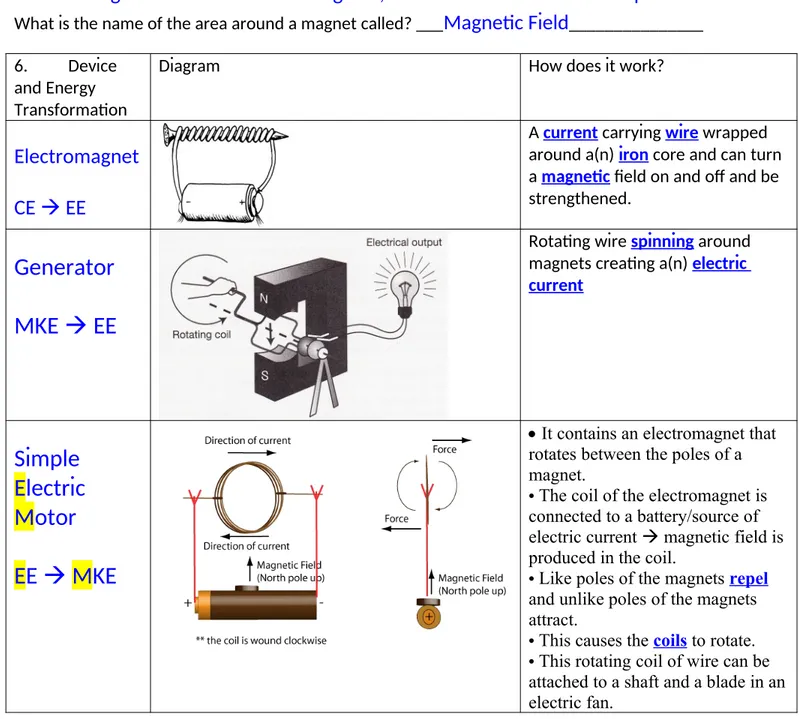
_______________6. Device and Energy Transformation
Diagram How does it work?
Electromagnet
CE
EE
A current carrying wire wrapped around a(n) iron core and can turn a magnetic field on and off and be strengthened.
Generator
MKE EE
Rotating wire spinning around magnets creating a(n) electric current
Simple
Electric
Motor
EE MKE
It contains an electromagnet that rotates between the poles of a magnet.
The coil of the electromagnet is
connected to a battery/source of electric current magnetic field is produced in the coil.
Like poles of the magnets
repel
and unlike poles of the magnets attract.
This causes the
coils to rotate.
This rotating coil of wire can be
attached to a shaft and a blade in an electric fan.
7. Fill in the chart.
Cold Hot
N
N S S N N S
- How atoms behave in different temperature materials.
-Fill in the blanks with the following words (used once): closer, expand, farther apart, faster, shrink, slower
- atoms are closer - atoms move slower
- cold materials seem to shrink
- atoms are farther apart - atoms move faster
- hot materials seem to expand 8. Heat can move in 3 different ways. Identify and describe the 3 methods of heat transfer.
Conduction direct contact of atoms, through solids.
Convection current movement of particles in a fluid (gas or liquid) Radiation use of rays or waves, through space (w/ no atoms present)
9. Each box shows air temperature. Draw an arrow showing the direction that heat would transfer for the following situations: (hot to cold)
10. Which temperature change above would have the greatest exchange of heat? (A,
B
, or C) Why?
greatest temp difference, 45 degree change. (A-only 30, C-0)11. What type of heat transfer is shown in #9 above? convection- Explain. Movement from hot to cold in a fluid (air)
12. Overtime, if all variables were kept constant/the same in a closed system (not room temperature), what would be the approximate temperature of heat transfer B above? (85+40)/2 = 62.5 degrees Why? temps will move until equilibrium is reached
13. Identify an “X” in the box that identifies the main energy heat transfer described. Conduction Convection Radiation Scenario
X A. An egg is frying in a pan.
X B. The sun is heating a sidewalk.
X C. A sea breeze is blowing at the beach.
X D. Spaghetti noodles are “rolling” in a pot of boiling water. X E. You feel the glow of a campfire from 15 feet away.
X F. A cup of hot chocolate warms your hand.
X G. You hold a nail + place the tip in a flame. Soon your fingers get hot. X H. Fast particles colliding with slower particles.
X I. Method air travels.
X J. Transfer through solids.
X K. Transfer through space.
X L. Moves as a current.
X M. Sun rays reaching earth.
X N. Occurs with fluids.
X O. A coil on an electric stove.
X P. Incubator lamp above newborn baby ducks. 14. Fill in the chart.
Conductor Insulator
Define. A material that transfers heat or electricity well
A material that prevents heat or electricity from moving through it.
Examples (at least 3)
copper, iron, silver, gold (almost all metals)
15. Match the device with the energy transformation given. Energy Transformation Device Name Device Choices a. KE EE AE
b. KE EE HE c. KE AE d. SE EE
e. EE KE + AE + HE
a. electric guitar b. iron
c. piano
d. solar calculator e. mixer
16. Why should you get out of a body of water during a lightning storm? Water can conduct the electricity flowing from lightning. You can get electrocuted just by being in the water.
17. Define the Law of Conservation of Energy (all 3 parts). Energy cannot be created nor destroyed. It can change from one form into another, it is never lost.
18. Lightbulb Electrical Energy Required Light Produced Heat Produced
A 100 units 80 units 20 units
B 100 units 66 units 34 units
a. What would be the energy transformation for the scenario above? EE LE + HE
b. How does this follow the Law of Conservation of Energy? Some EE transformed to LE, some lost to HE, but 100% is accounted for.
c. Which light bulb is the most efficient? A Explain your answer: more EE LE, with less heat loss D. IV: lightbulb type
E. DV: amount of light and heat produced F. Graph type: bar (dif. types of bulbs)
19. a. What is an appropriate energy transformation for a wind turbine? MKE EE b. What is causing the blades to move? wind
Use the diagram to answer the next 4 questions.
Series Circuit- has one path electrons can flow (one loop). Parallel circuit-has multiple paths electrons can flow.
20.Which circuit diagram represents circuit B? _E_
21.What will happen to bulb 1 in circuit A if the switch is opened? __It will go out. _________________
23.What will happen to bulb 2 in circuit diagram D if bulb 1 burns out? __The rest of the circuit dies_______ 24.Using electrical symbols, create circuit diagrams for various situations. For example:
Draw a circuit diagram that converts chemical → electrical → sound energy.
Battery is chemical-switch is electrical-speaker is sound. Must return back to battery.
Draw a circuit diagram that converts chemical → electrical → mechanical energy.
Battery is chemical-switch is electrical-motor is mechanical. Must return back to battery.
Draw a circuit diagram that converts chemical → electrical → radiant energy.
Battery is chemical-switch is electrical-lightbulb is radiant. Must return to battery.
Draw a circuit diagram that converts chemical → electrical → thermal energy.
Battery is chemical-switch is electrical-heater is thermal. Must return to battery.
Weather Review 1
Weather Review Part 1:
Across
4 type of front with light rain, warmer and humid after
7 Variable that is on the y-axis.
10 technology that shows precipitation and storm intensity and movement
15 type of graph that compares different sets
16 lines of equal temperatures
19 number in the top right corner of a station model, 011 = 1001.1 mb
20 type of graph that show quantitative change over time
21 type of graph that shows percentages of a whole
23 type of front with rainy/stormy during, cool clear afterward
24 instrument that measures wind speed in knots
26 air moves from high to _____ pressure
28 station model with a triangle shaped flag will have a wind speed of ___ knots
29 type of pressure system with cold air sinking and cool, clear weather
31 location of two air masses colliding, forcing a change in weather
32 instrument like a wind sock that measures the direction wind is coming from
33 type of front where warm air is pushed and trapped above cold air
35 type of map that shows isobars, isotherms, fronts, and station models
36 instrument that measures relative humidity (%)
DOWN
1 station model with two full flags will have a wind speed of ____ knots
2 front line symbol is triangles
3 instrument that measures amount of rainfall in cm, inches, mL
5 number in top left of station model, ex: 32
6 front line symbol is circles and triangles in opposite directions
8 cold air sinks and is more _____ than warm air that rises
9 technology used to track cloud movement
11 instrument that measures temperature in Celsius
12 amount of moisture in the air
13 instrument that measures air pressure in mb, inHg, mmHg, pas, atm, psi
14 type of front where warm and cold air collide, don't move, creating lots of rain
17 front line symbol is half circles
18 front line symbol is circles and triangles in the same direction
22 Variable that is on the left side of a data table.
25 station model with half-shaded circle will be partly ___
30 lines of equal pressure
Weather Review Part 2
Across
8 trade, westerly, and polar easterly are all ____ winds 10 winds formed over land are more ___
11 all storms form in a ___ pressure system 13 winds formed near ocean are more ___
17 climate zone that is between 0 and 30 degrees North latitude, warm temps 20 there will be a greater range of temperatures near ___ than near water 21 type of storm with thunder, lightning maybe near a cold front
23 cold ocean current that moves down the west coast of the US in the Pacific Ocean 24 land and sea breezes are ___ winds
26 global wind located nearest the equator that moves warm air from E to W
DOWN
1 climate zone that is between 30 and 60 degrees North latitude
2 imaginary lines that measure N and S, the farther from the equator the colder 3 Type of local wind that moves cool air from the sea during the day.
4 air moving from the poles will be ___
5 global wind located between 60 and 90 degrees N that moves cold air NE to W 6 global wind located in the temperate regions that moves W to E
7 warm ocean current that moves up the east coast of the US in the Atlantic Ocean 9 imaginary lines that measure E and W
12 water that moves due to temperature and density differences 14 it will be colder at a higher ___ in the mountains
15 type of global wind-fast moving ribbons of air
18 climate zone that is between 60 and 90 degrees North latitude, colder 19 type of storm with winds more than 74 mph forming over warm ocean water 22 type of storm with strong winds and funnel-shaped cloud