ENGINEERING AND GINNING
Cotton Gin Regulatory Issues
Phillip Wakelyn and Kelley Green*
P. Wakelyn, Retired National Cotton Council and consultant, 5615 Kirkside Drive, Chevy Chase, MD 20815; and K. Green*, Texas Cotton Ginners’ Association, 408 West 14th
Street, Austin, TX 78701-1619 *Corresponding author: [email protected]
ABSTRACT
The many workplace, environmental, and other regulations that apply to cotton gins that need to be addressed through programs to ensure compliance are discussed. Some of the regulations discussed in this chapter apply to all gins, whereas other regulations will apply to some gins, but not all. Most of the environmental and workplace leg-islation was passed by Congress in the 1970s. This has led to many workplace and environmental regulations promulgated pursuant to these laws. In the future there will be even more regulations and these regulations will continue to be more comprehensive and restrictive.
M
any regulations governing workplace (safety and health), environment (air, water, and solid waste), biosecurity, food safety, fire codes, and others apply to cotton gins and need to be addressed through management programs to ensure compliance. Some of the regulations discussed in this chapter apply to all gins, whereas other regulations will apply to some gins, but not all. Most of the environmental and workplacelegislation was first passed by Congress in the
1970s in response to increased general public awareness, concern, and the desire for a cleaner environment and safer workplace. Since then, Congress has amended some of these laws. This has led to an increasing number of workplace and environmental regulations promulgated pursuant to these laws. In addition, Biosecurity/Agro-terrorism regulations have come about as a result of the 11 September 2001 attack on the U.S. It is expected in the future that there will be even more regulations and these regulations will continue to be more comprehensive and restrictive.
Each ginning and cotton storage facility is expected to establish programs to ensure proper compliance with various regulations, take proper corrective actions, and develop written programs where necessary. Programs can include for example, engineering controls, written programs, auditing, re-cord keeping, reporting, warning labels, and worker training programs, according to the particular regula-tions that pertain. Regularegula-tions are enforced by the appropriate federal and/or state agency.
Even if a particular regulation does not have mandatory requirements for cotton gins, it might be prudent for cotton gin managers to consider if some type of voluntary control measure is necessary and consider whether environmental, health and safety, and quality management programs are appropriate.
A Glossary of Terms for the abbreviations used
in this paper is included. Specific sections are:
I. Workplace Health and Safety Regulations II. Environmental Regulations
III. Biosecurity IV. FDA Regulations
V. Fire and Building Codes VI. Transportation
VII. References VIII. Glossary of Terms
I. WORKPLACE HEALTH AND SAFETY REGULATIONS
Workplace regulations are promulgated and regulated by the U.S. Occupational Safety and Health Administration (OSHA), which is part of the U.S. Department of Labor (DOL), under the Occupational Safety and Health Act (OSH Act; PL 91-596 as amended by PL 101 552; 29 U.S. Code 651 et seq.) Cotton production and ginning (see Lange, R.D., and G. Visscher, 2002; Wakelyn et al., 2005) are covered by OSHA agriculture standards (29 CFR 1928) and other cotton industry segments are covered by OSHA general industry standards (29 CFR 1910) (Table 1). It is important to remember that the general industry standards listed in 29 CFR 1928.21–applicable standards in 29 CFR 1910 also
For cotton ginning, the North American Industry
Classification System (115111) and the Standard
Industrial Classification code (0724) are under agricultural-support activities for crop production.
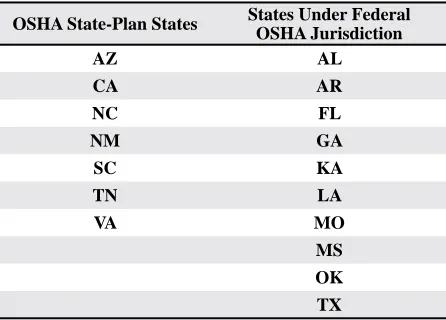
Federal OSHA enforces all OSHA standards except where there is a state-plan program (Table 2). Ginners should know whether their state is a state-plan state (i.e., administers its own OSHA program) or is under federal OSHA, because the 25 state-plan states can have different regulations than federal OSHA. State and local government standards only have to be as effective as the federal standards, but they can be, and sometimes are, more severe. A “guidance” issued by OSHA is not a standard or
regulation and creates no legal obligation; it is only informational/advisory and intended to assist em-ployers in providing a safe and healthy workplace.
General Duty Clause. If there is not a specific
standard but there is a recognized hazard and employers do not take reasonable action to prevent or abate the hazard, OSHA can cite an employer under the “general duty clause” [OSH Act Sec. 5(a)(1)]. The general duty clause requires employers to “furnish to each of his employees employment and a place of employment which are free from recognized hazards that are causing or are likely to cause death or serious physical harm to his employees.” Section 5(a)(2) requires employers to “comply with occupational safety and health standards promulgated under this Act.” Section 5(b) requires that “Each employee shall comply with occupational safety and health standards and all rules, regulations, and orders issued pursuant to this Act which are applicable to his own actions and conduct.”
Occupational Injury and Illness Recording and Reporting Rule. Under the OSHA Recordkeeping regu-lation (29 CFR 1904), covered employers are required to prepare and maintain records of serious occupational injuries and illnesses, using the OSHA 300 Log. De-tailed guidance from OSHA explaining the regulation and related interpretations for recording and reporting occupational injuries and illnesses is available on the OSHA website (www.osha.gov). Employers with 10 or fewer employees are normally exempt from federal OSHA injury and illness recordkeeping and posting requirements. Beginning on 1 February of each year, employers are required to post a summary of the total number of job-related injuries and illnesses that oc-curred during the previous calendar year (OSHA Form
Table 1. OSHA Regulations that Apply to Cotton Industry Sectorsz
Industry Sector 1C Code NAICSy OSHA Standards that Apply
Cotton Farming 0131 11192 (Agriculture)x 29 CFR 1928
Cotton Ginning 0724 11511 (Agriculture)x 29 CFR 1928
Cottonseed Oil Mills 2074 311224 (Soybean and other oilseed processing)311225 (Fats and Oils Refining and Blending) (General Industry) 29 CFR 1910
Warehouse (Farm Product
Warehousing and Storage) 4221 493130 (General Industry) 29 CFR 1910
z Regulations that apply to all sectors:
• OSHA Act (29 U.S. Code 651 et seq.); (“general duty clause” is Sec. 5(a)(1)) • 29 CFR 1903 – Inspections, citations, and proposed penalties
• 29 CFR 1904 – Posting, recording and reporting requirements for occupational injuries and illnesses • 29 CFR 1905 – Rules for Variance, limitations and exceptions
• 29 CFR 1908 – Consultation agreements
• 29 CFR 1952 – Recordkeeping and reporting for state plan states • 29 CFR 1910 – General industry standards
• 29 CFR 1928 – Agriculture standards
y NAICS: North American Industry Classification System
x The only general industry standards that apply to agriculture are specifically listed under 29 CFR 1928.21(a).
Table 2. Cotton Belt States OSHA Enforcement
OSHA State-Plan States States Under Federal
OSHA Jurisdiction
AZ AL
CA AR
NC FL
NM GA
SC KA
TN LA
VA MO
MS
300A-Summary). The previous calendar year sum-mary must be posted from 1 February to 30 April. The summary must include the total number of job-related injuries and illnesses that occurred in the previous calendar year and were logged on OSHA Form 300.
Form 300A-Summary must be signed and certified by a
company executive and displayed in a common area in the building. Employers are required to maintain these records for 5 years following the end of the calendar year that these records cover.
Reporting Fatalities and Hospitalization Inci-dents to OSHA (29 CFR 1904.39). Within 8 hours after the death of any employee from a work-related incident or within 24 hours of any inpatient hospi-talization, amputation, or eye loss of any employee as a result of a work-related incident, the fatality or injury/hospitalization must be reported to OSHA.
This notification may be made by phone, fax, or online. For more information related to notification,
visit the OSHA website.
Criminal Penalties. OSHA also can refer a case to the Department of Justice to bring criminal pen-alties against an employer. The OSH Act provides that any employer who willfully violates any OSHA requirement that causes death to any employee, or for cases of false statements or misrepresentations,
could be subject to criminal penalties including a fine
(up to $250,000 and $500,000 for a corporation) or imprisonment (up to 1 year) or both. These crimes are considered a misdemeanor.
Enhanced Enforcement Program. The OSHA Enhanced Enforcement Program (EEP) affects employers who are subject to enforcement actions (EEPdirectiveCPL 02-00-145). The EEP will take into account previous violations, especially previous willful, repeat, and failure-to-abate violations.
OSHA has broadened the criteria for enhanced enforcement cases to include:
1. A fatality inspection in which OSHA finds one or more willful or repeated violations related to the death;
2. A fatality inspection in which OSHA finds one or more serious violations related to the death and the employer has either an OSHA history of violations similar in kind to the violation that led to the current fatality consisting of at least one serious, willful, or repeat violation within the last 3 years, or the occurrence of another fatality within the last 3 years regard-less of whether any citation was issued; 3. An inspection that results in the citation of
three or more serious violations that are also
classified as willful or repeat and the employer
has an OSHA history of violations similar in kind to one or more of the violations found in the current inspection consisting of at least one serious, willful, or repeat violation within the last 3 years;
4. An inspection that results in one or more failure-to-abate notices where the underlying
violations were classified as serious;
5. Any egregious case or a significant case con -sisting of one or more inspections in which the proposed penalties total more than $100,000; 6. Grouped and combined violations that are
counted as one violation; or
7. An unclassified violation, depending upon
what the citation classification was, or would have been, if the unclassified designation was
not used.
A large percentage of inspections have involved employers with 25 or fewer employees. Those small employers that have had only one serious violation
related to a fatality and no significant OSHA histo -ries within the previous 3 years are removed from the program.
Employers who want help in recognizing and correcting potential safety and health problems and in improving their safety and health programs can get help from a free consultation program funded by OSHA (29 CFR 1908–Consultation agreements). The service is delivered by state governments using well-trained professional staff. The consultation program addresses immediate problems and offers advice and help in maintaining a continued effective health and safety protection.
Some Health and Safety Standards that Af-fect or Potentially AfAf-fect Cotton Ginning. Only agricultural standards listed in 29 CFR 1928 and general industry standards listed in 29 CFR 1928.21
specifically apply to gins (Wakelyn et al., 2005). If
potential hazards/risks are found at cotton ginning
operations that are not covered by specific regula -tions, there should be practices in place to address all hazards to workers. For example, standards for the control of hazardous energy (“lockout/tag out”),
confined space, and noise do not specifically apply
The HCS requires information on hazardous chemicals to be transmitted to employees through labels, safety data sheets (SDS), and training programs. A written hazard com-munication program and recordkeeping are also required. Some gins receive requests for
an SDS for cotton gin trash, cotton fiber, and
cottonseed. Not every material must have an SDS; an SDS is required only for a hazardous chemical to be given to downstream users to communicate information on those hazards.
Because cotton gin trash, cotton fiber, and cot -tonseed are not a chemical or physical hazard, an SDS is not required under the HCS. 3. Bloodborne Pathogens (29 CFR 1910.1030;
specifically covers all industry, including gins). Injuries that expose workers to blood and bloodborne pathogens are an important public health concern, particularly since
Hu-man Immunodeficiency Virus and Acquired Immunodeficiency Syndrome have become
more prevalent. OSHA issued the Bloodborne Pathogens Standard to protect workers from this risk. OSHA’s Bloodborne Pathogens Standard applies to all employers who have employees with reasonably anticipated occu-pational exposure to blood or other potentially infectious materials, regardless of how many workers are employed. However, workplaces with 10 or fewer employees are exempt from OSHA recordkeeping requirements. Employ-ers must implement the applicable require-ments set forth in the standard, which can be located on OSHA’s website.
4. Access to employee exposure and medical records (29 CFR 1910.1020). This provides employees and their designated representa-tives a right of access to relevant exposure and medical records; and provides representatives of the head of OSHA a right of access to these
records to fulfill responsibilities under the
OSH Act. Access by employees, their repre-sentatives, and the head of OSHA is necessary to yield both direct and indirect improvements in the detection, treatment, and prevention of occupational disease.
5. Occupational Exposure to Hexavalent Chro-mium (29 CFR 1910.1026). This rule could affect welding stainless steel operations used in repairs; most welding rods used on steel no longer contain hexavalent chromium (Cr+6).
A. OSHA Health Standards
1. Injury and Illness Prevention Program (I2P2). There is no federal standard but there is fed-eral guidance. Fedfed-eral OSHA in 1989 issued OSHA Voluntary Safety and Health Program Management Guidelines to encourage em-ployers to do more than just comply with regu-lations to prevent occupational injuries and illnesses. In November 2015, OSHA issued a draft updated version of its voluntary Safety and Health Program Management Guidelines
(OSHA-2015-0018) to be finalized in 2016.
These guidelines update and replace OSHA’s 1989 voluntary guidelines. They build on les-sons learned about successful approaches and best practices under OSHA’s programs such as Voluntary Protection program and Safety and Health Achievement Recognition Pro-gram and are consistent with many national and international consensus standards. These guidelines do not change employers’ obliga-tions to comply with the requirements of any OSHA standard. According to OSHA, the guidelines are advisory and informative in content. They are not new standards or regu-lations; also they do not create any new legal obligations or alter existing obligations. It is possible, however, that OSHA could use these voluntary guidelines as a generally recognized practice. For gins in California since 1991, there is a CAL OSHA mandatory standard—a written, effective Injury and Illness Prevention program that is required for every California employer (8 California CR 3203).
2. Hazard Communication Standard (HCS)/ Globally Harmonized System (GHS) (29 CFR
1910.1200; specifically covers all industry,
including gins; it is listed in 1928.21). In 2012 OSHA revised its 1994 HCS, aligning it with the United Nations’ Globally Harmonized System of Classification and Labeling of Chemicals. This revision will be fully imple-mented in 2016. [6/1/15 Compliance with all
modified provisions of this final rule, except:
12/1/15 The Distributor shall not ship con-tainers labeled by the chemical manufacturer or importer unless it is a GHS label; 6/1/16 Update alternative workplace labeling and hazard communication program as necessary, and provide additional employee training for
There is not a specific rule for agriculture;
agriculture could be covered by the general duty clause if there is an exposure that exceeds the OSHA Permissible Exposure Limits (PEL). 6. Air Contaminants Rule (29 CFR 1910.1000;
the PEL for air contaminants). Gins are not covered by these regulations but the general duty clause can be applied if there are
sig-nificant worker exposures to any regulated
chemical. If there is worker exposure above a general industry PEL, there needs to be a program to address this exposure. Engineering controls, written programs, and work practices are some of the requirements.
7. Occupational Exposure to Respirable Crys-talline Silica (29 CFR 1910. 1000). A final rule with a new permissible exposure limit, calculated as an 8-hour time-weighted aver-age of 50 micrograms of respirable crystalline
silica per cubic meter of air (50 μg/m3) and an
action level of 25ug/m3 is expected in early
2016. OSHA also includes other ancillary provisions for employee protection such as preferred methods for controlling exposure, respiratory protection, medical surveillance, hazard communication, and recordkeeping.
There is no specific rule for agricultural (in
-sufficient data to determine if a new PEL is
feasible in agricultural operations). But if the dust level in an operation is 1 mg/m3 or more
and the agricultural dust, which usually is more than 50% soil, is 2.5% crystalline silica, a facility would hit the action level and could be affected by this rule.
8. Cotton Dust Standard (29 CFR 1910.1043). The OSHA’s cotton dust standard at 29
CFR 1910.1043(a)(2) specifically excludes
cotton ginning from coverage and 29 CFR 1910.1043(c) addresses permissible
expo-sure limits but questions often are raised. The dust in the cotton ginning workplace should be considered a “nuisance dust” or “particulate not otherwise regulated” (29 CFR 1910.1000) as cotton dust. The dust generated through the ginning process is composed primarily of inorganic/inert mate-rial and is recognized by OSHA as different from cotton-related dust in composition and worker reaction when compared with the dust subject to the Cotton Dust Standards for tex-tile manufacturing and other cotton industry
sectors specifically covered by the standard.
In some countries cotton dust regulations could apply to ginning and it is prudent health and safety practice to keep dust levels below 1 mg/m3 respirable dust.
B. OSHA Safety Standards
1. Machine Guarding of Cotton Ginning Equip-ment [29 CFR 1928.57(d)]. Machine guarding
is the only agriculture standard specific to
cotton gins. At the time of initial assignment and at least annually thereafter, the employer should instruct every employee in the safe operation and servicing of all covered equip-ment at the gin with which he is or will be involved, including the following safe operat-ing practices:
a. Keep all guards in place when the ma-chine is in operation;
b. Stop the engine, disconnect the power source, and wait for all machine move-ment to stop before servicing, adjusting, cleaning, or unclogging the equipment, except where the machine must be run-ning to be properly serviced or main-tained, in which case the employer shall instruct employees as to all steps and procedures that are necessary to safely service or maintain the equipment; c. Ensure everyone is clear of machinery
before starting the engine, engaging power, or operating the machine; d. Lock out electrical power before
per-forming maintenance or service on farmstead equipment; and
e. Where guards are used to provide the protection required, they shall be de-signed and located to protect against inadvertent contact with the hazard be-ing guarded.
2. Temporary Labor Camps (29 CFR 1910.142; listed in 1928.21).
3. Storage and Handling of Anhydrous Am-monia [29 CFR 1919.111(a) and (b); listed in 1928.21].
4. Slow-moving Vehicles (29 CFR 1910.145; listed in 1928.21).
5. Powered Industrial Truck Operator Training (29 CFR 1910.178). This covers forklift trucks
(final standard 1 Dec. 1998, 63 FR 66239);
pub-lished 7 December 2000. This standard does not apply to agriculture, but elements of the regulation might be helpful in developing a training program for forklift operators. The general duty clause can be, and sometimes is, used to cite gins that do not effectively train their forklift operators.
6. Electrical Standards (29 CFR 1910 Subpart S. These regulations apply to general industry
and maritime but not specifically to agricul -ture. (Some state OSHAs might require this rule for gins and the general duty clause could be used to enforce these rules.) The focus is on safety in the design and installation of electrical equipment in the workplace. This affects electrical use broadly, including exten-sion cords.
7. Permit-Required Confined Space (29 CFR 1910.146). This does not cover gins
spe-cifically; however, there is a need to identify
spaces within a gin and provide guidance on proper procedures to follow when entering these spaces. This can be and is sometimes enforced with the general duty clause. 8. Lockout-Tagout (29 CFR 1910.147). This
does not cover gins specifically but hazardous
energy sources need to be controlled when performing work on machinery. A gin should consider controlling sources where there is the possibility for worker injury. This can be and is often enforced with the general duty clause. Some state-plan states have different requirements. California, for example,
re-quires written machinery-specific procedures
for all equipment/machinery.
9. Employee Emergency Plans (29 CFR 1910.38). This does not specifically apply
to gins under federal law, but some state-plan states have different requirements. The emergency action plan should address emergencies that the employer can reason-ably expect in the workplace. Examples
are: fire, toxic chemical releases, hurricanes, tornadoes, blizzards, floods, and others. An employer must have an emergency action plan whenever an OSHA standard requires one. An emergency action plan must be in writing, kept in the workplace, and avail-able to employees for review. However, an employer with 10 or fewer employees may communicate the plan orally to employees.
10. Fire Prevention Plan [29 CFR 1910.38(b)(1)].
The Fire Prevention Plan does not specifically
apply to gins under federal law, but some state-plan states have different requirements. There are requirements under the general industry standard.
a. Fire Brigades (29 CFR 1910.156). This rule contains requirements for the orga-nization, training, and personal
protec-tive equipment of fire brigades whenever
they are established by an employer.
b. Combustible Dust Explosions. For some facilities OSHA enforces for combus-tible dust under general duty (house-keeping) and the amended HCS GHS rule. The amended HCS GHS Rule can address combustible dust for some industries [court ruling indicated 24
Oct. 14, specifically covers as a “hazard not otherwise classified” (9 Jan. 2014
OSHA guidance on combustible dust under HazCom); 9 Feb. 2015 memo
outlines how OSHA will define ‘reason -able diligence”/“good faith efforts” for compliance/establishes new dates for future compliance: https://www.osha. gov/dep/enforcement/hazcom_enforce-ment-memo.html]; the general duty clause and legislation or rulemaking or guidance could force mandatory regulations. Cotton gins or cotton lint or cottonseed handling operations do not present an explosion potential because the minimum explosive concentration (MEC) for cotton of approximately 50 g/m3 is not reached. For cotton gins
where dust is high in soil content (i.e., inorganic noncombustible dust) the MEC would be much higher, if an MEC could be determined. Additional information on dust explosions can be found in Palmer (1973) and Cross and Farrer (1982).
11. Occupational Noise Exposure (29 CFR 1910.95) and Hearing Conservation Program, [29 CFR 1910.95(c)]. OSHA noise standards
(29 CFR 1910.95), and where feasible, en-gineering or administrative controls must be utilized in general industry when employees are subjected to sound exceeding the PEL; and possibly below 85 dBA (the action level), which is when hearing conservation programs are required for general industry. It is important to understand that OSHA recognizes that noise exposure is different in agriculture (short-term exposure followed by long respite from exposure/recovery time) than general industry (continuous exposure), which is why agriculture is not regulated un-der the noise standard (Lange and Visscher, 2002), so 90 dBA in a cotton gin is not the same as 90 dBA in a general industry busi-ness. The hearing conservation program (29 CFR 1910.95b), required when noise levels exceed the 85 dBA action level, includes noise-level monitoring, audiometric testing, and making hearing protection available to all employees when noise levels cannot be engineered below 90 dBA.
Noise levels can be mitigated by engineer-ing controls or personal protective equipment. Engineering controls would include methods such as replacing Vane Axial fans with centrifu-gal units, moving all fans to a separate fan room,
and using mufflers on seed blowers. Reducing
noise in the gin plant is always desirable, and is worth considering when developing plans for upgrading the ginning machinery. Personal protective equipment includes ear plugs and ear muffs. Ensure that employees who are wearing
this equipment understand the proper fit and
use of the particular equipment.
12. Ergonomics. There is no federal standard but ergonomics can be regulated under the OSHA general duty clause and California has
a specific ergonomic rule. OSHA does have
a four-pronged comprehensive approach to ergonomics designed to quickly and effec-tively address musculoskeletal disorders in the workplace (https://www.osha.gov/SLTC/ ergonomics/).
13. Personal Protection Equipment (29 CFR 1910.132). These rules do not specifically cov
-er gins und-er fed-eral law, but some state-plan states have different requirements. If respira-tors or other personal protective equipment (PPE) are offered by the employer, gins need
to have a written program. Any PPE required by any OSHA standard has to be provided and paid for by the employer. A standard was pub-lished by OSHA 15 November 2007 (Federal Register Vol. 72, No. 220, p. 64342–64430)
codifying this. Specific PPE standards: 29
CFR 1910.132 (General requirements), 29 CFR 1910.133 (Eye and face protection), 29 CFR 1910.135 (Head protection), 29 CFR 1910.136 (Foot protection), 29 CFR 1910. 137
(Electrical protective equipment), and 29 CFR 1910.138 (Hand protection); in addition, indi-vidual OSHA general industry and agriculture standards also have PPE requirements (see https://www.osha.gov/Publications/osha3151. html).
14. Heat Stress. There is no federal OSHA stan-dard for heat stress, only guidelines (See OSHA’s Heat Illness Prevention page for more information at https://www.osha.gov/SLTC/ heatillness/index.html or order heat illness educational materials at http://www.osha.gov/ SLTC/heatstress/index.html). Some state-plan states have different requirements. However, federal OSHA can, under the general duty clause [Section 5(a)(1)], site an employee for this risk to workers. High air temperature and humidity put gin and other agricultural workers at special risk of heat illness (CAL OSHA, 2006; OSHA, 2002, 2006). As dis-cussed later, the Worker Protection Standard also has requirements to prevent heat illness. Some of the requirements to prevent heat ill-ness are training, adjusting work schedules, and providing shade and water.
C. Emergency Preparedness and Response
The OSHA Emergency Preparedness and Re-sponse home page is http://www.osha.gov/SLTC/ emergencypreparedness/index.html. Elements of OSHA emergency responder health and safety are regulated by OSHA primarily under the following standards:
1. Hazardous Waste Operations and Emergency Response Standard (29 CFR 1910.120); 2. Personal Protective Equipment General
Re-quirements Standard (29 CFR 1910.132); 3. Respiratory Protection Standard (29 CFR
1910.134);
5. Fire Brigade Standard (29 CFR 1910.156); and
6. Bloodborne Pathogens Standard (29 CFR 1910.1030).
Currently OSHA is evaluating the types of per-sonnel who would constitute either emergency re-sponders or skilled support employees at such events, as well as the range of activities that might constitute emergency response and preparedness, particularly
with interest in ways to incorporate flexibility into its
standards to make them more suited to the demands of emergency response activities.
D. Preparing Security Personnel in Emergencies
Security personnel (i.e., guards) can benefit
from a publication by OSHA entitled “Preparing and Protecting Security Personnel in Emergencies”. This publication addresses emergencies involving hazardous substance releases and provides guidance for employers and their security personnel who could be involved in the emergency response.
E. Other Department of Labor Regulations
In some cases, OSHA inspectors can be accom-panied by other DOL inspectors, such as Wage and Hour inspectors. In addition to OSHA regulations, the DOL might look at compliance with other regu-lations listed below. Some of these are covered in more detail in other chapters.
1. The Fair Labor Standards Act;
2. The Occupational Safety and Health Act of 1970;
3. The Migrant and Seasonal Agricultural Worker Protection Act;
4. The National Labor Relations Act;
5. 41 U.S.C. Chapter 67, also known as the Ser-vice Contract Act;
6. Executive Order 11246 of 24 September 1965 (Equal Employment Opportunity);
7. Section 503 of the Rehabilitation Act of 1973; 8. The Family and Medical Leave Act;
9. Title VII of the Civil Rights Act of 1964; and 10. The Americans with Disabilities Act of 1990.
II. ENVIRONMENTAL REGULATIONS
The U.S. Environmental Protection Agency (EPA) administers all regulations affecting the en-vironment (air, water, solid waste) and chemicals in commerce (Toxic Substances Control Act) and ag-ricultural chemicals (Federal Insecticide, Fungicide
and Rodenticide Act). EPA regulations are intended to protect human health and welfare and the environ-ment. The individual states and state environmental regulatory control boards implement and enforce most of the regulations. Some of the more important environmental regulations that affect cotton ginning are summarized below. Regulations for agricultural chemicals and chemical in commerce do not affect gins unless they store chemicals not used in ginning. The legislation that serves as the basis for the regu-lations can be divided into: Clean Air Act (CAA), Clean Water Act (CWA), and Resources Conserva-tion and Recovery Act (RCRA).
A. Clean Air Act (42 U.S. Code 7401 et seq.)
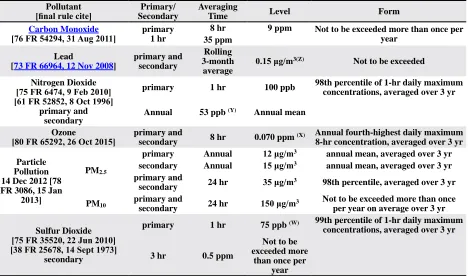
Under the CAA, EPA promulgates standards for and regulates air pollutants. Criteria pollut-ants [particulate matter (PM), ozone, NOx, SOx,
CO, lead] are regulated with National Ambient Air Quality Standards (NAAQS) (Table 3). Haz-ardous air pollutants are regulated with National Emission Standards for Hazardous Air Pollutants (NESHAPs) and maximum achievable control technology (MACT) standards. There are regula-tions for stationary sources and mobile sources. The air pollutant of most concern to cotton gins is PM. Most cotton gins are not major sources of PM. Gin PM emissions (total suspended particulate, TSP) are approximately 35% PM10 and approximately
2.5% PM2.5. There is no NAAQS for TSP/PM; the
standards address specific size fractions of PM:
PM10 and PM2.5. In 1993, EPA eliminated TSP as
the ambient indicator for measuring compliance with both the NAAQS and the Prevention of
Sig-nificant Deterioration/Federal New Source Review
increments. Thus, EPA no longer considers TSP to be a regulated pollutant but some states still have TSP in their regulations. PM controls would have to be part of a facility’s federal and state permit. Cotton gins also emit small amounts of NOx and
SOx, in addition to other products of combustion.
Cotton gins are not significant sources of precur -sors of ozone [e.g., volatile organic compounds (VOCs) and NOx], so they are not directly affected
1. Federal New Source Review (NSR) and
Pre-vention of Significant Deterioration (PSD)
NSR/PSD. Emissions from cotton gins should not trigger federal NSR (100 tons/yr) or PSD 250 (tons/yr), but most gins will be subject to some state preconstruction and/or operat-ing permit requirements. Dependoperat-ing on state
regulations, any new or significantly modified
facility might have to comply with permitting requirements. NSR is also referred to as con-struction permitting or preconcon-struction permit-ting program. Each facility should understand applicable regulations before beginning a new construction project. There are three types of NSR permitting requirements:
a. PSD permits; required for new major sources or a major source making a
ma-jor modification in a NAAQS attainment
or unclassified area;
b. Nonattainment NSR permits; required for new major sources or major sources
making a major modification in a nonat -tainment area; and
c. Minor source permits; typically require the following:
1) Installation of the “Best Available Control Technology”;
2) An air quality analysis and addi-tional impacts analysis; and 3) Public notification in some cases.
Table 3. National Ambient Air Quality Standards as of October 2011
Pollutant
[final rule cite] SecondaryPrimary/
Averaging
Time Level Form
Carbon Monoxide
[76 FR 54294, 31 Aug 2011] primary1 hr
8 hr 9 ppm Not to be exceeded more than once per
year 35 ppm
Lead
[73 FR 66964, 12 Nov 2008]
primary and secondary
Rolling 3-month
average
0.15 μg/m3(Z) Not to be exceeded
Nitrogen Dioxide
[75 FR 6474, 9 Feb 2010] [61 FR 52852, 8 Oct 1996]
primary and secondary
primary 1 hr 100 ppb 98th percentile of 1-hr daily maximum
concentrations, averaged over 3 yr
Annual 53 ppb (Y) Annual mean
Ozone
[80 FR 65292, 26 Oct 2015] primary and secondary 8 hr 0.070 ppm
(X) Annual fourth-highest daily maximum
8-hr concentration, averaged over 3 yr
Particle Pollution 14 Dec 2012 [78 FR 3086, 15 Jan
2013]
PM2.5
primary Annual 12 μg/m3 annual mean, averaged over 3 yr
secondary Annual 15 μg/m3 annual mean, averaged over 3 yr
primary and
secondary 24 hr 35 μg/m3 98th percentile, averaged over 3 yr
PM10 primary and
secondary 24 hr 150 μg/m
3 Not to be exceeded more than once
per year on average over 3 yr
Sulfur Dioxide
[75 FR 35520, 22 Jun 2010] [38 FR 25678, 14 Sept 1973]
secondary
primary 1 hr 75 ppb (W) 99th percentile of 1-hr daily maximum
concentrations, averaged over 3 yr
3 hr 0.5 ppm
Not to be exceeded more
than once per year
Z Final rule signed 15 October 2008. The 1978 lead standard (1.5 µg/m3 as a quarterly average) remains in effect until
1 yr after an area is designated for the 2008 standard, except that in areas designated nonattainment for the 1978, the 1978 standard remains in effect until implementation plans to attain or maintain the 2008 standard are approved.
Y The official level of the annual NO
2 standard is 0.053 ppm, equal to 53 ppb, which is shown here for the purpose of
clearer comparison to the 1-hr standard.
X Final rule signed 12 March 2008. The 1997 ozone standard (0.08 ppm, annual fourth-highest daily maximum 8-hr
con-centration, averaged over 3 yrs) and related implementation rules remain in place. In 1997, EPA revoked the 1-hr ozone standard (0.12 ppm, not to be exceeded more than once per year) in all areas, although some areas have continued obligations under that standard (“anti-backsliding”). The 1-hr ozone standard is attained when the expected number of days per calendar year with maximum hourly average concentrations above 0.12 ppm is less than or equal to 1.
W Final rule signed 2 June 2010. The 1971 annual and 24-hr SO
2 standards were revoked in that same rulemaking.
2. Federal Permits (40 CFR 70). All major sources of regulated pollutants are required to have federally enforceable operating per-mits (also referred to as Title V perper-mits). If a facility is a major source (100/250 tons/yr of a criteria air pollutant, which includes PM and 10/25 tons/yr of a single HAP or combination of HAPs) for any pollutant, a Title V federal operating permit is required, and all emissions of any regulated air pollutant would have to be included in the federal operating permit. Few cotton gins are major sources for PM or for any criteria pollutants. No gins are a major source for any HAP.
B. Clean Water Act (33 U.S. Code 1251 et seq.)
Under the CWA, the U.S. EPA establishes water-quality criteria used to develop water
qual-ity standards, technology-based effluent limitation
guidelines, and pretreatment standards and has estab-lished a national permit program [National Pollution Discharge Elimination System (NPDES) permits; 40 CFR 122 for pollutant discharges] to regulate the discharge of pollutants. Most gins are not covered by these rules and do not need an NPDES permit. States have responsibility to develop water-quality manage-ment programs and enforce most of the regulations promulgated pursuant to the CWA.
Stormwater. Some cotton gins may be covered by stormwater regulations requiring a stormwater permit (40 CFR 122 and 123). Phase I covered indus-trial activities and construction sites (land disturbing activities) greater than 5 acres; Phase II addressed construction sites of 1 to 5 acres (64 FR 68722, 8 Dec. 1999; coverage due 10 Mar. 2003). The storm-water permit for runoff from industrial activities is now part of the NPDES permit; for construction, a construction general permit is required (Green et al., 2005). Compliance with the stormwater rules is something cotton gins did not face until after the general permit requirements were released in July 2003. Although gins are a small part of the overall stormwater picture, gins are subject to the rules if they have a construction project that disturbs more than 1 acre of land. The penalties for noncompliance can be substantial, but the costs of obtaining a permit and putting a plan into place are fairly minimal. The plan can be done in a fairly reasonable amount of time. EPA has a robust web page with guidance on this issue (https://www.epa.gov/npdes/npdes-storm-water-program). It is important that these rules and
their impact on the operation are fully understood before beginning a major construction project.
Spill Prevention, Control, and Counter-Mea-sures Plan (SPCC) (40 CFR 112). These rules can apply to a cotton gin if there are at least 1,320 gallons of petroleum product (aggregated threshold) stored on site. To determine if the rule applies at a given site, there is also a consideration for whether a spill would discharge into a navigable water (Wakelyn et al., 2005; Wakelyn and Thompson, 2006). In
2015, EPA and the U.S. Army clarified what consti -tutes “navigable waters/water of the U.S.” On the EPA website there are many clean water factsheets explaining the rule. This rule has been challenged
in the courts and could be further modified. The re -sponse plan threshold is 42,000 gallons and requires a federal response plan. However, the response plan requirement does not affect gins because all their oil containing vessels are less than 42,000 gallons.
SPCC requirements clarify regulation of oil-filled
process equipment (e.g., the gin bale press) and add
a small facility and a self-certification option. The EPA website offers significant information to help
in compliance with this rule.
For gins, the rule provides an alternative to the general secondary containment requirements for
qualified oil-filled operational equipment—equip -ment that includes an oil storage container or associ-ated piping intrinsic to the operation of the equipment [examples include hydraulic systems (e.g., the gin bale press), lubricating systems, and gear boxes] is not considered a bulk storage container but is counted toward the 1,320 gallons aggregate oil on site. Instead of providing secondary containment for
qualified oil-filled operational equipment, an owner
or operator can prepare an oil-spill contingency plan and a written commitment of manpower, equip-ment, and materials to quickly control and remove discharged oil and have an inspection or monitoring program for the equipment to detect a failure and/or discharge. Alternately (as proposed 15 Oct. 2007), if the oil-containing equipment is inside a building, this could be considered secondary containment if a spill cannot get to navigable water because it cannot get out of the building or go down a drain.
stream-lined regulatory requirements. An owner/operator
of a qualified facility can choose to self-certify the
facility’s SPCC Plan and plan amendments instead
of having the SPCC Plan reviewed and certified
by a licensed professional engineer and can take advantage of other tailored requirements.
Guidelines for SPCC Plans can be found on
EPA’s website. Plans must be certified by a profes -sional engineer, with the following two exceptions: (1) Owners/operators can self-certify a plan after meeting all requirements, if the total storage capacity is less than 10,000 gallons of total storage capacity
(i.e., is a qualified facility), and the facility has had no
reportable spills within the past 36 months. Owners/ operators may not deviate from any of the require-ments of the plan (such as secondary containment requirements) if this option is chosen. A contingency plan may be used in place of secondary containment
under this option for oil-filled operational equipment.
(2) If a facility meets the above requirements, and has no single tank larger than 5,000 gallons, the owner/operator can complete and self-certify the EPA-provided SPCC plan template. Plans should be reviewed whenever there is a material change to the facility, or every 5 years, whichever is shorter.
C. Resource Conservation and Recovery Act (RCRA) (42 U.S. Code 6901 et seq.); Comprehensive Environmental Response Compensation and Liability Act (CERCLA); Superfund Amendments and Reauthorization Act (SARA); Emergency Planning and Community Right-to-Know (Title III of SARA) (EPCRA)
Solid waste is regulated by U.S. EPA under the RCRA and CERCLA [SARA, enacted in 1986, reau-thorized and amended CERCLA to include addition-al enforcement authorities, technicaddition-al requirements, community involvement requirements, and various
clarifications. SARA Title III authorized Emergency
Planning and Community Right-to-Know (EPCRA)].
RCRA defines what a hazardous waste is. CERCLA/
SARA deal with cleanup of hazardous waste sites and does not affect most gins.
To be considered a hazardous waste, a material
first must be classified as a solid waste (40 CFR 261.2). EPA defines solid waste as garbage, refuse,
sludge, or other discarded material (including solids, semisolids, liquids, and contained gaseous materials). If a waste is considered solid waste, it must then be determined if it is hazardous waste (40 CFR 262.11). RCRA Subtitle D covers nonhazardous wastes.
Subtitle C (40 CFR 261) is a federal cradle-to-grave system to manage hazardous waste (including provi-sions for cleaning up releases and setting statutory and regulatory requirements). Materials or items are hazardous wastes if and when they are discarded or intended to be discarded. Hazardous wastes are either listed wastes (40 CFR 261.30 to 261.33) or characteristic wastes (40 CFR 261.21 to 261.24). The
EPA defines four characteristics for hazardous waste:
ignitability (40 CFR 260.21); corrosivity (40 CFR 260.22); reactivity (40 CFR 260.23); and toxicity (40 CFR 260.24).
Cotton gins usually do not have solid waste requirements. However, gin trash piles can require controls to prevent nuisance dust emissions. In some states, if gins are located near water they can be subject to these requirements. Some states also have regulations related to storage and handling of cotton gin trash.
III. BIOSECURITY
Concern with agro-terrorism/bioterrorism and biosecurity for food, feed, and agriculture has greatly increased since 11 September 2001 (Wakelyn et al., 2007). All segments of the cotton industry are potentially affected. The regulations and directives issued so far are likely only the beginning of a pro-cess that will continue to have more detailed and/or mandatory requirements. There are three Food and Agriculture subcouncils (Food and Agriculture is one of 13 critical infrastructures and four key resource sectors) that affect cotton industry sectors. Cotton gins and cottonseed oil mills already have reporting requirements under the Bioterrorism Act of 2002 and cotton warehouses have security plan requirements because of Homeland Security Presidential Direc-tive-7. There are USDA voluntary guidelines that might be helpful to cotton production (e.g., USDA, 2006). Chemical security legislation has been intro-duced and there are chemical security requirement
in the fiscal year 2007 Department of Homeland
Security (DHS) appropriations that could affect the use of anhydrous ammonia and other agricultural chemicals used in cotton production that are some-times stored by gins and at the farm.
Suggested security practices can be found at that website. Owners/operators should conduct a security assessment of the facility and have a designated person in charge of security. Some security practices include:
1. Post signs in highly visible locations for “no trespassing”, “private property”, “all visitors
must check-in with front office”, and “must
be escorted”;
2. Use a security alarm monitoring system; 3. Install fencing and access gates where
appro-priate and have restricted access to driveways, etc.;
4. Have sufficient exterior lighting for law en -forcement and passers-by to see the property; 5. Establish a procedure and responsibility for
locking up if facility is closed or unattended; 6. Keep backup copies of electronic and paper
documents off site in a secure location; 7. Know your inventory; have ongoing process
for control of materials stored at the facility; 8. Inspect any fuel and chemical storage each
day;
9. Establish and maintain relationships with local
law enforcement, fire department and other
emergency responders. Provide them with current emergency contact information for the facility and keep this information current; and 10. Involve employees in security planning; train
employees to spot suspicious individuals and behavior; conduct emergency drills with
employees for fire, evacuation, and security. Farm Security. To help the agricultural producer reduce security risks at the farm, USDA has put to-gether some voluntary guidelines and checklist that provide a pre-harvest security resource. This material can be found in the Pre-Harvest Security Guidelines and Checklist 2006 (USDA, 2006).
Chemical Security (Requirements for Propane, Anhydrous Ammonia, Ammonium Nitrate, and Other Farm Chemicals). In late 2007, the DHS
pub-lished the final Appendix A of the Chemical Facilities
Anti-Terrorism Standard in the Federal Register (10 Nov. 2007, 72 FR 65396; Appendix A: Final Rule,
https://www.dhs.gov/sites/default/files/publications/ Appendix-A-finalrule-508.pdf).
Provisions require a complete list of the chemi-cals and thresholds above which facilities must submit to the DHS’s Top Screen process, which analyzes the security threat of the facility based on
several parameters, which are in Appendix A. More information regarding the Chemical Security Final Rule is available at https://www.dhs.gov/critical-infrastructure-chemical-security. The threshold for propane is 60,000 lb (14,285 gallons), and indi-vidual tanks of less than 10,000 lbs do not need to be counted. Ammonia has the same threshold as the Risk Management Plan threshold quantity of 10,000 lbs. If gins and farms exceed the threshold for propane or any other chemical, they must submit information to the DHS Top Screen process.
IV. FDA FOOD SAFETY MODERNIZATION ACT (FSMA)
The Federal Food, Drug, and Cosmetic Act (21 U.S.C. 301 et seq.; http://www.fda.gov/Food/ GuidanceRegulation/FSMA/default.htm) requires all facilities that handle human or animal food products to be registered with the FDA. FSMA, the most sweeping reform of our food safety laws in more than 70 years, was signed into law by President Obama on 4 January 2011. FSMA aims to ensure the U.S. food supply is safe by shifting the focus from responding to contamination of the food supply to preventing it. The law applies to human food as well as to food for animals. FDA’s FSMA webpage contains complete information about the implementation of the law. Cotton gins are typically required to register with the FDA because cotton gins produce cottonseed, which is an ingredient in animal feed and human food. This registration must be renewed every 2 years.
Facilities that simply store a “raw agricultural commodity” are required to register, and are exempt from most, but still subject to some of the FDA re-quirements. The federal Food, Drug, and Cosmetic
Act defines “raw agricultural commodity” in Section
201(r) as “any food in its raw or natural state, includ-ing all fruits that are washed, colored, or otherwise treated in their unpeeled natural form prior to market-ing.” In addition, FDA previously has indicated that the post-harvest activity of ginning cotton does not transform the resulting cottonseed into a “processed
food,” thus cottonseed falls within the definition of a
Portions of the FSMA that will impact facilities that are solely engaged in storing raw agricultural commodities include some of the following:
1. Facilities required to register with FDA as food facilities are mandated to be inspected by FDA at a prescribed frequency. These inspec-tions generally have focused on sanitation and pet control practices.
2. Facilities are subject to FDA’s new manda-tory recall authority and increased access to food/feed records in the event of a food safety incident.
3. Facilities will not be exempted from the requirements that FDA will establish in its Sanitary Transportation of Food rule, which will address truck and rail transportation of food/feed/grains.
4. FDA has not proposed to exempt agricultural commodity storage facilities from its Foreign
Supplier Verification Program rule.
In September 2015, FDA issued additional rules related to animal feed production and storage. The preamble to some of the rules have indicated that FDA might consider cotton gins to have a food processing component, which would cause gins to be subject to additional sections of the regulation. These issues will addressed in the near future, but it is important to review FDA regulations with your regulatory specialists to be sure your understanding is fully up to date.
V. FIRE AND BUILDING CODES
Ginning is an agricultural process operated by agricultural workers [according to the comment sup-port language used to justify the listing in Section 2903.4 Agricultural Products of the International Code Council (ICC) International Fire Code (IFC)]. So it follows that ginning facilities are agricultural
buildings, covered by fire and building code re -quirements for agricultural buildings, not general industrial rules.
Prior to 2005, “cotton fibers” were in a Hazard
-ous Material Classification in code standards for the two national fire and building code organiza -tions: ICC and National Fire Protection Association (NFPA) (Wakelyn et al., 2004, 2005, 2006). It was necessary to amend these codes to prevent unnec-essary requirements for bale cotton warehouses for both new construction and occupancy permits for existing buildings.
The 2006 code changes mean that in the ICC, IFC, International Building Code (IBC), and NFPA
fire and building codes, densely packed baled cotton
[cotton made into banded bale with a packing den-sity of at least 22 lb/ft3 (225 kg/m3)]; complies with
ISO 8115 (ISO, 1986) is not a combustible fiber or
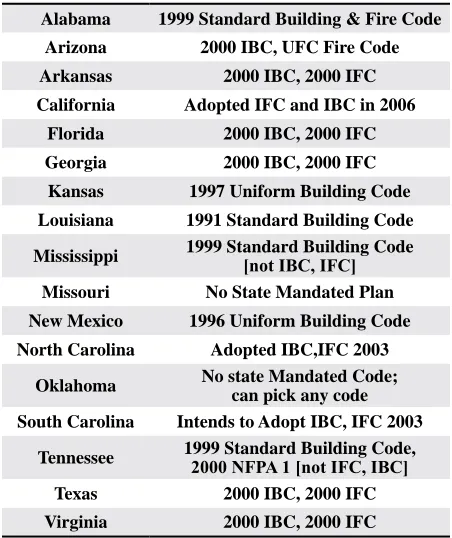
a hazardous material. Most of the cotton producing and ginning states have adopted the ICC, IFC, and IBC code standards (see Table 4).
Table 4. Cotton Producing States and the Codes Presently in Force
Alabama 1999 Standard Building & Fire Code
Arizona 2000 IBC, UFC Fire Code
Arkansas 2000 IBC, 2000 IFC
California Adopted IFC and IBC in 2006
Florida 2000 IBC, 2000 IFC
Georgia 2000 IBC, 2000 IFC
Kansas 1997 Uniform Building Code
Louisiana 1991 Standard Building Code
Mississippi 1999 Standard Building Code [not IBC, IFC]
Missouri No State Mandated Plan
New Mexico 1996 Uniform Building Code
North Carolina Adopted IBC,IFC 2003
Oklahoma No state Mandated Code;
can pick any code
South Carolina Intends to Adopt IBC, IFC 2003
Tennessee 1999 Standard Building Code, 2000 NFPA 1 [not IFC, IBC]
Texas 2000 IBC, 2000 IFC
Virginia 2000 IBC, 2000 IFC
VI. TRANSPORTATION
The U.S. Department of Transportation (DOT) regulates the movement of products on U.S. high-ways, railroads, and waterways. Prior to 1998, the U.S. Coast Guard, as the DOT enforcement arm for vessel shipments, required cotton shippers to prepare dangerous goods declarations for cotton exports because they were required to follow International Maritime Organization (IMO) International Mari-time Dangerous Goods (IMDG) Code Regulations
that classified cotton as Class 4.1 (flammable solid)
It was concluded in 1999 by the IMO sub-committee on Dangerous Goods, Solid Cargo and Containers [Amendment 29 to the IMDG Code, Amendment to Schedule Class 4.1, Cotton, Dry (IMO 1997, 1998) and DOT (49 CFR 172.101and 102) (Harmonization, 1998, 1999)] that bales of cotton packaged in accordance with ISO 8115 (ISO, 1986) [compressed to a density of about 360 kg/m3
(22.4 lb/ft3)] and as presently packaged in the U.S.
should not be considered a flammable solid.
Therefore, a bale of cotton, compressed to 22 lb/ ft3 (225 kg/m3) or greater, is not considered a Class
4.1 flammable solid and does not require special
shipping papers for any mode of shipping. Cotton
is not classified also as a Class 4.2 spontaneously
combustible solid.
VII. REFERENCES
California Occupational Safety and Health Standards Board [CAL OSHA]. 2006. Heat illness prevention. California Code of Regulations, General Industry Safety Order, Title 8: Chapter 4, Subchapter 7, Article 10, New Section 3395 [effective 27 July 2006].
Cross, J., and D. Farrer. 1982. Dust Explosions. Plenum Press, New York, NY.
Green, J.K., R.A. Isom, P.J. Wakelyn, and D. Findley. 2005. U.S. EPA storm water regulations and their impact on cotton gins.p. 3001–3004 In Proc. Beltwide Cotton Conf., New Orleans, LA. 4-7 Jan. 2005. Natl. Cotton Counc. Am., Memphis, TN.
Harmonization with the United Nations Recommendations, International Maritime Dangerous Goods Code [Har-monization]. 1998. Final Rule. Federal Register Vol. 63, p.57929, 29 Oct. 1998.
Harmonization with the United Nations Recommendations, International Maritime Dangerous Goods Code [Har-monization].1999. Final Rule. Federal Register Vol. 64, pp.10741, 10745, 10775, 5 Mar. 1999.
International Maritime Organization, Subcommittee on Dangerous Goods, Solid Cargo and Containers [IMO] 1997. Amendment 29 to the IMDG Code, Amendment to Schedule Class 4.1, Cotton, Dry. Submitted by the United States, DSC 3/3/10, 14 Nov. 1997.
International Maritime Organization, Subcommittee on Dan-gerous Goods, Solid Cargo and Containers [IMO]. 1998. Draft Report to the Maritime Safety Committee, DSC 3/ WP.4, 12 Feb. 1998.
International Organization for Standardization [ISO]. 1986. 8115. Cotton Bales Dimensions and Den-sity [online]. Available at: https://www.iso.org/obp/ ui/#iso:std:iso:8115:ed-1:v1:en (verified 19 Feb. 2016)
Lange, R.D., and G. Visscher. 2002. Memorandum: Cotton Gins [Standards Interpretation] (9 Sept. 2002, revised 21 Jan. 2009.) [online]. Available at https://www. osha.gov/pls/oshaweb/owadisp.show_document?p_ table=INTERPRETATIONS&p_id=24189 (verified 29 Feb. 2016).
National Cotton Council.1996. The Transport of Baled Cotton Petition for Rulemaking. National Cotton Council to U.S. DOT. 3 June 1996 and Supplemental Materials, 31 July 1996. DOT Assigned Number, P-1316.
Palmer, K.N. 1973. Dust Explosions and Fires. Chapman and Hall, London, UK.
Toews, M.D. and Bh. Subramanyan. 2002. Sanitation in Grain Storage and Handling. p. 481-497. In Y.H. Hui, L.B. Bruinsma, J.R. Gorham, W. Nip, P S. Tong, and P Ventresca (eds.) Food Plant Sanitation. Marcel Dekker, Inc., New York.
U.S. Department of Agriculture [USDA]. 2006. Pre-Harvest Security Guidelines and Checklist 2006 [online]. Avail-able at
http://www.usda.gov/documents/PreHarvestSecu-rity_final.pdf (verified 29 Feb. 2016).
U.S. Occupational Safety and Health Administration [OSHA]. 2002. Heat stress card. OSHA Publication 3154 [online]. http://www.osha.gov/Publications/osha3154.pdf (verified 29 Feb. 2016).
U.S. Occupational Safety and Health Administration [OSHA]. 2006. Heat stress, Hazards and possible solutions, https:// www.osha.gov/SLTC/heatstress/index.html (verified 15 June 2016)
U.S. Occupational Safety and Health Administration [OSHA]. Wakelyn, P.J. and S.E. Hughs. 2002. Evaluation of the
flammability of cotton bales. Fire Materials 26:183–189.
Wakelyn, P.J., and D.W. Thompson. 2006. Regulatory Update: air quality, biosecurity, SPCC, and phytosanitary issues, p. 716–724 In Proc. Beltwide Cotton Conf., San Antonio, TX. 3-6 Jan. 2006. Natl. Cotton Counc. Am., Memphis, TN.
Wakelyn, P.J., A. Kelly, and D.T. Thompson. 2007. Biosecu-rity/Agroterrorism and the cotton industry. p. 1948–1956
In Proc. Beltwide Cotton Conf., New Orleans, LA. 9-12 Jan. 2007. Natl. Cotton Counc. Am., Memphis, TN. Wakelyn, P.J., D. Thompson, and B. Nevius. 2004. U.S. codes
Wakelyn P. J., D.W. Thompson, and C.B. Nevius. 2006.
National fire and building codes and baled cotton storage.
p. 689–693 In Proc. Beltwide Cotton Conf., San Antonio, TX. 3-6 Jan. 2006. Natl. Cotton Counc. Am., Memphis, TN.
Wakelyn, P.J., D.W. Thompson, B.M. Norman, C.B.Nevius, and D.S. Findley. 2005. Why cotton ginning is consid-ered agriculture. Cotton Gin Oil Mill Press 106(8):5–9.
VIII. GLOSSARY OF TERMS
ACGIH: American Conference of Industrial Hygienists, an independent standards setting organization BACM: Best Available Control Measures
CAA: Clean Air Act, 42 U.S. Code 1251 et seq.
CERCLA (Superfund): Comprehensive Environmental Re-sponse, Compensation, and Liability Act, 42 U.S. Code 9601 et seq. CFR: Code of Federal Regulations. This is where the U.S.
federal regulations after promulgation are codified. The
preceding number is the Title, the succeeding number (after CFR) is the Part of Section (e.g., 29 CFR 1910 is Title 29 Code of Federal Regulations at Part 1910). CO: Carbon Monoxide
CWA: Clean Water Act (Federal Water Pollution Control Act), 33 U.S. Code 1251 et seq.
DHS: Department of Homeland Security DOL: U.S. Department of Labor DOT: U.S. Department of Transportation EEP: OSHA Enhanced Enforcement Program
EPA: Environnemental Protection Agency, 42 U.S. Code 4321 et seq.
EPCRA: Emergency Planning and Community Right-to-know Act, part of CERLA/Superfund, Title III of SARA,
the 1986 amended Superfund FDA: U.S. Food and Drug Administration
FR: Federal Register. This is where regulatory
announce-ments and new rules and their justification are published.
The preceding number is the volume, the succeeding number (after FR) is the page, usually followed by the date when it appeared (e.g., 51 FR 27956 is Volume 51 Federal Register, page 27956).
FSMA: Food Safety Modernization Act (Food and Drug Administration)
HAP: Hazardous Air Pollutant, 40 CFR 61
HCS: Hazard Communication Standard, 29 CFR 1910.1200
IBC: International Building Code ( ICC: International Code Council IFC: International Fire Code
MACT: Maximum achievable control technology MEC: Minimum explosive concentration
NAAQS: National Ambient Air Quality Standard, 40 CFR 50
NAICS: North American Industry Classification System
NESHAP: National Emission Standard for Hazardous Air Pollutants under the CAA
NFPA: National Fire Protection Association
Nonattainment: Areas that are not meeting NAAQS, 40 CFR 51.100 et seq.
NOx: Nitrogen Oxides – criteria pollutant with a NAAQS and
acts as a precursor to ozone.
NPDES: National Pollution Discharge Elimination System. The national permit program under the CWA, 40 CFR 122
NSR: New Source Review
OSHA: Occupational Safety and Health Administration (part of the U.S. Dept. of Labor), 29 U.S. Code 651 et seq. Ozone (O3): Criteria pollutant with a NAAQS and is formed
through chemical reaction in the atmosphere in-volving VOC, NOx, and sunlight; also a primary
constituent of smog.
PEL: Permissible Exposure Limit for an air contaminant under OSHA standards.
PM: Particulate Matter – a criteria pollutant; denotes the amount of solid or liquid matter suspended in the atmo-sphere. The EPA regulates PM as PM10 (“coarse”
par-ticulate 10 microns or less) and PM2.5 (“fine” particulate
2.5 microns or less).
PPE: personal protective equipment
PSD: Prevention of Significant Deterioration, a requirement
of NSR.
RCRA: Resource Conservation and Recovery Act, 42 U.S. Code 6901 et seq.
RCRA-Characteristic Wastes: Hazardous wastes that are ignitable, corrosive, reactive, or toxic, 40 CFR 260.64.
RCRA-Listed Wastes: Specially listed hazardous wastes in 40 CFR 261.30-33.
SARA: Superfund Amendments and Reauthorization Act of 1986.
SOx: Sulfur Oxides
SPCC plan: Spill Prevention, Control and Counter-measures plan, part of CWA regulations.
Title V: The part of the Clean Air Act that deals with federal permits, 40 CFR 70.
TLV: Threshold Limit Value for an air contaminant under ACGIH regulations.
TSP: total suspended particulate TWA: Time weighted average.
U.S. Code: The United States Code where legislation, includ-ing health, safety, and environmental legislation,
is codified once it is passed by Congress (e.g., 42
U.S. Code 7401 is Title 42 U.S. Code at para-graph 7401).
USDA: United States Department of Agriculture
VOCs: Volatile Organic Compounds. A group of chemicals that react in the atmosphere with NOx in the presence