ENGINEERING AND GINNING
Second Stage Mote System PM
10Emission Factors and Rates for Cotton Gins:
Method 201A PM
10Sizing Cyclones
Michael D. Buser*, Derek P. Whitelock, J. Clif Boykin, and Gregory A. Holt
M.D. Buser*, Biosystems and Agricultural Engineering, Oklahoma State University, 214 Agricultural Hall, Stillwater, OK 74078; D.P. Whitelock, USDA-ARS Southwestern Cotton Ginning Research Laboratory, 300 E College Dr., P.O. Box 578, Mesilla Park, NM 88047; J.C. Boykin, USDA-ARS Cotton Ginning Research Unit, 111 Experiment Station Road, P.O. Box 256, Stoneville, MS 38776; and G.A. Holt, USDA-ARS Cotton Production and Processing Research Unit, Rt. 3
Box 215, Lubbock, TX 79401
*Corresponding author: [email protected]
ABSTRACT
This report is part of a project to characterize cotton gin emissions from the standpoint of stack sampling. The impetus behind this project was the urgent need to collect cotton gin emissions data to address current regulatory issues. A key component of this study was focused on EPA emis-sion factors for particulate matter with a particle diameter nominally less than or equal to 10 µm (PM10). The 1996 EPA AP-42 emission factors
were assigned quality ratings, from A (Excellent) to E (Poor), to assess the quality of the data being referenced. Emission factor quality ratings for cot-ton gins are extremely low. Also, some commonly used cotton gin systems were not represented or were combined with another system under a single emission factor in AP-42. There were no 1996 EPA AP-42 emission factors published for 2nd stage
mote systems. The objective of this study was to collect PM10 emission factor data for 2nd stage
mote systems at cotton gins located in regions across the cotton belt based on EPA-approved stack sampling methodology, Method 201A. The project plan included sampling seven cotton gins across the cotton belt. Key factors for selecting
specific cotton gins included: 1) facility location, 2)
production capacity, 3) processing systems. and 4) abatement technologies. Five of the seven gins were equipped with 2nd stage mote systems that were not
combined with 1st stage mote systems. In terms of
capacity, the five gins were typical of the industry,
averaging 29.4 bales/h during testing. The 2nd stage
mote system average emission factors for PM10
and total particulate were 0.0081 kg/227-kg bale (0.018 lb/500-lb bale) and 0.011 kg/bale (0.025 lb/ bale), respectively. System average PM10 and total
particulate emission factors were lower than those currently published in EPA AP-42 for 1st and 2nd
stage mote systems combined. The 2nd stage mote
system PM10 emission rate test averages ranged
from 0.072 to 0.59 kg/h (0.16-1.31 lb/h). The ratio of 2nd stage mote system PM
10 to total particulate
was 72.1%.
U
.S. Environmental Protection Agency (EPA) emission factors were published in EPA’s Compilation of Air Pollution Emission Factors, AP-42 (EPA, 1996b). These factors were assigned a rating from A (Excellent) to E (Poor) that is used to assess the quality of the data being referenced. In the 1996 EPA AP-42, there are emission factors for particulate matter with a particle diameter less than or equal to a nominal 10-mm (PM10) aerodynamic equivalent diameter listed for 11 common cotton gin systems. The EPA emission factor quality ratings for these data are extremely low. Cotton gin data received these low ratings because they were collected almost exclusively from a single geographical region (EPA, 1996a). The AP-42 data are limited in that some systems commonly used in cotton gins are not represented or are combined with another system under a single emission factor (e.g., 1st and 2nd stage mote systems are represented by the mote fan). Cotton ginners’ associations across the cotton belt, including the National, Texas, Southern, Southeastern, and California associations, agreed that there was an urgent need to collect additional cotton gin emissions data to address current regulatory issues. Working with cotton ginning associations across the country, state and federal regulatory agencies, Oklahoma State University, and USDA-Agricultural Research Service (ARS) researchers developed a proposal and sampling plan that was initiated in 2008 to address this need for additional data. This report is part of a series that details cotton gin emissions measured by stack sampling. Each manuscript in the series addresses ain the series include: unloading, 1st stage seed-cotton cleaning, 2nd stage seed-cotton cleaning, 3rd stage
seed-cotton cleaning, overflow, 1st stage lint cleaning, 2nd stage lint cleaning, combined lint cleaning, cyclone robber, 1st stage mote, 2nd stage mote, combined mote, mote cyclone robber, mote cleaner, mote trash, battery condenser, and master trash. This report focuses on PM10 emissions from 2nd stage mote systems.
There were no 1996 EPA AP-42 emission factors for 2nd stage mote systems (EPA, 1996b). Second stage lint-cleaning systems would be similar to the mote fan listed in AP-42, but the AP-42 factor repre-sents 1st and 2nd stage mote systems combined. The AP-42 average PM10 emission factor for the mote fan (combined 1st and 2nd stage mote systems) was 0.060 kg (0.13 lb) per 217-kg (480-lb) equivalent bale with a range of 0.023 to 0.14 kg (0.050-0.30 lb) per bale (EPA, 1996a, b). This average and range was based on six tests conducted in one geographical location; the EPA emission factor quality rating was D, which is the second lowest possible rating (EPA, 1996a). The AP-42 average total particulate emission factor for the mote fan was 0.13 kg (0.28 lb) per bale with a range of 0.045 to 0.47 kg (0.099-1.0 lb) per bale. This average and range was based on nine tests conducted in one geographical location and the EPA emission factor quality rating was also D.
Seed cotton is a perishable commodity that has
no real value until the fiber and seed are separated
(Wakelyn et al., 2005). Cotton must be processed or
ginned at the cotton gin to separate the fiber and seed,
producing 227-kg (500-lb) bales of marketable cotton
fiber. Cotton ginning is considered an agricultural pro -cess and an extension of the harvest by several federal and state agencies (Wakelyn et al., 2005). Although the main function of the cotton gin is to remove the
lint fiber from the seed, many other processes also
occur during ginning, such as cleaning, drying, and packaging the lint. Pneumatic conveying systems are the primary method of material handling in the cot-ton gin. As material reaches a processing point, the conveying air is separated and emitted outside the gin through a pollution control device. The amount of dust emitted by a system varies with the process and the condition of the material in the process.
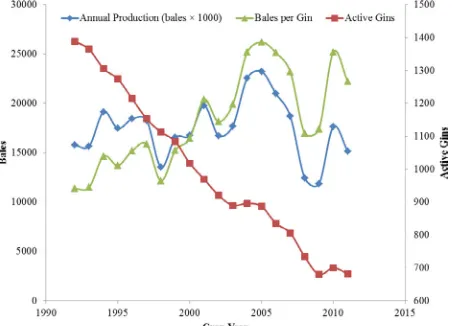
Cotton ginning is a seasonal industry with the ginning season lasting from 75 to 120 days, depending on the size and condition of the crop. Although the trend for U.S. cotton production remained generally
flat at about 17 million bales per year during the last
20 years, production from one year to the next often
varied greatly for various reasons, including climate and market pressure (Fig. 1). The number of active gins in the U.S. has not remained constant, steadily declining to fewer than 700 in 2011. Consequently, the average volume of cotton handled by each gin has risen and gin capacity has increased to an average of approximately 25 bales per hour across the U.S. cotton belt (Valco et al., 2003, 2006, 2009, 2012).
Figure 1. Annual U.S. cotton production, active U.S. gins, and average ginning volume (bales per gin) (NASS, 1993-2012).
Typical cotton gin processing systems include: unloading system, dryers, seed-cotton cleaners, gin
stands, overflow collector, lint cleaners, battery con -denser, bale packaging system, and trash handling systems (Fig. 2); however, the number and type of machines and processes can vary. Each of these sys-tems serves a unique function with the ultimate goal of ginning the cotton to produce a marketable product.
Raw seed cotton harvested from the field is compacted
into large units called “modules” for delivery to the gin. The unloading system removes seed cotton either mechanically or pneumatically from the module feed system and conveys the seed cotton to the seed-cotton cleaning systems. Seed-cotton cleaning systems assist with drying the seed cotton and remove foreign mat-ter prior to ginning. Cotton gin systems also remove
foreign matter and separate the cotton fiber from seed.
Lint-cleaning systems further clean the cotton lint after ginning. The battery condenser and packaging systems combine lint from the lint-cleaning systems
and compress the lint into dense bales for efficient
transport. Ginning systems produce some type of by-products or trash, such as rocks, soil, sticks, hulls, leaf
material, and short or tangled immature fiber (motes),
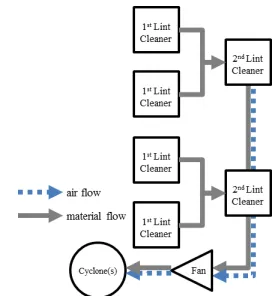
After the seed and lint are separated at the gin stand, the lint is cleaned by one or more stages of lint cleaners. The material removed by lint cleaners is referred to as “motes” and is handled by the mote systems (Fig. 3). Motes are pneumatically conveyed by suction away from the lint cleaners, through a centrifugal fan, to one or two particulate abatement cyclones. Depending on the gin facility, the 1st and 2nd stages of lint cleaning might share a mote system, thus sharing a fan and abatement devices, or lint-cleaning stages might have mote systems that oper-ate independently with separoper-ate fans and cyclones, denoted as 1st stage mote systems or 2nd stage mote systems. The material handled by the mote cyclones typically includes small trash and particulate and
large amounts of lint fibers (Fig. 4).
Figure 2. Typical modern cotton gin layout (Courtesy Lum-mus Corporation, Savannah, GA).
Figure 3. Typical cotton gin 2nd stage mote system layout
(Courtesy Lummus Corporation, Savannah, GA).
Figure 4. Photograph of typical trash captured by the 2nd
stage mote system cyclones.
Cyclones are the most common particulate mat-ter abatement devices used at cotton gins. Standard cyclone designs used at cotton ginning facilities are the 2D2D and 1D3D (Whitelock et al., 2009).
The first D in the designation indicates the length
of the cyclone barrel relative to the cyclone barrel diameter and the second D indicates the length of the cyclone cone relative to the cyclone barrel diameter. A standard 2D2D cyclone (Fig. 5) has an inlet height
of D/2 and width of D/4 and design inlet velocity of 15.2 ± 2 m/s (3000 ± 400 fpm). The standard 1D3D cyclone (Fig. 5) has the same inlet dimensions as the 2D2D or might have the original 1D3D inlet with height of D and width D/8. Also, it has a design inlet velocity of 16.3 ± 2 m/s (3200 ± 400 fpm).
These trash systems typically further process the by-products (e.g., mote cleaners) and/or consolidate the trash from the gin systems into a hopper or pile for subsequent removal.
sizing cyclone catch acetone wash) and ≤ 10 µm
(PM10 sizing cyclone exit acetone wash and filter). The PM10 mass was determined by adding the mass
of particulates captured on the filter and the ≤ 10 µm
wash. Total particulate was determined by adding the PM10 mass and the mass of the > 10 µm wash. The objective of this study was to collect PM10
emission factor data for 2nd stage mote systems with cyclones for emissions control at cotton gins located in regions across the cotton belt based on EPA-approved stack sampling methodologies.
METHODS
Two advisory groups were established for this project. The industry group consisted of cotton gin-ning industry leaders and university and government researchers. The air quality group included members from state and federal regulatory agencies and uni-versity and government researchers. These groups were formed to aid in project planning, gin selection, data analysis, and reporting. The project plan was described in detail by Buser et al. (2012).
Seven cotton gins were sampled across the
cot-ton belt. Key factors for selecting specific cotcot-ton gins
included: 1) facility location, 2) production capacity, 3) processing systems, and 4) abatement technolo-gies. Operating permits, site plans, and aerial pho-tographs were reviewed to evaluate potential sites. On-site visits were conducted on all candidate gins to evaluate the process systems and gather information including system condition, layout, capacities, and standard operation. Using this information, several gins from each selected geographical region were selected and prioritized based on industry advisory group discussions. Final gin selection from the
pri-oritized list was influenced by crop limitations and
adverse weather events in the region.
Based on air quality advisory group consensus, EPA Method 201A was used to sample the 2nd stage mote system at each gin. Method 201A was revised in 2010 to incorporate options for PM2.5 (particulate matter with particle diameter less than or equal to a nominal 2.5-mm aerodynamic equivalent diameter) sampling (CFR, 2010); these revisions did not affect the PM10 stack sampling methodology used in this project. Method 201A is a constant sampling-rate procedure. For the PM10 sampling methodology, the particulate-laden stack gas was withdrawn isokineti-cally (the velocity of the gas entering the sampler was equal to the velocity of the gas in the stack) through a PM10 sizing cyclone and then collected on an in-stack
filter (Fig. 6). The methods for retrieving the filter
and conducting acetone washes of the sizing cyclone are described in detail in Method 201A (CFR, 2010). The mass of each size fraction was determined by
gravimetric analysis and included: > 10 µm (PM10
Figure 6. EPA Method 201A PM10 sizing cyclone and in-stack filter holder schematic (CFR, 2010) and photograph ( ≤ 10 µm, > 10 µm).
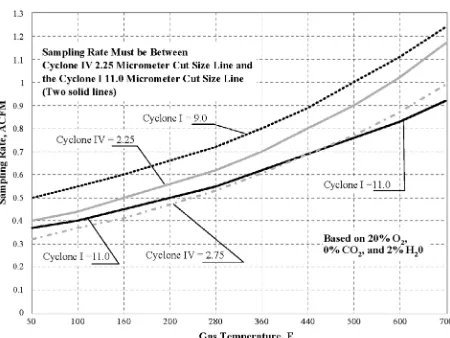
Figure 7 shows the performance curves for the Method 201A sizing cyclones. To measure PM10, the method requires selecting a gas sampling nozzle to achieve a sampling rate that produces a cut size be-tween 9.0 and 11.0 mm at the stack gas temperature.
For this study, Method 201A was specifically used to collect filterable PM10 emissions (solid particles emitted by a source at the stack and captured in the
≤ 10 µm wash and on the filter [CFR, 2010]).
Figure 7. Acceptable sampling rate for sizing cyclones (CFR, 2010) Cyclone I = PM10 sizing cyclone (gas temperatures
for the 2nd stage mote systems ranged from 21 to 46°C
Only one stack from each 2nd stage mote system was tested. For systems with multiple stacks, it was assumed that emissions from each stack of the system were equivalent and the total emissions were calculated by multiplying the measured emission rates by the total number of cyclones used to control the process tested (EPA, 1996a). To obtain reliable results, the same
tech-nician from the same certified stack sampling company
(Reliable Emissions Measurements, Auberry, CA), trained and experienced in stack sampling cotton gins, conducted the tests at all seven cotton gins.
All stack sampling equipment, including the siz-ing cyclone, was purchased from Apex Instruments
(Fuquay-Varina, NC) and met specifications of Method 201A. The sampling media were 47-mm Zefluor fil -ters (Pall Corporation, Port Washington, NY) and the sample recovery and analytical reagent was American
Chemical Society certified acetone (A18-4, Fisher Chemical, Pittsburgh, PA; assay ≥ 99.5%). Filters and
wash tubs with lids were prelabeled, preweighed, and stored in sealed containers at the USDA-ARS Air Qual-ity Lab (AQL) in Lubbock, TX, and then transported to
each test site. Prior to testing, the certified stack testing
technician calibrated and checked all sampling equip-ment according to EPA Method 201A.
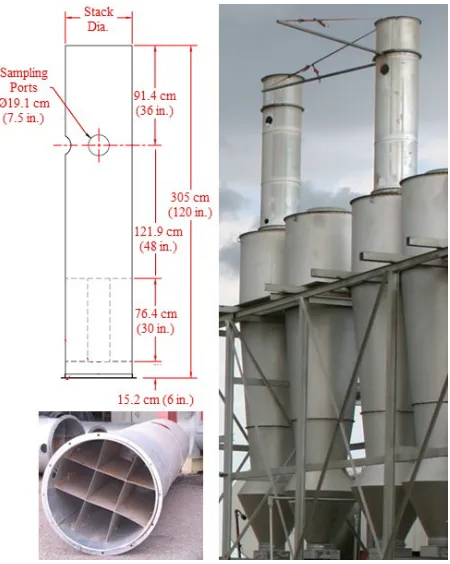
Each cyclone selected for testing was fitted with
a cyclone stack extension that incorporated two
sampling ports (90° apart) and airflow straightening vanes to eliminate the cyclonic flow of the air exiting
the cyclone (Fig. 8). The extensions were designed to meet EPA criteria (EPA, 1989) with an overall length of 3 m (10 ft) and sampling ports 1.2-m (48-in) downstream from the straightening vanes and 0.9-m (36-in.) upstream from the extension exit.
The tests were conducted by the certified stack
sampling technician in an enclosed sampling trailer at the base of the cyclone bank (Fig. 9). Sample retrieval,
including filters and sampler head acetone washes, was
conducted according to Method 201A. After retrieval,
filters were sealed in individual Petri dishes and acetone
washes were dried on-site in a conduction oven at 49°C (120°F) and then sealed with preweighed lids and placed in individual plastic bags for transport to the AQL in Lub-bock, TX for gravimetric analyses. During testing, bale data (ID number, weight, and date/time of bale pressing) were either manually recorded by the bale press operator or captured electronically by the gin’s computer system for use in calculating emission factors in terms of kg/227-kg bale (lb/500-lb bale). Emission factors and rates were calculated in accordance with Method 201A and ASAE Standard S582 (ASABE, 2005).
Figure 8. Schematic and photographs of stack extensions with sampling ports and staightening vanes (rail attached to extension above sampling port; at right, supports sampling probe during testing traverse).
All laboratory analyses were conducted at the
AQL. All filters were conditioned in an environ
-mental chamber (21 ± 2°C [70 ± 3.6°F]; 35 ± 5%
RH) for 48 h prior to gravimetric analyses. Filters were weighed in the environmental chamber on a Mettler MX-5 microbalance (Mettler-Toledo Inc.,
Columbus, OH; 1 µg readability and 0.9 µg repeat -ability) after being passed through an antistatic
Figure 9. Clockwise from top right: cotton gin stack sampling
with air quality lab trailer and technicians on lifts; certified
device. The MX-5 microbalance was leveled on a marble table and housed inside an acrylic box to minimize the effects of air currents and vibra-tions. To reduce recording errors, weights were electronically transferred from the microbalance directly to a spreadsheet. Technicians wore latex gloves and a particulate respirator mask to avoid contamination. AQL procedures required that each sample be weighed three times. If the standard de-viation of the weights for a given sample exceeded
10 μg, the sample was reweighed. Gravimetric
procedures for the acetone wash tubs were the
same as those used for filters.
In addition to gravimetric analyses, each sample was visually inspected for unusual characteristics, such as cotton lint content or extraneous material.
Digital pictures were taken of all filters and washes
for documentation purposes prior to further analyses. After the laboratory analyses were completed, all stack sampling, cotton gin production, and laboratory data were merged.
Five of the seven gins were equipped with 2nd stage mote systems. The 2nd stage mote systems sampled were typical for the industry, but varied among the gins. After the 1st stage lint-cleaning systems, the cotton lint was cleaned a second time in three 2nd stage lint-cleaning systems at gin A. The trash removed from the lint in the 2nd stage lint-cleaning systems was combined in the 2nd stage mote system and pneumatically conveyed from the lint cleaners through a fan and exhausted through one or more cyclones (Fig. 10). The 2nd stage mote system at gin C was essentially the same, except the 2nd stage mote system pulled trash from two 2nd stage lint-cleaning systems (Fig. 11). At gin B, the 2nd stage mote system was similar to that at gin C, but each 2nd stage lint-cleaning system processed lint from double 1st stage lint-cleaning systems (Fig. 12). The 2nd stage mote systems at gins D and F were also similar, but the systems at those gins pulled material from four 2nd stage lint-cleaning systems (Fig. 13).
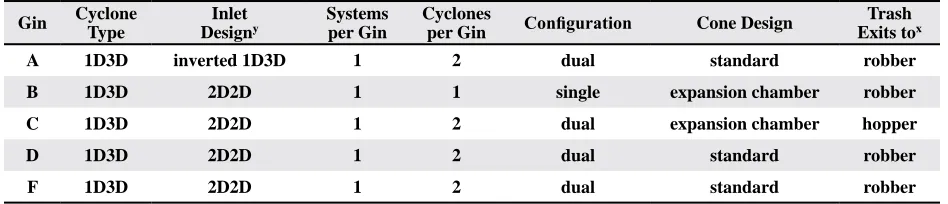
All 2nd stage mote systems sampled utilized 1D3D cyclones to control emissions (Fig. 5), but there were some cyclone design variations among the gins (Table 1 and Fig. 14). All the gins, except
gin B, split the system exhaust flow between two cyclones in a dual configuration (side by side as op -posed to one behind another). The system airstream for gin B was exhausted through a single cyclone. Inlets on all the 2nd stage mote cyclones were 2D2D
Figure 10. Schematic of 2nd stage mote system pulling
material from three 2nd stage lint-cleaning systems (gin A).
Figure 11. Schematic of 2nd stage mote system pulling
material from two 2nd stage lint-cleaning systems (gin C).
Figure 12. Schematic of 2nd stage mote system pulling
material from two 2nd stage lint-cleaning systems each
preceded by double 1st stage lint-cleaning systems (gin B).
Figure 13. Schematic of 2nd stage mote system pulling
material from four 2nd stage lint-cleaning systems (gins
type, except gin A that had inverted 1D3D inlets. Standard cones were present on 2nd stage mote cyclones at all gins, except gins B and C that had expansion chambers. The cyclones tested at gins A, B, D, and F had mote cyclone robber systems
pulling airflow from their exits. This configuration
helps remove lint and other trash from the cyclone that could otherwise circulate near the trash exit at the bottom of the cone for a period of time before
dropping out. All of the cyclone configurations out -lined above, if properly designed and maintained, are recommended for controlling cotton gin emis-sions (Whitelock et al., 2009).
Figure 14. Cyclone design variations for the tested systems
(left to right): dual configuration that splits flow between
identical 1D3D cyclones with 2D2D inlets; 1D3D cyclone with an inverted 1D3D inlet; 1D3D cyclone with 2D2D inlet and expansion chamber on the cone; 1D3D cyclone with 2D2D inlet and standard cone.
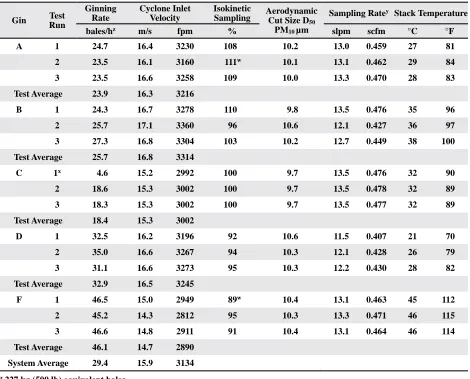
bales). Gin C test run one was not included in test averages because of inconsistent gin opera-tion during testing. The capacity of gins sampled was representative of the industry average, ap-proximately 25 bales/h. The 1D3D cyclones were all operated with inlet velocities within design criteria, 16.3 ± 2 m/s (3200 ± 400 fpm).
There are criteria specified in EPA Method
201A for test runs to be valid for PM10 or total particulate measurements (CFR, 2010). Isokinetic sampling and PM10 aerodynamic cut size must fall
within EPA defined ranges (100 ± 20% and 10.0 ± 1.0 µm, respectively) for valid PM10 test runs. All tests met both criteria (Table 2). To use the
method to obtain total filterable particulate also, sampling must be within 90 to 110% of isokinetic flow. This criterion was not met in the second test run for gin A or the first test run for gin F; thus
the data associated with these runs were omitted from the total particulate test averages. Sampling rates ranged from 11.5 to 13.5 standard l/min (0.407-0.478 standard ft3/min). The stack gas temperatures ranged from 21 to 46°C (70-115°F).
PM10 emissions data (ginning and emission rates and corresponding emission factors) for the 2nd stage mote systems are shown in Table 3. The system average PM10 emission factor was 0.0081 kg/bale (0.018 lb/bale). The test average emission factors ranged from 0.0039 to 0.018 kg (0.0086-0.040 lb) per bale and emission rates ranged from 0.072 to 0.59 kg/h (0.16-1.31 lb/h). Total particulate emissions data (ginning and emission rates and cor-responding emission factors) for the 2nd stage mote systems are shown in Table 4. The system average total particulate emission factor was 0.011 kg/bale (0.025 lb/bale). The test average emission factors ranged from 0.0063 to 0.023 kg (0.014-0.052 lb)
Table 1. Abatement device configurationz for 2nd stage mote systems tested.
Gin Cyclone Type
Inlet Designy
Systems per Gin
Cyclones
per Gin Configuration Cone Design
Trash Exits tox
A 1D3D inverted 1D3D 1 2 dual standard robber B 1D3D 2D2D 1 1 single expansion chamber robber C 1D3D 2D2D 1 2 dual expansion chamber hopper D 1D3D 2D2D 1 2 dual standard robber F 1D3D 2D2D 1 2 dual standard robber
z Figures 5 and 14
y Inverted 1D3D inlet has duct in line with the bottom of the inlet
x Systems to remove material from cyclone trash exits: hopper = large storage container directly under cyclone trash exit;
robber = pneumatic suction system
RESULTS
Table 2 shows the test parameters for each Method 201A test run for the 2nd stage mote
sys-tems sampled at the five gins. The system average
ginning rate was 29.4 bales/h and the test average ginning rate at each gin ranged from 18.4 to 46.1
per bale. The test average total particulate emission rates ranged from 0.13 to 0.77 kg/h (0.29-1.70 lb/h). The ratio of PM10 to total particulate was 72.1% (ratios calculated using Tables 3 and 4 might vary slightly from those listed due to rounding).
The average 2nd stage mote system total
particu-late emission factor for this project was about 8.8%
of the EPA AP-42 published value for the mote fan (EPA, 1996a, b), which is an equivalent system to combined 1st and 2nd stage mote systems. The range of test average total particulate emission factors de-termined for this project was lower than the range of AP-42 emission factor data. The average 2nd stage mote system PM10 emission factor for this project
was 13.7% of the EPA AP-42 published value for
the mote fan. The test average PM10 emission
fac-tor range was also lower than the AP-42 emission factor data range.
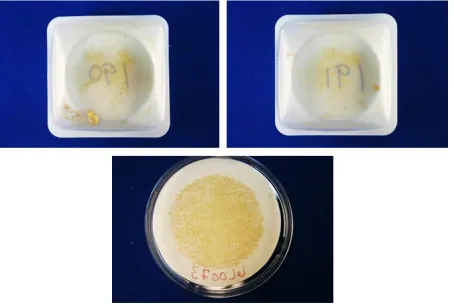
Figure 15 shows an example of samples recov-ered from a typical 2nd stage mote system test run.
Often, there were cotton lint fibers, which have
cross-sectional diameters much greater than 10
µm, in the cotton gin cyclone exhausts. Therefore, it was not unusual to find lint fiber in the > 10 µm wash from Method 201A. However, lint fibers can
pass through the PM10 cyclone and collect on the
filter. This type of material carryover can bias the
gravimetric measurements and affect reported PM10 emission data. EPA Method 201A does not suggest methods to account for these anomalies. Thus, no effort was made to adjust the data reported in this manuscript to account for these issues.
Table 2. Cotton gin production data and stack sampling performance metrics for the 2nd stage mote systems.
Gin Test Run
Ginning Rate
Cyclone Inlet Velocity
Isokinetic
Sampling Aerodynamic Cut Size D50 PM10 µm
Sampling Ratey Stack Temperature
bales/hz m/s fpm % slpm scfm °C °F
A 1 24.7 16.4 3230 108 10.2 13.0 0.459 27 81 2 23.5 16.1 3160 111w 10.1 13.1 0.462 29 84
3 23.5 16.6 3258 109 10.0 13.3 0.470 28 83 Test Average 23.9 16.3 3216
B 1 24.3 16.7 3278 110 9.8 13.5 0.476 35 96 2 25.7 17.1 3360 96 10.6 12.1 0.427 36 97 3 27.3 16.8 3304 103 10.2 12.7 0.449 38 100 Test Average 25.7 16.8 3314
C 1x 4.6 15.2 2992 100 9.7 13.5 0.476 32 90
2 18.6 15.3 3002 100 9.7 13.5 0.478 32 89 3 18.3 15.3 3002 100 9.7 13.5 0.477 32 89 Test Average 18.4 15.3 3002
D 1 32.5 16.2 3196 92 10.6 11.5 0.407 21 70 2 35.0 16.6 3267 94 10.3 12.1 0.428 26 79 3 31.1 16.6 3273 95 10.3 12.2 0.430 28 82 Test Average 32.9 16.5 3245
F 1 46.5 15.0 2949 89w 10.4 13.1 0.463 45 112
2 45.2 14.3 2812 95 10.3 13.3 0.471 46 115 3 46.6 14.8 2911 91 10.4 13.1 0.464 46 114 Test Average 46.1 14.7 2890
System Average 29.4 15.9 3134
z 227 kg (500 lb) equivalent bales
y slpm = standard l/min, scfm = standard ft3/min
Figure 15. Typical EPA Method 201A filter and sampler head
acetone washes from the 2nd stage mote system. Clockwise from top left: > 10 µm wash, ≤ 10 µm wash, and filter.
Table 3. PM10 emissions data for the 2nd stage mote systems.
Gin Test Run Emission Rate Emission Factor kg/h lb/h kg/balez lb/balez
A 1 0.17 0.37 0.0068 0.015 2 0.13 0.29 0.0056 0.012 3 0.13 0.29 0.0056 0.012 Test Average (n=3) 0.14 0.32 0.0060 0.013 B 1 0.23 0.50 0.0093 0.021 2 0.22 0.49 0.0087 0.019 3 0.19 0.42 0.0071 0.016 Test Average (n=3) 0.21 0.47 0.0084 0.018 C 1y 0.054 0.12 0.012 0.026
2 0.055 0.12 0.0030 0.0066 3 0.088 0.19 0.0048 0.011 Test Average (n=2) 0.072 0.16 0.0039 0.0086
D 1 0.60 1.32 0.018 0.041 2 0.68 1.51 0.020 0.043 3 0.49 1.09 0.016 0.035 Test Average (n=3) 0.59 1.31 0.018 0.040 F 1 0.17 0.38 0.0037 0.0082
2 0.21 0.45 0.0046 0.010 3 0.21 0.47 0.0046 0.010 Test Average (n=3) 0.20 0.44 0.0043 0.0095 System Average (n=5) 0.0081 0.018
z 227 kg (500 lb) equivalent bales
y Test run omitted from test averages because of
inconsistent gin operation during test
Table 4. Total particulate emissions data for the 2nd stage
mote systems.
Gin Test Run Emission Rate Emission Factor kg/h lb/h kg/balez lb/balez
A 1 0.21 0.47 0.0087 0.019 2x 0.18 0.40 0.0077 0.017
3 0.19 0.41 0.0079 0.017 Test Average (n=2) 0.20 0.44 0.0083 0.018 B 1 0.29 0.65 0.012 0.027 2 0.29 0.64 0.011 0.025 3 0.27 0.60 0.010 0.022 Test Average (n=3) 0.29 0.63 0.011 0.025 C 1y 0.093 0.21 0.020 0.045
2 0.11 0.24 0.0058 0.013 3 0.15 0.34 0.0084 0.019 Test Average (n=2) 0.13 0.29 0.0071 0.016 D 1 0.80 1.77 0.025 0.055 2 0.87 1.91 0.025 0.055 3 0.64 1.41 0.021 0.045 Test Average (n=3) 0.77 1.70 0.023 0.052 F 1x 0.22 0.50 0.0048 0.011
2 0.29 0.64 0.0064 0.014 3 0.29 0.63 0.0061 0.014 Test Average (n=2) 0.29 0.63 0.0063 0.014 System Average (n=5) 0.011 0.025
z 227 kg (500 lb) equivalent bales
y Test run omitted from test averages because of
inconsistent gin operation during test
x Test run omitted from test averages because isokinetic
sampling rate (100 ± 10%) was not met
SUMMARY
Seven cotton gins across the U.S. cotton belt were sampled using EPA Method 201A to collect
data to fill the data gap that exists for cotton gin
design. In terms of capacity, the five gins were typical
of the industry, averaging 29.4 bales/h during testing. The 2nd stage mote system average emission factors for PM10 and total particulate were 0.0081 kg/227-kg bale (0.018 lb/500-lb bale) and 0.011 kg/bale (0.025 lb/bale), respectively. System average PM10 and total particulate emission factors were lower than those currently published in EPA AP-42 for 1st and 2nd stage mote systems combined. The gin test average PM10 and total particulate emission rates ranged from 0.072 to 0.59 kg/h (0.16-1.31 lb/h) and 0.13 to 0.77 kg/h (0.29-1.70 lb/h), respectively. Based on the 2nd stage mote system average emission factors, the ratio of PM10 to total particulate was 72.1%.
ACKNOWLEDGMENTS
The authors appreciate the cooperating gin man-agers and personnel who generously allowed and endured sampling at their gins. In addition, we thank California Cotton Ginners’ and Growers’ Association, Cotton Incorporated, San Joaquin Valleywide Air Pollution Study Agency, Southeastern Cotton Gin-ners’ Association, Southern Cotton GinGin-ners’ Associa-tion, Texas Cotton Ginners’ AssociaAssocia-tion, Texas State Support Committee, and The Cotton Foundation for funding this project. The authors also thank the Cot-ton Gin Advisory Group and Air Quality Advisory Group for their involvement and participation in planning, execution, and data analyses for this proj-ect that is essential to developing quality data that will be used by industry, regulatory agencies, and the
scientific community. The advisory groups included:
the funding agencies listed above, California Air Resources Board, Missouri Department of Natural Resources, National Cotton Council, National Cot-ton Ginners’ Association, North Carolina Depart-ment of EnvironDepart-ment and Natural Resources, San Joaquin Valley Air Pollution Control District, Texas A&M University, Texas Commission on Environ-mental Quality, USDA-NRCS National Air Quality and Atmospheric Change, and U.S. Environmental Protection Agency (national, Region 4 and 9).
DISCLAIMER
Mention of trade names or commercial prod-ucts in this publication is solely for the purpose of
providing specific information and does not imply
recommendation or endorsement by the Oklahoma
State University or U.S. Department of Agriculture. Oklahoma State University and USDA are equal opportunity providers and employers.
REFERENCES
American Society of Agricultural and Biological Engineers (ASABE). 2005. Cotton Gins—Method of Utilizing Emission Factors in Determining Emission Parameters. ASAE S582, March 2005. American Society of Agricul-tural and Biological Engineers, St. Joseph, MI.
Buser, M.D., D.P. Whitelock, J.C. Boykin, and G.A. Holt. 2012. Characterization of cotton gin particulate matter emissions—Project plan. J. Cotton Sci. 16:105–116. Code of Federal Regulations (CFR). 2010. Method 201A—
Determination of PM10and PM2.5emissions from station-ary sources (constant sampling rate procedure). 40 CFR 51, Appendix M. Available at http://www.epa.gov/ttn/ emc/promgate/m-201a.pdf (verified 14 Feb. 2014). Environmental Protection Agency (EPA). 1989. Particulate
sampling in cyclonic flow. U.S. Environmental Protec -tion Agency, Washington, DC. Available online at http:// www.epa.gov/ttn/emc/guidlnd/gd-008.pdf (verified 14 Feb. 2014).
Environmental Protection Agency (EPA). 1996a. Emission factor documentation for AP-42, Section 9.7, Cotton Ginning (EPA Contract No. 68-D2-0159; MRI Project No. 4603-01, Apr. 1996). Publ. AP-42. U.S. Environ-mental Protection Agency, Washington, DC.
Environmental Protection Agency (EPA). 1996b. Food and agricultural industries: Cotton gins. In Compilation of Air Pollution Emission Factors, Volume 1: Stationary Point and Area Sources. Publ. AP-42. U.S. Environmen-tal Protection Agency, Washington, DC.
National Agricultural Statistics Service (NASS).1993-2012.
Cotton Ginnings Annual Summary [Online]. USDA
National Agricultural Statistics Service, Washington, DC. Available at http://usda.mannlib.cornell.edu/MannUsda/ viewDocumentInfo.do?documentID=1042 (verified 14 Feb. 2014).
Valco, T.D., H. Ashley, J.K. Green, D.S. Findley, T.L. Price, J.M. Fannin, and R.A. Isom. 2012. The cost of gin-ning cotton—2010 survey results. p. 616–619 In Proc. Beltwide Cotton Conf., Orlando, FL 3-6 Jan. 2012. Natl. Cotton Counc. Am., Memphis, TN.
Valco, T.D., J.K. Green, R.A. Isom, D.S. Findley, T.L. Price, and H. Ashley. 2009. The cost of ginning cotton—2007 survey results. p. 540–545 In Proc. Beltwide Cotton Conf., San Antonio, TX 5-8 Jan. 2009. Natl. Cotton Counc. Am., Memphis, TN.
Valco, T.D., J.K. Green, T.L. Price, R.A. Isom, and D.S. Find-ley. 2006. Cost of ginning cotton—2004 survey results. p. 618–626 In Proc. Beltwide Cotton Conf., San Antonio, TX 3-6 Jan. 2006. Natl. Cotton Counc. Am., Memphis, TN.
Wakelyn, P.J., D.W. Thompson, B.M. Norman, C.B. Nevius, and D.S. Findley. 2005. Why cotton ginning is con-sidered agriculture. Cotton Gin and Oil Mill Press 106(8):5–9.