Teachers’ sentiments to Bikol MTB-MLE: Using sentiment
analysis and text mining techniques
Arispe, Maria Charmy A.
Bicol University Polangui Campus, Philippines ([email protected])
Capucao, Joni Neil B.
Partido State University, Philippines ([email protected])
Relucio, Floradel S.
Bicol University Polangui Campus, Philippines ([email protected])
Maligat, Daniel E., Jr.
Camarines Norte State College, Philippines ([email protected])
Received: 27 March 2019 Revised: 16 April 2019 Accepted: 29 May 2019 Available Online: 1 July 2019 DOI: 10.5861/ijrse.2019.4906
ISSN: 2243-7703 Online ISSN: 2243-7711
OPEN ACCESS
Abstract
Mother Tongue Based – Multilingual Education (MTB-MLE) is one of the quality programs
of the K to 12 Law (RA 10533) that raises the country’s standard of education. The research
study specifically looks into the sentiments of the teacher participants in the
Bikol
MTB-MLE
from Grades 1, 2 and 3 public elementary schools by classifying their opinions using
sentiment analysis and text mining techniques. Set of validated researchers made
semi-structured survey questionnaire were gathered from the responses of 1,365 respondents
from the province of Albay. Manual cleaning and R software package were employed in
classifying both negative and positive responses and also facilitated the data manipulation and
graphical representation. The information was tested using Naïve Bayes algorithm and
obtained 88% accuracy. The results indicated success; however, it encourages similar
researches possibly involving other mother tongue languages.
Keywords:
Bikol MTB-MLE; mother tongue; K-12; sentiment analysis; text-mining
Teachers’ sentiments to Bikol MTB-MLE: Using sentiment analysis and text mining
techniques
1. Introduction
The Department of Education (DepEd) implemented the utilization of mother tongue as a medium of instruction in the Philippines which started in June of school year 2012-2013 (DepEd order No. 74, series of 2009). Having implemented for seven years (2012 to 2019) limited research has been observed for Bicol Region using sentiment analysis and text mining technique on the implementation of Bikol Mother Tongue-Based-Multilingual Education (MTB-MLE) subject. Conducting study concerning whether teachers and other stakeholders acknowledge its educational worth, does not only provide answers to the lacunae but highlighted the need to conduct sentiment analysis that can validate the assumption that the sentiments of the teachers in teaching Bikol MTB-MLE will be very encouraging.
Williams, Metila, Pradilla, and Digo (2014) on their ACTRC phase 1 progress report confirmed that the Mother Tongue-Based of Multilingual Education (MTB-MLE) approach in the country includes usage of native languages as the dialect of direction in Kindergarten to Grade 3. After Grade 3, the national language Filipino and official language English were conferred as the language of instruction. Then, Dekker and Dumatog (2003) presents the adoption of MTB-MLE as motivated by the desire for achieving higher level of education at par with international standards as encouraged by international studies of small-scale MTB-MLE programs in the Philippines, as well as in other countries.
This study is more of discovering teachers’ positive and negative sentiments that could lead in determining its problems, challenges and successes in the implementation of Bikol MTB-MLE subject. Sentiment analysis method and text mining techniques were used to classify the sentiments of the teachers from Grade 1 to 3. Specifically, it answered the following research questions: (1) What are the sentiments of the teachers in teaching
Bikol MTB-MLE?; (2) What are the strategies utilized by the teachers, as they experienced difficulties in the implementation of Bikol MTB-MLE?; and (3) What sentiment analysis and text mining techniques may be used in classifying teacher’s sentiments in teaching Bikol MTB-MLE?
2. Methodology
Semi-structured, open-ended researchers’ made questionnaires were validated by research professors, guidance counselors, and experts in natural language processing for sentiment analysis and distributed to all the grades 1 to 3 teacher-participants. Respondents were taken within the Province of Albay since Bikol MTB-MLE textbooks were written in Albay-based mother tongue by local Albayano authors. Sentiment analysis and text mining methodology covers the sequential steps of data gathering (for text documents), data cleaning (structured representation), data classification (patterns and relations in the text), and data result (visualized patterns).
Figure 1. Sentiment Analysis and Text Mining Methodology
3. Results and Discussion
Empirical studies show that teachers have usually negative implications towards MTB-MLE for various reasons. On the contrary, Paulson Stone (2010) asserted that for effective implementation of MTB-MLE, teachers should act as a support, instead of a barrier.
3.1 Sentiments of the Teachers in Teaching Bikol MTB-MLE
From 1,395 answered survey forms, responses were manually annotated by classifying the positive and negative sentiments of the teachers. From a total of 900 cleaned responses, 513 or 57 percent responses were classified positive sentiments and 387 or 43 percent responses were classified negative sentiments. Table 1 shows the percentage of responses with manual cleaning.
Table 1
Manual cleaning of positive and negative sentiments (N=900)
Responses Percentage Indicator
513 57 Positive response
387 43 Negative response
Total 100
3.2 Bikol MTB-MLE strategies
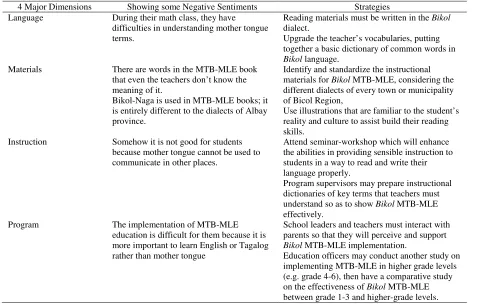
Based from the manually classified positive and negative sentiments of this study, Table 2 and 3 shows the four major dimensions (Malone, 2010), teachers’ sentiments and strategies for Bikol MTB-MLE. The dimensions presented were underpinning from the phase 1 strategies and challenges progress report of MTB-MLE implementation (Williams, Metila, Pradilla, & Digo, 2014).
3.3 Techniques in classifying teacher’s sentiments in teaching Bikol MTB-MLE
accuracy of the data tested obtained 88%, which support the two (2) annotations for teachers’ sentiments on
Bikol MTB-MLE implementations.
Table 2
Dimensions, positive sentiments and strategies
4 Major Dimensions Showing some Positive Sentiments Strategies
Language Good for children to express their opinions
and ideas without such difficulty.
Have full oral proficiency and able to communicate absolutely and freely with their students.
Use on-site demonstration for Bikol MTB-MLE subjects.
Materials At some aspects on MTB implementation, the
use of MTB instructional materials is indeed a good way of teaching pupils especially for those who have mostly just begun their learning experience.
Learning materials must be used to promote important improvement in writing and reading skills.
If has no or limited school instructional resources, teachers may utilize their personal materials.
Instruction Students were active in the discussion since
most of them are using Bikol dialect when conveying in school and at home.
Majority of the pupils understand the lesson better when being translated in mother tongue.
Teach the children a language that’s at home with them.
Used the Bikol MTB-MLE as medium of instruction.
Program Its effective because half of the class are
participating during class discussion. They understand the dialect they are using in their place.
Teacher’s training improves their Bikol MTB-MLE teaching methods.
Explain the underlying principles and structure of Bikol MTB-MLE.
Table 3
Dimensions, negative sentiments and strategies
4 Major Dimensions Showing some Negative Sentiments Strategies
Language During their math class, they have
difficulties in understanding mother tongue terms.
Reading materials must be written in the Bikol
dialect.
Upgrade the teacher’s vocabularies, putting together a basic dictionary of common words in
Bikol language.
Materials There are words in the MTB-MLE book
that even the teachers don’t know the meaning of it.
Bikol-Naga is used in MTB-MLE books; it is entirely different to the dialects of Albay province.
Identify and standardize the instructional materials for Bikol MTB-MLE, considering the different dialects of every town or municipality of Bicol Region,
Use illustrations that are familiar to the student’s reality and culture to assist build their reading skills.
Instruction Somehow it is not good for students
because mother tongue cannot be used to communicate in other places.
Attend seminar-workshop which will enhance the abilities in providing sensible instruction to students in a way to read and write their language properly.
Program supervisors may prepare instructional dictionaries of key terms that teachers must understand so as to show Bikol MTB-MLE effectively.
Program The implementation of MTB-MLE
education is difficult for them because it is more important to learn English or Tagalog rather than mother tongue
School leaders and teachers must interact with parents so that they will perceive and support
Bikol MTB-MLE implementation.
Education officers may conduct another study on implementing MTB-MLE in higher grade levels (e.g. grade 4-6), then have a comparative study on the effectiveness of Bikol MTB-MLE between grade 1-3 and higher-grade levels.
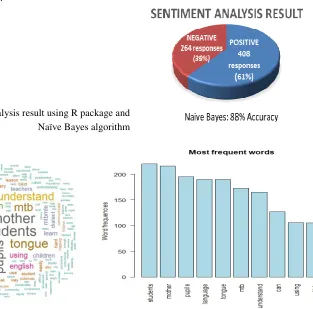
and 4 showed the word cloud and bar graph results. The font size of each term in the word cloud shows the number of mentions of that term in the sentiments, indicating its importance and positive effects to the Bikol
MTB-MLE implementation.
Figure 2. Sentiment analysis result using R package and Naïve Bayes algorithm
Figure 3. Word Cloud of Teacher’s Sentiments Figure 4. Bar Graph of top 10 most frequent words
4. Conclusion
It is capable to collect, pre-process, apply sentiment analysis and text mining techniques, and visualize the teacher’s sentiments on the implementation of Bikol MTB-MLE. The implications of the sentiment analysis revealed bigger rate of positive opinions (61 percent positive with 39 percent negative). It suggests that educators can viably actualize the use of Bikol MTB-MLE in helping their students get the fundamental knowledge and learning. This research study was conjointly conducted to provide additional information and inputs on the implementation of Bikol MTB-MLE program. Proper monitoring mechanism, followed by applicable measures to deal with gaps and different requirements, must be incorporated into the Bikol MTB-MLE program structure for better outcomes. An essential viewpoint for future work can be the building of internet-based framework and monitoring system, as sentiments or opinions are ever-changing after some time. For better classroom exchanges, it’s in addition also profitable to utilize a different method in sentiment analysis and text mining to cluster progressively the inclusion of teachers and students in their Bikol MTB-MLE subjects.
5. References
Dekker, D. E., & Dumatog, R. (2003). First language education in Lubuagan, Kalinga, Northern Philippines. Paper presented at the 1st International Conference on Language Development, Language
Revitalisation and Multilingual Education in Minority Communities in Asia, Bangkok, Thailand. Retrieved from https://www.sil.org/resources/archives/4909
Malone, S. (2010). Planning mother tongue-based education programs in minority language communities: Resource manual for speakers of minority languages engaged in planning and implementing mother tongue-based education programs in their own communities. Bangkok: UNESCO. Retrieved from https://actrc.files.wordpress.com/2013/07/mtb-mle-phase-1-progress-report.pdf
Malone, S. (2017). MTB-MLE: What have we learned about best practices in developing strong programs? New York: Springer.
Metila, R., Pradilla, L. A., & Williams, A. (2017). Investigating best practice in Mother Tongue-Based
Multilingual Education (MTB-MLE) in the Philippines, Phase 3 progress report: Strategies of exemplar schools. Report prepared for Australian Department of Foreign Affairs and Trade and Philippine Department of Education. Melbourne and Manila: Assessment, Curriculum and Technology Research Centre. Retrieved from
https://actrc.org/projects/understanding-best-practices-in-mtb-mle-in-the-philippines/
Paulson Stone, R. (2010). Enhancing learning through the use of mother tongue language: Analysis of the forces for and against mother tongue education. Amherst: University of Massachusetts.
https://doi.org/10.1007/978-94-6209-218-1_10
Rahlf, T. (2017). Data visualization with R. New York: Springer. https://doi.org/10.1007/978-3-319-49751-8 Williams, A. B., Metila, R. A., Pradilla, L. A. S., & Digo, M. M. B. (2014). Strategies and challenges in
MTB-MLE implementation in the early years (Phase 1 Progress Report). Quezon City: University of the Philippines and University of Melbourne. Retrieved from