DESERT
Online at http://jdesert.ut.ac.ir DESERT 12 (2008) 129-137
Water and radiation use efficiency in different developmental stages
in four bread wheat cultivars under moisture stress conditions
M. Ghodsi
a*, M.R. Jalal Kamali
b, D. Mazaheri
c, M.R. Chaichi
da
Scientific member, Agriculture and Natural Resources Research Center of Khorasan Province, Mashhad, Iran
b
Scientific member, Seed and Seedling Improvement Research Institute, Karaj, Iran
c
Professor, Faculty of Agriculture, University of Tehran, Karaj, Iran
d
Associate professor, Faculty of Agriculture, University of Tehran, Karaj, Iran
Received 4 January 2006; received in revised form 26 July 2006; accepted 5 December 2007
Abstract
This research was conducted in Toroq Experimental field station, Mashhad, Iran, for two successive cropping seasons (2000-2002), using split plot experimental design based on complete randomized blocks with three replications. Moisture
stress treatments (at seven levels) were assigned to main plots, including: D1 ( full irrigation), D2 (no irrigation from
one-leaf to double ridge) stage, and in other treatments, no irrigation and preventing rainfall as: D3 (from one-leaf to floral
initiation stage), D4 (from floral initiation to the commencement of stem elongation or Terminal spikelet), D5 ( from
commencement of stem elongation to flag leaf emergence), D6 (from flag leaf emergence to anthesis) and D7 (from
anthesis to the soft dough), and four wheat cultivars, namely: Roshan, Qods, Marvdasht and Chamran, were sown in sub
plots. The results of combined analysis of variance showed that the effect of moisture stress was significant. Applying D5,
D6 and D7 treatments reduced the grain yield in comparison with control (D1) by 36.7, 22.8 and 45.6, respectively. Severe
moisture stress treatments (D5 and D7) caused a reduction in water use efficiency (WUE) and radiation use efficiency
(RUE), due mainly to reduction of dry matter. Based on these results, grain filling (D7) and fast growing (D5) stages of
wheat were more sensitive to moisture stress. Genotypic differences were also observed with respect to concerned characteristics. Chamran had a higher moisture tolerance, therefore, greater grain yield as compared with the other cultivars.
Keywords: Moisture stress; Developmental Stages; Water Use Efficiency; Radiation Use Efficiency; Grain yield
1. Introduction
Wheat is one of the oldest and most valuable crop plants on the earth. It is widely grown, occupying the vastest production area among crop plants. Moisture stress is one of the main limiting factors in wheat producing areas. It is estimated that almost 33% of all wheat growing areas in the world and 55% of wheat growing areas in developing countries, including Iran, are to some extent affected by moisture stress. The results of many a researche have demonstrated that moisture stress in different wheat growing stages cause
∗ Corresponding author. Tel.: +98 511 3822351;
fax: +98 511 3400390.
E-mail address: [email protected]
significant reductions in total dry matter yield (biomass) as well as in grain yield. Furthermore, the effects of moisture stress have been reported to be different, considering the severity of stress and the developmental stage in which the plant faces moisture stress (Araus et al., 2003, Zarea and Ghodsi, 2004). Passioura (1996) has developed the following relationship for estimation of grain yield under moisture stressed conditions:
GY = W × WUE × HI …. (1)
Where:
• GY: grain yield
• W: amount of water used up by the crop
• HI: Harvest Index
Water use efficiency is the capability of the crop to produce dry matter (biomass) in return for the evaporated and transpired water. It has been expressed by Richards (1991), as per following:
WUE = TE / [ 1 + (Es/T) ] ... (2)
Where:
• TE: Transpiration Efficiency (the ratio of above ground dry matter to the amount of water lost as transpiration from plant surfaces)
• Es: the amount of water lost as evaporation from soil surface
• T: the amount of water lost as transpiration by the plant.
According to the above relationships developed by Passioura (1996) and Richards (1991), to increase the grain yield in stress prevailing environments, the concerned characteristics should be improved through:
♦ Improving crop water use
♦ Enhancing water use efficiency
♦ Improving the ability of crop plants in allocating dry matter to grains, i.e. HI
In equation (2), it is shown that WUE can be improved either by increasing TE or through decreasing Es components. This can be realized through breeding as well as through field management practices. In addition, the grain yield of a particular crop (e.g. wheat) through a certain period is determined as:
GY = RAD × RI × RUE × HI … (3)
Where:
• RAD: total incident solar Radiation Absorbed by the crop during its growth period
• RI: fraction of RAD absorbed by the canopy of crop (Radiation Interception Percentage)
• RUE: Radiation Use Efficiency
• HI: Harvest Index
Hence, it becomes evident that grain yield is closely associated with canopy photosynthesis during the growth period (Villegase et al., 2001). Such management practices as changing the sowing dates or opting for breeding approaches to change the plant life cycle (e.g. phenological variations, increasing stress tolerance and leaf surface durability) can influence RI. The level of RI can be increased by early ground cover (i.e. early growth vigor) within a shorter period of time (e.g. development of tolerant cultivars adapted to stressful environments). Radiation Use Efficiency can also be improved by increasing absorption of
Photosynthesis Active Radiation (PAR) by leaves as well as by improving the overall plant photosynthesis rate in stressful conditions. In addition to increasing the absorption of radiation during the growth period, improving the rate of dry matter production per unit of used radiation (i.e. RUE) by the crop is an important and practical measure in evaluating the production of biomass in the crop. Thus, dry matter production under normal conditions is a function of time, PAR, absorbed PAR and RUE (Tollennar and Aguilera, 1992). Monteith (1972) reported that RUE can be relatively constant. He has reported that RUE is about 1.4 g/MJ for field crops. In contrast, other researchers have shown that RUE is variant for different cultivars (Jast and Cathren, 2000). Calderini et al. (1997) in a study on the impact of wheat breeding research on biomass, radiation interception and RUE, concluded that; although RUE in the pre- anthesis phase in new and old cultivars was the same, RUE and crop growth rate (CGR) were clearly higher in the new cultivars, during the post anthesis phase, in comparison with old cultivars. Many studies have demonstrated that moisture stress affects leaf growth and canopy development earlier than photosynthesis (Passioura 1996). To optimize for photosynthesis efficiency under stress prone conditions, the balance between maximum level of photosynthesis in the critical growth stages (under the optimum conditions) and the destructive effects of additional radiation incidence in stress prone environments must be taken into consideration. On this basis, stress conditions (the intensity and timing of stress incidence) should be considered in selecting for the concerned desirable characteristics. The main objective of this study was therefore to investigate the effects of moisture stress, in different growth stages, on grain yield, water use efficiency (WUE) and radiation use efficiency (RUE) in wheat cultivars.
2. Materials and Methods
The research was carried out as a field experiment, using split plot arrangement in a randomized complete blocks design with three replications in fields of Toroq Experimental Station, Mashhad, Iran with a latitude of 36° 13' N and an altitude of 59° 40' E (985 m above sea level), in two successive cropping seasons (2000-2002). Soil was of Fine-loamy over Sandy-Skeletal, Mixed, Mesic type. Moisture stress treatments were applied in seven phases (as main plots) of D1 ( Full irrigation); D2 (No irrigation
irrigation and preventing rainfall as: D3 (from
one-leaf to double ridge stage); D4 (from double ridge
to the commencement of stem elongation/ Terminal spikelet, 23-31 of Zadoks scale); D5
(from the commencement of stem elongation to flag leaf emergence, stages 31-41 of Zadoks scale); D6 (from flag leaf emergence to anthesis,
41-65 of Zadoks) and D7 (from anthesis to soft
dough stage, 65-85 of Zadoks). Four spring bread wheat cultivars, C1: Roshan (an old cultivar with
wide adaptation to different enviroments), C2:
Qods (a high yield potential cultivar and susceptible to moisture deficit), C3: Marvdasht (an
improved cultivar with high yield potential but unknown response to moisture stress) and C4:
Chamran (an improved cultivar with high yield potential and tolerant to terminal drought) were sown in sub-plots of 3×2.4=7.2 m2. Each cultivar
was planted in 12 rows with 20 cm row spacings. In order to prevent moisture interference through infiltration, a distance of 2.4 meters was left out between main plots. Sowing date was late October, and the seeding rate calculated based upon 400 seeds per square meter taking into account 1000 kernel weight. The seeds having been treated with fungicide, Carboxin-Tiram (Vitavax) were planted at 5 cm depths.
Fertilizer need was determined based upon soil test and applied using (120-90-50 kg/ha) N-P-K per hectare formula. The whole phosphorous and potassium fertilizers as well as one third of nitrogen fertilizer were applied at sowing time while the rest of nitrogen fertilizer being applied at two stages of: commencement of stem elongation and beginning of spike emergence. Trial was sown using seed plotter (Winter Stieger) and the first irrigation was applied on the 11th of November. The experimental field was weeded once or twice during the growing season. During the 2nd year, climatic conditions were favorable for the incidence of diseases, and when the first symptoms of yellow rust were observed on some susceptible cultivars (e.g. Roshan and Qods), fungicide (Tilt) with a dose of 0.75 per thousand was applied to control the disease. Moisture stress treatments in different growth stages were also applied as no irrigation accompanied by prevention of rainfall. A mobile rain shelter was employed in each sub- plot to prevent rainfall. The rain shelters had been constructed out of frame beams and white greenhouse poly-ethylene plastics of 95% light transparency rate. The shelters were mobile and their heights adjustable. These plastic shelters were spread over the field only whenever there was rain. In the full irrigation treatment as well as other treatments, after application of moisture stress treatments in the concerned growth stages the required volume of
water for each plot as well as and timing of irrigation was determined following weighing method soil moisture measurements. Irrigation was applied through furrows. In order to measure water use in each irrigation interval, prior to applying the next irrigation, soil samples (up to 60 cm depth) were taken. The samples were placed in the oven at 105°C for 24 hours. The dry weight of samples was found out and the percent moisture for soil samples calculated. Forty eight hours after irrigation and at the threshold of Field Capacity (FC), sampling was repeated and volume of water reserved at depth of 60 cm (the depth sufficient for root development) calculated using the following equation:
(θw1 – θw2) × Bd × r/100 = R .... (4)
Where
θw1: percent soil moisture after irrigation
θw2: percent soil moisture before irrigation
Bd: bulk density (apparent specific gravity gr/cm3)
R: depth of wheat root development R: depth of reserved moisture in centimeters
The volume of irrigation water (V) was calculated using the following equation (5): V (m3) = (R/100) × 10000 m2
Based on 50% soil moisture depletion (from field capacity level) irrigation was applied up to root development depth. Partial Flume type IV was employed to measure the volume of water into and out of each plot to control water use based on the volume needed as calculated for each treatment. The amount of water use was calculated based on water column needed for saturation of soil profile at the maximum root development depth, in cubic meters. Soil sampling demonstrated that soil moisture percentages at threshold of F.C. and Permanent Wilting Point (PWP) were 18% and 8%, respectively. Soil moisture percentages in more severe moisture stress treatments; i.e. D5 and D7 were 12% and
The level of radiation incidence was measured using a radiation meter device equipped with a 1-meter sensor, located in lower and higher halves of canopy. Radiation level was recorded at solar noon (with one hour difference) and with a clear sky. The radiation sensor was placed horizontally, above the plants, in each sub- plot and the incoming radiation recorded as incident radiation (I0). The radiation at the lower canopy was measured in three different directions, and the average considered as transmitted radiation (I) through canopy. Then, the percentage of intercepted radiation (IR%) and extinction coefficient (K) were calculated as follows:
RI% = [1-(I/ I0) × 100 … (6) K = [Ln (I/ I0)] / LAI … (7)
Equation (6) was used by Fischer (2001). LAI is the leaf area index. Using the daily radiation data (from a meteorological station near the experimental field) and the following relationships, the values for daily and cumulative radiation were calculated:
PAR0 = 0.48 RG0 … (8) PARa = 0.95 × PAR0 [1- exp (-k × GLAI)] … (9)
Where:
PAR0 is the active photosynthesis radiation in the higher canopy
RG0 is the incoming radiation PARa is the intercepted PAR
LAI values for different growing stages (6 stages: one leaf, double ridge, terminal spikelet, booting, anthesis and soft dough) were measured using leaf area meter. Radiation Use Efficiency (RUE) was calculated using the following equation:
RUE=(Wn-Wn-1)/(cPARa n-cPARa n-1) … (10)
Where:
Wn and Wn-1 are the dry matter weights (biomass) of above ground plant parts in nth and n-1 (th) days, respectively. cPARa n and cPARa n-1 are intercepted PAR in nth and n-1(th) days, respectively.
In order to determine the growing phases for application of moisture stress treatments, five plants were randomly taken from each plot and by dissection of shoot apex, double ridge and terminal spikelet, different stages were determined using binocular. Other growing stages were identified as: emergence of more than 50% of flag
leaf (booting), emergence of more than 50% of anthers (anthesis), and 50% of grains in soft dough (soft dough stage). To avoid marginal effects, six rows (three rows from each side) and one meter from the top and bottom ends of each plot were discarded. Six central rows covering on area of 1.2 square meters were harvested, using sickle, and then threshed. Grain yield was assessed and recorded for each plot. SAS and MSTATc softwares were employed to analyze the data. Barttlet homogenity test was performed on the concerned variances. Combined analysis of variance was then performed.
3. Results and Discussion
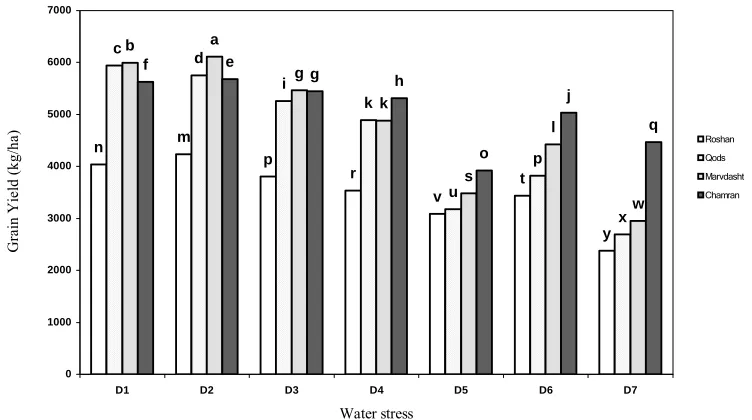
Results indicated that the highest and the lowest grain yields belonged to D2 and D7,
respectively. Significant decrease in grain yield was observed in D7, D5 and D6 treatments, in
comparison with D1 as control. The average grain
yield in these treatments, as compared to D1,
decreased by 45.6, 36.7 and 22.8%, respectively (Fig. 1). Meanwhile, moisture stress in initial growth phases (D2, D3 and D4 treatments) did not
result in a significant decrease in grain yield. There are many other reports on the effects of moisture stress in various growth stages of wheat that confirm these results.
Besides different effects of moisture stress on grain yield, cultivars responded differently to various treatments. In general, among the tested cultivars, Roshan showed a very low grain yield potential. Grain yield of Roshan and Chamran cultivars under D5 treatment decreased by 23.5
and 30.2%, respectively, in comparison with their grain yield in control treatment (D1). Grain yield
of Qods and Marvdasht cultivars under the same treatments decreased by 46.5 and 41.7%, respectively (Fig. 1). Furthermore, under the severe moisture stress conditions ( D7 treatment),
grain yield in Roshan, Chamran, Qods and Marvdasht cultivars decreased by 41.1, 34.1, 54.5, and 50.6%, respectively, as compared with control (D1) (Fig. 1).
threshold of tolerance to moisture stress conditions. Usually, cultivars with high grain yields under optimum conditions, are more
tolerant to moisture stress, and produce reasonable grain yield under these conditions.
n m
p
r
v
t
y c
d
i
k
u
p
x
b a
g
k
s
l
w
f e
g h
o
j
q
0 1000 2000 3000 4000 5000 6000 7000
D1 D2 D3 D4 D5 D6 D7
Water stress
G
rai
n Y
ie
ld (
kg/
ha) Roshan
Qods Marvdasht Chamran
Fig. 1. The interaction of moisture stress and cultivar on grain yield
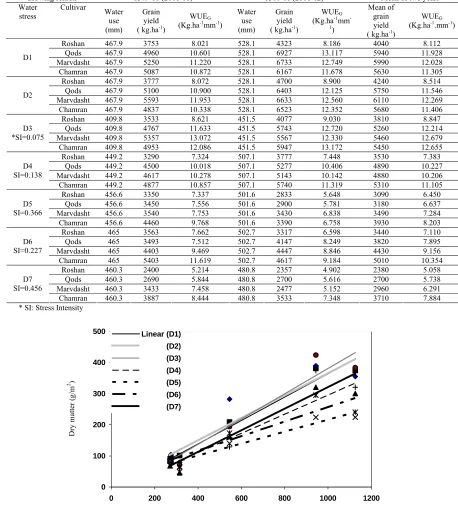
Precipitation, evaporation from class A evaporation pan, water use, and water use efficiency using grain yield (WUEG) in different moisture stress treatments over 2 years are presented in Table 1. Due to higher precipitation levels during the second year (2001-2002), water use (including effective rainfall) was greater than that in the first year (2000 – 2001). Water use in
control (D1, full irrigation) and D2 (No irrigation
from one-leaf to double ridge stage except rainfall) treatments were almost similar; 467.9 and 528.1 mm in the first and second years, respectively. Evaporation from class A pan at the beginning of growth stages in the second year was higher than that in the first year (Table 1).
Table 1. Precipitation, evaporation from class A pan, water use and water use efficiency (WUE) in different moisture stress treatments Moisture
stress treatments
Growing Seasons
Precipitation (mm)
Water use plus effective rainfall
(mm)
Evaporation from class A pan (mm)
Grain yield
(Kg.ha-1) (Kg.haWUEG -1.mm-1)
Mean of 2 years WUEG (Kg.ha-1.mm-1)
First 58.1 467.9 0 4763 10.18
D1 Second 76.6 528.1 21 6038 11.43 10.805
First 58.1 467.9 0 4827 10.32
D2 Second 76.6 528.1 21 6065 11.48 10.900
First 58.1 409.8 0 4653 11.35
D3 Second 76.6 451.5 21 5333 11.81 11.580
First 18.7 449.2 0 4321 9.62
D4 Second 21.0 507.1 0 4981 9.83 9.725
First 18.3 456.6 81.3 3700 8.10
D5 Second 26.5 501.6 83.2 3138 6.26 7.180
First 2.9 465.0 79.5 4216 9.07
D6 Second 25.4 502.7 80.1 4132 8.22 8.645
First 7.6 460.3 228.9 3103 6.74
D7 Second 47.3 480.8 165.6 2767 5.75 6.245
Results obtained on the basis of water use efficiency using grain yield (WUEG) revealed that
in the first year, in all moisture stress treatments, WUEG was higher than that during the second
year (Table 1). Application of lower moisture stress treatments (D3 and D4 treatments) relatively
increased WUEG, whereas, application of higher
moisture stress treatments (D5, D6 and D7
treatments) increased WUEG, in either year. The
average WUEG showed that application of D3
treatment, relatively increased water use efficiency (WUEG), but D5, D6 and D7 treatments
decreased WUEG by 8kg.mm-3 (Table 1).
Although the amount of water use is almost the same in D1 and D7 treatments, grain yield in
significantly decreased in comparison with control treatment (D1) and consequently, had considerable
effect on reducing WUEG in D7 treatment. This is
mainly due to reduction of WUEG under more severe moisture stress treatments (No irrigation) in critical growth phases (e. g. grain filling ). Re-watering of treatments following termination of moisture stress did not have any significant effect on grain yield, however, it was considered in calculations of water use. This was true for all moisture stress treatments. Anderson (1992) reported that under severe moisture stress treatments, wheat water use efficiency decreased, because stress treatments were applied in critical growth stages (e.g. double ridge, commencement of stem elongation, and anthesis) and had adverse effects on dry matter accumulation. His findings confirm the results of this research.
Furthermore, water use, effective precipitation, grain yield, and water use efficiency of different wheat cultivars under different moisture stress treatments, over two years, are presented in Table 2. The intensity of environmental stress (SI) for each environment (stress treatment) was calculated and it was determined that grain yield under D3, D4, D5, D6 and D7 treatments decreased by 7.5, 13.8, 36.6, 22.7, and 45.6%, respectively, as compared to full irrigation treatment (D1). Under D5 and D7 treatments, stress was more severe and subsequently, the environmental severity was more than in the other treatments (Table 2). Acevedo et al. (2002) reported that water use efficiency in wheat under moisture stress treatments in growth phases before anthesis and grain filling stages were 14.6, 12.4 and 15.2, respectively. They reported WUE of16.8 kg.mm-3
for control treatment (D1). They concluded that moisture stress in critical growth stages (anthesis and grain filling stages) significantly decreased water use efficiency, which confirms the results of this research.
In the first year, the highest WUEG under D1, D2 and D3 treatments belonged to Qods and Marvdasht cultivars, however, under D4, D5, D6 and D7 treatments, the highest WUEG belonged to Chamran cultivar. On the other hand, Roshan had the lowest WUEG under all moisture stress treatments, in both growing seasons. Under D1 to D5 treatments, Qods, Marvdasht, and Chamran cultivars had almost the same WUEG, while under severe moisture stress treatments (D6 and D7), Chamran cultivar had the highest WUEG (Table 2). Nakhjavani Moqaddam and Qahraman (2004) studied the effect of moisture stress on grain yield, agronomical characteristics and water use efficiency in different growth stages for Tous a facultative wheat cultivar. They concluded that
there is a significant difference in WUEG between
moisture stress treatments and control treatment (D1), particularly in tillering, stem elongation and anthesis stages. Nakhjavani Moqaddam and Qahraman (2004) also reported that ceasing of irrigation in each growth phase caused some variations in grain yield and water use, thus, combined effects of these two parameters, changed water use efficiency. They also concluded that differences in water use under moisture stress treatments as compared to control, depended on grain yield and water use differences.
These differences imply the likely differences in sensitivity of wheat at different growth stages to water deficit. These results also are in match with the results of the present research. Variations in WUEG between different cultivars and moisture stress treatments are due mainly to differences in grain yield of cultivars. Passioura (1996) believes that under circumstances where water use for different wheat cultivars is similar, the cultivars that produce higher grain yield under optimum (no stress) conditions would have greater water use efficiency under stress conditions too. This is in agreement with the findings in this study in which the lowest and the highest water use efficiency (as averaged over two growing seasons (2000-2002)) were obtained for Roshan and Chamran, respectively (Table 2). Radiation Use Efficiency (RUE) is the ratio of produced dry matter to cumulative intercepted photosynthesis active radiation (cPARa) (Fig. 2). It is clearly shown that RUE increases with time and growth stage progression. This is due mainly to expansion of leaf area (increase in leaf area index) which leads to an increase in green active photosynthetic area for interception of more incident radiation. Potential radiation use efficiency depends on the following factors (Acevedo et al., 2002): sufficient
Sufficient moisture for maximum stomata conductance and CO2 transfer to the leaves; relative vertical arrangement of leaves to facilitate the penetration of solar radiation through canopy; sufficient nourishment of leaves to support photosynthesis; and enough canopy for interception of CO2 and dissemination of extra
heat.
Table 2. The calculated water use and water use efficiency for four wheat cultivars under different moisture stress treatments
Growing season 1379-80 (2000-01) 1380-81 (2001-02) Mean of two years
Water
stress Cultivar Water use (mm)
Grain yield ( kg.ha-1)
WUEG
(Kg.ha-1mm-1)
Water use (mm)
Grain yield ( kg.ha-1)
WUEG
(Kg.ha-1mm -1)
Mean of grain yield ( kg.ha-1)
WUEG
(Kg.ha-1.mm-1)
Roshan 467.9 3753 8.021 528.1 4323 8.186 4040 8.112
Qods 467.9 4960 10.601 528.1 6927 13.117 5940 11.928
Marvdasht 467.9 5250 11.220 528.1 6733 12.749 5990 12.028
D1
Chamran 467.9 5087 10.872 528.1 6167 11.678 5630 11.305
Roshan 467.9 3777 8.072 528.1 4700 8.900 4240 8.514
Qods 467.9 5100 10.900 528.1 6403 12.125 5750 11.546
Marvdasht 467.9 5593 11.953 528.1 6633 12.560 6110 12.269
D2
Chamran 467.9 4837 10.338 528.1 6523 12.352 5680 11.406
Roshan 409.8 3533 8.621 451.5 4077 9.030 3810 8.847
Qods 409.8 4767 11.633 451.5 5743 12.720 5260 12.214
Marvdasht 409.8 5357 13.072 451.5 5567 12.330 5460 12.679
D3 *SI=0.075
Chamran 409.8 4953 12.086 451.5 5947 13.172 5450 12.655
Roshan 449.2 3290 7.324 507.1 3777 7.448 3530 7.383
Qods 449.2 4500 10.018 507.1 5277 10.406 4890 10.227
Marvdasht 449.2 4617 10.278 507.1 5143 10.142 4880 10.206
D4 SI=0.138
Chamran 449.2 4877 10.857 507.1 5740 11.319 5310 11.105
Roshan 456.6 3350 7.337 501.6 2833 5.648 3090 6.450
Qods 456.6 3450 7.556 501.6 2900 5.781 3180 6.637
Marvdasht 456.6 3540 7.753 501.6 3430 6.838 3490 7.284
D5 SI=0.366
Chamran 456.6 4460 9.768 501.6 3390 6.758 3930 8.203
Roshan 465 3563 7.662 502.7 3317 6.598 3440 7.110
Qods 465 3493 7.512 502.7 4147 8.249 3820 7.895
Marvdasht 465 4403 9.469 502.7 4447 8.846 4430 9.156
D6 SI=0.227
Chamran 465 5403 11.619 502.7 4617 9.184 5010 10.354
Roshan 460.3 2400 5.214 480.8 2357 4.902 2380 5.058
Qods 460.3 2690 5.844 480.8 2700 5.616 2700 5.738
Marvdasht 460.3 3433 7.458 480.8 2477 5.152 2960 6.291
D7 SI=0.456
Chamran 460.3 3887 8.444 480.8 3533 7.348 3710 7.884
* SI: Stress Intensity
0 100 200 300 400 500
0 200 400 600 800 1000 1200
Absorbed cumulative photosyntetic active radiation (cPARa) (Mj/m2)
D
ry
m
atte
r (
g/m
2 )
Linear (D1) Linear (D2) Linear (D3)
Linear (D4) Linear (D5) Linear (D6) Linear (D7)
Fig. 2. Variation in Radiation Use Efficiency (RUE) in different moisture stress treatments
The trend of variations in RUE is similar to that of grain yield which was discussed earlier. Generally, in severe moisture stress treatments (D5, D6 and D7), reduction in leaf area index, green active photosynthetic areas as well as the
matter per each mega joules of absorbed solar radiation. Other researchers (Jost and Cothren, 2000) believe it would vary for different crops and genotypes. For instance, Acevedo, et al. (2002), reported RUE values for wheat as 3gMj-1, which
was calculated based upon the above ground dry matter and roots. They also believed that moisture stress had a slight effect on RUE; however, radiation intensity in a defined area influenced RUE. Calderini et al. (1997) studied RUE in wheat cultivars and reported that in newly bred cultivars, during post- anthesis stage, RUE and the crop growth rate were clearly greater than in old cultivars; however, RUE was similar in all cultivars, in the pre-anthesis stage. This is also in agreement accordance with the findings in this study. They also emphasized that in new cultivars, at anthesis stage, biomass was lower than in old cultivars, therefore, suggested that RUE must be taken into consideration for genetic improvement in wheat breeding programs as an important physiological attribute. Overall, improving crop photosynthesis under stress prone conditions requires a balance between maximum level of photosynthesis at critical growth stages (optimum conditions) and avoidance from destructive effect of surplus intercepted radiation in severe stress conditions. In these environments, selection for desired characteristics would be based on the definition and severity of stress conditions (i.e. timing as well as intensity).
4. Conclusion
The results of this study illustrated that imposing moisture stress in critical growth stages (Commencement of stem elongation, anthesis and grain filling) would significantly decrease grain yield; however, imposing moisture stress in initial growth stages would not have such a significant effect on grain yield. Furthermore, wheat cultivars reacted differently to different moisture stress treatments. Chamran cultivar had a higher grain yield and was more tolerant to moisture stress during critical growth stages. On the other hand, it was demonstrated that application of lower moisture stress treatments (D3 and D4) relatively increased water use efficiency (WUE), however, severe moisture stress treatments (D5, D6 and D7) decreased WUE. Genetic differences also played a significant role in variation in WUE among different cultivars. Roshan and Chamran cultivars exhibited the lowest and the highest WUE, respectively. It was also illustrated that there were some differences in moisture stress treatments for radiation use efficiency (RUE). D1, D2 and D3 treatments showed the highest RUE, while the lowest RUE belonged to D5 and D6 treatments.
This can be due mainly to significant reduction in leaf area index, radiation interception areas as well as to the percentage of intercepted radiation which led to reduction in dry matter, grain yield, and RUE.
Acknowledgements
All, particularly the first author are grateful and acknowledge the assistance and facilities provided by Khorasan Agricultural and Natural Resources Research Center and colleagues in Khorasan Cereal Research Project.
References
Alizadeh, A., 1993. Principles of Designing of Irrigation Systems. The University of Emam Reza. Pp. 202-205 Naderi, A. and Mosharraf, G.A., 2000. Effect of drought stress on rain yield and associated agronomical characteristics in wheat genotypes. Proceedings of 6th Iranian Crop Sciences Congress. Babolsar, Mazanderan, Iran.
Nakhjavani Moghaddam, M.M. and Qahraman, B., 2004. Study of effect of water stress on Evapo-transpiration and production indices in winter wheat. Journal of Agricultural Sciences and Industries. Vol. 18: No. 2. pp. 139-149.
Acevedo, E., Silva, P. and Silva, H., 2002. Wheat Growth and physiology. In: Bread wheat, Improvement and Production. Curtis, B.C., Rajaram, S., and Gomez Macpherson, H. (editors). FAO Plant Production and Protection. No. 30.
Anderson, W.K., 1992. Inceasing grain yield and water use of wheat in a rainfed mediteranian type environment. Aust. J. Agric. Res. 43: 1-17.
Araus, J.L., Bort, J., Steduto, P., Villegas, D. and Royo, C., 2003. Breeding cereal for Mediteranean conditions: ecophysiological clues for biotechnology application. Ann. Appl. Biol. 142: 129-141.
Calderini, D.F., Dreccer, M.F. and Slafer, G.A., 1997. Consequences of breeding on biomass, radiation interception and radiation use efficiency in wheat. Field Crop Res. 52: 271-281.
Fisher, R.A., 2001. Selection traits for improving yield potential. In: Reynolds, M.P; Ortiz-Monasterio, J.I. and McNab, A. (eds). Application of Physiology in Wheat Breeding. Mexico, D.F. CIMMYT. Pp. 148-160. Gomez-Macpherson, H. and Richards, R.A., 1995. Effects of sowing time on yield and agronomic characteristics of wheat in south-eastern Australia. Aust. J. Agric. Res. 46: 1381-1399.
Jost, P.H. and Cothren, J.T., 2000. Growth and yield comparisons of cotton planted in conventional and ultra-narrow row spacings. Crop Sci. 40:430-435. Kirigwi, F.M., Van Ginkel, M., Trethowan, R.G., Sears, R.G., Rajaram, S. and Paulsen, G.M., 2004. Evaluation of selection strategies for wheat adaptation across water regimes. Euphytica, 135: 361-371.
Monteith, J.L., 1972. Solar radiation and productivity in tropical ecosystems. J. Appl. Ecol. 9: 747-766.
Passioura, J.B., 1996. Drought and drought tolerance. Plant Growth Regulation. 20: 79-83.
Richards, R.A., Condon, A.G. and Rebetzke, G.J., 2001. Traits to improve yield in dry environments. In: Reynolds, M.P; Ortiz-Monasterio, J.I. and McNab, A. (eds). Application of Physiology in Wheat Breeding. Mexico, D.F. CIMMYT. 240 pages.
Sinclair, T.R. and Muchow, R.C., 1999. Radiation-use efficiency. In Advances in Agronomy. Sparks, D.L., (ed). PP 215-265.
Slafer, G.A., Andrade, F.H. and Satorre, E.H., 1990.
Genetic-improvement effects on pre-anthesis
physiological attributes related to wheat grain-yield. Field Crop Res. 23: 255-263.
Tollenaar, M. and Aguilera, A., 1992. Radiation use efficiency of an old and a new maize hybrid. Agron. J. 84: 536-541.
Varlet Grancher, C., Gosse, G., Chartier, M., Sinoquet, H., Bonhomme, R. and Allirand, J.M., 1989. Mise au point:
Rayonnement solaire absorbe ou intercepte par un couvert vegetal. Agronomie. 9: 419-439.
Villegas, D., Aparicio, N. and Royo, R., 2001. Biomass accumulation and main stem elongation of durum wheat grown under Mediteranian conditions. Ann. of Bot. 88: 617-627.
Zadoks, J.C., Chang,T.T. and Konzak, C.F., 1974. A decimal code for the growth stages of cereals. Weed Research. 14: 415-421.
Zarea Feizabady, A. and Ghodsi, M., 2004. Evaluation of Yield and Yield components of facultative and winter bread wheat genotypes (Triticum aestivum L.) under