I J H S
International Journal of Health Studies
Original Article
Optimization of Medium Components Using Artificial Neural Networks
Mohamad Hosein Aghajani1*, Hemat Aghagolzadeh haji2, Mostafa Mir3, Mahdi Aghajani4**1 Dept. of Nanotechnology, The Persian Gulf Nuclear Medicine Research Center, The Persian Gulf Biomedical Sciences Institute, Bushehr University of Medical Sciences, Bushehr, Iran. 2 School of Medicine, Shahroud University of Medical Sciences, Shahroud, Iran.
3 Research Committee, Babol University of Medical Sciences, Iran.
4 School of Advanced Medical Technology, Golestan University of Medical Sciences, Gorgan, Iran.
Received: 10 October 2016 Accepted: 30 November 2016
Abstract
Background: Achieving high cell density is an important goal in recombinant proteins production. Optimization of medium components to achieve high cell density and consequently high yield recombinant protein is a common practice in the biotechnology industry. We could not find an article that just examine the effects of salt on growht transformed BL21. On the other hand, salt is a critical component of medium that can be made up in a medium optimization.
Methods: Here, we separately investigated effect of K2HPO4, MgSO4, (NH4)2SO4 and NH4CL on maximum growth of bacteria BL21 after transforming BL21 with PET-32α that containing para thyroid hormones gene. Then, the salts were combined and added to the culture medium for optimization of their effects on high cell density using artificial neural network modelling (ANNs).
Results: After ANN modeling, the obtained model showed that MgSO4 has dominant on high cell density other than salts if final concentration of MgSO4 is 25mg/ml. The best concentration each of salt be lower 30 mg/ml and critical total concentration of slats is 120 mg/ml that inhibitory effect was seen after a critical concentration.
Conclusions: In current study, ANN modeling shows that in prediction of effects of salts (i.e. K2HPO4, MgSO4, (NH4)2SO4 and NH4CL) on cell density to reach high cell density, is effective and efficient.
Keywords: High cell density, Artificial neural networks, Culture medium, Optimization.
*
Corresponding to: MH Aghajani, Email: [email protected], **Corresponding to: M Aghajani, Email: [email protected]
Please cite this paper as: Aghajani MH, Aghagolzadeh Haji H, Mir M, Aghajani M. Optimization of medium components using artificial neural networks. Int J Health Stud 2017;3(1):5-13.
I
ntroduction
Biotechnology has many branches, one them is the production of recombinant protein. The recombinant protein has many applications, especially in the medical field.1 For example, bovine somatotropin is expected to have an annual market of up to 100 tonnes in the USA alone. Recombinant protein production has different and complicated process.2,3 The expression of proteins in eukaryotic or prokaryotic host is a way to study of gene function and the production of large amounts of protein in commercial and investigational use. The host has a crucial role in this process. The selection of an appropriate host is dependent on various conditions.4,5 More important considerations in the choice of host are ensuring the maximal amount of protein expression and ensure the function and proper folding of protein. Many hosts apply to this field that the most common microorganism is E. coli for recombinant protein production.6,7 Because a good and enough
information is about expression vectors, production strains, protein folding and fermentation technologies of E. coli.8 And more than 30% of approved protein therapeutics are produced in E. coli that indicating it is a major workhorse for recombinant therapeutic production.9,10 The components used to cultivate E. coli usually included several essential resources such as a carbon, nitrogen, essential salts and trace elements.11 There are three types of media: defined, semi-defined and complex. Semi-defined media are generally used to obtain high cell-density.12 Defined medium is composed of chemicals of known identities and concentrations, while other medium composition is not completely known.13 Some nutrients, including carbon and nitrogen sources, can inhibit cell growth when they are present above a certain concentration. This explains why just increasing the concentrations of nutrients in batch culture media has not yielded high cell-density.14 To have high cell growth as well as high recombinant protein production, the concentration of each component in these three different types of media must be carefully formulated. Optimization of medium components for reach high cell density and consequently high yield production is a common practice in the industry.15 Various technics used to obtain the best formula of medium ingredient, including design of experiments (DOE) to determinate effects of different components and their interactions on cell/protein growth with artificial neural network.16,17 We could not find an article that just examine the effects of salt on growht transformed BL21. On the other hand, salt is a critical component of medium that can be made up in a medium optimization.
In this study, we evaluate the effect of several salt on cell density of transformed BL21 separately and then combine the salts and add to medium. To determinate the effects of interaction of salts (input experimental parameters) on BL21 growth (high cell density) as output parameter, data were optimized using artificial neural networks modeling.18
Materials and Methods
Monopotassium phosphate (K2HPO4), Magnesium sulfate (MgSO4), and Ammonium sulfate (NH4)2SO4 were purchased from Sigma-Aldrich, USA. Ammonium chloride was purchased from Merck Millipore. The construct was ordered from the genscript (lot: 4194933) and BL21 was provided from Pasteur Institute of Iran.
Aghajani et al
International Journal of Health Studies 2017;3(1) | 6
overnight in a shaking incubator at 37 with RPM 180. The culture medium was transferred to a 250 ml erllen containing 50 ml LB that were placed in a shaking incubator (180 rpm) at 37 ºC for 4 h until the optical density (OD; represents cell density) is reached in 0.4-0.6 at 600 nm. Then precipitation procedure was performed in 8000 rpm for 5 minutes. Afterwards, vector containing the gene encoding the protein, namely parathyroid, was transformed into bacteria with CaCl2 procedure. The transformed bacteria were cultured in 250 ml erllen containing 50 ml LB with antibiotic ampicillin to a final concentration of 50 mg per ml. Medium made with 21 different concentrations for each of salts while adjusting the PH range between 5 and 8. After overnight culture, cell density measured by spectrophotometric method. The procedure was performed for each 4 salt. The concentration of the salts is shown in results ( Figures 1-4). After viewing effect of each salt on the cell density, this times added different concentrations of salt together in a medium where 49 samples were obtained. All of them were cultured overnight in a shaking incubator (180 rpm) at 37 ºC and the cell density (OD) was measured by spectrophotometry.
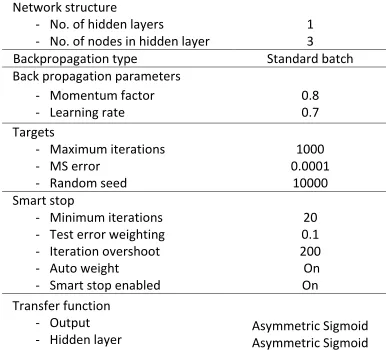
The modeling relations between independent variables (i.e., MgSO4, K2HPO4, (NH4)2SO4 and NH4CL concentration) and dependent variable (i.e., OD) was performed using a commercial ANNs software (INForm 4.02, Intelligensys, UK). The response surfaces obtained in form of 3D-graphs were applied to evaluate the change of output variable (OD) against changes of two input variables while two other input variables were fixed at low, mid-range and high values, as was explained previously.19-21 Number of 49 experimental samples were prepared with random input values for each sample (i.e. randomly concentration variation of MgSO4 in the range of 25-500 mg/ml, K2HPO4 in the range of 25-1375 mg/ml, (NH4)2SO4 in the range of 25-1250 mg/ml and NH4CL in the range of 100-1375 mg/ml). The data set of 49 samples with OD as output parameter, were used to train, test and validate a model by ANNs. Here, 39 data sets were applied as training set for teaching the network in order to find the relations between inputs and output. Also, to prevent overtraining process, three data sets as test data set were separated to evaluate software (i.e., 10% of the training data set). The training parameters applied during ANNs modeling are shown in table 1, as details have been described previously.22
Following network training, 10 remaining data sets with the OD results was employed as unseen data set or validation data for the evaluation generated model by ANN software (table 2). Finally, a better predictability of the generated model was determined using correlation coefficient (R2) close to one for the unseen data.23,24
In this experiment, to measure cell density, we start with a blank for calibration of spectrophotometer that in deed is a medium free of bacteria. Afterwards, wavelength was set to 600 nm. After reading each of the four samples, to ensure correct procedure of spectrophotometer, the device was calibrated. Samples with cell density higher than 2 were dilution to follow the Beer- Lambert's law.
Table 1. The training parameters applied in Inform v4.02
Network structure
- No. of hidden layers 1
3
- No. of nodes in hidden layer
Backpropagation type Standard batch
Back propagation parameters
- Momentum factor
- Learning rate
0.8 0.7 Targets
- Maximum iterations
- MS error
- Random seed
1000 0.0001 10000 Smart stop
- Minimum iterations
- Test error weighting
- Iteration overshoot
- Auto weight
- Smart stop enabled
20 0.1 200 On On Transfer function - Output
- Hidden layer Asymmetric Sigmoid Asymmetric Sigmoid
Results
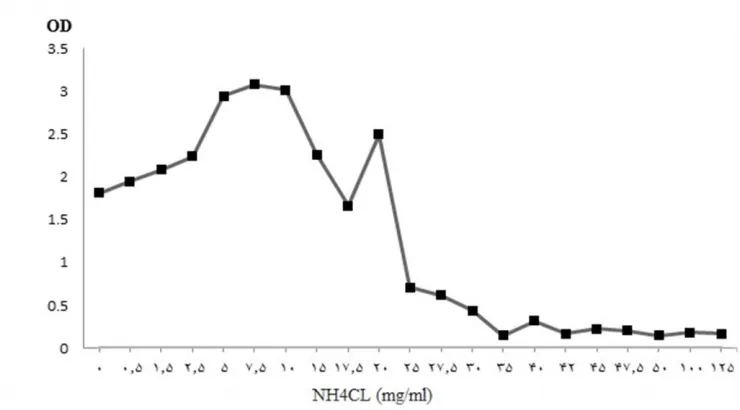
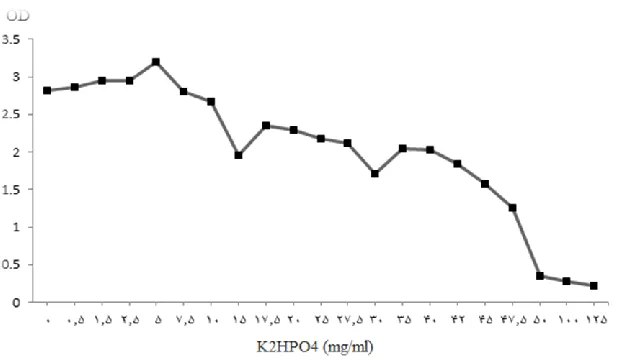
The impact of each of salts on cell density is shown separately. As figure 1 show, at first with adding NH4CL increase the cell density but after the concentration of 20 mg/ml not only don't increase cell density but also decrease that. In figure 2, increasing concentration of (NH4)2SO4 quickly decrease cell density after 2.5 mg/ml, because the PH of the medium can be reduced and condition probably for growth is undesirable. As showed in figure 3, the cell density after 25 mg/ml decreases and increasing MgSO4 do not increase cell density uniformly. The reason for these fluctuations in the chart may be due to aeration. Figure 4 show that increasing K2HPO4 initially leads to an increase in high cell density but after concentration 5 mg/ml adding K2HPO4 continuously decrease cell density. Subsequence of modeling using ANN software, the model generated R2 values of 0.73, 0.81 and 0.72 for the training, test and unseen data sets, respectively. These values indicate an acceptable trained model obtained by ANNs study. Then, according to this model, the impact of independent input variables mentioned in current study on the high cell density medium was evaluated. The use of sensitivity analyses approach can be the first choice to determine the relations of independent input variables and dependent output parameter in the optimized model using ANNs modeling.25 Here, we applied a systematic approach reported previously21,26 for a semi-quantitative study of relations between the input variables and the output variable. Briefly, in this approach, response surfaces generated by ANNs modeling in form of 3D-graphs are used for the evaluation of the effect of two input variables on output variable, whereas the other input variable(s) are fixed on the predetermined values of low, mid-range and high.
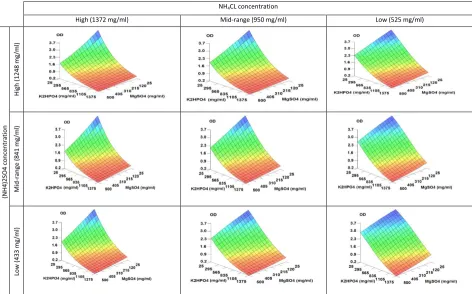
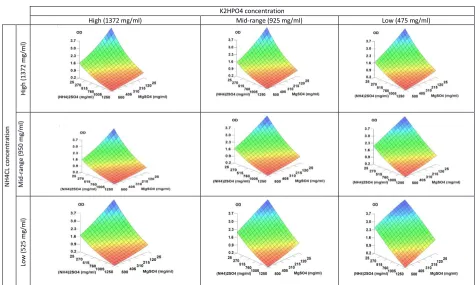
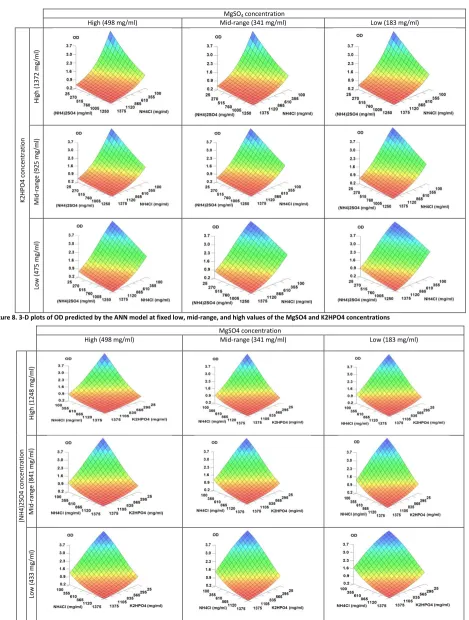
In figure 5, the effect of concentration of MgSO4 and K2HPO4 on the OD is shown, when two other input variables, namely, concentration of NH4CL and (NH4)2SO4, are fixed at 1372, 950 and 525 mg/ml and 1248, 841 and 433 mg/ml, respectively (i.e., high, mid-range and low values). As shown in Figure 5, increasing K2HPO4 after a certain amount, reduced cell density while increasing Mgso4 increases the cell density. In figure 6, to study the impact of changes in NH4CL and MgSO4 concentration on the OD, we fixed concentration of K2HPO4 and (NH4)2SO4 at 1372, 925 and 475 mg/ml and 1248, 841 and 433 mg/ml for high, mid-range and low values, respectively. Increasing NH4CL decreased cell density. This effect more pronounced than the MgSO4. In figure 7, the effect of MgSO4 and (NH4)2SO4 concentration on the OD is shown, while two other input parameters are fixed at high, mid-range and low concentrations (i.e., 1372, 950 and 525 mg/ml for NH4CL, and 1372, 925 and 475 mg/ml for K2HPO4). It is
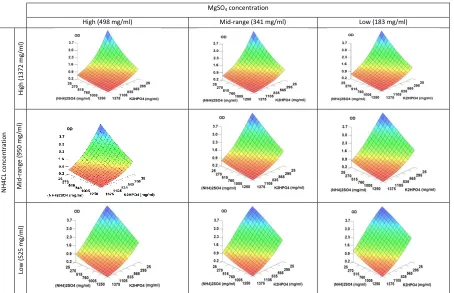
clear that decrease in the OD against increasing concentration of (NH4)2SO4 is further compared with an increase in the concentration of MgSO4. In figure 8, the effect of two variables, namely concentration of NH4CL and (NH4)2SO4 is shown on the OD, while two other variables are fixed at their high, mid-range and low values. As shown, an increase in (NH4)2SO4 concentration leads to decreasing cell density slowly, as mentioned above. Also, increasing concentration of NH4CL results in a reduction of cell density. Of course, this effect is more obvious at the high concentrations of MgSO4 and K2HPO4. In figure 9, with increasing concentration two variable, K2HPO4 and NH4CL concentration, OD decreases at high, mid-range and low concentrations of (NH4)2SO4 and MgSO4. In figure 10, obviously, the effect of K2HPO4 concentration on OD is much at low concentrations of MgSO4 and NH4CL, as an increase in K2HPO4
concentration considerably reduces OD.
Figure 1. NH4CL effects on OD while the concentrations of other salts waswere unchanged Table 2. Unseen data sets used in artificial neural network software
MgSO4 concentration
(mg/ml)
K2HPO4 concentration (mg/ml)
NH4CL concentration
(mg/ml)
(NH4)2SO4 concentration
(mg/ml) Observed OD Predicated OD
75 125 1375 250 1.6 1.4
500 500 250 500 3.7 2.1
250 500 1000 750 0.4 0.9
25 250 1000 125 3.3 2.1
75 250 375 250 2.5 3.1
500 250 250 500 3.1 2.5
25 1250 500 25 1.5 1.7
250 1250 1000 75 0.2 0.6
Aghajani et al
International Journal of Health Studies 2017;3(1) | 8
Figure 2. (NH4)2SO4 effects on OD while the concentrations of other salts were unchanged
Figure 3. MgSO4 effects on OD while the concentrations of other salts waswere unchanged
Figure 4. K2HPO4 effects on OD while the concentrations of other salts were unchanged
0 0.5 1 1.5 2 2.5 3 3.5
0 0.5 1.5 2.5 5 7.5 10 15 17.5 20 25 27.5 30 35 40 42 45 47.5 50 100 125
OD
Discussion
Recently, artificial neural network as a powerful tool used for modeling particularly for experiments that variables don't have a direct relationship with each other.27,28 Recombinant
protein production costs are high. The manufacturing process must be optimized. One of the key components for achieving this goal is the medium. Achieving the high cell density for production of recombinant proteins is most important way to obtain the large amount of protein. There are many ways to reach this purpose. One of these methods is the change in the composition of the culture medium. For optimization, the evaluation of effect of each variables is difficult and expensive work. Therefore, the use of artificial neural network modeling is very helpful.29
Due to the rapid growth, low cost medium, and cost-effectiveness E. coli , it is widely used in the production of recombinant proteins.30 In general, the components of the culture medium is containing a carbon source and salt and trace nutrients. The amount of glucose, carbon, required for proper cell density was evaluated in a different articles.31 The amount of salt to achieve high cell density was optimized in batch culture. After adding salt, PH medium was adjusted between 5 and 8 as an important and impressive factor in the procedure.32,33 Increasing the concentration of (NH4)2SO4 and
NH4CL resulted in less effect of concentration of K2HPO4 on cell density. Because PH of culture medium is unfavorable for E.coli growth. While MgSO4 effect is obvious when total concentration salt is lower 120 mg/ml. As well as, the MgSO4 effect clearly seen on increasing cell density when the K2HPO4 and NH4CL concentration is low. Unlike the other salts, when concentration of MgSO4 increases, at some points the cell density changes (shown in Figure 3). In fact, mg2+ uptake affected by enzyme activity such as RNA polymerase that is proportional with the growth of bacteria.34,35 But, because of the limited number of other nutrients, there is no a significant change in high cell density.
Reducing the time and cost, and improvement of efficiency are most essential requirements in biotechnology industry. In this study, the (NH4)2SO4 effect was slight on the cell density and data showed that total concentration salt more than 120 mg/ml have inhibitory effect on BL21 growth. An amount of 25-30 mg/ml is optimum concentration to reach high cell density. However, for gathering more accurate and more comprehensive information, other factors such as aeration should be studied at the same time. Also, it should be considered that due to the complexity of metabolic system and large number of physical and chemical factors affecting on growth, creating a powerful and convenient model to predict productivity is difficult.
NH4CL concentration
High (1372 mg/ml) Mid-range (950 mg/ml) Low (525 mg/ml)
(N
H4)2SO4
c
o
n
ce
n
tr
ation
High
(
12
48
m
g/m
l)
Mid
-ra
n
ge
(
84
1
m
g/m
l)
Low
(
43
3
m
g/m
l)
Aghajani et al
International Journal of Health Studies 2017;3(1) | 10
K2HPO4 concentration
High (1372 mg/ml) Mid-range (925 mg/ml) Low (475 mg/ml)
(N
H4)2SO4
c
o
n
ce
n
tr
ation
High
(
12
48
m
g/m
l)
Mid
-ra
n
ge
(
84
1
m
g/m
l)
Low
(
43
3
m
g/m
l)
Figure 6. 3-D plots of OD predicted by the ANN model at fixed low, mid-range, and high values of K2HPO4 and (NH4)2SO4 concentrations
K2HPO4 concentration
High (1372 mg/ml) Mid-range (925 mg/ml) Low (475 mg/ml)
N
H4C
L
co
n
cent
ratio
n
High
(
13
72
m
g/m
l)
Mid
-ra
n
ge
(
95
0
m
g/m
l)
Low
(
52
5
m
g/m
l)
MgSO4 concentration
High (498 mg/ml) Mid-range (341 mg/ml) Low (183 mg/ml)
K2HP
O
4
conc
en
trati
o
n
High
(
13
72
m
g/m
l)
Mid
-ra
n
ge
(
92
5
m
g/m
l)
Low
(
47
5
m
g/m
l)
Figure 8. 3-D plots of OD predicted by the ANN model at fixed low, mid-range, and high values of the MgSO4 and K2HPO4 concentrations
MgSO4 concentration
High (498 mg/ml) Mid-range (341 mg/ml) Low (183 mg/ml)
(N
H4)2SO4
c
o
n
ce
n
tr
ation
High
(
12
48
m
g/m
l)
Mid
-ra
n
ge
(
84
1
m
g/m
l)
Low
(
43
3
m
g/m
l)
Aghajani et al
International Journal of Health Studies 2017;3(1) | 12
MgSO4 concentration
High (498 mg/ml) Mid-range (341 mg/ml) Low (183 mg/ml)
N
H4C
L
co
n
cent
ratio
n
High
(
13
72
m
g/m
l)
Mid
-ra
n
ge
(
95
0
m
g/m
l)
Low
(
52
5
m
g/m
l)
Figure 10. 3-D plots of OD predicted by the ANN model at fixed low, mid-range, and high values of the MgSO4 and NH4CL concentrations
Acknowledgement
This study was supported by the vice-chancellor of research at Bushehr University of Medical Sciences & Health Services grant no. 20-18-3-46334.
Conflict of Interest
The authors declare that they have no conflicts of interest to disclose.
References
1. Rosano GL, Ceccarelli EA. Recombinant protein expression in Escherichia coli: advances and challenges. Front Microbiol 2014;5:1-17.
doi:10.3389/fmicb.2014.00172
2. Palomares LA, Kuri-Breña F, Ramírez OT. Industrial recombinant protein production. EOLSS 2002.
3. Gräslund S, Nordlund P, Weigelt J, Bray J, Gileadi O, Knapp S, et al. Protein production and purification. Nat Methods 2008;5:135-46.
doi:10.1038/nmeth.f.202
4. Waegeman H, Soetaert W. Increasing recombinant protein production in Escherichia coli through metabolic and genetic engineering. J Ind Microbiol Biotechnol 2011;38:1891-910.doi:10.1007/s10295-011-1034-4
5. Joseph BC, Pichaimuthu S, Srimeenakshi S, Murthy M, Selvakumar K, Ganesan M, et al. An overview of the parameters for recombinant protein expression in Escherichia coli. Science & Therapy 2015;6:1-7.
doi:0.4172/2157-7013.1000221
6. Demain AL, Vaishnav P. Production of recombinant proteins by microbes and higher organisms. Biotechnol Adv 2009;27:297-306.
doi:10.1016/j.biotechadv.2009.01.008
7. Ferrer-Miralles N, Domingo-Espín J, Corchero JL, Vázquez E, Villaverde A. Microbial factories for recombinant pharmaceuticals. Microb cell fact 2009;8:1-8.doi:10.1186/1475-2859-8-17
8. Huang CJ, Lin H, Yang X. Industrial production of recombinant therapeutics in Escherichia coli and its recent advancements. J Ind Microbiol Biotechnol 2012;39:383-99.doi:10.1007/s10295-011-1082-9
9. Choi JH, Keum KC, Lee SY. Production of recombinant proteins by high cell density culture of Escherichia coli. Chemical Engineering Science. 2006;61:876-85.
10. Graumann K, Premstaller A. Manufacturing of recombinant therapeutic proteins in microbial systems. Biotechnol J 2006;1:164-86.
11. Shiloach J, Fass R. Growing E. coli to high cell density—a historical perspective on method development. Biotechnol Adv 2005;23:345-57.
doi:10.1016/j.biotechadv.2005.04.004
12. Ng W, Ting YP. Development of a semi-defined medium for high cell density cultivation of Escherichia coli in shake flask culture system: Part 1. PeerJ PrePrints 2015:1-2
13. Shojaosadati SA, Varedi Kolaei SM, Babaeipour V, Farnoud AM. Recent advances in high cell density cultivation for production of recombinant protein. Iranian Journal of Biotechnology 2008;6:63-84.
14. Tapia F, Vázquez-Ramírez D, Genzel Y, Reichl U. Bioreactors for high cell density and continuous multi-stage cultivations: options for process intensification in cell culture-based viral vaccine production. Appl Microbiol Biotechnol 2016;100:2121-32.doi:10.1007/s00253-015-7267-9
15. Sivashanmugam A, Murray V, Cui C, Zhang Y, Wang J, Li Q. Practical protocols for production of very high yields of recombinant proteins using Escherichia coli. Protein Sci 2009;18:936-48.doi:10.1002/pro.102
16. Nagata Y, Chu KH. Optimization of a fermentation medium using neural networks and genetic algorithms. Biotechnol Lett 2003;25:1837-42. 17. Franco-Lara E, Link H, Weuster-Botz D. Evaluation of artificial neural
networks for modelling and optimization of medium composition with a genetic algorithm. Process Biochemistry 2006;41:2200-6.
doi:10.1016/j.procbio.2006.06.024
18. Aichouri I, Hani A, Bougherira N, Djabri L, Chaffai H, Lallahem S. River flow model using artificial neural networks. Energy Procedia 2015;74:1007-14.
doi:10.1016/j.egypro.2015.07.832
20. Mostafavi SH, Aghajani M, Amani A, Darvishi B, Noori Koopaei M, Pashazadeh AM, et al. Optimization of paclitaxel-loaded poly (d, l-lactide-co-glycolide-N-p-maleimido benzoic hydrazide) nanoparticles size using artificial neural networks. Pharm Dev Technol 2014;20:1-9.
doi:10.3109/10837450.2014.930487
21. Amani A, York P, Chrystyn H, Clark BJ, Do DQ. Determination of factors controlling the particle size in nanoemulsions using Artificial Neural Networks. Eur J Pharm Sci 2008;35:42-51.doi:10.1016/j.ejps.2008.06.002
22. Shao Q, Rowe RC, York P. Comparison of neurofuzzy logic and neural networks in modelling experimental data of an immediate release tablet formulation. Eur J Pharm Sci 2006;28:394-404.
doi:10.1016/j.ejps.2006.04.007
23. Ali HS, Blagden N, York P, Amani A, Brook T. Artificial neural networks modelling the prednisolone nanoprecipitation in microfluidic reactors. Eur J Pharm Sci 2009;37:514-22.doi:10.1016/j.ejps.2009.04.007
24. Aghajani M, Shahverdi AR, Amani A. The use of artificial neural networks for optimizing polydispersity index (PDI) in nanoprecipitation process of acetaminophen in microfluidic devices. AAPS PharmSciTech 2012;13:1293-301.doi:10.1208/s12249-012-9859-3
25. Olden JD, Jackson DA. Illuminating the “black box”: a randomization approach for understanding variable contributions in artificial neural networks. Ecological modelling 2002;154:135-50.doi:10.1016/S0304-3800(02)00064-9
26. Aghajani M, Shahverdi AR, Rezayat SM, Amini MA, Amani A. Preparation and optimization of acetaminophen nanosuspension through nanoprecipitation using microfluidic devices: an artificial neural networks study. Pharm Dev Technol 2013;18:609-18.doi:10.3109/10837450.2011.649854
27. Desai KM, Akolkar SK, Badhe YP, Tambe SS, Lele S. Optimization of fermentation media for exopolysaccharide production from Lactobacillus plantarum using artificial intelligence-based techniques. Process Biochemistry 2006;41:1842-8. doi:10.1016/j.procbio.2006.03.037
28. Desai KM, Survase SA, Saudagar PS, Lele SS, Singhal RS. Comparison of artificial neural network (ANN) and response surface methodology (RSM) in fermentation media optimization: case study of fermentative production of scleroglucan. Biochemical Engineering Journal 2008;41:266-73.
doi:10.1016/j.bej.2008.05.009
29. Survase SA, Saudagar PS, Singhal RS. Production of scleroglucan from Sclerotium rolfsii MTCC 2156. Bioresour Technol 2006;97:989-93.
doi:10.1016/j.biortech.2005.04.037
30. Aune TEV. High level recombinant protein production in Escherichia coli by engineering broad-host-range plasmid vectors containing the Pm/xylS expression cassette. NTNU Open 2008.
31. Poccia ME, Beccaria AJ, Dondo RG. Modeling the microbial growth of two Escherichia coli strains in a multi-substrate environment. Brazilian Journal of Chemical Engineering 2014;31:347-54. doi:10.1590/0104-6632.20140312s00002587
32. Rosso L, Lobry JR, Bajard S, Flandrois JP. Convenient Model To Describe the Combined Effects of Temperature and pH on Microbial Growth. Applied and environmental microbiology 1995;61:610-6.
33. Gale EF, Epps HM. The effect of the pH of the medium during growth on the enzymic activities of bacteria (Escherichia coli and Micrococcus lysodeikticus) and the biological significance of the changes produced. Biochem J 1942;36:600-18.
34. Yegane‐Sarkandy S, Farnoud A, Shojaosadati S, Khalilzadeh R, Sadeghyzadeh M, Ranjbar B, et al. Overproduction of human interleukin‐2 in recombinant Escherichia coli BL21 high‐cell‐density culture by the determination and optimization of essential amino acids using a simple stoichiometric model. Biotechnol Appl Biochem 2009;54:31-9.
doi:10.1042/BA20080300