University of New Orleans University of New Orleans
ScholarWorks@UNO
ScholarWorks@UNO
University of New Orleans Theses and
Dissertations Dissertations and Theses
Fall 12-20-2013
The Interaction of Post-Partum Depression and Maternal
The Interaction of Post-Partum Depression and Maternal
Knowledge of Infant Development on Change in Sensitive and
Knowledge of Infant Development on Change in Sensitive and
Responsive Parenting during Early Infancy
Responsive Parenting during Early Infancy
Julie Weiss
University of New Orleans, [email protected]
Follow this and additional works at: https://scholarworks.uno.edu/td
Part of the Child Psychology Commons, and the Developmental Psychology Commons
Recommended Citation Recommended Citation
Weiss, Julie, "The Interaction of Post-Partum Depression and Maternal Knowledge of Infant Development on Change in Sensitive and Responsive Parenting during Early Infancy" (2013). University of New Orleans Theses and Dissertations. 1774.
https://scholarworks.uno.edu/td/1774
This Thesis is protected by copyright and/or related rights. It has been brought to you by ScholarWorks@UNO with permission from the rights-holder(s). You are free to use this Thesis in any way that is permitted by the copyright and related rights legislation that applies to your use. For other uses you need to obtain permission from the rights-holder(s) directly, unless additional rights are indicated by a Creative Commons license in the record and/or on the work itself.
The Interaction of Post-Partum Depression and Maternal Knowledge of Infant Development on Change in Sensitive and Responsive Parenting During Early Infancy
A Thesis
Submitted to the Graduate Faculty of the University of New Orleans
in partial fulfillment of the requirements of the degree of
Master of Science in
Psychology
By
Juli L. Weiss
B.A. University of Tampa 2006
Table of Contents
Abstract ... iii
Introduction ...1
Study Goals ...14
Methods………..14
Analyses……….25
Results………27
Discussion………..31
References………..40
Tables……….46
Figures………51
Abstract
Sensitive and responsive parenting during early infancy is highly understudied, particularly in families with a low socioeconomic status. Longitudinal data from 41 mothers and their 4 to 16 week old infants found that accurate maternal knowledge of infant development positively affected parenting contemporaneously and over time while depression did not affect parenting in this sample. Implications for intervention and research are discussed.
The Interaction of Post-Partum Depression and Maternal Knowledge of
Infant Development on Change in Sensitive and Responsive Parenting
during Early Infancy
Theoretically, the quality of mother-infant interactions observed during the infancy period has profound effects on children’s adjustment during infancy and into childhood
(Ainsworth, 1979). Importantly, emerging relationship quality is highly dependent on mothers’
ability to sensitively respond to the needs of their developing infants. Infants who are cared for by warm, engaged mothers who are stimulating and responsive have been found to be more
securely attached to their mothers, more social infants and children, and more successful in future challenges such as school achievement and extracurricular activities (Combs-Orme, Wilson, Cain, Page & Kirby, 2003). In contrast, infants with disengaged, non-responsive or
inconsistent parents have higher rates of behavioral and emotional problems in childhood that are often associated with a lack of emotional control and social and cognitive disturbances (Green &
Goldwyn, 2002; Wakschlag & Hans, 1999). Thus, sensitive/responsive parenting, defined as mothers’ ability to respond to infant cues in a timely and developmentally appropriate manner (Wakschlag & Hans, 1999), has emerged as the parenting ‘gold-standard’ which promotes
optimal development during infancy and places mothers and infants on trajectories of increasing competence during the early childhood period (Landry, Smith, Swank, Assel, & Vellet, 2001).
One critical limitation with research considering the quality of early mother-infant interactions is that very few, if any, have focused on the early infancy period or the period from birth to 6 months of age. The lack of research considering the early infancy period is concerning
and infant attachment (e.g., Ainsworth, 1979). Second, socioeconomic status (e.g. Eamon, 2000),
lack of knowledge of infant development (e.g. Reich, 2005) and post-partum depression (e.g., Sohr-Preston & Scaramella, 2006) measured during the early infancy period have been found to negatively impact children’s social, emotional, and cognitive adjustment during later
developmental periods. Finally, in all likelihood low socioeconomic status, poor understanding of infant development, and elevated symptoms of maternal post-partum depression also
negatively impact mothers’ ability to read infants’ cues and to sensitively respond to infants’ needs. Given the preponderance of theoretical and empirical research highlighting the
importance of responsive parenting during early infancy (e.g. Combs-Orme et al., 2003), a more
thorough understanding of the interpersonal and environmental characteristics that may affect mothers’ ability to engage in sensitive and responsive parenting during this critical
developmental period is needed.
Although factors that may interfere with mothers’ ability to sensitively respond to their infants needs are potentially limitless, the current research study considers the role of mothers’
post-partum depression and knowledge of infant development on change in sensitive and responsive parenting during the early infancy period, or from infant age 4 to 16 weeks.
Specifically, elevated and sustained levels of post-partum depression and a lack of understanding of the timing of infant skill acquisition (poor maternal knowledge) are expected to be associated with lower levels of sensitive and responsive parenting. The following sections will discuss the
importance of sensitive and responsive parenting during the infancy period and then will describe how post-partum depression and inaccurate knowledge of infant development may
impoverished families. The importance of better understanding processes related to the
development of sensitive and responsive parenting among this social group will be discussed.
The developmental significance of sensitive/responsive parenting during early infancy
Sensitive/responsive parenting has been defined as mothers’ ability to attend to their
children’s needs and emotions in ways that are developmentally appropriate in emotion, type, timing and intensity (Wakschlag & Hans, 1999). Sensitive responding can include giving and
communicating affection, accurately interpreting and addressing the source of infants’ distress, and being accepting and empathetic during distress bouts (Keller, Lohaus, Volker, Elben & Ball, 2003; Weis & Toolis, 2010). Additionally, sensitivity is characterized by parental responses that
are well-timed developmentally, such that mothers respond quickly to very young infants’ cries but may give older infants more time to attempt to self soothe. Importantly, sensitive/responsive
parenting promotes infants’ emerging autonomy by allowing infants periods of disengagement (e.g., gaze aversion) and engagement during social interactions (Tronick, Als & Brazelton, 1977).
Although sensitive parenting during the infancy period has been linked to more positive social adjustment during infancy and childhood (e.g. Landry et al., 2001), engaging in sensitive
parenting is not easy for parents. By not matching infants’ distress with distress, sensitive parents may need to regulate their own emotional arousal. That is, sensitive parents typically sooth their distressed infants’ with calmness and warmth while managing the source of their babies’ distress
(LaGasse, Neal & Lester, 2005). However, even the most sensitive parents often experience difficulty calming their babies and experience times in which the source of their infants’ distress
sensitive/responsive parents manage their infants’ needs and cues, rather than their own (Smith,
Landry & Swank, 2005). Taken together, sensitive/responsive parenting is a complex parenting style requiring well-timed and often soothing (i.e., calm and warm) responses to infants’ distress while, potentially, also managing parents’ own emotional arousal.
Adding to the complexity of the sensitive/responsive parenting construct is that sensitive parenting changes in response to infants’ development. During the newborn period (0-3 months)
parenting responses that quickly and accurately identify the source of infants’ distress are rated as higher in sensitivity (Keller et al., 2003). During this early infancy period, infants’ memory is limited so that delayed periods of waiting for a caregiver response can be even more distressing
than during later developmental periods (Keller et al., 2003). Theoretically, timely and accurate parental responses to infants’ distress enhances infants’ development of self-regulation by
increasing infants’ trust in their caregiver (Kopp, 1982; Landry, Smith & Swank, 2006). That is, the more contingent and appropriate parents’ responses are to infants’ signaling, the sooner regular routines, parent-infant reciprocal interactions, and infants’ self-regulatory abilities will
emerge (Kopp, 1982).
Compared to later developmental periods, sensitive/responsive caregiving is perhaps
most challenging and least rewarding during the early infancy period; very young infants do not have the ability to socially smile in response to caregivers’ activities and are not an active
participant in dyadic interactions (Spitz, 1949). Thus, the amount of positive feedback caregivers
receive from infants for their efforts is limited. Increases in infants’ ability to socially engage their parents from 4 to 12 months makes sensitive responding more rewarding, but ironically,
of encouraging and promoting infants’ autonomy (Bayer, Sanson & Hemphill, 2006). Reflecting
the dynamic and changing nature of sensitive parenting, parents’ contingent responses to infants’ cues are no longer enough to define sensitive and responsive parenting. The middle infancy period is associated with fewer feedings with more time in between feedings, increasingly longer
periods of wake time, and increases in the length of sleep overnight. In addition, middle infants are able to smile socially, show pleasure during dyadic interactions, are able to focus and sustain
attention for longer periods of time, and demonstrate significant increases their activity level (e.g., crawling; Kopp, 1982). While these physical, social and cognitive changes are positively received by parents, such infant advances also require increasingly more attention and
stimulation from caregivers which can be as demanding as the constant caregiving needs of the early infancy period (Kopp, 1982). Characteristically, sensitive parenting during the middle
infancy period promotes and encourages exploration of their environments, while simultaneously monitoring the safety of the environment (Landry et al., 2006).
Thus, sensitive parenting requires a frequent re-calibration of how and when to respond
to infants’ cues based on parents’ expectations and perceptions of their infants’ ability to autonomously regulate or manage their own emotions or behaviors. In other words, sensitive
parents may become less responsive to their babies in order to provide babies with an
opportunity to ‘try it on their own’. Such delays in responding to their babies’ cries may reflect an expectation that their infants can manage their distress independently. What distinguishes
sensitive from unresponsive parents is that sensitive parents continue to monitor infants’ distress. If infants are unable to self-soothe, sensitive parents will intervene where unresponsive parents
on the quality of infants’ physical, social, cognitive and motor development. Quite surprisingly,
very few studies examine parenting during early infancy and how parents come to adopt
sensitive responding. The lack of parenting research during early infancy may be due to a general expectation that the transition to parenthood is stressful and that new mothers have little time or
energy to participate in research. Alternatively, since the primary parenting duties in early infancy involve feeding, diapering and sleep, few measurable parenting experiences may exist,
limiting the variability in responsive parenting. Despite the challenges for researchers, the early infancy period does pose a number of new parenting challenges for mothers. Mothers must balance the caregiving demands inherent to the newborn period while developing a sensitive and
responsive parenting style. Research that clarifies barriers impeding the development of sensitive and responsive parenting is clearly needed. One such barrier to using more sensitivity may be a
lack of knowledge of infant development.
The relationship between maternal knowledge of infant development and sensitive/responsive
parenting
Parents with little or no knowledge of infant developmental abilities or infant social, emotional and cognitive development may experience more difficulties adapting to the changing
demands of infant development.For instance, mothers who expect their infants to sleep through the night or increase feeding intervals before their infants are developmentally able to do so may become increasingly frustrated with these caregiving demands (Reich, 2005). Presumably,
mothers whose knowledge of infant developmental abilities coincides with actual abilities should be more tolerant of the early infancy period in which demands on caregivers is high and
and night should become less frustrated with infant cries, inconsistent sleep patterns and feeding
routines and be will be more tolerant of the demands associated with early infant caregiving. Closely tied to knowledge of infant development are expectations for infants’ behavior. In all likelihood, a positive association between knowledge of infant development and
expectations of infant behavior exists. For instance, mothers who are more knowledgeable about infant developmental processes also tend to have more realistic expectations of their infants’
abilities (Reis, 1988). However, this association is far from absolute. Quite possibly, mothers may have unrealistic expectations for their own infants’ behavior even though they have
generally accurate understanding of how infants develop. That is, even if mothers are aware that
infants do not sleep through the night at three months of age, mothers may still expect such behavior from their own babies. Mothers’ expectations for the timing of their infants’ skill
development is likely to be more subjective than actual knowledge of the timing of infant skill development. Moreover, given the paucity of empirical research even focusing on the role of knowledge of infant development on sensitive parenting, the proposed study will consider only
how maternal knowledge of infant development is related to sensitive and responsive parenting and will not focus on maternal expectations for skill development.
Quite surprisingly, mothers generally seem to be poor estimators of the timing of infants’ developmental abilities. Using a sample of 203 low-income mothers recruited from pediatric waiting rooms, mothers were asked to complete questionnaires regarding infant abilities at
varying stages of development as well as appropriate parenting practices for each of these stages. Mothers were found to overestimate the abilities of their 6 month old infants’ sleep, feeding and
of doing may be associated with less sensitive and responsive parenting. That is, mothers may
become overly frustrated with normal infant behaviors when mothers’ knowledge of infant developmental milestones is inaccurate (Fox et al, 1995). Consistent with this idea, more accurate knowledge of infant development has been associated with higher levels of sensitive,
stimulatory and flexible child-rearing behaviors (Knoche et al., 2007). For example, adolescent mothers who rated themselves as more capable and more knowledgeable had 9.5 month old
infants who scored higher on the Bayley Scales of Infant Development (Knoche et al., 2007), suggesting that more competent and knowledgeable mothers provide more effective infant stimulation. Similarly, using a sample of 254 mothers and their 20 month old toddlers, Bornstein
and colleagues (2007) found that the mothers who scored the highest on observer ratings of positive parenting practices including warmth and sensitivity had a better understanding of
normative developmental social and cognitive progression (e.g. language competence and sociability) and were more aware of how the environment influences infant development. In the current study, more accurate knowledge of infant development at 1 month of age was
hypothesized to predict increases in sensitive and responsive parenting from 1 to 4 months of age (see Figure 1).
Post-partum depression undermines sensitive/responsive parenting
While research evaluating the links between accurate knowledge of infant development and parenting is limited, an abundance of evidence has linked depression with reductions in
sensitive parenting. Post-partum depression has been found to affect approximately 20% of new mothers with symptoms beginning as early as the eighteenth week of pregnancy (Sohr-Preston &
develop into post-partum depression (Livingood, Daen & Smith, 1983; Sohr-Preston &
Scaramella, 2006). Although elevated symptoms of depression are normative immediately following childbirth, very little is known regarding the impact of change in depressive symptoms for the emerging mother-infant relationship or the quality of mothers’ parenting. One possibility
is that depressive symptoms during the weeks immediately following childbirth have no effect on the emerging parenting quality. Alternatively, as early depressive symptoms dissipate during
the post-partum period, mothers become increasingly more sensitive and responsive to their babies’ needs; again, no lasting negative effects may occur. However, if depressive symptoms are slow to wane, mothers may be placed on a trajectory of decreasing parenting sensitivity (e.g.
Sohr-Preston & Scaramella, 2006).
Compared to mild or transient depressive symptoms, depressive symptoms that persist
may negatively impact the quality of mothers’ parenting. For instance, depressed mothers have been found to be more irritable, hostile, uninvolved and unaffectionate during interactions with their infants than non-depressed mothers (e.g. Albright & Tamis-LeMonda, 2002; Dodge, 1990;
Livingood et al., 1983). New mothers with elevated levels of depressive symptoms also seem to have problems using appropriate levels of stimulation with their babies during dyadic exchanges
and have been found to either over or under stimulate their babies (Livingood et al., 1983; Sohr-Preston & Scaramella, 2006). Perhaps most concerning, beyond the newborn period, depressed mothers have been found to look at their children less, speak to them less frequently, are more
easily frustrated and overwhelmed by typical infant demands, and are less able to meet the demands of their children (Knoche, Givens & Sheridan, 2007; Livingood et al., 1983;
post-partum is expected to be associated with less sensitive and responsive parenting observed at 4
months, even after controlling for earlier sensitivity.
Placing sensitive/responsive parenting within a social context of risk
Regardless of socioeconomic status, most mothers experience some stress when caring
for a newborn infant. However, the stress associated with caring for a newborn can be amplified by the presence of other children, household chores, work demands, a lack of sleep, and the
mothers’ physical recovery to childbirth. While increases in stress related to increased caregiving demands are common, low income status may exacerbate such stress. Low socioeconomic status is typically defined as low income (e.g., incomes at or below 200% of the poverty line), hourly
work status with little or no maternity leave, and fewer years of educational attainment (e.g., Conger & Donnellan, 2007). The financial burden of caring for a newborn will be significantly
greater for families making less money because all infants require the same level of basic care (e.g., diapers, formula). In other words, low-income families may choose to purchase cheaper diapers, but not have much flexibility in how many diapers are used.
Compared to more affluent mothers, low SES families cope with more daily stressors and, over time, these daily stressors can undermine parents’ abilities to handle subsequent stress
including the demands of caring for children (Klebanov, Brooks-Gunn & Duncan, 1994). Not surprisingly, low-income at-risk mothers have been found to be less responsive to their babies, perhaps because of the stress associated with low SES and household chaos (Wachs, 1999;
Wakschlag & Hans, 1999). During later developmental periods, economically impoverished mothers have been found to convey fewer positive feelings towards their preschool-aged
attainment, disproportionately found in among low SES individuals, have been found to score
lower on measures of nurturance and warmth than mothers with higher education (Fox et al., 1995).
Despite recognizing the additional stressors that low-SES mothers face on a daily basis,
very little research has considered the impact of economic disadvantage on parenting during the early infancy period. Not surprisingly, mothers who display little affection, sensitivity, warmth
and responsiveness towards their infants have infants who are at a higher risk for developing social, emotional or cognitive problems (Bayer et al., 2010; Wakschlag & Hans, 1999; Weis & Toolis, 2010). However, few, if any, studies have considered the increased risk for post-partum
depression that low SES women face and virtually no research has considered how maternal knowledge of infant development would affect mothers’ sensitivity among economically
impoverished mothers.
Infant temperament, maternal age and sensitive and responsive parenting
While little is known about how maternal knowledge and low SES may affect sensitive
parenting during infancy, infant temperament repeatedly has been found to affect parenting style. In other words, some infants are simply easier to sensitively parent than others (i.e. Seifer,
Schiller, Sameroff, Resnick & Riordan, 1996). Seifer and colleagues (1996) highlight that infant behavior (i.e. soothability) is typically the sole indicator of mothers’ sensitivity, but infant
temperament may affect how easy babies are to soothe (Seifer et al., 1996). Given the established
link between more reactive infant temperament and less responsive parenting (Koenig, Barry & Kochanska, 2010), in the current study, infant distress was controlled statistically in all analyses.
than younger, particularly adolescent-aged, mothers. In reports comparing first time adolescent
mothers with first time adult-aged mothers, adolescent mothers report greater feelings of stress, depression and feeling ‘out of control’ than older mothers (Barratt, Roach, Morgan & Colbert, 1996). Quite possibly, younger mothers are less cognitively ready to parent when compared to
older mothers (Miller, Miceli, Whitman & Borkowski, 1996). Mothers’ age, in addition to infant distress reactivity, also was controlled in all analyses.
Study Goals
This study addresses critical research gaps by considering the role of maternal knowledge of infant development and levels of post-partum depression on the emergence of
sensitive/responsive parenting during the early infancy period. First, stability in sensitive parenting from 1 to 4 months post-partum was examined. Next, maternal knowledge and levels
of depression measured when infants were 1 month of age were expected to predict change in sensitive parenting from 1 to 4 months of age. Finally, more maternal depression was expected to diminish the positive impact of elevated maternal knowledge, measured at 1 month of age, on
increases in sensitive parenting from 1 to 4 months. Importantly, a sample of socioeconomically at risk women, an understudied population in terms of risk for post-partum depression, maternal
knowledge of development and parenting during infancy, was included. Specifically, the current study tested the following hypotheses:
Hypothesis 1: Maternal sensitivity will demonstrate modest stability over time, reflecting within sample variability in the amount of change in sensitivity (either increasing
sensitivity or decreasing sensitivity) during the early infancy period.
Hypothesis 3: Elevated levels of depression and low levels of maternal knowledge
measured at 1 or 4 months of age will interactively predict change in sensitive/responsive parenting from 1 to 4 months of age. Specifically, under conditions of high maternal depression, maternal knowledge will have little effect on responsive parenting. Under
conditions of low maternal depression, maternal knowledge will predict increases in responsive parenting.
Methods
Participants
Forty-one mothers with infants aged 0 - 4 weeks participated in the current study. All
mothers were recruited from a clinic targeting serving economically disadvantaged families in the New Orleans area (i.e. Daughters of Charity). Mother’saveraged 25 years of age (SD = 6.25)
at the first assessment. Participants were predominately African American (83%) with an
average annual income of $14,900. Since income alone does not take into account family size, an income-to-needs ratio was computed. The income-to-needs ratio converts annual household
income to a score reflecting the distance from poverty. Scores of 1 reflect incomes that are at the poverty line, with scores below 1 reflecting incomes below poverty and values greater than 1
representing the distance from the poverty line. Income-to-needs ratio is calculated dividing total annual income by the 2012 poverty guideline for the comparably sized family. In the current investigation, the average income-to-needs ratio was .65 indicating that the majority of families
had incomes that were 35% below the poverty level. Eighty-three percent of mothers graduated from high school, although only approximately 10% completed any post high school education.
Participants were first recruited during visits to the health clinic. Clinical caseworkers
affiliated with the Daughters of Charity explained the study to pregnant women and women who had recently delivered a healthy baby and whose baby was younger than 4 weeks of age.
Mothers who were interested in learning more information about the study gave the clinical
caseworker permission for their name and contact number to be provided to project staff. Twice a week, clinic staff sent the names and phone numbers of interested participants to the Project
Manager. The Project Manager contacted interested mothers, explained the study, and reviewed eligibility requirements. Women were eligible if they received health care through Daughters of Charity, had a baby who was not less than 36 weeks gestational age at birth, and who did not
have any severe medical conditions. Interested women who were still pregnant were re-contacted shortly after the birth of their baby and screened for eligibility.
While 41 mothers completed the 4 week assessment, only 26 mothers participated in the 16 week assessment (retention = 63%). A number of reasons for not participating emerged, none of which seemed directly tied to the activities of the interview. The 16 week time point seemed
to be a particularly challenging developmental period for mothers, especially if mothers were returning to work. Other mothers did not have working telephone numbers, even though they had
been contacted a few weeks prior to the 16 week interview date. Some mothers were not home when interviewers arrived for the pre-scheduled meeting. A set of paired t-tests were computed to compare participating mothers with nonparticipating mothers at 16 weeks on critical study
constructs; no statistically significant differences emerged.
Procedures
age. Both the 4 and 16 week visits included an in-home feeding assessment and videotaped
mother-infant behavior. To decrease participant burden, the 10 week assessment was a brief assessment, with no in home observations that could be completed in home or over the phone. Interviews were scheduled in the participants’ homes or at the University of New Orleans to
occur within 3 days of the infants’ 4 week (1 month), 10 week, and 16 week (4 months) birthday. Only data from the 1 and 4 month assessments were used in the current study. Mothers were
compensated $25 for the initial 1-month assessment and $35 for the 4-month assessment. Upon arrival to the home, interviewers first reviewed the consent form with mothers (all assessments) and obtained her signed consent (only at 4 weeks). Next, interviewers set up the
interview and brought an infant carrier, camera and tripod to the home. The entire interview was videotaped. Mothers were asked to sit in a comfortable place with their babies and the
interviewer reviewed the activities for the assessment. Mothers completed three activities: feeding her baby, completing questionnaires, and participating in a structured activity which involved swaddling her baby. At the 16 week assessment, mothers also completed a still face
activity with their babies, but this activity was not used in the current report. Mothers selected the order in which they wanted to complete the feeding, the questionnaire interviews, and the
swaddling activity based on their babies’ expected sleeping and feeding schedule.
The questionnaire portion of the interview involved interviewers reading a series of questions to the mothers and recording their answers. Mothers followed along in a blank
questionnaire booklet. The only exception was when interviewers asked mothers about their feelings of depression. At this time, mothers and interviewers traded questionnaires.
if they had high levels of depression, their interviewers would contact them and contact the
Clinical Caseworker at Daughters of Charity. Mothers’ depression answers were scored within 48 hours of completing the interview. The Principal Investigator of the study was notified of all mothers scoring in the clinically significant range for depression (i.e., over 30); interviewers
contacted mothers and then notified the Clinical Caseworker. Three mothers had scores in the range which required them and their Clinical Caseworker to be contacted.
Interviewers helped mothers complete a sleep/feeding/crying diary for themselves and their babies that recorded both mothers’ and babies’ eating and sleeping schedule during the past 24 hours and marked any instance of crying during the previous 24 hours. Mothers were taught
how to use the schedule and asked to record the sleep/feeding/crying diary for themselves and their infant for 3 days immediately following the 1 and 4 month assessment. After 3 days the
interviewer called mothers and recorded the information over the phone. In the present study, only the diary data collected at the time of the initial assessment was used.
Two observational procedures were used to measure mothers’ sensitive and responsive
parenting at the 1 and 4 month assessments. First, mothers’ were videotaped feeding their infants and their feeding behaviors were later coded using the NCAST feeding coding system. Next,
mothers were videotaped swaddling their babies in a large receiving blanket. Interviewers demonstrated the swaddling procedure using a baby doll and mothers then practiced swaddling their babies. This activity was expected to generate variation in mothers’ sensitive handling and
Measures
Maternal Knowledge. Two measures were used to assess maternal knowledge of infant development. The 20-item Concepts of Development Questionnaire (CODQ; Sameroff & Feil, 1985; Gutierrez & Sameroff, 1988; Benasich & Brooks-Gunn, 1996) is a measure of mothers’
understanding of infant development. Mothers respond on a 4-point scale (1 = strongly disagree, 4 = strongly agree). Items assess mothers’ understanding of infant characteristics (e.g. “girls tend
to be easier babies to take care of than boys”) as well as mothers’ perspective regarding infant development (e.g. “the mischief that 2 year olds get into is part of a passing stage they will grow out of”). Based on the scoring procedures developed by Sameroff and Feil (1985), items for the
perspective scale and categorical scale are summed and divided by 10. A composite score is computed by subtracting the categorical scale from the perspective scale and adding 3. Next, the
total score is computed by dividing the score by 2. The possible range of the CODQ was 0-4. Average scores at the 4 and 16 week assessments were 1.81 indicating that mothers had only modest understanding of infant development.
Mothers also completed the 45-item Opinions about Babies questionnaire (OAB; Reich, 2005) which measures mothers’ understanding of typical child developmental milestones and
abilities. Developed from the American Pediatric Association recommendations, mothers indicated whether or not they agreed (1) or disagreed (0) with each statement; a ‘no opinion’ category (2) also was included when mothers were unaware of the milestone described. Sample
questions include “baby food and cereal should be given when a baby is 3 months old” and “babies learn from watching what their mothers do”. Scores were computed by summing the
weeks (M = 50.54) to 16 weeks (M = 53.94). Mothers’ scores again indicated modest levels of
knowledge of the American Pediatric Association recommendations of infant achievements. Not surprisingly, the two indexes of maternal knowledge were moderately correlated (4 weeks: r
= .42, p < .01; 16 weeks: r = .52, p < .01). An overall index of maternal knowledge was
computed by standardizing the two scores, one derived from the CODQ composite score and the other derived from the OAB, and averaging the scores separately for each point in time.
Symptoms of depression. Mothers’ levels of depressive symptoms were measured at 1 and 4 months post-partum using the Beck Depression Inventory (BDI; Beck, Steer & Garbin, 1988; Da Silva, Vieria, Pinheiro, Horta, Pinheiro, Di Silva, 2008). The BDI is a widely used
21-item depression measure that requires individuals to rate constructs on a 0 (no feelings of this nature) to 3 (strong feelings of this nature). Items include assessment for failures, pessimism,
crying, self-dislike and feelings of worthlessness and guilt. As requested by the Institutional Review Board, the suicidality item was eliminated from the questionnaire. A final score was computed by averaging across the 20 items and multiplying this score by 21. Since the BDI has a
metric for converting scores to a likelihood of reaching clinical levels of depression, converting the scale to the 21 item distribution allows for a more accurate interpretation of the severity of
the depressive symptoms.
Sensitive/responsive parenting. Mothers’ sensitivity during interactions with their infants was measured in two ways. First, mothers’ were observed feeding their infants and qualitative
characteristics of the feeding interaction were live coded using the NCAST Feeding Scale. The NCAST Feeding Scale is widely used observational rating system designed to measure parental
interactional strengths and weaknesses (Byrne & Keefe, 2003). Although the NCAST system can
be used with fathers, reliability and validity has primarily been conducted with mother-infant feedings.
The NCAST system is comprised of 76-items which create 6 subscales, sensitivity to
cues (i.e., caregiver allows child to suck/chew without interruption), response to distress (i.e., caregiver changes voice volume to softer or higher pitch [while infant is distressed]),
social-emotional growth fostering (i.e., caregiver engages in social forms of interaction at least once during the feeding), cognitive growth fostering (i.e., caregiver talks to child using two words at least three times during the feeding), clarity of cues (i.e., child signals readiness to eat) and
responsiveness to caregiver (i.e., child explores caregiver or reaches out to touch caregiver during feeding). For each item that occurred during the feeding, the response of “yes” (1) is
recorded. If the item does not occur during the feeding, response of “no” (0) is recorded. In general, higher scores indicate more sensitive parenting. In the present investigation,
sensitive/responsive parenting was comprised of the summing scores from the sensitivity to cues,
response to distress, social-emotional growth fostering, and cognitive growth fostering subscales. These four subscales (50 items) were used to create the Caregiver Total scale and higher total
scores indicated more sensitive/responsive parenting. To date, the NCAST is the only assessment of maternal sensitivity that has been validated for early infancy (NCAST Programs, 1994).
Given the lack of well validated measures assessing the quality of mothers’
responsiveness during early infancy, a second coding procedure was developed to rate mothers’ attentiveness towards babies during the first 30 minutes of the in home interview. Specifically,
consecutive 30 seconds of the first 30 minutes of the interview, resulting in a total of 60 coded
epochs. In each epoch, coders marked a 1 if the behavior occurred during that epoch and a 0 if the behavior did not occur. Scores were created by summing each of the 60 epochs separately for each code. Each behavioral code/indicator could range from 0 to 60. A maternal involvement
score was created by summing across the 5 involvement codes (possible range 0-300). Twenty-five percent of the maternal involvement videos were double-coded with an average inter-rater
reliability of .90.
Since both maternal caregiving during the feeding (caregiver total) and maternal
involvement were expected to be indicators of an overall sensitivity construct, the next step was
to correlate the caregiver total score from the NCAST feeding scale with the maternal involvement score. Maternal involvement and the caregiver total score were more strongly
correlated at 16 weeks (r = .51, p < .05) than at 4 weeks (r = .39, p < .05). One possible reason for the variation in the magnitude of the bivariate association could actually be the increased validity of the NCAST feeding scale. Although the NCAST has been validated on infants as
young as 4 weeks old, many of the items in the feeding assessment may be “too old” for a one month old infant. For example, one-month-old infants rarely smile, laugh, coo or initiate contact
with their mothers; however, multiple NCAST items require these behaviors from infants in order to be scored positively. Conversely, at 16 weeks infants were much more active and engaged during feeding so that more of the categories could be coded.
An overall sensitive parenting score was computed by standardizing and averaging the maternal involvement and caregiver total scores at 4 and 16 weeks. Since the maternal
Infant demandingness. Finally, an Infant Demandingness score was created to control for variability in infant characteristics.Demanding infants were defined as those who require more attention from caregivers. For example, fussy infants who do not sleep well require more attention from mothers than infants who are quietly watchful and sleep with regularity. Five
indicators were used to measure infant demandingness: infant reactivity, poor feeding cues, sleep and eating regularity, and number of overnight awakenings. Each indicator will be described in
turn.
First, using the videotaped mother-infant behavior during the first 30 minutes of the assessments coders rated infants’ level of reactivity, specifically their vocalizations and distress.
Vocalizations included any non-distress sounds which babies made; such vocalizations do not solicit help from mothers and were not included. In contrast, distress vocalizations included any
whines, cries, or clear distress cues. These vocalizations are more demanding and are used to get mothers’ attention. The summed infant distress code was used to measure the frequency of distress vocalizations during the first 30 minutes of the assessment. Possible scores ranged from
0-60. The mean level of distress in the current sample was 14. Using this cutoff, infants with levels of distress below 14 were scored no risk (0) and infants at or above 14 were scored as risk
(1).
A second indicator of demandingness was infants’ abilities to provide clear feeding cues. Infants’ ability to signal or interact with their caregiver throughout a feeding provides the
caregiver with cues of their feeling states (i.e. satiation, pleasure, frustration; Sumner & Speitz, 1994). Infants who do not signal regularly throughout the feeding were considered more difficult
caregiver’s face or eyes at least once during the feeding, and child demonstrates satiation at the
end of the feeding. Infants are coded as 1 if they display a cue at least once and 0 if no evidence of the cue is present. The 14 codes were summed to create an overall clarity of cues score. Higher scores indicated less demandingness and more clarity of cues. The mean infant clarify of
cues score was 11. Infants with scores at or below 11 were coded as more difficult/demanding(1) all other infants received scores of 0.
Next, indicators of sleeping and feeding regularity were coded to measure
demandingness. The work of Chess and Thomas (1979) suggests that more biological regularity (e.g., sleep, eating) is associated with an easier and less demanding temperament (see also
Rothbart & Ahadi, 1994). Based on pediatric recommended norms, 1-month-old infants should sleep on average 15.5-16.5 hours per day and eat 10 times; 4-month-old infants should sleep on
average 15 hours per day and eat 8 times (American Pediatric Association, 2012).A regularity score was computed by calculating the difference between the total hours infants slept during a day from the expected norm (16 at 1 month; 15 at 4 months). Positive scores indicate that infants
received more than the recommended number of sleep hours, while negative values indicates the number of hours less than the expected norm. The same procedure was used to compute an infant
feeding score, and scores were computed to reflect the total number of feedings that infants differed from the recommended norms for their age. Using these values, infants who slept more than and ate less than the pediatric recommended norms were coded as less demanding (0) and
infants sleeping or feeding below recommended levels were coded as considered more demanding and coded as 1.
more attention from caregivers, they also interrupt caregivers’ sleep and may leave caregivers
more fatigued the next day (and potentially less responsive). Using the sleep/eat/cry diary, the total number of over-night awakenings was recorded. The typical number of overnight
awakenings for infants less than 16 weeks of age is 3 (American Pediatric Association, 2012).
Infants who woke up 3 or fewer times per night were coded as not demanding (0) and infants who woke more than 3 times per night were coded as demanding (1).
To create an overall demandingness score, the 5 indicators of demandingness were summed. Scores were created separately at 4 and 16 weeks. On average, 4 week old infants slept 13.5 hours per day, ate 9 times per day, awoke twice between 10pm and 6am, had 17 instances of
distress during the 30 minute questionnaire paradigm and cued mom 14 times during a feeding. At 16 weeks, the average infant slept 13 hours per day, ate 8 times per day, awoke 1.5 times
between 10pm and 6am, had 4 instances of distress during the questionnaire paradigm and cued mom 17 times during the feeding. Not surprisingly, at 4 and 16 weeks infant sleep and infant feedings were negatively and significantly correlated (4 weeks: r = -.42; 16 weeks: r = -.43),
indicating that infants who slept more ate less. No other demandingness indicators were
significantly correlated. At 16 weeks, more of the indicators were correlated. In addition to the
sleep and feeding scores, infant total sleep and infant distress (r = .42), infant distress and overnight awakenings (r = .46), and overnight awakenings and total feedings (r = .44) were positively and significantly correlated. Not surprisingly, infants who wake up more frequently
during the night, probably cry more and are fed more in response to this awakening.
Analyses
measures were related in theoretically consistent ways. Finally, hierarchical linear regression
equations were computed to evaluate the extent to which maternal knowledge conditioned the association between maternal depression and sensitive/ responsive parenting within both points in time.
Because of sample size restrictions, regression equations were computed including the statistical controls of infant demandingness and maternal age and then re-computed without the
controls. As a general rule, at least 10 participants are needed for every variable included in a regression equation (Tabachnick & Fidell, 2007). With a sample of 41, only 4 variables can be included and with the sample of 26, only 2 variables can be included in the regression equations.
For the 4 week models, the two main effects and the 1 interaction term fit within this requirement, but the 16 week model and the change from 4 to 16 week model do not have a
sufficiently sized sample for the planned analyses. While the statistical controls were significant in some models and not others, the pattern of theoretical significance among the study constructs did not change and results are reported without including the statistical controls. Since any
analyses involving the 16 week data (hypotheses 2 and 3) violated sample size requirements, partial correlations also were estimated and are summarized. Like a standardized beta, partial
correlation coefficients essentially estimate the bivariate association between an independent and dependent variable controlling for the other study variables. However, the interpretation of the partial correlation and standardized beta coefficients are different. The partial correlation reflects
the magnitude of the relationship between two constructs, keeping other variables constant (e.g., controls), while the standardized beta reflects relative unit of increase in the dependent variable
partial correlation and the standardized beta coefficient, increases confidence in the robustness of
the association particularly when sample size violations have occurred.
Two sets of contemporaneous models were estimated, at 4 and 16 weeks, and one longitudinal model was computed examining change from 4 to 16 weeks. All independent
variables were centered by subtracting the mean from the score. In the first step of the regression equation, maternal age and infant demandingness were entered as statistical controls. In the next
step, the main effects of post-partum depression and maternal knowledge at infant age 4 or 16 weeks, respectively, were entered. In the third step, the interaction between maternal knowledge and post-partum depression was entered. Consistent with expectations, maternal knowledge was
expected to be associated with more sensitive parenting at low but not high levels of maternal depression.
Results
Prior to testing study hypotheses, the distributional properties of the study constructs were examined. Skewness and kurtosis values were in the acceptable range (i.e., below 3.0) and
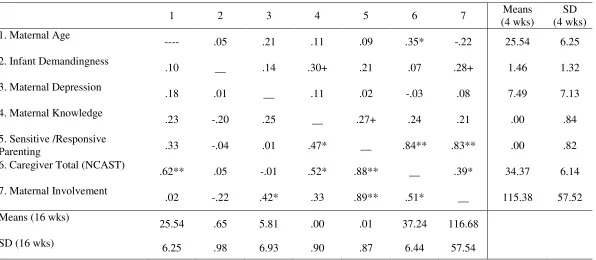
no transformations were performed. Means and standard deviations of study constructs are summarized in Table 1. Quite surprisingly, mothers reported very low levels of depression at
both time points. However, results of a paired t-test indicate a significant decrease in depression scores from 4 weeks (M = 7.49, SD = 7.13) to 16 weeks (M = 5.81, SD = 6.93). Since, maternal knowledge scores were a composite of two standardized indicators, change could not be
evaluated. The means and standard deviation of the overall sensitivity score and the two indicators of sensitivity also were examined. Regarding the individual indicators, the NCAST
Table 1 – Summary of the means, standard deviations and bivariate correlations of study
constructs by infant age1.
Note:1 Scores above the diagonal represent 4 week means, standard deviations, and correlations. Sixteen week scores are below the diagonal; scores on the diagonal represent the value of the across time correlation.
+ p < .10; * p < .05; ** p < .01.
At 4 weeks the average caregiver total score was below 35 (M = 34.23, SD = 6.26) and
50 percent of mothers had scores in the ‘risk’ range. Means were slightly higher at 16 weeks (M = 37.24, SD = 6.44), with 11 of the 26 participating mothers scoring in the ‘risk’ range.
Regarding the observational ratings of mothers’ attentiveness or involvement to infants, mothers’
scores remained fairly stable at both points of time (4 weeks, M = 115.38. SD = 57.52; 16 weeks, 116.68, SD = 57.54). Mothers verbally or visually attended to their babies about 39 percent of
the first 30 minutes of the interview.
1 2 3 4 5 6 7 Means
(4 wks)
SD (4 wks) 1. Maternal Age
---- .05 .21 .11 .09 .35* -.22 25.54 6.25
2. Infant Demandingness
.10 __ .14 .30+ .21 .07 .28+ 1.46 1.32
3. Maternal Depression
.18 .01 __ .11 .02 -.03 .08 7.49 7.13
4. Maternal Knowledge
.23 -.20 .25 __ .27+ .24 .21 .00 .84
5. Sensitive /Responsive
Parenting .33 -.04 .01 .47* __ .84** .83** .00 .82
6. Caregiver Total (NCAST)
.62** .05 -.01 .52* .88** __ .39* 34.37 6.14
7. Maternal Involvement
.02 -.22 .42* .33 .89** .51* __ 115.38 57.52
Means (16 wks)
25.54 .65 5.81 .00 .01 37.24 116.68
Next, correlations were computed to evaluate the extent to which study constructs were
related in theoretically consistent ways (see Table 1). Maternal knowledge and depression scores were not statistically and significantly correlated. Importantly, for moderation to occur, a
statistically significant correlation is not required. Maternal knowledge was marginally
statistically and significantly correlated with sensitive/responsive (SR) parenting at 4 weeks (r = .27, p < .10) and significantly correlated at 16 weeks (r = .47, p < .05), indicating that more
knowledge was associated with more sensitive and responsive parenting. In contrast, depression was not significantly correlated with parenting at either point in time (see Table 1). A less consistent pattern of associations emerged with knowledge and depression among the indicators
of sensitivity, perhaps because these correlations were computed using a very small sample size. Considering the statistical associations among maternal age and infant demandingness
with the study constructs, both maternal age and infant demandingness were statistically and significantly correlated with indicators of sensitive parenting, but not the composited score. Mother’s age was significantly correlated with the caregiver total score at 4 (r = .35, p <. 05) and
16 (r = .62, p < .01) weeks, but not with observed involvement at either points in time. In contrast, a trend towards statistical significance emerged for infant demandingness maternal
involvement at 4 weeks only (r = .28; p < .10).
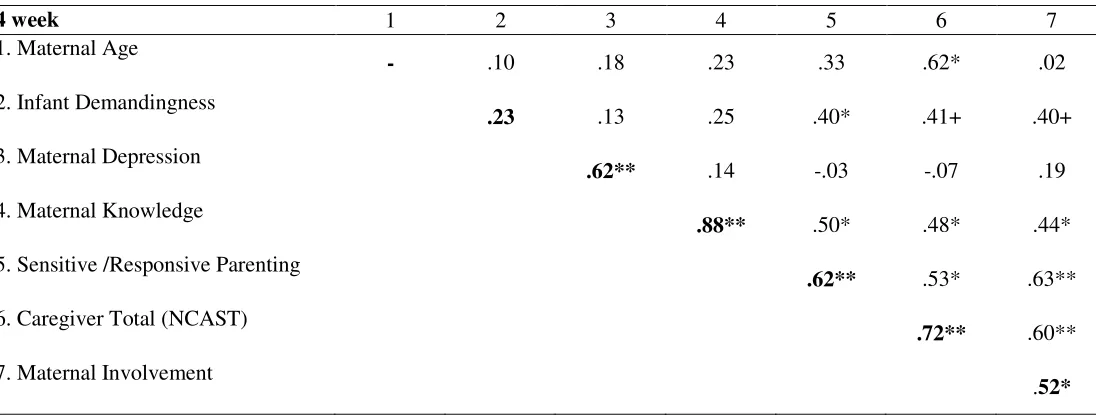
Finally, correlations were computed to examine the relationship between maternal knowledge and depression measured at 4 weeks with sensitive parenting measured at 16 weeks
(See Table 2). Maternal knowledge measured at 4 weeks was significantly associated with 16 week sensitive parenting (r = .50, p < .05) and the indicators of sensitive parenting, caregiver
Table 2 – Summary of the longitudinal means, standard deviations and bivariate correlations of study constructs from infant age 4 to 16 weeks1
16 week
Note:1 Scores on the left represent 4 week constructs; Sixteen week constructs are along the top; scores on the diagonal represent the value of the across time correlation.
+ p < .10; * p < .05; ** p < .01.
In contrast, depression levels measured at 4 weeks were not significantly associated with
the sensitive parenting composite or with the indicators of sensitivity. The results of the correlational analyses indicated some support for the study hypotheses. The next step was to
formally test the hypotheses using regression analyses.
Hypothesis 1 and 2: Maternal depression and maternal knowledge predict sensitive and
responsive parenting contemporaneously at 4 and 16 weeks
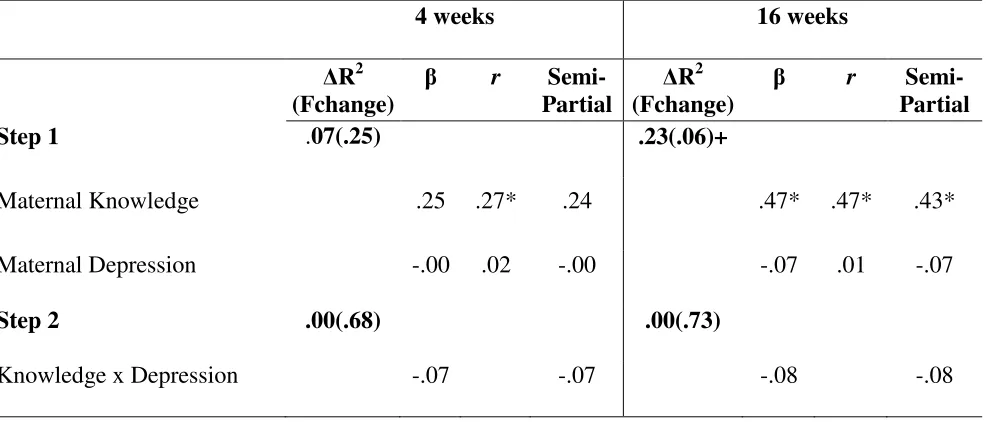
Considering the within time effects of depression and knowledge on sensitive parenting measured at 4 weeks of age, maternal knowledge and depression scores were entered in the first
step and the interaction term in the second step of the regression equation. None of the beta coefficients associated with maternal knowledge, maternal depression, or their interaction
4 week 1 2 3 4 5 6 7
1. Maternal Age
- .10 .18 .23 .33 .62* .02
2. Infant Demandingness
.23 .13 .25 .40* .41+ .40+
3. Maternal Depression
.62** .14 -.03 -.07 .19
4. Maternal Knowledge
.88** .50* .48* .44*
5. Sensitive /Responsive Parenting
.62** .53* .63**
6. Caregiver Total (NCAST)
.72** .60**
7. Maternal Involvement
accounted for statistically significant portions of the variance associated with 4 week SR
parenting (see Table 3).
Table 3 – Summary of contemporaneous hierarchical regression equations estimating the extent to which maternal knowledge of infant development moderates the within time association of
maternal depression and sensitive and responsive parenting at infant ages 4 and 16 weeks
4 weeks 16 weeks
∆R2 (Fchange)
β r
Semi-Partial
∆R2 (Fchange)
β r
Semi-Partial
Step 1 .07(.25) .23(.06)+
Maternal Knowledge .25 .27* .24 .47* .47* .43*
Maternal Depression -.00 .02 -.00 -.07 .01 -.07
Step 2 .00(.68) .00(.73)
Knowledge x Depression -.07 -.07 -.08 -.08
Note: +p < .10; *p < .05; **p < .01
Upon examination of the partial correlations, the same pattern of non-significance emerged. Although not presented in Table 3, the same pattern of statistical non-significance
emerged even after considering each indicator of sensitive parenting separately.
Regarding 16-week associations, in the first step of the equation the beta coefficient associated with maternal knowledge was statistically significant (β = .47, p < .05; see Table 3).
The partial correlation term of maternal knowledge was significant as well (r = .43), increasing the statistical confidence of the significant effect of knowledge on sensitive parenting.
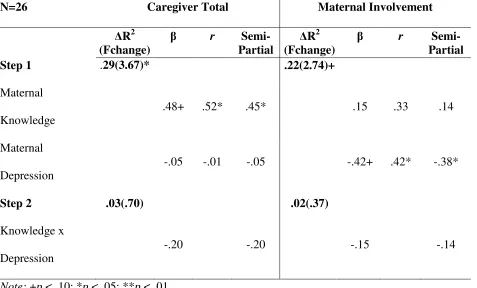
re-estimated for each indicator of sensitive parenting (i.e., caregiver total and maternal
involvement). Considering the specific dimensions of parenting, the beta coefficient associated with maternal knowledge was statistically significant in the caregiver total model, indicating more knowledge was associated with a higher caregiver total score (see Table 5). In contrast,
more maternal depression was marginally associated with lower ratings of maternal involvement (see Table 5). In both instances, the partial correlation term also was significant (r = .45; r =
-.38). The knowledge x depression interaction term was not significant in either the caregiver total or the maternal involvement models.
Table 5 – Summary of contemporaneous hierarchical regression equations estimating the extent to which maternal knowledge of infant development moderates the within time association of maternal depression and caregiver total and maternal involvement parenting scores at infant age 16 weeks
N=26 Caregiver Total Maternal Involvement
∆R2 (Fchange)
β r
Semi-Partial
∆R2 (Fchange)
β r
Semi-Partial
Step 1 .29(3.67)* .22(2.74)+
Maternal Knowledge
.48+ .52* .45* .15 .33 .14
Maternal Depression
-.05 -.01 -.05 -.42+ .42* -.38*
Step 2 .03(.70) .02(.37)
Knowledge x Depression
-.20 -.20 -.15 -.14
Hypothesis 3: Estimating the direct and interactive effects of maternal knowledge and
depression on change in parenting sensitivity from infant age 4 to 16 weeks.
The final set of analyses considered the direct and interactive effect of maternal
knowledge and depression, measured at 4 weeks post-partum, on change in observed sensitive
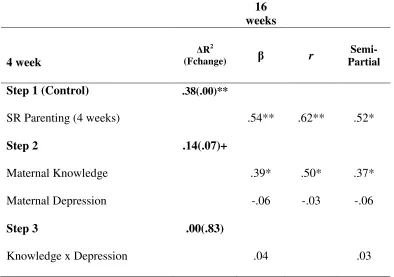
parenting from 4 to 16 weeks. As shown in Table 4,a marginally significant R-square emerged after estimating the impact of maternal depression and knowledge. Examining the beta
coefficients indicated that only maternal knowledge contributed to the explained variance in sensitive parenting (β = .39, p < .05; see Table 4). Examining the partial correlations confirmed these findings (r = .37). Specifically, more knowledge at 4 weeks post-partum was associated
with more parenting sensitivity at 16 weeks, adjusted for 4 week levels of parenting sensitivity. The depression x knowledge interaction term did not explain statistically significant portions of
the variance associated with sensitive parenting.
Next, the components of sensitive parenting were considered. Results were consistent with the correlational analyses. That is, when predicting change in sensitive parenting using only
the caregiver total score, only maternal knowledge accounted for unique portions of the variance associated with the 16 week caregiver total score, controlling for 4 week scores. When predicting
Table 4 – Summary of the hierarchical regression equation estimating maternal knowledge of infant development as a moderator of the of maternal depression on change in sensitive and responsive parenting from infant ages 4 to 16 weeks
Note: +p < .10; *p < .05; **p < .01
Discussion
Sensitive and responsive parenting during early infancy, specifically in a low-income population, greatly lacks research and understanding. While was comprises sensitive and
responsive parenting during early infancy is relatively defined, what allows one parent able to be sensitive whereas others are not has been given little attention in current research. Using
longitudinal data from low-income mothers and infants, the current study addresses maternal depression and maternal knowledge of infant development as two possible components of sensitive and responsive parenting. Results indicate that maternal knowledge of infant
development has a positive relationship with sensitive and responsive parenting from infant ages
16 weeks
4 week
∆R2
(Fchange) β r
Semi-Partial
Step 1 (Control) .38(.00)**
SR Parenting (4 weeks) .54** .62** .52*
Step 2 .14(.07)+
Maternal Knowledge .39* .50* .37*
Maternal Depression -.06 -.03 -.06
Step 3 .00(.83)
4 to 16 weeks as well as contemporaneously at 16 weeks. Maternal depression, however, did not
have a significant effect on sensitive and responsive parenting during the course of this study. The following sections will first describe the methodological challenges associated with
measuring sensitive parenting during the early infancy period. Next, the importance of maternal
knowledge for parenting and infant development and the impact of maternal depression on sensitive/responsive parenting will be discussed. Finally, the strengths and limitations of the
current study will be outlined, concluding with implications for future work in this area. An interesting pattern of statistical associations emerged regarding maternal knowledge and depression. No statistical association emerged between levels of maternal depression and
indicators of sensitivity at 4 or 16 weeks of age or when considering change in sensitivity from 4 to 16 weeks of age. While statistically significant correlations between constructs are not
required for moderation to occur, the finding that depression and knowledge were not associated with sensitive parenting at the bivariate level was surprising. First considering depression, mean depression scores were lower in the current sample than in other studies (i.e. Chung, McCullom,
Elo, Lee & Culhane, 2004). Limited variability in the depression and sensitivity scores and limited power to detect associations with such a small sample may have distorted the magnitude
of this association. Alternatively, depression may be less prevalent among some demographic subgroups than others. Additional research clarifying the prevalence of post-partum depression among low income mothers is clearly needed. Second, maternal knowledge was not correlated
with sensitive parenting, but once the effects of maternal depression were considered, a
statistically significant association emerged. Specifically, more knowledge of infant development
involvement score. While the maternal involvement score mainly requires mothers to notice and
attend to their infants over an extended period of time, the caregiver total score requires mothers to have an understanding of how to: play with an infant (i.e. finger play, allowing the infant to explore mother), talk to an infant (i.e. speaks to infant using two or more words three or more
times, talks to infant about something other than feeding), and read infant cues (i.e. stops feeding when satiation or a potent disengagement cue occurs, only offers food when infant is attending).
More knowledge may reflect mothers’ who have a better understanding of infancy in general, thereby increasing their ability to be sensitive to infant needs.
Measuring Sensitive Parenting during Early Infancy
Central to the current study was the concept of sensitive parenting. Sensitive parenting is one of the few constructs in which scientists are generally in agreement regarding the definition.
The most commonly agreed upon component of sensitive parenting definitions is that sensitivity involves prompt responses to distress cues from infants (i.e., Keller et al., 2003). Unique to early infancy, the range of typical causes of infant distress is generally limited to feeding, diapering,
sleep and stimulation needs. Thus, as compared to later developmental periods, a clear set of parental responses constitute sensitive parenting exists during the newborn period (i.e., Sumner
& Speitz, 1994).
Despite this relative restricted range of sensitive caregiving behaviors, few empirical studies have measured sensitive parenting during the newborn period, or 1-month post-partum.
Procedures for measuring sensitivity have been established. For instance, one of the most widely used observational measures of sensitive parenting is the NCAST feeding system. This measure
abilities to read infant cues are important markers of sensitivity, yet scoring these dimensions of
sensitivity depend on infants abilities to provide mothers with social cues (e.g., smiling, cooing or talking, and initiating eye contact or touch; Sumner & Speitz, 1994). Developmentally, four-week-old infants have limited social interaction skills and often feed in a drowsy state rather than
an alert state needed for social interaction (Lavelli & Poli, 1998). In later developmental periods, feedings become much more social and infants are likely to exhibit some, if not all, of the social
and disengagement cues. Importantly, scoring mothers’ sensitivity in responding to infants depended on infants’ demonstration of social or disengagement cues. If infants are incapable of providing social cues to mothers, as in the newborn period, then scores may not accurately
represent mothers’ ability to read babies’ cues. Alternatively, since babies tend not to exhibit many social or disengagement cues during early infancy, this skill may be less critical for
sensitive parenting during early infancy.
Similarly, the maternal involvement observational coding system may not be a good indicator of mothers’ monitoring and attentional focusing of their babies because babies were
positioned next to mothers and most slept through a good portion of the interview. Sensitive parenting has less variability during the early infancy period, and therefore is quite difficult to
assess. Alternatively, most mothers are capable of being attentive to their infants during low stress situations like when their only requirement is to answer questions from an interviewer and their baby has likely just been fed and is asleep. What is still untapped is how sensitively mothers
can manage competing attentional demands.
In addition to assessing parenting sensitivity during high stress times, measures of
parenting sensitivity may be improved by supplementing these procedures with indirect
in measures of parenting sensitivity. Surprisingly, on average the infants in the current study
slept 2.5 hours less than recommended hours of sleep at 4 weeks and 2 hours less than recommended at 16 weeks (American Pediatric Association, 2012). Some mothers may miss important sleep cues from babies and are less able to create an environment that supports healthy
sleep habits. Such indirect measures of maternal sensitivity may improve the validity of sensitivity during this developmental period.
Maternal Knowledge and its Changing Effect on Sensitive and Responsive Parenting
A general understanding of how and when infants develop may provide mothers with a framework from which to interpret their babies’ behavior and respond more sensitively (Reich,
2005). Elevated levels of depression were expected to disrupt and negate the benefits of knowledge of infant development on emerging parenting sensitivity. In general, results were
somewhat inconsistent with expectations. That is, while levels of maternal knowledge measured at 4 and 16 week were associated with parenting sensitivity at 16 weeks, depression did not moderate these associations.
Although maternal knowledge did not interact with depression as expected, the findings do have interesting implications for the role of maternal knowledge and depression on emerging
parenting quality. Maternal knowledge is a vastly understudied paradigm in developmental psychology. Understanding infant needs and developmental abilities may be a critical precursor to sensitive parenting. Knoche and colleagues (2007) found that mothers with more accurate
knowledge of infant development demonstrated more sensitive and flexible child rearing practices engaged in a play activity with their child. Studies of toddler-aged children also
demonstrated a similar link between maternal knowledge and sensitive parenting (e.g.,
demonstrate less variability and be universally higher than later developmental periods, maternal
knowledge may be more critical during developmental transition periods than during early infancy. For instance, with increases in infants’ age, mothers’ expectations for infant autonomy begin to increase (e.g., Kopp, 1989). That is, mothers increasingly begin to expect that their
babies to self soothe, play unattended, sleep longer periods, sleep through the night, or hold a bottle. Mothers’ who expect their babies to be able to master these tasks before their babies are
actually capable of mastering the tasks may be less responsive to their infants before infants are ready for such autonomy. Thus, accuracy of knowledge may help maintain levels of sensitivity, or insensitivity, throughout the infancy period but the periods in which there is the greatest
mismatch between mothers’ expectations and infants’ abilities also may be characterized by the least parenting sensitivity. Future research which more carefully examines the impact of
developmental variability in knowledge on sensitivity is clearly needed.
Like sensitive parenting, however, measuring knowledge in newborns proved quite challenging. While dramatic changes in infant needs and abilities occur during the early infancy
period (Kopp, 1982), at 4 weeks infants have not achieved any developmental milestones and are extremely limited in their ability to engage in autonomous activity (Kopp, 1982; Reich, 2005).
Only a few questions actually infants’ abilities at 4 weeks old and these items generally focused on naptime and bedtime routines. Quite possibly, the measures used missed critical components of newborn knowledge such as how much sleep babies need or how much babies should eat.
Directly measuring knowledge of infant development also is impacted by the lack of clear consensus of infant development. Considerable variability in the timing of when babies reach