Paper received: 28.2.2008 Paper accepted: 15.5.2008
Cognitive Product Development: A Method for Continuous
Improvement of Products And Processes
Wim Gielingh
Delft University o f Technology, Faculty o f Civil Engineering, The Netherlands
In current engineering practice, designers usually start a new project with a blanc sheet o f paper or an empty modeling space. As a single designer has not all knowledge about all aspects o f the product, the design has to be verified by other experts. The design may have to be changed, is further detailed, again verified and approved, and so on, until it is ready. But only the final product, once it exists, will prove the correctness o f the design. Given the complexity o f modem industrial products, the intermediate verification and change processes require substantial time. This has a major negative impact on the development time and costs o f the product. Cognitive Product Development, as proposed here, approaches design as a scientific learning process. It is based on a well known and successfully applied theory fo r Cognitive Psychology. In stead o f relying solely on the experiences o f a single individual, CPD makes the combined knowledge o f multiple disciplines, acquired throughout the life ofexisting products, available through generic design objects. CPD thus approaches design as the configuration o f existing and verified knowledge. It is expected that this accelerates the product development process and results in designs o f higher quality and reliability without affecting the creative freedom o f the designer.
© 2008 Journal o f Mechanical Engineering. All rights reserved.
Keywords: product development, cognitive engineering, continuous improvement, parametric modelling
1 INTRODUCTION
1.1 The High Costs and Risks of Product Development
The development o f complex systems such as buildings, plants, infrastructures, off-shore structures and aircrafts, has a high risk o f budget and time overruns. In the construction sector, for example, budget overruns between 10% and 30% happen frequently. But overruns o f 80% or more are n o t ex cep tio n al [9]. A lso the aerospace, automotive and railway industries are often plagued by serious budget and time overruns. These costs and risks make many enterprises reluctant with the introduction of new products or the investment in new projects.
A lth o u g h m any d iffe re n t fa cto rs m ay contribute to these overruns, two factors appear to be essential for most cases: (
1
) problems caused by high complexity, and (2
) the unpredictability o f consequences o f ‘new ’ knowledge.The complexity o f a system can be defined as th e to ta l n u m b e r o f in te r a c tio n s or
interdependencies betw een com ponents o f a system [13]. Complexity depends on the number o f com ponents, but tends to grow m ore than proportional to this number. Also the num ber o f interaction- or dependency-types may increase complexity. Examples o f interaction types are m echanical in teractio n (such as m echanical fix atio n ), electrical-, chem ical-, and control interaction. If a system has n components and i interaction-types, it may have maximally i-n-(n-1) in te ra c tio n s w ith o th e r c o m p o n e n ts. Complexity can thus be reduced by reducing the n u m b er o f co m p o n e n ts or by re d u c in g the num ber o f interactions or dependencies. The latter can be accom plished by m odularizing a design such that each module behaves as a ‘black b o x ’ th at has m inim um interactio n s w ith its environment.
On the other hand, the trend towards ‘mass- customization’, i.e. the offering o f client specific solutions based on a generic design, increases product complexity because designers have to keep all variant-solutions and their consequences in mind.
A new product is the result o f ‘new know ledge’. The consequences o f this know ledge are often unpredictable. T hat is w hy a design has to be verified thoroughly through m odeling, analysis, simulation and testing, before the actual product is being realised. F or the autom otive sector it is estimated that design changes make up 75% o f total product development time and costs [
1
],Product development may thus be improved in terms o f costs, risks and quality if the problems caused by high complexity and the consequences o f “new knowledge” can be reduced. This subject w ill be addressed by com bining principles for system s m odelling w ith a theory on cognitive psychology that is generalized and extended for design, engineering and production.
1.2 Origin of This Theory
The methodology that is described in this p ap er finds its o rig in in a th eo ry for p ro d u ct m odelling developed by the author in the 1980- ies. After several implementations, applications and further refinem ents it evolved into a theory and methodology for the acquisition, organization and use o f product and process knowledge. Milestone publications were: (a) the General AEC Reference M odel [3] which became part o f the Initial Draft o f ISO 10303 STEP; (b) the IMPPACT Reference M odel [4], which was implemented for integrated design and m anufacturing o f ship propellers at LIPS and the design and manufacturing o f aircraft components at PIAI; (c) the PISA Reference Model [5], which was implemented to support the early design process o f cars at BMW; and (d) the Theory o f Cognitive Engineering [
6
] w hich was partially applied in a large Design-Build-M aintain project in the oil and gas sector. This paper presents a comprehensive summary o f the last - most recent - theory.1.3 Structure of This Paper
This paper starts with an introduction o f the Theory o f Cognition which is founded on a well known theory for cognitive psychology (chapter 2). Next, this theory is generalized and extended for design, production and product lifecycle support (chapter 3). Chapter 4 discusses in brief a Theory o f Systems. It addresses in particular the principles o f modularization o f systems. Subsequently chapter
5 combines the theories unfolded in 3 and 4 into a theory for cognitive design, production and support o f complex systems. Chapter
6
describes one o f the cases where these principles are applied: a large design-build-maintain project for the oil and gas sector. Chapter 7, finally, draws conclusions.2 KNOWLEDGE CREATION AND CONTINUOUS IMPROVEMENT
2.1 Continuous Improvement
Continuous Improvement (Cl) is a widely used concept with a variety o f meanings. For many it is synonymous to innovation, for others it is a com er stone o f total quality management.
C l is a b a sic e le m e n t o f L ean M anufacturing, where it is known as the kaizen principle [16]. In this context Cl aims primarily at quality management. It is implemented here as an organizational solution, by making teams o f people responsible for im proving their own part o f the production process.
Bessant and Caffyn [2] define C l as ‘an organization-wide process o f focused and sustained incremental innovation’. Lindberg and Berger [
8
] propose a m odel, identifying five types o f Cl organization, which is based on two dimensions. The first dimension addresses whether Cl is part o f o rd in ary tasks or not, the second m akes a distinction betw een group tasks and individual tasks. In practically all studies, focus is on the human aspect of Continuous Improvement.2.2 A Theory of the Learning Organization
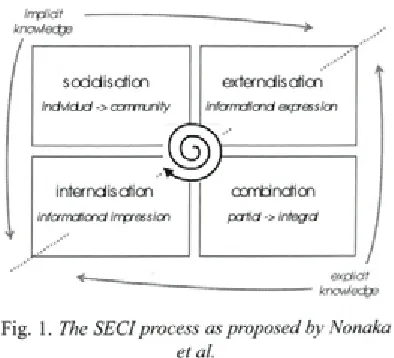
Also theories about learning organizations are human centered. Probably the most well known one is the SECI model ofN onaka et.al. [11] and [12].
According to this theory, design knowledge within an organization is developed according to a sp ira lin g p ro c e ss th a t cro sse s tw o array s o f apparently opposite values, such as chaos and order, m icro and m acro, part and whole, im plicit and explicit, body and mind, deduction and induction, emotion and logic. According to these authors, the key for successful knowledge management is to m anage dialectic thin k in g in order to resolve apparent conflicts in design objectives.
hum an individuals) and explicit (i.e. recorded, transferable and shareable) knowledge.
Four stages o f knowledge transformation are recognized: Socialization, E xternalization, Combination and Internalization, to be abbreviated as SECI.
S o c ia liz a tio n is a p ro c e ss in w hich individual implicit knowledge is transformed into shared implicit knowledge, for example through (informal) meetings, discussions and other forms o f human interaction.
Externalization is the expression and/or recording o f know ledge w ith the objective to become a shared resource for the organization.
C o m b in a tio n is a p ro c e ss aim in g at unification, integration and/or generalization o f individual pieces o f shared know ledge, w hich re su lts in know ledge o f h ig h er value for the organization.
Internalization, finally, is the process in which individual members o f the organization pick up shared explicit knowledge, for example through reading, learning, training and experiencing.
The process o f sharing depends heavily on the existence o f a platform o f common experiences, values and concepts. Such a platform provides context that is necessary for the understanding o f words and gestures. It forms the ‘commonality’ o f a shared domain. This platform is called ‘b a’ by Shimizu [14]: ‘b a ’ is the Japanese word for ‘place’ or ‘location’. ‘B a’ can be a physical or a virtual place, and represents not only a location in space but also a location in time.
N o n a k a ’s th eo ry com prises further the notion o f Knowledge Assets (KA’s): the different
Fig. 1. The SECI process as proposed by Nonaka et al.
form s in w hich know ledge is en cap su lated . E xam ples o f KA’s are experiences (im p licit knowledge developed through practicing), routines (business practices that may exist in implicit or explicit form), concepts (com m on ideas) and systems (explicit knowledge, recorded in the form o f documents, databases and models).
2.3 An Assessment of the SECI Model
Nonaka’s theory focuses largely on (a) the interaction o f human individuals w ith other individuals through socialization and (b) the sharing of knowledge in explicit (i.e. documented) form. It does not incorporate feedback from real world experiences. Also, it does not address the possible role o f m ore advanced form s o f know ledge representation, such as in the form of product models.
Product models that are used for simulation, such as structural analysis, virtual reality and the digital mock-up, may play an essential role in the learning cycle of a design and engineering team.
Product modelling requires a paradigm shift in industrial production, because its nature is so different from document based working. A product model is a near-to-reality ‘image’ o f a product that may exist on different levels o f concreteness and completeness. Product models result in (virtual) experiences for the human beings that work with them. In contrast, documents must be read in order to provide knowledge for the reader and are hence only accessible for those who master the language in which they are written.
Consequently, there is a need to make KM theory consistent with modem scientific principles, including feedback from virtual or real experiences.
2.4 Theory of Cognition
The missing link between KM theory and feedback from reality is provided by a modem theory on cognitive psychology [10]. N eisser defines Cognition as ‘ the acquisition, organization and use o f knowledge’. As his theory originated in the context o f psychology, it is focused on the human individual. This part o f the theory will be discussed first; in section 3 it will be generalized and adapted to learning organizations for design and engineering.
m em orized and organized by the hum an brain. Sim ilar experiences confirm and reinforce each other, and result in abstract structures in the human m ind that are called schemata. For exam ple, a person who has seen dozens o f dogs will develop an abstract idea that combines the observed features that all dogs have in common. This abstract idea becom es a concept [15]. Concepts m ay become independent sources o f knowledge. By associating concepts with symbols such as words, knowledge can be communicated to other people.
Concepts and conceptual structures have a biological origin: they enable a hum an being to a n tic ip a te a n d a c t m o re e f f e c tiv e ly in n ew situations. A child that has touched a hot stove once or twice will associate the two concepts ‘stove’ and ‘hot’, and will be more cautious in next encounters w ith stoves. Similarly, once we have eaten many apples, we associate the shape and colour o f apples w ith their taste: we know that small green apples can be hard and sour, and that yellow or red ones are mostly sweet and soft.
The hum an senses provide an enorm ous amount and a continuous stream o f sensory stimuli. Only some o f these are really o f importance. The extraction o f useful stimuli from the irrelevant ones is called perception [
10
],As the life-experiences o f individual people differ, the understanding and in terp retatio n o f sensory stimuli, in the form o f new experiences, will also differ. Flence, two people m ay act and react differently if they are confronted w ith one and the same situation. For example, a person who is once attacked by an aggressive dog will have a different concept, and may act differently, than a person who never had such an experience.
From the above it can be concluded that ‘old k n o w le d g e ’ plays an essen tial ro le in hum an perception, an thereby affects the creation o f ‘new know ledge’. Existing knowledge determines how new inform ation is interpreted and valued. The entire process o f sensing and the interpretation o f sensory stimuli by a human being will be called impression.
Learning is not just a passive process that is based on the observation o f physical reality. M u ch c a n be le a rn e d b y e x p lo ra tio n and experimentation. B aby’s leam by touching things, by putting them in their mouth, and by throwing them away. Children leam by playing, which is a com bination o f action and observation. A ction
partially affects and changes the physical reality th a t s u rro u n d s us. T he w h o le o f a c tiv itie s perform ed by hum an beings that affect physical reality will be called expression.
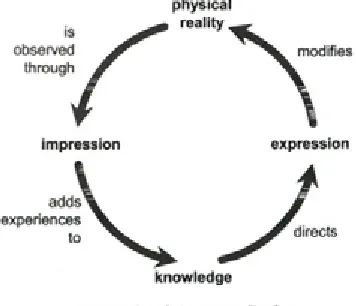
The learning process o f human individuals can thus be depicted by a circle that is intersected by two orthogonal axes (Fig. 2). The vertical axis represents physical reality (top) versus knowledge a b o u t re a lity (b o tto m ). T he h o riz o n ta l axis represents impression, w hich includes processes su ch as sen sin g , o b se rv in g , in te rp re tin g and perceiving (left) and the process o f expression, which includes various forms o f acting (right).
The cognitive process that is depicted in Figure 2 applies to individual people but it can also be applied to organizations, such as industrial enterprises. For enterprises, physical reality may fo rm a m a rk e t. M a rk e t a n a ly s is , or the in te rp re ta tio n o f c lie n t n e e d s, is a fo rm o f impression. To serve this m arket or these clients w ith p ro d u c ts a n d /o r se rv ic e s is a fo rm o f expression. Once these products and/or services are consumed or applied, physical reality has changed. T hese changes m ay form input for product or process innovation.
The cognitive cycle m ay also be applied to e le c tro n ic k n o w le d g e p ro c e s s in g sy stem s. Knowledge about existing reality may be obtained via input devices, such as sensors or measuring equipment, or through human observations that are documented. And existing reality can be changed through output devices such as CNC machinery, p ro c e ss c o n tro l sy ste m s or d o c u m e n te d instructions.
The cognitive cycle forms thus the basis for a theory about learning enterprises and learning
physical
knowledge
information systems that, in contrast to Nonaka’s theory, involves reality.
3 RETHINKING DESIGN AND PRODUCTION AS A SPECIAL FORM OF COGNITION
Concepts that result from experiences with real phenomena can be analyzed and decomposed into conceptual primitives. These primitives - or features - can be manipulated in the human mind to form new concepts. A simple but illustrative example is the mermaid, which originated in the m ind o f Hans Christian Andersen. This imaginary creature is partially a girl and partially a fish. The mermaid is an example o f an imaginary concept: although m erm aids do not exist and cannot be observed, it is ‘assembled’ from features that can be sensed. As a concept it can also be visualized in the form o f a naturalistic expression, such as a painting or a statue.
A n ew p ro d u c t re su lts also from im a g in a tio n . D e sig n s o f new p ro d u c ts are assem blies o f features that are extracted from existing reality. These features comprise knowledge a b o u t sh a p e s, m a te ria ls, tec h n iq u e s and technologies, and are manipulated in the mind: they can be resized, reshaped or re-arranged.
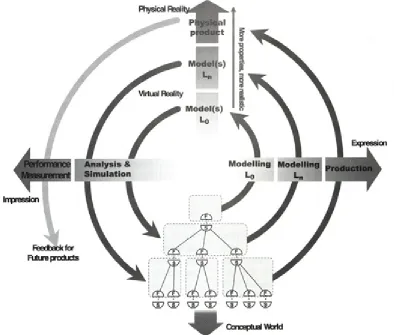
If the cognitive cycle is applied to industrial e n te rp rise s, th en “p h y sic a l re a lity ” includes p h y sic a l p ro d u c ts, c lie n ts and m ark ets, “im p ressio n ” includes analysis, “k now ledge” includes technological and production knowledge as w ell as design, and “exp ressio n ” includes production and servicing. The cognitive cycle for product creation is shown in Figure 3.
physical reality
Fig. 3. The cognitive cycle fo r product creation
The design of a new product usually has to be verified before it can be produced. Such a verification can be done by m aking physical prototypes, or by asking experts to analyze and approve the design. W ith the advent o f CA- technologies, it is now also possible to verify a design in virtual reality through product models and simulation technologies (Fig. 4).
As a model is an abstraction o f reality, it is used to check some - but not all - properties of the anticipated product. In early design phases, only a few properties are checked, and the more design progresses into detailed design, the more properties are added.
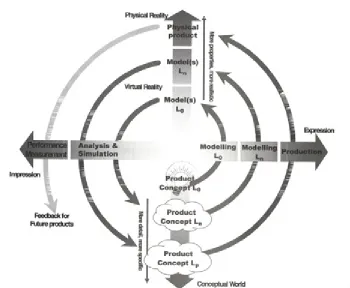
Hence, the cognitive cycle is not traversed only once for the development of a product, but many times. Each successive traversal of the cognitive loop adds more detail to the product specification, up to a point where sufficient knowledge is acquired so that a safe, error-free production process can be expected, and the resulting product is likely to meet client and market expectations. This iterative process can be depicted by expanding the cognitive cycle into a spiral (Fig. 5).
In this figure, the design process is supposed to start with an initial idea (Product Concept L0), which is modelled and simulated in virtual reality through M odel L0, and which is subsequently analyzed. Based on the outcome o f this analysis a modified and/or more detailed specification is made (Product Concept Ln), modelled and simulated, and so on. This process ends once the final specification
Fig. 4. To improve speed and quality o f a design, physical reality can be simulated through virtual
Fig. 5. A top-down design process can be depicted in the Cognitive Cycle by a spiral is ready (Product Concept Lp), after which production
can start. Production is the final stage o f expression, resulting in the intended physical product.
The Figure 5 shows that the cognitive loop doesn’t stop there. The physical product, once in use, can be considered as a prototype for a future product. K now ledge that is acq u ired from the product in actual use can be very helpful for the creation o f new products, for example for analysis and simulation purposes.
A product concept is not lim ited to a static description o f the product. It m ay also apply to processes, such as production, m aintenance and operation processes.
The w hole o f m odels, an aly sis resu lts, performance data and other information forms an in te rre la te d stru c tu re o f p ro d u c t and p ro cess know ledge that can be used as a basis for new designs. This structure will be briefly described in the next chapter.
4 THEORY OF SYSTEMS
M odem products can be seen as complex systems, consisting o f objects, where each object interacts with one or more other objects to form a
fu n c tio n a l w h o le. H e n c e , b e c a u se o f th e ir interaction, the whole is m ore than the sum o f objects that form its parts. An object can be a system by itself, in which case it is called a sub-system. Complex systems may have multiple levels o f sub- and sub-sub-systems. And as the performance o f a p ro d u ct is determ in ed by its b ehaviour in its e n v iro n m e n t, th e p ro d u c t its e lf can also be considered as a sub-system.
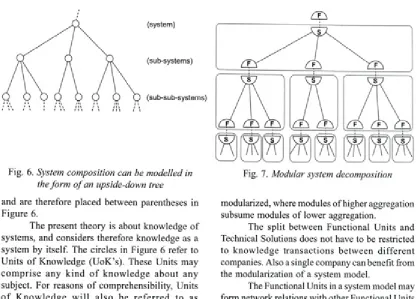
Systems are often m odelled and depicted graphically by means o f an inverted tree structure. The top (or root) o f this inverted tree depicts the whole; the branches depict the parts; see also Figure
6
.Fig.
6
. System composition can be modelled in Fig. 7. Modular system decomposition the form o f an upside-down treeand are therefore placed between parentheses in Figure
6
.The present theory is about knowledge o f systems, and considers therefore knowledge as a system by itself. The circles in Figure
6
refer to Units o f Knowledge (U oK ’s). These Units may co m p rise any k in d o f k n o w led g e about any subject. For reasons o f comprehensibility, Units o f K n o w le d g e w ill a lso be re fe rre d to as ‘kno w led g e o b je c ts ’, or sim ply ‘o b je c ts’. A knowledge object may refer by itself to a physical object, a (physical) process, a feature o f a physical object, or other phenom ena that are subject o f interest.M o d ern e n te rp ris e s o p erate to d ay in collaborative networks. A vehicle, for example, is not designed and built by a single company, but by many companies that together form a supply chain. As a consequence, a part or subsystem within a vehicle may have two intellectual owners: the OEM and the supplier. The OEM defines requirements and boundary conditions for the part or subsystem, while the supplier proposes a solution for it. The supplier may, on his turn, have its own supply- chain.
This idea is depicted in Figure 7 by splitting each circ le in tw o h alv es. The u p p e r h alv e represents requirements and boundary conditions, the lower halve the proposed solution. This idea was first proposed as part o f the General AEC Reference Model [3], where the upper halve was called ‘F unctional U n it’ and the low er halve ‘Technical Solution’.
The im portance o f this concept is that knowledge about objects in a system can now be
modularized, where modules of higher aggregation subsume modules o f lower aggregation.
The split betw een Functional Units and Technical Solutions does not have to be restricted to know ledge transactions betw een different companies. Also a single company can benefit from the modularization o f a system model.
The Functional Units in a system model may form network relations with other Functional Units within the same module, or with other modules on the same level o f aggregation.
Each m odule can be described at two d istin c tiv e levels: (
1
) gen eric, p a ram etric description, and (2
) specific description, where all parameter values are defined or where objects are described in explicit non-parametric form.The specific description is split into three sub-levels: (2a) Lot (i.e. one or more identical objects), (
2
b) Individual (a single individual object) and (2c) Occurrence (a moment in the life o f an individual).The modules should not be made too large so that the number o f interactions or dependencies inside a m odule rem ain lim ited. C om plexity reduction makes it possible to describe all modules with parametric technology. The resulting hierarchy o f modules is capable to represent any system, regardless its overall complexity, using parametric technology.
A top-down oriented design process usually stops at a point where pre-existing solutions exist that fulfill the requirem ents o f corresponding Functional Units.
5 P R O D U C T C R E A T IO N A S A C O G N IT IV E P R O C E S S
T h e s y s t e m m o d e l t h a t is d e s c r i b e d in c h a p t e r 4 f i t s i n t o t h e c o g n i t i v e p r o d u c t d e v e lo p m e n t p ro c e s s s u c h as d e s c r ib e d in c h a p te r 3. W h ile a to p - d o w n d e s ig n p ro c e s s p ro g re s s e s , it u n c o v e r s s e v e r a l l a y e r s o f d e t a i l , e a c h l a y e r c o r r e s p o n d i n g w ith a le v e l o f th e c o m p o s iti o n h ie ra rc h y o f th e sy ste m . T h is c o n tin u e s u n til p r e e x i s t i n g s o l u t i o n s a r e f o u n d t h a t m e e t t h e r e q u ir e m e n ts o f c o rre s p o n d in g F u n c tio n a l U n its. T h e s e fin a l (p re -e x is tin g ) so lu tio n s a re d e p ic te d b y th e h a lv e c irc le s m a rk e d F a t th e b o tto m o f th is fig u re .
T h e s y s te m m o d u le s th a t a re d e p ic te d b y r e c ta n g le s w ith r o u n d e d e n d s in F ig u re 7 m a y also b e b a s e d o n p r e - e x is tin g s o lu tio n s. T h e s e so lu tio n s m a y b e re u s e d in p a ra m e tric fo rm , so th a t p a ra m e te r v a lu e s still h a v e to b e d e fin e d , o r in e x p lic it, n o n - p a ra m e tric fo rm . In e ith e r c a se it w ill b e p o s s ib le
to r e p la c e o ld e r s o lu t io n s t h a t w e r e c h o s e n in
p re v io u s d e s ig n s b y n e w so lu tio n s. T h is p rin c ip le is s h o w n in F ig u re 9.
I t s h o w s o n th e l e f t t h e c o n f i g u r a t i o n h ie ra rc h y o f th e d e s ig n o f an in itial p ro d u c t, an d o n th e rig h t o f a re v is e d d e s ig n , p o ss ib ly o f a n e x t v e rs io n o f th is p ro d u c t. T h e so lu tio n s c o lo re d w h ite a re r e u s e d w ith o u t m o d if ic a tio n . T h e s o lu tio n s c o lo re d b la c k are new . T h e so lu tio n s c o lo re d g re y are re u s e d b u t w ith so m e m o d ific a tio n . T h e la tte r g r o u p m a y m a k e u s e o f t h e s a m e g e n e r i c (p a ra m e tric ) te m p la te , b u t w ith d iffe re n t p a ra m e te r v a lu e s.
T h is id e a c a n b e r e m o te ly c o m p a re d w ith th e c o n fig u ra tio n o f a p e rs o n a l co m p u ter. A t th e to p -le v e l o f a c o m p u te r m o d e l, a c o m p u te r h a s a p r o c e s s o r , p r i m a r y m e m o r y a n d s e c o n d a r y m e m o ry .
T h e a rc h ite c tu re o f a c o m p u te r is su c h th a t fo r e a c h fu n c tio n a l u n it d iffe re n t so lu tio n s ca n b e in sta lle d : a c o m p u te r m a y u s e d iffe re n t p ro c e sso rs ,
b
717
b b b b
Conceptual World
Product Version 1 Product Version 2
F ig . 9. S o l u t i o n s ( o r s p e c i f i c a t i o n s ) a r e m a r k e d w i t h a n S . R e u s e d s o l u t i o n s t h a t a r e n o t c h a n g e d a r e
c o l o u r e d w h i t e , t h e o n e s t h a t a r e c h a n g e d b u t b a s e d o n t h e s a m e g e n e r i c t e m p l a t e a r e c o l o u r e d g r e y , a n d f u l l y n e w s o l u t i o n s a r e c o l o u r e d b l a c k
d iffe re n t p rim a ry m e m o ries an d d ifferent se co n d ary m e m o ries. To re p la c e o n e b y a n o th e r is o ften as s im p le a s p u l l i n g o u t o n e c a r d o r d e v ic e a n d p lu g g in g in another. A lth o u g h tw o p rim ary m em o ry c a rd s m a y h a v e d iffe re n t c a p ac ity a n d be p ro d u c e d b y d iffe re n t v en d o rs, th e ch ip s o r o th e r elec tro n ic co m p o n e n ts m a y b e o b ta in e d fro m the sam e su b
supplier. H ence, re-u se o f solutions m a y o cc u r on an y level.
U s in g th i s p r i n c i p l e , d e s ig n b e c o m e s b asica lly a p ro cess o f co n fig u rin g solutions.
I f each m o d u le - i.e. each solution - is traced f r o m d e s ig n to s u b s e q u e n t l i f e c y c l e p h a s e s , l i f e c y c l e p e r f o r m a n c e k n o w l e d g e b e c o m e s
Conceptud Hietcrchy
Specification Hiercxchy
Instdlation Hiercichy
Actual
Phase
( p r o d u c t io n , c o n s t r u c t i o n , o p e r a t io n , m a n t e n e r C 8 , d i s p o s a )
Imaginciy Phase
( d e s i c i , p la n n in g )
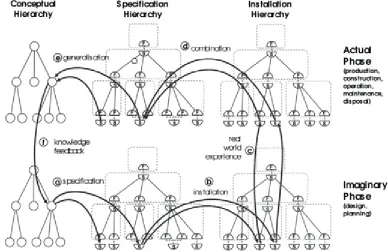
Fig. 10. T h e t h r e e t y p e s o f h i e r a r c h y , f i l l e d w i t h i m a g i n a r y o r a c t u a l d a t a , f o r m t h e b a s i s f o r c o g n i t i v e
p r o d u c t d e v e l o p m e n t . I t s t a r t s a t t h e l o w e r l e f t c o r n e r ( a ) w i t h t h e s p e c i f i c a t i o n o f a p r o d u c t u s i n g t h e g e n e r i c d e s i g n o b j e c t s . D u r i n g a n d a f t e r t h e r e a l i z a t i o n o f t h e p r o d u c t , r e a l w o r l d d a t a a r e c o l l e c t e d ,
a v a ila b le f o r e a c h o b je c t. T h is k n o w le d g e w ill be a c q u ire d fo r in d iv id u a ls a t d iffe re n t o c c u rre n c e s , b u t c a n b e g e n e r a l i z e d a n d , a f t e r s t a t i s t i c a l p r o c e s s i n g , b e m a d e a v a i l a b l e to g e n e r i c (p a ra m e tric ) d e s c rip tio n s . T h is m e a n s th a t fo r all o b je c ts m a rk e d w h ite o r g re y in F ig u re 9 p ro d u c t life c y c le k n o w le d g e is a v a ila b le fo r d e sig n . T h is k n o w le d g e c a n b e u s e d fo r g ra d u a l im p ro v e m e n t o f a d e s ig n .
T h e r e s u lt is th a t th e g e n e r ic p a r a m e tr ic d e s ig n o b je c ts in d e s ig n sy ste m s p ro v id e a c c e ss to a h u g e a m o u n t o f life c y c le d a ta a s s o c ia te d w ith p r e v io u s a p p lic a tio n s a n d im p le m e n ta tio n s . T h e m o r e th is s y s te m is u s e d , th e m o r e e x p e r ie n c e s b e c o m e a v a ila b le fo r d e s ig n . D e s ig n th e n b e c o m e s a c o g n i tiv e p r o c e s s , w h e r e g e n e r ic , p a r a m e tr ic te m p la te s b u ilt o n to p o f th e k n o w le d g e a c q u ire d b y o th e r e x p e rts in th e p r o d u c t life c y c le p la y th e ro le o f c o g n itiv e sc h em e s.
F ig u re 10 sh o w s h o riz o n ta lly th e th re e ty p e s o f h i e r a r c h y ( i.e . th e c o n c e p t u a l h i e r a r c h y o f i m p l i c i t p a r a m e t r i c o b j e c t s , t h e s p e c i f i c a t i o n h ie ra rc h y o f e x p lic it o b je c ts , a n d th e in s ta lla tio n h i e r a r c h y o f i n d iv i d u a l o b je c ts ) a n d v e r t i c a l l y a c tu a l v e rs u s im a g in a ry data.
T h e c o g n i t i v e c y c l e s t a r t s w i t h t h e s p e c if ic a ti o n o f a n e w p r o d u c t (1 0 a , lo w e r le ft c o m e r). T h is s p e c ific a tio n c a n b e e ith e r in e x p lic it o r im p lic it fo rm . In th e la tte r c a se , u s e is m a d e o f a g e n e r i c p a r a m e t r i c m o d e l . T h e r e s u l t is an I m a g in a r y S p e c ific a tio n H ie ra rc h y . T h e in d iv id u a l c o m p o n e n ts a re d e r iv e d f ro m th e s p e c if ic a tio n , r e s u ltin g in a n Im a g in a ry In s ta lla tio n H ie ra rc h y (b). A f t e r r e a l i z a t i o n o f t h e p r o d u c t , r e a l w o r l d e x p e rie n c e s are c o lle c te d firs t o n a n in d iv id u a l le v el (c) a n d th e n c o m b in e d v ia s ta tis tic a l a n a ly sis (d). T h is k n o w le d g e c a n th e n b e g e n e ra liz e d a n d a d d e d
to a g e n e ric (p a ra m e tric ) p r o d u c t m o d e l. F ro m th e n o n it w ill b e a v a ila b le at th e s ta rt-u p o f n e w d e s ig n p ro je c ts .
A f te r s e v e r a l tr a v e rs a ls th e s o lu tio n b a s e b e c o m e s r ic h e r a n d o f fe rs i n c r e a s i n g le v e ls o f h is to ric life -c y c le k n o w le d g e to th e d esig n er.
6 A P P L IC A T IO N S
6.1 Early Applications Based on Parametric Technology
M o s t p rin c ip le s d e s c rib e d in th is p a p e r h a v e
b e e n a p p l i e d , i m p l e m e n t e d a n d im p r o v e d in
p ro je c ts o f d iffe re n t k in d a n d fo r d iffe re n t in d u stria l se cto rs, su c h as m e ch a n ic a l p ro d u cts, sh ip -b u ild in g , e le c tro n ic s, a u to m o tiv e a n d co n stru c tio n .
T h e firs t d e ta ile d s o ftw a re im p le m e n ta tio n w a s fo r a m a n u fa c tu re r o f in te rio r w a lls in 1982, a n d is d e s c rib e d in so m e d e ta il in [7].
A se c o n d c a se w a s th e im p le m e n ta tio n o f a fe a tu re b a s e d , fu lly in te g ra te d C A D /C A M so lu tio n f o r a m a n u fa c tu re r o f sh ip p ro p e lle rs. I t is d e s c rib e d in [4],
B o th c a se s le d to sig n ific a n t efficien c y g ain s in th e o v e ra ll p ro d u c tio n p ro c e ss. B u t th e y la c k e d k n o w l e d g e f e e d b a c k to s u p p o r t th e c o g n i tiv e p ro c e s s su c h as d e s c rib e d in th is paper.
6.2 Application in a Large Project for the Oil and Gas Sector
T h e c a s e th a t w ill b e d e s c r ib e d in m o re d e t a i l h e r e d id a d d r e s s th e la t t e r s u b je c t . F o r p r a c tic a l re a s o n s it w a s n o t b a s e d o n p a ra m e tric te c h n o lo g y b u t o n a d a ta w a re h o u s e su p p o rte d b y a P D M sy stem . T h is c a se c o n c e rn s th e re a liz a tio n o f 2 9 a lm o s t id e n tic a l p la n ts in a se ria l c o n s tru c tio n p ro c e s s .
B e lo w th e su rfa c e o f G ro n in g e n , a p ro v in c e in th e n o rth e rn p a rt o f th e N e th e rla n d s, lie s o n e o f th e la rg e st re s e rv o irs o f n a tu ra l g a s in th e w o rld . T h is re s e rv o ir is e x p lo ite d sin c e 1958 a n d is n o w m o re th a n h a l f em pty. A s th e n a tu ra l g a s -p re ss u re h a s d ro p p e d th e re w a s re c e n tly a n e e d to in sta ll c o m p re s s io n u n its. A ls o , as th e in sta lla tio n s w e re n e a r in g th e e n d o f t h e i r lif e tim e a n d h a d h ig h o p e ra tio n a l co sts, th e re w a s a n e e d to re n o v a te the in sta lla tio n s . T h e c o m p a n y th a t ex p lo its th is g as- re s e rv o ir - N A M , a jo in t v e n tu re o f S h ell a n d E x x o n - d e c id e d to co n tra c t th is h u g e effo rt as a n in te g rate d D e s ig n -B u ild -M a in ta in p ro je c t. T h e p ro je c t sta rted in 1996 a n d h a s a d u ra tio n o f a t le a st 2 5 y ears.
T h e n a tu ra l g a s is e x p lo ite d v ia h u n d re d s o f p ip e lin e s th a t re a c h th e su rfa ce o f th e E a rth on 2 9 lo c atio n s, c a lle d clu ste rs, d istrib u te d o v e r a large a re a o f la n d (F ig . 11). E a c h clu ste r is e q u ip p e d w ith a sm a ll p la n t fo r th e d ry in g a n d c le a n in g o f th e g a s , a n d f o r th e s e p a r a t i o n a n d p r o c e s s i n g o f p o llu ta n ts . A n a e ria l p h o to o f on e o f th e se c lu ste rs is s h o w n in F ig u re 12.
F ig . 11. N o r t h e r n p a r t o f T h e N e t h e r l a n d s w i t h
t h e t o w n s G r o n i n g e n a n d D e l f z i j l . T h e l i g h t g r e y a r e a i s t h e G r o n i n g e n g a s - f i e l d . L o c a t i o n s o f g a s p r o d u c t i o n u n i t s ( s o c a l l e d c l u s t e r s ) a r e m a r k e d
w i t h d o t s .
Fig. 12. A e r i a l p h o t o o f o n e g a s p r o d u c t i o n
c l u s t e r n e a r a c a n a l . T h e w e l l s s u r f a c e a t t h e l i g h t - g r e y r e c t a n g u l a r a r e a . T h e g a s i s t r e a t e d i n
a p l a n t b e f o r e i t i s s u p p l i e d t o t h e i n t e r n a t i o n a l g a s d i s t r i b u t i o n n e t w o r k .
start 12 to 15 y ears after th e first one. In these years, co nstruction-, o p eratio n - an d m ain ten an ce personnel g a in a lot o f ex p erien ce th a t can b e u sed to im prove th e qu ality o f the desig n , th e q uality o f processes, a n d the red u ctio n o f overall lifecycle costs.
F u rth e rm o re , te c h n o lo g y an d sc ien c e w ill co n tin u e to d ev elo p . E q u ip m e n t such as p u m p s an d v alv es, m e a su rin g d ev ice s an d co n tro l sy stem s w ill b e im p r o v e d . I t m a k e s t h e r e f o r e s e n s e to in c o rp o ra te th e p o te n tia l o f n ew k n o w le d g e in to a d e s ig n . B u t, o n th e o t h e r h a n d , it m a y b e a d isa d v a n ta g e fo r o p e ra tio n an d m a in te n an c e i f all p la n ts b e c o m e d ifferen t. H en c e, it w as d e c id e d to s t r i v e f o r a n o p t i m u m b e t w e e n f u n c t i o n a l u n ifo rm ity an d te c h n ic a l d iffe ren tia tio n .
T h is p ro b le m w as so lv e d b y o rg an iz in g the d e s ig n a s a m o d u la r s y s te m , in lin e w ith th e p r i n c i p l e s d e s c r i b e d in th is p a p e r . W h e r e v e r p o ssib le, th e sa m e so lu tio n s w o u ld b e c h o sen for e a c h p la n t, re s u ltin g in u n ifo rm ity . T h is m a d e it a l s o p o s s i b l e to t r a c k l i f e c y c l e e x p e r i e n c e s , en a b lin g b u ild in g a n d m a in te n an c e p ro c e sse s to be fu rth e r o p tim ize d . T h e g o al w as to b u ild th e last p la n t f o r 7 0 % o f th e c o s ts o f th e f irs t. N e w k n o w le d g e th a t c o u ld im p ro v e th e d e sig n w o u ld b e in c o rp o ra te d in n e w m o d u le s th a t re p la c e o ld e r m o d u les. A p p lic a tio n o f m o d u la riza tio n p rin cip les w as essen tial here: it h a d to b e av o id ed th a t a sim p le d e s ig n c h a n g e w o u ld p ro p a g a te to o fa r in o th e r
p la c e s o f a desig n .
A n im p o rta n t to o l fo r th e re a liza tio n o f th is c o n c e p t w a s th e d e v e lo p m e n t o f th e k n o w le d g e
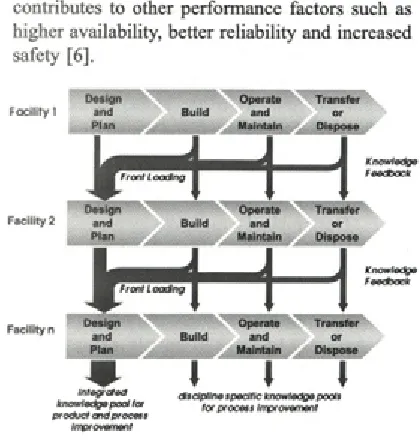
feedback system , see F ig u re 14. K n o w led g e created in each p ro cess w o u ld b e u sed by that p ro ce ss for co n tin u o u s im provem ent. B u t th is k n o w led g e also had to be m ade av ailab le to the desig n an d p lan n in g discip lin es, so th a t d esig n an d p la n n in g co u ld b e fu rth e r o p tim ized . T h e la tte r is also c a lle d fro n t loading.
T h ree ty p es o f d ata and k n o w led g e so u rces a re id e n tifie d ; se e a lso F ig u re 13. T h e f ir s t is au to m ated d ata c o llec tio n fro m sen so rs an d o th e r e q u i p m e n t in th e p la n t. T h e s e c o n d is n o n - au to m ated data co llec tio n such as fro m in sp e ctio n rep o rts. In sp ec tio n rep o rts are d irec tly en te re d as d ata in a co m p u ter, such as lap-top o r a h an d -h eld device. T h ese tw o so u rces o f d ata are still raw and n ee d to b e p ro ce ssed befo re th e y b ec o m e useful.
F ig u re 13 sh o w s th a t th is is a tw o sta g e p rocess. R a w d ata m a y b e an aly zed a n d d ia g n o sed fo r o p era tio n al usag e. N o t all o f th a t d ata is u seful fo r o th e r p u rp o ses. T h e filtered d ata are sto red for lo n g te r m d a t a a n a ly s i s , s u c h as f o r ta c t i c a l p u rp o se s (m ain ten a n ce p la n n in g an d sch ed u lin g ) a n d strateg ic p u rp o ses (co n tin u o u s im p ro v em en t).
T a c tic a l a n a ly s is c a n b e s u p p o r te d b y a k n o w le d g e s y s te m , u s in g ru le b a s e d in fe re n c e , w h ile ta c tic a l an a ly sis can b e su p p o rted b y d ata m in in g technology.
T h e th ir d s o u r c e is e x p l ic i t k n o w le d g e r e c o r d in g , s u c h a s in th e f o rm o f i d e a ’s a n d su g g e stio n s for im p ro v em en t.
i
1
AutomatedData Acqui stion
I
raw data
Inspection Reporting
raw data
I
Knowledge Recording
lessons learned & improvement concepts
Operational Analysis & Diacpiastics rule based inference
Data Ritering
i
Long Tene Data Collectic
Operation stupori data
Operation
Tactical Analysis rule based inference
Strategic Analysis &Knov^edge
Acquisition data mining
new inference
rules Conciti on &Performance
Improvement Raming
Improvement Rans
Maintenance Raming & Scheduling
Desiai &
Maintenance Improvement Raming
F ig . 13. T h e G L T p r o j e c t u s e s t h r e e p r i n c i p a l s o u r c e s o f d a t a c o l l e c t i o n ( t o p ) t h a t a r e a n a l y z e d a n d
p r o c e s s e d f o r o p e r a t i o n a l , t a c t i c a l a n d s t r a t e g i c u s a g e
c o m m o n d a ta w a re h o u s e a n d m a n a g e d w ith su p p o rt o f a P D M sy stem .
A p a r t fro m th e P D M sy ste m , a la rg e n u m b e r o f o th e r c o m p u te r a p p lic a tio n s a r e u s e d in th is p ro je c t, ra n g in g fro m a v a rie ty o f C A -a p p lic a tio n s , E R P , m a i n te n a n c e m a n a g e m e n t a n d o p e r a tio n s m a n a g e m e n t s y s t e m s . T h e l o g i c a l k n o w l e d g e stru c tu re a s d e s c rib e d in th is p a p e r a ffe c ts m o s t - i f n o t all - a p p lic a tio n s in u se.
P r a c t i c a l l i m i t a t i o n s m a d e i t h o w e v e r u n v ia b le to c h a n g e a ll a p p lic a tio n s a c c o rd in g to th e p r in c ip le s o u tlin e d in th is p a p e r. T h e re a s o n w a s th a t s o ftw a re c h a n g e s h a d to b e d o n e in a fu lly o p e ra tio n a l e n v iro n m e n t, w h ic h w o u ld d is ru p t th e o n g o in g w o rk to o m u c h . T h e re fo re th e p rin c ip le s w e r e a p p l ie d a s a w o r k i n g p r a c t i c e w ith in th e o r g a n i z a t i o n , s u p p o r t e d b y t h e P D M / W F M s o ftw a re .
D e sp ite th is re stric tio n , th e p rin c ip le s a p p e a r to b e h i g h l y b e n e f ic ia l f o r th e s tr u c t u r i n g a n d o r g a n i z a t i o n o f k n o w l e d g e a n d s u p p o r t e d c o n t i n u o u s i m p r o v e m e n t o f t h e d e s i g n ,
c o n s t r u c t i o n a n d s e r v ic in g p r o c e s s e s . B e n e f its r e s u lt f ro m c o s t r e d u c tio n s a n d h ig h e r e n d - u s e r v a lu e . L ife c y c le c o s ts a re e s tim a te d to b e re d u c e d b e t w e e n 2 5 a n d 3 0 % , w h i l e t h e s y s t e m a l s o
c o n trib u te s to o th e r p e rfo rm a n c e fa c to rs su c h as h ig h e r av a ila b ility , b e tte r re lia b ility a n d in c re a se d sa fe ty [6],
F acility t
Facility 2
Facility n
Build
Operate Transfer
ilr l a n W
Q|-%
Dispose jjrOperate Transfer
Build and or
Maintain Dispose
Transfer
in teg ra ted kn o w led g e pool for p ro d u ct a n d pro ce ss im provem ent
Maintain Dispose
[
I
I
discipline sp ec ific kn o w ledge pools for p ro ce ss im provem ent
F ig. 14. T h e c r e a t i o n o f a l e a r n i n g a n d
i n n o v a t i v e o r g a n i z a t i o n b y a t t a c h i n g k n o w l e d g e c r e a t e d i n a l l p h a s e s o f t h e p r o d u c t l i f e c y c l e t o d e s i g n o b j e c t s . T h i s r e s u l t s i n d i s c i p l i n e s p e c i f i c
k n o w l e d g e p o o l s a n d a n i n t e g r a t e d k n o w l e d g e p o o l t h a t i s a v a i l a b l e f o r d e s i g n e r s i n n e w
7 C O N C L U S IO N S A N D R E C O M M E N D A T IO N S
T h e t h e o r y a n d m e t h o d o l o g y t h a t is d e s c rib e d h ere aim s at th e reu se a n d im p ro v e m en t o f d e s ig n a n d e n g in e e rin g so lu tio n s. It su p p o rts C o n tin u o u s Im p ro v e m e n t (C l) as a ta sk th a t is fully in te g ra te d w ith re g u la r b u sin e ss p ro cesses. G en eric d e s ig n o b je cts th a t are a v a ila b le in th e d e sig n an d p la n n in g s y s te m s g iv e d e s ig n e rs a n d e n g in e e rs a c c e ss to a c tu a l p e rfo rm a n c e d ata o f th e se ob jects in e a rlie r pro jec ts. T h is en a b le s th e m to le a rn fro m th e p ast, ev e n i f th e d e s ig n e rs w ere n o t p e rso n a lly in v o lv e d in th e se p ro jects.
T he im provem ent process does not only rely o n the creation o f id ea’s b y people involved in each business process, but m akes also use o f the analysis o f data that are collected autom atically via sensors o r via inspection reports, or o f know ledge records.
E a r l y i m p l e m e n t a t i o n s w e r e b a s e d o n p a r a m e t r i c t e c h n o l o g y a n d le d to s u b s t a n tia l effic ie n c y g ain s in b u sin e ss p ro cesses. P aram e tric te c h n o lo g y o ffe rs th e p o ssib ility to re-u se d esig n k n o w le d g e e v e n in th e c o n te x t o f e n tire ly n e w s p e c i f i c a t i o n s . M o r e d e t a i l s a b o u t t h e s e ap p lic a tio n s ca n b e fo u n d in [7], [4] an d [6].
A m ore rec en t ap p licatio n based o n a P D M b a s e d d ata w areh o u se clo sed the co g n itiv e cy cle an d su p p o rts a p ro ce ss o f co n tin u o u s im p ro v em en t in a large co n stru ctio n p ro jec t fo r the oil an d gas sector.
P arts o f th e th e o ry h av e b ee n p u b lish ed and/ o r u sed for stan d ard s fo r th e exch an g e an d sharing o f p r o d u c t d a ta , b u t a re in th e s e c o n te x ts n o t p re se n te d as a so lu tio n fo r cog n itiv e p ro cesses. It co u ld b e o f in terest for u se rs an d application v endors to ex p lo re this asp ect o f the prese n ted th eo ry further.
G e n e ric so ftw a re th a t su p p o rts th e o ry an d m e th o d o lo g y v ia p a ra m e tric te c h n o lo g y d id ex ist in t h e p a s t b u t w a s n o t m a i n t a i n e d . F u t u r e ap p lic a tio n s w o u ld b e n e fit fro m re d e v e lo p m e n t o f th is softw are.
8 R E F E R E N C E S
[1] A IA G . E n g i n e e r i n g c h a n g e m a n a g e m e n t
-b u s i n e s s c a s e . A I A G C o l l a b o r a t i v e E n g in e e rin g S tee rin g C o m m ittee, 2005. [2] B e s s a n t, J ., C a ff y n , S. H ig h - in v o lv e m e n t
in n o v a tio n th ro u g h co n tin u o u s im p ro v e m en t,
I n i . J . T e c h n o l o g y M a n a g e m e n t , v o i. 14
(1 9 9 7 ), no. 1, p. 7-28.
[3] G ielingh, W.F. G e n e r a l A E C r e f e r e n c e m o d e l
(version 4); D o cu m en t N 329 o f ISO T C I 84/ S C 4 /W G 1 , O ct. 1988. P u b lis h e d a s T N O R eport B I-8 8 -1 50.
[4] G ielingh, W., Suhm , A. IM PPA C T referen ce m o d e l f o r in te g r a te d p r o d u c t a n d p ro c e s s m o d e llin g . S p rin g e r- V erla g , IS B N 3 -5 4 0 - 56150-1 /0 -3 8 7 -5 6 1 5 0 -1 , 1993.
[5] G ie lin g h , W ., L o s, R ., L u ijte n , B ., P u tte n , J.van, V elten, V. T he P IS A pro ject, a su rv ey on STEP. A ach en : S h ak er V erlag, IS B N 3- 8265-1118-2, 1996.
[6] G ielingh, W.F. I m p r o v i n g t h e p e r f o r m a n c e o f
c o n s t r u c t i o n b y t h e a c q u i s i t i o n , o r g a n i z a t i o n a n d u s e o f k n o w l e d g e .D elft, p. 372, IS B N 90- 8 1 0001-1-X , 2005.
[7] G ielingh, W.F. A th e o ry an d m e th o d o lo g y for the m o d ellin g o f co m p lex system s. S u bm itted f o r p u b l i c a t i o n in th e J o u r n a l f o r I T i n
C o n s t r u c t i o n , 2008.
[8] L i n d b e r g , P ., B e r g e r , A . C o n t i n u o u s i m p r o v e m e n t: d e s i g n , o r g a n i z a t i o n a n d m anagem ent. I n t . J . T e c h n o l o g y M a n a g e m e n t ,
voi. 1 4 (1 9 9 7 ), no. l , p . 86-101.
[9] M orris, P.W .G., H ough, G .H . T h e a n a t o m y o f
m a j o r p r o j e c t s . Jo h n W iley & Sons, IS B N 0-
4 7 1 -9 1 5 5 1 -3 , 1987.
[10] N eisser, U. C o g n itio n an d rea lity - p rin cip les a n d im p lic a tio n s o f c o g n itiv e p s y c h o lo g y , N ew Y ork, IS B N 0 -7 1 6 7 -0 4 7 7 -3 , 1976. [11] N onaka, I., B yosiere, P , B om cki, C .C ., K onno,
N . O rganizational know ledge creatio n theory.
I n t e r n a t i o n a l B u s i n e s s R e v i e w , 3 (1994). [12] N o n ak a, I., T oyam a, R., K onno, N . S E C I, Ba
and lead ersh ip : a u n ified m o d el o f d y n am ic k n o w le d g e cre atio n . L o n g R a n g e P l a n n i n g ,
voi. 33 (2 0 0 0 ), no. 1.
[13] R o c h a , L. M . C o m p le x sy ste m s m o d e lin g : u sin g m e tap h o rs fro m n atu re in sim u latio n and s c i e n t i f i c m o d e ls . B I T S : C o m p u t e r a n d
C o m m u n i c a t i o n s N e w s , L os A lam o s N atio n al L ab o rato ry , N o v e m b e r 1999.
[14] S h im izu , H. B a p rin cip le: n ew lo g ic fo r the rea l-tim e em erg en ce o f inform ation. H o l o n i c s ,
5(1), 1995
[15] S m ith , E .E . C o n c e p t s a n d t h o u g h t . T h e
p s y c h o l o g y o f h u m a n t h o u g h t . C a m b rid g e :
C a m b rid g e U n iv e rs ity p re s s , IS B N 0 -5 2 1 -
3 2 2 2 9 -4 , 1988.
[16] W om ack, J., Jones, D ., R oo s, D. T h e m a c h i n e