Iranian journal of educational Sociology
(Interdisciplinary Journal of Education)
Available online at: http://www.iase-idje.ir/ Volume 1, Number 8, October 2018
Developing the Training Package of Self-Awareness based On the
Logo-therapy Approach in Order to Improve the Self-Control of
Adolescent Girls
Fereshteh Karimizadeh
1, Ahmad Borjali
2, Abdollah Shafiabadi
3, Kiuomars Farahbakhsh
4 1. PhD student of psychology, Allameh Tabataba'i University, Tehran, Iran.2. Associate Professor of Psychology, Allameh Tabataba'i University, Tehran, Iran. 3. Professor of Consulting group, Allameh Tabataba'i University, Tehran, Iran.
4. Associate Professor of Consulting group, Allameh Tabataba'i University, Tehran, Iran.
Article history:
Received date: 10 September 2017 Review date: 20 October 2017 Accepted date:19 November 2017 Printed on line: 15 November 2018
Abstract
Purpose:
The purpose of this study was to develop a
self-knowledge training package based on the logo therapy approach in
order to improve the self-control of adolescent girls.
Methodology:
The method of this study was mixed. The
statistical population of the study was all theologians and professors
in the field of logo therapy. Sample size was determined by
referring to the saturation rule for 15 people who were selected
purposefully. In order to achieve the goal of research, qualitative
and quantitative study was done according to the experts' opinion.
Findings:
The results of the content validity analysis of the
package, according to the experts, showed CVR = 0.73 and CVI =
0.83, both of them were in the optimum level and the content
validity of the package was confirmed. Also, the Cronbach's Alpha
coefficient for determining the internal consistency of experts for
the component of self-communication was 0.73, for the component
of communication with the others was 0.77 and for the component
of communication with the universe was 0.79.
Discussion
:
According to the findings of the study, it is suggested that
psychotherapists use the self-awareness training package (based on
the logo therapy approach) in order to correct the attitudes to
strengthen self-control in the adolescent girls.
Keywords:
Awareness, Control,
Self-Control, Adolescent Girls
Please cite this article as: Karimizadeh F,Borjali A,Shafiabadi A,Farahbakhsh K. (2018).Developing the Training Package of Self-Awareness based On the Logo-therapy Approach in Order to Improve the Self-Control of Adolescent Girls, Iranian journal of educational Sociology, 1(8), 188-195.
Corresponding Author: [email protected]
1.
Introduction
The change in lifestyle and the complexities of today's life threatens the health and well-being, and life
problems increase the vulnerability of humans (Kottler, 2003, Yousefi, 2010). For this reason, people often
suffer from anxiety, depression, lack of self-awareness and self-control in dealing with life problems, which
affects the adolescence group more often due to the critical conditions (Palmer, 2002, Yousefi, 2010).
During this period, physical, psychological and social changes take place; incidence of disorders such as
vulnerability to mental disorders can seriously affect the capabilities and ultimately the future and fate of
adolescents (Zanjiran et al, 2015). One of the most important issues facing training is the psychological
problems and challenges in addition to the training al problems of students; this is due to the factors such as
lack of self-control in academic activities and low level of students' development, which influence the
performance and academic achievement of students (Ghasemi, 2006).
In the latest census, the country's teenage girls have formed about 7 million people (Statistical Yearbook
of the Country, (2016). Adolescence will be the foundation of the future and will have a direct impact on
the families and their children. The results of some studies show that spending leisure time with friends and
focusing on music is one of the priorities of adolescent needs. These needs are likely to increase the likelihood
of a tendency towards high-risk behaviors and behavioral disorders (Rahgosha, Mousavi and Alavi Ardakani,
2017). In support of this claim, there is also evidence that the past two decades, the increasing crime, drug
use and escape from home are rising among teenagers (Jankowski, Meca, Lui and Zamboanga, 2018).
According to the statistics in Iran, the most cases of sexual immorality (55.6%) occur between the ages
16-21 years old. The average age of smoking is 16 years among adolescents (Zeinali and Sharifi, 2017). Grasmick
(1993) has indicated that there is an inverse relationship between self-control and criminal acts. Spears et al.
(2017), confirmed the relationship between self-control and deviant behavior. These dilemmas place
adolescents at the serious social harm; in order to stay safe from them, adolescents need to learn skills,
including self-control skills, which can be interpreted, learned and trained. (Butler, 2010).
In studies, the relationship between self-control and non-self-control in dealing with social injuries has
been confirmed and shown that individuals with self-control, have extraordinary control over their decisions
and external factors do not affect them in any way (Leahy et al., 2012).
In many studies, the relationship between self-control and alcohol abuse, the use of cigarettes and drug
abuse (Butler, 1994; Sawadi, 1999; Bashirian, 2012), lack of self-esteem and lack of necessary skills for
communication with the others (Bashirian, Heidarnia, Allahverdipour, 2012), addiction, anger (Baumeister
and Nadal, 2017) and crime (Hirchi, 2004), have been approved. Also, the relationship between low
self-control and the ability to conduct the criminal behavior and risky behaviors has been confirmed
(Gottfredson, 2012).
The other focus of this research is to train self-awareness skills based on the logo therapy approach, since
the methods of logo therapy will create greater passion for students' advancement and endeavor, and training
will find a human aspect in this way (Ghavami and Moin, 2016). The basis of Frankl's view is that humans
are knowledgeable and responsible (Asayesh and Qazi, 2016). Logo therapy is one of the variables related
to growth, which leads to situations in which happiness and satisfaction occur (Abdi and Ahmadian, 2016).
Therefore, logo therapy can lead to the joy and full satisfaction of individuals (Lent, 2004). Logo therapy is
an effective therapeutic approach in the form of teamwork.
The design of self-awareness training package based on this method for improving self-control of
girl-centered adolescents is carried out in this study.
2.
Methodology
In this research, according to the purpose and nature of the research, mixed research method has been
used through integration of qualitative and quantitative methods. Considering the above issues, since the main
purpose of the study was to develop and validate the self-awareness training package based on the logo therapy
approach, in addition to the theoretical foundations, a survey for more understanding has been used in order
to deepen the study and further understanding of the subject in the context of the components of
self-awareness training al package based on the logo therapy approach. Then, quantitative approaches are used to
confirm the qualitative results. The study in mixed methods involves the compilation and analysis of
quantitative and qualitative data in which data are collected simultaneously or sequentially. Due to the
necessity of qualitative research before the quantitative method, in this research, a sequential exploratory
design and classification model has been used as one of the research strategies in mixed methods.
Qualitative Study: The main purpose of this step of research was to explore the concepts and categories
related to self-awareness package based on the logo therapy approach for a quantitative section. In this
research, the analytic inference method was used in the qualitative section. The qualitative section takes place
in steps. The first step is to refer to the sources related to the subject of the logo therapy approach, and in the
next step, the concepts and self-awareness components of the sources were extracted from the sources and
were finally validated under the experts' supervision.
Sample Population and Sampling Method: The statistical population of the study was all theologians and
professors in the domain of logo therapy. Sample size was determined by referring to the saturation rule for
15 people who were selected purposefully.
The Training Package Development Steps: 1- Determine the general headings of package. 2- Convert
general headings to more precise headings. 3- Development of the necessary content to achieve the goals. 4-
Qualitative and quantitative review of the experts' opinion. 6- Development of the final package.
Determine the Validity and Reliability of the Training Package: The experts' opinion is used in order to
determine the formal and content validity of the developed training al package. In this regard, with referring
to 15 professors of the university that have been specializing in the field of logo therapy and the subject of the
present research, they were asked to provide their expert opinion on the quality of the training al package
components. To determine the reliability of the package, with providing a questionnaire that consists of
measuring the implementation stages of the curriculum, goals, methods and components of the training
package, they ranged from 1 to 5 grades. Then, the internal validity of the package was determined by
Cronbach's alpha test.
3.
Finding
The first step in determining the validity (training package) is to examine content validity. Content validity
depends on the logical analysis of the content of a test (training pack) and its determination is based on
individual and objective judgment. Content validity was evaluated in the following way.
Content Validity Ratio (CVR): This index is designed by Lavashe (1987). In order to calculate this index,
the experts' opinions on the content of the test were used and with explaining the objectives of the test for
them and providing the operational definitions concerning the content of the questions to them, they were
asked to classify each of the questions on the basis of the three-section Likert scale "necessary", " useful but
not necessary" and "not necessary". Then, the content validity ratio was calculated based on the following
pheromone.
According to the number of specialists who have evaluated the questions, the minimum acceptable CVR
should be based on the table below.
Table 1. The minimum CVR acceptable value based on the number of expert giving score Number of
specialists CVR value
Number of
specialists CVR value
Number of
specialists CVR value
5 0/99 11 0/59 25 0/37
6 0/99 12 0/56 30 0/33
7 0/99 13 0/54 35 0/31
8 0/75 14 0/51 40 0/29
9 0/78 15 0/49
10 0/62 20 0/42
In this study, 15 experts have commented on the curriculum, who 13 ones confirmed its necessity and 2
ones confirmed its usefulness. According to the formula CVR = 0.73, and according to the above table, it is
an optimal value and the content validity of the package is verified.
Content Validity Index (CVI): Waltz and Bassel (1989) was used for the content validity index. In that
way that experts identified each item from "not related", "relatively related", and "related" to "totally
related". The simplicity of the item is also 1 "not simple", 2 "relatively simple", 3 "simple", 4 " relevant
simple", and the clarity of the item is also 1 "not clear", 2 "relatively clear ", 3 is" clear ", up to 4" relevant
clear".
The minimum acceptable value for the CVI index is 0.79. If the CVI index is less than 0.79, then the item
should be deleted. Given that 13 professors have chosen options 3 and 4, this coefficient is 0.83, which
indicates an acceptable value.
Reliability of the Test: At this stage, it is emphasized the uniformity and harmony of components of the
training package with the internal consistency method. For this research, the Cronbach's alpha coefficient in
the component of communication with itself is 0.73, in the component of communication with others 0.77
and for the component of communication with the universe is 0.79. In all three components, the alpha
coefficient is higher than 0.7, indicating a high reliability of test.
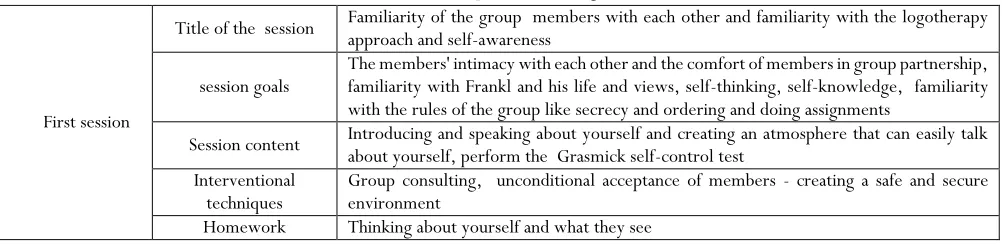
Table 2. Description of Training Sessions
First session
Title of the session Familiarity of the group members with each other and familiarity with the logotherapy approach and self-awareness
session goals
The members' intimacy with each other and the comfort of members in group partnership, familiarity with Frankl and his life and views, self-thinking, self-knowledge, familiarity with the rules of the group like secrecy and ordering and doing assignments
Session content Introducing and speaking about yourself and creating an atmosphere that can easily talk about yourself, perform the Grasmick self-control test Interventional
techniques Group consulting, unconditional acceptance of members - creating a safe and secure environment Homework Thinking about yourself and what they see
Second session
Title of the session search for meaning in man
session goals Students will surely realize the meaning of life
Session content
Review the homework of last session
In Frankl's opinion, within every human being there is a force that leads him to try to find the meaning of life. Frankel considers this human effort to find a meaning for his life as a genuine adventure, not a second justification for his instinctive instincts. Frankl expresses the specific meaning of life of each person, specific for himself and believes that it is he alone who must and can act in that sense. As much as he understands the meaning of life, man knows himself.
In Frankl's view, the realization of meaning in life is possible in three ways, all of which refer to as universal values.
Experimental values are in the form of experiences that life gives us, and this acceptance can be as meaningful as the creation. Frankel regards creativity as the love of the impersonal spirit. Attitudinal values are the product of our attitude to life. Attitudinal values include virtues such as compassion, courage, humor, etc. The most famous example that Frankl put in, is to find meaning through suffering.
Interventional
techniques Discussion, showing films about the wonders of nature and art, and showing the conscience and love the human beings to nature, animals and human beings at times that are helpless. Effective explanations after watching movies.
Homework Examine your own values and find meaning in life and write each case
Third session
subject Freedom of my will in choosing the meaning of life
session goals
Understanding the free will and deliberately choosing your own behavior and accepting responsibility
Students should be able to identify and name a few examples of their impact on their choices
Session content
Review the homework
Contrary to the psychoanalytic understanding of humans, which drown him in a halo of external stimuli and impulses that are not in the hands of person, the most important principle in psychology of Frankl's existentialism is human consciousness to himself. In the shadow of this awareness to the real self (what is) and the point with the true one (what should be), in one self-excitement, he tries to approach the true self by choosing the means that is, the meaning of his life. Freedom to choose a place in any situation you encounter, is a unique ability of a human being. A person is free to form his personality and is a self-interested person who has made himself. What matters is not the characteristics of our personality or the self-perpetuity of ourselves, but the position we choose to the others. Under any circumstances, humans benefit from this freedom. Frankl believes that if we want to have a mental health, we must have freedom to choose our behavior, and the freedom means the liberation of three things: instincts, habits, environment
Interventional techniques
Discussion Show habits
Use memories and experiences Brainstorming
Create a free impression in choosing a way to get a suggested problem analyze
Homework Remember the choices that have been made so far and how they are meaningful
Forth session
Title of the session My experimental values
session goals Students can recognize empirical values and learn how to make love and give examples
Session content
Review the last session homework
Experiential values are in the form of experiences that life gives us, and this acceptance can be as meaningful as the creation. These values are, in Frankl's view, fascinated by the beauty of the nature or art. The most important example of experiential values is the love that we bring to the others.
Interventional
techniques Discussion, Use of Experiences
Homework Writing examples of your own and others' values
Fifth session
Title of the session My creative values
session goals Students' engagement in their plans come to the senses. At this stage, students can create meaning and value in their work.
Session content Values that are perceived with the activities and usually consider a kind of work that can be observed in all areas of life. The job of a person as his shareholding in society is the origin of his unique meaning and value. Of course, the type of occupation is not important here, but the way of doing it and creating meaning is important.
Interventional
techniques Review and analysis - presentation of ideas Homework Creating meaning values in the programs ahead
Sixth session
Title of the session My attitude of values
session goals Students can identify their attitudinal values and can find meaning for their lives, and can name their worthwhile attitudes Session content Attitudinal values are because of our attitude to life. The positions demanding attitudinal values are those that are not capable of transforming or avoiding them. Attitudinal values include human virtues such as compassion, sacrifice, courage, and so on
Interventional
techniques Brainstorming, argumentation and discussion Homework Check the own situations and find your attitude value
Seventh session
Title of the session My conscience
session goals Students can understand their conscience and identify some examples of conscientiousness
Session content
Homework of the last session
Conscience is one of the main concepts used by Victor Frankl. He considers the conscience as a kind of unconscious spirituality. Conscientiousness is not just a component among the other components, but is the core of our existence and the source of our personal integrity. He explicitly states about conscience that being human means responsibility that is, being responsible for our own existence. Conscientiousness is an intuitive and largely personal issue. Frankl refers to conscience as a prehistoric ontological or wisdom. Frankl, like Eric Forum, points out that animals have instincts that guide them. Most of the efforts to find guidance are in harmony with the population and follow the customs.
Interventional
techniques Brainstorming, Show, Use of the Socratic Method
Homework Review your own issues and identify your conscience position
Eighth session
Title of the session My unpleasant sufferings and conditions
session goals Students recognize their unfortunate unpleasant sufferings and conditions, create meaning and continue their activity using their values
Session content
Logo therapy extends the person's field of vision, where the meanings and values are in his field of view. Logo therapy draws the human into a challenge and activity and states what makes people out of life, is not their desperate suffering, but the meaninglessness of life that is disastrous. According to this view, if we accept patience boldly, life will continue until the last second, and the meaning of life can even include the potential meaning of the potential pain. If life is coincided with suffering, there must be a sense of suffering inevitably, in order to survive. Man is able to live for his ideas and values, or he will die in this way.
Interventional
techniques Writing, brainstorming, displaying people who have a successful life Homework Create meaning for your and close family members sufferings
Ninth session
Title of the session My Existential Objectives
session goals Students can experience emptiness and meaninglessness in their lives and react to these experiences
Session content Today, people seem to experience vanity, meaningless, frivolous and wandering, and so on in their lives more than ever and with unusual behaviors hurt themselves and others and society or to all three. One of the metaphors of interest to Frankl is the existence vacuum. Frankl insists that one of the most significant symptoms of existence vacuum in
4.
Discussion
The results of the data analysis showed that the self-awareness training package (based on the logo therapy
approach) has a good validity and reliability.
In explaining these findings, it can be said that logo therapy is useful for those who are faced with an
existential failure or a failure to find a "cause for life". The main purpose of the design of the training package
in the present study was that the girls participation in these group meetings and exchanging their thoughts
and ideas, found a meaning for what has been past to them; they acquire the ability and awareness that life
always has meaning and can be found in every phenomenon that comes about. Also, self-awareness sessions
(based on the group's logo therapy approach) provide an opportunity for members to recognize and
understand themselves or experience the full and informed participation of the above process, and thereby
self-actualization and anger.
Also, in the training package, the person tried to realize that although he could not change the definitive
events of his life, he could learn to change the way of coping with them and react to that event (Lent, 2004).
In the design of this package, it was tried to convey the concept that, since the meanings are unique, they
are constantly changing, but they never go away, and life never lacks meaning. Certainly this is only
understandable if we know that there is always a potential meaning to find meaning, even beyond the love
and work. Of course, we are accustomed to discover the meaning in creating a job or doing a task, or in
experiencing one thing or encouraging a person; but we must never forget that it is possible even in the face
with a disappointing situation, we can find a meaning in life. With participation in these group meetings and
exchanging thoughts and ideas and finding meaning for what has been past, the girls will acquire the ability
and awareness that life always has meaning and it can be understood in every phenomenon that comes about.
Also, logotherapy group meetings will provide an opportunity to allow members to recognize, understand
and relinquish the obstacles that have impeded their freedom or to participation fully and consciously in the
process.
society is blame. He points out how humans do not do anything when they finally get the chance to do what they want, and they are caught up in a critical situation.
Interventional
techniques Visualization and Imagination, Discussion
Homework Find own existential vacuum and do the right reaction
Tenth session
Subject of the session summary and conclusion
session goals Achieving a general conclusion about self-assessment
Session content Remember the titles in the 10 training sessions and get feedback from the members and provide the methods for the stabilization of the lessons and follow the Tangy self-control Interventional
techniques Brainstorming, meditation on learning - recruiting and evaluating yourself Homework Every day think one hour to the performance in order to improve his behavior
References
Abdi A, Ahmadiyan A, Shahabizadeh F. (2016). The Effectiveness of Group Logo therapy on Resilience and Psychological Hardiness in Secondary School Students of Kerman Province, Second National Conference on Psychology and Behavioral Sciences, Tehran, Narcish Information Institute.
Alivedinia A, Younesi A. (2014). The Effect of Self-Control Rate On Crime Among Students. Culture Strategy, 26: 93-118. Asayesh M.H, Qazi G. (2016). Ontological counseling and treatment (basics of logo therapy). Tehran, Academic Publishers Bashiriyan A, Heydarnia A R, Verdipour H, Hajizadeh E. (2012). Investigating the relationship between self-control and
adolescents' desire for drug use. Journal of Hamadan Nursing and Midwifery Faculty, 20 (1):45-55.
Baumeister R F, Nadal A C. (2017). Addiction: Motivation, Action Control, and Habits of Pleasure. Motivation Science, 3(3):179-195.
Ghasemi M. (2016). The Effect of Group Self-Controlling Teaching in a Rigorous Way, Master's Thesis, Allameh Tabataba'i University.
Ghavami M, Ladan M. (2016). The Effectiveness of Group Logo therapy on Increasing the Self-efficacy of MS Patients in Shiraz, World Conference on Psychology and Training al Sciences, Law and Social Sciences at the Beginning of the Third Millennium, Shiraz, Research Company Green Market Idea.
Grasmick H R, Bursik B, Arneklev. (1993). Reduction in Drunk Driving as A Response. To Increased Threats of Shame, Embarrassment, And Legal Sanctions. Criminology. 31:41-67
Jankowski P J, Meca A, Lui P P, Zamboanga B L. (2018). Religiousness and Acculturation as Moderators of the Association Linking Acculturative Stress to Levels of Hazardous Alcohol Use in College Students. Psychology of Religion and Spirituality. Advance Online Publication.
Leahy L, Dennis D, Tirch A, Napolitano. (2012). Emotion Regulation in Psychotherapy: A Practitioner's Guide. New York: Guilford Press.
Lent R W. (2004). Toward A Unifying Theoretical and Practical Perspective on Well-Being and Psychosocial Adjustment. Journal of Counseling Psychology, 51:482–509.
Rahgosha A H, Mousavi E, Alavi Ardakani M. (2017). Prevention of Growth-Centered from Criminalization of Children and Adolescents in Cyber Space. Afagh Human Sciences. 10:1-14
Spears C A, Hedeker D, Li L. Anderson N K, Houchins S, Wetter D. (2017). Mechanisms Underlying Mindfulness-Based Addiction Treatment versus Cognitive Behavioral Therapy and Usual Care for Smoking Cessation. Journal of Consulting and Clinical Psychology, 85(11):1029-1040.
Yousefi N. (2010). Comparison of The Effectiveness of Two Counseling and Logo therapy Approaches to Gestalt Therapy and Logotherapy in Reducing Depression, Anxiety and Aggression Syndromes Among Female Applicants for Divorce Referring to The Saqez Family Counseling Center. Article Presented at the 2nd Family Pathology Congress in Iran, Shahid Beheshti University
Zanjiran S, Kiyani L, Zare M, Shayghian Z. (2015). The Effectiveness of Group Logo therapy on the Loneliness of Older Women Living in the Nursing Home, Journal of Knowledge and Research in Applied Psychology. 16(3):60-67.
Zeynali A, Sharifi H P. (2017). Risk factors and alcohol and drug abuse in adolescents. Urmia Medical Journal, 28(12):770-782.