ENGINEERING AND GINNING
Changes in Bale Moisture, Thickness, and Force
Due to Changing Environments and Bagging
W. Stanley Anthony
W. S. Anthony, USDA-ARS, Cotton Ginning Research Unit, 111 Experiment Station Road, Stoneville, MS 38776 [email protected]
ABSTRACT
In a three-phase study, changes in moisture content, bale thickness, and bale tie forces in cot-ton bales were strongly influenced by bale density, storage climate, and permeability of the protective covering on the bales. In Phase I, eight bales of cotton were packaged at universal density and stored without bagging at ambient conditions for 81 d. Bale thickness and tie force were measured periodically, and the bale weights were taken be-fore and after the storage period. The same eight bales were then randomly placed in four different types of bagging and stored at 26.7 °C (80 °F) and 80% relative humidity (RH) for 100 d (Phase II). The bagging included two types of experimental bagging and two types of standard bagging. The experimental bagging was less permeable than the standard bagging. In Phase III, the same bales were stored for 305 d at 21.1 °C (70 °F) and 50% RH. The bales gained moisture (weight) during Phases I and II but lost moisture during Phase III. In Phase I, bale thickness and tie force initially increased after storage and then responded to the fluctuations in climatic conditions. During Phase II at 80% RH, the bale thickness and tie force increased, but during Phase III at 50% RH, the thickness and the tie force decreased. Weight of bales covered in the standard bags changed by 2.19, 1.42, and -2.35 after storage at ambient conditions, 80% RH, and 50% RH, respectively. Weight of bales covered in experimental bags changed by 2.08, 1.02, and -1.67% after storage at ambient conditions, 80% RH, and 50% RH, respectively.
T
he Joint Cotton Industry Bale Packaging Committee (JCIBPC) was established in 1968 to improve the physical condition of cotton balesproduced in the United States. The change within the cotton industry to trading based on net weight opened the door to numerous advancements in lightweight bale bagging and ties. For marketing based on gross weight, heavy packaging materials offered considerable economic advantage, so prior to 1968, most bales were covered in jute and restrained by flat steel bands with a tare weight of 9.5 kg (21 lb). Currently, most bales are packaged in woven polypropylene or polyethylene film and restrained with wire ties. These bales have a tare weight of less than 2.3 kg (5 lb). As bale storage and handling practices change and new technologies emerge, new types of bagging and ties have been developed in response to the new requirements. The JCIBPC thoroughly investigates new bagging and tie materials to ensure that they perform satisfactorily before approving widespread commercial use. Some of the initial evaluation of the new materials is conducted at the U.S. Cotton Ginning Laboratory at Stoneville, MS. The Stoneville studies usually involve accelerated conditioning at high or low humidity in order to quickly assess the response of the new materials prior to commercial testing.
After cotton fiber is packaged into a bale, moisture transfer occurs very slowly, especially at high densities. In fact, bales at densities of 192 kg/m3 (12 lb/ft3) required over 60 d to equilibrate
with the environment, while bales at 448 kg/m3 (28
lb/ft3) required over 110 d (Anthony, 1982). The
rate of adsorption and desorption is influenced by bale density, ambient temperature and humidity, bale covering, surface area, air changes, and fiber history (Anthony, 1997). Anthony (1982) stored low-moisture bales for periods up to 1 yr in jute, burlap, woven polypropylene, strip-laminated woven polypropylene, dimpled polyethylene, and polyethylene bagging. Bales covered in the rela-tively impermeable polyethylene, required over 365 d to equilibrate with the environment compared to 120 d for the other bale coverings.
bales in burlap, woven polypropylene with lami-nated strips of polyethylene to prevent fibrillation, and polyethylene with 0.95-cm (3/8-in) diameter perforations on 45.7-cm (18-in) centers to allow air to escape during bag emplacement. The bales were packaged at 3.5% moisture and stored at 21.1 °C (70 ºF) and 80% RH. The woven polypropylene-covered bales reached equilibrium in less than 161 d, whereas the polyethylene-covered bales had not reached equilibrium after 378 d. After 161 d, the polyethylene-covered bales had gained only about 40% of the moisture gained by polypropylene-cov-ered bales. Barker and Laird (1993) reported that desorption occurs at about twice the rate of adsorp-tion for small samples of lint, so bales should lose moisture faster than they gain moisture.
Bale tie forces are strongly influenced by the moisture content of the bale (Anthony, 2000). Tie forces increase over time after compression and release. They also respond to the initial moisture content after packaging (Anthony, 2001). During a 130-d storage period, tie forces increased for the first 60 d after packaging as the internal moistures of the bales increased and the bales equilibrated with the climatic conditions, and then remained constant. Weight change stabilized at about the same time. Thus, fluctuations in climatic conditions produce changes in bale tie forces.
In 2003, U.S. cotton bales were packaged mostly in woven polypropylene (strip-coated or fully coated with linear low density polyethylene) (53%), poly-ethylene (39%), and burlap, (8%) (Valco and nor-man, 2004). The cotton industry is seeking bagging that does not allow foreign matter to enter but does allow moisture transfer. These two features are not compatible in the same bagging, so a compromise must be reached in permeability. The traditional strip-coated woven polypropylene bag is strong and allows adequate moisture transfer. The traditional, relatively impermeable polyethylene bag limits contamination from dust and dirt but is weaker and does not allow rapid moisture transfer. Merging these two features (strength and permeability) into one bagging can be accomplished by sacrificing some permeability and fully coating the interior (or exterior) of a woven polypropylene bag with a thin layer of polyethylene. This must be carefully done to retain adequate moisture permeability. In addi-tion, bales are normally “stuffed” into the bale bag mechanically through the open end, and the cotton bale rapidly displaces the air in the bag. As a result,
a means for the air to exit must be provided. Avail-able alternatives are 1) cutting slots or holes near the sealed end of the bag, 2) pulling vacuum inside the bag while it is being stuffed, or 3) omitting sections of the coating.
The purpose of this research was to determine the change in moisture, bale weight, and bale tieforce of universal density cotton bales packaged in differ-ent bagging materials and stored at known climatic conditions for extended periods of time.
MATERIALS AND METHODS
For this study, the Continental Bespress (Con-tinental Eagle; Prattville, AL) at the U.S. Cotton Ginning Laboratory was used to compress the eight bales of cotton using three different types of compression surfaces called platens. The bale fiber and moisture characteristics were determined by averaging 10 samples taken per bale using high volume instrumentation (HVI) classification and oven-dried moisture measurements on a wet basis (ASTM, 1971). The standard Bespress is equipped with the upper and lower platens that have the out-side edges turned upward in order 1) to pre-form the bale slightly, 2) to make it easier to install bale ties, and 3) to prevent the cotton from interfering with the insertion of the bale ties (Fig. 1a). other presses common in the cotton industry, however, use flat platens. For one of the treatments in this study, the standard bottom platen was converted to a flat platen by installing wooden inserts to counter the height of the shaped section of the platen (Fig. 1b), and to make the platen appear flat when the wood was installed on the top and bottom platens. For the third treatment, the standard bottom platen was replaced with the cast steel bottom platen (Fig. 1c) (Anthony, 2002). The shaped top platen was converted to flat by installing wooden inserts similar to the procedure used for the bottom platen. Due to operational constraints, the top platen was flat for all three treatments.
(Fig. 2). The wire was held in the bolt with setscrews installed in the sides of the bolts. The transducers were connected to a notebook computer, and data were collected as soon as the bale was removed from the press. Bales were added to the test about every 15 min due to the ginning rate and transducer application time requirements.
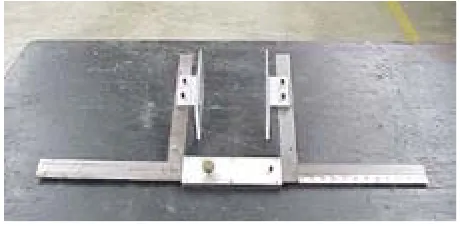
For Phase I, the thickness of the bales was mea-sured at each of the seven “humps” or bulges between the eight ties using calipers equipped with flat plates (Fig. 3) to expand the contact surface area. The thick-ness was measured only at hump 5 for Phase II.
Phase I. Eight bales of Stoneville 4892 BR
cotton (Stoneville Pedigreed Seed; Stoneville, MS) were ginned and compressed to a density of about 672 kg/m3 (42 lb/ft3) (Table 1). The average bale
weight was targeted at 227 kg (500 lb), so that the weight of the bales being compressed was typical for the industry. The bales changed moisture content continuously during storage, but the bales were only
weighed before and after storage because of the con-cern that movement of the bales might change the tension on the bale ties and cause tie failure. The tie force exerted on one tie of each bale and the thickness of the bale at each of the seven humps was measured twice weekly during the 80 d of storage.
Phase I was conducted with two replications (bales) in a completely random experimental design with type of platen and days of storage as indepen-dent variables and bale thickness, tie force, and bale weight as dependent variables. The General Linear Models procedure of SAS (version 8.2; SAS Institute; Cary, nC) was used to conduct the analy-sis of variance to determine the significance of the variables.
Phase II. The eight bales of cotton were then
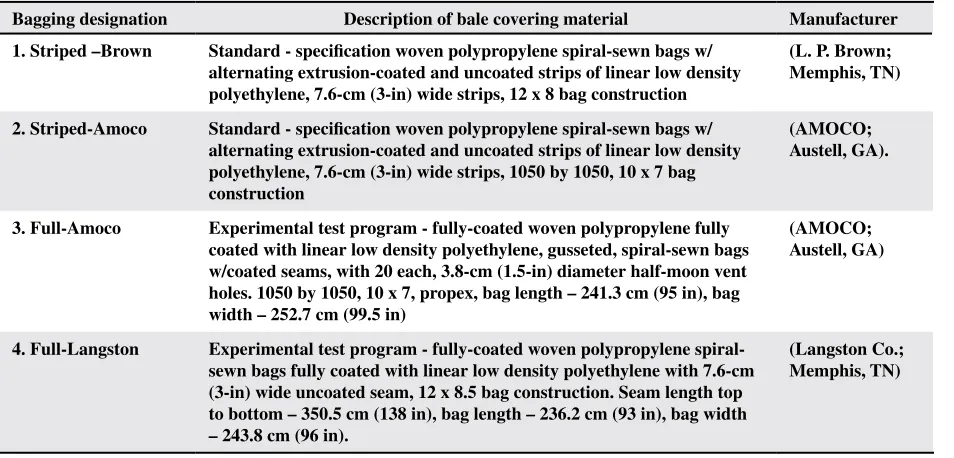
placed in four different types of bale covering materials and stored under controlled conditions. The bale cover-ings described in Table 2 included woven polypropylene bags that were either strip-coated or fully coated. Two bales were covered in each of these test materials. The bales were stored in a conditioning chamber at 26.7 °C (80 °F) and 80% RH. Tie force at tie 5, thickness at hump 5, and bale weight were recorded 2 or 3 times per
Fig. 1. Botton platens used in pressing the bales. Shown are A.) Standard bottom platen for Continental Bespress. Note the outside edges of the platens are turned up to make it easier to insert the bale ties. B.) Standard platen with wooden inserts to create a flat platen. Similar inserts were used on the top platen for all treatments. C.) Cast steel platen.
Fig. 2. Transducer installed in bale tie to measure bale tie forces.
Fig. 3. Two carpenters squares joined together using a sliding mechanism with setscrews was used to measure hump thickness. Wide flanges were added to assist in measuring.
1a
1b
week for about 100 d at these conditions. As the bales were weighed, they were rotated to a different location in the conditioning room.
Phase II was conducted with two replications (bales) in a completely random experimental design with type of bagging and days of storage as inde-pendent variables and the change in bale thickness, tie force, and bale weight as dependent variables. The General Linear Models procedure of SAS (version 8.2; SAS Institute; Cary, nC) was used to conduct the analysis of variance to determine the significance of the variables. The effect of platen type was not considered.
Phase III.The bales were then moved to another
conditioning chamber and stored at 21.1 °C (70 °F)
and 40 to 50% RH for 305 d. The tie force and bale weight were recorded 2 or 3 times per week under these conditions. As the bales were weighed, they were rotated to a different location in the condition-ing room.
Phase III was conducted with two replications (bales) in a completely random experimental design with type of bagging and days of storage as indepen-dent variables and the change in bale thickness, tie force, and bale weight as dependent variables. The General Linear Models procedure of SAS (version 8.2; SAS Institute; Cary, nC) was used to conduct the analysis of variance to determine the significance of the variables. The impact of type of platen was not considered.
Table 1. Compression-related properties of bales ginned at the beginning of the experiment on 21 May 2001
Gin
ID Platenz numberBale Bale weight, initial (kg) Compression density (kg/m³) tie force (N)Initial initial (%)Moisture,
1 Flat 949 231 699.2 2549.9 5.2
2 Cast 950 227 640.0 3315.3 4.8
3 Flat 951 225 680.0 2492.0 4.8
4 Cast 952 224 632.0 3106.1 4.7
5 Standard 953 228 689.6 2509.8 4.7
6 Cast 954 232 654.4 3448.8 5.0
7 Standard 955 229 692.8 2514.3 4.7
8 Standard 956 228 689.6 2554.3 4.8
z Refers to the bottom platen. Standard = Bespress platen with the outside edges turned up; flat = standard platen
con-verted to a flat platen by inserting wood to counter the height of the up-turned edges; cast = cast steel platen. The top platen was flat for all bales.
Table 2. Types of bagging material used in the study
Bagging designation Description of bale covering material Manufacturer
1. Striped –Brown Standard - specification woven polypropylene spiral-sewn bags w/
alternating extrusion-coated and uncoated strips of linear low density polyethylene, 7.6-cm (3-in) wide strips, 12 x 8 bag construction
(L. P. Brown; Memphis, TN)
2. Striped-Amoco Standard - specification woven polypropylene spiral-sewn bags w/
alternating extrusion-coated and uncoated strips of linear low density polyethylene, 7.6-cm (3-in) wide strips, 1050 by 1050, 10 x 7 bag construction
(AMOCO; Austell, GA).
3. Full-Amoco Experimental test program - fully-coated woven polypropylene fully
coated with linear low density polyethylene, gusseted, spiral-sewn bags w/coated seams, with 20 each, 3.8-cm (1.5-in) diameter half-moon vent holes. 1050 by 1050, 10 x 7, propex, bag length – 241.3 cm (95 in), bag width – 252.7 cm (99.5 in)
(AMOCO; Austell, GA)
4. Full-Langston Experimental test program - fully-coated woven polypropylene
spiral-sewn bags fully coated with linear low density polyethylene with 7.6-cm (3-in) wide uncoated seam, 12 x 8.5 bag construction. Seam length top to bottom – 350.5 cm (138 in), bag length – 236.2 cm (93 in), bag width – 243.8 cm (96 in).
RESULTS AND DISCUSSION
Phase I. The data collected during the initial
packaging of the bales for Phase I are shown in Table 1. For the eight bales in this study, the mois-ture content after ginning averaged about 5% and ranged from 4.7 to 5.2%. The initial moisture con-tents were different due to the change in humidity as the day progressed during ginning. Initial bale weights ranged from 224 to 232 kg (494 to 511 lb). Compression densities averaged 672 kg/m3 (42 lb/
ft3) but ranged from 632 to 699 kg/m3 (39.5 to 43.7
lb/ft3). HVI data determined by the USDA,
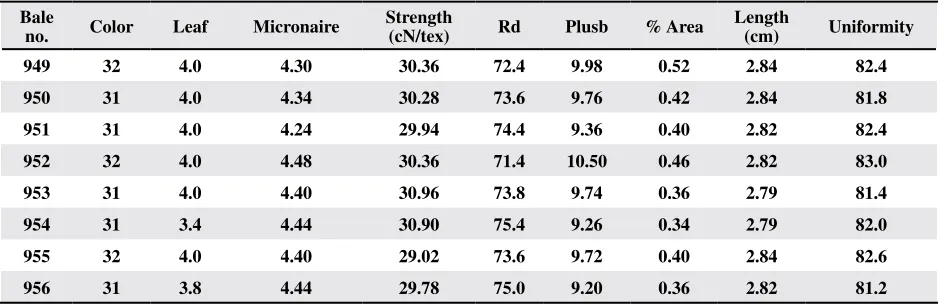
Agricul-tural Marketing Service are reported in Table 3 and identify the marketing properties of the bales. The data indicates that the fiber properties were similar between the bales. Differences in HVI properties have no practical significance.
Bale weights after the first phase of storage without bagging and RH or temperature control ranged from 229 to 238 kg (504 to 524 lb). After 81 d, estimated bale moisture contents averaged 5.9% and ranged from 5.6 to 6.3%. The tie force and the change in bale tie force during storage were sig-nificantly different (P < 0.0001) for platen and days of storage, but the interaction was not significantly different (P = 0.96). Comparisons cannot be drawn between the tie force for the bales compressed with the different platens because of differences in the compression densities and moisture contents, but the data is presented for informational purposes, since the change in tie forces are meaningful.The average initial bale tie forces when the bales were first removed from the press were 2523, 2528, and 3289 n (567, 568, and 739 lb) for the flat, standard, and cast platens, respectively. When the bales were actually placed in the storage later that day after all the bales were ginned, bale tie force had increased
about 300n (67 lb) (Fig. 4). After 3 d of storage, bale tie forces were 3222, 3222, and 4036 kg (724, 724, and 907 lb) for the flat, standard, and cast platens, respectively. After 81 d of storage, tie forces were 3057, 3324, and 3943 n (687, 747, and 886 lb) for the flat, standard, and cast platens, respectively. Means for the entire storage period were 3253, 3431, and 4143 n (731, 771, and 931 lb) for the flat, standard, and cast platens, respectively.
Fig. 4. Bale tie tension as a function of days in storage for the three types of platens in Phase I.
Table 3. Initial High Volume Instrument (HVI) data of the fiber quality of the bales
Bale
no. Color Leaf Micronaire Strength (cN/tex) Rd Plusb % Area Length (cm) Uniformity
949 32 4.0 4.30 30.36 72.4 9.98 0.52 2.84 82.4
950 31 4.0 4.34 30.28 73.6 9.76 0.42 2.84 81.8
951 31 4.0 4.24 29.94 74.4 9.36 0.40 2.82 82.4
952 32 4.0 4.48 30.36 71.4 10.50 0.46 2.82 83.0
953 31 4.0 4.40 30.96 73.8 9.74 0.36 2.79 81.4
954 31 3.4 4.44 30.90 75.4 9.26 0.34 2.79 82.0
955 32 4.0 4.40 29.02 73.6 9.72 0.40 2.84 82.6
956 31 3.8 4.44 29.78 75.0 9.20 0.36 2.82 81.2
2650 2850 3050 3250 3450 3650 3850 4050 4250 4450 4650
0 4 10 12 14 18 20 24 26 28 32 34 52 54 56 60 63 68 73 75 77 81
T
e
n
s
io
n
(N)
Flat Standard
Cast Average
Days in storage
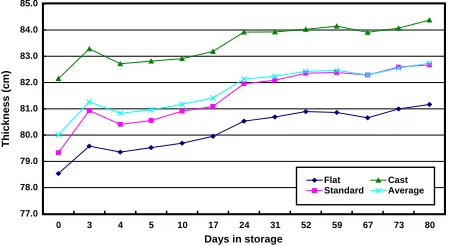
The average bale thickness at the hump was sig-nificantly different (P < 0.001) for platens, but days of storage was not significant (P = 0.62). Again, the differences in compression densities and moisture contents restrict comparison of the thickness data, but the data is presented for reference purposes. The average bale thickness at the hump for the entire storage period was 82 cm (32.3 in) across all bales and was 80.3, 81.3, 83.6 cm (31.6, 32.0, and 32.9 in) for the flat, standard, and cast platens, respectively. The thickness for each type platen after each storage period is plotted against days of storage in Fig. 5.
Phase II.The types of bagging material used in
polyeth-ylene strips to prevent fibrillation, as well as similar bags that were fully coated on the interior to reduce contamination. The change in bale weight, in average bale thickness at the hump, and in bale tie tension were significantly different (P < 0.001) for type of bagging and days of storage, but the interaction was not significantly different. on average, bale weights increased 2%, and increased 2.3, 2.2, 2.0, and 1.5% for stripped-Brown, striped-Amoco, full-Amoco, and full-Langston bagging, respectively (Fig. 6). Weight increases averaged for the entire storage period were 1.48, 1.35, 1.25, and 0.8% for stripped-Brown, striped-Amoco, full-striped-Amoco, and full-Langston, respectively. The full-Langston bagging gained weight at a lower rate than for the other bags.
Fig. 5. Thickness of the bale averaged across all seven “humps” as a function of days in storage for the three types of platens for Phase I.
77.0 78.0 79.0 80.0 81.0 82.0 83.0 84.0 85.0
0 3 4 5 10 17 24 31 52 59 67 73 80
Th
ic
kn
es
s
(c
m)
Flat
Standard CastAverage
Days in storage
0.00 0.50 1.00 1.50 2.00 2.50
0 10 20 30 40 50 60 70 80 90 100
W
ei
gh
tc
ha
ng
e
(%)
Striped-Brown Striped-Amoco Full-Amoco Full-Langston
Days in storage
Fig. 6. Weight gain (%) as a function of days in storage at 26.7 ºC (80 °F) and 80% RH for universal density bales covered in four types of bagging for Phase II.
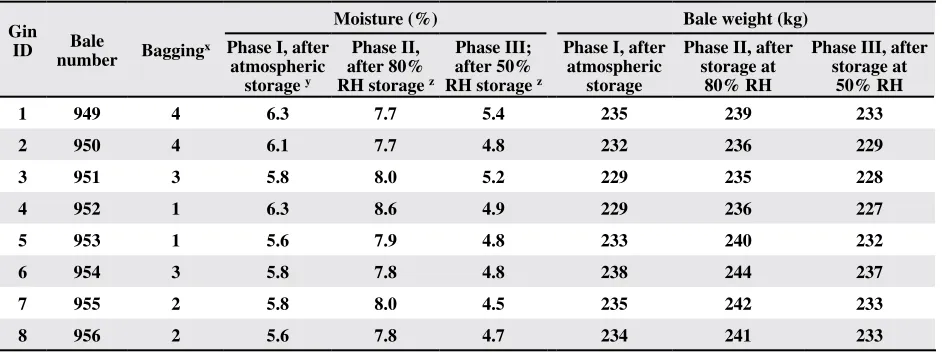
Final moisture contents were not measured since the bales were scheduled for further testing, but were estimated to be about 7.9% based on the weight gain and the initial moisture. Based on initial moisture contents of 6.3, 6.1, 5.8, 6.3, 5.6, 5.8, 5.8, and 5.6% estimated for bales and the weight gain, final bale moistures after storage at 80% RH were 7.7, 7.7, 8.0,
8.6, 7.9, 7.8, 8.0, and 7.8% for bales 949 through 956, respectively.
Bale tie tension started different levels but ap-peared to follow the same trends for all three platens (Fig. 7). The bale tie force increased about 10% due to the moisture gain initially, but then stabilized for the remainder of the storage period. The average tie force was 4285, 4200, 4614, and 4307 for stripped-Brown, striped-Amoco, full-Amoco, and full-Langs-ton bagging, respectively, which indicates tie forces were similar for all types of bagging.
3500 3700 3900 4100 4300 4500 4700 4900
0 10 20 30 40 50 60 70 80 90 100
Ti
e
Fo
rc
e
(N)
Days in storage
Striped-Brown Striped-Amoco Full-Amoco Full-Langston
Thickness in the bale at the measured hump generally increased by 0.51 to 1.27 cm (0.2 up to 0.5 in) due to the type of bagging. Bale thickness was different as a result of the types of bagging but followed the same trend with day of storage (Fig. 8). The thickness of the bale increased initially and then remained relatively constant for the remainder of the storage period. The average thickness across the entire storage period was 85.27, 85.47, 85.83, 84.84 for stripped-Brown, striped-Amoco, full-Amoco, and full-Langston bags, respectively.
Fig. 7. Tie force (N) as a function of days in storage at 26.7 ºC (80 °F) and 80% RH for universal density bales covered in four types of bagging for Phase II.
83.0 83.5 84.0 84.5 85.0 85.5 86.0 86.5 87.0
0 10 20 30 40 50 60 70 80 90 100
Th
ic
kn
es
s
at
hu
m
p
(c
m)
Striped-Brown Striped-Amoco
Full-Amoco Full-Langston
Days in storage
Table 4. Moisture and bale weight after storage for Phases I, II, and III
Gin
ID numberBale Baggingx
Moisture (%) Bale weight (kg)
Phase I, after atmospheric
storage y
Phase II, after 80%
RH storage z
Phase III; after 50%
RH storage z
Phase I, after atmospheric
storage
Phase II, after storage at
80% RH
Phase III, after storage at
50% RH
1 949 4 6.3 7.7 5.4 235 239 233
2 950 4 6.1 7.7 4.8 232 236 229
3 951 3 5.8 8.0 5.2 229 235 228
4 952 1 6.3 8.6 4.9 229 236 227
5 953 1 5.6 7.9 4.8 233 240 232
6 954 3 5.8 7.8 4.8 238 244 237
7 955 2 5.8 8.0 4.5 235 242 233
8 956 2 5.6 7.8 4.7 234 241 233
x Type 1 = striped-Brown, 2= striped-Amoco, 3 = full-Amoco, 4 = full-Langston. Bagging was not applied until the start of
Phase II.
y Initial oven-based moistures were 5.2, 4.8, 4.8, 4.7, 4.7, 5.0, 4.7, and 4.8% for bales 1-8, respectively.
z Bale moisture estimated based on initial moisture and weight changes during storage.
Table 5. Bale thickness and tie force after storage for Phase I, II, and III
Gin
ID numberBale Baggingz
Thickness (cm) Tie force (N)
Phase I, after atmospheric
storage
Phase II, after 80% RH storage
Phase III, after 50% RH storage
Phase I, after atmospheric
storage
Phase II, after storage at
80% RH
Phase III, after storage at
50% RH,
1 949 4 80.87 83.03 82.87 3115 4130 2055
2 950 4 84.30 86.04 85.88 3742 4753 2375
3 951 3 81.46 84.46 83.82 3088 4001 1873
4 952 1 84.18 86.04 85.57 3609 4526 1877
5 953 1 82.84 84.30 84.14 3244 4147 1793
6 954 3 84.66 87.16 86.36 4481 5296 2438
7 955 2 82.41 85.09 84.61 3311 4134 1761
8 956 2 82.75 86.04 85.09 3426 4268 1721
z Type 1 = striped-Brown, 2= striped-Amoco, 3 = full-Amoco, 4 = full-Langston. Bagging was not applied until the start of
Phase II.
Phase III. Initial moisture content of the bales
for Phase III was assumed to be the final bale weight for Phase II adjusted for weight change during the 10 d that elapsed while the bales were not in a controlled environment. Initial weight and thickness measure-ments were taken on the first day of Phase III.
The change in bale weight change, bale thickness at the hump, and bale tie tension were significantly different (P < 0.001) for type of bagging, days of storage, but the interaction was not significant. The bale weight, moisture, tie force, and thickness data at the conclusion of Phase III are summarized in Tables 4 and 5. Bale weight decreased an average of 2.44, 2.25, 1.73, and 1.61% for stripped-Brown,
Fig. 9. Bale weight change (kg) as a function of days in storage at 21.1 °C (70 °F) and 50% RH for Phase III.
-8 -7 -6 -5 -4 -3 -2 -1 0
0 12 24 35 52 69 98 132 160 179 228 251 279 297
W
ei
gh
t(
kg
)
Striped-Brown Striped-Amoco Full-Amoco Full-Langston Means
Days in storage
0 500 1000 1500 2000 2500 3000 3500 4000 4500
0 25 50 75 100 125 150 175 200 225 250 275 300
Ti
e
Fo
rc
e
(N)
Days in storage
Striped-Brown Striped-Amoco Full-Amoco Full-Langston Means
Fig. 10. Tie force (N) as a function of days in storage at 21 °C (70 °F) and 50% RH for Phase III.
-1.2 -1.0 -0.8 -0.6 -0.4 -0.2 0.0 0.2 0.4 0.6
0 7 14 21 28 35 45 55 66 76 98 125 137 153 166 176 203 228 244 255 275 286 297
C
ha
ng
e
in
th
ic
kn
es
s
(c
m)
Stripped Full
Days in storage
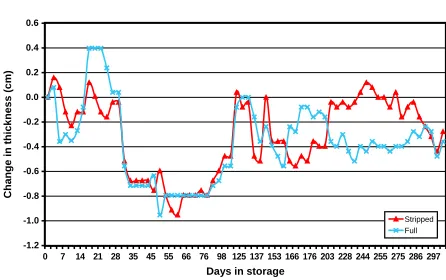
Fig. 11. Bale thickness (cm) at humps for the strip-coated and fully coated bales for days in storage at 21.1 °C (70 °F) and 50% RH for Phase III.
rounded portion of the bales is soft. In addition, the thickness was only measured at one hump for Phase III compared to the average for all seven humps for Phases I and II. Apparently the variability in the measurement technique dictates the need for mul-tiple measurements. The bales generally decreased about 0.34 cm (0.30 to 0.39 cm) during storage at 50% RH.
SUMMARY AND CONCLUSIONS
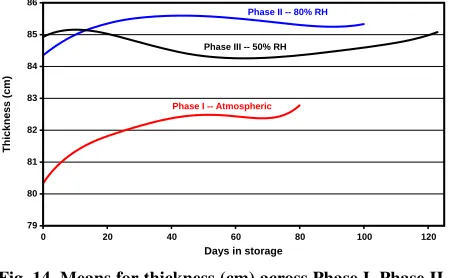
The response of bale weight to storage condi-tions is shown in Fig. 12 for all three phases. The bales gained moisture (weight) for Phases I and II but lost moisture for Phase III due to the lower humidity. Weight was gained at about the same rate that it was lost (2% per 100 d). Bale tie force changed over time as atmospheric conditions fluctuated; they increased in storage at 80% RH and then decreased during stor-age at 50% RH (Fig. 13). Bale thickness increased initially after storage as climatic conditions fluctu-ated during Phase I (Fig. 14). During Phase II at 80% RH, bale thickness increased, but during Phase III at 50% RH, the thickness decreased. It appears that bale thickness measurements fluctuated substantially due to measurement techniques, so the technique needs improvement. The bale thickness averaged 81.9 cm (32.25 in) at the beginning of Phase I and was 82.7, 85.3, and 84.8 cm (32.55, 33.58, and 33.38 in) after Phases I, II, and III. The change in tie force appeared to be consistent across types of bagging and the changes were due the different moisture contents as climatic conditions changed. These bags all had simi-lar structural strengths and provided some restraint of the cotton fiber. Weak bags such as polyethylene film might exhibit different levels of tie force since the bagging does not assist in bale restraint.
The bales covered in the experimental bags were less responsive to changes in climatic conditions due to the coating of linear low density polyethylene. Bales covered in the standard woven polypropylene strip-coated bagging and experimental woven poly-propylene fully coated bags changed weight by 2.19, 1.42, and -2.35%, and 2.08, 1.02, and -1.67% after storage at ambient conditions, 80% RH and 50% RH, respectively. In general, bale weight (moisture), tie force, and bale thickness respond substantially
- 4 - 3 - 2 - 1 0 1 2 3
0 50 100 150 200 250 300
W
ei
gh
tc
ha
ng
e
(%) Phase II -- 80% RH
Phase III -- 50% RH
Phase I -- Uncontrolled RH
Days in storage
Fig. 13. Means for tie force (N) across Phase I, Phase II, and Phase III. Data for days 100-305 in Phase III were not substantially different from day 100 and are not shown in order to provide adequate resolution in this figure.
1500 2000 2500 3000 3500 4000 4500 5000
0 10 20 30 40 50 60 70 80 90 100
Ti
e
fo
rc
e (N)
Phase II -- 80% RH
Phase I -- Atmospheric
Phase III -- 50% RH
Days in storage
79 80 81 82 83 84 85 86
0 20 40 60 80 100 120
Th
ic
kn
es
s
(c
m)
Phase I -- Atmospheric
Phase II -- 80% RH
Phase III -- 50% RH
Days in storage
Fig. 14. Means for thickness (cm) across Phase I, Phase II, and Phase III. Data for days 125-305 in Phase III were not substantially different from day 120 and are not shown in order to provide adequate resolution in figure.
to changes in climatic conditions during long term storage. The two experimental bags do not gain or lose weight (moisture) as rapidly as the standard bags and will not be fully acceptable to industry. other bags with better moisture transfer characteristics will likely be developed. Bale weights, bale thicknesses, and tie forces will be dynamic until the bales fully equilibrate with a constant environment.
DISCLAIMER
Mention of a trade names or commercial prod-ucts in the publication is solely for the purpose of providing specific information and does not imply recommendation or endorsement by the U. S. Depart-ment of Agriculture.
REFERENCES
American Society for Testing and Materials (ASTM). 1971. Standard method of test for moisture in cotton by oven-drying, D 2495. p. 419-426. In Annual Book of ASTM Standards, Part 25. ASTM, West Conshohocken, PA. Anthony, W.S. 1982. Effect of bale covering and density on
moisture gain of cotton bales. Cotton Ginners’ J. and yearbook 50:7-18.
Anthony, W.S. 1997. Solving gin-related cotton bale tie fail-ures. Cotton Gin and oil Mill Press 98(24): 5-11. Anthony, W. S. 2000. Forces exerted on cotton bales with six-
and eight-tie patterns of steel strapping. Appl. J. ASAE 16(1):23-30.
Anthony, W. S. 2001. Concept to reduce cotton bale packag-ing forces. Appl. J. ASAE 17(4):433-440.
Anthony, W. S. 2002. Comparison of compression character-istics of flat and shaped platens. Unpaginated CDRoM. In Proc. Beltwide Cotton Conf., Atlanta, GA. 7-12 Jan. 2002. natl. Cotton Counc. Am., Memphis, Tn. Anthony, W. S. and D.J. Herber. 1991. Moisture transfer of
cotton bales covered with experimental bagging. p. 978-980. In Proc. Beltwide Cotton Conf., San Antonio, TX. 8-12 Jan. 2002. natl. Cotton Counc. Am. Memphis, Tn. Barker, G.L. and J.W. Laird. 1993. Drying humidification
rates for cotton lint. Trans. ASAE 36(6):1555-1562. Valco, T. D., and B. norman. 2004. Cotton ginning trends. p.