VOLUME 36, ARTICLE 61, PAGES 1859
,
1888
PUBLISHED 27 JUNE 2017
http://www.demographic-research.org/Volumes/Vol36/61/ DOI: 10.4054/DemRes.2017.36.61
Research Article
The change in single mothers’ educational
gradient over time in Spain
Anna Garriga
Clara Cortina
This publication is part of the Special Collection on “Separation, Divorce, Repartnering, and Remarriage around the World,” organized by Guest Editors Benoît Laplante and Andrew Cherlin.
© 2017 Anna Garriga & Clara Cortina.
This open-access work is published under the terms of the Creative Commons Attribution NonCommercial License 2.0 Germany, which permits use, reproduction & distribution in any medium for non-commercial purposes, provided the original author(s) and source are given credit.
1 Introduction 1860
2 Background 1861
3 Research questions 1865
4 Data and methods 1865
4.1 Population censuses 1865
4.2 Sample selection and variables 1867
5 Results 1869
5.1 Diversification of family structures and educational profiles 1869 5.2 Change over time in the educational gradient of single motherhood 1871 5.3 Change over time in the educational gradient of single motherhood
by age group
1875
6 Summary and discussion 1879
7 Acknowledgements 1880
References 1881
The change in single mothers’ educational gradient over time in
Spain
Anna Garriga1
Clara Cortina2
Abstract
BACKGROUND
Family structures changed enormously during the latter decades of the 20th century,
with the diffusion of less-common family forms, especially among low-educated women. Previous research suggests that in Spain these changes have taken place in a very short period of time.
OBJECTIVE
The aim of this paper is, specifically, to analyse the educational gradient of single-mother families and its evolution in recent decades, focusing on age differences.
METHODS
We use the 1991, 2001, and 2011 Spanish population censuses and apply logistic regression analysis. Our investigation focuses on non-widowed mothers with children under 18.
RESULTS
Results show how the educational gradient of single motherhood reversed between 1991 and 2011. Our analyses reveal differences by age. While mothers younger than 30 present a consistent and even increasingly negative educational gradient across the whole period, the reversal applies to older mothers. It is this reversal that has resulted in changing a positive to a negative or neutral educational gradient.
CONCLUSIONS
The diversification of educational profiles of Spanish mothers’ family structures is a process that is here to stay.
CONTRIBUTION
The article contributes to understanding the consequences of the diversification of family structures in the context of an economic crisis in which education is becoming increasingly important in determining mothers’ and children’s opportunities.
1. Introduction
Family structures changed enormously during the later decades of the 20th century, with
the introduction of some new family forms (Martin and Kats 2003; Cherlin and Seltzer 2014). Over the last century the percentage of children living in single-parent families has increased substantially in most Western societies. However, nowadays one of the most important social changes is not the increase in family complexity per se but rather the fact that this has become more common among low-educated women (McLanahan 2004). Several researchers have highlighted the potential consequences of socioeconomically uneven family change on children’s well-being and living conditions (McLanahan and Percheski 2008; Putnam 2015). In spite of the importance of this question, previous research has mainly focused on the United States and has not considered if this social trend diverges between historical periods or generations (see McLanahan 2004; Härkönen 2014; McLanahan and Jacobsen 2015).
There is some evidence that the transformation of the social composition of family structures has not occurred at the same pace across all Western societies (Härkönen 2014). Data from the 1990s and early 2000s showed that highly educated women in Spain were more likely to live in single-parent families (Treviño 2006; Flaquer, Almeda, and Navarro 2006; Garriga 2010), while the opposite was true in Northern Europe (Kennedy and Thomson 2010; Turunen 2011). However, Garriga, Sarasa, and Berta (2015), using EU-SILC data from waves 2005 and 2011, find that the relationship between mother’s educational level and being a single mother is negative in Spain, while it is not significant in Italy. Hence, results from previous research suggest that in Spain the change in the educational gradient of single motherhood has occurred in a very short period of time, which may in fact be shorter than in other Western countries, and may have taken place during the early part of the last decade (Garriga, Sarasa, and Berta 2015; Härkönen 2014).
period of two decades is especially suited to capturing the magnitude of the effects of the radical social, cultural, and economic transformation that Spain has experienced since the beginning of democracy in the late 1970s. This data is also useful for observing the relationship between education and family structures in very different historical periods characterized by very different economic situations: the most important economic growth in recent Spanish history during the period 1995–2007 and one of Spain’s most important economic recessions in the period since 2007 (IVIE 2011).
We analyse how the relationship between education and single motherhood has changed over time and when it in fact happened. Is the polarization of mothers’ family structures by educational level a deep process in Spanish society? Our main findings show that the educational gradient of diversification of family structures is a process that is here to stay. We observe that between 1991 and 2011 the educational gradient of single motherhood changed from positive to negative. Our analyses also reveal differences by age, since the change in educational gradient over time is different in each age group. Mothers younger than 30 are the most disadvantaged, as since the 1990s the relationship between education and single motherhood has been negative for this age group; furthermore, this disadvantage has intensified over time. Mothers in their thirties experienced a change in their educational gradient from positive in 1991 to negative in 2011. Among mothers in their forties the relationship between education and single motherhood varies, from positive in 1991 to non-existent in 2011, while for mothers in their fifties this relationship is positive in all census years but its magnitude lessens over time.
The structure of the paper is as follows: firstly, we present the empirical and theoretical background on which the research questions are grounded; secondly, we specify the data and methods used (sample, variables, plan of analysis); thirdly, we present the main results (descriptive figures followed by logistic regression models); and, finally, we discuss the contribution of our results and their key limitations.
2. Background
Single parenthood of non-widowed mothers is the result of parental separation or childbearing by single mothers. Compared with the United States, the latter source of single parenthood is uncommon in Europe (except in the United Kingdom and Ireland) (Part et al. 2013). Single-parent families in Europe are mainly formed through dissolution of married or cohabiting unions (Heuveline, Timberlake, and Furstenberg 2003). Marital instability increased all over Europe during the second half of the 20th
(Sobotka and Toulemon 2008). Spain is clearly a late-comer to this transformation process, partially due to the only very recent legal changes: the first Divorce Law was approved in 1981 and reformed in a very liberal way in 2005. But the increase in the crude divorce rate in Spain has been quite remarkable and has recently reached similar levels to those of Central and Northern European countries: from a crude divorce rate of 0.6 in 1990, in 2014 it was 2.3 (Spanish Statistical Office). The number of cohabiting unions producing a child has also grown in Europe, and it is well known that these unions are at greater risk of separation than marriages (Kiernan 2002). The percentage of cohabitating unions has grown in Spain, especially among young adults (Castro-Martín and Seiz 2014) and the percentage of births to unwed mothers (where most of them occurred in cohabiting couples) has increased from 10% in 1990 to 41% in 2013 (Spanish Statistical Office). Thus, these findings suggest that parental separation, which is the main source of single parenthood in the Spanish context, has experienced a spectacular increase during the last two decades.
The diffusion process of divorce has been shown to imply a reversal of the relationship between education and divorce: in Western European countries the highest risk of union dissolution is nowadays observed among women with lower education (Härkönen and Dronkers 2006). This reversal was predicted by William Goode (Goode 1993), who explained it through the lower costs of acquiring divorced status. He argues that the relationship between class and family instability depends on the extent to which divorce is easily acquired and diffused. When divorce is rare, highly educated women are in the vanguard of change because they have the means to deal with restrictive legislation and the financial and social costs associated with separation. By contrast, when economic, social, and legal barriers fall and divorce is widespread, marital instability becomes more frequent among the lower classes, since the economic strain that lower class marriages experience increases their risk of divorce (Bernardi and Martínez-Pastor 2011).
study women with children. Similar differences are observed in England and the USA, where the association between education and cohabitation is much greater for women with children than it is for all women (see McLanahan and Jacobsen 2015). McLanahan and Jacobsen (2015: 18) explain these different results by arguing that “whereas highly educated women may be more willing and able to experiment with new ideas and lifestyles than less educated women, their motivation may change once they decide to become mothers.”
Changes over time in single motherhood profiles have been mostly explained using a period framework. One of the crucial theories, the well-known “diverging destinies” argument (McLanahan 2004), argues that changes in family behaviours, such as the growth in single motherhood since the early 1960s, are driving a polarization in children’s opportunities depending on the socioeconomic status of the mother. Four factors of polarization are suggested: the development of birth control technologies, the second wave of the feminist movement, changes in the labour market, and an increase of welfare policies for unmarried mothers. Feminism and birth control technologies encourage and allow women to pursue education and/or a career and these factors lead to a destigmatization of single motherhood, cohabitation, and divorce. Changes in labour-market conditions lead to a decrease in employment and earnings among lower-skilled men, which make them less marriageable (Oppenheimer, Kalmijn, and Lim 1997). Finally, income-tested benefits increase educational differentials by family structure, but universal benefits may actually reduce them (McLanahan and Jaconson 2015).
on families is substantially lower than in other countries (e.g., 3.5% of GDP in Sweden), and therefore Spanish family policies are not able to stabilize marriages by reducing the economic strain.
Table 1: Socioeconomic characteristics by sex and public expenditure on family, Spain 1991–2011 (figures expressed in percentages)
1991 2001 2011 Women with tertiary education aged 25 to 64 11.4 23.2 33.3 Men with tertiary education aged 25 to 65 14.2 24.3 30.5 Women with tertiary education aged 25 to 34 21.6 38.9 45.7 Men with tertiary education aged 25 to 34 19.5 32.0 35.5 Women employment rate aged 20 to 64 34.5 46.3 56.1 Men employment rate aged 20 to 64 73.0 77.8 67.7
Women unemployment rate 22.6 15.2 21.8
Men unemployment rate 11.6 7.5 21.1
Percentage disagree: A child needs a home with a
father and a mother to grow up happily 7.0 13.0 25.0 Public expenditure on families as a % of the GDP 0.3 1.0 1.5
Source: Eurostat, OECD Family Database, World Values Survey
Notes: Employment rate and education are measured in 1992. Public expenditure on families is measured in 1990.
Percentage of those that disagree that a child needs a father and a mother to grow up happily measured in 1990, 1999, and 2008.
Finally, understanding the phenomenon of single motherhood also requires taking into account the repartnering dynamics and age profiles of the mothers. Firstly, single mothers are those who do not exit that state by forming a stepfamily. Although there has been very little research on repartnering in Spain, there is evidence to illustrate that there has been a relative intensification of repartnering, measured through the increase in the ratio of stepfamilies to single-parent families – from 11 repartnered-mother families for each single-mother family in 1999, to 25 in 2010 (Treviño and Gumà 2013).
Spain is associated with a high risk of union dissolution (Castro-Martín and Seiz 2014); and iv) there are more cohabiting mothers among the lower-educated (Hu, Garriga, and Flaquer 2016).
3. Research questions
We want to analyse the educational gradient of single mothers and its evolution across Spanish cohorts born in the second half of the 20th century. Considering the impact of
new patterns of union dissolution and the specificities of the social profiles of young mothers, we formulate the following research questions:
a) What is the role of single motherhood in the diversification of family structures in Spain in the late 20th and early 21st centuries?
b) To what extent is the increase in single-mother families associated with a reversal in their educational gradient over time?
c) Is this reversal in the educational gradient of single mothers to be found in all age ranges?
4. Data and methods
4.1 Population censuses
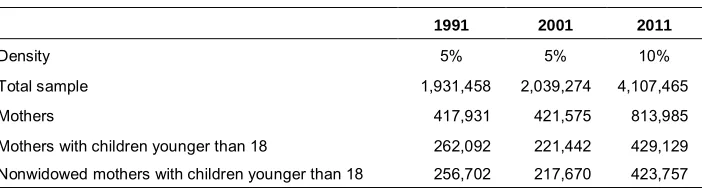
Table 2: Sample size Spanish population censuses 1991, 2001, and 2011
1991 2001 2011
Density 5% 5% 10%
Total sample 1,931,458 2,039,274 4,107,465
Mothers 417,931 421,575 813,985
Mothers with children younger than 18 262,092 221,442 429,129 Nonwidowed mothers with children younger than 18 256,702 217,670 423,757
Source: Spanish population censuses 1991, 2001, and 2011
Notes: Unweighted data. 2011 is a real sample while 1991 and 2001 are random samples of cases of an exhaustive census.
The household structure in the census information is used as the basis for classifying family types (the 1991 dataset has some restrictions and does not allow distinguishing stepfamilies). We can, for example, measure the incidence of single-parent families, but some inconsistencies appear. The Spanish census registers a surprisingly high proportion of married single mothers living with a child younger than 18: 19.7% in 1991, 26% in 2001, and 23% in 2011. Alternative datasets offer a very different proportion of married single mothers: The Labour Force Survey for 2011 shows a figure of 11%; the EU-SILC for 2005 and 2011 shows a figure of 13%; and the Encuesta Continua de Vidas Laborales for 2013 shows a figure of 8%. These differentials suggest that the census could be capturing ‘false’ single mothers and we should take into account the potential biasing effect of this problem.
There are several possible explanations for this unexpected composition by marital status: i) residential separation in migration contexts; ii) transition situations in separation processes (Treviño 2006 suggests that married single mothers have become single mothers more recently, on average); iii) false single-parenthood status. In order to control for the potential bias of considering such a heterogeneous group, we have conducted robustness checks on our results by replicating the analysis without married single mothers, obtaining no significant differences.
previous experience of a step-parent family (or might in the future), and repartnered mothers have experienced a period of single motherhood.
4.2 Sample selection and variables
We first select families with at least one child younger than 18, excluding single-father families. We then reduce our sample to mothers living in a household with at least one child younger than 18 because our analysis is focused on females. We finally exclude widowed mothers from our sample, which gives a reduction of 2.1% in 1991, 1.7% in 2001, and 1.3% in 2011. The proportion of widowed mothers with young children lessens over time, as does its importance as a way of entry into single motherhood (from 25% of widowed single mothers in 1991 to only 6% two decades later). Excluding them from the sample is consistent with our research interests and hypotheses, which focus on family structures resulting from individual decisions. The crucial decision that leads to single motherhood is certainly union dissolution, while separation of partners due to migration (there is a partner but there is no coresidence), single mothers by choice (those who decided to have a child without a partner), and unplanned births (Part et al. 2013) are only second or third in order of importance. Table 2 shows the size of the selected sample for each of the three census years.
Our main variable of interest is type of family, which we classify in two categories: two-parent family (families consisting of a father and mother with at least one child, and families comprising a repartnered mother who has at least one child); and single-mother family (formed by one mother with at least one child).3
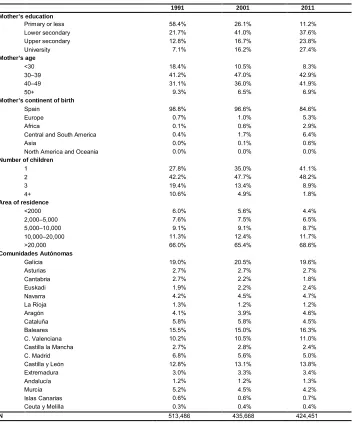
In our analysis we consider a set of individual characteristics of the mother and some characteristics at the family level. At the individual level we use age (grouped in four categories: younger than 30 years, adults between 30 and 39 years of age, adults between 40 and 49 years of age, adults with completed reproductive life aged 50 or older); educational attainment level (grouped in four categories: primary or less, lower secondary, upper secondary, and university); mother’s country/continent of birth (Spain, Europe, Africa, Central and South America, Asia, and North America and Oceania). Table 3 presents the composition of the sample in the three censuses according to these variables. The figures show, for example, the extraordinary process of educational expansion experienced by Spanish society over this period: mothers with university education have moved from 7% to 27% in just two decades.
Table 3: Descriptive figures of the variables included in the multivariate analysis, Spain (non-widowed mothers with children under 18)
1991 2001 2011
Mother’s education
Primary or less 58.4% 26.1% 11.2%
Lower secondary 21.7% 41.0% 37.6%
Upper secondary 12.8% 16.7% 23.8%
University 7.1% 16.2% 27.4%
Mother’s age
<30 18.4% 10.5% 8.3%
30–39 41.2% 47.0% 42.9%
40–49 31.1% 36.0% 41.9%
50+ 9.3% 6.5% 6.9%
Mother’s continent of birth
Spain 98.8% 96.6% 84.6%
Europe 0.7% 1.0% 5.3%
Africa 0.1% 0.6% 2.9%
Central and South America 0.4% 1.7% 6.4%
Asia 0.0% 0.1% 0.6%
North America and Oceania 0.0% 0.0% 0.0%
Number of children
1 27.8% 35.0% 41.1%
2 42.2% 47.7% 48.2%
3 19.4% 13.4% 8.9%
4+ 10.6% 4.9% 1.8%
Area of residence
<2000 6.0% 5.6% 4.4%
2,000–5,000 7.6% 7.5% 6.5%
5,000–10,000 9.1% 9.1% 8.7%
10,000–20,000 11.3% 12.4% 11.7%
>20,000 66.0% 65.4% 68.6%
Comunidades Autónomas
Galicia 19.0% 20.5% 19.6%
Asturias 2.7% 2.7% 2.7%
Cantabria 2.7% 2.2% 1.8%
Euskadi 1.9% 2.2% 2.4%
Navarra 4.2% 4.5% 4.7%
La Rioja 1.3% 1.2% 1.2%
Aragón 4.1% 3.9% 4.6%
Cataluña 5.8% 5.8% 4.5%
Baleares 15.5% 15.0% 16.3%
C. Valenciana 10.2% 10.5% 11.0%
Castilla la Mancha 2.7% 2.8% 2.4%
C. Madrid 6.8% 5.6% 5.0%
Castilla y León 12.8% 13.1% 13.8%
Extremadura 3.0% 3.3% 3.4%
Andalucía 1.2% 1.2% 1.3%
Murcia 5.2% 4.5% 4.2%
Islas Canarias 0.6% 0.6% 0.7%
Ceuta y Melilla 0.3% 0.4% 0.4%
N 513,486 435,668 424,451
At the family level we take into account the number of children (four categories) and two contextual variables referring to the geographical heterogeneity within Spain: region of residence (consisting of the 17 Comunidades Autónomas – NUTS 2 with an important degree of legislative autonomy and cultural diversity) and area of residence or degree of urbanization (urban/rural), coded in five categories according to the number of inhabitants (small municipalities with less than 2,000 inhabitants, small-medium with 2,000–5,000, small-medium with 5,000–10,000, small-medium-large 10,000–20,000, and cities with more than 20,000). Finally, we consider the census year in order to explore the changes over time.
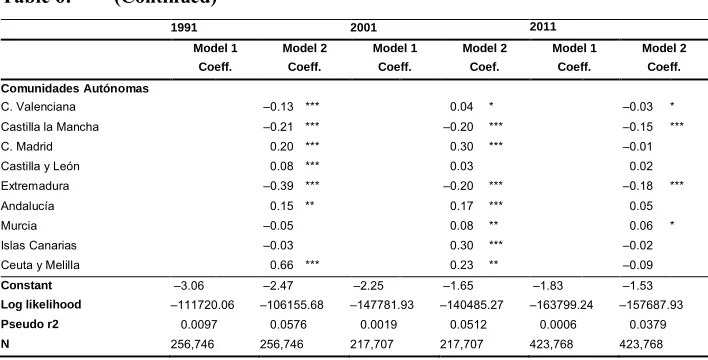
Our main interest is to explore the educational profile of mothers in different types of family and to assess the changes in the educational gradient associated with single motherhood. To do so, we apply logistic regression models to our subsample of non-widowed mothers with children younger than 18. We first explore the effect of education in each census and we analyse how this effect has changed across censuses. We also control for a complementary set of variables: age, continent of birth, area of residence, region of residence, and number of children. Second, using a pooled dataset of the three population censuses (1991–2011) we introduce an interaction between the census year and the educational level of the mother, and a triple interaction between census year, educational level, and age of the mother. Predicted probabilities (with 95% confidence intervals) are computed and plotted for every model that includes interaction of variables.
5. Results
5.1 Diversification of family structures and educational profiles
only a relative increase of 20%. These findings led us to the second research question: to what extent is the increase in single-mother families associated with a change in their educational gradient?
Table 4: Distribution of nonwidowed mothers with children under 18, by family type and census year
1991* 2001 2011
N % N % N %
Two-parent family* 484,078 94.3 Mother and biological-father family 374,318 86.0 345,921 81.5
Single-mother family 29,408 5.7 Single-mother family 46,554 10.7 55,129 13.0
Mother and stepfather family 14,468 3.3 23,287 5.5
Total 513,486 100 Total 435,340 100 424,337 100
Source: Spanish Population Censuses 1991, 2001, and 2011
Notes: Weighted data. *For 1991 it is not possible to distinguish stepfather from biological father. The category ‘two-parent family’ includes a mother and a biological father or stepfather.
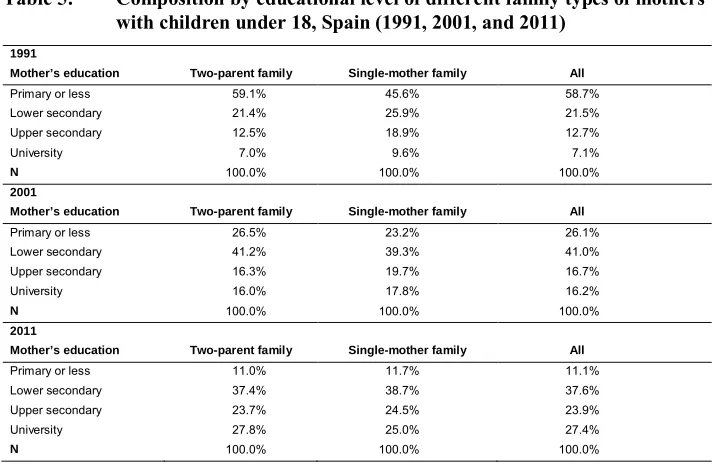
Table 5 presents the educational structure of mothers in different types of family, and the changes in this structure between 1991, 2001, and 2011. The aforementioned educational expansion affects all types of family, but we observe important educational differences across types. Descriptive results show a reversal of the educational gradient of single motherhood across census data. In 1991, mothers in single-mother families have a slightly higher educational level than mothers in two-parent families. In 2001 there are few educational differences between single mothers and mothers in two-parent families, while in 2011, single mothers have a lower educational level than those in two-parent families. These results are in accordance with findings from Garriga, Sarasa, and Berta (2015) using EU-SILC data from 2005 and 2011.
Table 5: Composition by educational level of different family types of mothers with children under 18, Spain (1991, 2001, and 2011)
1991
Mother’s education Two-parent family Single-mother family All
Primary or less 59.1% 45.6% 58.7%
Lower secondary 21.4% 25.9% 21.5%
Upper secondary 12.5% 18.9% 12.7%
University 7.0% 9.6% 7.1%
N 100.0% 100.0% 100.0%
2001
Mother’s education Two-parent family Single-mother family All
Primary or less 26.5% 23.2% 26.1%
Lower secondary 41.2% 39.3% 41.0%
Upper secondary 16.3% 19.7% 16.7%
University 16.0% 17.8% 16.2%
N 100.0% 100.0% 100.0%
2011
Mother’s education Two-parent family Single-mother family All
Primary or less 11.0% 11.7% 11.1%
Lower secondary 37.4% 38.7% 37.6%
Upper secondary 23.7% 24.5% 23.9%
University 27.8% 25.0% 27.4%
N 100.0% 100.0% 100.0%
Source: Spanish population censuses 1991, 2001, and 2011.
5.2 Change over time in the educational gradient of single motherhood
single mothers than those from Spain, while in 2011 only mothers born in Central or South America have a higher probability of being single mothers than Spanish mothers.
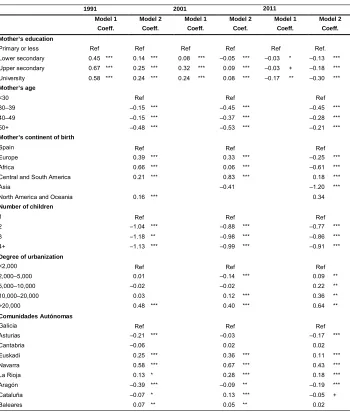
Table 6: Logistic regression of single-mother versus two-parent family
1991 2001 2011
Model 1 Model 2 Model 1 Model 2 Model 1 Model 2
Coeff. Coeff. Coeff. Coef. Coeff. Coeff.
Mother’s education
Primary or less Ref Ref Ref Ref Ref Ref.
Lower secondary 0.45 *** 0.14 *** 0.08 *** –0.05 *** –0.03 * –0.13 ***
Upper secondary 0.67 *** 0.25 *** 0.32 *** 0.09 *** –0.03 + –0.18 ***
University 0.58 *** 0.24 *** 0.24 *** 0.08 *** –0.17 ** –0.30 ***
Mother’s age
<30 Ref Ref Ref
30–39 –0.15 *** –0.45 *** –0.45 ***
40–49 –0.15 *** –0.37 *** –0.28 ***
50+ –0.48 *** –0.53 *** –0.21 ***
Mother’s continent of birth
Spain Ref Ref Ref
Europe 0.39 *** 0.33 *** –0.25 ***
Africa 0.66 *** 0.06 *** –0.61 ***
Central and South America 0.21 *** 0.83 *** 0.18 ***
Asia –0.41 –1.20 ***
North America and Oceania 0.16 *** 0.34
Number of children
1 Ref Ref Ref
2 –1.04 *** –0.88 *** –0.77 ***
3 –1.18 ** –0.98 *** –0.86 ***
4+ –1.13 *** –0.99 *** –0.91 ***
Degree of urbanization
<2,000 Ref Ref Ref
2,000–5,000 0.01 –0.14 *** 0.09 **
5,000–10,000 –0.02 –0.02 0.22 **
10,000–20,000 0.03 0.12 *** 0.36 **
>20,000 0.48 *** 0.40 *** 0.64 **
Comunidades Autónomas
Galicia Ref Ref Ref
Asturias –0.21 *** –0.03 –0.17 ***
Cantabria –0.06 0.02 0.02
Euskadi 0.25 *** 0.36 *** 0.11 ***
Navarra 0.58 *** 0.67 *** 0.43 ***
La Rioja 0.13 * 0.28 *** 0.18 ***
Aragón –0.39 *** –0.09 ** –0.19 ***
Cataluña –0.07 * 0.13 *** –0.05 +
Table 6: (Continued)
1991 2001 2011
Model 1 Model 2 Model 1 Model 2 Model 1 Model 2
Coeff. Coeff. Coeff. Coef. Coeff. Coeff.
Comunidades Autónomas
C. Valenciana –0.13 *** 0.04 * –0.03 *
Castilla la Mancha –0.21 *** –0.20 *** –0.15 ***
C. Madrid 0.20 *** 0.30 *** –0.01
Castilla y León 0.08 *** 0.03 0.02
Extremadura –0.39 *** –0.20 *** –0.18 ***
Andalucía 0.15 ** 0.17 *** 0.05
Murcia –0.05 0.08 ** 0.06 *
Islas Canarias –0.03 0.30 *** –0.02
Ceuta y Melilla 0.66 *** 0.23 ** –0.09
Constant –3.06 –2.47 –2.25 –1.65 –1.83 –1.53
Log likelihood –111720.06 –106155.68 –147781.93 –140485.27 –163799.24 –157687.93
Pseudo r2 0.0097 0.0576 0.0019 0.0512 0.0006 0.0379
N 256,746 256,746 217,707 217,707 423,768 423,768
Source: Spanish population censuses.
Notes: Weighted data. + p < 0.10; * p < 0.05; ** p < 0.01; *** < 0.001.
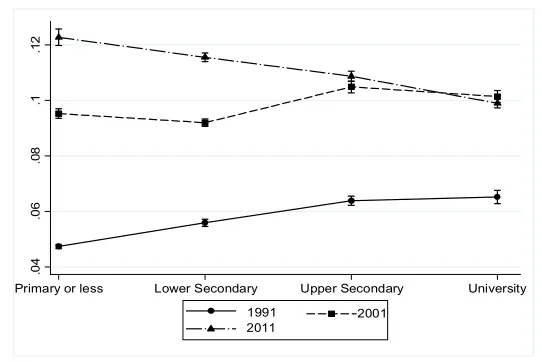
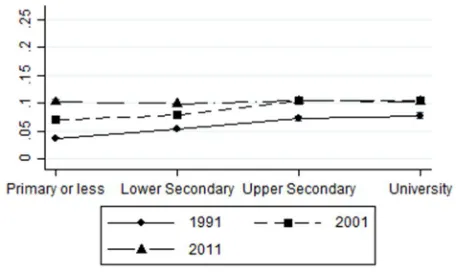
Figure 1: Predicted probabilities for the interaction between mother’s education and census year, single-mother versus two-parent family
Source: Spanish population censuses.
Notes: This figure is based on Model 1 in Appendix Table A-1.
Finally, we carry out a stricter statistical test of the educational differences between censuses. We estimate a multivariate model with data pooled from all census years. We include all the covariates and an interaction between the educational level and the census year. The coefficients of this interaction are significant (see Table A-1 in the Appendix). The results of the interaction are presented graphically through predicted probabilities in order to aid interpretation. Confidence intervals of the predicted probability of being a single mother are plotted in the graph. Each line corresponds to a level of the covariates, and each dot corresponds to a different educational level. Figure 1 confirms the results obtained with separate samples: the increase in single motherhood has not been proportional across educational levels and there is a reversal of the educational gradient in the probability of being a single mother across census years. For women with university education the probability of being a single mother is lower in 2011 than in 1991, while for women with primary education or less it is greater in 2011 than in 1991. However, do we find this same reversal across all age groups?
.0
4
.0
6
.0
8
.1
.1
2
Primary or less Lower Secondary Upper Secondary University
1991 2001
5.3 Change over time in the educational gradient of single motherhood by age group
In order to analyse the age pattern of the change in the educational gradient we test the three-way interaction between mother’s age (Model 3, Table A-1 in the Appendix), mother’s education, and census year, and find it to be significant. However, predicted probabilities based on the interaction between these three variables are complex and not easy to interpret. For this reason, we perform alternative two-way interactions: one between census and age and another four between census and education for each age group.
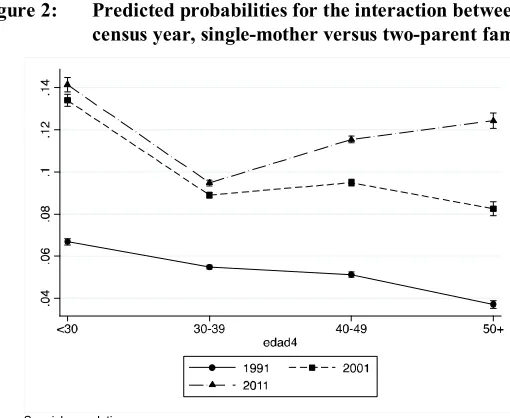
In Figure 2 we show the relationship between mother’s age and census year. In 1991 the predicted probability of being a single mother clearly decreases as mother’s age increases. In 2001 there is a greater chance of being a single mother among mothers younger than 30 than among older mothers but no substantial differences between older mothers. By contrast, in 2011 the relationship between mother’s age and the probability of single motherhood is curvilinear. The highest chances of being a single mother are found at the farthest edges of the age spectrum: among mothers younger than 30 and among those aged 50 years or older.
Figure 2: Predicted probabilities for the interaction between mother’s age and census year, single-mother versus two-parent family
Source: Spanish population censuses.
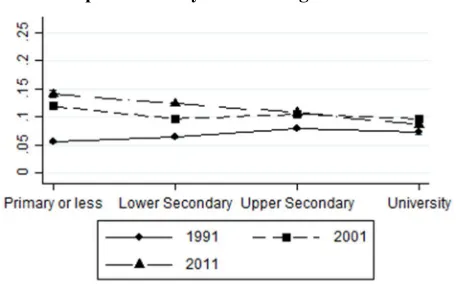
We present in Figures 3, 4, 5, and 6 the educational gradients of the probability of single motherhood in 1991, 2001, and 2011 for each age group. We observe that each mother’s age group has a different educational gradient together with a different evolution across census years. Figure 3 indicates that the educational gradient of mothers younger than 30 is clearly negative in all census years: the predicted probability of being a single mother is lower among those with higher education than among those with lower education. However, it is important to highlight that the negative gradient is more pronounced in 2011 than in 1991. By contrast, the following two age groups experience a change of sign of their educational gradient across census years. Figure 4 shows that there is a reversal of educational gradient between 1991 and 2011 among mothers aged 30 to 39 years: it is slightly positive in 1991, inexistent in 2001, and slightly negative in 2011. Figure 5 also displays a change in educational gradient among mothers aged 40 to 49 years, but no reversal is observed. The relationship between education and the probability of being a single mother is clearly positive in 1991. This positive slope is less pronounced in 2001 than in 1991 and there is no educational gradient in 2011. A comparison of Figures 4 and 5 indicates that the slope of the relationship between education and single motherhood of mothers aged 40 to 49 years in 2011 is very similar to the slope of mothers aged 30 to 39 years in 2001. Turning to the oldest age group, the educational gradient of mothers aged 50 years or more is positive in 1991, 2001, and 2011. However, the magnitude of the positive slope of the relationship between education and single motherhood decreases across census years.
Figure 3: Predicted probabilities for the interaction between mother’s education and census year in different ages groups, single-mother versus two-parent family. Mothers aged <30
Source: Spanish population censuses.
Notes: These figures are based on Models 1, 2, 3, and 4 in the Appendix Table A-2.
Figure 4: Predicted probabilities for the interaction between mother’s education and census year in different ages groups, single-mother versus two-parent family. Mothers aged 30–39
Source: Spanish population censuses.
Figure 5: Predicted probabilities for the interaction between mother’s education and census year in different ages groups, single-mother versus two-parent family. Mothers aged 40–49
Source: Spanish population censuses.
Notes: These figures are based on Models 1, 2, 3, and 4 in the Appendix Table A-2.
Figure 6: Predicted probabilities for the interaction between mother’s education and census year in different ages groups, single-mother versus two-parent family. Mothers aged 50+
Source: Spanish population censuses.
6. Summary and discussion
Due to the lack of recent longitudinal data in Spain with which to study family behaviour, in this study we have used data from the three available censuses. We are not analysing the transition to single motherhood but simply comparing those who were already single mothers, or those who were not. Obviously, having access to longitudinal data for Spain would be the best way to confirm some of the results obtained here.
After describing the radical increase in single motherhood in Spain (13% in 2011 compared to around 5.5% in 1991) we analysed the educational gradient of single motherhood and its recent evolution. On the one hand, we have shown a reversal in the educational gradient of single motherhood between 1991 and 2011. Around 30 years ago the probability of being single was greater for mothers with a higher education, while in 2011 education is negatively associated with single motherhood. We observe an increase in educational differentials during different historical periods characterized by opposing economic cycles.
On the other hand, we have found that several age groups have followed different patterns. Literature shows that mother’s age is related to children’s well-being, since young mothers are less educated and less psychologically mature than older mothers, and these factors are important for parenting quality (McLanahan 2004). Our analyses reveal a certain disadvantage for mothers younger than 30. Firstly, there is a negative educational gradient of single motherhood among mothers younger than 30 in all census years and there is an intensification of the negative relationship between education and single motherhood over time. Secondly, the highest probability of being a single mother is among mothers of this age group with primary or lower secondary education. Mothers younger than 30 with primary or lower secondary education have the highest probability of being a single mother in all census years and especially in 2011, since the highest predicted value of single motherhood is found in this year. To the contrary, for mothers older than 30, the educational gradient has gradually changed across the census years: a stable reversal for ages 30–39, from positive to non-existent for ages 40–49, and a less positive slope for mothers aged 50 or older.
Therefore, our results reveal that there is an accumulation of risks among young mothers with a low educational level, since they have an increasing risk of being a single mother. At the same time these results suggest that the reversal in the educational gradient of single motherhood is a process that has come to stay and may continue into the future, since it is happening for each age group above 30 years of age. These two elements point to a combination of age and cohort effects: an age effect for young mothers and a generational change for older mothers.
well-established situation in other countries such as the United States and Sweden, where there are signs of polarization between mothers and children from different social backgrounds (Kennedy and Thomson 2010; McLanahan 2004). However, although the increase in single-mother families is common in most Western countries, we think that this change may have more important negative consequences in Spain than in other countries. Young, single parents and families with low-educated parents are those that are suffering the most negative effects of the economic crisis (Sarasa, Porcel, and Navarro-Varas 2013). Differences in unemployment rates between the lower- and higher-educated are greater in this economic recession than in the economic recession that occurred at the beginning of the 1990s (IVIE 2011). Single mothers in that economic crisis had a better educational level than mothers in two-parent families, but this has reversed. In other words, in Spain the change in educational gradient has happened in a historical period when education is becoming increasingly important for determining mothers’ and children’s opportunities.
7. Acknowledgements
References
Bernardi, F. and Martinez-Pastor, J.-I. (2010). Female education and marriage dissolution: Is it a selection effect?European Sociological Review 27(6): 693– 707.doi:10.1093/esr/jcq031.
Bernardi, F. and Martinez-Pastor, J.-I. (2011). Divorce risk factors and their variations over time in Spain.Demographic Research 24(31): 771–800. doi:10.4054/Dem Res.2011.24.31.
Castro-Martín, T. and Seiz, M. (2014). La transformación de las familias en España desde una perspectiva socio-demografica. VII Informe sobre exclusión y desarrollo social en España 2014. Madrid: Fundación FOESSA (Documento de Trabajo 1.1).
Chan, T.W. and Halpin, B. (2005). The instability of divorce risk factors in the UK. Paper presented at British Society for Population Studies annual conference, Canterbury, United Kingdom, September 12–14, 2005.
Cherlin, A.J. and Seltzer, J. (2014). Family complexity, the family safety net, and public policy.Annals of the American Academy of Political and Social Science
654(1): 231–239.doi:10.1177/0002716214530854.
Flaquer, L., Almeda, E., and Navarro-Varas, L. (2006). Monoparentalidad e infancia. Barcelona: Colección Estudios Sociales 20. Obra Social La Caixa.
Garriga, A. (2010). Consequences of parental divorce and family structure on children’s outcomes in European societies: Individual cohort and country explanations. [PhD thesis]. Barcelona: University Pompeu Fabra, Department of Political and Social Science.
Garriga, A., Sarasa, S., and Berta, P. (2015). Mother’s educational level and single motherhood: Comparing Spain and Italy.Demographic Research 33(42): 1165– 1210.doi:10.4054/DemRes.2015.33.42.
Goode, W. (1993). World changes in divorce patterns. New Haven: Yale University Press.
Härkönen, J. and Dronkers, J. (2006). Stability and change in the educational gradient of divorce. A comparison of seventeen countries.European Sociological Review
22(5): 501–517.doi:10.1093/esr/jcl011.
Heuveline, P., Timberlake, J.M., and Furstenberg, F.F. (2003). Shifting childrearing to single mothers: Results from 17 Western countries. Population and Development Review 29(1): 47–71.doi:10.1111/j.1728-4457.2003.00047.x. Hu, X., Garriga, A., and Flaquer, L. (2016).Mothers’ union status, economic resources,
and newborns’ health outcomes during the economic crisis in Spain. Paper presented at the Annual Seminar of the Research Committee on Family Research, Beijing, China, May 25–28, 2016.
IVIE (The Valencian Institute of Economic Research) (2011). Human capital and employment in Spanish regions. Valencia: IVIE (Human Capital Notes n.º128). Kennedy, S. and Thomson, E. (2010). Children’s experiences of family disruption in
Sweden: Differentials by parent education over three decades. Demographic Research23(17): 479–508.doi:10.4054/DemRes.2010.23.17.
Kiernan, K.E. (2002). Cohabitation in Western Europe: Trends, issues, and implications. In: Booth, A. and Crouter, A. (eds.). Just living together: Implications of cohabitation on families, children, and social policy. Mahwah: Erlbaum: 3–30.
McLanahan, S. (2004). Diverging destinies: How children are faring under the second demographic transition. Demography 41(4): 607–627. doi:10.1353/dem.2004. 0033.
McLanahan, S. and Jacobsen, W. (2015). Diverging destinies revisited. In: Amato, P.R., McHale, S.L., Booth, A., and Hook, J. (eds.). Diverging destinies: Families in an era of increasing inequality. New York: Springer: 3–24.
doi:10.1007/978-3-319-08308-7_1.
McLanahan, S. and Percheski, C. (2008). Family structure and the reproduction of inequalities.Annual Review of Sociology 34: 257–276.doi:10.1146/annurev.soc.
34.040507.134549.
Martin, G. and Katz, V. (2003). Families and work in transition in 12 countries, 1980– 2001.Monthly Labor Review126: 3.
Matysiak, A., Styrc, M., and Vignoli, D. (2014). The educational gradient in marital disruption: A meta-analysis of European research findings. Population Studies
Oppenheimer, V.K., Kalmijn, M., and Lim, N. (1997). Men’s career development and marriage timing during a period of rising inequality. Demography 34(3): 311– 330.doi:10.2307/3038286.
Part, K., Moreau, C., Donati, S., Gissler, M., Fronteira, I., and Karro, H. (2013). Teenage pregnancies in the European Union in the context of legislation and youth sexual and reproductive health services. Acta Obstetricia Gynecologica Scandinavica 92(12):1395–1406.doi:10.1111/aogs.12253.
Putnam, R.D. (2015).Our kids: The American dream in crisis? New York: Simon and Schuster.
Rotz, D. (2016). Why have divorce rates fallen? The role of women’s age at marriage.
Journal of Human Ressources 51(4): 961–1002.
doi:10.3368/jhr.51.4.0214-6224R.
Sarasa, S., Porcel, S., and Navarro-Varas, L. (2013). L’impacte social de la crisi a l’àrea metropolitana de Barcelona i a Catalunya. Papers Regió Metropolitana de Barcelona56: 9–89.
Sobotka, T. and Toulemon, L. (2008). Overview chapter 4: Changing family and partnership behaviour: Common trends and persistent diversity across Europe.
Demographic Research 19(8): 85–138.doi:10.4054/DemRes.2008.19.6.
Tapales, A. and Finer, L. (2015). Unintended pregnancy and the changing demography of American women, 1987–2008. Demographic Research 33(45): 1257–1270.
doi:10.4054/DemRes.2015.33.45.
Treviño, R. (2006). Estructura y dinámica de la monoparentalidad en España. [PhD thesis]. Barcelona: Autonomous University of Barcelona, Department of Sociology.
Treviño, R. and Gumà, J. (2013). De la monoparentalidad a la reconstitución familiar: Un análisis a partir de fuentes transversales.Papers Revista de Sociologia 98(2): 287–309.doi:10.5565/rev/papers/v98n2.357.
Appendix
Table A-1: Logistic regression of single-mother versus two-parent families
Model 1 Model 2 Model 3
Coeff. Coeff. Coeff.
Mother’s education
Primary or less Ref Ref Ref
Lower secondary 0.17 *** 0.03 *** –0.17 *** Upper secondary 0.31 *** 0.08 *** –0.26 ***
University 0.34 *** 0.00 –0.51
Mother’s age
<30 Ref Ref Ref
30–39 –0.21 *** –0.21 *** –0.51 ***
40–49 –0.30 *** –0.28 *** –0.66 ***
50+ –0.64 *** –0.62 *** –0.92 ***
Census
1991 Ref Ref Ref
2001 0.76 *** 0.77 *** 0.76 ***
2011 1.10 *** 0.83 *** 1.10 ***
Mother’s education* census
2001* Lower secondary –0.21 *** –0.07 +
2001* Upper secondary –0.21 *** 0.00
2001* University –0.27 *** 0.22 ***
2011* Lower secondary –0.30 *** 0.05
2011* Upper secondary –0.51 *** –0.28 ***
2011* University –0.63 *** –0.39 ***
Mother’s age* census
2001* 30–39 –0.25 *** 0.05
2001* 40–49 –0.11 *** –0.14 ***
2001* 50+ 0.08 * –0.09 +
2011* 30–39 –0.24 *** 0.15 **
2011* 40–49 0.05 * 0.19 ***
Table A-1 (Continued)
Model 1 Model 2 Model 3
Coeff. Coeff. Coeff.
Mother’s education* Mother’s age
30–39* Lower secondary 0.35 ***
30–39* Upper secondary 0.65 ***
30–39* University 0.80 ***
40–49* Lower secondary 0.57 ***
40–49* Upper secondary 1.00 ***
40–49* University 1.30 ***
50+* Lower secondary 0.55 ***
50+* Upper secondary 1.28 ***
50+* University 1.17 ***
Census*mother’s age* mother’s education
2001* 30–39* Lower secondary 0.05 ***
2001* 30–39* Upper secondary –0.55 ***
2001* 30–39* University –0.76 ***
2001* 40–49* Lower secondary –0.20 ***
2001* 40–49* Upper secondary –0.29 ***
2001* 40–49* University –0.56 ***
2001* 50+* Lower secondary 0.01
2001* 50+* Upper secondary –0.20
2001* 50+* University –0.20
2011* 30–39* Lower secondary –0.42 ***
2011* 30–39* Upper secondary –0.47 ***
2011* 30–39* University –0.52 ***
2011* 40–49* Lower secondary –0.51 ***
2011* 40–49* Upper secondary –0.45 ***
2011* 40–49* University –0.42 ***
2011* 50+* Lower secondary –0.57 ***
2011* 50+* Upper secondary –0.60 ***
2011* 50+* University –0.04
Constant –2.52 *** –2.45 *** –2.27 *** Log likelihood –405354.45 –405440.34 –403873.12 Pseudo r2 0.0629 0.0627 0.0664
N 898,221 898,221 898,221
Table A-2: Logistic regression of single–mother versus two–parent families in different ages groups
Model 1 <30
Model 2 30–39
Model 3 40–49
Model 4 50+
Coeff. Coeff. Coeff. Coeff.
Mother's education
Primary or less Ref Ref Ref Ref
Lower secondary –0.17 *** 0.19 *** 0.39 *** 0.33 ***
Upper secondary –0.26 *** 0.41 *** 0.72 *** 0.98 ***
University secondary –0.52 *** 0.30 *** 0.78 *** 0.65 ***
Census
1991 Ref Ref Ref Ref
2001 0.86 *** 0.86 *** 0.67 *** 0.72 ***
2011 1.14 *** 1.07 *** 1.08 *** 1.32 ***
Mother's education* census 2001* Lower
secondary –0.09 * –0.43 *** –0.26 *** –0.05 2001* Upper
secondary –0.00 –0.55 *** –0.28 *** –0.22 + 2001* University 0.21 ** –0.54 *** –0.34 *** –0.01 2011* Lower
secondary –0.03 –0.35 *** –0.43 *** –0.45 *** 2011* Upper
secondary –0.24 *** –0.72 *** –0.71 *** –0.84 *** 2011* University –0.42 *** –0.88 *** –0.77 *** –0.41 **
Constant –2.10 *** –2.74 *** –3.07 *** –3.48 ***
Log likelihood –65.984.173 –173798.42 –137736.26 –25.732.961
Pseudo r2 0.0674 0.0530 0.068 0.0892
N 95,373 376,230 353,032 73,580
Table A-3: Predicted probabilities based on the models of Table A-2
Model 1 Model 2: Model 3: Model 4:
Mother’s education <30 30–39 40–49 50+
Primary or less* 1991 0.09 0.05 0.04 0.03
Lower secondary* 1991 0.20 0.12 0.07 0.06
Upper secondary* 1991 0.25 0.14 0.10 0.10
University* 1991 0.08 0.07 0.05 0.04
Primary or less* 2001 0.16 0.10 0.08 0.08
Lower secondary* 2001 0.21 0.12 0.10 0.09
Upper secondary* 2001 0.07 0.08 0.07 0.07
University* 2001 0.16 0.10 0.10 0.12
Primary or less* 2011 0.16 0.11 0.10 0.11
Lower secondary* 2011 0.06 0.07 0.08 0.06
Upper secondary* 2011 0.16 0.10 0.10 0.11
University* 2011 0.11 0.09 0.10 0.13
Table A-4: Percentages of relative increases of predicted probabilities between 1991 and 2011, by educational group
Aged <30
Aged 30–39
Aged 40–49
Aged 50 + Relative increase of the pr.prob. of
primary or less 73.80 97.09 180.81 292.67
Relative increase of the pr.prob. of lower
secondary –70.44 –39.42 10.46 –5.98
Relative increase of the pr.prob. of upper
secondary –37.25 –31.44 1.53 3.83
Relative increase of the pr.prob. of