VOLUME 38, ARTICLE 23, PAGES 577
,
618
PUBLISHED 20 FEBRUARY 2018
http://www.demographic-research.org/Volumes/Vol38/23/ DOI: 10.4054/DemRes.2018.38.23
Research Article
Adolescents’ educational aspirations and ethnic
background:
The case of students of African and Latin
American migrant origins in Spain
Carlos J. Gil-Hernández
Pablo Gracia
© 2018 Carlos J. Gil-Hernández & Pablo Gracia.
This open-access work is published under the terms of the Creative Commons Attribution 3.0 Germany (CC BY 3.0 DE), which permits use, reproduction, and distribution in any medium, provided the original author(s) and source are given credit.
1 Introduction 578
2 The Spanish context 581
3 Analytical framework 584
3.1 Conceptualization of educational aspirations 584
3.2 Migrant optimism 584
3.2.1 Selection 584
3.2.2 Moderation: Socioeconomic status and educational performance 585 3.3 Ethnicity-related determinants of educational aspirations 586
3.3.1 Differences by age of arrival in Spain 586
3.3.2 Differences by language use 587
4 Data and methods 588
4.1 Data and sample selection 588
4.2 Dependent variable 590
4.3 Independent variables 591
4.4 Empirical strategy 592
5 Findings 593
5.1 Descriptive analyses and distributions 593
5.2 Multivariate statistical analyses 598
5.2.1 Migrant optimism: Selection 598
5.2.2 Moderation effects: Socioeconomic status and educational performance
599 5.2.3 Ethnic-related determinants of educational aspirations 601
6 Discussion 603
7 Acknowledgements 608
References 609
Adolescents’ educational aspirations and ethnic background:
The case of students of African and Latin American migrant origins
in Spain
Carlos J. Gil-Hernández1 Pablo Gracia2
Abstract
BACKGROUND
Minority students were found to have high educational aspirations, considering their background characteristics. This finding is often attributed to ‘migrant optimism.’ Yet, whether socioeconomic, educational, or demographic differences between and within ethnic groups mediate and/or moderate students’ educational aspirations remains an inconclusive question.
OBJECTIVES
This study investigates the educational aspirations of children of African and Latin American migrants in Spain, looking at four critical factors: (1) family background, (2) educational performance, (3) years lived in Spain, and (4) language used at home.
METHODS
Data comes from the 2010 General Evaluation of Educational Diagnostic (GEED) on lower-secondary students aged 14 (n = 19,293), on average. Multivariate logistic models are applied using mediation and moderation analyses.
RESULTS
Results show that (1) minority students have higher college aspirations than students of Spanish origin after accounting for parental socioeconomic status and educational performance; (2) ethnic differentials in aspirations – especially for pupils with Latin American origin – are concentrated among low-performing and disadvantaged students; (3) recent arrival in Spain is not significantly associated with differences in educational aspirations within minority groups; (4) speaking Spanish at home does not lead to differences in aspirations for pupils of African origin.
1 Department of Political and Social Sciences (SPS), European University Institute, San Domenico di Fiesole,
Italy. Email:[email protected].
2 Department of Sociology, School of Social Sciences and Philosophy, Trinity College Dublin, Ireland.
CONCLUSIONS
Migrant optimism, as opposed to family language use and years of contact with the Spanish culture and society, seems to be an important factor for the high (net) educational aspirations of students from African and Latin American backgrounds.
CONTRIBUTION
The article provides new evidence on ethnic heterogeneity in educational aspirations, being the first that uses representative data from the whole Spanish educational system.
1. Introduction
Adolescents’ educational aspirations are key predictors of their future educational attainment (Sewell, Haller, and Portes 1969; Portes, McLeod, and Parker 1978). From the Wisconsin model of status attainment (Sewell and Hauser 1975), parental socioeconomic background and educational performance are established to be strongly associated with educational aspirations.3 The focus on ethnic differences in educational aspirations is particularly relevant for the ethnic stratification literature, as it is a valid indicator of (potential) future integration, labour market outcomes, and upward social mobility (Breen and Jonsson 2005; Heath, Rothon, and Kilpi 2008). Previous studies on different Western industrialised countries found that the children of migrants are generally disadvantaged in their family background and educational performance at different educational stages (Kalter, Granato, and Kristen 2007; Heath, Rothon, and Kilpi 2008; Azzolini, Schnell, and Palmer 2014; Gracia, Vázquez-Quesada, and Van de Werfhorst 2016). Yet, research on European countries and the United States found that, after accounting for their disadvantaged background, adolescents of ethnic minority groups tend to have higher aspirations than pupils from the national majority (Qian and Blair 1999; OECD 2006; Salikutluk 2016).
Three main theoretical approaches, not necessarily mutually exclusive, have been elaborated to explain the overall high net aspirations of minority students. First, the ‘migrant optimism’ explanation posits that first-generation migrants are a positively selected demographic group with generally unfulfilled (upward) social mobility ambitions in the host country, which are passed on to their children as high educational
3 Throughout the paper we will refer to ‘educational performance’ as an indicator measured at the same time
and occupational aspirations (Kao and Tienda 1995). Second, the ‘information bias’ approach argues that migrant families and their children tend to overestimate their real schooling and labour market chances because of their lack of information on how these institutions operate, for example via cultural or linguistic barriers (Kao and Tienda 1998; Lareau 2015). Third, the ‘blocked opportunities’ thesis suggests that minority pupils anticipate ethnic discrimination in their future school-to-work transition, which brings them to aim high in the educational system to overcome potential discrimination in the labour market (Heath and Brinbaum 2007; Jackson, Jonsson, and Rudolphi 2012).
The international ethnicity literature on educational aspirations offers quite limited evidence on these theorised mechanisms and is restricted to specific countries and variables. In the United States studies suggest that migrant optimism, typically measured as minority parents’ aspirations, influences the high educational aspirations of minority students (Kao and Tienda 1995; Qian and Blair 1999; Raleigh and Kao 2010). Research in Europe focused only on some specific countries. Teney, Devleeshouwer, and Hanquinet (2013), using a mixed-method approach with Belgian data, found that perceived job market discrimination is not associated with high educational aspirations, yet discrimination experienced at school was linked to high educational aspirations for some ethnic groups. Salikutluk (2016), analysing survey data from Germany, found that adolescents from Turkish origins, as opposed to adolescents of German origin and those coming from the former Soviet Union, display higher educational expectations that are partly attributable to social mobility aspirations and parental expectations. Similar results on high parental expectations among ethnic minorities were found by Brinbaum and Cebolla-Boado (2007) in France. Using data from England, Fernández-Reino’s (2016) study reveals that the gap in aspirations for minority pupils can be attributed to declared immigrant optimism, but not to anticipated discrimination.
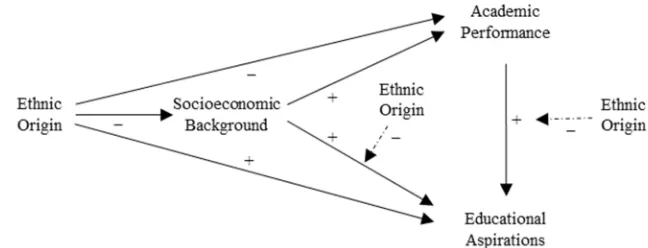
Figure 1: Conceptual model
Source: Authors’ own elaboration
Note:+ positive relationship;-negative relationship; interaction effects
In this study, we propose three main analytical levels to investigate ethnic differentials in educational aspirations: (1) selection, (2) moderation, and 3) variation within minorities. First, by ‘selection’ we refer to ethnic distribution across groups with distinct educational aspirations. Selection should be taken into account when analysing educational aspirations of minority students, not only the fact that minority families are overrepresented into disadvantaged families (as considered in many studies), but also the potential ethnic selection in students with lower educational performance (less considered in previous studies). Second, by ‘moderation’ we refer to the different impact that predictors of educational aspirations have across ethnic groups. Drawing on the migrant optimism thesis, minorities might be less responsive – compared to students from the national majority – to their objective socioeconomic disadvantage (driven by social mobility goals) and potential low educational performance (driven by strong career ambitions). Third, by ‘variation within minorities’ we consider possible alternative explanations to the migrant optimism hypothesis. We highlight two specific indicators, one related to family potential access to information (e.g., parents’ language use of the host society’s official language), and another related to potential assimilation and integration in the host culture (e.g., children’s years lived in the host country). Figure 1 above summarizes the analytical framework that guides this study, which is developed in detail in the theoretical framework section.
a national sample of pupils at Grade 8 (second year of lower-secondary education). Our main research questions can be summarized as follows. First, we ask whether the children of African and Latin American migrants present gross differences in educational aspirations with respect to their counterparts with Spanish origins. Second, we analyse whether ethnic variation in educational aspirations is mediated and/or moderated by parental socioeconomic background and students’ educational performance. Third, we investigate whether educational aspirations differ within ethnic minority groups, depending on the years lived in the country and language spoken at home.
Spain is a relevant case for the international ethnicity literature, at least for three reasons. First, Spain is a quite new destination country that experienced intense and sudden immigration flows in recent years. This differs from many Western European countries that received important fluxes of immigration already by the 1950s–1960s, like Germany and the United Kingdom, previously investigated in the literature on aspirations (Fernández-Reino 2016; Salikutluk 2016). Second, our focus on African and Latin American minorities – the latter less represented in Western European countries – captures two large disadvantaged groups in the Spanish social structure that also present interesting differences in their cultural, socioeconomic, and integration profiles (Reher and Requena 2009). Third, previous studies on Spain offered inconclusive evidence on minorities’ educational aspirations, and were restricted to specific regional settings (Portes et al. 2013; Cebolla-Boado and Martínez de Lizarrondo 2015).
2. The Spanish context
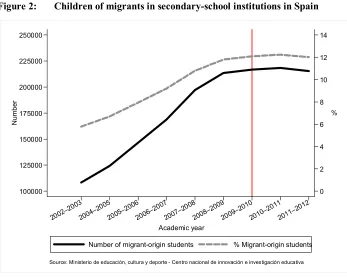
Figure 2: Children of migrants in secondary-school institutions in Spain
Source: Ministerio de Educación, Cultura y Deporte – Centro Nacional de Innovación e Investigación Educativa
The national origin of migrants in Spain shows clear differences with respect to other European countries (Reher and Requena 2009). Migration fluxes in Spain were firstly filled by African migration during the 1990s (most coming from Morocco), and later by the substantial arrival of Romanians and migrants from Latin American countries during the 2000s, mainly coming from Ecuador, Colombia, Bolivia, Peru, and Argentina (from largest to smallest share) (Reher and Requena 2009; INE 2010). These migration fluxes occurred in a period of sustained economic growth with a large demand of low-skilled employment, increasing participation of Spanish young cohorts in college education, and of women into the labour force (Garrido 2005). Latin American migrants, and migrants from African origins to a higher extent, typically worked in low-skilled jobs in the agriculture, domestic services, tourism, industry, and construction sectors, while often residing in disadvantaged working-class neighbourhoods (Reher and Requena 2009; Vidal-Coso and Miret-Gamundi 2014).
0 2 4 6 8 10 12 14 % 100000 125000 150000 175000 200000 225000 250000 N um be r 2004–2 005 2002–2 003 2005–2 006 2006–2 007 2007–2 008 2008–2 009 2009–2 010 2010–2 011 2011–2 012 Academic year
Number of migrant-origin students % Migrant-origin students
The Spanish educational system combines a low level of stratification (i.e., first tracking at 16 years old) (Crul and Vermeulen 2003) with high levels of dropouts in compulsory education (lower-secondary), affecting working class and minorities particularly (Bernardi and Cebolla 2014; Miyar Busto 2017). Children of African migrants, and to a lesser extent those with parents born in Latin America, experience high levels of dropout (60% and 35%, respectively) and grade retention (Martínez García 2013), even after controlling for their disadvantaged socioeconomic backgrounds (Miyar Busto 2017).
The integration of Latin Americans in the Spanish society was relatively smoother than it was for African migrants. This can be partly attributed to the fact that Latin American migrants, compared to African migrants, share the language with Spaniards and tend to feel closer in cultural terms (Guzmán, Feliciano, and Jiménez Llanos 2011).4 In relation to pupils from Latin American origin, pupils from African background are more disadvantaged at school (e.g., educational performance, grade retention), come from more modest family backgrounds, and have more difficulties with the Spanish language (or other regional languages like Catalan) (Carabaña 2004, 2006).
Only two studies, to our knowledge, have analysed the links between ethnicity and adolescents’ educational aspirations in the Spanish context. Portes et al. (2013), using data collected from 2008 to 2010 across schools in the cities of Barcelona and Madrid, found that students of ethnic minority have lower or similar educational aspirations than adolescents with Spanish-born parents, with specific minority groups showing the lowest levels of educational aspirations (e.g., Argentinians, Ecuadorians, and Moroccans). However, it must be stressed that their study did not control for educational performance. They found a positive association between socioeconomic background and educational aspirations, and minor differences by parental language use and length of stay in Spain. Cebolla-Boado and Martínez de Lizarrondo (2015) analysed the educational aspirations of minority pupils in the region of Navarra with data from the General Evaluation of Educational Diagnostic (GEED) carried out in 2010. They found that adolescents of ethnic minority groups have significantly higher educational aspirations than adolescents of Spanish origin, after accounting for social background and educational performance. Using a multilevel design, their study on Navarra did not find (ethnic) peer effects at the school level on students’ aspirations.
4 In a qualitative study drawing information from coordinators of integration programs among schools with
These two studies, despite providing important insights, use different analytical approaches and offer contradictory findings on Spain. First, they focused on regions with different migration and socioeconomic contexts; the cities of Barcelona and Madrid have the highest rates of migrant population in Spain (circa 17%), while Navarra ranks around the average (circa 11%) (INE 2009). This motivates a study that considers a large representative sample of the whole Spanish educational system. Second, Portes et al. (2013) did not include objective measures of student educational performance, a key mediator and/or moderator variable to explain aspirations. This might explain why their results differ from those of Cebolla-Boado and Martínez de Lizarrondo (2015), whose work did include controls for educational performance. Third, both studies leave important questions inconclusive, like those related to the distribution of aspirations across different socioeconomic backgrounds and levels of educational performance (moderation), along with the potential role of integration mechanisms (e.g., parental language use, age on arrival in the country). We seek to fill these gaps in our study on Spain.
3. Analytical framework
3.1 Conceptualization of educational aspirations
Adolescents’ aspirations capture valuable information on their dreams, motivations, and idealistic beliefs that can potentially influence their future schooling and labour market transitions (Sewell, Haller, and Portes 1969; Portes, McLeod, and Parker 1978; Morgan 1998). The concept of ‘aspirations’ reflects on the goals that people can have in a world without obstacles. By contrast, the concept of ‘expectations’ implies that individuals express a set of goals by considering the existence of barriers and constraints, namely whether they assume they can ‘realistically’ reach one specific situation (Morgan 1998; Jacob and Wilder 2010; Portes et al. 2013). Ideally, one would investigate both educational expectations and aspirations. In this study we only analyse aspirations, as unfortunately we do not have information on expectations.
3.2 Migrant optimism
3.2.1 Selection
students typically have high motivation and ambition (OECD 2006). However, the overrepresentation of minority pupils in disadvantaged social backgrounds and underperforming groups might lead them to not having, on average, higher (gross) aspirations than their counterparts from the national majority (Cebolla-Boado and Martínez de Lizarrondo 2015). Even if social background and academic performance may influence adolescents’ aspirations differently across ethnic groups (see Section 3.2.2 on moderation effects), being raised in a disadvantaged socioeconomic background and obtaining low educational performance generally reduces students’ college aspirations in different demographic groups (Kao and Tienda 1998; Khattab 2015). Therefore, one should account for family background and educational performance to properly adjust for ethnic differences in aspirations. We anticipate that students from African and Latin American minorities have considerably higher (that is, more optimistic) educational aspirations than students with Spanish-born parents, but these differences should be only observed after having properly accounted for selection of these minority groups into the most disadvantaged families and lowest educational performance (Miyar Busto 2017):
Hypothesis 1a: Children of African and Latin American migrants have higher
educational aspirations than those with Spanish-born parents, but only after accounting for parental socioeconomic status and educational performance.
3.2.2 Moderation: Socioeconomic status and educational performance
Hunkler 2017) could further lead to high aspirations among African and Latin American pupils. In short, we anticipate the largest differences in aspirations by ethnic status to be found at the bottom of the socioeconomic hierarchy:
Hypothesis 1b: The association between parental socioeconomic status and
educational aspirations is stronger for students of Spanish origin than it is for students of African and Latin American background.
By the same token, we expect the educational aspirations of the children of migrants to respond differently to their educational performance than students with native-born parents. Minority students’ aspirations would be less responsive to experiencing grade retention and low performance in standardized tests, as high levels of career ambitions (Kao and Tienda 1995) would lead them to have relatively high aspirations. Thus, the largest differences in aspirations by ethnic origin should be observed at the bottom of the educational performance distribution (measured as grade retention or academic standardized tests), while we should find ethnic convergence in (high) educational aspirations among students with higher educational performance:
Hypothesis 1c: The association between educational performance and educational
aspirations is stronger for students of Spanish origin than it is for students of African and Latin American background.
3.3 Ethnicity-related determinants of educational aspirations
3.3.1 Differences by age of arrival in Spain
recently arrived in Spain during primary or secondary school (the 1.5 generation or migrant children arrived at ages 6–15) might have higher educational aspirations than those born in Spain (second generation), or fully educated in the Spanish educational system (the so-called 1.75 generation, arrived at ages 0–5):
Hypothesis 2: Minority students recently arrived in Spain during primary or
secondary education have higher educational aspirations than those born or arrived in Spain before starting primary education.
3.3.2 Differences by language use
Secondly, we further explore differences within minority groups by looking at language use in the family. The language use at home is a relevant indicator of families’ potential access to valuable information on the schooling system. In line with the information bias approach, Kao and Tienda (1998) argue that minority pupils can lack access to precise information on the actual levels of performance and effort needed to succeed at school. This might reflect minorities’ difficulties to get precise information on how the schooling system works (Cebolla-Boado and Martínez de Lizarrondo 2015; Kirk et al. 2011). Speaking the official language of the country might allow migrant parents to read published information, as well as to access to information via interpersonal relations with members of the community, which might provide useful reliable knowledge on how the schooling system works. This information could be transmitted from parents to children in everyday family life. The Spanish case provides an interesting setting to test this hypothesis. Unlike (Spanish-speaking) Latin American migrants, African migrant families (from Arabic or sub-Saharan origin) do not necessarily speak Spanish. We expect that speaking Spanish at home, or other official languages (e.g., Catalan, Galician), brings children of African origin to show lower aspirations than students of African origin not speaking Spanish, or other official languages, regularly at home:
4. Data and methods
4.1 Data and sample selection
We use data from the 2010-GEED. This survey was carried out by the National Institute of Educational Evaluation (INEE) for a representative sample of the student population at second grade of compulsory lower-secondary education (ESO), with an average age of 14 (GEED 2011). The sample was stratified by regions and schools (n = 870), including a total of 27,032 students with valid information, and a response rate of 86%.
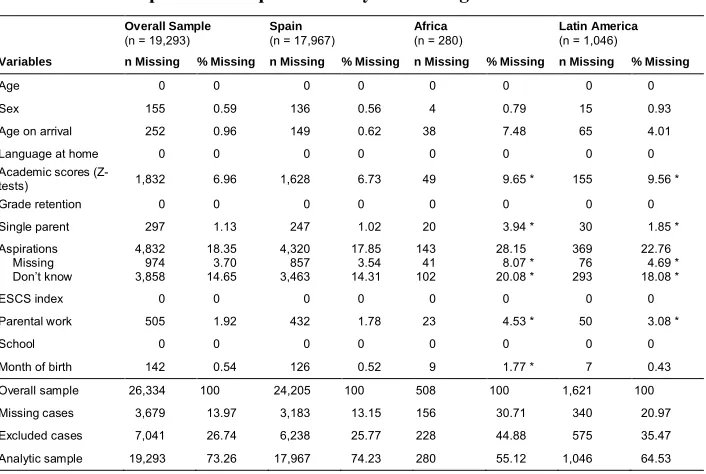
Table 1 describes the cases missing and excluded from our three ethnic groups of study on the main variables of analyses. We focus on three demographic groups: (1) Spanish origin (either one or both parents were born in Spain); (2) African origin5 (both parents were born in an African country); (3) Latin American origin6 (both parents were born in a Spanish-speaking Latin American country). We excluded 698 cases without information on the country of birth of either the mother or the father7; the cases of children with parents from European origin8 (a diverse group from various regions) (593); other countries and regions (e.g., Asia, Australia, Brazil, and the United States) (254); and a mixture of parents from two different migrant groups (82). This left us with 26,334 observations for those students with Spanish-born parents (24,205), African parents (508) and Latin American parents (1,621).
Overall, among the 26,334 observations with identified ethnic origin, 14% of cases had missing responses in at least one of our variables of interest. Missing data affected minorities particularly, as is unfortunately common in studies on ethnicity: 3,183 cases of pupils of Spanish origin (13.2%), 156 of the African group (30.7%), and 340 of Latin American background (20.9%). Minorities showed a higher likelihood of not answering the question on educational aspirations (3.7% of total cases). The majority of missing cases were on academic scores (7% of total cases), which are difficult to impute for being standardized tests containing different items, affecting minorities to a higher extent than students of Spanish origin.
5 84% were of Moroccan origin.
6 The GEED-2010 survey does not differentiate between subregions in Latin America, so we had to lump
together different country nationalities with different socioeconomic profiles and migration histories (Aparicio 2007). We excluded the group of Brazilian minorities, as we concentrated only on Spanish-speaking Latin American groups. Within Latin American migrants, Ecuadorians account for the greatest share, followed by Colombians, Bolivians, Peruvians, and Argentinians (INE 2010).
7 This group of missing cases on ethnic origins is negatively selected in terms of socioeconomic background
and academic performance.
8 Even though the migrant group of Romanians is among the largest migrant groups in Spain, unfortunately,
We followed a twofold exclusion criteria to select the analytic sample. First, among the sample with identified ethnic origin (n = 26,334), we excluded those cases with missing values on at least one of the variables of interest (n = 3,679; 14%). Second, we excluded those cases expressing uncertain educational aspirations (response category ‘don’t know yet’) (n = 3,858; 14.7%). This second criteria brought us to exclude 14.3% of pupils of Spanish origin who reported not yet knowing which educational level they aspired to, a category with higher incidence of children of Latin American migrants (18.1%), and those with African-born parents (20.1%). Additional multinomial analyses showed robust results when including these excluded cases as a response category in the main analyses on educational aspirations (see Appendix, Table A-1).
Table 1: Sample selection procedure by ethnic origin
Overall Sample
(n = 19,293)
Spain
(n = 17,967)
Africa
(n = 280)
Latin America
(n = 1,046)
Variables n Missing % Missing n Missing % Missing n Missing % Missing n Missing % Missing
Age 0 0 0 0 0 0 0 0
Sex 155 0.59 136 0.56 4 0.79 15 0.93
Age on arrival 252 0.96 149 0.62 38 7.48 65 4.01
Language at home 0 0 0 0 0 0 0 0
Academic scores
(Z-tests) 1,832 6.96 1,628 6.73 49 9.65 * 155 9.56 *
Grade retention 0 0 0 0 0 0 0 0
Single parent 297 1.13 247 1.02 20 3.94 * 30 1.85 *
Aspirations Missing Don’t know 4,832 974 3,858 18.35 3.70 14.65 4,320 857 3,463 17.85 3.54 14.31 143 41 102 28.15 8.07 * 20.08 * 369 76 293 22.76 4.69 * 18.08 *
ESCS index 0 0 0 0 0 0 0 0
Parental work 505 1.92 432 1.78 23 4.53 * 50 3.08 *
School 0 0 0 0 0 0 0 0
Month of birth 142 0.54 126 0.52 9 1.77 * 7 0.43
Overall sample 26,334 100 24,205 100 508 100 1,621 100
Missing cases 3,679 13.97 3,183 13.15 156 30.71 340 20.97
Excluded cases 7,041 26.74 6,238 25.77 228 44.88 575 35.47
Analytic sample 19,293 73.26 17,967 74.23 280 55.12 1,046 64.53
Note: * p < .05 (t-test differences in reporting missing information or being excluded from the sample between each of the two minority groups and the Spanish origin group).
representative the African and Latin American origin groups in the analytic sample are relative to the overall and excluded samples, Table S-1 in the online appendix shows the distributions of the variables of interest for each sample selection by ethnic groups. The variables’ distribution in the analytic sample is highly consistent with the overall sample distribution before applying list-wise deletion. However, it should be noted that given the negative selection of the excluded sample, the overall analytic sample is slightly more likely to be of Spanish origin (around +2%). Furthermore, students of Spanish, African, and Latin American origin are, to a similar extent, slightly more prone to be distributed in more advantaged socioeconomic backgrounds (around +0.10 SD units), higher academic performance (around +0.10 SD units), and to be women (around +3%), so leading to slightly higher (around +3%) college aspirations. We acknowledge this small selection bias. Yet, given the high similarity in the variables’ distributions between the overall and analytic samples, we decided not to impute missing cases, and to apply list-wise deletion instead (Portes et al. 2013). We assume that results might show conservative estimates in case of producing significant statistical effects (Allison 2002; Firebaugh 2008).
4.2 Dependent variable
The dependent variable is a dummy measure that identifies whether adolescents aspire to achieve college education (1=yes) or lower levels of education (0=no). This measure is constructed from the following question, which includes different educational aspirations: “Which of the following levels of education do you want to complete?” We conduct as robustness checks additional analyses on the incidence of uncertainty (response category ‘don’t know yet’) in aspirations (see Appendix, Table A-1), and on the probability of aspiring to post-compulsory vocational education, as opposed to academic tracks for different ethnic groups (see Appendix, Table A-2).9
9 Additional analyses were conducted for other samples with two alternative definitions of aspirations: (1) a
4.3 Independent variables
The main independent variable is ethnic status, a categorical variable with three specified subgroups: (1) Spanish origin (at least one parent born in Spain); (2) African origin (both parents born in Africa); (3) Latin American origin (both parents born in Spanish-speaking Latin American countries). Age on arrival is a categorical measure with four categories that depend on the age on arrival in Spain and ethnic status: (1) children of African migrants born in Spain – second-generation migrants – or arriving in Spain before primary education enrolment age – starting at age six – (1.75 generation or aged 0–5); (2) children of Latin American migrants born in Spain – second-generation migrants – or arriving in Spain before primary education enrolment age – starting at age six – (1.75 generation or aged 0–5); (3) children of African migrants arriving at primary- or secondary-school age (1.5 generation or aged 6–15); (4) children of African migrants arriving at primary- or secondary-school age (1.5 generation or aged 6–15). Language at home measures the language spoken by parents of African origin, dividing this group based on whether or not parents speak an official Spanish language regularly.10
To measure social background, we use the Economic, Social and Cultural Status (ESCS) index. This OECD index was created for PISA reports, used for the GEED-2010, by combining information on (1) parental occupation; (2) the highest level of parental education; (3) home possessions related to family wealth; and (4) home educational resources and possessions related to cultural environments (e.g., books, classical literature, cultural participation) (GEED 2011). This measure provides a parsimonious multidimensional index of social origin that better captures the full array of parental resources, minimizing missing information due to a standardized system of imputation in comparison to other single variables of social background (e.g., education, occupational class).
We use two measures on educational performance.11 These measures potentially control for teachers’ bias and other noncognitive factors, such as emotional readiness
additional support to our main hypothesis on migrant optimism. Second, Table A-2 reveals that when only basic demographic controls are added, minority students with an African background show higher aspirations to vocational education as opposed to the academic track (p < .001). However, when socioeconomic factors and, especially, academic performance are considered in the models, the two minority groups are considerably less prone to aspire to vocational education, compared to their counterparts of Spanish origin (p < .001).
10 It should be noted that 17% of students with African parents who speak Spanish at home arrived in Spain
between the ages of 6 and 15 years old (1.5 generation), and 38% of students with African parents who do not speak Spanish at home at home did so.
11 It would be ideal to test whether educational aspirations at t
0 are met at t+1; unfortunately, to the best of our
and behavioural problems, as we use both standardized tests (academic scores) and a proxy for teacher-assigned or school grades (grade retention). Academic scores are a multiple index of educational performance based on combined standardized tests in four competence:12 (1) linguistic, (2) mathematic, (3) scientific, and (4) civic-social competences. Grade retention is a dummy variable that differentiates between students who have experienced grade retention (yes=1) and those who have not experienced grade retention in their school trajectory (no=0).
We use different control variables. Male differentiates boys (1 = yes) from girls (0 = no). Month of birth is a dummy variable accounting for whether the pupil was born from September to December (1 = yes) or from January to August (0 = no). Private school is a dummy variable that differentiates between students who attend a school that is (fully or partly) privately funded (1 = yes) from those in a strictly publicly-funded school (0 = no). Single-parent household is a dummy variable that separates children living with one parent (1 = yes) from those living with two parents (0 = no). Parental employment status contains three categories: (1) two parents employed; (2) one parent employed; (3) no parent employed.
4.4 Empirical strategy
We follow different empirical steps: (1) We provide descriptive analyses on the distributions and associations of the main variables of interest. (2) We conduct different sets of binary logistic regression models predicting the probability of aspiring to college education, as opposed to not aspiring to college, under different model specifications. We run average marginal effects (AME) to compare the coefficients of ethnic groups across different models (Mood 2010). Model 1 is the basic model, including only demographic factors. Model 2 adds social background and other socioeconomic measures. Model 3 accounts for educational performance. (3) We explore interaction effects between ethnicity and (a) educational performance (Table A-3, models 3a and 3b), and (b) social background (Table A-3, model 3c). (4) We conduct two general full-models predicting college aspirations with AME, using two variations of ethnicity variables in each model, namely: (a) age on arrival in the country (model 4a and 4b) and (b) parents’ language use (model 5).
12 We carried out a factor analysis to assess the reliability of our combined measure of standardized tests in
5. Findings
5.1 Descriptive analyses and distributions
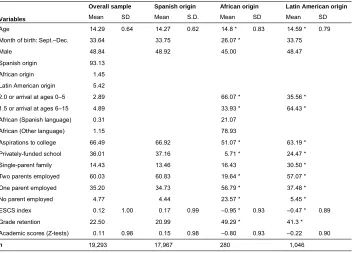
Table 2: Summary statistics: Means and standard deviations (analytic sample)
Variables
Overall sample Spanish origin African origin Latin American origin
Mean SD Mean S.D. Mean SD Mean SD
Age 14.29 0.64 14.27 0.62 14.8 * 0.83 14.59 * 0.79
Month of birth: Sept.–Dec. 33.64 33.75 26.07 * 33.75
Male 48.84 48.92 45.00 48.47
Spanish origin 93.13
African origin 1.45
Latin American origin 5.42
2.0 or arrival at ages 0–5 2.89 66.07 * 35.56 *
1.5 or arrival at ages 6–15 4.89 33.93 * 64.43 *
African (Spanish language) 0.31 21.07
African (Other language) 1.15 78.93
Aspirations to college 66.49 66.92 51.07 * 63.19 *
Privately-funded school 36.01 37.16 5.71 * 24.47 *
Single-parent family 14.43 13.46 16.43 30.50 *
Two parents employed 60.03 60.83 19.64 * 57.07 *
One parent employed 35.20 34.73 56.79 * 37.48 *
No parent employed 4.77 4.44 23.57 * 5.45 *
ESCS index 0.12 1.00 0.17 0.99 –0.95 * 0.93 –0.47 * 0.89
Grade retention 22.50 20.99 49.29 * 41.3 *
Academic scores (Z-tests) 0.11 0.98 0.15 0.98 –0.80 0.93 –0.22 0.90
n 19,293 17,967 280 1,046
Note: * p < .05 (t-test differences).
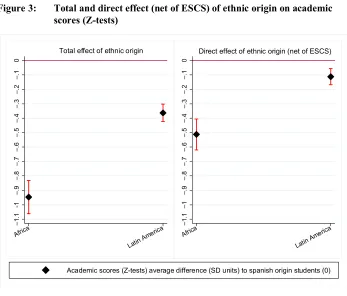
Figure 3: Total and direct effect (net of ESCS) of ethnic origin on academic scores (Z-tests)
Note: Standardized coefficients estimated from bivariate (ethnic origin) and multivariate (ethnic origin and ESCS) OLS linear regression models and average marginal effects. 95% confidence intervals; n = 19,293.
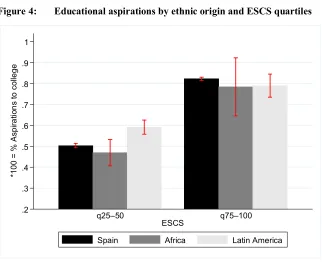
Second, Figure 4 and Figure 5 show whether compositional effects in the ESCS distribution by ethnic status might be associated with the observed gross differences in educational aspirations across ethnic groups. Figure 4 displays how, once ESCS is controlled for, Latin Americans aspire more to college than Spanish students, while African pupils display similar rates to the latter.
-1 0 –1 .1 –. 9 –. 8 –. 7 –. 6 –. 5 –. 4 –. 3 –. 2 –. 1 Africa
Latin A merica Total effect of ethnic origin
0 –1 .1 –1 –. 9 –. 8 –. 7 –. 6 –. 5 –. 4 –. 3 –. 2 –. 1 Africa
Latin A merica Direct effect of ethnic origin (net of ESCS)
Figure 4: Educational aspirations by ethnic origin and ESCS quartiles
Note: 95% confidence intervals; n = 19,293.
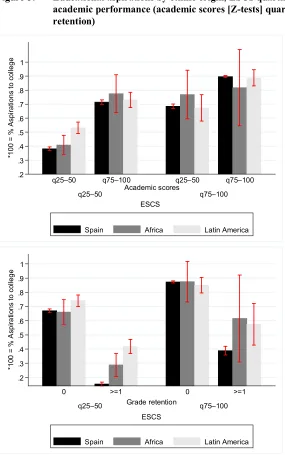
Figure 5 shows that, on average, the aspirations of the two minority groups become larger than those of students with Spanish-born parents when ESCS and educational performance are controlled for. This would indicate compositional effects or suppressor variables (inconsistent mediation). That is, while initially lower (negative relationship), the net or direct effect of being an ethnic minority seems to lead to higher educational aspirations than for the national majority (positive relationship), keeping social background and educational performance constant. Finally, descriptive analyses reveal that differences in aspirations are concentrated at the bottom of the educational performance and ESCS distributions, suggesting moderation effects.
.2 .3 .4 .5 .6 .7 .8 .9 1
*1
0
0
=
%
A
sp
ira
tio
n
s
to
co
lle
g
e
q25–50 q75–100
ESCS
Figure 5: Educational aspirations by ethnic origin, ESCS quartiles and
academic performance (academic scores [Z-tests] quartiles and grade retention)
Note: 95% confidence intervals; n = 19,293. .2 .3 .4 .5 .6 .7 .8 .9 1 *1 0 0 = % A sp ir a tio n s to co lle g e
q25–50 q75–100 q25–50 q75–100
q25–50 Academic scores q75–100
Spain Africa Latin America
ESCS .2 .3 .4 .5 .6 .7 .8 .9 1 *1 00 = % A sp ira tio n s to co lle g e
0 >=1 0 >=1
q25–50 q75–100
ESCS
Spain Africa Latin America
5.2 Multivariate statistical analyses
5.2.1 Migrant optimism: Selection
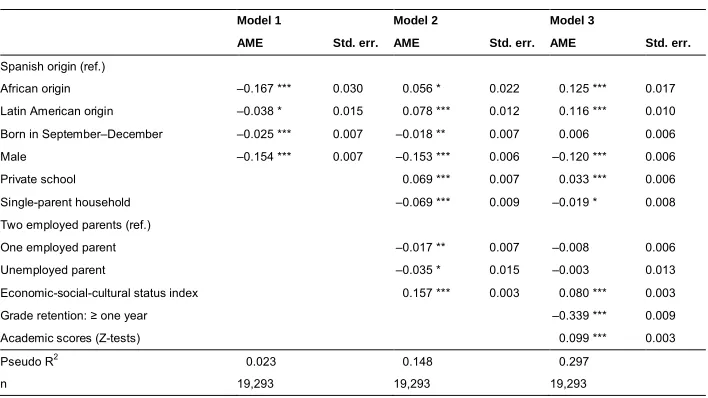
Table 3 shows the multivariate logistic models for college aspirations. Model 1 shows that compared to children of Spanish origin the probability of aspiring to college is 17% lower for students of African origin (p < .001), and 4% lower for those from a Latin American background (p< .05). Model 2 shows that after accounting for socioeconomic background the probabilities of aspiring to college, compared to the reference of Spanish origin, become positive for the two minority groups, shifting to a 6% higher probability for children of African origin (p < .05), and 8% for those with a Latin American background (p < .001). In model 3 when we account for heterogeneity in educational performance, the positive association of minority groups with aspirations becomes even larger, with 12% higher probabilities of aspiring to college (p < .001).13 The results yielded by model 1 resemble evidence for Barcelona and Madrid (Portes et al. 2013), showing that minority students have lower educational aspirations than the national majority. Yet, in line with studies for the Spanish region of Navarra (Cebolla-Boado and Martínez de Lizarrondo 2015) and other countries (Salikutluk 2016), minorities seem to have lower (gross) aspirations than students of Spanish origin because of their disadvantaged background and educational performance.
13 The total effect of ethnic status is lower than the direct effect, net of socioeconomic background, and
Table 3: Binary logistic models (average marginal effects) on aspirations to college education
Model 1 Model 2 Model 3
AME Std. err. AME Std. err. AME Std. err.
Spanish origin (ref.)
African origin –0.167 *** 0.030 0.056 * 0.022 0.125 *** 0.017
Latin American origin –0.038 * 0.015 0.078 *** 0.012 0.116 *** 0.010
Born in September–December –0.025 *** 0.007 –0.018 ** 0.007 0.006 0.006
Male –0.154 *** 0.007 –0.153 *** 0.006 –0.120 *** 0.006
Private school 0.069 *** 0.007 0.033 *** 0.006
Single-parent household –0.069 *** 0.009 –0.019 * 0.008
Two employed parents (ref.)
One employed parent –0.017 ** 0.007 –0.008 0.006
Unemployed parent –0.035 * 0.015 –0.003 0.013
Economic-social-cultural status index 0.157 *** 0.003 0.080 *** 0.003
Grade retention: ≥ one year –0.339 *** 0.009
Academic scores (Z-tests) 0.099 *** 0.003
Pseudo R2 0.023 0.148 0.297
n 19,293 19,293 19,293
Note:***p < .001 **p < .01 *p < .05 +p < .10; AME = average marginal effects (with standard errors in second column).
5.2.2 Moderation effects: Socioeconomic status and educational performance
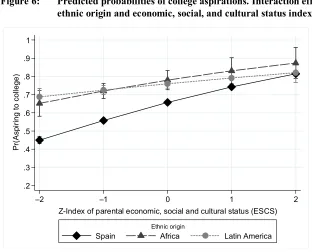
We conduct two types of interaction effects models that predict aspirations to college education with logistic models.14 Figure 6 shows the predicted probabilities of aspiring to college from a model with an interaction effect between ethnicity and the ESCS index. This model (see also Appendix, Table A-3, model 3c) includes all the main independent and control variables of the study. This interaction effect shows that differences in aspirations of minorities of both African and Latin American origin, in comparison to the Spanish majority, are larger in the most disadvantaged families. These gaps are especially visible for students of Latin American background. We see that at higher levels of the ESCS index the ethnic gap in aspirations tends to vanish. In
14 As pointed out by an anonymous reviewer, the group of children of African origin had a relatively small
short, Figure 6 shows that ESCS index is a stronger predictor of aspirations for students with Spanish parents than it is for ethnic minorities.
Figure 6: Predicted probabilities of college aspirations. Interaction effects for ethnic origin and economic, social, and cultural status index (ESCS)
Note: The interaction effect for the Latin American group is statistically significant at p<.001, while for the African group it is not statistically significant (see Appendix, Table A-3, model 3c); n = 19,293.
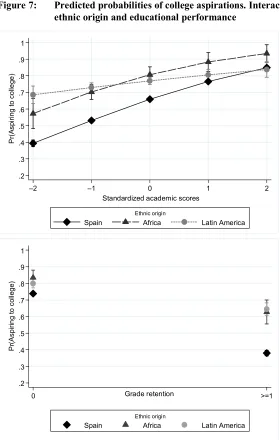
Figure 7 shows the predicted probabilities of aspiring to college education from the interaction effects models between ethnicity and two indicators of educational performance: (1) standardized test scores (see also Appendix, Table A-3, model 3a); and (2) grade retention (see also Appendix, Table A-3, model 3b). The models include all the main independent and control variables of the study. Figure 7, in the top graph, shows how both ethnic minority groups have higher aspirations to college than the Spanish majority across the test scores distribution, and that for the children of Latin American, this difference is concentrated in the group of low-performing students. In other words, the Latin American minority is less sensitive to its educational performance in the expressed educational aspirations, while for African and Spanish students educational performance is more predictive. Figure 7, in the bottom graph, shows that adolescents with parents from the Spanish majority present levels of college
.2 .3 .4 .5 .6 .7 .8 .9 1
P
r(
A
sp
ir
in
g
to
co
lle
ge
)
–2 –1 0 1 2
Z-Index of parental economic, social and cultural status (ESCS)
Spain Africa Latin America
aspirations that are more (negatively) associated to grade retention, as compared to pupils of ethnic minority groups. Indeed, even though grade retention is the main predictor of later school dropout in Spain (Bernardi 2012), experiencing it at school among the children of African and Latin American origin does not imply a considerable reduction in the probability of desiring attending college education in comparison to their counterparts with Spanish-born parents.15
5.2.3 Ethnic-related determinants of educational aspirations
Table 4 presents the AME for two additional models on two potential sources of ethnic variation: (1) age on arrival within ethnic subgroups, and (2) parents’ language use. In model 4a we observe that in comparison with the group of second-generation African migrants or children of African migrants who arrived in Spain before primary school (aged 0–5), African children who arrived at primary- or secondary-school age (aged 6– 15) have lower probabilities of aspiring to college education (–7%), even if the significance level is at 10%. Model 4b shows that in comparison with the group of second-generation Latin American migrants or children of Latin Americans who arrived in Spain before primary school (aged 0–5), Latin American children who arrived at primary- or secondary-school age (aged 6–15) have slightly higher probabilities of aspiring to college education (+3%). Yet, this difference is not statistically significant. As for the parents’ language use, Table 4, model 5 does not yield any meaningful or significant difference between children of African origin whose parents speak regularly Spanish at home and those whose parents do not speak Spanish regularly at home.
15 As a robustness check, Figure A-1 (See Appendix) shows that, when accounting for the potential (positive)
Figure 7: Predicted probabilities of college aspirations. Interaction effects for ethnic origin and educational performance
Note: Models control for all the variables included in the study (95% C.I. included). For academic scores (top graph), the interaction effect for the Latin American group is statistically significant atp<.001, while for the African group it is not statistically significant (Table A-3, model 3a). For grade retention (bottom graph), the interaction effect is statistically significant atp<.001 for the Latin American group, andp<.05 for the African group (Table A-3, model 3b). n = 19,293.
.2 .3 .4 .5 .6 .7 .8 .9 1 P r( A sp ir in g to co lle ge )
–2 –1 0 1 2
Standardized academic scores
Spain Africa Latin America
Ethnic origin .2 .3 .4 .5 .6 .7 .8 .9 1 P r( A sp ir in g to co lle g e)
0 Grade retention >=1
Spain Africa Latin America
Table 4: Binary logistic models (AME) on aspirations to college education
Age on arrival Language at Home
Model 4a Model 4b Model 5
AME Std. err. AME Std. err. AME Std. err.
Age on arrival
2.0 or arrival at 0–5/African
2.0 or arrival at 0–5/Latin American –0.054*(ref.) 0.025 0.054*(ref.) 0.025 Spanish–Native origin –0.148*** 0.019 –0.094*** 0.017 1.5 or arrival at ages 6–15/African
1.5 or arrival at ages 6–15/Latin American –0.066 +
–0.023 0.0360.022 –0.012 0.031 0.0350.020 Parents’ language spoken at home
African-born parents: Spanish (ref.)
Spanish-born parents –0.133*** 0.034
Latin American-born parents –0.017 0.035
African-born parents: Other languages –0.010 0.039
Born in September–December 0.006 0.006 0.006 0.006 0.006 0.006
Male –0.120*** 0.006 –0.120*** 0.006 –0.120*** 0.006
Private school 0.032*** 0.006 0.032*** 0.006 0.033*** 0.006
Single-parent household –0.018* 0.008 –0.018* 0.008 –0.018** 0.008
Two employed parents (ref.)
One employed parent –0.008 0.006 –0.008 0.006 –0.008 0.006
Unemployed parent –0.002 0.013 –0.002 0.013 –0.002 0.013
Economic-social-cultural status Index 0.080*** 0.003 0.080*** 0.003 0.080*** 0.003 Grade retention: ≥ one year –0.340*** 0.009 –0.340*** 0.009 –0.340*** 0.009 Academic scores (Z-tests) 0.099*** 0.003 0.099*** 0.003 0.099*** 0.003
Pseudo R2 0.297 0.297
n 19,293 19,293
Note: ***p < .001 **p < .01 *p < .05 +p < .10; AME = average marginal effects (with standard errors in second column).
6. Discussion
controlled for educational performance (Cebolla-Boado and Martínez de Lizarrondo 2015), a critical variable to measure ethnic differentials in educational aspirations (Salikutluk 2016). Our study addresses ethnic differences in educational aspirations by looking at three key domains (selection, moderation, and variation within minorities) with representative data on the Spanish educational system to answer our research questions.
We developed different hypotheses that we tested empirically. We found support for Hypothesis 1a on selection or compositional effects, namely that ethnic minorities have higher net educational aspirations than their counterparts with native-born parents. On average, without controlling for social background, minority pupils in Spain have lower chances of aspiring to college education than students with Spanish-born parents. Yet, when accounting for family background, and especially for educational performance, we found higher probabilities (around 12% higher) of aspiring to college among minority students in comparison to students with Spanish-born parents. This result suggests that the migrant optimism thesis holds for the Spanish population, consistent with Cebolla-Boado and Martínez de Lizarrondo’s (2015) study on the region of Navarra.
We found partial support for Hypothesis 1b, which stated that the association between parental socioeconomic status and educational aspirations is stronger for students of Spanish origin than it is for students of African and Latin American background. Results show that parental socioeconomic and cultural status is less predictive of educational aspirations for ethnic minority groups, especially so for Latin Americans. The largest differences in educational aspirations between ethnic minorities – especially those with Latin American migrant parents – and students with Spanish-born parents can be found among families with lower socioeconomic and cultural resources. These results suggest that disadvantaged ethnic minorities, probably because of having ambitions of (upward) social mobility (Salikutluk 2016) and strong motivation (Kao and Tienda 1995), seek to overcome their underprivileged origin by transmitting high educational aspirations to their children. In line with Feliciano and Lanuza (2017), we need to consider that migrant families are a positively selected group that is usually over-skilled, so instead of seeking long-range upward mobility, minority families might just be trying to obtain those positions that they were supposed to get in the first place based on their former socioeconomic status in their origin country. Additional analyses suggest that Latin American families have similar levels of education to Spanish ones,16 but reveal a high rate of over-qualification and under-employment (Kraus and Castro-Martín 2017; Vidal-Coso and Miret-Gamundi 2014).
16 Kraus and Castro-Martín (2017) indicate that fathers, and especially mothers, of the 1.5 Ecuadorian
We do not find similar patterns and differences for African migrants, possibly linked to their more modest socioeconomic profile (Aparicio 2007). This tentative evidence may drive the observed differences between ethnic minorities. Future research with precise data in this direction should further investigate the role of ambitions and positive selection in shaping ethnic differences in aspirations across socioeconomic groups and specific minority groups.
We also found support to Hypothesis 1c, which stated that the association between educational performance and educational aspirations is stronger for students of Spanish origin than it is for students of African and Latin American background. We found that among those minority children who experienced grade retention, pupils of Latin American background as well as pupils from African background do not adjust their high educational aspirations downwards, while it is the case for the Spanish majority. These results are solid after controlling for the positive relationship between age on arrival and grade retention. Regarding standardized test scores, we found that Latin Americans’ performance is not as steeply associated to aspirations as it is for the Spanish majority, as low-performers from Latin American origin show high aspirations.17 Thus, Hypothesis 1c also suggests that minority students display intrinsic optimism and (upward) social mobility ambitions regardless of constrains.
Concerning potential determinants of aspirations within ethnic groups, we anticipated in Hypothesis 2 that minority students who recently arrived in Spain during primary or secondary education have higher educational aspirations than those who were born in or arrived in Spain before starting primary education. Results do not give support to this hypothesis. We found that minority students who arrived in Spain at primary- or secondary-school age (aged 6–15) do not generally show higher educational aspirations than second-generation minority students or those who arrived before starting formal primary school (aged 0−5). While Africans arriving in Spain as 6–15-year-olds show lower aspirations (–7%) than their 2.0 generation counterparts (significance level at 10%), Latin Americans express slightly higher aspirations (+3%), though not statistically significant. This result suggests that recently arrived minorities do not have a significantly stronger motivation than the children of migrants socialized entirely in the Spanish schooling system. This might imply that there are intrinsic high educational aspirations and optimism among minorities regardless of their time of exposure to the host country. These negligible differences by age on arrival are in line with previous studies (Minello and Barban 2012; Portes et al. 2013), yet these studies –
17 It could be argued that the moderation effects found in Hypothesis 1b and Hypothesis 1c could be just
unlike ours – did not account for heterogeneity in educational performance by age on arrival.
The last expectation was presented in Hypothesis 3. It anticipated that having parents who speak an official Spanish language leads children of African origin to lower educational aspirations in comparison to children of African origin who speak Arab or other foreign languages at home. We did not find support for this hypothesis. We did not observe any meaningful and/or significant difference between children of African origin whose parents speak Spanish and those whose parents do not speak Spanish at home. It should be noted that the group of students with Spanish-speaking African parents was relatively small, and our measures did not include rich information on parental proficiency in Spanish or bilingualism. Our results resemble those from Portes et al. (2013) for Barcelona and Madrid in finding no effects of parental language on educational aspirations. Future studies should provide more precise information on how the use of the official national language among migrant families leads to differences in access to valuable information to navigate the educational system.
Overall, our study implies that the migrant optimism hypothesis holds in Spain, as in recent work on other European countries, like the study of Fernández-Reino (2016) on England and Salikutluk (2016) on Germany. We found that after accounting for the disadvantaged socioeconomic status and educational performance of Latin American and African students, they show higher aspirations than the Spanish majority. Furthermore, socioeconomic background and educational performance are less predictive of educational aspirations for ethnic minorities than for students of Spanish origins. The higher educational aspirations of minorities are concentrated among disadvantaged students in social background and educational performance, so suggesting high intrinsic motivation and (upward) social mobility ambitions. This interpretation is further supported by the inconclusive evidence on the role of age on arrival in Spain, and language use at home, used as tentative proxies of acculturation and information bias. Furthermore, the fact that Latin Americans, an ethnic-group that is very close in many respects to students of Spanish origin in terms of language and culture, showed higher aspirations can serve as an indirect test against the information bias and acculturation hypotheses.
clearly applies to the children of migrants in Spain (including those from African and Latin American backgrounds), who tend to have lower chances of accessing college education than those of Spanish origin (Miyar Busto 2017). Future studies should analyse the potential consequences of this apparent contradiction in minority pupils’ aspirations and actual educational chances (i.e., transition rates to academic upper-secondary education controlling for performance and aspirations, or upper-secondary effects; see Jonsson and Rudolphi 2011).
7. Acknowledgements
References
Allison, P.D. (2002). Missing data. Thousand Oaks: Sage. doi:10.4135/9781412985
079.
Aparicio, R. (2007). The integration of the second and 1.5 generations of Moroccan, Dominican and Peruvian origin in Madrid and Barcelona.Journal of Ethnic and
Migration Studies 33(7): 1169–1193.doi:10.1080/13691830701541713.
Aysa-Lastra, M. and Cachón-Rodríguez, L. (2013). Determinants of segmented occupational mobility of non-European union immigrants in Spain. Revista Internacional de Sociología 71(2): 383–413.
Azzolini, D., Schnell, P., and Palmer, J. (2012). Educational achievement gaps between immigrant and native students in two ‘new’ immigration countries: Italy and Spain in comparison. The Annals of the American Academy of Political and
Social Science 643(1): 46–77.doi:10.1177/0002716212441590.
Bernardi, F. (2012). Unequal transitions: Selection bias and the compensatory effect of social background in educational careers. Research in Social Stratification and Mobility 30(2): 159–174.doi:10.1016/j.rssm.2011.05.005.
Bernardi, F. and Cebolla, H. (2014). Class and school performance as predictors of educational paths in Spain. Revista Española de Investigaciones Sociológicas 146: 3–22.
Bernardi, F., Garrido, L., and Miyar Busto, M. (2011). The recent fast upsurge of immigrants in Spain and their employment patterns and occupational attainment.
International Migration 49(1): 148–187.doi:10.1111/j.1468-2435.2010.00610.x.
Berry, J.W. (2005). Acculturation: Living successfully in two cultures. International Journal of Intercultural Relations 29(6): 697–712. doi:10.1016/j.ijintrel.2005.
07.013.
Breen, R. and Goldthorpe, J. (1997). Explaining educational differentials: Towards a formal rational action theory. Rationality and Society 9(3): 275–305.
doi:10.1177/104346397009003002.
Breen, R. and Jonsson, J.O. (2005). Inequality of opportunity in comparative perspective: Recent research on educational attainment and social mobility.
Annual Review of Sociology 31(1): 223–243. doi:10.1146/annurev.soc.31.041
Brinbaum, Y. and Cebolla-Boado, H. (2007). The school careers of ethnic minority youth in France: Success or disillusion?Ethnicities 7(3): 445–474.doi:10.1177/
1468796807080237.
Butler, T. and Hamnett, C. (2011). Ethnicity, class and aspiration: Understanding London’s new East End. Bristol: Policy Press.
Carabaña, J. (2004). La inmigración y la escuela.Economistas 99: 62–73.
Carabaña, J. (2006). Los alumnos inmigrantes en la escuela española. In: Aja, E. and Arango, J. (eds.).Veinte años de inmigración en España: Perspective jurídica y
sociológica (1985–2004). Barcelona: CIDOB: 275–299.
Cebolla-Boado, H. and Martínez de Lizarrondo, A. (2015). The educational expectations of immigrants in Navarra: Immigrant optimism or school effects? Revista Internacional de Sociología 73(1): 1–13.
Cebolla-Boado, H. and Soysal, Y.N. (2017). Educational optimism in China: Migrant selectivity or migration experience? Journal of Ethnic and Migration Studies.
doi:10.1080/1369183X.2017.1417825.
Crul, M. and Vermeulen, H. (2003). The second generation in Europe. International
Migration Review 37(4): 965–986.doi:10.1111/j.1747-7379.2003.tb00166.x.
Feliciano, C. and Lanuza, Y.R. (2017). An immigrant paradox? Contextual attainment and intergenerational educational mobility.American Sociological Review 82(1): 211–241.doi:10.1177/0003122416684777.
Fernández-Reino, M. (2016). Immigrant optimism or anticipated discrimination? Explaining the first educational transition of ethnic minorities in England. Research in Social Stratification and Mobility 46: 141–156.
Firebaugh, G. (2008).Seven rules for social research. Princeton: Princeton University Press.
Gambetta, D. (1987). Were they pushed or did they jump? Individual decision
mechanisms in education.Cambridge: Cambridge University Press.doi:10.1017/
CBO9780511735868.
GEED (2011). Evaluación general de diagnóstico 2010: Informe de resultados [electronic resource]. Madrid: MECD. https://www.mecd.gob.es/dctm/
ievaluacion/informe-egd-2010.pdf?documentId=0901e72b80d5ad3e.
Gracia, P., Vázquez-Quesada, L., and Van de Werfhorst, H.G. (2016). Ethnic penalties? The role of human capital and social origin in labour market outcomes of second-generation Moroccans and Turks in the Netherlands. Journal of Ethnic and Migration Studies 42(1): 69–87.
Guzmán, R., Feliciano, L.A., and Jiménez Llanos, A.B. (2011). Learning difficulties of Hispanic immigrant students: The perspective of Intercultural Education Programme coordinators.Revista de Educación 355: 547–570.
Heath, A. and Brinbaum. Y. (2007). Explaining ethnic inequalities in educational attainment.Ethnicities 7(3): 291–305.doi:10.1177/1468796807080230.
Heath, A., Rothon, C., and Kilpi, E. (2008). The second generation in Western Europe: Education, unemployment, and occupational attainment. Annual Review of
Sociology 34: 211–235.doi:10.1146/annurev.soc.34.040507.134728.
INE (2009). 2009 Municipal Census. Madrid: National Institute of Statistics (INE), Migration Observatory, Centre of Studies and Data.
INE (2010). 2010 Municipal Census. Madrid: National Institute of Statistics (INE), Migration Observatory, Centre of Studies and Data.
Jackson, M., Jonsson, J.O., and Rudolphi, F. (2012). Ethnic inequality in choice-driven education systems: A longitudinal study of performance and choice in England and Sweden. Sociology of Education 85(2): 158–178. doi:10.1177/00380407
11427311.
Jacob, B. and Wilder, T. (2010). Educational expectations and attainment. In: Duncan, G. and Murnane, R. (eds.). Whither opportunity? Rising inequality and the
uncertain life chances of low-income children. New York: Russell Sage: 133–
164.
Jonsson, J.O. and Rudolphi, F. (2011). Weak performance – Strong determination: School achievement and educational choice among children of immigrants in Sweden.European Sociological Review 27(4): 487–508.
Kalter, F., Granato, N., and Kristen, C. (2007). Disentangling recent trends of the second generation’s structural assimilation in Germany. In: Scherer, S., Pollak, R., Otte, G., and Gangl, M. (eds.). From origin to destination: Trends and
Kao, G. and Tienda, M. (1995). Optimism and achievement: The educational performance of immigrant youth.Social Science Quarterly76(1): 1–19.
Kao, G. and Tienda, M. (1998). Educational aspirations of minority youth. American
Journal of Education 106(3): 349–384.doi:10.1086/444188.
Khattab, N. (2015). Students’ aspirations, expectations and school achievement: What really matters? British Educational Research Journal 41(5): 731–748.
doi:10.1002/berj.3171.
Kirk, C.M., Lewis-Moss, R.K., Nilsen, C., and Colvin, D.Q. (2011). The role of parent expectations on adolescent educational aspirations. Educational Studies 37(1): 89–99.doi:10.1080/03055691003728965.
Kraus, E.K. and Castro-Martín, T. (2017). Does migrant background matter for adolescents’ fertility preferences? The Latin American 1.5 generation in Spain.
European Journal of Population.doi:10.1007/s10680-017-9427-3.
Lareau, A. (2003). Unequal childhoods: Class, race, and family life. Berkeley: University of California Press.
Lareau, A. (2015). Cultural knowledge and social inequality. American Sociological
Review 80(1): 1–27.doi:10.1177/0003122414565814.
Martínez García, J.S. (2013).Estructura social y desigualdad en España. Madrid: Los Libros de la Catarata.
Mato Díaz, F. and Miyar Busto, M. (2017). Immigration policy and economic cycle effects on spousal reunification in Spain. Revista Internacional de Sociología 75(3): e071.
Minello, A. and Barban, N. (2012). The educational expectations of children of immigrants in Italy.The Annals of the American Academy of Political and Social
Science 643(1): 78–103.
Miyar Busto, M. (2017). Immigrant-origin youth engagement in education in Spain during the Great Recession. Revista Española de Investigaciones Sociológicas 157: 123–140.
Mood, C. (2010). Logistic regression: Why we cannot do what we think we can do, and what we can do about it. European Sociological Review 26(1): 67–82.
Mooi-Reci, I. and Muñoz-Comet, J. (2016). The Great Recession and the immigrant– native gap in job loss in the Spanish labour market. European Sociological
Review 32(6): 730–751.doi:10.1093/esr/jcw031.
Morgan, S.L. (1998). Adolescent educational expectations rationalized, fantasized, or both? Rationality and Society 10(2): 131–162. doi:10.1177/10434639801000
2001.
OECD (2006). Performance of immigrant students in PISA 2003: Where immigrant students succeed: A comparative review of performance and engagement in
PISA 2003. Paris: OECD.
Portes, A., McLeod, S.A., and Parker, R.N. (1978). Immigrant aspirations.Sociology of
Education 51(4): 241–260.
Portes, A., Vickstrom, E., Haller, W.J., and Aparicio, R. (2013). Dreaming in Spain: Parental determinants of immigrant children’s ambition. Ethnic and Racial
Studies 36(4): 557–589.doi:10.1080/01419870.2013.757339.
Qian, Z. and Blair, S.L. (1999). Racial/ethnic differences in educational aspirations of high school seniors.Sociological Perspectives 42(4): 605–625.doi:10.2307/138
9576.
Raleigh, E. and Kao, G. (2010). Do immigrant minority parents have more consistent college aspirations for their children? Social Science Quarterly 91(4): 1083– 1102.doi:10.1111/j.1540-6237.2010.00750.x.
Redfield, R., Linton, R., and Herskovits, M. (1936). Memorandum on the study of acculturation. American Anthropologist 38(1): 149–152. doi:10.1525/aa.1936.
38.1.02a00330.
Reher, D. and Requena, M. (2009). The National Immigrant Survey of Spain: A new data source for migration studies in Europe. Demographic Research 20(12): 253–278.doi:10.4054/DemRes.2009.20.12.
Salikutluk, Z. (2016). Why do immigrant students aim high? Explaining the aspiration– achievement paradox of Immigrants in Germany.European Sociological Review 32(5): 581–592.doi:10.1093/esr/jcw004.
Sewell, W.H., Haller, A.O., and Portes, A. (1969). The educational and early occupational attainment process. American Sociological Review 34(1): 82–92.
doi:10.2307/2092789.
Teney, C., Devleeshouwer, P., and Hanquinet, L. (2013). Educational aspirations among ethnic minority youth in Brussels: Does the perception of ethnic discrimination in the labour market matter? A mixed-method approach.
Ethnicities 13(5): 584–606.doi:10.1177/1468796812472009.
Tjaden, J.D. and Hunkler, C. (2017). Optimism, information, or discrimination? Explaining ethnic choice effects in Germany’s secondary education system.
Social Science Research67: 213‒228.doi:10.1016/j.ssresearch.2017.04.004.
Vidal-Coso, E. and Miret-Gamundi, P. (2014). The labour trajectories of immigrant women in Spain: Are there signs of upward social mobility? Demographic