ACQUISITION OF NONVERBAL DECODING SKILL
by Julia Berger
A thesis
submitted in partial fulfillment of the requirements for the degree of
Master of Arts in Communication Boise State University
© 2017 Julia Berger
DEFENSE COMMITTEE AND FINAL READING APPROVALS
of the thesis submitted by
Julia Berger
Thesis Title: Decoding Nonverbal Ability: A Theoretical Model for the Acquisition of Nonverbal Decoding Skill
Date of Final Oral Examination: 20 June 2017
The following individuals read and discussed the thesis submitted by student Julia Berger, and they evaluated her presentation and response to questions during the final oral examination. They found that the student passed the final oral examination.
Heidi M. Reeder, Ph.D. Chair, Supervisory Committee John G. McClellan, Ph.D. Member, Supervisory Committee Kathryn Demps, Ph.D. Member, Supervisory Committee Julia Thom Oxford, Ph.D. Member, Supervisory Committee
iv
Nonverbal communication adds multiple layers of meaning to social interaction above that conveyed by words. The comprehension of these nonverbal messages depends on individual ability which varies greatly between individuals. Variation in nonverbal communication ability and the variables of influence that have been associated with it over decades of research are the topic of this research project. Variables that have been correlated to nonverbal communication skill were used to develop a theory for the
development of this skill and construct an evidence-based theoretical model that provides an explanation for nonverbal skill acquisition and variability. This model was also
v
ABSTRACT ... iv
LIST OF TABLES ... viii
LIST OF FIGURES ... ix
LIST OF ABBREVIATIONS ...x
CHAPTER ONE: INTRODUCTION ...1
A Clarification of Concepts ...5
Justification ...6
CHAPTER TWO: CURRENT THEORETICAL PERSPECTIVES ...8
Learning Models ...9
Social Learning ...11
Co-development of Language and Gesture ...13
Mirror Neurons ...16
Evolution and Genetics ...19
Additional Perspectives on Nonverbal Learning ...22
CHAPTER THREE: METHOD ...28
Data Collection ...28
Data Analysis ...31
Theory Construction ...33
vi
Model Extension ...37
CHAPTER FOUR: RESULTS AND ANALYSIS ...39
Initial Variable Collection...40
Variable Definitions, Themes, and Analysis ...42
The Female Advantage ...43
Concern for Others ...46
Knowledge of Oneself ...52
Additional Positive Traits ...59
Additional Negative Traits ...66
Childhood Factors ...76
Experience and Performance ...79
Polar Ideals...85
CHAPTER FIVE: THEORY ...90
Major Theoretical Claims for NDS Acquisition ...92
Infant Conditioning ...93
Childhood Learning ...102
Adolescent Augmentation ...113
Adult Consequences...117
Model for the Acquisition of Nonverbal Decoding Skills ...120
Some Minor Hypotheses ...123
A Box-Building Hypothesis ...124
vii
A Math-Like Problem ...127
An “Always Right” Pedagogy ...128
Implications for Related Theories ...129
CONCLUSION ...135
viii
Table 4.1 Initial Collection of Variables Correlated to Nonverbal Decoding Skill (NDS; Hall et al. 2009; Ickes, 2009; Riggio & Darioly, 2016) ... 41 Table 4.2 Hypothetical Personalities at the Polar Ends of the Nonverbal Decoding
ix
Figure 2.1 Model of influences on nonverbal communication ability. Adapted from Zeidner et al. (2009, p. 145). ... 23 Figure 2.2 Variables influencing emotional intelligence. Adapted from Zeidner et al.
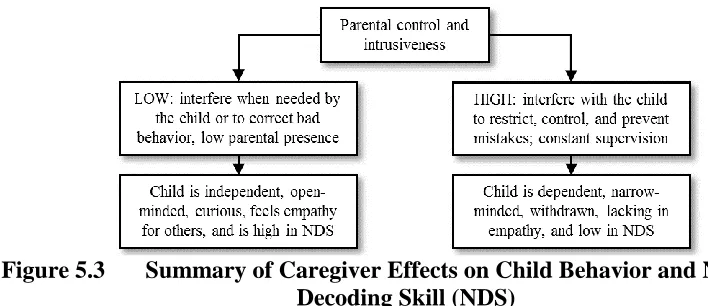
(2009, p. 163). ... 24 Figure 5.1 Potential Effects Diagram for Nonverbal Decoding Skill ... 91 Figure 5.2 Model for the Acquisition of Nonverbal Decoding Skill... 122 Figure 5.3 Summary of Caregiver Effects on Child Behavior and Nonverbal
x
APA American Psychological Association
ASL American Sign Language
CPI California Psychological Inventory
ILC Internal Locus of Control
NDS Nonverbal Decoding Skill RWA Right Wing Authoritarianism SDO Social Dominance Orientation
CHAPTER ONE: INTRODUCTION
The ability to communicate and understand each other is a particularly nuanced skill in humans. This skill is generally acquired during the early years of life, and includes subtle, ambiguous, and continuously evolving content in the form of words, gestures, and a variety of other signals that can be used simultaneously to convey information. These layers of communication are constructed of elements that vary enormously across groups and between individuals. Each culture apparently contains equally complex communication systems with unique patterns and arrangements of words, signs, and symbols. Perhaps like any other skill, communication is acquired non-uniformly between individuals, leading to variation in the ability to understand and communicate proficiently.
relationship quality be related to the development of communication skills? The
researcher may theorize that children who are better at nonverbal communication are able to use those abilities to develop better relationships throughout their lives, or researchers may theorize that having been exposed to healthier relationships leads to better
communication skills in general. It may also be the case that other, unmeasured variables are acting upon both nonverbal skills and relationship quality to cause the observed correlation. One may even theorize that there is a reciprocal, or circular chain of influence between variables, causing them to increase or decrease together. As theories such as these are suggested by researchers, more routes of investigation open up for future studies—too many such avenues for all of them to be explored exhaustively. The result is a collection of correlational data, interesting ideas, and unanswered questions.
In most of these correlational studies, the variables related to nonverbal
theoretical work to understand what it all means. When theories are proposed in such studies, they concentrate on only a few variables while summarizing the remaining results in tables of statistics, perhaps due to the constraints of journal publication or the daunting complexity of the system of variables. Attempts that have been made to create unified explanations for nonverbal communication abilities tend to default to well-recognized models about learning, memory, or development (Greene, 2003), rather than to utilize the large body of research available to construct novel insights or new
theoretical constructs.
A theoretical explanation that was built from and attempted to unify results from across the literature would have greater explanatory power than any one of the existing theories or variables alone. A theory of this kind would also have potential to explain unexplored interactions between individual variables, since it would consider them in its construction. This theory would also have the benefit of potential generalizability to other communication skills. For example, if it is known how one learns to understand
nonverbal communication, perhaps it can be better understood how one acquires spoken language, sign language, writing skills, musical or mathematical skill, etc. The purpose of this project was to construct such a theoretical model, a model developed from a
what they mean, their relationship to nonverbal communication, and their relationship to other variables of interest. The analysis also looked for larger themes among the
interactions, with the intention of finding a more comprehensive theoretical explanation for the entire system.
The examination of prior research ultimately led to the conclusion that childhood and early developmental factors were central to answering this question. Causal
explanations for the entire system of variables were found in childrearing practices, which influence the development of both nonverbal skill and the collection of related variables, including moral behavior and personality traits. Specifically, the levels of control and support behaviors put forward by parents can have a powerful impact on later competencies. As will be shown, well-intended intrusive parental behavior can negatively affect social and moral development, while decreased presence of caregivers can lead to improvement in a range of skills.
The consequences of childrearing practices in early development offer a new explanation for how the skills and behaviors examined in this project are related to NDS. The model constructed during this process draws causal connections between
childrearing practices and the child’s later social behaviors and abilities. Following the presentation of this new theoretical model, potential implications for other areas of research are discussed. In the next chapter, current theories used to interpret NDS
A Clarification of Concepts
Nonverbal communication and nonverbal behavior are both terms commonly used in this area of study. The difference may not be clear during this discussion without a clarification. A nonverbal behavior, such as scratching one’s nose, may be considered to nonverbally communicate something or not by either the sender or the receiver of the message, making it ambiguous whether or not such a behavior is communicative. At the very least, many communication scholars agree that a behavior must be observed or received at some point in order to be considered communication (for a review of different theories see Littlejohn, 1999, Chapter 1). A behavior exhibited by a message sender, in the absence of a receiver, would not be said to have communicated something because no one has received a message, consciously or otherwise. This project is focused on
communication rather than behavior, so the research that follows is biased towards the perception, observation, or understanding (i.e., decoding) of messages rather than the behaviors that may be perceived to send that information.
A more pertinent reason to focus on message reception, rather than sending, is that the determination of skill in message sending relies heavily on accurate perception and understanding to determine if the sender has conveyed what they intended. Only a skilled receiver can reliably determine a skilled sender. It is also difficult to measure deficiencies in the sending of nonverbal messages because the lack of observer
comprehension can always be blamed on poor communication skills at the receiving end. Increased comprehension of sent messages by the receiver, on the other hand, can
Finally, one of the reasons to restrict this project to the receiving end of nonverbal messages was to limit the scope of the project.
The perception (or receiving) and understanding of nonverbal messages is
referred to as decoding, so throughout this project I may refer to the “accurate decoding” of nonverbal behaviors, or how an individual is determined a more- or less-skilled decoder of that content by objective assessment to determine their ability level in
comparison to others. The scores on these tests are a measure of nonverbal decoding skill (NDS), which is the variable being modeled in this project.
What qualifies as a communicative nonverbal behavior is very broad across the literature examined here. Since even unintentional behaviors can convey nonverbal information, many researchers agree to include in this category everything that can communicate information except written and spoken words (Knapp, 1972; Matsumoto, Hwang, & Frank, 2016). Examples of nonverbal behavior examined in the research discussed below include postures, facial expressions, situational contexts, voice qualities like pitch and tone, emotional responsiveness, and combinations of unspecified behaviors used to deduce relational information like how two interactants know one another. NDS assessments may use any of these communication channels, depending on the test construction. The variables of focus in this project tend to have been verified across multiple such tests, making their correlation to NDS fairly reliable.
Justification
fields typically focus on variables particular to an individual’s present circumstances, personality, or demographic variables when examining NDS. This project redirects explanations for NDS acquisition towards childhood environmental factors. Specifically, I conclude that one’s NDS competency, social development, and moral reasoning are more strongly determined by the effects of early parenting behaviors than by later adult circumstances such as career choice, recreational pursuits, or demographic variables. This implies that researchers in the fields mentioned above would benefit from exploring alternative explanations for adult outcomes by investigating early environments and parental interactions. The hope for this study is that researchers in these fields may turn greater attention toward the effects of parenting, and that they will consider and test the ideas presented here in order to arrive at new insights about learning, child development, skill acquisition models, and NDS in particular.
CHAPTER TWO: CURRENT THEORETICAL PERSPECTIVES Current explanations for NDS come from a variety of disciplines and include mechanisms related to learning, memory, psychology, physiology, evolution, and early development. In each instance of a particular variable (e.g., “relationship quality”) being correlated to NDS, one of these known mechanisms is used by researchers to explain the correlation or interpret results of the study. It was unclear before beginning this project which (if any) of these mechanisms would retain explanatory power when looking at the larger collection of correlated variables as a system of interconnected influences, so all relevant perspectives and research are considered potentially useful in the course of the discussion.
adequately account for a large collection of these correlated variables, in a way that gives insight to the larger system of interactions, is the purpose of this project.
Learning Models
Current explanations for NDS in adults are heavily concentrated on childhood learning models which also form the basis of adult learning models (Greene, 2003). These learning models focus on memory and generally involve two basic steps: the learning of associations and learning to generalize those associations from experience (Haviland-Jones, Gebelt, & Stapley, 1997). First, one makes sense of information by forming an initial association and then learns to apply that association to other similar instances. A proposed third follow-up step involves repetition of use which leads to increased speed and accuracy of applying the generalization (Greene, 2003). To illustrate these steps: acquisition of a communication rule might include the realization that when a particular person is “cowering,” the person is “afraid.” The later refinement of that skill involves the experience of other instances of cowering, to develop the generalization that this behavior comes in many forms from many individuals or that “cowering (in general) = fear (in general),” with the recognition of such instances naturally increasing in speed and accuracy through repetition.
relationship quality. Such an explanation might be that better relationships put one in a position to interact more often and learn communication rules with regular feedback, which improves or speeds up the nonverbal learning process according to the learning model. Relationship quality could have continuous effects on NDS throughout life, meaning that improved relationships in later life could have a positive impact on NDS, or that poor relationships could negatively affect NDS.
Another way to use learning models to interpret a correlated variable might be to discuss how increased NDS might improve learning in other areas that influence the variable of interest. For example, NDS may affect how one learns to develop, maintain, and nurture relationships, which then leads to the observed positive correlation with relationship quality. Being high in NDS may also increase the speed with which one first notices an interpersonal phenomenon, providing valuable information for relationship maintenance. The next step in the learning process is learning to generalize, which might be sped up by increased NDS, allowing faster identification of similar behaviors across diverse individuals and resulting in higher quality relationships of various kinds.
perceptions and the interpretation of those perceptions. The steps of learning— acquisition, refinement, and repetition—rely strongly on the proper development of sensory organs and the brain, so anyone without these properly functioning systems would be at a communicative disadvantage. Learning models are therefore influenced by other systems as well.
The three-step learning model described above provides a general explanation for one’s ability to understand nonverbal messages that relies on experience and basic biological preparedness. Learning models are meant to be widely applicable as an explanation for skills acquisition, so the application to NDS is an easy one to make. Exposure to information leads to rule formations, and repetitive exposure to similar instances leads to increased recognition. The implication for NDS from this type of explanation is that those with more exposure to the stimuli (nonverbal messages) and those with properly functioning biological systems would be better at understanding nonverbal messages. Increased exposure or experience should lead to increased NDS.
Social Learning
can be used to direct future actions and can also be used to strengthen or weaken prior learning.
The key steps in the process of social learning are similar to those found in the general learning model described above. First, the attention to stimuli drives the choice of information being observed. Next the distinctive features of the observation are
differentiated from each other, followed by correlating or associating the information into categories of similar events. Lastly, the information is organized into “easily remembered schemes” (Bandura, 1971, p. 21) for later use. This process is considered to take place unintentionally, as a psychological learning response in social situations.
In terms of the example variable “relationship quality,” an association with NDS could be explained by social learning in a couple of ways. One explanation is that better relationship quality places one in a position to better observe reliable and consistent behaviors, improving the type of psychological models one is able to internalize. These reliable and healthy models assist one to predict future behaviors and better understand the world around them in ways that a person with poor relationships may not be able to achieve. The other type of explanation possible from social learning models is related to the influence NDS would have on the psychological modeling process. NDS would affect the ability to perceive, understand, and learn from observed interactions in the immediate environment. The psychological modeling process used in social learning would
therefore be affected, allowing a nonverbally skilled observer to better learn how to maintain high quality relationships just by observing the relationships in their
others, decreasing the benefits of psychological modeling that might help them improve their relationships and better navigate the social world.
A social learning perspective provides an explanation for NDS based on input from observed interactions in the environment. If one has limited exposure to
information, then one has less information on which to build psychological models. Exposure or direct experience is a key variable in skill acquisition under this theory (Bandura, 1971). Without prior observation or experience, an individual is less prepared when first encountering a situation. A social learning perspective of skill acquisition would then support the importance of a childhood environment that exposes the child to a variety of observable interactions from which to learn. Being around other people, having friends, and being able to observe the interactions of family members would increase an individual’s ability to navigate future social situations. This perspective places heavy emphasis on social exposure for the acquisition of NDS.
Co-development of Language and Gesture
Another perspective of NDS development suggests that verbal and nonverbal communication skills co-develop; that is, the understanding of physical expression or gesture, and the later understanding of spoken language, may both rely on the same cognitive processes during development (Cartmill & Goldin-Meadow, 2016). Clear and comprehensible gestures and expressions are used by infants and toddlers prior to proficiency in spoken language, but are used to augment and stand-in for linguistic
gesture are an early sign of spoken language delays (Sauer, Levine, & Goldin-Meadow, 2010).
Implications commonly drawn from this interaction between language and gesture are that the same cognitive mechanisms are required for both verbal and nonverbal
communication skills. This would suggest that proficiency in either area should be associated with proficiency in the other, with increased skills augmenting each other through either childhood or adult learning. Similarly, deficiency in either verbal or nonverbal communication may be a sign of deficiency in the other. The cognitive mechanism suggested by this perspective is one that determines proficiency in the learning and understanding of information of multiple kinds simultaneously.
This simultaneous learning suggests that verbal and nonverbal language may be better understood as one language. For example, children who were delayed in spoken language compared to their peers were caught up one year later if they were performing at a normal level with gesture proficiency, but their peers who were deficient in gesture failed to catch up in spoken language (Thal, Tobias, & Morrison, 1991). This suggests that being able to communicate with gesture allowed children to catch up with spoken language as if the two skills were different subparts of the same language system. Because gesture occurs earlier in development, it can be used as an early warning of disorders like autism, that include a range of other communicative deficiencies (Cartmill & Goldin-Meadow, 2016). Deficiency in gesture is an early signal of general language delay.
draw the connection that social competence and communication ability are just a part of an even larger system of co-developing skills for dealing with and understanding other people later in life (Keating, 2016b). This would mean that skill level would manifest in a variety of communication competencies. Some authors have described these intersecting abilities as a dynamic systems model that requires adequate socialization processes in order synthesize information from a variety of sources such as emotion, expression, and personal interactions (Keating, 2016b), all of which are heavily reliant on exposure to interaction.
Interaction during childhood is when these associations are formed, labels are created for acquired knowledge, and the child learns to self-regulate their own behavior based on feedback (Buck & Miller, 2016). This means that the co-development
perspective of skills acquisition drastically increases the importance of the childhood environment. The emphasis on childhood environment follows suit with most other models that attempt to explain nonverbal communication skills (Greene, 2003).
period allows for skills development and brain growth. The time limitations of the critical period may be the limiting factor that requires the co-development of skills.
As an explanatory mechanism in the illustrative variable “relationship quality,” the early co-development of verbal and nonverbal language skills might explain the correlation because better relationships could provide the opportunity for more verbal language practice, especially when these skills are first developing. Poor relationships might provide less exposure and therefore less practice for spoken language learning, impacting the co-development of NDS. Another interpretation of a co-development perspective might be that someone with higher NDS would also have better verbal communication, which would assist in the creation of better relationships through improved communication.
The co-development perspective of communication skill acquisition suggests that a varied system of informational input allows for greater proficiency in multiple skills, as they supplement each other in the learning process. This view also implies that skills are more connected than is typically imagined, with environment so influential that it affects the learning of skills not apparently related to the information coming in. This perspective suggests that a more complex and, perhaps, less-controlled environment may be more ideal to the natural learning process than an organized and controlled one, since it may be unpredictable which types of information will augment the learning of related skills.
Mirror Neurons
The next perspective of NDS acquisition explored here is an innate, hard-wired, physiological mechanism proposed by some researchers to explain the ability to
usually believed to have come pre-packaged because, directly after birth, infants readily express recognized signals of internal states like fear, anger, and sadness without any prior exposure to stimuli (Haviland-Jones et al., 1997). The theory behind mirror neurons suggests that, in addition to hard-wired emotional expressions, humans have a hard-wired ability to understand the internal states of others based on the information being
perceived, verbally or otherwise.
The research behind this perspective comes from studies on macaque monkeys that showed the same neurons fire both when individuals conduct an action, like picking something up with their hand, and when that individual perceives the same action being conducted by another (Keysers, Thioux, & Gazzola, 2013). The neurons that fire under both conditions are referred to as “mirror neurons” because they behave the same way whether it is the self or a perceived other exhibiting that behavior. This mechanism is commonly generalized to more complex human behaviors in order to provide an
explanation why one person may feel pain while watching another person feel pain. That is, mirror neurons are often used to explain feelings of sympathy, empathy, or a general understanding of the internal states of others.
Mirror neurons are a biological mechanism, so this perspective suggests that understanding others is biologically hard-wired, at least to some degree. However, there is evidence that observed actions elicit more response when one has previously conducted the action for themselves (Cannon et al., 2014) and that just being familiar with the action can increase the mirror neuron response (Liew, Han, & Aziz-Zadeh, 2011). This means that prior experience is important to this mechanism. The mental storage of an
through the same experience. The implication is that if one had no experience with sadness or pain, one may be less likely to “catch” those feelings by being around another person via the mirror neurons. Conversely, if one had experienced much sadness in their life, they may automatically be negatively affected when surrounded by unhappy people. A varied history of feelings and experience would lead to a greater ability to understand the perspectives and feelings of others. This ability would be physiological and not well-controlled. It is believed to create in the observer an effortless sense of knowing the feelings of others that may feel as if they are experiencing that feeling themselves. This physiological response to others would create a heightened awareness of others’ internal states during the observation of nonverbal behaviors. This is very different from the type of understanding that one acquires through intentional, conscious effort to empathize with and understand another person.
In terms of the illustrative example variable “relationship quality,” the existence of mirror neurons may suggest that relationship quality is associated with NDS because NDS would positively correlate to one’s range of social experience and having more social experience would assist one to find and maintain better quality relationships. Any experience that increases the range of one’s emotions and interactions should also increase the mirror neuron response that connects to an internal awareness of social situations.
perspective offers an interesting explanation for how individuals may understand what another person is thinking just by observing them. Experience is important to mirror neurons, which suggests a varied set of experiences would lead to a better understanding of others and therefore increased NDS.
Evolution and Genetics
From an evolutionary perspective, nonverbally communicated messages can make information available to other organisms which could increase their ability to survive or reproduce. This information can come in any form; sight, sound, smell, touch, taste, or situational contexts. Nonverbal signals in animals are sometimes broadly defined as anything that results in some change in another individual (Smith, 1977). Individuals that best understand these subtle messages would know faster than others when situations were dangerous or beneficial, which would increase their survival or ability to
reproduce—also called fitness. The adaptive situations considered affected by nonverbal communication include confrontation avoidance, sensing danger, finding food, and coordinating action among group members (Keating, 2016a). In other words, the understanding of nonverbal cues is driven by immediate social goals and motives that satisfy basic needs (Fiske, 2010) which may be used to forecast expectations and future behaviors of others (Fridlund & Russell, 2006). From an evolutionary perspective, nonverbally skilled individuals have increased fitness in a variety of situations and contribute more offspring to the next generation, genetically selecting for the ability to understand nonverbal information over time.
an honest one (e.g., signaling false strength; Keating, 2016a). This means that the ability to fake a nonverbal signal could also increase one’s survival and therefore be selected for over time. False information may lead to somewhat of an arms race between the ability to accurately perceive a message and the ability to fake a message (e.g., Mokkonen & Lindstedt, 2016). For example, it would be beneficial to appear strong in order to avoid fighting, but those who could accurately perceive when this was a false signal of strength would easily gain an advantage, so there is also room for the evolution of nonverbal communication skills that are sensitive to false information.
At the level of specific types of nonverbal human signals, like smiles or frowns, many studies have shown there are universal human expressions that convey the same meaning regardless of race or culture (Keating, 2016a), and the muscles required to produce these expressions also appear to have been selected for in humans (Waller, Cray, & Burrows, 2008). This cross-cultural work suggests a set of nonverbal signals that may have been genetically selected or hard-wired to display particular feeling states to other individuals. However, the comprehension of additional, subtler cues such as culturally relative innuendo and symbols would still need to be learned.
Non-innate signaling that requires learning in the environment can still be driven by genetic selection because the genes that predispose one to acquire that understanding with greater speed and accuracy may also be selected for. The selective advantage would then be given to those with better sensory perception, neural functioning, or other
stressor that naturally benefited individuals who were able to survive because of their more accurate perception or cognition.
In the case of the example variable, “relationship quality,” the evolutionary perspective may explain a positive relationship to NDS through a genetic predisposition to associate with others, form communities, and contribute offspring to the next
generation. If NDS is selected for, increased NDS would increase one’s ability to form high-quality relationships, making them more likely to survive because of cooperation or mutual assistance, and eventually be more successful at producing offspring. Similarly, relationship quality may be feeding into the genetic mechanism that allows one to learn culturally specific means of communicating, therefore assisting in the acquisition of nonverbal communication rules.
An evolutionary perspective of NDS provides one explanation for the observed human universality in nonverbal messages and their meanings (e.g., Liszkowski, Brown, Callaghan, Takada, & de Vos, 2012)—universality which would allow for better
decoding of nonverbal information between individuals from across an entire species. Evolved mechanisms would include expressive behaviors and the sensory and neural mechanisms required to make sense of them when observed in others. A history of unpredictable environments and other selective pressures would result in the selection of increased abilities to decipher information from available cues that could increase the ability to survive. Over the course of one individual’s lifetime, this may manifest in a hard-wired ability to learn novel message systems as they arise and to use that
Additional Perspectives on Nonverbal Learning
The theories and perspectives described above have consistently been used to understand and interpret research findings in nonverbal communication. In this section, I will describe some efforts that have been made to construct more precise explanations for the development of NDS and where such explanations typically occur in the literature. Unlike the perspectives mentioned above, which are taken from other areas of study, the explanations described here are particular to nonverbal communication. I will first discuss a prior model of influences and then explain why such models are rare through a brief explanation of prior meta-analytical work in this area.
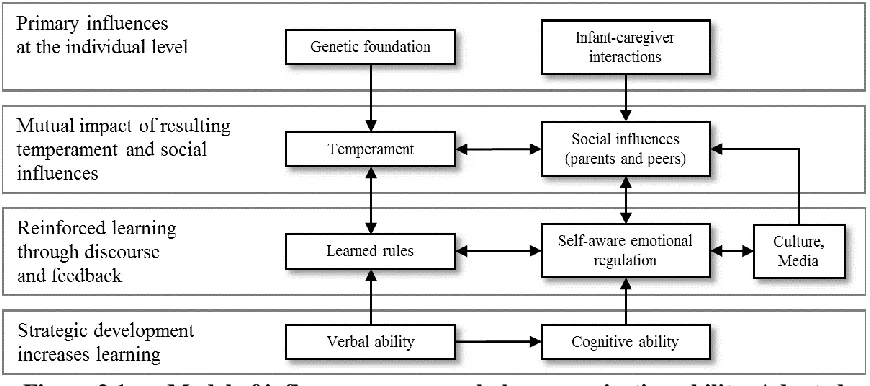
The model shown in Figure 2.1 describes different levels of influence at the individual level that may affect NDS, according to Zeidner et al. (2009). Biological and temperamental predispositions combine with social interactions to influence the
development of NDS and related emotional competencies. Primary influences in this system are genetic predisposition and interactions with infant caregivers, both of which are considered most influential in how the individual will respond in later social
expressed by children, according to this model, are determined by a combination of biology and environment.
Figure 2.1 Model of influences on nonverbal communication ability. Adapted from Zeidner et al. (2009, p. 145).
This model is limited in its ability to contribute new insights or causal explanations. Neither genetics nor environment are disputed by researchers to be
influential at the individual level. While the model is able to more particularly address the topic of NDS, it does not appear to be much more specific than any of the theories
described above. However, it does synthesize prior theories fairly well. Such a synthesis is possible because the theories discussed above are not mutually exclusive. Many, if not all, of them could be true at the same time. This model may therefore be a way of
visualizing their interactions, but it does not provide additional insight into the causal forces acting on the system.
importance but does not explain causal relationships that would be necessary for the variables of interest in this project. For example, the variable “relationship quality” might be easily placed within the model at various locations—infant caregiver, parent, peers, etc.—but it is unclear how this relationship quality influences the system in any way more illuminating than the influences suggested in the theoretical discussions undertaken above.
A different type of model might be one that was constructed by analyzing the research on variables correlated to NDS. The closest to such a model is frequently just a cluster or list of known influences, lacking in specific hierarchy or organization that would inform inference-making or theoretical explanations for any new information that might be proposed to influence the system. A visual model that merely depicts
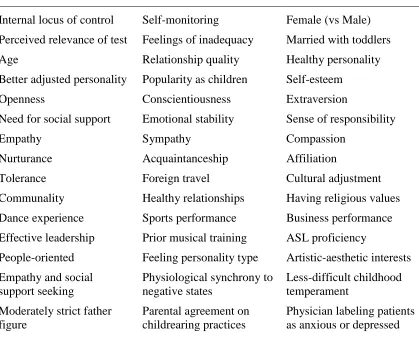
information in non-informative displays, such as the model depicted in Figure 2.2, for the related ability of emotional intelligence, does not explain how specific variables interact with the system. These models appear to be limited to whether or not certain variables are in the system, making the model no more helpful than a list of information.
Figure 2.2 Variables influencing emotional intelligence. Adapted from Zeidner et al. (2009, p. 163).
communication. The meta-analyses most informative to this project have gathered variables that are associated with NDS and analyzed them for statistical significance. Individual studies included in such meta-analyses usually look at only a few variables of interest and are therefore inadequate for developing a comprehensive theory. For
example, one recent meta-analysis examined what type of information was assessed in individual studies on nonverbal skills and found that most studies examined only a few aspects of nonverbal communication, such as identifying emotions or situational contexts, while being similarly limited in how many expressive channels were being examined (e.g., eyes, faces, body language; Boone & Schlegel, 2016). The purpose of the study that reported these findings was to run a statistical analysis to determine what types of studies were most common in nonverbal research, so the attempt to construct a theoretical
explanation for NDS was a peripheral discussion point. However, the authors did come to a theoretical conclusion that the mechanism influencing the variables may be similar to the mirror neuron mechanism described above, relying on mimicry and the embodiment of observed behaviors. How any particular variables in the system may interact with each other to influence learning at the individual level or cause changes in NDS seemed to be beyond the scope of the paper. This failing of meta-analyses is common because the construction of novel theory is usually not the purpose of such an analysis.
An earlier study that attempted to synthesize research findings in a way similar to the goal of this project, looked at the relationship between variables in the areas of
cognition and learning (Ackerman, 1988). The author found three broad principles for the system, which were proposed to be the governing variables of all learning:
ability for accuracy. This proposed simplification of influential variables into groups of influence helps to construct explanations for new information. For example, both pre-determined intelligence and psychomotor ability have hard-wired biological components. This means that Ackerman’s explanation for the connection between cognition and learning relies heavily on biology or genetics. If new information is found to influence the relationship between cognition and learning, a genetic explanation for that
information could be explored first, since that explanation has already provided order to the system of influences.
I contend that more statistical work or data collection is not necessary in order to make sense of the data. What is needed is to identify the causal explanations that have been called for by prior researchers (e.g., Hall et al., 2009). One assumption of this project is that there are more than enough prior studies and collected data to carry out this work. The intention of this study was to move beyond a focus on data collection and toward theory building. The studies mentioned above, and those that were collected throughout this project, form a body of literature that serves as a foundation from which to begin exploring possible interactions in the development of NDS. Further data is explored below as the discussion warrants and the work is extended in order to bring these variables together into a theoretical model or explanation for how the associated variables are influencing the acquisition of NDS. This is not a mathematical model, nor a rigorous meta-analysis; but rather an exploration with the goal of asserting a new
CHAPTER THREE: METHOD
In order to explain how someone becomes proficient in NDS, a theoretical model was developed for this project from a collection of research findings published during the last several decades. Personal attributes correlated to NDS, such as one’s “relationship quality,” were investigated for how they may be influencing NDS. The results of this investigation directed the discussion towards childhood environmental factors, which became the primary factors used in the model to explain the development of NDS.
The method used for this project was exploratory and theoretical. Smagorinsky (2008) suggests that in projects where exact outcomes of the work are unknown ahead of time, that the method section be used to describe what occurred after the fact. For
example, rather than to decide categories for data ahead of time, this type of project would allow categories to evolve during the process and to have that process explained afterwards in the method section. This procedure was employed in the construction of the method section for this project. An exploratory method was best suited for this project because it allowed room for new avenues of research to be developed as the investigation progressed. That being the case, the method section here describes a process with some fixed points and some more fluid.
Data Collection
personal attributes that have been correlated to these scores may be referred to as the
independent or predictor variables, though this designation should not be taken to imply
causation. The predictor variables are often collected from research participants before or after NDS assessments and include demographic or other personal information such as a participant’s “relationship quality.” Results are then statistically analyzed to determine if predictor variables are significantly correlated to NDS scores. Some of these variables are from other types of assessments, like personality or IQ tests, which may be given in tandem with nonverbal assessments. In recent years, there have been several published collections of such variables in meta-analyses (Hall et al., 2009; Hall, Mast, & Latu, 2015; Murphy, Mast, & Hall, 2016). These works collect previously correlated variables and assess them for statistical significance across multiple studies to see how well they may predict NDS. This project sought to find new explanations for these statistical correlations, so recently published reviews of prior work on NDS were used to jumpstart this investigation, which remained open to insights from additional studies as the
exploration continued.
Initial data (variable) collection was guided by the recently published APA
Handbook of Nonverbal Communication (Matsumoto et al., 2016), which reviewed
few related reviews for further investigation (e.g., Hall et al., 2009; Ickes, 2009) which were independently examined for additional variables.
After this initial collection of variables was conducted, brief descriptions and definitions for each variable were collected and discussed. Most of the variables were found in the Encyclopedia of Social Psychology (Baumeister & Vohs, 2007), which also contains within most definitions other additional variables that tend to be correlated to the predictor variable. Although these peripheral variables are not necessarily directly
correlated to NDS, they were also collected in order to inform the discussion and gain a better understanding of influences that may be acting upon NDS. In cases where the predictor or other variables were not found in the Encyclopedia, a literature search was conducted to locate a source that defined the variable and reviewed its connection to other traits of interest. Each additional variable found to be related to the predictor variables during this process was open to further investigation in a similar manner during the analysis described in the next section. This means that some data collection continued throughout the process.
process branches out and away from this initial collection of information to explore other findings.
Data Analysis
The analysis of variables for this project entailed a discussion of possible
interactions and associations based on information collected from the literature. Predictor variables were examined for how they may be associated with NDS based on a discussion of their definitions and past related research. The analysis of these variables revealed several themes, as discussed throughout Chapter Four. The process achieved a deeper understanding of the variables, suggested a host of potential interactions, and revealed possible explanations for why particular variables are correlated to NDS. The conclusion, reflected in the model formation, was that childhood environment is influencing the majority of variables.
Throughout this process, additional variables of interest were identified and brought into the conversation, especially if it was conceivable that something else was driving the system. These variables arose primarily during the variable definition and discussion process. For example, exhibiting hostility to perceived threat is related to several predictor variables, including self-esteem, locus of control, and neuroticism. This means that hostility to perceived threat may be meaningful to the system and was
During this investigation, apparent contradictions among the variables appeared and required explanation. For example, while “relationship quality” is positively
correlated to NDS, “being more in love” is negatively correlated to NDS (Hall et al., 2009). Relationship quality and being in love may appear on the surface to be similar, but my analysis explains how they are not and that their difference is meaningful to this project. Apparent contradictions were examined in this way, with the expectation of arriving at new insights that inform the understanding of the larger system.
To summarize the examination of variables described thus far: the variables were first defined and discussed individually and then in combination with other variables that are similar in order to find major themes of influence, such as “concern for others.” This is a useful process for understanding complex systems of interactions because by
understanding the smaller, decomposed parts of a system and how they operate, solutions can be uncovered for the larger whole (Morris, 1970). The result of this analysis was a description of potential interactions and additional variables that are theorized to govern the system. In particular, factors of childhood environment arose repeatedly as a possible source for most variables in the system.
The data collection and analysis for this project included a discussion of predictor variables with significant correlations to NDS, definition and description of the variables in relation to each other, and an examination of additional variables as the discussion explored new possible interactions—all while addressing problems of causation and any insights found along the way. Each of these pieces of information were used to inform the theory construction process described below.
Theory Construction
Theories do not typically arise from a proposed method, but appear to originate off-paper in the minds of theorists and only appear as finished products after unplanned processes occur. For example, Darwin can hardly be said to have proposed in detail how he would travel about, engaging in observations of various critters with the intention of formulating specific deductions about them, culminating in a cohesive theory that could (in one sense) explain all life as we know it. And it would be silly to have expected such a proposal ahead of time. Steps can be enumerated from an investigation of the process after the fact, but that does not mean that if those steps had been followed at the outset that the conclusion would have been the same. With that in mind, what this section provides is a description of the major steps that took place during the process of
Causal Claims
In order to explain how the predictor variables were related to NDS, causal claims were made. The relationship between two variables x and y might be that x causes an increase, a decrease, or no change in y; or that x and y are related in some more complicated way, perhaps acted upon by a third variable. More importantly, the information collected during the analysis leads to some proposed explanation of why these variables are related in such a way; the why is the justification for the theorized causal interaction. The causal claims made throughout the discussion of collected
research suggested childhood factors were causing the reported correlations in the system of variables. How those variables interact with NDS in adulthood was therefore a
confusing place to start. Causation was further explored from the perspective of childhood environment.
According to Reynolds (1971), causal claims are the natural product of research-based theory creation. Reynolds describes data-driven theory as an attempt to discover and identify the “real” patterns in nature, patterns which are difficult to determine due to the large number of undiscovered variables in living systems. The data collection and analysis in this project included an effort to identify these undiscovered variables and simplify them into workable units. Identifying causal relationships between the variables simplified the focus of the model on the specific theme of childhood environment.
is, decisions should be determined by available information and a logical process that others can evaluate and test.
Assembling the Model
The first step in assembling the model was determining which variables were primary, direct influences on the system and which were indirect or intermediary. For example, a variable like “child-rearing practices” is known to determine change in both popularity and concern for others, which are both correlated to NDS. This suggests that child-rearing practices are more influential on the system than either of these predictor variables, even if child-rearing practices had not been previously correlated to NDS. Decisions were made, in situations such as this, to focus on the variables that appeared to be most influential on the system. In this case, child-rearing practices continually
emerged as a driver of the system.
Another type of simplification occurred if a chain reaction of influences was suggested by the published research. If several predictor variables were connected in this way to influence NDS, then the decision was made to concentrate attention on the head of the chain reaction. For example, if child-rearing practices influences relationship quality, which influences openness to experience, which influences NDS; then the most attention would be directed to the variables closest to the start of this chain reaction. Such
decisions were justified as they occurred, but ultimately resulted in simplifying the model by reducing the number of variables considered to be causally affecting the system.
influences that govern or predict large portions of the system. Luce (1970) says the best explanations for a system are able to account for the greatest number of unique variables. Causal interactions were simplified during this project in a way that developed a
theoretical description of the entire system that was simple, without losing its ability to explain the large number of unique variables involved. The process of simplifying the system by identifying variables that exert the most influence therefore continued until the system became simple enough to suggest one or more new explanations for NDS. This remaining set of primary influences, focused heavily on child-rearing practices, were used to construct the model represented below both graphically and verbally as a set of influences on NDS.
One particular goal of this process was to avoid vague, over-arching explanations such as “child environment.” While it may be the case that many variables are related to child environment in some way, to say that child environment influences any or all of the predictor variables is not a conclusion that informs future work. Novel connections and explanations were sought throughout this process and especially at steps attempting to simplify the system by investigating recent literature, including new theory and scientific findings. An explanation that stated “child environment is important,” or something similar, would not have been helpful or informative. The goal here was to investigate alternative explanations for interactions and arrive at new possibilities for understanding the human experience. Specifically, to explain why these influences were exerting the observed effect on NDS.
model for what causes variation NDS. These individual explanations were broad in their application to the entire system of variables, but particular in their application to even the smallest of identified interactions between individual variables. Each theoretical causal connection was formulated through a series of logical processes based on the related, published research. Theoretical explanations were examined as described in the following section for potential application to other research or theory.
Model Extension
At least two things were addressed after completing the process of creating a theoretical model. The first was to summarize and explain the model in terms of how it was derived from the collection of variables that initiated this project, including how the ultimate claims of the model are consequences of evidence initially collected on the correlated variables. This involves a deeper explanation of the model’s major conclusions. The second item to address was how the model related to other major theories or areas of research, including hypothetical consequences of the model and if it answered any other questions outside the scope of this project.
Similarly, since this same system of predictor variables has been used by other researchers to describe response variables other than NDS, the explanatory theory developed here was examined for how it applies to those related response variables. For example, emotional intelligence has been used as a response variable for this system, which includes the ability to manage one’s own emotions (Goleman, 1995). This means that it was productive to theorize how the explanatory theory constructed by this project explains the development of emotional management skills, which in turn has implications for how a variety of mental disorders may develop.
The theory and corresponding model of interactions developed by this project provides an explanation for how the collection of correlated variables found in the
CHAPTER FOUR: RESULTS AND ANALYSIS
In this chapter I discuss the process and the results of variable collection,
discussion, and analysis that were described above. There were multiple potential areas of investigation revealed throughout this process which were each given attention as they arose.
Initial Variable Collection
As described above, the variable collection for this project began with a recent review of published literature which provided the initial variables and information needed to explore and locate additional variables during the subsequent analysis. The chapter on nonverbal sensitivity in the APA Handbook of Nonverbal Communication (Riggio & Darioly, 2016) is relatively short, concisely describing various methods of assessing NDS, some major predictor variables identified by each test method, and other issues related to NDS. The most frequently used tests are discussed, with assessed
communication channels that include audio, video, combinations of both audio and video, still images, a variety of situational and relational contexts, and self-assessments.
Definitions for NDS within this chapter include a variety of abilities, such as correctly interpreting the meaning of nonverbal cues, reading a person’s traits, detecting deception, recognizing adherence to social norms, sensitivity to subtle appearance cues, and
recognizing emotions and feelings in others. More information on these various
communication channels and the tests used to assess NDS can be found throughout the APA handbook (Matsumoto et al., 2016).
variables are defined, explored for relationships with each other, and other potential variables are identified and brought into the discussion as interactions are explored.
Not everything that is associated with NDS was useful to this project. As mentioned by Riggio and Darioly (2016), lie detection is highly unpredictable. Respondents usually score little better than random chance at detecting lies, and professionals who might be expected to be proficient, such as law enforcement and federal officers, polygraphers, and psychiatrists, are no better than the average person at detecting a lie. For these reasons, lie detection is typically not included in recent studies on this topic and I did not include it in this project.
Table 4.1 Initial Collection of Variables Correlated to Nonverbal Decoding Skill (NDS; Hall et al. 2009; Ickes, 2009; Riggio & Darioly, 2016)
Positively correlated to NDS
Internal locus of control Self-monitoring Female (vs Male) Perceived relevance of test Feelings of inadequacy Married with toddlers
Age Relationship quality Healthy personality
Better adjusted personality Popularity as children Self-esteem
Openness Conscientiousness Extraversion
Need for social support Emotional stability Sense of responsibility
Empathy Sympathy Compassion
Nurturance Acquaintanceship Affiliation
Tolerance Foreign travel Cultural adjustment
Communality Healthy relationships Having religious values Dance experience Sports performance Business performance Effective leadership Prior musical training ASL proficiency
People-oriented Feeling personality type Artistic-aesthetic interests Empathy and social
support seeking
Physiological synchrony to negative states
Less-difficult childhood temperament
Moderately strict father figure
Parental agreement on childrearing practices
Fine arts majors (vs STEM)
Business administration majors (vs STEM)
Doctors with more satisfied patients
Rated as more effective workers
Positive evaluation by co-workers
Rated by superiors as better clinicians or teachers Peer-ratings as more
interpersonally sensitive
Other-rated as assurance seeking
Negatively correlated to NDS
Aggressiveness Anxiety Social Anxiety
Depression Neuroticism Introversion
Shyness Loneliness Exhibition
Autism Schizophrenia Alcoholism
Family expressiveness Feeling hurried Other-rated as hurried Bullied by childhood
classmates
Duration of marriage (after 1-2 years)
Mothers have joint custody (vs full custody)
Abusive husbands (when judging wives)
Being more in love or obsessed with love
Other-rated as rebellious or non-conforming
Over-estimating one’s value to others on the team
Variable Definitions, Themes, and Analysis
The following section illustrates how the correlated variables listed in Table 4.1 are defined and understood, summarizing what is generally known about them from prior studies in order to develop an understanding of the system I am attempting to model. The discussion begins with the most frequently correlated and well-documented variables related to NDS. As variables are introduced into the discussion below, they are defined and explored for implications, expanding into discussions of similar traits and abilities that are either already correlated, or that are hypothesized to be impacting the system. Much of the following discussion starts with basic information or definitions taken from
sources located as terms and interactions are explored in greater detail. From this exploration of variables, general conclusions are drawn in an effort to begin to simplify the conversation and focus in on elements of interest for the theory construction that follows.
The Female Advantage
This discussion begins with the variable that is considered one of the best documented and consistent correlates to NDS; the so-called “female advantage,” that women consistently perform better on NDS assessments than men. Further information regarding this difference can be found in Judith Hall’s book Nonverbal Sex Differences (1984). In her extensive review of the topic, Hall found that, although women perform better than men, when masculinity and femininity were assessed independent of sex, the more masculine of both sex were the better decoders, with correlations to masculinity becoming more positive with age and correlations to femininity becoming more negative with age. Other interesting differences were that women with more liberal and less traditional views of women’s roles were better at decoding and that women are generally more likely to overestimate their NDS ability in self-reports.
One theory put forward for sex differences in NDS is that positions of oppression cause individuals who are deprived of power to become more alert (Hall, 1984). As Hall reports, that theory is not supported by other studies examining similarly oppressed populations, including studies comparing white majority to black minority populations in America, which failed to find a significant difference in NDS. Similarly, more liberal and masculine women score higher on nonverbal assessments than those holding more
women’s increased scores likely originates elsewhere than in a position of inferiority or oppression.
One variable found to affect the test score difference between men and women is “perceived relevance of test” (Mufson & Nowicki, 1991), which is correlated to increased NDS scores. Researchers were able to eliminate the score difference between men and women by telling men that their score would reflect their social competence. The sex difference observed in regular studies may exist because men may often be less interested in appearing to understand and accurately interpret emotions and feelings than women. Many of the nonverbal assessments described above rely primarily on emotion-based stimuli, requiring men to pay attention to and admit their observations, which may not be a pattern of behavior they have been socialized to feel as comfortable with as women. They may be performing less well because that is what is expected. Women have also been shown to perform worse on assessments if they are primed to believe they should be worse at the skill measured (Martens, Johns, Greenberg, & Schimel, 2006). This
motivational influence on assessment scores is considered a highly plausible cause of the sex difference in NDS, since other researchers have had success in eliminating the sex difference after motivating test takers to perform better on assessments by offering them money (Klein & Hodges, 2001). Given this collection of findings, I will not be
considering sex or cultural oppression as significant causal factors in the development of NDS.
correlation to aggressiveness. These correlations suggest that a person high in NDS is low in aggressiveness and high in masculinity, so there must be different masculine qualities that correspond to increased NDS than aggression. In studies that assessed a variety of traits related to gender stereotypes, NDS scores were positively correlated to
responsiveness to others’ needs (Bronfenbrenner, Harding, & Gallwey, 1958). Combined with the extraverted and independent traits identified during the variable collection described above, this suggests those with high NDS would be more assertive in general, especially in taking care of others. Bronfenbrenner et al. (1958) also conclude from their studies that empathy is an “unequivocal” aspect of NDS, which would make aggression a predictor of nonverbal deficiency. Indeed, NDS is positively correlated to empathy, sympathy, and compassion (Table 4.1). My suggestion is that masculinity may correlate to NDS as a result of assertive care-taking behaviors and independence that individuals high in NDS may exhibit.
The conclusions I take away from this discussion are that women perform better on NDS assessments because they are more motivated to appear knowledgeable about emotions and feelings; or, to put it in another way, men are de-motivated to do so. This would mean that the sex difference in NDS is a side-effect of social pressure to perform as expected. This effect is very small, but significant and predictable (as reviewed in LaFrance & Vial, 2016), suggesting that there may be similar minor effects in the system resulting from perceptions of stereotypes affecting NDS scores.
While NDS is not correlated to femininity, it is positively correlated to a variety of helping, nurturing, and affiliative behaviors. These traits are the next topic of
Concern for Others
NDS is associated with a concern for other people, with positive correlations to variables like compassion, empathy, sympathy, and other types of positive people-oriented characteristics like affiliation and communality (see Table 4.1). Keltner and Goetz (2007) defined compassion as feeling for another’s suffering and wanting to assist them. These feelings can override the desire to avoid personal harm, creating feelings of forgiveness and the perception of commonality between the self and the perceived other. According to the authors, compassion “amplifies the sense of common humanity” (p. 160), which is distinguished from empathy—to truly understand another and mirror their feelings. Between the two traits, an individual would possess understanding of another’s feelings and the perception that they shared a common humanity, making it easy to assist someone in need. Hodges and Myers (2007) clarified the definition of empathy to involve the responses one has to perceiving another’s experience, understanding their position as if experiencing it for oneself. This may also help to explain the positive NDS correlation to tolerance, since understanding another’s position would make it more difficult to demonize them.
shield one from assumptions of superiority, as their perception reveals commonalities between themselves and others. The person high in NDS is likely to think more carefully before acting when those actions have consequences for others.
In contrast to empathy and compassion, sympathy is more of an expression, a way of being moved to help others (Hodges & Myers, 2007). Studies conducted by Oliner and Oliner (1992) found that sympathetic acts were more likely from those who felt empathy for those in need, felt personal responsibility for those in need, and had a strong sense of self-efficacy—the belief that their actions would produce results, which is another trait correlated to NDS in the form of internal locus of control (ILC). This constellation of terms (empathy, sympathy, compassion) is often used interchangeably throughout the research, as definitions change over time, with researchers occasionally using the term “empathy” to refer to any number of related qualities depending on researcher preference or convention (as discussed in Decety & Ickes, 2009). The collection of these traits, regardless of what terminology is used to refer to them, trace a path of understanding others, wanting to help them when needed, and feeling obliged to follow through on that urge with the belief that one’s actions will be effective. These behaviors may be partially responsible for the related positive NDS correlations with relationship quality, feeling (vs thinking) personality types, and being generally people-oriented and prosocial.
unintentionally mirrored, resulting in smoother interactions and increased liking between interaction partners, with empathic individuals showing greater mimicry. Chartrand and Bargh called this the chameleon effect because the individuals change their behavior to match their environment. Mimicking of facial expressions is suggested to occur in as young as 10-week old infants (Haviland & Lelwica, 1987). This mimicry is unintentional and appears to be genetically hard-wired. It is correlated to empathy which supports the idea that empathy may also be partly genetic. The correlation between empathy and acts of sympathy or compassion may then be potentially hard-wired, which would be in agreement with the extensive literature on the altruistic behavior thought to have evolved in order to maintain cooperation and build communities among groups of people (e.g., Dugatkin, 1999). A genetic basis for mimicry suggests a genetic basis for NDS. If the prior analyses are correct, then humans should be predisposed to perceive commonalities in others, show empathy, and help each other.
Attempting to draw a causal claim from this, when prosocial behaviors may develop in infancy, is difficult. Prosocial behavior is voluntary behavior intended to benefit others. More precisely, Eisenberg (2007) includes helping, sharing, and providing comfort as prosocial behaviors, which are caused by any variety of either selfish or altruistic motives. The term “prosocial” is therefore similar to many other traits found to be positively correlated to NDS. As a specific trait, prosociality has also been