AND CURL-FREE RADIAL BASIS FUNCTIONS IN THE
FLAT LIMIT
by
Kathryn Primrose Drake
A thesis
submitted in partial fulfillment
of the requirements for the degree of
Master of Science in Mathematics
Boise State University
DEFENSE COMMITTEE AND FINAL READING APPROVALS
of the thesis submitted by
Kathryn Primrose Drake
Thesis Title: A Stable Algorithm for Divergence-Free and Curl-Free Radial Basis Functions in the Flat Limit
Date of Final Oral Examination: 02 June 2017
The following individuals read and discussed the thesis submitted by student Kathryn Primrose Drake, and they evaluated the presentation and response to questions during the final oral examination. They found that the student passed the final oral examination.
Grady B. Wright, Ph.D. Chair, Supervisory Committee
Jodi Mead, Ph.D. Member, Supervisory Committee
Donna Calhoun, Ph.D. Member, Supervisory Committee
I first express my gratitude to my advisor, Dr. Grady Wright. His constant
guidance, patience, and enthusiasm helped me to become a better mathematician and
researcher. Next I thank the other members of my committee, Dr. Jodi Mead and
Dr. Donna Calhoun. Their instruction and accomplishments inspired me to challenge myself and persist. I am also grateful to the Boise State University Mathematics
Department and Graduate College for the funding that supported this work.
I have been immeasurably fortunate to have family members that love and support
me. Special thanks goes to my mother, Jennifer. Her love has been the foundation
upon which I have built my character. My friends have provided endless light and
laughter throughout my life, which has been especially meaningful during my time in
this program. Thank you to Kayla and Kara, whose friendships formed my childhood and continue to encourage me every day. I am also sincerely grateful to my fellow
math graduate students. Our camaraderie allowed us to form a bond that I will
always cherish.
Finally, I thank my husband, Bodie. You made my dreams your own and then
you helped make them a reality. You fill every day with joy and every journey with
adventure. I cannot imagine walking this road with a better companion and friend.
Radial basis functions (RBFs) were originally developed in the 1970s for
interpo-lating scattered topographic data. Since then they have become increasingly popular
for other applications involving the approximation of scattered, scalar-valued data in
two and higher dimensions, especially data collected on the surface of a sphere. In the late 2000s, matrix-valued RBFs were introduced for approximating divergence-free
and curl-free vector fields on the surface of a sphere from scattered samples, which
arise naturally in atmospheric and oceanic sciences. The intriguing property of these
RBFs is that the resulting vector-valued approximations analytically preserve the
divergence-free or curl-free properties of the field.
The most commonly used RBFs feature a shape parameter that controls how
peaked or flat the basis functions are, with the choice of this parameter greatly affecting the accuracy of the RBF approximation to the underlying data. Flatter
basis functions, which correspond to small shape parameters, generally result in more
accurate approximations when the sampled data comes from a smooth function or
vector-field. However, the direct method for computing the resulting RBF
approxi-mation becomes horribly ill-conditioned as the basis functions are made flatter and
flatter. For scalar-valued RBF approximation, this was a fundamental issue until
the mid-2000s when researchers started to develop stable algorithms for “flat” RBFs. One of the most successful of these is the RBF-QR algorithm, which completely
bypasses the ill-conditioning associated with flat scalar-valued RBFs on the sphere
using a clever change of basis. In this thesis, we extend the RBF-QR algorithm to
fields on the sphere. We give numerical results illustrating the effectiveness of this
new algorithm and also show that in the limit where the matrix-valued RBFs become entirely flat, the resulting approximations converge to vector spherical harmonic
approximants. This is the first algorithm that allows for stable computations of
divergence-free and curl-free matrix-valued RBFs in the flat limit.
ABSTRACT . . . vi
LIST OF TABLES . . . x
LIST OF FIGURES . . . xi
1 Background . . . 1
1.1 Introduction . . . 1
1.2 Radial Basis Function (RBF) Interpolation . . . 3
1.2.1 RBF Interpolation of Scalar-valued Functions . . . 4
1.2.2 RBF Interpolation of Vector Fields . . . 9
1.3 RBF Interpolation of Surface Divergence-Free and Curl-Free fields on the Sphere . . . 14
1.3.1 Surface Differential Operators for Vector Fields inR3 . . . 14
1.3.2 Vector RBF Interpolation on the Sphere . . . 15
1.4 Spherical Harmonics . . . 22
1.4.1 Scalar Spherical Harmonics . . . 23
1.4.2 Vector Spherical Harmonics . . . 24
1.5 Overview of the Thesis . . . 26
2 The RBF-QR Algorithm for Stable Scalar-Valued RBF Interpolation on the Sphere . . . 28
2.2 Scalar RBF-QR Algorithm . . . 31
2.2.1 Spherical Harmonic Expansion of RBF Kernels . . . 31
2.2.2 Matrix Representation and QR Factorization . . . 33
2.2.3 Numerical Results . . . 38
2.2.4 The Size of n. . . 39
3 Vector RBF-QR Algorithm . . . 41
3.1 Vector-Valued RBF Interpolation in the Flat Limit . . . 41
3.2 Vector RBF-QR Algorithm for Surface Divergence-Free RBFs . . . 42
3.2.1 Vector Spherical Harmonic Expansion . . . 42
3.2.2 Matrix Representation and QR Factorization . . . 43
3.3 Vector RBF-QR Algorithm for Surface Curl-Free RBFs . . . 49
3.4 Vector RBF-QR Algorithm for the Helmholtz-Hodge Decomposition of Surface Vector Fields . . . 52
4 Numerical Results from the Vector RBF-QR Algorithm . . . 53
4.1 Surface Divergence-Free Vector Fields . . . 53
4.2 Surface Curl-Free Vector Fields . . . 59
4.3 Conclusions . . . 62
5 Conclusions . . . 63
REFERENCES . . . 65
A Proof of Lemma . . . 68
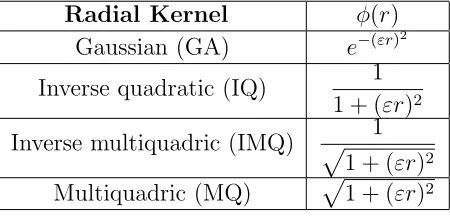
1.1 Commonly used radial kernels, where the first three are positive
defi-nite, r=kx−yk, and ε is the shape parameter. . . 7
2.1 SPH expansion coefficients for various radial kernels on the sphere. In the formula for the IQ kernel, 2F1(. . .) denotes the hypergeometric
function, and in the formula for the GA kernel, Iµ+1/2 denotes the
Bessel function of the second kind. Note that the apparent singularity
of the cµ,ε for the GA kernel is a removable one due to the identity Iµ+1/2(2ε2)
ε2µ+1 =
1 Γ(µ+1)√π
R1 −1e
2ε2t
(1−t2)kdt. . . 32
1.1 The process of using RBFs to interpolate a set of scattered data in
2D. (a) a target functionf sampled at some set of distinct nodes, (b) a set of radial basis functions interpolating the data (c) a reconstructed surface resulting from the interpolation . . . 7
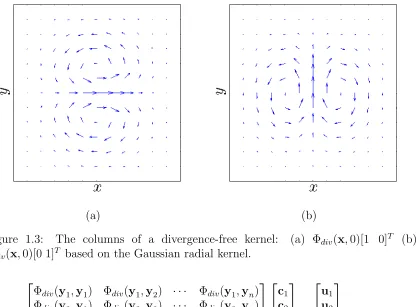
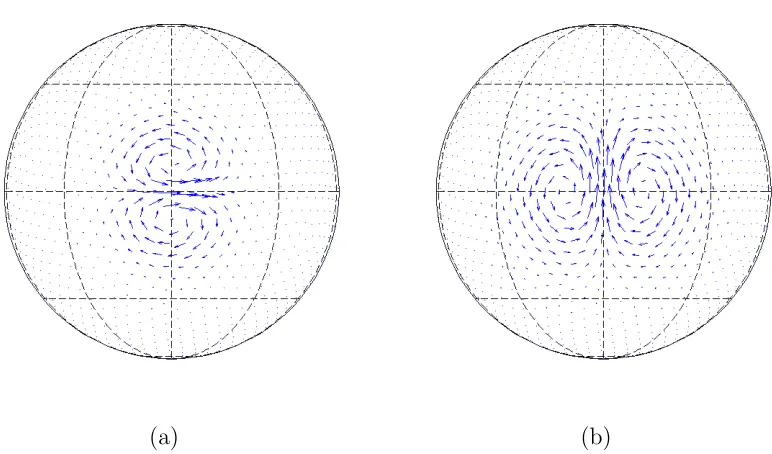
1.2 (a)The Gaussian (ε = 2), (b) inverse quadric (ε = 3.5), (c) inverse multiquadric (ε= 6), and (d) multiquadric radial kernels (ε= 2). . . 8 1.3 The columns of a divergence-free kernel: (a) Φdiv(x,0)[1 0]T (b) Φdiv(x,0)[0 1]T
based on the Gaussian radial kernel. . . 11
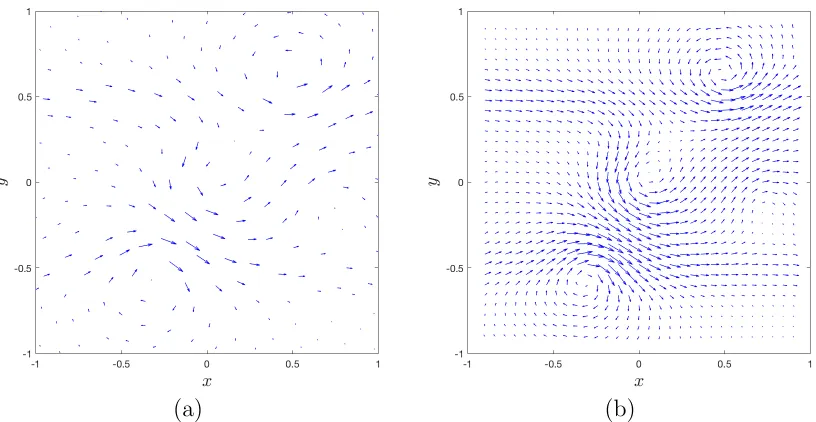
1.4 (a) The samples of a divergence-free vector field and (b) the interpolant
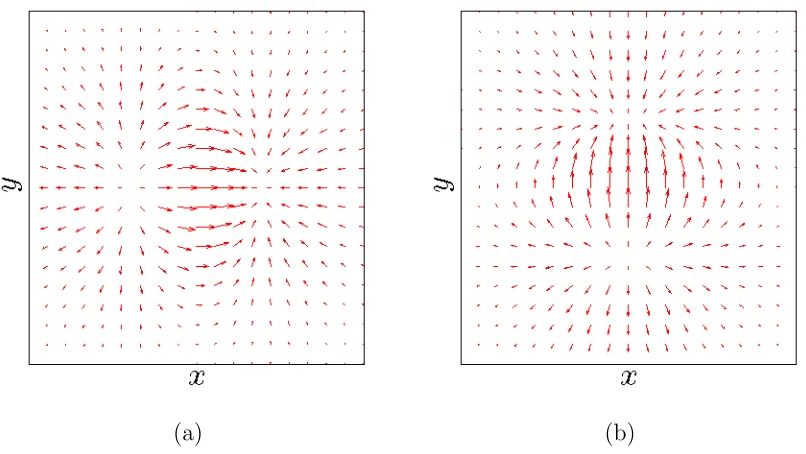
of the field using the Gaussian kernel withε = 4.5. . . 12 1.5 The columns of a curl-free kernel: (a) Φcurl(x,0)[1 0]T (b) Φcur(x,0)[0 1]T
based on the Gaussian radial kernel. . . 13
1.6 (a) The samples of a curl-free vector field and (b) the interpolant of
the field using the Gaussian kernel withε = 4.5. . . 13 1.7 The two components of the tangent vector basis atyj: (a) Zonal basis,
Ψdiv(x,yj)ej (b) Meridional basis, Ψdiv(x,yj)dj . . . 18 1.8 (a) The scattered samples of a surface divergence-free vector field in
blue and (b) the interpolant of the field using the surface divergence-free RBF interpolant in black. . . 19
Ψcurl(x,yj)ej (b) Meridional basis, Ψcurl(x,yj)dj . . . 20 1.10 (a) The scattered samples of a surface curl-free vector field in red
and (b) the interpolant of the field using the surface curl-free RBF
interpolant in black. . . 21
1.11 Pseudocolor plot of the scalar spherical harmonics basis functions of
degrees µ = 0,1,2,3,4 and orders ν = −µ, . . . , µ. The colors range from blue to red, which correspond to negative and positive values,
respectively. . . 24
2.1 The inverse multiquadric kernel for (a)ε= 10, (b) ε= 5, and (c)ε = 1 28 2.2 A problem illustrating ill-conditioning that enters the interpolation
process in the RBF Direct method for an interpolation problem on
the sphere consisting of (a)n = 529 quasi-uniformly distributed nodes and (b) the target function f = sin(xyz) on the sphere. (c) Condition number of the AY matrix in (1.6) vs ε. (d) Max norm error vs ε in the resulting RBF interpolant over the sphere computed with the RBF
Direct approach. The IMQ kernel was used here. . . 30 2.3 Log-log plot of the max norm error vs. values of ε for the target
function f = sin(xyz). Here n = 529, and the IMQ RBF kernel was used. Note that for larger values of ε, the RBF Direct and RBF-QR methods give equivalent results. Though not clearly visible in the
figure, this equivalence is demonstrated where the black line lies on
top of the dashed red line. . . 38
tion process in the RBF Direct method for n = 528 quasi-uniformly distributed nodes and target function Ψ used in the second numerical test in Chapter 4. (a) Condition number of theAΨdiv matrix from (1.23) vs. ε (b) Max norm error vs ε in the surface divergence-free RBF interpolant using the RBF Direct approach . . . 42
4.1 Minimum energy node sets used in the numerical experiments: (a) 120
nodes and (b) 528 nodes . . . 54
4.2 The surface divergence-free vector field to be interpolated for test 1. . . . 54
4.3 Numerical test 1: Log-log plot of the max-norm error in the approxi-mation of the true field vs values ofεfor both the RBF Direct method and the Vector RBF-QR method with the (a) MQ and (b) IMQ kernels. 55
4.4 The surface divergence-free vector field to be interpolated in test 2. . . . 56
4.5 Numerical test 2: Log-log plot of the max-norm error in the
approxi-mation of the true field vs values ofεfor both the RBF Direct method and the Vector RBF-QR method with the (a) MQ and (b) IMQ kernels. 57
4.6 The surface divergence-free vector field to be interpolated for test 3. . . . 58 4.7 Numerical test 3: Log-log plot of the max-norm error in the
approxi-mation of the true field vs values ofεfor both the RBF Direct method and the Vector RBF-QR method with the (a) MQ and (b) IMQ kernels. 58
4.8 The surface curl-free vector field to be interpolated for test 1. . . 59
approximation of the true field vs values of εfor both the RBF Direct method and the Vector RBF-QR method with the (a) MQ and (b) IMQ kernels. . . 60
4.10 The surface curl-free vector field to be interpolated for test 2. . . 61
4.11 Curl-free numerical test 2: Log-log plot of the max-norm error in the
approximation of the true field vs values of εfor both the RBF Direct method and the Vector RBF-QR method with the (a) MQ and (b)
IMQ kernels. . . 61
CHAPTER 1
BACKGROUND
1.1
Introduction
The interpolation of scattered data is a problem that emerges in multiple scientific
dis-ciplines and applications, such as meteorology, electronic imaging, computer graphics,
medicine, and the Earth sciences [1,9,19,25,27]. Radial Basis Functions (RBFs) were first introduced in 1968 by R.L. Hardy to solve a 2D scattered data interpolation problem in cartography [15, 16]. Named for their use of linear combinations of
shifts of radially symmetric functions to interpolate data and approximate surfaces,
these scalar-valued RBFs have been used for various applications in fields ranging
from geophysics to statistics [10, 24]. Part of the usefulness behind RBFs is their
inclusion of a “shape parameter,” which controls the peakedness of the basis functions.
Researchers have observed that this shape parameter directly impacts the accuracy
of the target function approximation. Specifically, they noted that smaller values of the shape parameter result in better approximations to a point at which severe
ill-conditioning enters into the system of equations for determining the interpolation
coefficients. While there is a substantial amount of literature dedicated to finding the
“optimal” shape parameter for scalar-valued RBFs [4, 26], these methods have been
restricted by this ill-conditioning that is introduced into the system when the shape
In 2007, Fornberg and Piret developed the RBF-QR algorithm, which bypassed
the ill-conditioning of scalar RBF interpolation on the sphere in the flat limit [7].
They achieved this through a clever use of spherical harmonic expansions and the QR factorization to create a new set of basis functions that span the same space as
the RBF basis, but are well-conditioned in the flat limit. While this method allowed
for the full range of the shape parameter to be explored for scalar-valued RBFs on
the sphere, it did not directly apply to vector-valued RBF interpolants, which are
used to approximate vector fields.
Vector fields arise in many scientific applications, as they describe certain
fun-damental physical quantities. Specifically, there are two properties of vector fields
that are useful when representing physical data: divergence (sources and sinks in a
field) and curl (rotational movement of a field). RBF interpolation theory has been
extended for use of interpolating both divergence-free and curl-free vector fields in
Rd [11, 22] and on the sphere [13, 23], but these vector-valued interpolants suffer the same dependence on the shape parameter.
This thesis introduces the first stable numerical method for calculating vector-valued RBF interpolants on the sphere in the flat limit. Our method, which we
call the Vector RBF-QR algorithm, synthesizes existing derivations of vector-valued
RBF interpolation on the sphere [13] and Fornberg and Piret’s stable algorithm for
scalar-valued RBF interpolation in the flat limit [7]. Similar to the Scalar RBF-QR
al-gorithm, the Vector RBF-QR algorithm utilizes vector spherical harmonic expansions
and a QR factorization in order to create a better conditioned set of basis functions
that span the same space as the standard vector basis used to construct the vector RBF interpolant.
overview of the background material needed for the algorithms presented in Chapters
2 and 3. This includes details of both scalar-valued and vector-valued RBF
interpola-tion, as well as relevant information on scalar and vector spherical harmonics. Chapter 2 offers extensive detail of Fornberg and Piret’s RBF-QR algorithm for scalar-valued
RBF interpolation, including numerical results. The main result of this thesis, the
Vector RBF-QR algorithm, is presented in Chapter 3. We include numerical results
from this algorithm in Chapter 4 and conclude with comments on future work in
Chapter 5.
1.2
Radial Basis Function (RBF) Interpolation
As mentioned in the introduction, interpolating scattered data is a problem that arises in many disciplines, including engineering, hydrology, and geophysics. Several
established techniques, like polynomial and trigonometric interpolation, have been
used to solve this problem in one dimension. These methods typically use linear
combinations from a fixed set of basis functions {ψj(x)}nj=1 to form a function s(x)
that will interpolate the data points {xj}nj=1 at the values {fj}nj=1. The resulting
function is of the form
s(x) = n
X
j=1
cjψj(x) (1.1)
and must satisfy the interpolation conditionss(xj) =fj, forj = 1, . . . , n. These con-ditions lead to linear constraints on the expansion coefficients, cj. These coefficients can be determined by solving the linear system of equations
A
c
=
f
where the entries ofAare given by aj,k =ψk(xj)j, k = 1, . . . , n, cis a vector contain-ing the cj’s, and f is a vector containing the fj’s. Many of these methods, including polynomial and trigonometric interpolation, work well in the one-dimensional case because this linear system is guaranteed to be non-singular whenever the given data
are distinct [31]. However, this is not always the case for data in more than one
dimension. The Mairhuber-Curtis theorem shows that for any set of basis functions
that are independent of the data, there exist sets of distinct data points such that
the linear system in (1.2) becomes singular [29]. In 1968, R.L. Hardy pioneered a
solution to interpolating two-dimensional, scattered data in a way that bypasses the
Mairhuber-Curtis theorem. He achieved this by developing a type of basis function
thatdepends on the data rather than on a grid. This technique is known as the radial basis function (RBF) method.
1.2.1 RBF Interpolation of Scalar-valued Functions
The RBF method used today is a generalization of Hardy’s multiquadric (MQ)
method. The MQ method solved a common problem in cartography of finding a
continuous function that accurately represents a surface given sparse measurements.
Much of the motivation behind this investigation was twofold: to create contour maps
of topographic surfaces and to use methods of calculus on the representative function to determine characteristics of the surface [15, 16]. Before working on a solution
to this problem, Hardy first chose to investigate the one-dimensional version, i.e.
finding a continuous function that accurately represents a curve given scattered data
measurements. He first realized that a piecewise linear interpolating function provided
a satisfactory representation of the curve, but discontinuities of the first derivative
After some trial and error, he finally chose to use the continuously differentiable basis
function √a2+x2, where a 6= 0 is an arbitrary constant that affects the peakedness
of the quadric [15]. This choice leads to the interpolating function
s(x) = n
X
j=1
cj
q
a2 + (x−x
j)2, (1.3)
where the cj’s are determined as discussed in the previous section. Note that for
a= 0, the basis function becomes piecewise linear.
Hardy found that there were many benefits to this MQ method beyond the
fact that it accurately represented the desired curve. Specifically, he noticed that
calculus techniques could be applied to the interpolating function (when a 6= 0) to gain meaningful information about the curve and more importantly, that this new
approach could carry over to data in more than one dimension. This key property
is what allowed Hardy to find a solution to his original cartography problem of
approximating a surface with a mathematical function.
Hardy extended his one-dimensional interpolating technique first for data in 2D. He achieved this by instead using a linear combination of quadric basis functions that
were translated to be centered at each data point. For distinct points{(xj, yj)}nj=1 in
R2, the new interpolant is given by
s(x, y) = n
X
j=1
cj
q
a2+ (x−x
j)2 + (y−yj)2. (1.4) Hardy found that (1.4) performed well when used to approximate topographic surfaces
from sparse data measurements. He named this technique the “multiquadric method”
due to its most notable feature of “superpositioning quadric surfaces” [16]. While
Hardy’s initial goal was achieved, he noted that his method could be easily extended
after him in the 1970s and 1980s, lead to the formal definition for scalar interpolation
using RBFs:
Definition 1.2.1. (Scalar RBF Method) Given a distinct set of scattered nodes
Y = {yj}n
j=1 ⊂ Rd≥1 and some scalar-valued target function f sampled at Y, the
scalar-valued RBF interpolant of f|Y is given by
s(x) = n
X
j=1
cjφ ||x−yj||
, (1.5)
wherex∈Rd,||·||is the d-dimensional Euclidean norm, andφ(r) is some radial kernel (see Table 1.1 for examples). The expansion coefficients cj can be determined by solving the symmetric linear system formed by enforcing the interpolation conditions
s(yj) = fj, j = 1, . . . , n:
φ(||y1−y1||) φ(||y1−y2||) · · · φ(||y1−yn||)
φ(||y2−y1||) φ(||y2−y2||) · · · φ(||y2−yn||) ..
. ... . .. ...
φ(||yn−y1||) φ(||yn−y2||) · · · φ(||yn−yn||)
| {z }
AY c1 c2 .. . cn
| {z }
c = f1 f2 .. . fn .
| {z }
f
(1.6)
We note here that determining the interpolation coefficients in this manner will
be referred to as “RBF Direct” in this thesis. Geometrically, the RBF Direct method
can be viewed as interpolating the data with a linear combination of translates of a
single basis function, φ(r), that is radially symmetric about its center. This process can be seen graphically in Figure 1.1. Several options for these radial kernels have
been developed since Hardy’s multiquadric kernel, and this thesis will use those with
the following property.
Definition 1.2.2. (Positive Definite Kernel) Let Ω ⊂ Rd≥1. φ is a positive definite
(a) (b) (c)
Figure 1.1: The process of using RBFs to interpolate a set of scattered data in 2D. (a) a target function f sampled at some set of distinct nodes, (b) a set of radial basis functions interpolating the data (c) a reconstructed surface resulting from the interpolation
i.e.
n
X
i=1
n
X
j=1
biφ(yi,yj)bj >0, provided bi 6= 0, i= 1, . . . , n.
Table 1.1 lists some of the most commonly used, positive definite radial kernels,
and Figure 1.2 shows plots of these kernels. Using these kernels guarantees that the
AY matrix in (1.6) will be unconditionally nonsingular, i.e., that the RBF Direct method will be uniquely solvable [20]. Notice that the MQ kernel is precisely the one
Radial Kernel φ(r)
Gaussian (GA) e−(εr)2
Inverse quadratic (IQ) 1 1 + (εr)2
Inverse multiquadric (IMQ) p 1 1 + (εr)2
Multiquadric (MQ) p1 + (εr)2
Table 1.1: Commonly used radial kernels, where the first three are positive definite,
r=kx−yk, and ε is the shape parameter.
parameter.” The shape parameter plays a central role in this thesis and will be
discussed in more detail in subsequent chapters.
Since its introduction by Hardy, the scalar-valued RBF interpolation method
has been studied extensively for approximating scattered data in two and higher
dimensions. RBFs have become increasingly popular and are now being used for
(a) (b)
(c) (d)
Figure 1.2: (a)The Gaussian (ε = 2), (b) inverse quadric (ε = 3.5), (c) inverse multiquadric (ε= 6), and (d) multiquadric radial kernels (ε = 2).
applications such as computer animation, medical imaging, and fluid dynamics. This
section has given a brief overview of scalar-valued RBF interpolation, including their
origins in cartography. In the next section, we will cover how to use the radial kernels
in Table 1.1 for approximating vector-valued functions, i.e. vector fields, with certain
1.2.2 RBF Interpolation of Vector Fields
Vector fields arise naturally in many applications, as they describe certain
fundamen-tal physical quantities. Two specific properties of vector fields are particularly useful
when representing physical data: divergence (sources and sinks in a field) and curl
(rotational movement of a field). For example, divergence-free vector fields represent
incompressible fluid flows and (static) magnetic fields, while curl-free vector fields
represent gravity fields and (static) electric fields. Since these properties play a key
role in many applications, interest was stirred in finding a method that used the established scalar-valued radial kernels to construct vector-valued approximations to
vector fields with divergence-free or curl-free properties. We note here that many
people consider a na¨ıve approach for using RBFs to interpolate data collected from
vector fields: using the scalar-valued RBF method to interpolate each component of
the vector field individually. The disadvantage to this technique is that it does not
allow certain properties of the vector field to be preserved. In order to properly utilize
scalar-valued kernels to approximate vector fields while still preserving divergence-free and curl-free properties, researchers worked to extend the RBF theory for
interpo-lating all components of a vector field together. Narcowich and Ward accomplished
this in 1994 when they introduced matrix-valued kernels that can be used to produce
divergence-free interpolants at scattered points [22]. In 2006, Fuselier did the same
for curl-free interpolants [11].
The interpolation process for matrix-valued kernels is similar to that of the scalar
case. We begin with divergence-free interpolation. Let φ be any scalar-valued radial kernel that is twice continuously differentiable, then we consider the matrix-valued,
Φdiv(x,y) =−I∆φ(x,y) +∇∇Tφ(x,y), (1.7)
where ∇ is the gradient operator in Rd, ∇∇T is the Hessian operator, and ∆ is the Laplacian operator. In 2D, for example,
−I∆ =
−∆ 0
0 −∆
and ∇∇T =
∂xx ∂xy
∂yx ∂yy
.
Narcowich and Ward showed that Φdivis ad×dmatrix-valued function with divergence-free columns [22]. In order to demonstrate why the columns of this kernel are
divergence-free, we utilize the standard basis vectors ej ∈ Rd. The jth column of Φdiv is given by
Φdiv(x,y)ej =
−I∆φ(x,y) +∇∇Tφ(x,y) ej =∇ ×(∇ ×(φ(x,y)ej)) = ∇ ×g,
(1.8)
whereg is a vector field. Thus we see that each column of Φdiv is the curl of a vector field, so they are divergence-free; see Figure 1.3 for an illustration of the columns of
Φdiv in R2. Additionally, Narcowich and Ward showed how to use Φdiv to produce a divergence-free vector-valued interpolant.
Given a distinct set of scattered nodes Y = {yj}n
j=1 on Rd and a target vector
field u : Rd → Rd sampled at Y, the divergence-free vector RBF interpolant of u is given by
s(x) = n
X
j=1
Φdiv(x,yj)cj, cj ∈Rd. (1.9)
Similar to the scalar-valued interpolation method, the interpolation coefficients cj are determined by solving the linear system formed by enforcing the interpolation
(a) (b)
Figure 1.3: The columns of a divergence-free kernel: (a) Φdiv(x,0)[1 0]T (b) Φdiv(x,0)[0 1]T based on the Gaussian radial kernel.
Φdiv(y1,y1) Φdiv(y1,y2) · · · Φdiv(y1,yn) Φdiv(y2,y1) Φdiv(y2,y2) · · · Φdiv(y2,yn)
..
. ... . .. ...
Φdiv(yn,y1) Φdiv(yn,y2) · · · Φdiv(yn,yn)
| {z }
AY,Φdiv
c1 c2 .. . cn
| {z } c = u1 u2 .. . un
| {z } u
. (1.10)
Due to the symmetric structure of Φdiv, the matrixAY,Φdiv is also symmetric. It can also be shown to be positive definite for appropriately chosen φ [11], such as those in Table 1.1. This guarantees that (1.10) has a unique solution. Figure 1.4 shows a
divergence-free vector field sampled at distinct points and the resulting divergence-free
RBF interpolant.
The curl-free matrix-valued kernels are developed in a similar manner as the
divergence-free ones. As before, we let φ be any scalar-valued radial kernel that is twice continuously differentiable and act on it with the appropriate differential
(a) (b)
Figure 1.4: (a) The samples of a divergence-free vector field and (b) the interpolant of the field using the Gaussian kernel with ε= 4.5.
Φcurl(x,y) =−∇∇Tφ(x,y). (1.11) As in the divergence-free case, we utilize the standard basis vectors ej ∈ Rd to show that the columns of this kernel are curl-free. The jth column of Φ
curl is given by Φcurl(x,y)ej =−∇∇Tφ(x,y)ej =∇ −∇T(φ(x,y)ej)
=∇g, (1.12)
where g = −∂φ/∂x(j), and x(j) refers to the jth coordinate of x. Since g is a scalar function, we see that each column of Φcurl is the gradient of a scalar, so they are curl-free; see Figure 1.5 for an illustration of the columns of Φcurl in R2. With this established, the curl-free vector RBF interpolant is given as
s(x) = n
X
j=1
Φcurl(x,yj)cj, (1.13)
where the interpolation coefficients cj are found by solving the linear system as in (1.10), but with the matrixAY,Φcurl, whose (j, k)
thd×dblock is given by Φ
(a) (b)
Figure 1.5: The columns of a curl-free kernel: (a) Φcurl(x,0)[1 0]T (b) Φcur(x,0)[0 1]T based on the Gaussian radial kernel.
(a) (b)
AY,Φcurl is also symmetric. AY,Φcurl can also be shown to be positive definite for appropriately chosenφ, like those listed in Table 1.1 [11]. Figure 1.6 shows a curl-free vector field sampled at distinct points and the resulting curl-free RBF interpolant.
1.3
RBF Interpolation of Surface Divergence-Free and
Curl-Free fields on the Sphere
The results from Section 1.2.2 dealt with the interpolation of divergence-free or
curl-free vector fields in Rd, but there are many applications, particularly in geophysics, where vector fields tangent to the surface of the sphere arise. For example, in the
atmospheric sciences, horizontal wind fields are modeled as tangent vector fields, while
the same is true of surface ocean currents in the oceanic sciences. In this section, we
discuss how RBFs can be further customized for surface divergence-free or curl-free
interpolation on the domain of the sphere. We denote the matrix-valued kernels used
for defining these interpolants as Ψdiv and Ψcurl, respectively. Note that while these kernels are the respective spherical analogues of Φdiv and Φcurl, we cannot simply restrict Φdiv and Φcurl to the surface of the sphere because this would not result in surface divergence-free/curl-free kernels.
1.3.1 Surface Differential Operators for Vector Fields in R3
In order to aid our discussion in subsequent sections, we will define tangential
differ-ential operators for vector fields on the two-sphere, S2. Since
S2 is a two-dimensional domain, we can define the (surface-) curl of a scalar function analogously to the curl
of a scalar function inR2, where curl should be understood asn×∇. The surface-curl
asQx∇xf, where x∈S2,∇x is the usual gradient onR3 applied to x, and Qx is the
matrix that represents the cross product with the normal vector, i.e.
Qx:=
0 −z y z 0 −x
−y x 0
. (1.14)
Additionally, the surface-gradient of a scalar-valued functionf :S2 →
R, expressed in Cartesian coordinates, is given asPx∇xf, wherePx projects vectors onto the tangent
space on S2 at x:
Px:=I−xxT =
1−x2 −xy −xz
−xy 1−y2 −yz
−xz −yz 1−z2
. (1.15)
Both the surface-curl and surface-gradient operators produce vector fields that are
tangent toS2atxand are expressed with respect to the standard Cartesian coordinate
basis. We also note here that the surface-curl of a scalar function onS2 is
divergence-free, and fields that are surface-gradients of scalar functions on S2 are surface
curl-free [13]. With these surface operators defined, we can now discuss vector RBF
interpolation on the surface of the sphere.
1.3.2 Vector RBF Interpolation on the Sphere
We will begin with the derivation for the surface divergence-free matrix-valued RBF kernel for vector fields tangent to the sphere, which was first developed by Narcowich,
Ward, and Wright [23]. Note that we will use extrinsic (Cartesian) coordinates
because they do not suffer from pole singularities, unlike surface-based coordinate
systems on the sphere. Let x,y ∈ S2 and consider a scalar-valued radial kernel
Ψdiv(x,y) = (Qx∇x) (Qy∇y)T φ(kx−yk)
=Qx ∇x∇Tyφ(kx−yk)
Qy.
(1.16)
Notice that the matrix Qy eliminates the normal component of a vector, so for any
c= (c1, c2, c3)T, Ψdiv(x,y)cis tangent to S2 at x. Furthermore Ψdiv(x,y)c=
Qx ∇x∇Tyφ(kx−yk)
Qy
c
=Qx∇x
∇Ty(φ(kx−yk))Qyc
| {z }
f
=Qx(∇xf),
(1.17)
wheref is a scalar-valued function. Since Ψdiv(x,y)cis equivalent to the surface-curl of a scalar function, we know that it is surface divergence-free. With this kernel, we
can now construct an interpolant to a divergence-free tangent vector field on S2.
Similar to the interpolation process described in Section 1.2.2, we begin with
distinct nodes Y = {yj}nj=1 = {(xj, yj, zj)}nj=1 ⊂ S2 and a surface divergence-free
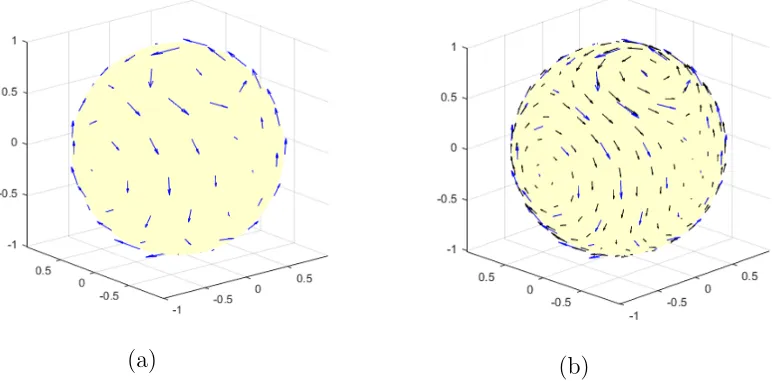
tangent vector field f sampled on Y, {fj}nj=1 ={[fj,1fj,2fj,3]T}nj=1; see Figure 1.8 (a)
for an illustration. The surface divergence-free RBF interpolant takes the form
t(x) = n
X
j=1
Ψdiv(x,yj)cj, (1.18)
where the interpolation coefficients cj are tangent to S2 at yj. This assumption is needed to make the interpolation problem well-posed. We note here that solving for
these interpolation coefficient vectors is a two-dimensional problem sincefj are really two-dimensional vectors, since they can be written as a sum of two orthonormal
vec-tors. This creates an issue due to the terms in the sum (1.18) being three-dimensional
vectors. A na¨ıve approach to solving for the cj’s will lead to a singular system of equations. Therefore we will explain how to set up the vector interpolant so
that the corresponding matrix for determining the interpolation coefficient vectors is
We denote an orthonormal coordinate system at each node, yj, as {dj,ej,nj}, where nj is the outward normal to S2,ej is a unit tangent vector, and dj =nj×ej. Then we see thatnj =yj (since on the unit sphere the outward normal atyj is justyj) and choose dj and ej to be the standard meridional and zonal vectors, respectively:
dj = 1
q
1−z2
j
−zjxj −zjyj 1−z2
j
, ej = 1
q
1−z2
j
−yj
xj 0
. (1.19)
It is important to note here that dj and ej form an orthonormal basis for the tangent space of S2 at y
j. Additionally, if y = [0,0,1] or y = [0,0,−1], e.g. at one of the poles, we can pick any orthogonal vectors in the plane z = 1 or
z = −1, respectively. Then the surface divergence-free vector RBF interpolant to the samples of f is constructed from linear combinations of the tangent vector basis {(Ψdiv(x,yj)dj,Ψdiv(x,yj)ej)}nj=1, i.e. the interpolant is of the form
t(x) = n
X
j=1
Ψdiv(x,yj) [αjdj +βjej]
| {z }
cj
, (1.20)
where the unknowns αj and βj are determined by solving t(yi) = fi, i = 1, . . . , n. Illustrations of the zonal and meridional basis vectors formed from Ψdiv are displayed in Figure 1.7.
Now solving for the interpolation coefficient vectors cj in (1.20) is equivalent to solving the linear system of equations,
n
X
j=1
Ψdiv(yi,yj)[αjdj+βjej] =fi, 1≤i≤n, (1.21)
forαj andβj. However, sincefi has three components, (1.21) is not a square system. We note that we can make (1.21) a square system by expressingfi in terms ofdi and
(a) (b)
Figure 1.7: The two components of the tangent vector basis at yj: (a) Zonal basis, Ψdiv(x,yj)ej (b) Meridional basis, Ψdiv(x,yj)dj
γi
δi
=
dT
i
eTi
fi. (1.22)
Using this, we can rewrite (1.21) as the 2n-by-2n linear system n
X
j=1
dT i
eT i
Ψdiv(yi,yj)
dj ej
| {z }
AΨdiv,(i,j)
αj
βj
=
γi
δi
, 1≤i≤n. (1.23)
The (i, j)th 2-by-2 block of this interpolation matrix is denoted by A
Ψdiv,(i,j) and is
given explicitly as [13]:
AΨdiv,(i,j)=
−ei·ej ei·dj
di·ej −di·dj
η(rij) +
ei·nj −di·nj
ni·ej −ni·dj
using the surface divergence-free RBF interpolant.
(a) (b)
Figure 1.8: (a) The scattered samples of a surface divergence-free vector field in blue and (b) the interpolant of the field using the surface divergence-free RBF interpolant in black.
We note that the construction of a surface curl-free interpolant using Ψcurl for scattered samples of a surface curl-free field is similar to that of the divergence-free process. So we discuss the curl-free case less extensively, highlighting the differences
from the divergence-free case.
As before, we let x,y ∈ S2 and consider the scalar-valued radial kernel centered
at y, φ(kx−yk). We then construct the 3-by-3 matrix-valued kernel, Ψcurl, using the surface-gradient operator from Section 1.3.1 as follows:
Ψcurl(x,y) = (Px∇x) (Py∇y)T φ(kx−yk)
=−Px ∇x∇Tyφ(kx−yk)
Py.
(1.25)
Ψcurl(x,y)c=
−Px ∇x∇Tyφ(kx−yk)
Py
c
=Px∇x
−∇T
y(φ(kx−yk))Pyc
| {z }
g
=Px(∇xg),
(1.26)
where g is a scalar-valued function. Since Ψcurl(x,y)c is equivalent to the surface-gradient of a scalar function, we know that it is surface curl-free. With this kernel,
we can now construct an interpolant to a surface curl-free tangent vector field on S2.
As before, we begin with distinct nodes Y = {yj}nj=1 = {(xj, yj, zj)}nj=1 ⊂ S2,
but now we have a surface curl-free tangent vector field f sampled on Y, {fj}nj=1 =
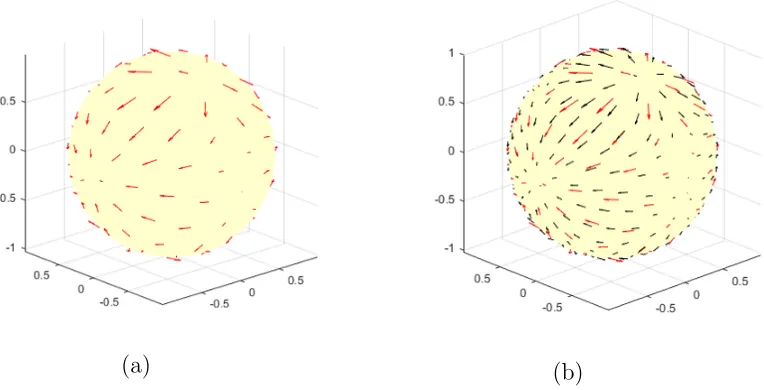
{[fj,1fj,2fj,3]T}nj=1; see Figure 1.10 for an illustration. The surface curl-free RBF
interpolant takes the form
t(x) = n
X
j=1
Ψcurl(x,yj)cj, (1.27)
wherecj is tangent toS2 atyj. We make the same modification as in (1.20) but with
(a) (b)
the tangent vector basis {(Ψcurl(x,yj)dj,Ψcurl(x,yj)ej)}nj=1 in order to get the 2n
-by-2n linear system for determining the interpolation coefficientscj = [αjej βjdj] : n
X
j=1
dT i
eT i
Ψcurl(yi,yj)
dj ej
| {z }
AΨcurl,(i,j)
αj
βj
=
γi
δi
, 1≤i≤n. (1.28)
Illustrations of the zonal and meridional basis vectors formed from Ψcurlare displayed in Figure 1.9. The (i, j)th 2-by-2 block of this interpolation matrix is denoted by
AΨcurl,(i,j), and is given explicitly as [13]:
AΨcurl,(i,j) =
di·dj di·ej
ei·dj ei·ej
η(rij) +
di·nj
ei·nj
ni·dj ni·ej
ζ(rij), (1.29) where rij, η(r), and ζ(r) are defined as in (1.24). The interpolation matrix that arises from these entries is size 2n-by-2nand is positive definite (and thus, invertible) if Ψcurl is constructed from any of the scalar kernels in Table 1.1 [13]. Figure 1.10 (b) illustrates an interpolated surface curl-free vector field on S2 using the surface
curl-free RBF interpolant.
(a) (b)
We conclude by noting that according to the Helmholtz-Hodge decomposition,
any vector field can be decomposed into a divergence-free component, a curl-free
component, and a harmonic component. Since tangent vector fields on the sphere do not have harmonic components, we can decompose every tangent vector field
on S2 uniquely into divergence-free and curl-free components. Fuselier and Wright
introduced a technique for decomposing tangent vector fields onS2using the Ψ
div and Ψcurl kernels [13]. They demonstrated that the kernel for interpolating any tangent vector field on S2 is simply defined as Ψ := Ψ
div+ Ψcurl. Then given distinct nodes
Y ={yj}nj=1 ⊂S2 and a surface tangent vector field f sampled onY, the interpolant
is thus of the form
t(x) = n
X
j=1
Ψ(x,yj)cj = n
X
j=1
Ψdiv(x,yj)cj
| {z }
Div. free +
n
X
j=1
Ψcurl(x,yj)cj.
| {z }
Curl free
(1.30)
Fuselier and Wright furthermore showed that t not only approximates the tangent
vector field being interpolated, but also that the divergence-free and curl-free terms
in the decomposition of t approximate the corresponding parts of the underlying
field [13].
1.4
Spherical Harmonics
In the algorithms presented in Chapters 2 and 3, we make heavy use of spherical
har-monic expansions, both scalar and vector ones. We therefore give a brief introduction
to these functions.
Spherical harmonics have many applications in the physical sciences, including
computing atomic electron configurations, representing gravitational and magnetic
graphics [3, 14, 30]. These expansions are the spherical analog of Fourier expansions,
which can be used to represent functions defined on the unit circle. Since we are
working specifically with functions on a sphere, we will be using scalar spherical harmonics and their vectorial analogue, vector spherical harmonics. The usefulness
of the spherical harmonics for representing functions on the sphere is due in part to
their inherent properties of orthogonality and completeness.
1.4.1 Scalar Spherical Harmonics
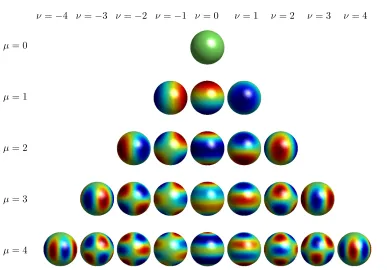
We denote the scalar spherical harmonic of degreeµ≥0 and order ν (see Figure 1.11 for illustrations) on S2 byYν
µ. These functions are the eigenfunctions of the Laplace-Beltrami operator, which can be expressed in spherical coordinates on the unit sphere
(x= sinθcosλ, y= sinθsinλ, z = cosθ) as
∇2
S2 ≡
∂2
∂θ2 + cotθ
∂ ∂θ +
1 sin2θ
∂2
∂λ2, 0≤θ≤π, −π≤λ≤π. (1.31)
Each spherical harmonic satisfies ∇2
S2Y
ν
µ = −µ(µ+ 1)Yµν, and for each µ there are 2µ+ 1 harmonics with the eigenvalue −µ(µ+ 1), enumerated by −µ ≤ ν ≤ µ [21]. This thesis will use the real-form of the spherical harmonics functions in Cartesian
coordinates. For (x, y, z)∈S2, they are as follows
Yµν(x, y, z) =
q
2µ+1 4π
q (µ−ν)! (µ+ν)!P
ν
µ(z) cos νtan−1 y x
, ν = 0,1, . . . , µ,
q 2µ+1
4π
q (µ−ν)! (µ+ν)!P
ν
µ(z) sin −νtan
−1 y x
, ν =−µ, . . . ,−1. (1.32) Here Pν
µ(z) are the associated Legendre functions of degree µ and order ν. The spherical harmonics form a complete, orthonormal set of basis functions for the
µ= 4
µ= 3
µ= 2
µ= 1
µ= 0
Figure 1.11: Pseudocolor plot of the scalar spherical harmonics basis functions of degrees µ= 0,1,2,3,4 and orders ν =−µ, . . . , µ. The colors range from blue to red, which correspond to negative and positive values, respectively.
f(x, y, z) =
∞ X
µ=0
µ
X
ν=−µ
cµ,νYµν(x, y, z), (1.33)
where cµ,ν are found using the usual L2-inner product for scalar functions on the sphere, cµ,ν =hf, Yµνi [2].
1.4.2 Vector Spherical Harmonics
Vector spherical harmonics are the vectorial analogue of scalar spherical harmonics,
and they are used for representing vector-valued functions on the sphere. There are
three L2-orthogonal types of these functions: one type that is normal to the sphere,
and two types that are tangent to the sphere [28]. In this thesis, we are working with
vector fields that are tangent to the sphere. Therefore, we are interested in deriving
and curl-free terms. For the following derivations, we use the real-form of the
scalar-valued spherical harmonic functions in Cartesian coordinates, as defined in (1.32).
We obtain the normalized surface divergence-free vector spherical harmonics by
applying the surface-curl operator to the scalar spherical harmonic functions at x,
Yν µ(x):
e
wνµ= Qx∇xY ν µ(x)
µ(µ+ 1) , (1.34)
provided thatµ6= 0 [28]. Since these are expressed as the surface-curl of scalar-valued functions, they are surface divergence-free. Similarly, we obtain the surface curl-free
vector spherical harmonics by applying the surface-gradient to Yν µ(x):
ez
ν µ=
Px∇xYµν
µ(µ+ 1). (1.35)
We see that these are surface curl-free since they are the surface-gradient of
scalar-valued functions. They can also be shown to be orthonormal in L2(S2) [28]. We will denote the non-normalized surface divergence-free and curl-free vector spherical
harmonics aswµν andzνµ, respectively. The surface divergence-free and curl-free vector spherical harmonics are the eigenfunctions of the vector Laplace-Beltrami operator,
which operates on vector fields tangent to S2. Additionally, they form a complete
orthonormal set of basis functions for the spectral representation of vector functions
on S2 [28]. We denote this space again by L2(
S2), but we define it using the inner product for vector functions f and g on S2:
hf,gi=
Z
S2
fTgdS,
where the dot product is taken in local coordinates [28]. With this inner product, we
define the vector spherical harmonic expansion of a vector function f ∈L2(
f =
∞ X
µ=1
µ
X
ν=−µ
ˆ
fdiv(µ, ν)wνµ+ ˆfcurl(µ, ν)zνµ
,
where
ˆ
fdiv(µ, ν) :=hf,wνµi and ˆfcurl(µ, ν) := hf,zνµi.
Note here that the outer sum excludes µ = 0. This is due to the fact that the constant spherical harmonic term, Y00(x), is annihilated by the surface-curl and surface-gradient operators.
As discussed in Section 1.3.2, the interpolation problem on the sphere requires
that we utilize the tangent basis vectors at x ∈ S2, d
x and ex. Therefore, it is
relevant to introduce the notation for the non-normalized surface divergence-free and
curl-free vector spherical harmonics in terms of these basis vectors:
Gνµ(x) = dTx ·Qx∇xYµν(x) (meridional, divergence-free),
Hµν(x) = eTx ·Qx∇xYµν(x) (zonal, divergence-free),
Kµν(x) = dTx ·Px∇xYµν(x) (meridional, curl-free),
Lνµ(x) = eTx ·Px∇xYµν(x) (zonal, curl-free).
1.5
Overview of the Thesis
As discussed in this chapter, RBF interpolation is an effective method for approxi-mating scalar functions and vector fields given only scattered data. However, we see
in Table 1.1 that the radial kernels used in this interpolation process are dependent
on the shape parameter ε, which controls the peakedness of the kernels. The shape parameter is the focus of this thesis because of how it affects the accuracy of RBF
system (1.6). After this point asε→0, the RBF Direct method becomes numerically unstable and the resulting approximations become highly inaccurate.
Fornberg and Piret developed an algorithm that bypasses the ill-conditioning of scalar RBF interpolation on the sphere in this flat limit [7]. Titled the RBF-QR
algorithm, their work is the foundation on which we conducted the research of this
thesis. Vector-valued RBF interpolants on the sphere have the same dependency on
the shape parameter as scalar-valued interpolants, because of their direct relation to
the scalar-valued radial kernels. In this thesis, we develop the first numerically stable
algorithm for vector-valued RBF interpolation on the sphere in the flat limit.
The rest of the thesis is structured as follows. In Chapter 2 we give an extensive
explanation of the Scalar RBF-QR algorithm of Fornberg and Piret [7], concluding with numerical results. In Chapter 3 we present the main result of the thesis, namely
the Vector RBF-QR algorithm. As this is an extension of the Scalar RBF-QR
algo-rithm, the Vector RBF-QR algorithm with be derived in a similar manner. Finally,
we will end the thesis with numerical results from the Vector RBF-QR algorithm in
CHAPTER 2
THE RBF-QR ALGORITHM FOR STABLE
SCALAR-VALUED RBF INTERPOLATION ON THE
SPHERE
2.1
Scalar-Valued RBF Interpolation in the Flat Limit
As discussed in the previous chapter, RBFs are used in many disciplines for scattered data approximation on surfaces. Recall that the linear system in (1.6), used to
solve for the interpolation coefficients, is guaranteed to be nonsingular for the φ(r) functions listed in Table 1.1. Researchers observed that the conditioning of the linear
system (1.6) and the accuracy of the resulting interpolant (1.5) are greatly dependent
on the shape parameter, ε. Specifically, they noted that (1.6) is well-conditioned for
(a) (b) (c)
Figure 2.1: The inverse multiquadric kernel for (a) ε= 10, (b) ε= 5, and (c)ε = 1
kernels, where larger values of ε cause the functions to become more spiked. For example, as ε → ∞ in the 1-D multiquadric function, the corresponding RBF in-terpolant converges to a piecewise linear inin-terpolant. In contrast, the radial kernels become flatter and flatter as the shape parameterε→0, hence the name “flat limit.” This is illustrated in Figure 2.1 for the inverse multiquadric function. Researchers also
observed that for smaller values ofε, the interpolant (1.5) gives a better approximation of the underlying target function to a point at which ill-conditioning of the linear
system (1.6) sets in. Figure 2.2 illustrates this phenomenon between ill-conditioning
and accuracy for an interpolation problem on S2.
There is extensive literature dedicated to finding the “optimal” shape parameter,
i.e. the value of εthat results in the best approximation of the target function [4, 26]. However, the proposed methods are limited because of the disastrous ill-conditioning
that enters the RBF Direct interpolation process in the flat limit. As researchers
investigated the flat limit, they hypothesized that the error trend seen in Figure 2.2
would not increase rapidly, provided that this ill-conditioning was eliminated. The
first step toward confirming this conjecture was recognizing where the ill-conditioning
enters the problem. As ε → 0, the basis functions all become 1, causing the linear system used to solve for the coefficients to become singular. In other words, the
columns ofAY become linearly dependent, and the condition number grows without bound, causing the coefficients to blow-up. They noticed that while the expansion
coefficients blow-up as ε → 0, the RBF interpolant remains well-behaved. In fact, Driscoll and Fornberg showed that for 1-D scattered data, the RBF interpolant
converges to the Lagrange interpolating polynomial as ε → 0 for all of the φ listed in Table 1.1 (and many others). They explained this convergence by first noting
(a) (b)
(c) (d)
Figure 2.2: A problem illustrating ill-conditioning that enters the interpolation process in the RBF Direct method for an interpolation problem on the sphere consisting of (a)n= 529 quasi-uniformly distributed nodes and (b) the target function
f = sin(xyz) on the sphere. (c) Condition number of the AY matrix in (1.6) vs ε. (d) Max norm error vs ε in the resulting RBF interpolant over the sphere computed with the RBF Direct approach. The IMQ kernel was used here.
dependence on ε, can be rewritten as
s(x, ε) =
φ(kx−y1k) φ(kx−y2k) · · · φ(kx−ynk)
c
=b(x, ε)A−Y1(ε)f , (2.1)
of cancellations occur when multiplying b(x, ε)T by A−1
Y (ε) that compensate for the divergence of the entries of A−Y1(ε). In other words, computing c directly via (1.6) and then from that the interpolant (1.5) is an ill-conditioned step in an otherwise well-conditioned interpolation process.
The first stable algorithm to bypass the inherent ill-conditioning of RBF Direct
was the contour-Pad´e method, developed by Fornberg and Wright in 2004 [8] (see
also [33]). Fornberg and Piret later developed a different stable algorithm for
interpo-lation on the sphere [7], which they termed RBF-QR (see also the extensions toR2 and
R3 [6]). This algorithm is the basis for the stable algorithm we develop in Chapter 3 for surface divergence-free and curl-free interpolation with RBFs. The remainder of
this chapter gives an overview of the Scalar RBF-QR algorithm of Fornberg and Piret.
2.2
Scalar RBF-QR Algorithm
One of the ways to bypass the ill-conditioning of the scalar-valued RBF Direct
interpolation system (1.6) in the flat limit is to replace the flat RBF basis with a
well-conditioned one that spans the same space. By doing this, we get an equivalent
interpolation result, but with a completely stable process. This is the key idea behind
the Scalar RBF-QR method. Fornberg and Piret achieved this in their algorithm by
first using scalar spherical harmonics to expand radial kernels. Then with some clever linear algebra, they were able to create a well-conditioned and equivalent basis.
2.2.1 Spherical Harmonic Expansion of RBF Kernels
In order to transform the RBF basis into a spherical harmonic basis, we can use the
the spherical harmonic expansion of each basis function [7]:
φ(kx−yjk) =
∞ X
µ=0
µ
X0
ν=−µ
{cµ,εε2µYµν(yj)}Yµν(x), (2.2)
where the symbol P0 denotes that the ν = 0 term is halved. Table 2.1 lists the expansion coefficients for many common radial kernels. These were first worked out by
Hubbert and Baxter [18] for the radial kernels listed in Table 1.1. It is also important
Radial Kernel Expansion Coefficient, cµ,ε
MQ −2π(2ε
2+ 1 + (µ+ 1/2)√1 + 4ε2)
(µ+ 3/2)(µ+ 1/2)(µ−1/2)
2 1 +√4ε2+ 1
2µ+1
IMQ 4π
(µ+ 1/2)
2 1 +√4ε2+ 1
2µ+1
IQ 4π
3/2µ!
Γ(µ+32)(1 + 4ε2)µ+1 2F1(µ+ 1, µ+ 1; 2µ+ 2; 4ε2
1+4ε2)
GA 4π
3/2
ε2µ+1e −2ε2
Iµ+1/2(2ε2)
Table 2.1: SPH expansion coefficients for various radial kernels on the sphere. In the formula for the IQ kernel, 2F1(. . .) denotes the hypergeometric function, and in
the formula for the GA kernel,Iµ+1/2 denotes the Bessel function of the second kind.
Note that the apparent singularity of the cµ,ε for the GA kernel is a removable one due to the identity Iµ+1/2(2ε2)
ε2µ+1 = Γ(µ+1)1 √π
R1 −1e
2ε2t
(1−t2)kdt.
to mention that the coefficients listed in Table 2.1 can be calculated without the loss
of any significant digits caused by numerical cancellations, even for vanishingly small
ε [7].
We note that the expansion coefficients in Table 2.1 depend solely onµ, as opposed to those in (1.33), which depend on both µ and ν. This follows from the Funk-Hecke formula [2, 21]. In the next section, we will show that the Scalar RBF-QR
2.2.2 Matrix Representation and QR Factorization
Using the spherical harmonic expansion formula (2.2), we can rewrite each radial
kernel in the RBF basis as an infinite sum:
φ(kx−y1k) =
c0,ε
2 Y 0
0(y1)Y00(x)+
+ε2c
1,ε{Y1−1(y1)Y1−1(x) + 12Y 0
0(y1)Y00(x) +Y11(y1)Y11(x)}+
+ε4c
2,ε{. . . .}+ε6c3,ε{. . . .}+ε8c4,ε{. . . .}+. . .
φ(kx−y2k) =
c0,ε
2 Y 0
0(y2)Y00(x)+
+ε2c
1,ε{Y1−1(y2)Y1−1(x) + 12Y 0
0(y2)Y00(x) +Y11(y2)Y11(x)}+
+ε4c
2,ε{. . . .}+ε6c3,ε{. . . .}+ε8c4,ε{. . . .}+. . . ..
. ...
φ(kx−ynk) = c0,ε
2 Y 0
0(yn)Y00(x)+
+ε2c1,ε{Y1−1(yn)Y −1
1 (x) + 12Y 0
0(yn)Y00(x) +Y11(yn)Y11(x)}+
+ε4c
2,ε{. . . .}+ε6c3,ε{. . . .}+ε8c4,ε{. . . .}+. . .
(2.3)
We note here that the Scalar RBF-QR algorithm is easiest to describe and implement when the number of interpolation nodes, n, is a perfect square, i.e. n = (µ0+ 1)2 for
some µ0 >0. This restriction allows for a unique way to split the RBF-QR system.
The summations in (2.3) are equivalent to the infinite matrix-vector product
φ(kx−y1k)
φ(kx−y2k)
.. .
φ(kx−ynk)
= =
c0,ε
2 Y 0
0(y1) c11,εY1−1(y1) c12,εY10(y1) c11,εY11(y1) · · ·
c0,ε
2 Y00(y2) c11,εY1−1(y2) c12,εY10(y2) c11,εY11(y2) · · ·
..
. ... ... ... · · ·
c0,ε
2 Y 0
0(yn) c11,εY1−1(yn) c12,εY10(yn) c11,εY11(yn) · · ·
ε0 ε2 ε2 ε2 . ..
Y00(x) Y1−1(x)
Y10(x) Y1 1(x) .. .
=B∞E∞Y∞.
(2.4) The first step of the Scalar RBF-QR algorithm truncates these infinite matrices based
computable. This truncation degree, µ = k, must satisfy two conditions. First, k
must be at least as large as the degree, µtrunc, that would ensure each row on the left-hand side of (2.4) is approximated to machine precision by the corresponding row on the right-hand side. Second, the choice of k must also be at least as big as µ0,
so that the matrix resulting from truncating B∞ is at least square. Thus, we pick
k ≥max [µtrunc, µ0]. We denote the truncated system (2.4) as
φ(kx−y1k)
φ(kx−y2k)
.. .
φ(kx−ynk)
| {z }
e p ≈ B E Y
, (2.5)
whereB is now sizen-by-m,E is size m-by-m, andY is sizem-by-1 form= (k+ 1)2.
Before describing the second step of the Scalar RBF-QR algorithm, we establish
dimensions and structures of the matrices involved. The system (2.5) is of the form
B0 B1 · · · Bµ0 Bµ0+1 · · · Bk
| {z }
B
EY,
where Bµ, 0≤µ≤k, are the block matrices of size n-by-(2µ+ 1) with entries
{Bµ}i,j =
(
cµ,εY
j−(µ+1)
µ (yi) j 6=µ+ 1, cµ,ε
2 Y 0
µ(yi) j =µ+ 1,
j = 1, . . . ,2µ+ 1, i= 1, . . . , n.
The diagonal E matrix can be written as two square, diagonal blocks, E1 and E2
E1 = 1
ε2I3 ε4I
5
. ..
ε2µ0I 2µ0+1
, (2.6) E2 =
ε2µ0+2I2
µ0+3
ε2µ0+4I2
µ0+5
. ..
ε2kI2k+1 , (2.7)
and Iµ is the identity matrix of size µ-by-µ. Due to the truncation and restriction onn, we see thatE1 is of size n-by-n, and E2 is of size (m−n)-by-(m−n). Finally,
the Y vector is given by
Y =
Y0 Y1 · · · Yµ0 Yµ0+1 · · · Yk
T
,
{Yµ}j = Yµj−(µ+1)(x), j = 1, . . . ,2µ+ 1.
The second step of the Scalar RBF-QR algorithm is to compute a QR factorization of
the B matrix. It is important to note that the goal of this is to form new linear combinations of the existing basis functions so that the new basis will span the
same space (we will address the well-conditioned nature of this new basis in the next
section). A QR factorization is ideal for this goal because it operates on the columns
of the matrix without combining terms in successive columns. In other words, the
QR-factorization ofB leads to
e
p≈Q[R1|R2] | {z }
R
E1
E2
Y, (2.8)
whereR1 is ann-by-nupper-triangular matrix, andR2 is ann-by-(m−n) full matrix.
Note that in terms of powers ofε, all entries ofR1 andR2 are O(1) since these powers
have been factored out into E.
The third step now proceeds by some clever factoring of the expression (2.8).
Assuming that the diagonal entries ofR1 are non-zero so that it is invertible1, we can
re-write this system as
e
p≈QR1
In|R−11R2
E1
E2
Y.
Exploiting the structure of E given in (2.6) and (2.7), we can re-write this expression again as
e
p ≈ QR1
E1|R−11R2E2
Y
= QR1E1
In|E1−1R −1 1 R2E2
| {z }
e
B
Y. (2.9)
It follows from this new expression that any element in the span of the rows ofpecan be represented to machine precision by a linear combination of the rows of BYe .
The fourth and final step of this algorithm is to reformulate Be using properties
of the Hadamard product of diagonal matrices. We will also use this to support the
claim that this new basis is much better conditioned than the original for small ε, and thus much more suitable for numerical work. To begin the final step, we consider
the product in the second block-column of Be from (2.9). Using the properties of
multiplication of a matrix on the left and right by diagonal matrices (see Appendix A),
we have
E1−1R−11R2E2 = R−11R2
◦(E1−1Jn,m−nE2)
| {z }
e
E
, (2.10)
where Jn,m−n is the n-by-(m−n) matrix whose entries are all 1, and ◦ denotes the Hadamard product, or entry wise multiplication. After considering the structure of
E1 andE2 given in (2.6) and (2.7), respectively, we see that the entries of Ee are given
explicitly by e E =
ε2µ0+2J
1,2µ0+3 ε
2µ0+4J
1,2µ0+5 · · · ε
2kJ
1,2k+1
ε2µ0J
3,2µ0+3 ε
2µ0+2J
3,2µ0+5 · · · ε
2k−2J 3,2k+1
ε2µ0−2J
5,2µ0+3 ε
2µ0J
5,2µ0+5 · · · ε
2k−4J 5,2k+1
..
. ... . .. ... ...
ε4J
2µ0−1,2µ0+3 ε
6J
2µ0−1,2µ0+5 · · · ε
2k−2µ0+2J
2µ0−1,2k+1
ε2J2µ0+1,2µ0+3 ε
4J
2µ0+1,2µ0+5 · · · ε
2k−2µ0J
2µ0+1,2k+1
. (2.11)
Rewriting BYe as
e
BY =hIn| R−11R2
◦Ee i
Y,
and recalling R−11R2 is O(1) in terms of the powers of ε, we see that each term in
this new basis is now a spherical harmonic function with anO(ε2) perturbation. This
follows from the property that the last block in the first column of (2.11) has an ε2
term with the rest being ε2j, j ≥ 2. This shows that the new basis converges to the spherical harmonic basis as ε → 0 and hence the RBF interpolant will converge to the spherical harmonic interpolant asε→0 whenever the point set is unisolvent with respect to the spherical harmonics.
Note that with the above derivation, it is also possible to include the spherical
harmonic coefficients cµ,ε in the diagonalE1 and E2 matrices, and generate a similar
de-pendence in the actual QR numerical computation, and thus removing any numerical
contamination for small ε. This approach unifies the Scalar RBF-QR method for all radial kernels since, for the same set of nodes, the only thing that would change is the Ee matrix.
2.2.3 Numerical Results
The numerical results from the Scalar RBF-QR algorithm confirmed the original
hypothesis of researchers: with the ill-conditioning removed from the interpolation
problem, the errors of the approximation did not blow up as ε → 0. As a means of testing the algorithm, we present numerical results for the test problem described
in Figure 2.2. Figure 2.2.3 shows the results of the RBF-QR algorithm on this test
Figure 2.3: Log-log plot of the max norm error vs. values of εfor the target function
f = sin(xyz). Heren= 529, and the IMQ RBF kernel was used. Note that for larger values of ε, the RBF Direct and RBF-QR methods give equivalent results. Though not clearly visible in the figure, this equivalence is demonstrated where the black line lies on top of the dashed red line.
ε = 1, the direct RBF interpolation method becomes numerically unstable, and the error quickly spikes. The errors from the Scalar RBF-QR approximations continue to
decay beyond ε = 1 before increasing slightly in the flat limit. The increase in error as ε → 0 corresponds to the basis functions converging to the spherical harmonics basis. We can infer from this that the Scalar RBF-QR algorithm can provide smaller
errors than both the RBF direct and spherical harmonic interpolation processes for
ε→0.
2.2.4 The Size of n
We conclude by commenting on the case when n is not a perfect square, which was not discussed with much detail in [7]. To illustrate the issues, consider the case when
n = (µ0 + 1)2 −2, with µ0 > 0. The QR procedure proceeds almost entirely as
described above, with the only change being in the E1 and E2 matrices, and thus the e
E matrix. E1 and E2, for this case, are given by
E1 = 1
ε2I 3
. ..
ε2µ0−2I2
µ0−1 ε2µ0I
2µ0+1−2 , (2.12) E2 =
ε2µ0I2
ε2µ0+2I2
µ0+3
. ..
ε2qI2q+1 , (2.13)
whereE1is again of sizenandE2 is of size (m−n)-by-(m−n). A direct computation