Please cite this article as: X. Zhou, L. Bai, C. Wang, Single Image Dehazing Algorithm Based on Dark Channel Prior and Inverse Image, International Journal of Engineering (IJE), TRANSACTIONS A: Basics Vol. 30, No. 10, (October 2017) 1471-1478
International Journal of Engineering
J o u r n a l H o m e p a g e : w w w . i j e . i rSingle Image Dehazing Algorithm Based on Dark Channel Prior and Inverse Image
X. Zhou, L. Bai, C. Wang*
School of Mechanical, Electrical and Information Engineering, Shandong University, Weihai, China
P A P E R I N F O
Paper history:
Received 28 February 2017 Received in revised form 04 May 2017 Accepted 07 July 2017
Keywords: Image Dehazing Haze Removal Dark Channel Prior Inverse Image
A B S T R A C T
The sky regions of foggy image processed by all the existing conventional dehazing methods are degraded by color distortion and severe noise. This paper proposes an improved algorithm which combines dark channel prior and inverse image. We first invert the foggy image, and then estimate the transmission of the inverse image. At last, compared with the non-inversed transmission, the larger values of the transmission are the final transmission. This algorithm tends to refine the medium transmission by adjusting the values of pixels in the bright region to meet the hypothesis of dark channel prior. The method is viable to eliminate color distortion of the dehazed image.
doi: 10.5829/ije.2017.30.10a.07
1. INTRODUCTION1
In foggy weather, there are lots of atmospheric particles in the atmosphere which affect the absorption and scattering of light. The images captured by sensors of monitor system outdoors will be degraded badly, which results in more difficulty in the follow-up processing and analysis, and affects the reliability of the system. As a result, haze removal attracts more and more attention of scholars, and becomes more and more important in many applications, such as reconnaissance and exploration, navigation and positioning, intelligent transportation and so on.
Image dehazing methods contain two categories: one is based on image enhancement, the other is based on image restoration [1]. The method based on image restoration establishes atmospheric scattering model [2], and then uses inversing degradation process to realize dehazing. This method lays more emphasis on the reason of degradation. As a result, the image turns out to be more natural without losing any information.
For image dehazing method based on image restoration, there are also two categories: multiple image dehazing method and single image dehazing
*Corresponding Author’s Email: [email protected] (C. Wang)
method. For multiple image dehazing method, many effective methods have been proposed by using multiple input image or extra information [3-6]. However, single image dehazing has played an increasingly significant part because it is simple and easy. Fattal [7] assumed that the transmission of light and the surface shading are locally irrelevant. Based on this assumption, Fattal [7] estimated the medium transmission. This method is physics-based and needs sufficient color information. As a result, it could only be used in thin haze. Tarel and Hautiere [8] assumed that the atmospheric veil inference is smooth locally, and estimated it using median filter.
However, this method may arise ‘halo’ in the haze-removed image when the depth has a large jump, and this method becomes difficult because it needs too many parameters. He et al. [9] proposed a single image dehazing method based on the dark channel prior. This method is effective to deal with outdoors image in most cases. However, it is invalid to handle the bright areas, which cannot meet the assumption of dark channel prior, where the transmission is estimated too small and the dehazed image appears halo artifacts and color distortion. However, this method obtains more attention because of its simplicity and the best dehazing ability in all the above algorithms.
color distortion in the sky region [10-12]. Among these, Jiang et al. [10] proposed an improved algorithm with a fault-tolerance mechanism. This method is valid, in a certain extent, for handling the regions which don’t meet the dark channel prior. However, this method relies heavily on experience. What’s more, this algorithm cannot eliminate color distortion completely.
This paper proposes a novel algorithm for sky region dehazing based on dark channel prior. Compared with other image dehazing algorithms, it is more valid and natural. The rest of this paper is organized as follows. Section 2 gives the review of the methods proposed in references [9,10], and then the proposed algorithm is described in Section 3. Experimental results are in the Section 4. Section 5 presents conclusions and remarks on possible further work.
2. RELATED WORK
2. 1.Atmospheric Scattering Model In computer vision and graphics, the atmospheric scattering model is widely used to describe the formation of foggy image:
( ) ( ) ( ) (1 ( )),
I x J x t x A t x (1)
where, x is the pixel in the scene; I is the observed image; J is the fog-free image; t is the medium transmission; and A is the global atmospheric light. In Equation (1), ( ) ( )J x t x is called direct attenuation, and
(1 ( ))
A t x is called airlight. The direct attenuation describes the scene radiance and its decay in the medium, and it presents the multiplicative distortion for the fog-free image. The airlight leads to the shift of the scene colors, and it’s an additive distortion. For image dehazing, we need to recover J from I.
2. 2. Image Dehazing Method Based on Dark Channel Prior The dark channel prior refers to fog-free outdoor images where at least one color channel has some pixels whose intensities are very low and close to zero in most of the non-sky patches. That is, the minimum intensity in the patch is close to zero.
For the image J, the dark channel dark
J is defined as:
dark
( ) { , , } ( ) min ( min c( )),
y x c r g b
J x J y
(2)
where, c
J is the color channel of J, and ( )x is a local patch centered at
x
. If J is a fog-free image except for sky region, the intensity of Jdark is very lowand close to zero based on the dark channel prior. Firstly, we estimate the transmission. He et al. [9] assumed that the atmospheric light A was given. They normalized the haze image in Equation (1) by A:
( ) ( )
( ) 1 ( ).
c c
c c
I x J x
t x t x
A A (3)
The transmission in a local patch is assumed as a constant by He et al. [9]. They denoted the transmission as t x( ), and put the minimum operators on both sides of Equation (3):
( ) { , , } ( ) { , , }
( ) ( )
min ( min ) ( ) min ( min ) 1 ( ).
c c
c c
y x c r g b y x c r g b
I y J y
t x t x
A A
(4)
Based on dark channel prior, the dark channel Jdark
is
close
to zero:dark
( ) { , , }
( ) min ( min c( )) 0.
y x c r g b
J x J y
(5)
c
A is always positive, so:
( ) { , , }
( )
min ( min ) 0.
c
c
y x c r g b
J y A
(6)
Substituting Equation (6) into Equation (4), the multiplicative distortion can be eliminated. The estimated transmission t can be expressed as:
( ) { , , }
( )
( ) 1 min ( min ).
c
c
y x c r g b
I y t x
A
(7)
If haze is removed thoroughly, the sense of depth will be lost. As a solution, they introduced a constant
(0 1)
into Equation (7) to keep a little amount haze for distant objects:
( ) { , , }
( )
( ) 1 min ( min ).
c
c
y x c r g b
I y t x
A
(8)
The main problem of the transmission estimated above is that it is coarse and the recovered haze-free images appear halo and block artifacts. So, they optimized the transmission using soft matting [13]. By solving the following sparse linear system, they got the optimal t:
(L
U t)
t, (9)where, L is the matting Laplacian matrix; U is an identity matrix; and is set as a small number. Since the run-time of soft matting algorithm is too long and the cost of internal memory is too large, the guided image filter [14] is adopted later.
Then, the atmospheric light A is estimated. The top 0.1% brightest pixels in the dark channel are picked. Among these pixels, the pixel with highest intensity in the foggy image I is selected as the atmospheric light.
Finally, the restoration of the original color image can be obtained by solving Equation (1) with respect to
J:
0 ( )
( ) .
max( ( ), )
I x A
J x A
t x t
(10)
separate the sky regions beforehand. However, after a great deal of experiments, we discover obvious color distortion in the sky region or other bright regions of the recovered image by the method of He et al. [9]. The reason is that bright areas cannot meet the assumption of dark channel prior. We could not find out dark channel of these regions even under haze-free conditions.
Figures 1 and 2 are the comparisons among the methods of Fattal [7], Tarel and Hautiere [8], and He et al. [9]. Figure 1 is the simulation results of an image with non-sky region. Figure 2 is the simulation results of an image with sky region.
2. 3. Jiang et al.’s Method Jiang et al. [10] added parameter K as the tolerance to the method of [9], and rewrote Equation (10) as:
0 ( )
( ) .
min(max( ,1) max( ( ), ),1) ( )
I x A
J x A
K
t x t I x A
(11)
(a) (b)
(c) (d)
Figure 1. Foggy image and dehazed images with non-sky
region: (a) the foggy image, (b) Fattal [7], (c) Tarel and Hautiere [8], and (d) He et al. [9]
(a) (b)
(c) (d)
Figure 2. Foggy image and dehazed images with sky region:
(a) the foggy image, (b) Fattal [7], (c) Tarel and Hautiere [8], and (d) He et al. [9]
The ability of dehazing is weakened by this method on bright regions. This method offsets the defects of the method in reference [9], and provides more natural results. However, this algorithm cannot provide a universal tolerance value, which means that the algorithm may fail in dealing with non-sky regions, and the ability of dehazing decreases when it is too large or the effect of tolerance reduces. Besides, the color distortion cannot be eliminated completely when non-sky region is too small.
3. IMPROVED ALGORITHM
As we presented before, the transmission of the sky region estimated by dark channel prior is lower than its real value. We can adjust the pixels’ values of the sky region to meet the hypothesis of dark channel prior, and then recover the haze-free images using the refined transmission given by Equation (8).
3. 1. Estimation of Medium Transmission
According to the limitations of dark channel prior, the transmission of the sky region is estimated lower than its real value. As a solution, we first invert the foggy image, and then estimate the transmission of the inverse image. The transmission obtained by the inverse image is contrary to the values of the hazing image’s transmission, which means the sky regions of the inverse image meet the assumption of dark channel prior.
The following steps are the procedures of estimating the transmission:
Step 1. Invert the input foggy image which is shown in Figure 3.
Step 2. Based on dark channel prior, calculate the dark channel of the input image and the inverse image, respectively, as shown in Figure 4.
Step 3. Assume that atmospheric light is known, the coarse transmission maps of the two images can be estimated, respectively, which are shown in Figure 5.
Step 4. Estimate the refined transmission of both two images using guided image filter which is discussed in reference [14]. The results are shown in Figure 6.
Step 5. Select the larger values of the two refined transmissions as the final transmission of the input image, as shown in Figure 7.
(a) (b)
Figure 3. Input image and its inverse image: (a) input image
(a) (b)
Figure 4. Dark channels: (a) dark channel of the input image
and (b) dark channel of the inverse image
(a) (b)
Figure 5. Coarse transmission maps: (a) the input image’s
coarse transmission map and (b) the inverse image’s coarse transmission map
(a) (b)
Figure 6. Refined transmission maps: (a) the input image’s
refined transmission map and (b) the inverse image’s refined transmission map
Figure 7. Final transmission
3. 2.Estimation of Global Atmospheric Light In the method of He et al. [9], the atmospheric light is the value of one pixel in the original image. If all light A of every channel tends to 255, the recovered image will appear to be serious shifts of color and a lot of patches. As an improvement, we estimate the global atmospheric light in a different way.
Step 1. Pick the top 0.1% brightest pixels in the dark channel at first. Calculate the average intensity of these pixels in the input image I and set the average value as the atmospheric light.
Step 2. Add one maximum global atmospheric light as a threshold. If the estimated A is greater than it,
select it as the final atmospheric light. This step is valid to eliminate the transition region of the sky area.
3. 3. Recovery of Scene Radiance With the atmospheric light and the transmission, we can restore the fog-free image according to Equation (12). We rewrite it as follows:
1 2 0
( )
( ) ,
max(max( ( ), ( )), )
I x A
J x A
t x t x t
(12)
where, t x1( ) and t x2( ) are the transmission of the foggy image and its inverse image, respectively. Figure 8 describes the restored image, and Figure 9 is the block diagram of our proposed algorithm. To prove the effectiveness of our algorithm, we restore a great deal of foggy images using our algorithm, and the next section will show some results of our simulation.
4. EXPERIMENTAL RESULTS
In our experiments, we take all simulations with MATLAB 7.0, on a PC with 1.8GB Intel Core (TM) i5-3337U CPU. All the images of this paper are from other authors’ personal home pages or the Internet.
In this section, we show some experimental results of our proposed image dehazing method on the images with non-sky region and the images with sky region, and compare it with the other two methods in references [9, 10].
(a) (b)
Figure 8. Restored image: (a) restored image of input image
and (b) restored image of refined image
Input Image
Dark Channel
Final Transmission Map Dark Channel
Haze-free Image
Inverse Image
1 2 0
( ) ( )
max(max( ( ), ( )), )
I x A
J x A
t x t x t
Inverse
Coarse Transmission Map Coarse Transmission Map
Refined Transmission Map Refined Transmission Map
Guided Image Filtering The Atmospheric
Light
The Atmospheric Light
Guided Image Filtering
The results demonstrate that our method is valid on both the images with non-sky region and the images with sky region, which means it makes a great progress compared with other algorithms.
In the method of He et al. [9], the window size of the patches is 15×15, and the parameter is 1. We get the refined transmission map using guided image filter whose radius is 12. In the method of Jiang et al. [10], we set the tolerance value as 50. In our method, we set the maximum global atmospheric light as 240. The window size of the minimum filter is 3×3; the parameter is 1; and the radius of the guided image filter is 12. Figure 10 shows the dehazed results of the images with non-sky region, and Figure 11 shows the dehazed results of the images with sky region.
Compared with the other two methods, we demonstrate that our method is valid on removing the haze of the images with non-sky region. Although its intensity of dehazing is a little weaker than others, the dehazed images with a small area of the sky or other bright regions by our method get more natural vision effect, while the images dehazed by the other two methods appear slight color distortion.
Compared with the other two methods, our method obtains much better results when handling the images with sky region. In Figure 11, the images dehazed by the methods of He et al. [9] and Jiang et al. [10] appear significant color distortion and halo artifacts in the sky region or even in the whole images, while the foggy image can be well restored by our algorithm.
(a) (b) (c) (d)
Figure 10. Foggy images and dehazed images with non-sky region: (a) the foggy images, (b) He et al. [9], (c) Jiang et al. [10],
(a) (b) (c) (d)
Figure 11. Foggy images and dehazed images with sky region: (a) the foggy images, (b) He et al. [9], (c) Jiang et al. [10], and (d) the
proposed
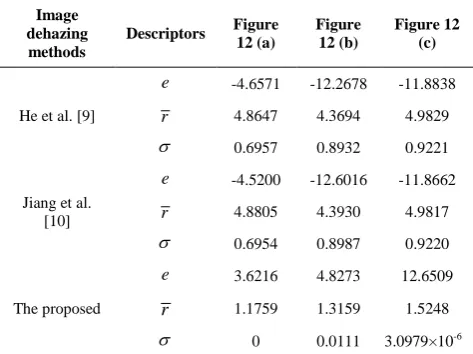
In this paper, we adopt the blind contrast enhancement assessment proposed in reference [15] to quantify the performance of our method. Three descriptors were used in reference [15], and they are the rate of new visible edges in dehazed images e, the geometric mean of the ratios of visibility level r, and increased percentage of saturated pixels . Good results of dehazed images are described by big values of
e and r and small values of . Table 1 gives the objective quality of dehazed images with non-sky region, and the corresponding foggy images are shown in Figure 12. Table 2 gives the objective quality of dehazed images with sky region, and the corresponding foggy images are shown in Figure 13. From Table 1 and Table 2, we can see that our proposed image dehazing method can obtain better dehazed images.
(a) (b) (c)
Figure 12. Foggy images with non-sky region
(a) (b) (c)
Figure 13. Foggy images with sky region
原图 原图 原图
TABLE 1. Objective quality of dehazed images with non-sky region
Image dehazing methods
Descriptors Figure 12 (a)
Figure 12 (b)
Figure 12 (c)
He et al. [9]
e -4.6571 -12.2678 -11.8838
r 4.8647 4.3694 4.9829 0.6957 0.8932 0.9221
Jiang et al. [10]
e -4.5200 -12.6016 -11.8662
r 4.8805 4.3930 4.9817 0.6954 0.8987 0.9220
The proposed
e 3.6216 4.8273 12.6509
r 1.1759 1.3159 1.5248 0 0.0111 3.0979×10⁻⁶
TABLE 2. Objective quality of dehazed images with sky
region
Image dehazing
methods
Descriptors Figure 13(a) Figure 13(b) Figure 13(c)
He et al. [9]
e -4.0880 -15.4531 1.8776
r 6.5136 28.1270 10.9064 0.5131 0.7077 0.8429
Jiang et al. [10]
e -3.5861 -17.0586 1.3865
r 6.4828 19.0388 9.8130 0.6068 0.8450 0.8491
The proposed
e 6.4900 1.6393 10.5056
r 1.2112 0.6278 1.7071
0 0.0128 0.0513
5. CONCLUSION
In this paper, we have proposed a novel image dehazing method based on dark channel prior for single image haze removal. By combining the dark channel prior and the inverse image, and changing the estimation of the atmospheric light, we get effective dehazing results compared with the other two methods based on dark channel prior.
However, there are still some limitations in our method: (i) Its dehazing intensity is not strong enough, especially for distant objects; (ii) Its processing speed is not fast enough as it needs to deal with both the input image and the inverse image using dark channel prior. Although we refine the transmission maps using the guided image filter, this method cannot meet the need of video processing. We leave these for future studies.
6. ACKNOWLEDGEMENTS
This work was supported by the Natural Science Foundation of Shandong Province, China (No. ZR2015PF004).
7. REFERENCES
1. Xu, Y., Wen, J., Fei, L. and Zhang, Z., "Review of video and image defogging algorithms and related studies on image restoration and enhancement", IEEE Access, Vol. 4, (2016), 165-188.
2. McCartney, E.J. and Hall, F.F., "Optics of the atmosphere: Scattering by molecules and particles", New York, John Wiley
and Sons, Inc., (1976), 23-32.
3. Oakley, J.P. and Satherley, B.L., "Improving image quality in poor visibility conditions using a physical model for contrast degradation", IEEE Transactions on Image Processing, Vol. 7, No. 2, (1998), 167-179.
4. Narasimhan, S.G. and Nayar, S.K., "Chromatic framework for vision in bad weather", in Computer Vision and Pattern Recognition, IEEE Computer Society Conference on, IEEE. Vol. 1, (2000), 598-605.
5. Narasimhan, S.G. and Nayar, S.K., "Vision and the atmosphere", International Journal of Computer Vision, Vol. 48, No. 3, (2002), 233-254.
6. Kopf, J., Neubert, B., Chen, B., Cohen, M., Cohen-Or, D., Deussen, O., Uyttendaele, M. and Lischinski, D., "Deep photo: Model-based photograph enhancement and viewing", ACM Transactions on Graphics, Vol. 27, No. 5, (2008), 1-10.
7. Fattal, R., "Single image dehazing", ACM Transactions on
Graphics, Vol. 27, No. 3, (2008), 1-9.
8. Tarel, J.-P. and Hautiere, N., "Fast visibility restoration from a single color or gray level image", in Computer Vision, IEEE 12th International Conference on, IEEE., (2009), 2201-2208. 9. He, K., Sun, J. and Tang, X., "Single image haze removal using
dark channel prior", IEEE Transactions on Pattern Analysis
and Machine Intelligence, Vol. 33, No. 12, (2011), 2341-2353.
10. Jiang, J., Hou, T. and Qi, M., "Improved algorithm on image haze removal using dark channel prior", Journal of Circuits and Systems, Vol. 16, No. 2, (2011), 7-12.
11. Wang, G., Ren, G., Jiang, L. and Quan, T., "Single image dehazing algorithm based on sky region segmentation",
Information Technology Journal, Vol. 12, No. 6, (2013),
1168-1175.
12. Zhang, H.-K., Zhou, P.-C. and Xue, M.-G., "Foggy weather image enhancement algorithm based on dark channel prior and histogram matching", Computer Engineering, Vol. 38, No. 1, (2012), 215-219.
13. Levin, A., Lischinski, D. and Weiss, Y., "A closed-form solution to natural image matting", IEEE Transactions on Pattern Analysis and Machine Intelligence, Vol. 30, No. 2, (2008), 228-242.
14. He, K., Sun, J. and Tang, X., "Guided image filtering", IEEE
Transactions on Pattern Analysis and Machine Intelligence,
Vol. 35, No. 6, (2013), 1397-1409.
Single Image Dehazing Algorithm Based on Dark Channel Prior and Inverse Image
X. Zhou, L. Bai, C. Wang
School of Mechanical, Electrical and Information Engineering, Shandong University, Weihai, China
P A P E R I N F O
Paper history:
Received 28 February 2017 Received in revised form 04 May 2017 Accepted 07 July 2017
Keywords: Image Dehazing Haze Removal Dark Channel Prior Inverse Image
ديكچ ه
دولآ هم ریواصت اب نامسآ یاه هیحان حت فراعتم یاهشور اب هک
یم رارق ییادز هم دوجوم یاه دنیآرف ت دنریگ
جاجوعا اب
دب دیدش زیون و گنر هیلوا کیرات لاناک هک دنک یم هئارا ار یا هتفای دوبهب متیروگلا هلاقم نیا .دنوش یمرت
(Dark
Channel Prior)
ریوصت نیا لاقتنا سپس و مینک یم نوراو ار دولآ هم ریوصت ادتبا .دنک یم بیکرت نوراوریوصت اب ار
.مینز یم نیمخت ار هدش نوراو ییاهن لاقتنا ریداقم نامه ،لاقتنا ریداقم نیرتگرزب هدشن نوراو ریوصت اب هسیاقم رد ماجنارس
کیرات لاناک ضرف ات دنک شیلااپ نشور هیحان یاه لسکیپ میظنت اب ار لاقتنا طیحم هک دراد لیامت متیروگلا نیا .دنشاب یم ریوصت گنر جاجوعا فذح یارب شور نیا .دزاس هدروآرب ار هیلوا .تسا بسانم هدش ییادز ماهبا
![Figure 2. Foggy image and dehazed images with sky region: (a) the foggy image, (b) Fattal [7], (c) Tarel and Hautiere [8], and (d) He et al](https://thumb-us.123doks.com/thumbv2/123dok_us/204933.2014795/3.595.58.282.293.525/figure-foggy-dehazed-images-region-fattal-tarel-hautiere.webp)