RESEARCH ARTICLE
Determinants of Farmers’ Adoption of Agricultural Development Programme
Extension Technology Packages in Ivo L.G.A of Ebonyi State
C. U. Okoye, G. V. C. Igwe, E. E. Nwagbo
Department of Agricultural Economics, Management and Extension, Faculty of Agriculture and Natural Resource Management, University of Nigeria, Nsukka, Ebonyi State University, Abakaliki and Ebonyi State, Nigeria
Received: 15-08-2019; Revised: 20-09-2019; Accepted: 20-10-2019
ABSTRACT
The study analyzed the determinants of farmers’ adoption of Agricultural Development Programme (ADP) extension technology packages in Ivo L.G.A of Ebonyi State. Multistage sampling procedure was employed to select 80 farmers and eight extension agents who formed the respondents for the study. Data were collected through the aid of questionnaire and interview schedule whereas the analysis was done using
descriptive and inferential statistics suiting each specific objective. The result showed that most of the
farmers (82.50%) and extension agents (75%) were males, respectively. Evidence showed that the mean age of the farmers was 37 years while the mean age of the extension agents was 44 years. It was obvious that 67.50% and 75% of the farmers and extension agents were, respectively, married. The mean annual income
of the farmers and extension agents was ₦98,070 and ₦504,200, respectively. The result showed further that about 81.9% change in the dependent variable (adoption of extension technology packages) was caused
by variations of socio-economic characteristics included in the regression model. The following were the research recommendations; educational facilities should be made available for rural farmers to enhance easy adoption of ADP extension technology packages to enhance production; government and NGOs should endeavor to subsidize the cost of ADP extension technology packages to enhance easy adoption by rural farmers; and credit institutions are advised to give farmers loans to enhance their accessibility of ADP extension technology packages in the area.
Key words: Adoption, extension, technology, packages, rural farmers
INTRODUCTION Background statement
It is obvious that the improvement of agricultural sciences and technology has brought about dramatic changes in the agricultural sector which has led to the increased need and opportunity for investigating the effectiveness of agricultural extension services in various parts of the world. Farmers in the rural
areas are beneficiaries of the numerous innovations
that an extension worker carries about which aims
Address for correspondence:
G. V. C. Igwe
E-mail: [email protected]
at rural development. The priority of agricultural
development in Nigeria is to be self-sufficient in food
supply. In the past, the traditional system allowed for subsistence farming, where individuals were able
to feed and there was self-sufficiency in basic food
needs. Millions of small farmers produced enough food for themselves. Everyone was responsible for the food requirement of the family members and self and the surplus was marketed. Substantial quantities of export crops such as cocoa, groundnut, oil palm, and coffee were also produced.[1]
The integrated Agricultural Development Programme (ADP) that could also be described as
agricultural development project started in 1975 as an enclave project which covered three small Available Online at www.aextj.com
geographical areas Funtua in Kaduna, Gusau in Sokoto, and Gombe in Bauchi states. These
formed the first generation of ADPs in Nigeria. The
program gradually expanded with the establishment
of other enclave ADPs in Lafia, Akungba, Bida,
Ilorin, Oyo North and Ekiti Akoko, in Kogi, Ondo, Niger, Kwara, Oyo, and Ekiti states, respectively.[2-5] Kemi (2016) was of the view that the mission of cooperative extension is to extend the resources of their respective resources to a variety of interested parties.
Anka (2010) noted that agricultural development is almost impossible without the presence of extension service which includes extension education. According to Oladele (2005), agricultural education is becoming increasingly important in countries which depend heavily on agriculture for both the
living of the majority of their population and their
export earnings. Nigerian labor is about 80% of farmers who basically depend on agriculture for a living.[6-10] Trager (2016) noted that agricultural extension includes the promotion of any aspect of technology development, method of resources acquisition by farmers, method of the evolvement of new technologies, determinants to farmers’ choice, the kind of support a given technology requires,
sources of finance for its, and its maintenance
method. Seevers and Graham (2012) opined that agricultural extension isthe exchange of knowledge with the aim of helping rural families to develop skills needed to solve their immediate problems and improve their standing of living.
Research institutes were established in different parts of the country to develop new innovations in agriculture. The primary responsibility of extension workers, therefore, is to disseminate these innovations to the farmers. The process of acceptance and use of ideas or innovations follows a successful pattern such as (a) awareness of the innovation, (b) interest of the farmers, (c) trail of the innovations through demonstrations, (d) adoption of new innovations, and (e) effective communication between the extension workers and farmers and a good working relationship must be maintained to make the farmers understand the innovations.
The role of extension is to empower farmers and enable them to identify and analyze their agricultural problems to be able to make correct decisions (Kimaro et al., 2010). Alunas (2014) reported that
almost all countries in the world deliver some type of extension service to help rural people advance their agricultural productivity and improve their living standards. The extension is responsible for serving about 1 billion small scale farmers in the world (Davis, 2010). The main role of extension is to empower farmers and enable them to identify and analyze their agricultural problems and be able to make the right decisions.[11,12] Jain (2010) pointed out that the central task of extension is to assist rural families to be able to help themselves through the application of science to their daily life of farming and homemaking and that it uses the communication of valuable information, which helps people make sound decisions. Another importance of extension is reaching a larger number of farmers while providing a greater amount of higher quality information to anyone interested.
However, the following factors affect the responses
of farmers on innovations such as cultural influence,
educational level, attitudes of the extension staff, bulkiness of the innovations, and low-income levels by the farmers. When these factors are properly understood, farmers are encouraged to respond positively to their production in the areas of crop production, animal production, apiary, horticulture, etc. All these serve as income earners for the farmers in the country.[13-15]
Agricultural technology packages include different techniques, methods, and practices which are adopted by farmers in the different stages of agricultural
production. Adejoh et al. (2017) defined technology
as an organized capacity for some purposive activity. These processes may include production of plant and animal breeding, the introduction of
new crops, livestock and fisheries, mechanization,
infrastructural development and inputs; planting distance, fertilizer application.
Swanson (2006) noted that there have been a number of criticisms regarding the acceptance of agricultural innovation generally in developing countries. These includes (a) a pro-innovation and the sources of failure of unsuccessful innovation, (b) a tendency to blame the farmers or the peasant for failure to adopt rather than question the
appropriateness or profitability of innovation,
affecting the efficiency of the extension system
include poor organizational structure, poor administrative and institutional structure, lack of clientele involved in the planning process, and untimely provision of extension services (Swanson and Samy, 2003). Kemi (2016) pointed out that a limited number of extension workers in relation to the number of farmers, lack of funds for supporting
farmer field schools and farmers demonstration plots constrain the flow of information reaching
farmers. Abdullah and Samah (2013) pointed out that weak perception of technology, low education of farmers, disorganization, and limited knowledge among extension workers are some of the factors that affect the success of extension training because extension deals with people.[16-20]
Kemi (2016) stated that the unhealthy perception of extension prevails in many developing countries, as a result of a weak extension lobby, imperfect initial organizational set-up, an inherent lack of trust in extension by most of the research organizations, and traditionally poor career development conditions in the profession of extension. Furthermore, many research works have been conducted on the importance of extension service delivery to farmers among which include Kemi, Israel, Abdulazeez and Foluke (2016) researched on the determinants of the level of participation of farmers in group activities in Kwara State, Nigeria. Alunas (2014) worked on the assessment of the factors impacting agricultural extension training programs in Tanzania. According to Lawal (2014), the assessment of factors affecting the acceptance of agricultural Innovations in Zurmi Local Government Area, Zamfara State Nigeria. Etwire, Dogbe, Wiredu, Etwire, Owusu and
Wahaga (2013) investigated the factors influencing farmer’s participation in agricultural projects: The
case of the agricultural value chain mentorship
project in the northern region of Ghana. None of these vividly evaluated the factors influencing
farmers’ perception and adoption of ADP extension technology packages in Ezza South L.G.A of Ebonyi State.[21-25]
Therefore, despite so many literatures listed above and many others, there seems to be a dearth in
empirical knowledge on the factors influencing
farmers’ perception and adoption of ADP extension technology packages in Ivo L.G.A of Ebonyi State. Thus, this research will be conducted with the broad
objective of analyzing the determinant of farmers’
adoption of ADP extension Technology Packages
in Ivo L.G.A of Ebonyi State. Specifically, the objectives include to describe the socio-economic
characteristics of farmers who use ADP extension
technology packages; determine the influence of
determinant factors on farmers’ perception and adoption of ADP agricultural extension technology packages while the null hypothesis stated that the selected socio-economic factors of farmers do
not significantly influence their adoption of ADP
agricultural extension programs packages in Ivo L.G.A of Ebonyi State.
METHODOLOGY
The study area is Ivo L.G.A of Ebonyi State. It is located in the southern senatorial district of Ebonyi State. The L.G.A is bounded in the north by Ohaozara L.G.A, in the south by Uturu in
Abia State, in the east by Afikpo South L.G.A
and by Awgu, Enugu State in the west. Ivo as a local Government Area got its name from the predominant river by name, Ivo River, which is
the major source of water to the inhabitants of
the area. The L.G.A is made up of 11 political wards to include Ngwogwo, Amagu, Amaeze, Akaeze, Umobor, Ndiokoroukwu, Amonye, Okue, Akazeukwu, Ihenta, and Obinagu. There are basically four autonomous communities in the area; Ishiagu, Akaeze, Okue, and Ihie. The topography of the area is relatively flat and with
found it difficult to read. The data collected were
analyzed using relevant descriptive and inferential
statistics lines with the different objectives: Objectives i and ii were achieved using frequency,
percentage and mean, with bar charts, objectives
iii and iv were analyzed using mean score obtained
from a 4-point Likert scale, and objective v was
achieved using multiple regressions. The null hypothesis was be tested using F-cal at 5% level
of significance.
Model specifications Multiple regression model
Multiple regression analyses were used to analyze
objective v.
K = F(X1, X2, X3, X4, X5, X6, X7) (3.1) The explicit form of the model is represented thus;
Y = g0 + g1X1 + g2X2 + g3X3 + g4X4 + g5X5
+ g6X6 + g7X7 + ut (3.2)
Where;
Y = number of technology packages adopted X1 = Age of respondent (years)
X2 = Gender of Respondent (dummy) X3 = Income level of respondents (#)
X4 = Household size of respondents (number) X5 = Farm size of respondents (ha)
X6 = Educational qualification of respondents
(years)
X7 = Marital status (dummy) g1–g7 = Estimated parameters
g0 = autonomous level of production known as the constant.
Test of hypothesis
The stated hypothesis (H0) was tested using the
F-test at 5% level of significance. The formula for
calculating F-cal is shown below:
F-cal= −
− −
R N K R K
2
2
1 1
( )
( )( ) (3.3)
Where,
R2 = Coefficient of multiple determination
N = Sample size
K = Number of variables
Decision Rule: If F- cal> F– tab, reject the null
hypothesis otherwise accept.
RESULT AND DISCUSSION
Socio-economic characteristics of respondents
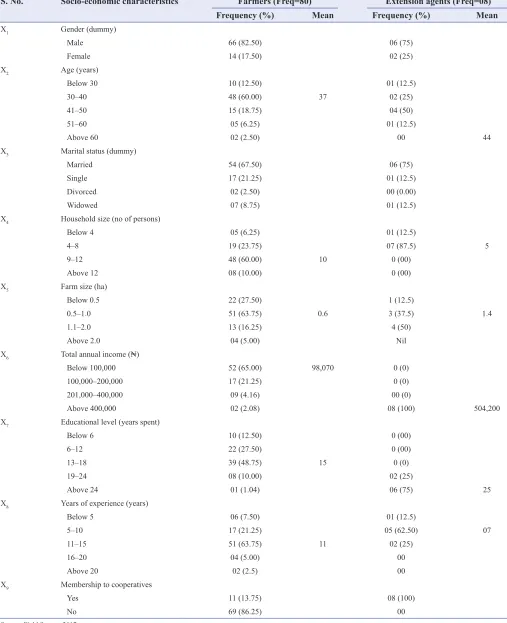
The result of the analysis presented in Table 1 showed that most of the farmers (82.50%) and extension agents (75%) were males, whereas 17.50% and 25% were females for farmers and extension agents,
respectively. This implies that the majority of the
respondents who were into farming were males. This is in line with the result of Ogunsumi (2008) in the analysis of extension activities on farmers’ productivity in Southwest, Nigeria, which reported that most of the farmers and extension agents in the area were males.
Relating to age, the result was evident that a good number of the farmers (60.00%) were between 30 and 40 years, while 50% of the extension agents were between 41 and 50 years. Furthermore, it showed revealed that nobody among the extension agents was above 60 years while only 2.50% of the
farmers were above 60 years. The result finding
further showed that the mean age of the farmers was 37 years while the mean age of the extension
agents was 44 years. The meaning of this finding is
that most of the farmers and extension agents fall between the age of active agricultural productivity. According to FAO (2012), the age for agricultural productivity is between 30 and 45 years. This explains the age when the farmers are agile and zealous.
For marital status, it was obvious that 67.50% and 75% of the farmers and extension agents were, respectively, married while nobody was divorced among the extension agents but it was seen that 2.50% of the farmers were divorced. This means that most of the farmers and the extension agents were married and have their families to take care
of. This finding concurs with that of Rewald (2001)
success and failure in achieving the goals of the world food summit in proceeding of an International Conference Sustainable food security for all by 2020 which reported that most of the farmers and extension agents were married.
The result on household size portrays that 60% of
the farmers had household size of between 9 and
12 persons while 87.5% of the extension agents had household size of between 4 and 8 persons. It was also revealed that the mean household size for
respectively. This means that the farmers had higher
household size than the extension agents probably because of the fact that the extension agents must have had higher adoption of family planning Table 1: Socio-economic characteristics of farmers in the study area
S. No. Socio-economic characteristics Farmers (Freq=80) Extension agents (Freq=08) Frequency (%) Mean Frequency (%) Mean X1 Gender (dummy)
Male 66 (82.50) 06 (75)
Female 14 (17.50) 02 (25)
X2 Age (years)
Below 30 10 (12.50) 01 (12.5)
30–40 48 (60.00) 37 02 (25)
41–50 15 (18.75) 04 (50)
51–60 05 (6.25) 01 (12.5)
Above 60 02 (2.50) 00 44
X3 Marital status (dummy)
Married 54 (67.50) 06 (75)
Single 17 (21.25) 01 (12.5)
Divorced 02 (2.50) 00 (0.00)
Widowed 07 (8.75) 01 (12.5)
X4 Household size (no of persons)
Below 4 05 (6.25) 01 (12.5)
4–8 19 (23.75) 07 (87.5) 5
9–12 48 (60.00) 10 0 (00)
Above 12 08 (10.00) 0 (00)
X5 Farm size (ha)
Below 0.5 22 (27.50) 1 (12.5)
0.5–1.0 51 (63.75) 0.6 3 (37.5) 1.4
1.1–2.0 13 (16.25) 4 (50)
Above 2.0 04 (5.00) Nil
X6 Total annual income (₦)
Below 100,000 52 (65.00) 98,070 0 (0)
100,000–200,000 17 (21.25) 0 (0)
201,000–400,000 09 (4.16) 00 (0)
Above 400,000 02 (2.08) 08 (100) 504,200
X7 Educational level (years spent)
Below 6 10 (12.50) 0 (00)
6–12 22 (27.50) 0 (00)
13–18 39 (48.75) 15 0 (0)
19–24 08 (10.00) 02 (25)
Above 24 01 (1.04) 06 (75) 25
X8 Years of experience (years)
Below 5 06 (7.50) 01 (12.5)
5–10 17 (21.25) 05 (62.50) 07
11–15 51 (63.75) 11 02 (25)
16–20 04 (5.00) 00
Above 20 02 (2.5) 00
X9 Membership to cooperatives
Yes 11 (13.75) 08 (100)
No 69 (86.25) 00
techniques than the farmers. This synchronizes with the report of Alunas (2014) in assessment of the factors impacting agricultural extension training programs in Tanzania which observed that most of the extension agents in Tanzania adopted family. For farm size, research evidence disclosed that 63.75% of the farmers had farm size between 0.5 and 1.0 ha in scattered plots while about 50% of the extension agents had farm size of between 1.1 and 2.0 ha in scattered plots. The result further showed a mean farm size of 0.6 and 1.4 ha, respectively, for farmers and extension agents. This connotes that the extension agents had bigger farms than the farmers maybe because of their ability to hire lands for agricultural production more than the farmers who do not have much fund. This was in tandem with the
finding of Swanson (2004) in extension strategies
for poverty alleviation in a global economy which reported that extension agents have higher ability to engage in commercial farming than small scale farmers [Table 2].
The evidence from research disclosed that 65.00%
of the farmers earned below ₦100,000 while 100% of the extension agents earned above ₦400,000
annually. The mean annual income of the farmers
and extension agents was ₦98,070 and ₦504,200,
respectively. This implied that the extension agents earned higher than the farmers in the area. This could
be attributed to the fact that most of the extension agents who are enrolled in government pay row still engage in other economic activities such as farming and business to enhance their income unlike the farmers who do not receive pay from the government. This concurs with Seevers and Graham (2012) in education through cooperative extension who reported that extension agents earned higher than rural farmers in India.
The analysis on educational level divulge that 48.75% of the farmers spent between 13 and 18 years in acquiring formal education which implied that they attended secondary school education while 75% of the extension agents of spent above 24 years in acquiring formal education
which signifies that they attended tertiary education.
The implication was that farmers had recieved less quality education than the extension agents. This is because though farmers do not require much education to engage in farming activities, extension agents require good education to be able to carry out their duties as trainers of farmers in different agro-enterprises. This corroborates Tladi-Sekgwama and Tselaesele (2010) in agricultural extension in Botswana: Growing a hybrid over decades of selective experience who argued that extension agents require quality education as a prerequisite for
effective and efficient extension service delivery to
farmers in Botswana.
The research evidence was obvious that 63.75% of the farmers had been into farming for between 11 and 15 years while 62.5% of the extension agents have been into extension service delivery for between 5 and 10 years. The mean years of experience was 11 and 7 for farmers and extension agents, respectively. This implied that the farmers have spent much more time in farming than extension agents have spent in extension service delivery that does not mean that the farmers have gathered more knowledge than the extension agents since education exposes the extension agents more than the farmers. This aligns with the result of Yurttas and Atsan (2006) in agricultural extension and communication techniques in Ataturk, Turkey which reported that though farmers have spent more number of years in farming than extension agents, they still were not as knowledgeable as the extension agents who had received quality training in different agricultural enterprises.
Table 2: Multiple regression analysis on the determinants
and influence on perception and adoption of extension
technology packages in the area
Variable
name Regression coefficient Standard error T-value significanceLevel of
Constant 2.278 0.401 5.680 ***
Age 0.499 0.087 5.736 ***
Gender 0.060 0.118 0.508 NS
Income level 0.013 0.011 1.180 * Household size 0.014 0.009 1.555 **
Farm size 0.472 0.053 8.905 ***
Educational
qualification 0.321 0.400 0.803 * Marital status -0.005 0.007 −0.714 NS F-ratio 108.31
R2 0.819
Adj R2 0.827
Standard error
of estimates 0.303 Durbin-Watson
The result on membership to cooperatives showed that all the extension agents were members of cooperative societies whereas only 13.75% of the farmers were cooperative members. The implication of this was that only a few farmers were consistently in contact with the extension agents through cooperative associations. This aligns with
Place, Kariuki, Wangila, Kristjanson, Makauki, and
Ndubi (2002) in assessing the factors underlying differences in group performance: Methodological
issues and empirical findings from the highlands
of central Kenya which reported that most of the rual farmers did not belong to cooperative societies. However, Oladele (2005) in farmers’ perception of agricultural extension agents’ characteristics as factors for enhancing adult learning in Mezam Division of Northwest Province of Cameroon reported that most of the rural farmers in the area were cooperative members.
DETERMINANTS AND INFLUENCE ON PERCEPTION AND ADOPTION OF EXTENSION TECHNOLOGY PACKAGES IN THE AREA
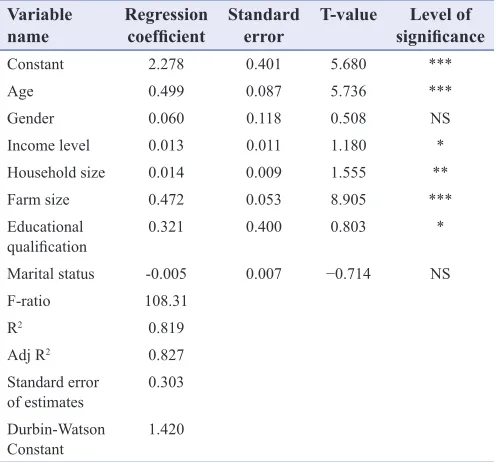
A coefficient of multiple determinations, R2 of 81.9% was obtained from multiple regression analysis. This
means that about 81.9% change in the dependent
variable (adoption of extension technology packages) was caused by variations of independent variables included in the regression model. This high value of R2 shows that the selected factors of the respondents have
strong influence on their adoption level. Furthermore, the overall influence of the independent variables was shown by F-statistics which was significant at 1% level of significance. It is believed that the power
of explanatory variables was not exaggerated since R2 was closely related to R2 adjusted in numerical value. The low value of Durbin-Watson constant indicates absence of autocorrelation in the regression
model meaning that the model was well-specified
because important variables were not omitted. It is therefore assumed that the forecasting power of the regression result is very high due to its statistical reliability and dependability as shown by the low value of standard error.
The coefficient of age was positive and statistically significant at 1%. This implies that any increase in
the age of the farmers will increase their adoption
of extension technology packages and vice versa. This does not align with the researcher’s a priori expectation since increase in age may decrease the farmers’ agility, zeal or interest in farming and as well lead to decrease in adoption of extension technology packages. This does not submit to
the finding of Alimba (2012) which reported that
older farmers are risk averse and so may not adopt improved technologies. Umeh et al. (2015) further opined that increase in age decreases adoption of improved rice production technologies among rural farmers in Ebonyi state.
Research finding showed that gender was positive and not statistically significant. This connotes that gender of farmers influences the adoption of
extension technology packages among rural farmers in the area. This does not align with the a priori expectation given that both males and females have equal opportunities to adopt extension technology packages if they have the capacity to do so. This corroborates the report of Rosedo (2004) who opined that both males and females have equal adoption to improved technologies in India.
Income was positively signed and statistically
significant at 10%. This means that any increase
in the amount of annual income generated by the farmers will lead to direct increase in the adoption of extension technology packages among the farmers and vice versa. This is in sympathy with
the finding of Adejoh et al. (2017) in assessment of the adoption of improved rice processing technologies: A case of rice farmers in the Federal
Capital Territory, Abuja, Nigeria who reported that
increase in income increases adoption of improved rice production technologies among farmers in
Abuja, Nigeria.
Household size was positively signed and
statistically significant at 5%. The meaning of
of Kogi State Agricultural Development Project,
Kogi State, Nigeria, who opined that increase in farmers’ household size is an advantage to farmers’ information source on fertilizer adoption in the area. However, Agwu (2006) in adoption of improved oil palm production and processing technologies in Arochukwu Local Government Area of Abia State, Nigeria, reported that increase in household size increases the farmers’ expenditure and so decreases ability to pay for improved production technologies in the area.
Farm size was positively signed and statistically
significant at 1%. This insinuates that any
increase in the farm size of the farmers will increase their adoption of extension technology packages and vice versa. This agrees with the researcher’s a priori expectation since increase in farm size leads to increase in zeal and readiness to adopt improved technologies to enhance easy production and ensure quality produce. This backs Sani, Abubakar, Yakubu, Atala and Abubakar
(2014) in socio-economic factors influencing
adoption of dual-purpose cowpea production technologies in Bichi Local Government Area of Kano State, Nigeria, who reported that farmers with higher farm size had higher adoption of improved technologies than those whose farm size was small.
The coefficient of educational qualification was positive and statistically significant at 10%.
The innuendo is that any increase in quality of education acquired by the farmers will directly lead to increase in the farmers’ adoption of extension technology packages and vice versa. This succumbs to the a priori expectation of the researcher who noted that access to quality education is an expository value which places farmers to quickly understand the usefulness of an extension technology and as such enhance
adoption. This sees eye to eye with the finding of Ofuoku, Egho, Enujeke (2009) in integrated pest
management adoption among farmers in Central Agro-ecological Zone of Delta State, Nigeria, who argued that increase in access to quality education increases farmers adoption of improved technologies in the area.
Marital status was negative and not statistically
significant. This implied that marital status does not influence adoption of extension technology
packages among the farmers. This is true with the a priori expectation since both the married, single, divorced, widowed, and separated can adopt extension technology packages if they are capable and willing to do so. This corroborates with the work of Otunaiya and Akinleye (2010) in adoption of improved maize production technologies in Yewa North LGA of Ogun state, Nigeria, which
reported that marital status did not influence
adoption of improved maize varieties among farmers in the area. However, Onoh and Peter-Onoh (2012) disclosed in adoption of improved oil palm production technology among farmers in Aboh Mbaise Local Government Area of Imo State that married people have higher family responsibilities to meet and so are under much pressure to adopt improved technologies to improve yield for better family enhancement.
The resultant model was presented thus,
Y = 2.278 + 0.4996X1 + 0.060 X2 + 0.013 X3 + 0.014 X4 + 0.472 X5 + 0.321 X6 − 0.005 X7 + 0.592
(0.408)* (0.087)***(0.118)NS (0.011)* (0.009)**
(0.053)|***(0.400)* (0.007) *
Test of hypothesis
The result of the F-test on the hypothesis which stated that the selected socio-economic factors of
farmers do not significantly influence their adoption
of ADP agricultural extension programs packages in Ivo L.G.A of Ebonyi State was presented. From appendix two, since F-cal (108.31) > F-tab
(2.12), the null hypothesis was rejected and the
alternative accepted. This means that the selected
socio-economic factors of farmers do significantly influence their adoption of ADP agricultural
extension programs packages in Ivo L.G.A of Ebonyi State.
CONCLUSION AND RECOMMENDATIONS
It was observed that socio-economic characteristics
of the farmers actually influenced their adoption
of such technologies. Hence, the following were recommended;
ADP extension technology packages to enhance production;
(ii) Government and NGOs should endeavor to subsidize the cost of ADP extension technology packages to enhance easy adoption by rural farmers;
(iii) Credit institutions are advised to give farmers loans to enhance their accessibility of ADP extension technology packages in the area;
(iv) Farmers are encouraged to register in cooperative societies as this will enhance their access to ADP extension packages in the area.
REFERENCES
1. Agwu AE. Adoption of improved oil palm production and processing technologies in Arochukwu local government area of Abia State, Nigeria. Agro Sci 2006;5:25-35. 2. Alunas MM. Assessment of the Factors Impacting
Agricultural Extension Training Programs in Tanzania:
A Descriptive Study. Iowa: Graduate Theses and
Dissertations, Iowa State University; 2014.
3. Anka LM, Khooharo AA. An appraisal of agricultural extension work in Zamfara State of Nigeria. Mod Agricu Hyderabad Pak 2010;20:38-40.
4. Adejoh SO, Madugu N, Shaibu UM. An Assessment of
the adoption of improved rice processing technologies: A case of rice farmers in the Federal Capital Territory,
Abuja, Nigeria. Asian Res J Agric 2017;5:1-9.
5. Morris JO. Agricultural extension, collective action and innovation systems: Lessons on network brokering from
Peru and Mexico. J Agric Educ Ext 1991;18:141-59. 6. John K, Rajan C, Sharma D, Singh C, Arora S. Farmers’
Participation in Agricultural Research and Extension
Systems. New Delhi, India: Concept Publishing
Company; 1997.
7. International Finance Corporation. Working with Smallholders: A Handbook for Firms Building Sustainable Supply Chains. “Archived copy”; 2013.
8. Kemi F. Determinants of level of participation of farmers in group activities in Kwara State, Nigeria. J Agricu Fac Gazi Univ 2016;33:21-7.
9. Kimaro WH, Mukandiwa L, Mario EZ, Editors. Towards
Improving Agricultural Extension Service Delivery in the SADC Region. Dar es Salaam, Tanzania: Proceedings of the Workshop on Information Sharing Among Extension Players in the SADC Region; 2010.
10. Jaines GE, Garforth C. The history, development, and future of agricultural extension in Swanson, B. Improving Agricultural Extension: A Reference Manual 3rd ed.
New York: FAO; 2010.
11. Ladele MA. Consolidating extension in the Lao PDR. Assessment of Factors Affecting the Acceptance of Agricultural Innovations in Zurmi Local Government Area,
Zamfara State Nigeria. NAFES National Agricultural and
Forestry Extension Service: Vientiane; 1990.
12. Ogunsumi LO. Analysis of Sustained use of Agricultural Technologies on Farmers’ Productivity in Southwest Nigeria, Unpublished Ph. D. Thesis. Akure, Nigeria: Federal University of Technology; 2008. p. 117-23. 13. Oladele I. Farmers’ perception of agricultural extension
agents’ characteristics as factors for enhancing adult learning in Mezam division of Northwest province of cameroon. Aust J Adult Learn 2005;45:223-35.
14. Okwoche VA, Obinne CP, Onugba JA. Adoption of herbicides and fertilizers among rural farmers of Zone B
area of Kogi State agricultural development project, Kogi State, Nigeria. Asian J Agricu Sci 2011;3:389-92.
15. Place F, Kariuki G, Wangila J, Kristjanson P, Makauki A,
Ndubi J. Assessing the Factors Underlying Differences
in Group Performance: Methodological Issues and
Empirical Findings from the Highlands of Central Kenya CAPRi Working Paper 25. Washington, DC: International Food Policy Research Institute; 2002.
16. Roseboo MJ. Adopting an Agricultural Innovation System Perspective. Implication for ASARECA Strategy. East African: ASARECA Strategic Planning; 2004. p. 7.
17. Ofuoku AU, Egho EO, Enujeke EC. Integrated pest
management adoption among farmers in central agro-ecological Zone of Delta State, Nigeria. Adv Biol Res
2009;3:29-33.
18. Onoh PA, Peter-Onoh CA. Adoption of improved oil palm production technology among farmers in Aboh Mbaise local government area of Imo State. Int J Agric Rural Dev
2012;15:966-71.
19. Otunaiya AO, Akinleye SO. Adoption of improved
Maize production technologies in Yewa North LGA
of Ogun State, Nigeria. Nigeria, Abuja: Proceedings of
10th Annual National Conference of Nigeria Association
of Agricultural Economists (NAAE) Held at University
of Abuja; 2008. p. 395-403.
20. Rewald M. Success and Failure in Achieving the Goals of the World Food Summit in Proceeding of an International Conference. Germany: Sustainable Food Security for all by Held at Bonn 2020; 2001. p. 21-2.
21. Sani A, Abubakar BZ, Yakubu DH, Atala TK, Abubakar L.
Socio-economic factors influencing adoption of
dual-purpose cowpea production technologies in bichi local government area of Kano State, Nigeria. Asian J Agricu Ext Econ Sociol 2014;3:257-74.
22. Swanson BE. Extension strategies for poverty alleviation in a global economy. Proceedings of the 2nd International Conference on Agricultural Education
and Environment. Los Baños, Philippines, PA: Asia
Pacifica Association of Educators in Agriculture and Environment;2004. p. 67-97.
23. Seevers B, Graham D. Education Through Cooperative Extensionl. 3rd ed. Fayetteville, AR: University of
Arkansas; 2012.
of selective experience. In: Kimaro WH, Mukandiwa L, Mario EZ, editors. Towards Improving Agricultural Extension Service Delivery in the Sadc Region. Dar es Salaam, Tanzania: Proceedings of the Workshop on Information Sharing among Extension Players in the
SADC Region, 26-28; 2010. p. 4-11.