www.astesj.com
Special issue on Advancement in Engineering Technology
Clean Energy Use for Cloud Computing Federation Workloads
Yahav Biran*,1, Sudeep Pasricha2, George Collins1, Joel Dubow3
1Colorado State University, Department of Systems Engineering, Fort Collins, 80523, CO, USA
2Colorado State University, Department of Electrical and Computer Engineering, Fort Collins, 80523, CO, USA 3Fulcrum Co., Cyber Security, Centreville, 20120, VA, USA
A R T I C L E I N F O A B S T R A C T Article history:
Received: 01 July, 2017 Accepted: 10 August, 2017 Online: 19, August, 2017
Cloudprovidersseektomaximizetheirmarketshare.Traditionally,they deploy datacenters withsufficient capacity to accommodate their entire computing demand while maintaining geographical affinity to its customers. Achieving these goals by a single cloud provider is increasinglyunrealisticfroma costofownership perspective.Moreover, thecarbonemissionsfrom underutilizeddatacentersplace anincreasing demandonelectricityandisagrowingfactorinthecostofcloudprovider datacenters. Cloud-basedsystemsmay beclassified into twocategories: servingsystemsandanalyticalsystems.Westudiedtwoprimaryworkload types, on-demand video streaming as a serving system and MapReduce jobsasananalyticalsystemsandsuggestedtwouniqueenergymixusage for processing that workloads. The recognition that on-demand video streamingnowconstitutesthebulkportionoftraffictoInternetconsumers provides a pathto mitigate rising energy demand. On-demandvideo is usuallyservedthroughContentDeliveryNetworks(CDN),oftenscheduled in backend and edge datacenters. This publication describes a CDN deployment solution that utilizes green energy to supply on-demand streaming workload. A cross-cloud provider collaboration will allow cloud providers to both operate near their customers and reduce operationalcosts,primarilyby loweringthe datacenterdeploymentsper provider ratio. Our approach optimizes cross-datacenters deployment. Specifically,wemodelanoptimizedCDN-edgeinstanceallocationsystem that maximizes, under a set of realistic constraints, green energy utilization. The architecture of this cross-cloud coordinator service is basedonUbernetes,anopensourcecontainerclustermanagerthatisa federation of Kubernetes clusters. It is shown how, under reasonable constraints, it can reduce the projected datacenter’s carbon emissions growthby22%fromthecurrentlyreportedconsumption.Wealsosuggest operating datacentersusing energy mixsources as a VoltDB-based fast data system to process offline workloads such as MapReduce jobs. We showhowcross-cloudcoordinatorservicecanreducetheprojected data-centers carbon emissions growth by 21% from the currently expected trajectorywhenprocessingofflineMapReducejobs.
Keywords:
power consumption resource utilization cloud computing cloud federation
1
Introduction
Over the past decade, cloud-based systems have been re-quired to serve an increasing demand from users work flows and data. Cloud-based systems may be classified into two categories: serving systems andanalytical systems. The former provides low-latency read or write access to data.
For example, a user requests a web page to load online or requests video or audio streaming. The latter provides batch-like compute tasks that process the data offline that are later sourced to the serving systems. The service level objectives (SLO) for serving jobs are on the order of frac-tions of a second, while the SLO for analytical jobs are on the order of hours, sometimes days.
*Corresponding Author, [email protected]
Today, public cloud service providers (CSP) attempt to process both of these workloads with a rich platform that guarantees cost and SLO to their clients. Cloud comput-ing is an emergcomput-ing infrastructure with limited regulation and compliance requirements [1]. Recently the Office of Management and Budget issued a Federal Data Center Op-timization Initiative that promotes increasing use of Green Energy and increased utilization efficiency for all US Fed-eral datacenters [2]. Specific target numbers are set for the end of fiscal year 2018. This publication addresses how those federal requirements may be attained and how feder-ated cloud computing is a key enabler for attaining those performance targets.
Beginning in 2013, the US government initiated a carbon-tax on IT organizations to encourage major CSPs to pursue green energy opportunities for their datacenters operations [3]. US datacenters are projected to consume ap-proximately 73 billion kWh by 2020 [3] with a correspond-ing increase greenhouse gases. Green energy generation growth is expected to triple by 2040 [4]. However, there is no cohesive system existing to coordinate the rising data-center energy demand with rising green energy supply. This chapter utilizes Cloud-Federation as a multi-cloud resource coordination system that matches computational resource demands with available energy supply to maximize the uti-lization of green energy for processing cloud-workloads.
Most CSPs seek more market share in competition with other CSPs. One outcome of such competition is an ever-growing infrastructure in the form of new datacenters across the globe with no countervailing forces to meet user demand more efficiently and satisfy societal environmental and en-ergy requirements. This sub optimum use of infrastructure increases the carbon footprint attributable to cloud comput-ing services and also drives up costs to CSP’s. The fol-lowing sections investigate two types of workloads, serv-ing and analytical systems. This chapter will focus on two workload types, On-demand streaming as a representation ofservingsystems. It will also investigateanalytical sys-tems and present a unique model that allows optimal clean energy usage.
1.1
Enabling Green Content Distribution
Network by Cloud Orchestration
On-demand streaming constitutes up to 85% of Internet traffic consumption [5]. On-demand streaming content is managed and distributed by content service providers. It then cached and distributed by Content Delivery Net-works(CDN) located at the edges of the Internet network close to the consumers. Because streaming constitutes such a large fraction of Internet resource consumption, this paper will, of necessity, focus on methods to employ green energy to better operate CDN instances of on-demand streaming jobs, which include both video and audio content.
Meeting the Federally mandated approach of maximiz-ing the utilization of green energy to operate CDN instances (for government with recommendations for private sector use as well) requires an energy source-demand coupling scheme that insures SLO levels of power availability but is structurally biased towards green energy sources over hy-drocarbon fueled energy sources. A system to accomplish
this will have to provide seamless failover in the case of sudden interruption of green energy to grid-energy sources or vice versa i.e., fallback from grid-energy to green energy when surplus green energy is available.
User expectations in on-demand streaming requires dif-ferent service level requirements than other serving sys-tems workloads. Serving systems workloads are com-prised of interactive sessions that pivots on minimum la-tency. However, low latency is less critical in analytical on-demand streaming since application clients use buffering techniques to mitigate long latency effects. Therefore, on-demand streaming workloads fits, more closely than inter-active workloads, with the observed intermittent and vary-ing green energy availability characteristics.
Green energy supply is unpredictable and requires a complex, adaptable, resource allocation system to provide CDN services with steady energy supplies while concur-rently seeking minimal carbon footprint. This dynamic availability of green energy resources in a smart grid re-quires real time communication of both short term and pre-dictive energy needs from cloud service providers to green energy providers. The green energy providers need to close availability dynamically to CSPs, who, in turn, dis-close their changing energy demands for near term comput-ing. SPs can then better maximize the use of green energy for on-demand streaming processing.
This is a classical resource management and coordina-tion problem [6, 7]. The following approach builds upon prior work that was done in this area [8, 9], specifically that done on alleviating the sudden lack of green energy to meet low-latency workloads. The approach herein em-ploys an application-buffering scheme that better allows for opportunistic, green, on-demand streaming processing. It requires an extended, cohesive, federated system that aggre-gates supply and demand across multiple geographic loca-tions employing the smart grid command and control infras-tructure to achieve an optimal dynamic matching of green energy sources and computing loads.
This chapter proposes an implementation that utilizes a control component in a federated cloud that coordinates and optimizes the resource allocation among the participant CDN providers. It treats the volatile nature of green energy resources as a resource allocation problem, the solution of which is a resource orchestration system that is optimized with the goal to operate increasingly near to the limit of supply by green energy sources constrained by SLO relia-bility requirements. This system will be demonstrated by modeling a prototype that simulates resource allocation in a micro federated cloud eco-system to achieve an energy supply-computation demand match optimized within sec-onds.
The chapter starts, with the on-demand streaming eco-nomics, increased green energy utilization and anticipated smart grid progressions as applied to on-demand streaming. Then it discusses the green energy utilization problem is analyzed. Finally, we present a cloud coordinator prototype that is built on Kubernetes [10, 11], an open source clus-ter manger, and extend that prototype to discusses the need for and requirements of a unified system that orchestrates cluster compute resources in a federated cloud.
1.1.1 On-Demand Streaming and CDN
Over the last decade, video and audio traffic became the dominant segment of consumer internet traffic. Cloud service-providers such as Netflix, Amazon Instant and YouTube disrupted the prior linear TV data distribution model. Also, video streams delivered by mobile terminals grew as mobile connectivity improved [12]. Video stream-ing is expected to constitute up to 85% of Internet con-sumers traffic [5] within a few years. The US portion of video streaming is 14%1and the number of US Unique IPv4 connected addresses is 17% [12]. The streaming work-load is comprised of live streaming and on-demand stream-ing, with the relative fractions of 6% and 94% respectively [5]. Other predictions support similar ratios, 12% live-streaming and 88% for on-demand.
A key driver for the rapid expansion of streaming video was the shift from specialized streaming protocols and infrastructures such as RTSP, and RTMP [13] to a sim-ple HTTP progressive download protocol. This led to a shift from proprietary streaming appliances to commodity servers. In turn, this change removed a barrier for CDN’s to process on-demand workloads. Most present day, CDN service providers support a seamless integration with cloud-based object storage that pipelines the digital content from the organization site to the CDN instance that runs at the In-ternet provider edge2. Furthermore, the HTTP chunk-based streaming protocol support in a CDN allows the client ap-plication sufficient time to detect the optimal CDN instance to handle user workload. The optimal CDN instance assign-ment is done by the cloud control plane resource manager. The prototype described below will demonstrate such opti-mal resource allocation.
We used server utilization and power metrics from [3, 12] to design the prototype. Most of these sources we considered have limited utilization rates and server utiliza-tion distribuutiliza-tion. Also, utilizautiliza-tion and power consumputiliza-tion do not scale linearly [14]. However, for clarity, in the in-terest of maintaining focus on the larger goal of the paper, CDN resource management systems for green energy uti-lization, we assumed linear relationships and accepted the risk of loss of accuracy in our estimates. High fidelity sim-ulation accuracy is not critical for the goal of this chapter.
1.1.2 Energy Saving Potential in Operating a Dis-tributed CDN Resource Management System
The approach is to aggregate the required traffic for on-demand workload processing, and use standard compute
device specification to assess the electrical energy and car-bon footprint that will be required by that workload3.
Time 1-hour increments
0 5 10 15 20 25 30 35 40 45 50
On-Demand Views per minute K
0 5 10 15 20 25 30
data fitted curve
Figure 1: On-Demand Video views observed throughout 48 hours with 1-hour increments. Data was fitted with smoothingspline for curve and surface fitting [5]
The estimated data rate for streaming is given asStotal=
63000PB/mo (where PB is Petabytes). Figure 1 shows users workload pattern of 9 busy hours in which the workload spans throughout 13 hours a day which yield 126PB/sec/mo/ The on-demand streaming portion is es-timated as 78% across four main US regions denoted by k =4, the number of region used, for the purposes of this paper although k can be varied depending upon the degree of granularity desired in the simulations.Son−demanddenote
the on-demand portion.
Son−demand=Stotal·78%=49140PB/mo
nhours/daydenotes the number of effective hours in a day
for streaming.
nhours/day =nbusy+k=13
Drate=
Son−demand
nhours/day
=126PB/sec/mo
Nmaxdenotes the estimated number of required servers
in maximum CPU capacity. Nmaxis bounded by the
maxi-mum network throughput a single server can ingest. Stan-dard commodity servers can handle up to 8.5Gbps i.e. 1.026GB/sec.
Nmax=
Drate
Tmax
=126·106GB/sec
1.026GB/sec =118588235.3 uopt denotes the CPU utilization factor so servers has
sufficient capacity to handle management tasks. We esti-mate 60% utilization factoruopt=100/60.
Nopt=Nmax·uopt=118588235.3·
100
60 =197647058.8 Es denotes the midrange server energy consumption
for various server types s. We consider three types of servers:(1) compute server(5kWh/server), (2)
1Internet Statistics retrieved from https://www.statista.com/chart/2647/global-internet-usage-by-the-numbers/
2Cloud Front reference retrieved from https://aws.amazon.com/cloudfront/
digital storage server(1.7kWh/server) and (3) network server(1kWh/server). Storage server acts the digital stor-age controller. The network server acts as the router and switch. The compute server is the server that processes the on-demand streaming.
Ey=Nopt·
X
s∈SEs (1)
=Nopt·(5kWh+1.7kWh+1kWh)
=1.521·106kWh/mo=18.26GWh/y
The saving potential from running on-demand video streaming using green energy resources is 18.26GWh a year based on current on-demand consumption and expected to grow 89% by 20194. i.e. 34.5GWh per year for on-demand streaming. The next sections will explain the challenges in utilizing green energy followed by a method that addresses some of these challenges and thereby maximizes the utiliza-tion of green energy.
1.2
Coordinating Green Clouds as
Data-Intensive Computing
The following paragraph focuses on analytical systems workloads that typically comprise 48% of the cloud work-load [15]. Also, some of the workwork-loads patterns can be predicted as recurring jobs [16] and the deadlines for an-alyticaljobs are more liberal by an order of magnitude than theservingjobs. Finally, one of the ways to handle offline workloads is to process the data streams offline through a highly scalable data-parallel frameworks like MapReduce by submitting jobs to a control plane [17].
This chapter proposes a component in a federated cloud that will optimize the resource allocation and coordination among the participant CSPs. It will also focus on address-ing the time and power volatile nature of renewable energy resources as a fast date problem. It will present a resource management system with a goal to increase the utilization of data-centers, and to operate increasingly to the limit of supply by renewable energy sources. Finally, a prototype is built to simulate resources allocation in a micro federated cloud eco-system to achieve a supply demand optimized match within seconds.
Clean energy sources are time and power volatile and require complex resource allocation and coordination sys-tems to maintain highly available data-center service with steady energy at a minimal carbon footprint. Further, avail-ability of clean energy resources in a smart grid can be pushed from a variety of energy sources deployed across the nation as can the pull needs of data-service centers. Thus, CSPs will publish their compute resources availability, and service providers (SP), will publish their changing energy demands for near term computing. These streams of data include both high-volume and high-velocity characteristics termed a fast-data problem [18]. Our proposal uses as a base previous work that was done in this area [8, 19, 20]. However, previous work treated clean energy within a sin-gle data-center operated by a CSP. The proposal below sug-gests an extended cohesive system that aggregates supply
and demand across multiple geographic locations employ-ing the smart grid sense command and control to achieve an optimal match.
1.2.1 Optimum Clean Energy Utilization is a Fast-Data Problem!
This study suggests that efficient, clean energy utilization requires three consecutive steps: (1) Clean energy resource availability signals. (2) Exploration and analysis of prior years seasonal solar data and current weather reports and evolving green energy capacity availability planning. (3) Acting fast enough based on the predictive analysis. The last step is the key component in solving the optimum allo-cation problem.
We judge that clean energy utilization is different from the classic big-data problem such as the Hadoop MapRe-duce Method. Big-data solutions solve the case where the data is at rest, not fully consistent (aka eventual consis-tency) and require liberal SLO that is later provided as com-puting trends, and other business intelligence applications. However, our case handles data in motion that requires con-sistent, real-time aggregation, and transaction processing. That is per-event decision making using both real-time con-textual and historical data as dual guides for proper algo-rithms. Finally, we argue that based on the clean energies’ volatile nature, processing streams of compute demand and clean energy supply requires that a need for a compute re-sources can be addressed with a currently available demand.
1.3
Why is Green Energy Utilization Hard?
The following section describes why utilizing green energy for compute purposes, while a justifiable goal, is limited by SLO reliability. It will present a scenario where balanc-ing time-varybalanc-ing energy generation patterns with changbalanc-ing dynamic energy demands of cloud computing sometimes conflict. The green energy time varying generation patterns considered by us focuses on wind and solar generation. Fig-ure 4 show historical data on dynamic natFig-ure of green en-ergy sources and Figure 5 shows the dynamic cloud enen-ergy demand.
1.3.1 Frequency Stability in Wind-Power Generation
The daily wind power variation characteristics will be em-ployed as a metric that illustrates the duration and level for a given amount if wind energy availability. The electric-ity generation process from wind is comprised of a wind turbine extracting a kinetic energy from the air flow. The wind is rarely steady; it is influenced by the weather system and the ground surface conditions, which are often turbu-lent [21]. Also, the generation process must happen at the same instant it is consumed [22] unless it is stored in grid level battery banks. Unfortunately, grid level energy storage technology is not keeping up with grid level energy genera-tion technology.
Sample wind and power generation data were obtained from NREL [22]. We used datasets from 2006-2012 across different regions in the US and aggregated more than 600
observations. Finally, the data were fit using smoothing splines5. The usable power generated from a wind turbine is generally described by a Rayleigh distribution [21]. It defines three main points in the wind power generation pro-cess: (1) the cut-in is the minimum viable wind speed for electricity generation from a wind turbine. (2) the rated level, describes the point where the power reached its lo-cal maximal capacity without adverse effects on the turbine life by too strong a wind. (3) Cut-Off, is the term for the lo-cal minimum for the generation cycle. Beneath that speed, there is not enough power for viable electricity generation. Thus, if the wind velocity is too low, the data-server gets no wind energy. Figure 2 shows wind generation variations that crudely fit a Rayleigh distribution with b = 300 as-suming the form of the Rayleigh Probability Distribution Function is:
f(x|b)= x b2e
−x2
2b2
The measured generation cycles range between 140 and 180 minutes per cycle. Equation 2 expresses the gener-ated power by a wind turbine, given a wind velocity. The functiongdescribes a viable electricity generation given a wind power. The wind power availability indications will be generated by a wind turbine and fed into the coordina-tor database as a potential power source to datacenters in a region. Our prototype will assume wind power availabil-ity indications as the wind tuple{region,cut-in,rated,cut-off}
indications.
Pout put(windv)=
0 : ifwindv≤rated
g(windv) : ifrated<windv≤cout
0 : ifwindv≤cout
(2)
Time (5min) increments
0 100 200 300 400 500 600 700 800 900
Actual - Power (MW)
0 5 10 15 20
Rayleigh p(B=300)
×10-3
0 1 2 3 4
cut-in rated
cut-off
Figure 2: Aggregated wind power measurements between 2007-2012 that fits Rayleigh Distribution with b=300
1.3.2 Efficiency and Daily/Hourly Availability in Solar-Power Generation
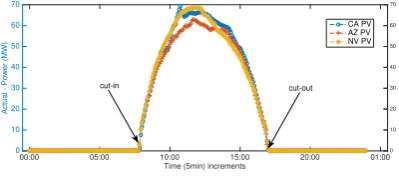
Photovoltaic solar (PV) energy availability is defined by the solar power intensity denoted by s(Watts/m2), which varies with local daylight hours and the clear or cloudy sky con-ditions [22]. Moreover, the PV cells are most effective at lower temperatures [23]. The PV cells electrical power gen-eration, defined by Equation 3, is a function of the solar intensity denoted byηsolar. Solar power generation also
de-pends on the PV power efficiency denoted bys. It encapsu-lates both the predicated temperature,the sky conditions, the solar cell efficiency, and the DC to AC inverter efficiency. The solar cell area denoted bya(m2).
Pout put(s)=ηsolar·s·a (3)
Our prototype will assume solar power availability indi-cations as the solar-tuple{region,power-efficiency}. Based on the solar generation pattern presented in figure 3, the generation prediction utilizes the the local time in a region and the given power-efficiency
Time (5min) increments
00:00 05:00 10:00 15:00 20:00 01:00
Actual - Power (MW)
0 10 20 30 40 50 60 70
0 10 20 30 40 50 60 70
CA PV AZ PV NV PV
cut-in cut-out
Figure 3: Aggregated solar power generation between 2008-2011 taken in Palm Springs CA, Prescott Airport CPV, AZ and Nevada Solar One, NV, indicating on a stable and fixed solar-based power [22]
1.3.3 Optimum Green Energy Utilization for On-Demand Streaming is a Resource Management Problem!
This study suggests that efficient; green energy utilization for on-demand video streaming workloads has three main requirements: (1) efficient compute resource discovery, (2) efficient load balancing among the provisioned compute re-sources and (3) smart failover mechanism that mask failover events from green CDN-edge instance togrid CDN-edge instance while end-users stream on-demand video [24]. These are discussed below.
Compute Resources Discovery. This assessment com-prises both internal and external discovery. Internal discov-ery refers to CDN-edge instances that run in compute pods that must be able to be easily discovered and connected to control-plane endpoints consistently regardless of which cloud-service-provider is hosting the CDN-edge. Exter-nal discovery refers to the ability of end-users discovering CDN-edge instances through DNS services for HTTP(S) on-demand video streaming.
Optimal Load Balancingis the seeking of the ”best” CDN-edge, based on optimization criteria, for any given the workload processing. After initial discover and connection, clients should be served by the optimal instances based on proximity from the end-users, current load factor, and the availability of green energy resources. e.g., session requests originated from New Jersey should be served by US East as oppose to US West to avoid latency and signal loss.
Efficient Failoveris a main component for on-demand video streaming based on green energy. If the endpoint becomes unavailable, in this case due to a sudden lack of green energy, the system must failover the client to another available endpoint that manages the streamed content. Also, failover must be completely automatic i.e. the clients end of the connection remains intact, and the end-user oblivious to the failover event, which means that the end-user’s client software requires no support handling failover events. Fi-nally, multiple CDN-edge instances co-located in a region should be accessible by end-users through Domain Naming
Service (DNS), as most clients-streaming (browsers) soft-ware supports DNS resolutions for finding available CDN-edges.
The green energy utilization model for processing on-demand video streaming is different than the classic scheduling problem where classical optimal resource allo-cation techniques are applied [25, 26]. We argue that based on the green energies’ volatile nature and the on-demand video streaming workload characteristics, the optimal source allocation approach should be opportunistic. It re-quires an effective resource management system for pro-cessing on-demand video streaming workloads. Our proto-type will employ a Kubernetes flavor ”Ubernetes” that im-plements the three main requirements above.
2
Clean Energy Mix Evaluation for
Online On-Demand System
In the following section we evaluate a compute load co-ordination system component that harmonizes on-demand streamingjob demands with available compute resources, with priority given to those powered by green energy sources. Such resources will be published to the co-ordination system through a resource availability tuple
{region,cut-in,rated,cut-off,power-efficiency}, whereregion indicates the geographic availability region. power-efficiency indicates solar or wind based energy power ef-ficiency. cut-in, ratedandcut-off the values appropriate to those energies.
On-demand streaming job demand includes the specific region, total-job workload, load-factor, as well as con-tract deadlineSLA. Theload-factorindicates the required number of CPU cores per the total-job-workload. The geographic regionindication will be used to optimize the match between the supply and demand. Also, the total-job-workloadand thedeadlinewill be compared against the cut-in,rated, cutoff time for wind orpower-efficiencyfor solar, based on the publishedload-factor.
We suggest a hybrid datacenter that does not deviate from the common datacenter architecture. The core dif-ference lies on an automatic transfer switch (ATS) that switches between different available power sources: gen-erator, grid or green energy when available. In both cases the datacenter design does not change and requires incre-mental changes only by adding green energy power sources to the datacenter’s ATS’s (Figure 6).
We suggest two types of compute clusters, green-clusters powered by green energy and grid-green-clusters powered by the electrical grid. Figure 6 shows a simplified datacen-ter power distribution that supports green energy sources. In such datacenter, bothservingandanalyticalsystems de-ployed in grid clusters. Further, for incoming analytical workloads, few clusters use green resources when there are a viable green energy and mostly standby. As a mitigation strategy, a compute live migration procedure will be avail-able in case of unpredicted lack of renewavail-able resources dur-ing a workload processdur-ing which presents a risk for SLO
violation.
2.1
Experiment Planning
Below is simulation of a cross-regional platform that is comprised of control-plane, workload-plane and coordinat-ing components. This will be embodied in a resource al-location system (Kubernetes). This system will: (1) pro-vision resources to be neared users; (2) optimize utiliza-tion by prioritizing the use of underutilized resources; and (3) seamlessly remove malfunctioning hardware from the system. The control-plane will enable an effective com-pute resource provisioning system that spans across dif-ferent public cloud providers and regions. The coordinat-ing components will accept user-workload demands as well as green energy availability from various regions and op-portunistically seek to process streaming workloads using compute resources provisioned by green energy resources. The workload-plane will be comprised of edge streaming servers that process the end-user on-demand video stream-ing. It will built of standard Apache HTTP6 servers that runs on the edge location.
The control-plane software infrastructure is based on Kubernetes [10], it facilitates internal discovery between CDN instances so instances can connect across different cloud boundaries and regions. Further, end-users can dis-cover the optimal CDN-edges that are (1) nearby, (2) less loaded and (3) healthy. Finally, the Kubernetes automation framework allows the failover mechanism with no depen-dency upon the end-user client. In particular, we will ex-ploit the livenessProbeoption that automatically removes green-compute pods, a set of CDN-edge instances, in case of a sudden lack of green energy.
The coordinator component accepts incoming supply and demand traffic, calculates a potential match, within minutes, and notifies back the CSP and the SP for transac-tion completransac-tion. We use Redis7as the in-memory data store as the database that stores the system supply and demand calls originated by the end-user workload. The workload is generated by Jmeter instances8. The workload gener-ated based on the on-demand video views observed by [12] depicted in Figure 1. Green energy availability simulated based on the known regional patterns depicted by Figure 2 and Figure 3.
We count the number of matches i.e. on-demand video streaming processed by CDN-edge instances operating on green energy. Also, we measure the false-positive cases where a match was suggested but did not met the SLO’s deadline due to a violation that caused by a sudden lack of green energy resources. We use the data to extrapolate the possible energy (kWh) that could be generated by the using green CDN-edge instances depicts in Equation 1.
2.2
Execution - The Preparation
The prototype experiment included the setup of three vir-tual datacenters deployed in different regions: (1) Central US, (2) West US and (3) East US. The clusters were sized
6Apache Web Server reference retrieved from https://httpd.apache.org
7http://redis.io
based on US population distribution9 by regions i.e. 20% for West US, 40% for East US and 40% Central US. The cluster sizes for West US, Central US, and East US are 3, 7 and 7 machines respectively. Each machine is standard 2-CPU cores with 7.5GB of memory. Also, the user demand simulation will rely on the US population distribution. Fi-nally, the green energy supply simulation will be based on wind or solar availability observed in the various regions.
The control-plane is comprised of docker API server and controller-manager. The controller coordinator com-ponent will need to allocate resources across several geo-graphic regions different cloud providers. The API server will run a new federation namespace dedicated for the ex-periment in a manner such that resources are provisioned under a single system. Since the single system may ex-pose external IPs it needs to be protected by an appropriate level of asynchronous encryption10. For simplicity, we use a single cloud provider, Google Container Engine, as it pro-vides a multi-zone production-grade compute orchestration system. The compute instances that process the user work-loads are deployed as Docker containers that run Ubuntu 15 loaded with Apache HTTP server. For simplicity, we avoid content distribution by embedding the video content to be streamed in the Docker image. We run 52 Docker contain-ers that span across the three regions and act as CDN-edges. Green CDN-edge instances differ from grid CDN-edge in-stances by Kubernetes labeling. The simulation of the hy-brid datacenter is depicted in Figure 6.
A coordination database system that aggregates green energy, solar or wind, availability, was built in software. When energy sources manifest the cut-in patterns depicted by Equation 2 and Equation 3, the coordination system starts green CDN edges in the availability regions. Also, when green energy availability reaches cut-offrates, the co-ordination system turns offgreen CDN edge instances.
2.3
Baseline and Variability of Workloads
The baseline execution included data populations of both green energy availability and user demand for video stream-ing. The data population was achieved by the Kubernetes-based Jmeter batch jobs. The loader jobs goal is to populate the coordinator database with green energy supply based on using a Weibull distribution, which is a generalization of the Rayleigh distribution described above for wind and a nor-mal distribution for solar. Also, the user demand was popu-lated according to the observed empirical patterns depicted by Figure 1.
We simulated the availability and unavailability of green energy using Jmeter-based workload plan against the co-ordination system. Our implementation starts green CDN-edge instances opportunistically upon green energy avail-ability. Once a CDN-edge instance declares its availability it processes live workloads.
We use the Kubernetes livenessProbe for communi-cation between CDN-edge instance pool and its load-balancer that divert traffic to its pool members. Finally, another workload Jmeter-based simulator generates on-demand streaming calls. This workload simulates end-user
demand. It includes HTTP progressive download calls to pre-deployed video media in the CDN-edges.
2.4
Main Execution
In each of the three regional CDN-edge clusters the Ku-bernetes Jmeter batch jobs that generated green availability traffic to the coordination component were executed. The simulation is comprised of availability indication that are based on Figure 2 and Figure 3. We randomized solar pro-duction by using a factor ofα=0.2 based on collected data between 2008-2011 in Palm Springs CA, Prescott Airport CPV, AZ and Nevada Solar One, NV [3]. Also, we ran-domized the wind production by a factor ofβ=0.4 based on collected data between the years 2007-2012 [22]. The demand simulations included a set of calls to the coordi-nator component spread across 48 hours. The calls orig-inated from three different timezones. The supply simula-tions consist of wind and solar-based energy time and power windows.
The experiment executions generated two main data traces that we used for the resulting generation computa-tion. The first trace is the simulators logs. The simula-tor logs includes the demand and supply records. Demand records stored in the Redis key-value store under the key ”DemandEvents” followed by timestamp, region and the required compute capacity. The supply calls were stored in the Redis key-value store under the key ”SupplyEvents” follows by timestamp, region and supply phase i.e. cutin,
cutout or rated. For query simplicity the loader ingested
three types of records for each supply and demand the by the keys: (1) supply or demand (2) timestamp, and (3) by region. This approach optimized the coordinator queries by timestamp and regions for green CDN-edge instances allo-cation.
The second trace is the actual allocation logs. It is generated by the coordination system that invokes the Ku-berenetes command for green CDN-edge instances initial-ization and disposal. This was used to determine the green energy utility translated into energy (kWh) that did not use grid energy sources.
2.4.1 Limitations
Every supply and demand was recorded three times to ease the query process. This approach was used since Redis provided limited query abilities by different keys. This ap-proach might suffer data inconsistency issues where a sup-ply metric was successfully committed to one key recode but missing on other key. Production systems should add extra safety gates when ingesting data. We used Redis be-cause of its popularity in the Kubentese community. How-ever, our approach is not limited to Redis or other database systems for that matter.
When measuring the green energy overall utility, we used the container initialization and disposal as indication that green energy utility was used. Specifically, we used the
‘kubectl logs POD‘command based on the assumption that
the coordination system invocation commands are tightly
9US Population Distribution retrieved from https://www.census.gov/popclock/data
coupled with green energy availability. It is likely that col-lecting the actual video streaming traces through the various Apache access logs of the CDN-edges will be more accu-rate.
In the case of a sudden lack of green energy while streaming video a failover occurs. Such failover event re-lies on domain naming services (DNS), the impact of DNS caching was not included since that might cause streaming delay on the user side. Also, when the coordinator algo-rithm determines there is enough green energy available it will take grid pods down and activate green pods up in a controlled fashion e.g., one at a time so that no requests are lost during the transition phase. For simplicity, the algo-rithm avoid that.
2.5
Analysis
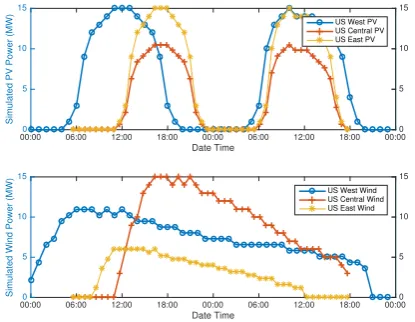
The green energy supply simulation plotted in Figure 4 shows the energy generation in MW for both wind and so-lar sources. The simulated amounts were adjusted to the amount observed in the traces between 2007-2012 [22].
The user workload simulation plotted in Figure 4 fol-lows the observed user patterns depicts in Figure 1. Also, it shows the aggregated green energy availability for each region. The cloud-coordinator uses these data sets to deter-mine if there is enough green energy available before pro-visioning green-pods and possibly taking grid-pods down.
Date Time
00:00 06:00 12:00 18:00 00:00 06:00 12:00 18:00 00:00
Simulated PV Power (MW)
0 5 10 15
0 5 10 15
US West PV US Central PV US East PV
Date Time
00:00 06:00 12:00 18:00 00:00 06:00 12:00 18:00 00:00
Simulated Wind Power (MW) 0 5 10 15
0 5 10 15
US West Wind US Central Wind US East Wind
Figure 4: Green energy availability simulated in MW across three regions. Amounts are adjusted to NERL measurements i.e., wind generation in West US moderate, Central US outstanding, East US fair. For solar gener-ation in West US strong, Central US moderate-high, and East US low.
The utility of the green energy was calculated based on the cases where sufficient green energy was available to run the green-CDN pods within the same region. Other-wise cross-regional latencies might degrade the on-demand video experience. The measurements in Figure 5 were ad-justed to the estimates of required energy (kWh) for oper-ating the green compute pods. The case where there was negative green energy available it was considered as a miss in the overall utility reckoning.
Date Time
00:00 06:00 12:00 18:00 00:00 06:00 12:00 18:00 00:00
Simulated User Demand KCPUs 0 20 40
0 20 40
US West US Central US East
Date Time
00:00 06:00 12:00 18:00 00:00 06:00 12:00 18:00 00:00
Simulated Green Power (MW) 0 5 10 15 20 25 30
0 5 10 15 20 25 30
US West US Central US East
Figure 5: Video on-demand user workload per region adjusted with user population opposed to aggregated green energy availability, solar and wind energy.
2.6
Discussion on Energy Mix when
Process-ing CDN Workloads
The scenario described above simulated the usage of green 801.3kWhout of total 3642kWhto process the video on-demand streaming workload. i.e. 22% by opportunistic matching. When counting the utility per region West US used 42% of the green energy. Central US used 28% of the simulated green energy. East US utilized only 18% as the initial ratio between user demand and green energy avail-ability was relatively low. Although West US reached 40% utilization it contributed nationally only to the 20% portion it contains from the entire experiment test set. By way of comparison, JeffBarr of AWS noted that their data centers utilize a 28% cleaner power mix11. Extrapolating the sim-ulation results to the initial assessment in Equation 1 yields to a saving of:
(18.26(GWh)·1.89)·0.1($/kWh)·22%=$759,250.8/year
3
Clean Energy Mix Evaluation for
O
ffl
ine System
In the following section we evaluate a coordination com-ponent that harmonizesanalyticsjobs demands with avail-able compute resources powered by green energy resources. Such resources will be published to the coordination system through a resource availability tuple { region,cut-in,rated,cut-off,power-efficiency}, whereregionand power-efficiencyindicates solar or wind based energy andregion, cut-in, ratedandcut-off of those energies.
Analyticsjob demand includes the specific region, total-job workload, load-factor, as well as contract deadline stermed tuple. Theload-factorindicates the required num-ber of CPU cores per thetotal-job-workload. The region indication will optimize the match between the supply and demand. Also, thetotal-job-workloadand thedeadlinewill be checked against the cut-in-rated, cutoff time for wind orpower-efficiencyfor solar, based on the published load-factor.
We will suggest a hybrid data center structure that does not deviate from the common data-center architecture. The core difference lies on an automatic transfer switch (ATS) that switches between different available power sources: generator, grid or clean-energy when available. In both cases the data-center design does not change and requires incremental changes only by adding clean-energy power sources to the datacenter’s ATS’s (Figure 6).
Figure 6 shows a simplified data-center power distribu-tion that supports clean energy sources. In a data-center with available clean-energy resources for bothservingand analyticalsystems deployed in brown clusters. Further, few clusters use green resources when there are a viable clean energy and standby for incominganalyticalworkloads. As a mitigation strategy, a compute live migration procedure will be available in case of unpredicted lack of renewable resources during a workload processing with a risk for SLO violation.
Figure 6: Datacenter Architecture - Compute server clusters aggregated by racks and chassis. Racks are fed by separate Power Distribution Unit (PDU) that connects to Uninterruptible Power Supply (UPS) that connects to the primary power source through Automatic Transfer Switch (ATS).
3.1
Experiment Planning
We wish to simulate an isolated group of computing re-sources so it can operate by various energy rere-sources, es-pecially available green ones. We use a group of leased resources from existing cloud providers to form a virtual-data-centers set that operates in a federated scheme. Each virtual-data-center includes with internal arbitrator compo-nent that collects and aggregates internal signals about its utilization and availability. The arbitrator then reports to the central coordination system. We use Apache Mesos12 for the virtual-data-center abstraction.
Also, we build a highly available coordination com-ponent that accepts incoming supply and demand traffic, calculates a potential match, within minutes, and notifies back the cloud-service-provider and the service-provider for transaction completion. We use VoltDB13 as the database and application server for the coordinator compo-nent.
Finally, we simulate customer’s demand for compute re-sources through client simulator with a Java-based applica-tion that generates pseudo demand traffic to the coordina-tor service. The coordinacoordina-tor service will run on separate resources pool than the virtual-data-centers and the client simulator.(Figure 7)
Cloud CoordinatorCloud
Coordinator
node node
…
node node node
…
node node node
…
node node node
…
node …
node node
…
node node node
…
node …
node node
…
node node node
…
node node node
…
node node node
…
node …
node node
…
node node node
…
node … node
node
…
node node node
…
node node node
…
node node node
…
node …
node node
…
node node node
…
node …
Client SimulatorClient
Simulator
Figure 7: Experiment Architecture - Three virtual clusters deployed on a public cloud services located in a different regions grouped by Apache Mesos. A single VoltDB instance as the coordinator service. Finally, Client simulator that generates pseudo demand that sends data to process
The data collected includes customer workload for jobs processing and jobs deadline. Also, the number of matches found by the coordination component and processed by green clusters without SLO. Finally, we measure the false-positive cases where a match was suggested but not met the SLO’s deadline due to a violation that caused by a sudden lack of clean energy resources. We use the data to extrap-olate the possible carbon-footprint that could be generated by the used virtual clusters.
The research goal is to show a significant improve-ment in the carbon emission generation by data-centers. LetMtCO2edenote the carbon emission. Electrical usage can be consumed by theConsumersset:{cooling, storage, servers, CPU, power}systems and denoted byEUmeasured in kWh. The average regional carbon dioxide emissions measured in lbs/kWhand denoted byREco2. Therefore, the
total electrical usage is:
EUT otal(kWh)=
X
ci∈Consumers
EU(ci) (4)
and the carbon footprint generated by the workload is:
MtCO2e=
EUT otal(kWh)·REco2(lbs/kWh)
2,204.6(lbs) (5) As the experiment uses virtual data-centers, we do not have access to the power consumption by the cooling, power and storage system. The results capture compute jobs durations
12http://mesos.apache.org
measure in serverCPUcoretime and use the average Thermal De-sign Power (TDP) of 200W per core (0.2kW).ciandti
de-notes the number of cores and time used per job respec-tively. The electric usage by server (EUservers) will be the
sum of the electric utilization of the executed jobs that was matched by the coordinator component (Equation 6)
EUservers(kWh)= jobs
X
i=1
ci·0.2·ti (6)
We assume a linear relation between the power utilization of the cooling, power and storage systems with the servers power utilization. (Equation 4)
3.2
Execution - The Preparation
The Preparation for the execution included the setup of the three virtual data-centers each with 6 machines D4 series with 8 Intel(R) Xeon(R) CPU E5-2660 0 @ 2.20GHz cores, 10Gbps NICs, 28 GB memory and run Ubuntu 15.0. Each virtual data-center is located in a different geo-location. The virtual data-centers were simulated by Mesosphere clus-ter with three jobtracker(Mesos masclus-ters) and three task-tracker(Mesos slaves). We installed Hadoop Cloudera CDH 4.2.1-MR1 on the takstrackers. The Coordinator Database run on a separate resource pool with 1 machine D series similar to the virtual data-centers specification. Finally, the loaders run on a 3 D2 series machines with 2 cores Intel(R) Xeon(R) CPU E5-2660 0 @ 2.20GHz cores, 10Gbps NICs, 7 GB memory and run Ubuntu 15.0. Apache Hadoop ships with a pre-built sample app, the ubiquitous WordCount ex-ample. The input data file was created using/dev/urandom on the takstrackers hosts14. The input data file was copied to the HDFS directory that was created as part of the Hadoop preparation (/user/foo/data).
Anticipated Required Deviations from the original job plan. The original plan was to simulate the scenario where the customer keeps his data at a different location than it might be processed. We plan on using a job mi-gration scheme that was originally designed for workload migration across different geo-location[20]. The suggested method optimizes the bandwidth costs of transferring ap-plication state and data over the wide-area network. Our experiment generated the data file at the loader host and did not include the job migration. We believe that includ-ing the job migration aspect could impact the presented re-sults. However, the job migrations proven efficiency and later studies minimize that deviation.
3.3
Baseline and Variability of Workloads
Baseline. The execution baseline included a load that runs without the coordinator component i.e. loaders generated load to the virtual data-centers resources for 48 hours. The load scenario included a single file generation that was sub-mitted to one of the tasktrackers. The output of each ex-ecuted jobs included the CPU time spent for each execu-tion. The data collection included the execution log of the
command: Hadoop jar loader.jar wordcount/user/foo/data
/user/foo/out.
Variability of Workloads. The workload comprises of data files with words that need to be counted using the Hadoop WordCount. The load complexity depends on two factors, the file randomness level, and its size. We rely on the native operating system randomness, and our vir-tual data-centers and loaders are homogeneous. Therefore, the size is the remaining factor for differentiating workload types. We evaluated the federated-cloud coordinator by generating three load types simultaneously. The three types intend to cover the following cases (1) A match was found between workload and sufficient green energy resources. (2) A match was found, but there was not enough power to complete the job with no SLO deadline violation. (3) Like the former but with SLO deadline violation. The three types will be uniquely distributed across wind and solar based vir-tual data-centers.
Date Time
00:00 06:00 12:00 18:00 00:00 06:00 12:00 18:00 00:00
Simulated PV Power (MW)
0 5 10 15
0 5 10 15
Region1 PV Region2 PV Region3 PV
Date Time
00:00 06:00 12:00 18:00 00:00 06:00 12:00 18:00 00:00
Simulated Wind Power (MW) 0 5 10 15
0 5 10 15
Region4 Wind Region5 Wind Region6 Wind
Figure 8: Green Energy availability simulated across six different time-zones, three for PV power and the bottom three for wind. These indica-tions are fed, in near-time, to the coordinator database that runs a temporal stored procedure that seeks for match with pending registered jobs.
3.4
Main Execution Issues
In each jobtracker host in a virtual data-center, we executed a simulator that generated green availability traffic to the co-ordination component. The simulation comprises of avail-ability indication that are based on figure 2 and figure 3. We randomized solar production by using a missing factor ofα = 0.2 based on collected data between 2008-2011 in Palm Springs CA, Prescott Airport CPV, AZ and Nevada Solar One, NV [22]. Also, we randomized the wind pro-duction by a missing factor ofβ= 0.4 based on collected data between the years 2007-2012 [22]. The demand sim-ulations included a set of calls to the coordinator compo-nent spread across 48 hours triggered by a Monte Carlo simulation inspired by [27]. We built a Rayleigh-based dis-tribution model in the Monte Carlo simulation using Mat-lab Statistics and Machine Learning Toolbox15. The calls originated from three different timezones. Each call com-prises of the tuple{region,total-job-workload, load-factor, contract deadlines}. The supply simulators are comprised of
14https://github.com/yahavb/GreenCloudCoordination/
the wind and solar-based energy time and power windows. Supply call to the coordinator includes the tuple{ region,cut-in,rated,cut-off,power-efficiency}. The coordinator runs a temporal stored procedure that find a match between the supply and demand data. When a match found, the coordi-nator generates an assignment call to the jobtracker in the corresponded virtual data-center to execute the jobs. The execution will fetch the data to be processed and report tem-poral statuses to the coordinator. Every status call generates a check against the current demand levels in the particular region. If the demand changed, and the request cannot be fulfilled, the job considered as false-positive. If the jobs are completed successfully, the request counted as success along with the Core/hour saved.
Date Time
00:00 06:00 12:00 18:00 00:00 06:00 12:00 18:00 00:00
Simulated Compute Demand (Core/h)
50 55 60 65 70
10 20 30 40 50
Region1 Region2 Region3
Date Time
00:00 06:00 12:00 18:00 00:00 06:00 12:00 18:00 00:00
Simulated Compute Demand (Core/h)
20 30 40 50 60 70 80 90
0 10 20 30 40 50 60 70
Region4 Region5 Region6
Figure 9: A Monte-Carlo-based simulated compute demand across six dif-ferent timezones, three for PV power and the bottom three for wind. These indications are fed, in near-time, to the coordinator database that runs a temporal stored procedure that seeks for match with available green en-ergy.
Date Time
00:00 06:00 12:00 18:00 00:00 06:00 12:00 18:00 00:00
Benefit from PV
-50 0 50 100
-50 0 50 100
Region1 PV Region2 PV Region3 PV
Date Time
00:00 06:00 12:00 18:00 00:00 06:00 12:00 18:00 00:00
Benefit from Wind
-20 0 20
-20 0 20
Region4 Wind Region5 Wind Region6 Wind
Wind Placement Benefit PV Placement Benefit
Figure 10: Job placement ranges denoted by the doted line in both the PV and the Wind plots. Any values above the zero levels indicate on poten-tial benefits. However, assigned jobs might not be able to fully processed when unpredicted drop in the availability.
3.5
Analysis
The experiment executions generated three core data logs that we used for the result generation. The first data set
is the simulators logs. The simulator logs comprise of the demand records. Demand records stored in the Demand VoltDB table. The supply calls were stored in the Supply VoltDB table. The match transactions stored in the Jobs VoltDB table with status and the number of cores/hour used for the job. Status values can be Success or False-Positive. Figure 9 shows the two supply indications. Both signals were generated based on Equation 2 and Equation 3. The demand data was generated based on known usage patterns that are spread across three timezones.
3.6
Discussion on Energy Mix when
Process-ing O
ffl
ine Workloads
The experiment simulated the usage of green 708kWhout of total required 3,252 kWhfor analyticalsystems work-load processing i.e. 22% less carbon emission (Equation 5). 1822kWh, 50% of the total workload consumption, was processed by brown energy because of false-positive events i.e. the coordinator assigned a job with no sufficient green recourses to process the job. We believe that optimizing the coordinator algorithm can improve the footprint reduction up to 50%.
Figure 10 shows the job placement ranges denoted by the dotted line in both the PV and the Wind plots. Any values above the zero levels indicate on potential benefits. However, such cases are subject to false positive events that can occur when an unpredicted drop in the availability. Fur-ther, such cases utilize the hybrid datacenter power scheme describes in figure 6.
4
Conclusions
Conflict of Interest The authors declare no conflict of in-terest.
References
[1] Mell, P.; Grance, T.Department of Energy2011,
[2] Rao, L.; Liu, X.; Xie, L.; Liu, W. Minimizing electricity cost: Op-timization of distributed internet data centers in a multi-electricity-market environment. INFOCOM, 2010 Proceedings IEEE. 2010; pp 1–9.
[3] Shehabi, A.; Smith, S.; Sartor, D.; Brown, R.; Herrlin, M.; Koomey, J.; Masanet, E.; Horner, N.; Azevedo, I.; Lintner, W.Data Center2016,
[4] Outlook, A. E.Department of Energy2010,92010, 1–15.
[5] Krishnan, S. S.; Sitaraman, R. K. Understanding the effectiveness of video ads: a measurement study. Proceedings of the 2013 conference on Internet measurement conference. 2013; pp 149–162.
[6] Liu, X.; Dobrian, F.; Milner, H.; Jiang, J.; Sekar, V.; Stoica, I.; Zhang, H. A case for a coordinated internet video control plane. Pro-ceedings of the ACM SIGCOMM 2012 conference on Applications, technologies, architectures, and protocols for computer communica-tion. 2012; pp 359–370.
[7] Biran, Y.; Collins, G.; Dubow, J.; Pasricha, S. Coordinating Green Clouds as Data-Intensive Computing. 2016: 3rd Smart Cloud Net-works & Systems Conference (SCNS’16). 2016; pp 1–8.
[8] Lim, N.; Majumdar, S.; Ashwood-Smith, P. Engineering resource management middleware for optimizing the performance of clouds processing mapreduce jobs with deadlines. Proceedings of the 5th
ACM/SPEC international conference on Performance engineering.
2014; pp 161–172.
[9] Biran, Y.; Collins, G.; Liberatore, J. Coordinating Green Clouds as Data-Intensive Computing. 2016 IEEE Green Technologies Confer-ence (GreenTech). 2016; pp 130–135.
[10] Burns, B.; Grant, B.; Oppenheimer, D.; Brewer, E.; Wilkes, J. Com-munications of the ACM2016,59, 50–57.
[11] Biran, Y.; Collins, G.; M, B. J.; Dubow, J.Advances in Science, Tech-nology and Engineering Systems Journal2017,2, 553–561.
[12] Nygren, E.; Sitaraman, R. K.; Sun, J.ACM SIGOPS Operating
Sys-tems Review2010,44, 2–19.
[13] Maier, G.; Feldmann, A.; Paxson, V.; Allman, M. On dominant char-acteristics of residential broadband internet traffic. Proceedings of the 9th ACM SIGCOMM conference on Internet measurement con-ference. 2009; pp 90–102.
[14] Barroso, L. A.; Clidaras, J.; H¨olzle, U.Synthesis lectures on com-puter architecture2013,8, 1–154.
[15] Abolfazli, S.; Sanaei, Z.; Ahmed, E.; Gani, A.; Buyya, R.IEEE Com-munications Surveys&Tutorials2014,16, 337–368.
[16] Ferguson, A. D.; Bodik, P.; Kandula, S.; Boutin, E.; Fonseca, R. Jockey: guaranteed job latency in data parallel clusters. Proceedings of the 7th ACM european conference on Computer Systems. 2012; pp 99–112.
[17] Dean, J.; Ghemawat, S. URL: http://static. googleusercontent.
com/media/resear ch. google. com (diunduh pada 2015-05-10)2004, 10–100.
[18] Lam, W.; Liu, L.; Prasad, S.; Rajaraman, A.; Vacheri, Z.; Doan, A.
Proceedings of the VLDB Endowment2012,5, 1814–1825.
[19] Liu, Z.; Lin, M.; Wierman, A.; Low, S. H.; Andrew, L. L.ACM SIG-METRICS Performance Evaluation Review2011,39, 62–66.
[20] Buchbinder, N.; Jain, N.; Menache, I.NETWORKING 20112011,
172–185.
[21] Deshmukh, M.; Deshmukh, S.Renewable and Sustainable Energy
Reviews2008,12, 235–249.
[22] Energy, G.NREL Subcontract Report2010, 1–13.
[23] Tiwari, A.; Sodha, M.Solar Energy2006,80, 751–759.
[24] Abdelbaky, M.; Diaz-Montes, J.; Parashar, M.; Unuvar, M.; Stein-der, M. Docker containers across multiple clouds and data centers.
Utility and Cloud Computing (UCC), 2015 IEEE/ACM 8th
Interna-tional Conference on. 2015; pp 368–371.
[25] Beloglazov, A.; Abawajy, J.Future generation computer systems
2012,28, 755–768.
[26] Zhang, Q.; Zhu, Q.; Boutaba, R. Dynamic resource allocation for spot markets in cloud computing environments. Utility and Cloud Computing (UCC), 2011 Fourth IEEE International Conference on. 2011; pp 178–185.
[27] Feijoo, A. E.; Cidras, J.; Dornelas, J. G.IEEE transactions on Energy Conversion1999,14, 1582–1588.
![Figure 1: On-Demand Video views observed throughout 48 hours with1-hour increments. Data was fitted with smoothingspline for curve andsurface fitting [5]](https://thumb-us.123doks.com/thumbv2/123dok_us/10072951.1993723/3.595.319.520.102.261/figure-demand-observed-increments-tted-smoothingspline-andsurface-tting.webp)